Pet Treat Magnetic Boxes Cost: Get Custom Quotes Fast
If you are comparing pet treat magnetic boxes cost, start with the board, the wrap, the insert, and the freight lane. The magnet matters, but it is usually a small line in the full math. Two boxes can look nearly identical on screen and still land a dollar apart once the structure, finish, and delivery route are set.
Pet brands choose rigid magnetic boxes for premium treat sets, holiday bundles, sampler kits, and subscription launches because the format feels giftable and handles fragile contents better than a thin tuck carton. Loose treats, crushed corners, and shelf presentation all push buyers toward a rigid build. A box that looks good and protects the product has a real job to do.
The trouble starts when a buyer asks for a price before the size, insert, finish stack, or shipping destination is locked down. The reply comes back vague, or polished, or both. A real number only shows up after the structure and print scope are clear, and that is the point where pet treat magnetic boxes cost becomes useful instead of guesswork.
Here is the practical breakdown: what these boxes include, which specs move unit cost, how MOQ changes the math, and how to compare bulk pricing without getting fooled by a low factory quote and a heavy freight bill later.
Pet Treat Magnetic Boxes Cost: What Buyers Usually Miss
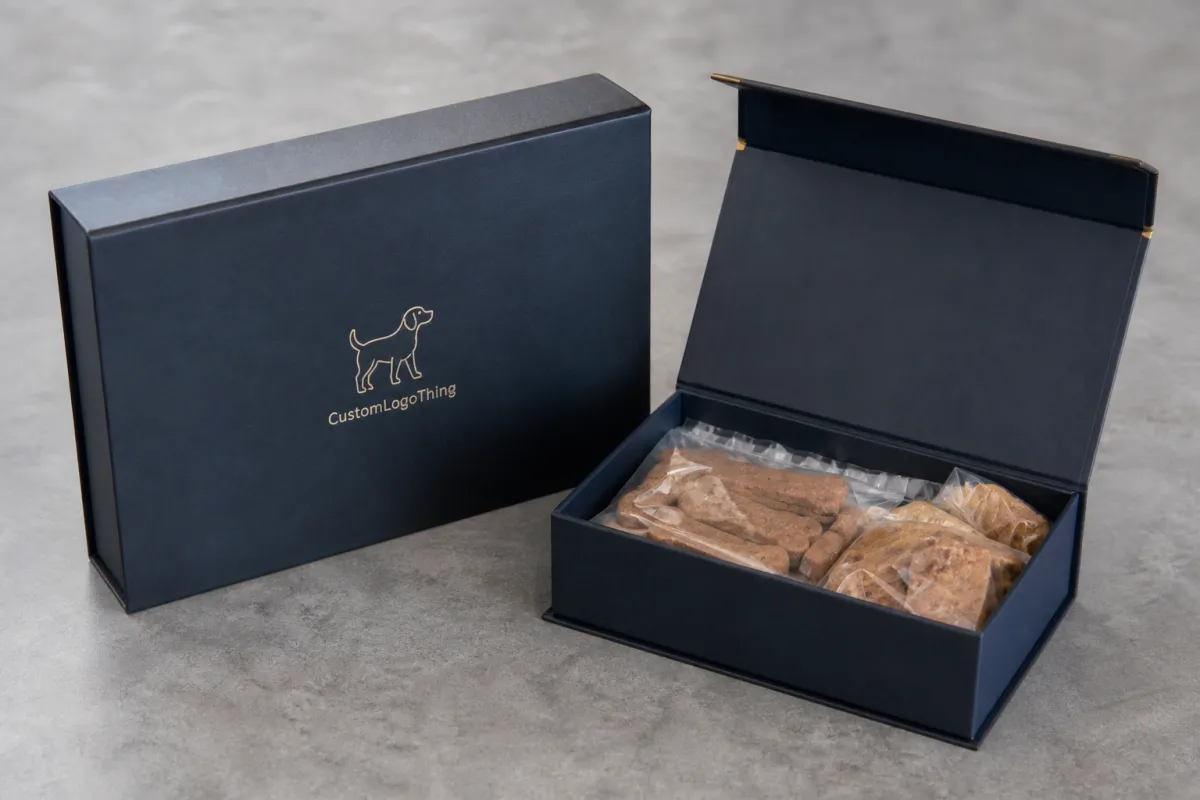
No, the magnet is not the expensive part. On most jobs, two small magnets add less to pet treat magnetic boxes cost than one extra color, a thicker wrap, or a custom insert that needs hand placement. The board caliper, the paper wrap, and the amount of assembly work carry most of the load.
That matters because pet treat packaging is rarely just a container. It supports product protection, shelf appeal, and brand signal at the same time. Premium treat boxes show up in seasonal sets, subscription launches, training treat samplers, and gift packs because they feel worth opening. A plain folding carton can handle basic retail, but once the product needs a stronger presentation, the magnetic rigid box starts earning its place.
From a packaging buyer's point of view, pet treat magnetic boxes cost is easier to justify when the contents are fragile, greasy, oddly shaped, or priced high enough to support better presentation. If the treats ship loose, rattle inside the box, or arrive damaged, the packaging is solving a real problem. That is not decoration. That is less waste and fewer complaints.
The mistake I see most often is a buyer comparing a quote for a full rigid build against a quote for a bare carton and calling that a fair comparison. It is not. A magnetic rigid box uses different labor, different materials, and different finishing steps. Treat it like a premium structure, because that is what it is.
A quote without finished dimensions, insert details, and freight destination is not a quote. It is a guess with cleaner formatting.
Here is the clean way to think about pet treat magnetic boxes cost: if the box raises the shelf price, lowers damage, or supports a giftable unboxing moment, the spend usually makes sense. If you only need a container, cheaper options exist. Buyers who understand that split save money fast.
What Pet Treat Magnetic Boxes Include
A standard rigid magnetic box starts with a thick paperboard shell, usually wrapped in printed paper and closed with hidden magnets in the front flap. The structure opens with a firm pull, closes with a clean catch, and keeps its shape better than a folding carton. That closure feel is a real part of why pet treat magnetic boxes cost more than standard packaging, and also why customers notice the difference.
Rigid shell and magnetic closure
The shell is the backbone. Most builds use rigid grayboard or paperboard in the 1000gsm to 1800gsm range, then wrap that board with printed art paper or specialty paper. The magnets sit inside the flap and front wall, so the closure stays hidden. A weak closure feels cheap. A misaligned one feels worse. Nobody wants a premium box that springs open in transit or sits crooked on shelf.
Because the shell is rigid, assembly takes more time than folding-carton work. Corners need to stay square, wraps need to pull tight, and the closure area needs accurate alignment. That extra labor is part of why pet treat magnetic boxes cost rises when the size gets larger or the artwork travels across more panels.
Interior fit for treat formats
The inside matters just as much as the exterior. Pet treats may be packed in pouches, jars, sachets, paper bags, chews, biscuits, or sampler trays. The interior often uses paperboard inserts, EVA foam, molded pulp, or custom cavities to hold the product in place. If the contents move around, the premium box turns into a noisy problem instead of a presentation piece.
Insert choice has a direct impact on pet treat magnetic boxes cost. A simple paperboard divider is usually cheaper than a foam insert with multiple cutouts. A custom cavity for one jar is easier to produce than a multi-compartment tray for four products. If the product already fits securely, there is no reason to add an insert just because it looks attractive on a mockup.
Finishes that change the feel
Buyers usually ask about matte lamination, gloss lamination, soft-touch coating, foil stamping, embossing, debossing, and spot UV. Those finishes are not free decoration. They change setup, handling, and sometimes drying time. Soft-touch gives a velvety feel. Foil adds contrast. Embossing adds texture. Each one adds another layer to pet treat magnetic boxes cost.
For a retail box, the finish stack often decides whether the box reads as premium or just expensive. Too much finish can look busy. Too little can make the product disappear on shelf. In practice, a clean printed wrap with one strong accent usually performs better than every effect on the menu thrown at the same carton.
A standard quote should list the outer shell, the wrap material, printing, magnet closure, insert if needed, hand assembly, and packing. If a supplier gives one number and skips the details, you are not comparing pet treat magnetic boxes cost fairly. You are comparing hidden assumptions.
If you want to compare rigid and folding formats side by side, browse our Custom Packaging Products page. It is easier to weigh options once you know which structural features are actually moving the price.
Specifications That Affect Fit, Strength, and Cost
The fastest way to get a meaningful quote is to lock the specs early. Finished size, board caliper, wrap paper, magnet strength, insert material, and print coverage are the main variables that shape pet treat magnetic boxes cost. Leave them open, and every estimate will drift.
Start with dimensions. Bigger panels use more board, more wrap, and more shipping weight. Even a small bump in length or depth can move the project into a higher material bracket. That is not a theory exercise. It happens on real production runs all the time. A box that grows by 15 mm on each side may seem minor on a screen. On a freight invoice, it does not feel minor.
Board thickness matters too. A 1200gsm rigid board is often enough for smaller treat sets. A larger gift box may need 1500gsm or thicker to hold its shape. Thicker board improves feel and durability, but it also raises material usage and can push pet treat magnetic boxes cost upward faster than the print does.
Then there is the wrap. Standard art paper is the default, but specialty textures, metallic stocks, and heavy coverage graphics all change pricing. Full-bleed print across the exterior usually costs more than a simpler layout with fewer ink-heavy panels. Interior print adds another layer. If the inside is visible during unboxing, it may be worth it. If nobody sees it, you may be paying for a feature that does nothing.
Product-contact needs deserve a direct conversation. A magnetic rigid box is often outer packaging, not direct food-contact packaging, but pet treat brands still want a clean, safe presentation. If the treats sit inside a pouch, a tray, or a barrier wrap, say so early. If you need a specific inner liner or a food-safe barrier layer, ask before quoting. Rework always costs more than planning.
Shipping and testing belong in the spec stage as well. If the box needs to survive parcel handling, ask about drop testing and compression expectations. For common parcel test language, ISTA is a useful reference point. If sustainability claims matter, ask for FSC-certified paperboard options and documentation through FSC. Those standards do not lower the price, but they do make the supply chain clearer.
One more practical point: sample first if the fit is tight. A prototype costs less than a production run that closes badly or crushes the product insert. A nice-looking box that will not shut properly is just expensive cardboard. That is how pet treat magnetic boxes cost gets inflated by avoidable mistakes. I have watched a project go sideways because a jar was 3 mm taller than the buyer's first estimate; that tiny miss forced a new insert and a new closure check, and suddenly everybody was reworking a box that should have been right the first time.
- Finished size: Controls material usage, shipping weight, and carton nesting efficiency.
- Board caliper: Affects stiffness, closure feel, and overall premium perception.
- Print coverage: Full wrap, inside print, and metallic accents all add labor.
- Insert type: Paperboard is usually cheaper than foam or molded cavities.
- Approval process: Faster proof sign-off keeps the schedule from slipping.
These details also explain why two quotes that seem close can behave very differently once production starts. One supplier may be quoting a standard shell with a plain insert. Another may be pricing a fully wrapped interior, a custom cavity, and heavier board. The numbers are not equal, so the comparison is not equal.
Pet Treat Magnetic Boxes Cost, Pricing, and MOQ
Now for the part everyone actually wants: numbers. Pet treat magnetic boxes cost usually falls in tiers because setup work and labor get spread across the order quantity. At 250 pieces, the unit cost can feel steep. At 1,000 pieces, the price per box usually drops noticeably. At larger runs, the savings become more obvious, as long as the spec stays reasonable.
How tiered pricing usually works
Rigid magnetic boxes are not priced like a commodity pouch or a folding carton. They require more handwork, more inspection, and more careful assembly. That means unit cost drops as quantity rises, but not always in a straight line. The first jump in volume often gives the biggest improvement because setup charges are being spread across more units.
For many buyers, the right question is not "what is the cheapest price?" It is "what does pet treat magnetic boxes cost at the quantity I actually need, and what is included in that number?" That is the better question. Cheap quotes have a habit of growing teeth once sampling, freight, or extra finishing steps show up.
What pushes MOQ higher
MOQ is not random. It reflects machine setup, labor efficiency, and the time needed to build a rigid box properly. Standard sizes with simple printing can sometimes start around 250 to 500 pieces, though 500 is more common for cleaner economics. More complex jobs, especially those with foam inserts, foil, or custom structure, can push MOQ to 1,000 or more.
Some vendors separate tooling fees from the box price. Others fold setup charges into the unit rate. You need to ask. If there is a die, a foil plate, a custom insert tool, or special handling involved, ask whether the supplier is treating that as a one-time line item or hiding it in the per-piece quote. That difference changes pet treat magnetic boxes cost more than most first-time buyers expect.
| Build Level | Typical Spec | MOQ | Typical Unit Cost at 500 pcs | Typical Unit Cost at 1,000 pcs | Best Use Case |
|---|---|---|---|---|---|
| Value Build | 1200gsm rigid board, matte wrap, simple one-color or light full-color print, paperboard insert | 250-500 | $1.60-$2.20 | $1.20-$1.70 | Starter launches, smaller treat sets, straightforward retail packs |
| Mid-Range Launch Pack | 1400gsm board, full-color wrap, soft-touch or matte lamination, custom insert, clean interior print | 500 | $2.40-$3.60 | $1.80-$2.80 | Premium retail, seasonal boxes, subscription bundles |
| Premium Display Box | 1500-1800gsm board, specialty paper, foil or embossing, complex insert, higher handwork | 500-1,000 | $4.10-$6.50 | $3.00-$4.80 | Gift sets, high-margin launches, showroom-ready presentation |
Those ranges are not promises. They are realistic planning numbers for buyers who want to budget before requesting samples. Size, print coverage, insert style, and freight all move the final landed price. The key point is the pattern: pet treat magnetic boxes cost drops with volume, but finishing choices can erase savings faster than most people expect.
Here is the cleanest way to compare quotes fairly:
- Ask for a separate line on the box, insert, sampling, and freight.
- Confirm whether tooling fees or setup charges are included.
- Compare the same size, same board, same finish stack, and same closure style.
- Request both a standard build and a cost-optimized build.
- Check whether the quote assumes sea freight, air freight, or no freight at all.
That last item is where a lot of confusion hides. A supplier may give you a strong ex-factory number, then freight wipes out the advantage. If you are comparing pet treat magnetic boxes cost across vendors, landed total matters more than the headline number.
There are sensible ways to trim price without gutting the design. Standardize the box dimensions. Keep the finish stack simple. Remove unnecessary interior printing. Choose a paperboard insert instead of foam if the product fits securely. Avoid custom shapes unless the product actually needs them. That is how buyers keep pet treat magnetic boxes cost under control without ending up with a boring box.
Production Process and Lead Time: From Dieline to Delivery
Lead time is usually easier to understand once the production steps are broken down. A normal run starts with dieline confirmation, then artwork submission, then proofing, then sample approval, followed by bulk manufacturing, quality control, packing, and freight booking. If any one of those steps stalls, pet treat magnetic boxes cost may not change much, but the schedule will.
Simple builds often move faster. A clean rigid box with standard wrap and a plain insert might ship in roughly 12 to 15 business days after proof approval. Add custom inserts, foil, embossing, or multiple revision rounds, and the timeline can stretch to 18 to 25 business days before freight. That is not unusual. That is normal production math.
Buyers sometimes treat proofing like a formality. It is not. A proof is where color drift, size errors, and insert mismatches get caught before a full run exists. One extra round of edits can save a full pallet of unusable boxes. That matters more than shaving a day off approval. In practice, the fastest way to raise pet treat magnetic boxes cost is to rush through the wrong details and fix them later.
What to prepare before you request a quote
Have the finished dimensions ready. Know the product weight. Decide whether the box needs an insert, a divider, or a cavity. Define the print scope: outside only, outside plus inside, or a specific accent area. Send the ship-to location too. Freight changes by destination, and it should not be guessed.
Also decide how you want the boxes packed for delivery. Master cartons, palletization, and carton strength matter if the boxes are going into storage before launch. If the outer packing is weak, the box can arrive perfect and still get crushed in your warehouse. That is not a packaging problem until it becomes one.
What slows production down
Late artwork revisions are a classic culprit. So is changing the insert after proof approval. Complex finishes can also add drying or inspection time. If you need a rush order, expect to pay for the privilege. Rush schedules interrupt the line, squeeze quality checks, and usually increase both handling cost and stress. Not a great trade.
For international orders, freight timing matters just as much as factory time. Air freight can move quickly, but it costs more. Ocean freight is cheaper on a per-unit basis, but it takes longer. The right choice depends on launch date, order size, and how much inventory you can hold. A smart buyer plans backward from the shelf date, not the approval date.
That is also why the quote should include timeline assumptions. If a vendor says "two weeks," ask whether that starts after payment, after proof approval, or after artwork sign-off. Small wording gaps create big schedule misses. Clear timing is part of honest pricing, and honest pricing is part of understanding pet treat magnetic boxes cost.
If you need a wider mix of packaging formats for launch planning, our Custom Packaging Products page is a good place to compare structures before you lock the order. The right box is rarely the cheapest one. It is the one that matches the product, the shelf, and the freight plan.
Why Buyers Choose Us for Pet Treat Packaging
Most buyers do not need a lecture. They need a clean quote, a sensible spec recommendation, and a box that closes properly. That is the real value in pet packaging work. A premium rigid box should arrive square, align well at the magnet, and feel intentional from the first touch. If it does not, the whole presentation takes a hit.
What buyers usually want from a vendor is simple: fast response, honest guidance, dieline support, decent proofing, and freight coordination that does not turn into a scavenger hunt. Those things do not sound glamorous, but they save time and money. More importantly, they keep pet treat magnetic boxes cost from drifting because someone forgot to ask the right questions early.
Custom Logo Things focuses on the practical side of custom packaging. That means helping you Choose the Right board thickness, the right insert style, and the right finish stack for the budget you actually have. If the box is for a holiday launch, a subscription pack, or a premium treat line, the structure should support the price point instead of fighting it.
We also see the same costly mistake over and over: brands overbuild the box before they know whether the product and the margin can support it. A little restraint goes a long way. A simpler structure with a sharp print treatment often beats a busy premium build that eats margin and then asks to be reshot for marketing anyway. That is why the best pet treat magnetic boxes cost conversations start with the use case, not with the fanciest finishing option on the sheet.
The strongest packaging decision is not the one with the most effects. It is the one that protects the product, sells the story, and keeps the margin where it belongs.
If you need more than one format, compare options across our Custom Packaging Products catalog before you finalize the spec. Different structures solve different problems. The job is to pick the one that solves yours without burning unnecessary budget.
Good packaging buying is simple: lock the size, confirm the insert, check the freight, and compare apples to apples. Do that, and pet treat magnetic boxes cost becomes manageable instead of mysterious.
Next Steps to Get an Accurate Quote
If you want a quote that means something, send the basic details up front. Finished dimensions, target quantity, product weight, print sides, insert needs, and shipping destination are the minimum. Without those, pet treat magnetic boxes cost is just a placeholder number.
A good next move is to request two versions of the estimate: one standard build and one cost-optimized build. That side-by-side view shows exactly what drives the difference. Maybe the foil is worth it. Maybe it is not. Maybe the foam insert looks premium but adds too much to unit cost. You will not know until the numbers are compared honestly.
Also send artwork files or at least clear brand references. Pantone targets, logo lockups, and preferred finish styles help the supplier quote a real production spec instead of guessing from a phone call. If you already know you want soft-touch, embossed logo, or interior print, say so. Guessing saves nobody time.
Finally, confirm the approval sequence before you commit. Ask how many proof rounds are included, whether a physical sample is available, and what freight method the quote assumes. Those details affect the landed total more than people want to admit. The more precise the brief, the more stable pet treat magnetic boxes cost becomes.
Send the right specs, Get the Right number, and stop letting packaging surprise the budget. That is the whole job.
What affects pet treat magnetic boxes cost the most?
Size and board thickness usually move the price first because they change material usage and shipping weight. Finishes, inserts, and inside printing add cost fast, especially when the box needs extra handwork. Quantity matters a lot too; higher volume spreads setup charges and lowers unit cost.
What is the usual MOQ for pet treat magnetic boxes?
MOQ depends on the box size, print complexity, and whether inserts or special finishes are included. Rigid magnetic boxes usually start at a higher MOQ than folding cartons because the build takes more labor. Standard sizes and simpler specs are the easiest way to keep pet treat magnetic boxes cost and MOQ accessible.
How long does production take for pet treat magnetic boxes?
Lead time depends on proof approval, sampling, bulk production, and shipping method. Simple builds move faster; custom inserts, foil, or heavy finishing usually add time. Rush schedules are possible, but they usually cost more and leave less room for revisions. That is why buyers should confirm timeline assumptions before they approve the quote.
Can I lower pet treat magnetic boxes cost without weakening the design?
Yes. Use a standard box size, simplify the finish stack, and avoid unnecessary interior print. Choose a practical insert instead of a highly customized one if the product already fits securely. Comparing a standard build and a premium build side by side usually shows where the savings are.
What should I send for an accurate quote on pet treat magnetic boxes?
Send finished dimensions, target quantity, artwork files, insert needs, and shipping destination. Include product weight and any display or shipping requirements so the quote reflects real use. If you want the fastest response, ask for a standard spec and a cost-optimized option at the same time. That is the cleanest way to pin down pet treat magnetic boxes cost without wasting back-and-forth.
The most useful takeaway is simple: lock the size, insert, finish stack, and ship-to location before you compare prices. Once those four pieces are set, pet treat magnetic boxes cost stops being a moving target and starts acting like a number you can actually plan around.

