Buyer Fit Snapshot
| Best fit | Plastic Envelopes Bulk Order projects where brand print, material claims, artwork control, MOQ, and repeat-order consistency need to be specified before quoting. |
|---|---|
| Quote inputs | Share finished size, material target, print colors, finish, packing count, annual reorder estimate, ship-to region, and any compliance wording. |
| Proofing check | Approve dieline scale, logo placement, barcode or warning zones, color tolerance, closure strength, and carton packing before bulk production. |
| Main risk | Vague material claims, crowded artwork, missing packing details, or unclear freight terms can make a low unit price expensive after revisions. |
Fast answer: Plastic Envelopes Bulk Order: Material, Print, Proofing, and Reorder Risk should be specified like a repeatable production item. The safest quote records material, print method, finish, artwork proof, packing count, and reorder notes in one written spec.
Production checks before approval
Compare the actual filled-product size with the drawing, then confirm tolerance on folds, seals, hang holes, label areas, and retail display edges. Reserve space for logos, QR codes, warning copy, and material claims before decorative graphics fill the panel.
Quote comparison points
Review material grade, print process, finish, sampling route, tooling charges, carton quantity, and freight assumptions side by side. A quote is only useful when the supplier can repeat the same color, closure quality, and packing count on the next order.
Plastic Envelopes Bulk Order: Specs, Pricing & MOQ Tips
A plastic envelopes bulk order usually beats small repeat purchases by a wide margin, and the savings show up faster than many buyers expect. Once a package size, print layout, and seal style settle into a stable rhythm, the unit cost falls, freight gets easier to forecast, and the late-night emergency reorder starts disappearing from the calendar.
Packaging buyers rarely make the decision on sticker price alone. The real question is whether the mailer survives transit, keeps the brand looking consistent, and still makes financial sense after packing labor, labeling, and shipping are folded in. Ecommerce brands, subscription box teams, fulfillment operations, and retail buyers all run into the same pattern: a weak mailer turns into a damaged shipment, and a damaged shipment is expensive in ways that never look tidy in a spreadsheet.
Bulk buying makes sense once the use case is steady enough to predict. Buying too much because the unit price looks attractive can backfire. Warehouses fill with the wrong size, the wrong adhesive, or a printed design that no longer matches the campaign. I have seen that happen more than once. The better outcome is consistency: a planned plastic envelopes bulk order lowers reorder friction, supports the brand presentation, and gives finance a landed cost they can actually trust.
If you are comparing broader packaging programs, the Wholesale Programs page is a useful starting point. For common policy and ordering questions, the FAQ can help later without making you hunt through a dozen emails.
Plastic Envelopes Bulk Order: Why Buyers Switch
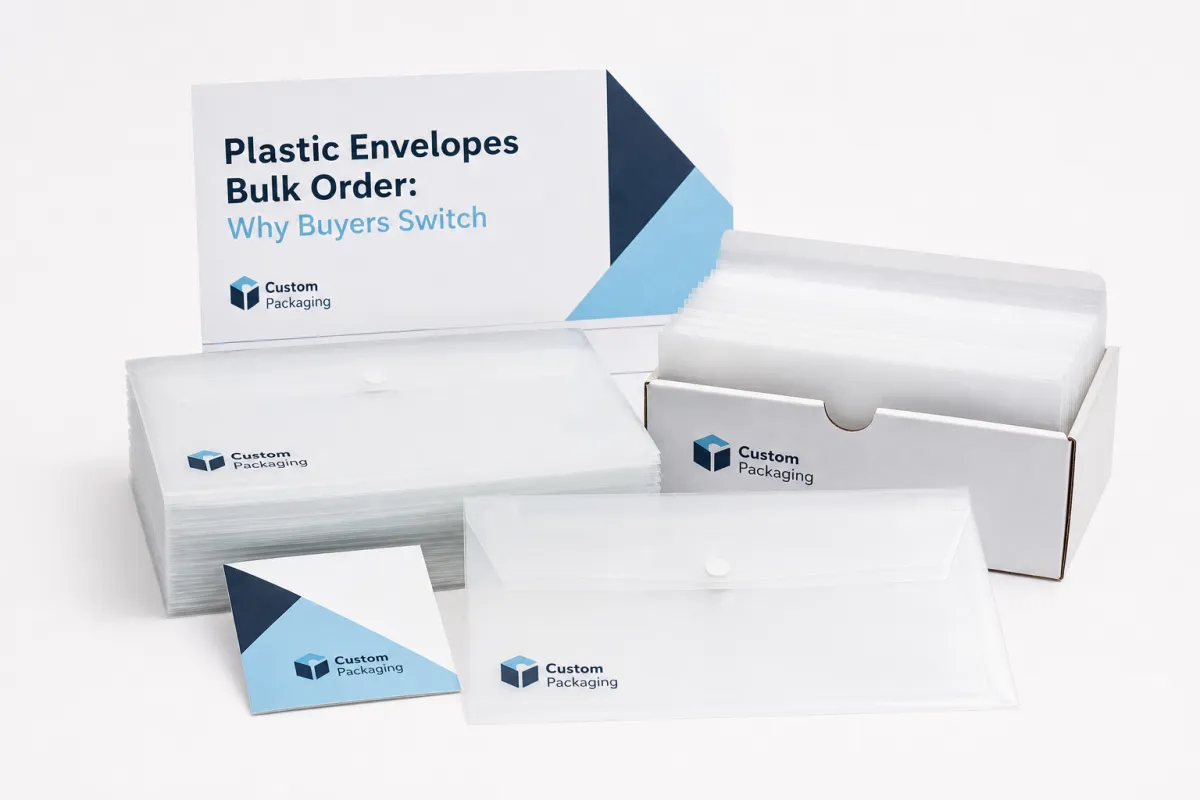
The switch usually starts with math. Small repeat buys carry the same setup, freight, and supplier handling costs, but those costs are spread over a smaller quantity. A plastic envelopes bulk order spreads them across a larger run, so the unit price drops and margin becomes easier to protect. That is not marketing language. It is how production economics works.
Operational drag matters too. Small buys mean more purchase orders, more approvals, more restock checks, and more chances of discovering the shelf is empty at exactly the wrong moment. A bulk order trims that noise. One approved spec. One approved print file. One production run. Then the warehouse can work on a schedule instead of a scramble.
This matters most for brands with steady shipping volume. Apparel labels need mailers that protect garments without adding much weight. Subscription box teams need packaging that looks identical from one drop to the next. Fulfillment teams need a package that seals cleanly and holds together after stacking, tossing, and compression. A proper plastic envelopes bulk order handles those jobs if the spec is right.
Bulk only works cleanly when the application is stable. A product that changes size every month, or artwork that changes every campaign, can turn a savings play into storage cost and waste. Overstock in the wrong dimensions is not savings. It is clutter with a purchase order attached.
The cheapest quote is rarely the cheapest outcome. A slightly better film gauge, a stronger adhesive, or a more dependable print method can save money by preventing damage, returns, and rework. That is why a plastic envelopes bulk order should be reviewed as a full system, not as a unit price alone.
Common reasons buyers move to bulk:
- Lower unit cost across a larger production run
- Fewer reorders and less admin time
- More consistent branding across shipments
- Better inventory control for steady shipping volumes
- Less risk of running out during promotions or seasonal peaks
From a purchasing angle, bulk is less about volume for its own sake and more about removing friction. If the same plastic envelopes bulk order will be used across a quarter or a full campaign cycle, the numbers usually support it. If usage is uneven, smaller stock runs may still be the smarter move.
I have sat in buying meetings where the room got fixated on a penny or two per unit and ignored the labor cost of placing six extra orders a year. That is the kind of detail that quietly eats budget. The savings on paper can be real, but only if the order pattern fits the business.
Plastic Envelopes Bulk Order: Product Types and Use Cases
Not every plastic envelope does the same job. The right plastic envelopes bulk order depends on product weight, shape, shipping method, and how much branding the package needs to carry. The industry uses a few common terms, but the categories are straightforward once the sales language gets out of the way.
Poly mailers are the standard choice for apparel, lightweight soft goods, and many ecommerce shipments. They are light, efficient, and cost-effective enough to protect margin. Tamper-evident mailers are better for sensitive items, documents, or sample kits that should show if the package has been opened. Clear sleeves work well for internal packaging, retail presentation, and grouped products. Branded shipping envelopes sit between protection and presentation, especially when the mailer is part of the unboxing experience.
Size matters more than many buyers expect. Measure the folded product, then add space for inserts, labels, and seal allowance. A shirt folded to 10 x 12 inches does not fit safely into a 10 x 12 bag. There needs to be room for the seal and for the package to flex without stress. Too tight and the closure gets strained. Too loose and the mailer looks sloppy. A solid plastic envelopes bulk order starts with dimensions that reflect reality, not optimism.
Use cases tend to fall into a few familiar groups:
- Apparel: Shirts, leggings, socks, and lightweight textile bundles
- Documents: Contracts, onboarding packets, notices, and secure paperwork
- Samples: Cosmetics, supplements, marketing kits, and small promotional sets
- Retail goods: Flat accessories, soft goods, and low-risk ecom inventory
Plain versus printed is another decision that changes both cost and timing. Plain stock mailers are faster and cheaper. Printed mailers cost more because of setup, artwork handling, and color control, yet they also reinforce brand recognition and make a routine shipment feel more deliberate. For some teams, that extra spend is easy to justify. For others, especially high-volume sellers working on thin margins, a plain plastic envelopes bulk order is the better financial fit.
Shipping performance stays in the conversation the whole time. Water resistance is one reason buyers choose plastic mailers in the first place. Puncture resistance is the other. If the film is too thin, sharp corners, zippers, or hard edges can tear it during handling. A cheap mailer that fails in transit is not cheap. It is a return waiting to happen. For transit testing, many buyers review industry methods such as those described by ISTA shipping test standards.
One more practical point: if your product moves through retail distribution or mixed shipping lanes, think about how the package is handled by warehouses, carriers, and customer service teams. A plastic envelopes bulk order should fit the actual process, not the ideal version of it. That is usually where the bad choices become visible.
There is also a human side to the decision. A fulfillment supervisor once told me a mailer choice is "either a quiet part of the job or a daily complaint." That line stuck with me because it is true. Packaging only gets attention when it causes trouble, so a good bulk spec should disappear into the workflow.
Materials, Thickness, and Print Specifications
Material choice is where a plastic envelopes bulk order either runs smoothly or turns into a headache. Most buyers will see LDPE, co-extruded film, recycled-content blends, and a few different surface finishes. Those are not just catalogue details. They change how the mailer feels, seals, prints, and survives transport.
LDPE is the common baseline. It is flexible, light, and cost-effective for everyday shipping. Co-extruded film gives more control over strength and appearance because different layers can improve toughness or print surface quality. Recycled-content options can fit a sustainability message, but the buyer should check performance, color consistency, and any certification claims before committing to a large plastic envelopes bulk order.
Thickness is often described in microns or mils, and buyers can get stuck in the math. The practical version is simpler: thinner film is cheaper and lighter, while thicker film usually resists tearing better. A lightweight apparel shipment may be fine in a thinner gauge. A shipment with boxy, hard, or sharp contents deserves more material. If the contents can press hard against one corner, move up. That small decision can save a pallet of returns.
Seal style matters too. A self-seal adhesive strip is common because fulfillment teams can close packages quickly. Tamper-evident adhesive gives stronger protection for secure shipments or higher-trust applications. Some buyers want a peel-and-stick closure that opens cleanly. Others need a stronger seal because the package will pass through multiple handling points. A plastic envelopes bulk order should match the closure to the product category, not just the cheapest available option.
Before quoting, gather the print spec:
- Artwork file format and resolution
- Number of ink colors or full-coverage requirements
- Front-only or front-and-back print
- White ink needs, matte finish, or gloss finish
- Color match expectations and brand tolerance
Color count affects price, but coverage area does as well. A small logo in one corner costs less than a full flood print. White ink and opaque print layers can add cost because they require more control. A heavier design may call for a different print process or extra setup time. That is normal. The quote should explain it clearly rather than hide it behind broad language.
Quality checks deserve more attention than they usually get. Odor can matter in some retail categories. Opacity matters if the contents should not show through. Seal integrity needs to be tested against the actual weight and shape of the product. Tolerance ranges on size and thickness should also be reviewed, because a bulk run is not a hand-made sample. A proper plastic envelopes bulk order should arrive with a usable production tolerance, not a surprise.
If recycled or forest-related claims are part of the packaging story, the documentation should match the claim. A buyer should not accept vague wording and hope for the best. For sustainability references, FSC certification guidance is one of the clearer places to verify chain-of-custody language. That is a better habit than vague green claims and crossed fingers.
Experienced buyers tend to save money here because they spec the job tightly the first time. A plastic envelopes bulk order with clear thickness, print, and closure details gets cleaner pricing and fewer revisions. Loose specs invite guesswork, and guesswork gets expensive quickly. If you have ever had to rework artwork after a proof cycle, you know how fast a simple order can become a small mess.
Pricing, MOQ, and What Moves the Quote
Pricing for a plastic envelopes bulk order usually comes down to five inputs: size, film weight, print complexity, quantity, and shipping method. Everything else hangs off those variables. If those five points are clear before the quote request goes out, the answer tends to be better and the back-and-forth tends to shrink.
Size changes material usage immediately. Larger mailers cost more because they need more film and usually more print area. Thickness changes cost because heavier gauges consume more resin and often behave differently on production lines. Print complexity affects setup, registration, and approval work. Quantity changes the unit price through scale. Shipping method changes landed cost, and landed cost is the number that actually matters.
MOQ matters because it determines where the real price break begins. A higher MOQ usually lowers the per-unit cost, but only if the order volume fits the forecast and storage capacity. A buyer who commits to a large plastic envelopes bulk order without a realistic usage plan may save a few cents per bag and lose much more in dead inventory. That is not a win. That is a warehouse problem wearing a discount tag.
Here is a practical comparison of common buying choices:
| Option | Typical MOQ | Indicative Price Range | Best Use | Main Tradeoff |
|---|---|---|---|---|
| Plain stock poly mailers | 500-1,000 units | $0.06-$0.14 each | Fast restocks, low branding needs | Lowest cost, but generic look |
| Custom printed mailers | 3,000-5,000 units | $0.12-$0.28 each | Branded ecommerce shipments | Setup and color control add cost |
| Heavier-gauge mailers | 3,000 units or more | $0.16-$0.35 each | Sharper edges, higher protection need | Better durability, higher material spend |
| Tamper-evident mailers | 5,000 units or more | $0.18-$0.40 each | Secure documents, samples, sensitive kits | Special closure increases unit cost |
Those ranges are not promises. They are practical buying ranges that move with film type, print coverage, adhesive style, and freight. A plastic envelopes bulk order with full-coverage print, white ink, or a specialty finish will sit higher. A simple one-color logo on a standard size can come in lower. The point is not to guess the exact number before quoting. The point is to compare comparable offers.
Hidden costs deserve attention. Setup fees, printing plates, sample charges, rush production, color-matching fees, and freight can all distort a quote. A suspiciously low price often comes back with extra lines buried elsewhere. Ask for a quote that states whether setup is included, whether samples are chargeable, and whether delivery to your location is already factored in. Otherwise you are kinda comparing apples to trucks.
A good quote should also show price tiers. If 3,000 units costs one amount and 5,000 units drops by 12 percent, that tells you where the break point sits. If 10,000 units only saves another 3 percent, the extra inventory may not be worth it. A disciplined plastic envelopes bulk order comparison includes tiered pricing, lead time by tier, and total landed cost. Anything less is just a guess with a spreadsheet attached.
For buyers who want a more formal supplier discussion, the Wholesale Programs page is useful because it frames the order as a supply relationship, not a one-off shopping cart decision. That matters once volume starts to rise.
Ordering Process and Production Timeline
A plastic envelopes bulk order moves faster when the buyer shows up prepared. The process is usually simple, but simple does not mean informal. A good supplier wants to confirm spec, artwork, proof, quantity, and delivery timing before production starts. Skipping those steps only creates delays later.
The normal sequence looks like this:
- Submit the inquiry with size, quantity, closure style, print needs, and destination
- Review the spec and confirm the material recommendation
- Approve artwork or request a proof
- Lock the quantity and production schedule
- Run production, inspection, packing, and shipping
Complete artwork files are one of the fastest ways to keep the order moving. Clear dimensions matter too. If the buyer gives a half-measured folded product and expects the supplier to infer the rest, the proof process slows down. The same problem appears when color guidance is vague. A plastic envelopes bulk order works best when the supplier is not guessing at the final output.
What usually slows things down? Missing files. Multiple color revisions. Late approvals. Conflicting size notes. A changing delivery address. All of these seem small until they start stacking. Production teams do not love uncertainty, and buyers who need the order on the dock by a certain date love it even less.
Timelines should be split into three pieces: proofing, production, and transit. Proofing may take a day or several days depending on artwork complexity. Production often takes the largest chunk of time, especially for custom printed jobs. Transit depends on destination and shipping method. If a supplier quotes a total lead time, ask for the stages separately. That makes scheduling much easier.
"The quote was fine, but the schedule mattered more. We needed the right plastic envelopes bulk order to arrive before a campaign launch, not after." That is the kind of buyer reality that makes timeline clarity more important than a pretty sales deck.
Repeat orders are faster when the spec is already saved. If nothing structural changes, reorders can move through proofing and production more efficiently. That is one reason a disciplined plastic envelopes bulk order is worth setting up carefully the first time. Once the dimensions, adhesive, and print file are locked, the follow-up job becomes much easier to manage.
A realistic planning rule: if the project is custom printed, build time around proof approval, then production, then freight. Do not compress all three into a fantasy deadline. That is how people end up paying rush charges. A well-managed plastic envelopes bulk order is usually about timing as much as cost.
There is a practical rhythm here that experienced buyers learn the hard way. If your campaign date is fixed, count backward from arrival, not from order date. Build in a cushion for proof corrections and transit delay, because carriers do not care about your launch calendar. That sounds obvious, but it gets missed all the time.
Why Choose Us for Bulk Poly Mailer Orders
Buyers want packaging that does its job and stays out of the way. That is the whole point. For a plastic envelopes bulk order, the right supplier should give you clear specs, controlled quality, and direct communication during production. No drama. No mystery charges. No vague promises that fall apart once the order gets large.
The first thing that matters is spec control. Size should be measured correctly. Material should be matched to the product weight and shipping risk. Adhesive style should fit the fulfillment flow. Print coverage should be set before the quote is finalized. When those pieces are handled properly, the plastic envelopes bulk order becomes predictable. Predictability is valuable. It keeps packaging from becoming a weekly fire drill.
Transparent pricing matters just as much. A buyer should know how MOQ affects the unit cost, where the setup fees sit, and whether freight is included. If the order needs a sample or a production proof, that should be obvious before approval. Clear communication saves time. It also prevents the awkward moment where a buyer thinks they are getting one thing and the production team is making another.
Customization is another practical advantage. A custom mailer is not just a logo placed on film. It can involve thickness, size, closure style, print color count, opacity, and presentation. Some brands want a minimal one-color logo. Others want full coverage with a matte look. Some need a standard plastic envelopes bulk order for shipping only. Others need the packaging to do light branding work too. The right production setup should support that range without making the process harder than it needs to be.
What a buyer should expect from a serious bulk order partner:
- Consistent size and thickness across the run
- Clean artwork handling and proof review
- Practical MOQ guidance instead of inflated minimums
- Clear timelines for production and shipping
- Repeatable color output across reorder cycles
Supply reliability is the quiet advantage nobody talks about until it goes wrong. A stable process keeps stock moving and brand presentation consistent. That matters even more if your packaging is used across multiple campaigns or fulfillment centers. One plastic envelopes bulk order should not create three different looks and two different quality levels. That defeats the point.
Buyers also appreciate direct talk about tradeoffs. Thicker film protects better, but costs more. Higher print coverage looks stronger on shelf, but raises the quote. Smaller MOQ reduces storage pressure, but may cost more per unit. That is how real buying decisions work. The cleanest option is not always the smartest one.
If you need broader support on common order questions, the FAQ is there for a reason. It saves time when you are comparing specs, lead times, and ordering rules before you commit to a plastic envelopes bulk order.
Next Steps for a Plastic Envelopes Bulk Order
If you are ready to request pricing, start with the basics. Gather the product dimensions, the shipping method, the target quantity, and whether the mailers need printing. That may sound obvious, yet a lot of delays in a plastic envelopes bulk order come from missing simple details that should have been settled before the first quote request.
Then ask for at least two or three quote tiers. One tier should reflect the quantity you expect to use. Another should show the next volume break. A third can show the point where the unit price improves again. That comparison helps you decide whether the extra inventory makes sense. A plastic envelopes bulk order should be judged on the full picture, not just the lowest quoted line.
Samples or proofs are worth it when print alignment, closure feel, or thickness matters. A sample tells you more in 30 seconds than a spec sheet sometimes tells you in three pages. If the product has corners, hardware, zippers, or anything that might stress the film, test it before the full run. One damaged shipment can erase the savings from a slightly cheaper gauge. That is not theoretical. It happens all the time.
Final checklist before approving the order:
- Confirm exact size and seal allowance
- Confirm material and thickness
- Confirm print coverage, color count, and finish
- Confirm MOQ, unit price tiers, and setup charges
- Confirm shipping destination and delivery window
If the numbers work and the spec is clear, move the order forward. That is the job. A plastic envelopes bulk order should make shipping easier, not more complicated. It should protect the product, support the brand, and keep the budget under control. Anything else is decoration.
For buyers who want a large, repeatable supply program rather than a one-off purchase, bulk is usually the smarter route. You get better control over the unit cost, fewer reorders, and a steadier workflow for fulfillment. Once the specs line up, place the plastic envelopes bulk order and move production.
The most useful takeaway is also the simplest: lock the dimensions, thickness, closure, and print spec before you ask for pricing. That single step cuts confusion, reduces revision cycles, and gives you a quote you can actually compare. If you already know the usage pattern, a plastic envelopes bulk order is usually the cleanest way to buy.
How Do You Compare a Plastic Envelopes Bulk Order Quote?
Start by lining up the same spec across every offer: size, film type, thickness, print coverage, closure style, and delivery destination. That removes the noise that often hides real value. A quote for a plastic envelopes bulk order should be judged on comparable inputs, not on a headline number that changes once the fine print appears.
Then check the extras. Setup, samples, freight, color matching, and rush fees can shift the total more than buyers expect. If one quote looks lower because it excludes shipping, it is not truly lower. A practical comparison also shows the next quantity tier, because the best price on a plastic envelopes bulk order sometimes sits just one step above the amount you were planning to buy.
One last filter: ask whether the supplier can repeat the same result on the next run. A good initial price matters, but consistency on reorder matters more. The goal is not to win one purchase order. The goal is to stop renegotiating the basics every quarter.
What qualifies as a bulk plastic mailer order?
Usually it means a purchase large enough to unlock tiered pricing rather than a small retail-style buy. The exact threshold depends on size, material, and whether the mailers are printed or plain. Ask for multiple quantity breaks so you can see where the real savings begin on a plastic envelopes bulk order.
What thickness should I choose for shipments?
Lighter goods often work with thinner film, while sharper or heavier items need a stronger gauge. If the product has corners, zippers, or hard edges, move up in thickness to reduce tears. A sample test is smarter than guessing, because one damaged shipment can wipe out a small cost saving in a plastic envelopes bulk order.
Can I print branding on a bulk plastic mailer order?
Yes, most bulk orders can be printed with logos, messaging, or simple color coverage. Print cost depends on artwork complexity, number of colors, and total coverage area. Have the artwork ready in the correct format before quoting, because cleanup work slows down a plastic envelopes bulk order fast.
How long does a custom mailer order usually take?
Lead time depends on proof approval, production volume, and freight method. Custom printed orders take longer than plain stock mailers because setup and approval are part of the process. If you need a firm delivery window, separate production time from shipping time in the quote for the plastic envelopes bulk order.
What is the best way to compare quotes for a bulk order?
Compare the same spec across every quote: size, material, thickness, print, and quantity. Check whether the quote includes setup, samples, freight, and any rush fees. The cheapest line item is not the best deal if it hides extra charges later, especially on a plastic envelopes bulk order.


