Buyer Fit Snapshot
| Best fit | Poly Mailers Factory Quote projects where brand print, material claims, artwork control, MOQ, and repeat-order consistency need to be specified before quoting. |
|---|---|
| Quote inputs | Share finished size, material target, print colors, finish, packing count, annual reorder estimate, ship-to region, and any compliance wording. |
| Proofing check | Approve dieline scale, logo placement, barcode or warning zones, color tolerance, closure strength, and carton packing before bulk production. |
| Main risk | Vague material claims, crowded artwork, missing packing details, or unclear freight terms can make a low unit price expensive after revisions. |
Fast answer: Poly Mailers Factory Quote: Pricing, Specs, and Lead Times should be specified like a repeatable production item. The safest quote records material, print method, finish, artwork proof, packing count, and reorder notes in one written spec.
Production checks before approval
Compare the actual filled-product size with the drawing, then confirm tolerance on folds, seals, hang holes, label areas, and retail display edges. Reserve space for logos, QR codes, warning copy, and material claims before decorative graphics fill the panel.
Quote comparison points
Review material grade, print process, finish, sampling route, tooling charges, carton quantity, and freight assumptions side by side. A quote is only useful when the supplier can repeat the same color, closure quality, and packing count on the next order.
A poly mailers factory quote is rarely about the mailer alone. Print coverage, film structure, freight lane, carton count, and packing format can move the number fast. Two quotes for the same 10 x 13 mailer can land more than 40% apart before a single bag ships. That is why smart buyers treat a poly mailers factory quote as a sourcing decision, not a price request with a nicer font.
That gap matters for apparel brands, accessory sellers, subscription kits, and fulfillment teams that need shipping bags to hold up in real use. A low number on the front end can turn ugly after artwork approval if the factory adds plate charges, testing, carton upgrades, or destination freight later. From a packaging buyer's point of view, the value of a poly mailers factory quote is clarity: what is included, what is optional, and what changes the price if the spec shifts. If you already know the product direction, compare it with Custom Poly Mailers and use that baseline to judge the next poly mailers factory quote with fewer assumptions.
I have seen the same mistake over and over. A buyer asks for "a poly mailer," the factory prices a generic bag, and the real order turns into another round of emails once the logo, thickness, and delivery terms are finally settled. That detour costs time and margin. A solid poly mailers factory quote should read like a production plan, not a teaser. If it feels vague, it probably is.
Poly Mailers Factory Quote: What Buyers Usually Miss
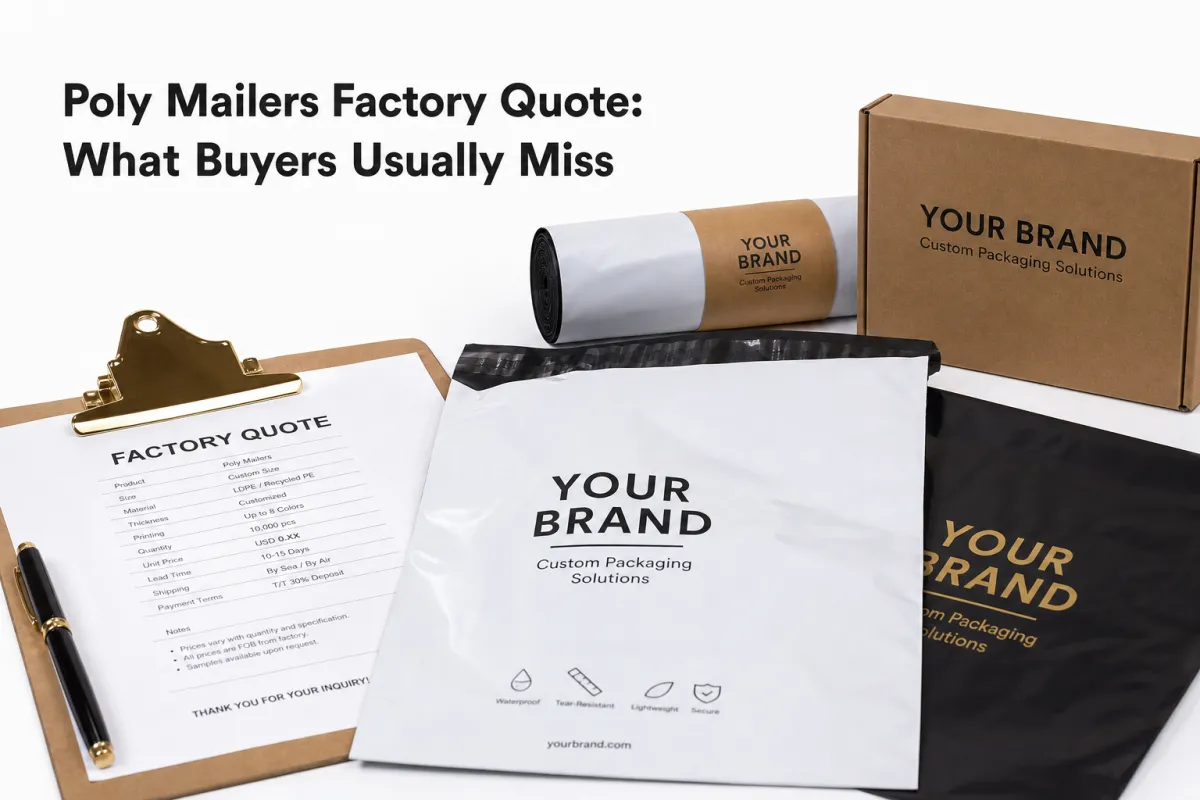
The biggest mistake is assuming the bag is the only cost driver. It is not. A poly mailers factory quote can shift sharply based on print coverage, film gauge, adhesive strip style, carton packing, and the freight lane chosen for delivery. If the same size mailer is quoted from two factories, one may include setup, print plates, and sampling while the other prices only the base bag. Those offers are not equal, even if the unit price looks close at first glance.
Buyers also miss how much the final order depends on the packaging format. A mailer packed 100 pieces per carton is not the same as a mailer packed 50 pieces per bundle with inner bags and pallet wrap. The unit price may move by pennies, but the shipping cost can swing enough to change the landed cost per thousand. A poly mailers factory quote should be checked against the full route to warehouse, not just the factory gate.
Artwork complexity causes another round of trouble. One-color logo printing is straightforward. Full-coverage artwork with tight registration, gradients, or multiple print zones is not. More ink coverage means more time on press, more waste at startup, and a higher chance that the factory adds a cushion for production loss. If the design has a black inner layer for privacy, a white exterior, and a glossy finish, the poly mailers factory quote should reflect that structure instead of a plain white film assumption.
For apparel brands, the problem usually shows up after artwork approval. The buyer thinks the order is locked, then the factory revises pricing because the approved file uses a larger print area or a second-side print that was never part of the first inquiry. That is how a supposedly fixed poly mailers factory quote becomes a moving target. A cleaner brief upfront protects margin and keeps launch calendars intact.
A good quote does more than print a number. It shows what the number buys. If a supplier cannot explain the film, seal, print, packing, and freight assumptions in plain language, the quote is only half the story.
There is also a sourcing angle many buyers underestimate. If you are building a recurring shipping program, a poly mailers factory quote should be judged on repeatability. A bag that looks fine in a sample but varies in opacity, seal strength, or color batch to batch becomes a hidden operational cost. Returns rise, brand presentation slips, and receiving teams waste time checking cartons instead of moving inventory.
For that reason, the best buyers ask for more than one version of the poly mailers factory quote: a test run price, a repeat-order price, and a volume tier that shows where the price breaks actually sit. That comparison reveals whether the factory is rewarding scale or just padding the small run to cover uncertainty.
Useful context helps too. For parcel transit performance, standards from the International Safe Transit Association matter because they provide a common language for shipping abuse tests and handling conditions. See current guidance at ISTA. If your shipping program includes recycled paper cartons or paper inserts, FSC certification can support responsible sourcing claims; more information is available at FSC. A strong poly mailers factory quote should not pretend those standards do not exist.
Product Details Behind a Poly Mailers Factory Quote
Before a factory can price the job correctly, it needs to know which mailer family is being quoted. Standard co-ex mailers, Custom Printed Mailers, recycled-content options, and tamper-evident versions all carry different cost structures. A poly mailers factory quote for a plain gray shipping bag is not the same as one for a branded white mailer with a double seal strip and a return-use closure.
Construction matters because film layers control both performance and cost. Single-layer film is usually less expensive, but co-extruded multi-layer film provides better strength-to-weight efficiency and more control over opacity. If a buyer asks for a 60 to 80 micron bag, the factory still needs to know whether that thickness refers to one layer, total film, or a finished gauge after extrusion. A sloppy spec can distort the poly mailers factory quote enough to make a supposedly cheaper option more expensive in practice. I have had buyers send a "standard thick" request and mean three different things. That one phrase can turn into a pricing mess real quick.
Adhesive systems matter too. A cheap seal strip that opens too easily can save a fraction of a cent, then create customer complaints or package tampering concerns. By contrast, a strong pressure-sensitive closure with a return-use strip may add cost, but it protects the shipment and can reduce damage claims. That should be visible in the poly mailers factory quote, not hidden inside a vague "standard construction" label.
Print structure is another major variable. One-color logos, two-color logos, and full-coverage artwork each use different press time and setup. If a brand wants a dark outer shell with a contrasting inner lining for privacy, the factory must price the color control and raw material mix. The same is true for custom-tinted stock, matte finishes, and gloss films. A practical poly mailers factory quote shows those choices plainly.
End use also shapes the recommendation. Apparel mailers often need a balanced mix of tear resistance and lightweight shipping cost. Cosmetics can require cleaner print presentation and better seal consistency. Books want flatness and puncture protection. Subscription kits may need a more premium look because the mailer is the first brand touchpoint. A factory that understands those use cases can produce a more accurate poly mailers factory quote on the first pass.
Here is a simple way to think about the product families:
- Standard co-ex mailers - lower price, broad use, straightforward branding.
- Custom printed mailers - logo or artwork, higher setup, stronger brand impact.
- Recycled-content mailers - PCR or PIR content, subject to film availability and color limits.
- Tamper-evident mailers - dual seals or security features, useful for high-value or sensitive shipments.
For many buyers, recycled-content film is not just a marketing choice. It can also affect opacity, stiffness, and the way the bag folds through automated packing. That is why a poly mailers factory quote for a recycled option may be higher even when the size stays the same. The factory is pricing raw material availability, not just a logo.
If you need a wider packaging mix, compare the mailer spec with other formats in Custom Packaging Products. The right mailer usually matches fill weight, branding demands, and outbound shipping speed. Cheap on paper. Wrong in practice. That combo gets expensive, and nobody enjoys explaining it after the first shipment lands.
Specifications to Lock Before You Request Quotes
A clean request starts with a clean spec sheet. A poly mailers factory quote is only as good as the dimensions and performance targets you provide. If the size is described as "about 10 x 13," one factory may price the usable interior opening while another prices the full outer size with flap allowance. That tiny difference can affect the final bag size, carton count, and freight cubic calculation.
These are the basics that should be fixed before the quote round begins:
- Width and length - include the flap allowance and usable interior if possible.
- Thickness - state microns or mils, and clarify whether the value is finished film thickness.
- Material grade - virgin LDPE, blended film, or recycled-content film.
- Color and opacity - white, black, gray, clear, matte, gloss, or custom tint.
- Print area - front only, both sides, edge-to-edge, or a limited logo zone.
- Closure style - standard adhesive, extra-strong strip, return-use seal, or tamper-evident closure.
- Packing format - pieces per carton, inner bags, pallet requirements, and any retail labeling.
Tolerance matters more than many buyers expect. A factory quote for a 10 x 13 mailer can still vary if the usable seal area is unclear, if the bag must fit a specific fold line, or if the customer has automated packing equipment that needs consistent dimensions. That is why a poly mailers factory quote should never be compared only on nominal size. Functional size is what matters in the warehouse.
Artwork files should be locked early. If the logo is supplied as a low-resolution image, the factory may need to clean up edges, rebuild text, or adjust the print plate layout. Each of those steps can shift the production plan. A better practice is to send vector artwork, note the preferred placement, and confirm bleed requirements before asking for the poly mailers factory quote. That keeps the quote tied to a real production file instead of a placeholder.
Buyers often ask whether samples are necessary. If the order depends on touch, seal strength, or print clarity, the answer is yes. A physical sample can expose issues a spec sheet will not show, such as weak closure feel, gloss variation, or a film that is too slippery for the pack station. A poly mailers factory quote can be compared against a sample faster than it can be corrected after mass production starts. That saves a lot of back-and-forth later.
In packaging testing, specific methods help remove guesswork. ASTM methods such as tensile and impact testing can support film evaluation, while transit programs can be aligned with parcel handling goals. The point is not to bury the buyer in standards. The point is to make the poly mailers factory quote defensible when the order is reviewed by operations, procurement, or finance.
Poly Mailers Factory Quote Pricing and MOQ Basics
Price follows a familiar curve. As volume rises, unit cost usually falls. The curve is not as smooth as buyers hope, though. Setup fees, plate charges, material waste, and freight can flatten the savings at low quantities. That is why a poly mailers factory quote should always be reviewed on a landed-cost basis, not just the factory-side unit price.
MOQ, or minimum order quantity, is not just a sales line. It reflects how the factory runs film, printing, and packing efficiently. If the line is already set for a certain film width, color batch, or carton size, the factory can spread setup across more units. If the run is too small, the per-unit price rises because the factory is absorbing more start-up cost. A smart buyer uses the MOQ to judge the efficiency of the poly mailers factory quote, not to argue with the number as if it were random.
Comparison is where many procurement teams get tripped up. One supplier may quote EXW pricing only. Another may include FOB terms. A third may offer DDP and then bury the freight, destination handling, and duty assumptions inside the total. Those quotes cannot be stacked side by side without normalizing the shipping terms. A proper poly mailers factory quote should show the basis of trade clearly.
The hidden costs are where the real surprises live:
- Artwork corrections - file cleanup, plate changes, or extra proof rounds.
- Packaging upgrades - retail sleeves, custom cartons, or pallet labels.
- Rush production - compressed schedules that force overtime or schedule changes.
- Split shipments - multiple delivery drops that increase freight handling.
- Destination charges - duties, local fees, or warehousing add-ons depending on the trade term.
Tiered pricing is the fairest way to evaluate options. Ask for a 5,000-piece test price, a 10,000-piece reorder price, and a 20,000-piece volume tier. That spread shows whether the factory is rewarding scale or just quoting a high low-volume number to cover uncertainty. A useful poly mailers factory quote should make the step-down obvious.
| Mailer Type | Typical MOQ | Indicative Unit Price | Best For | Common Lead Time |
|---|---|---|---|---|
| Plain co-ex mailer | 5,000 pieces | $0.04-$0.09 | Unbranded shipping, quick replenishment | 7-10 business days |
| One-color custom printed mailer | 10,000 pieces | $0.09-$0.18 | Logo branding, moderate repeat orders | 12-18 business days |
| Full-coverage printed mailer | 10,000-20,000 pieces | $0.16-$0.32 | Premium branding, higher print complexity | 15-25 business days |
| Recycled-content mailer | 10,000 pieces | $0.14-$0.28 | Sustainability-led programs, mixed branding | 12-20 business days |
| Tamper-evident or double-seal mailer | 10,000 pieces | $0.18-$0.34 | Higher-value goods, return-use applications | 12-20 business days |
The table above is directional, not a promise. Film thickness, print coverage, carton format, and freight can shift the landed number. Still, it is a useful reminder that a poly mailers factory quote is rarely just one price. It is a bundle of material, labor, setup, and logistics decisions that should be separated before procurement approves the order.
The cheapest quote is not always the lowest-risk quote. In packaging, the wrong assumption about thickness or closure quality can erase the savings on the first damaged shipment.
If you are comparing suppliers, ask each one to quote the same specification sheet and the same trade term. Otherwise the result is noise. One seller may include master cartons and export packing, another may not. One may quote a lower unit price but use a slower lead time that hurts launch timing. A disciplined poly mailers factory quote makes those differences visible before money changes hands.
Production Process and Timeline for Factory Orders
The production path is usually more predictable than buyers think, as long as the brief is complete. A standard poly mailers factory quote moves from inquiry to proof approval, then to material preparation, printing, sealing, packing, inspection, and shipment booking. Each stage has its own timing pressure, and the more custom the order, the more the schedule depends on the approval loop.
Proof approval is where many schedules slip. If artwork is still changing after the quote is issued, the factory cannot lock the print plate or reserve the production line with confidence. A fast poly mailers factory quote does not mean a fast delivery if the proof is not signed off. The quote can be perfect and still be useless if the buyer keeps revising the file.
Typical timing drivers include:
- Color matching - custom shades may require extra sampling or press adjustment.
- Plate creation - print plates or cylinders add setup time before the run starts.
- Raw material sourcing - recycled content or specialty film can lengthen the lead.
- Factory congestion - peak seasons and large export runs affect queue time.
- Inspection and packing - final count checks and carton labeling can take longer than expected.
A sensible buyer asks for an estimated ship date range, not a single promise. "Ship in 15 days" sounds confident, but it is weaker than "production in 12-15 business days after proof approval, then booking based on freight lane." That version of the poly mailers factory quote is more useful because it separates manufacturing time from transportation time.
Quality checkpoints should be explicit. At minimum, the factory should confirm seal integrity, print alignment, film appearance, and carton count. For branded mailers, print consistency across the run matters almost as much as the first approved proof. If the order uses a black inner lining, a security strip, or a return seal, those features should be checked before release. A serious poly mailers factory quote should make room for those controls rather than treating them as invisible overhead.
Shipping method also shapes the calendar. Air freight can accelerate urgent launches but compresses the margin. Ocean freight can improve landed economics on larger orders but needs more lead time and more planning. If the buyer wants cartons staged in a fulfillment center by a fixed date, the poly mailers factory quote should include a realistic buffer for transit, customs, and receiving.
Good suppliers avoid promising the impossible. They price the order, define the work, and leave enough visibility for planning. A poly mailers factory quote that explains the path from proof to pallet is more valuable than a quote that simply claims the soonest date.
Why Choose Our Factory for Poly Mailers
The factory advantage is not a slogan. It is control. When the same team manages material sourcing, print consistency, and production scheduling, a poly mailers factory quote becomes easier to trust because the assumptions come from the source of the work, not from a chain of relays. That matters when the order is tied to margin targets or a launch calendar.
Direct communication cuts misquotes. A buyer can confirm dimensions, artwork, packaging, shipping terms, and carton requirements in one loop instead of chasing answers through a middle layer. That shortens the approval cycle and lowers the odds of a corrected invoice later. In practical terms, a factory-based poly mailers factory quote is often better because the people pricing the job are the people who understand how it will actually be built.
Repeatability is where factory discipline shows up. If the first run used a 75 micron co-ex film with a certain opacity and the next run needs the same look, a controlled process is more likely to keep the batch close. That is not flashy. It protects brand presentation. A monthly replenishment program depends on that kind of consistency more than it depends on a cheap headline. A reliable poly mailers factory quote should therefore include stable specs, not just a low number.
Documentation matters too. Export packing notes, carton counts, sample references, and approved artwork records all help receiving teams and customs brokers. When the paperwork is clean, the shipment is easier to receive, easier to audit, and easier to reorder. That is another reason buyers value a transparent poly mailers factory quote: it reduces friction after the sale.
There is also a risk comparison worth making. An unclear vendor may tell you the bag is "standard" and then surprise you later with charges for printing, packing, or freight. A factory that documents the order from the beginning is far less likely to do that. For procurement teams, that difference shows up in fewer change orders, fewer stalled approvals, and fewer disputes over what was actually included in the poly mailers factory quote.
At Custom Logo Things, the goal is simple: the quotation should help you buy the right bag, not just the cheapest-looking bag. If you need a broader source of branded packaging, the team can help you compare format options across Custom Packaging Products and narrow down what best fits your ship volume, shelf presentation, and budget.
If the order is already moving and you need a direct conversation about size, print coverage, or destination details, use Contact Us. The fastest poly mailers factory quote comes from a complete brief, a clear artwork file, and a firm ship-to location. That is the practical route from inquiry to order, and it keeps the whole thing from turning into a guessing game.
Next Steps to Get an Accurate Poly Mailers Factory Quote
Start with a short brief. Not a long email. A complete poly mailers factory quote request should include bag size, thickness, color, print area, quantity, destination, and target delivery window. If the buyer knows the closure style and carton preference too, the quote gets sharper still.
Artwork should go in the first message if possible. Even a basic logo mockup helps the factory flag setup issues before pricing is finalized. A rough visual can reveal whether the print area is too small, whether the logo needs a second color, or whether the design would require larger plates. That is a faster path than revising the poly mailers factory quote after the first round is already on file.
Ask for three numbers in every reply:
- Unit price - so the cost can be compared across suppliers.
- MOQ - so you know where the volume threshold sits.
- Lead time - so operations can judge whether the order fits the calendar.
If the order depends on the exact feel of the film, request a sample or pre-production proof. A sample is especially helpful when the mailer must protect premium apparel, cosmetics, books, or subscription kits. It is easier to catch a weak seal or an off-color print on a desk than after 20,000 pieces have already run. That is one of the cleanest ways to protect a poly mailers factory quote from turning into an expensive revision.
Then compare everything on the same basis. Same size. Same thickness. Same print coverage. Same packing format. Same shipping term. Without that discipline, the cheaper quote may simply be the incomplete one. The best poly mailers factory quote is the one that survives a side-by-side comparison without needing apology, correction, or a hidden add-on.
One final check helps more than most buyers expect: confirm the ship-to destination before the quote is accepted. Freight, duties, and handling can move the landed total far more than a small change in bag price. If you want the quote to hold, lock the destination and make the assumptions visible. That is how a poly mailers factory quote turns into a purchase order instead of a negotiation loop.
What details do I need for a poly mailers factory quote?
Provide size, thickness, color, print requirements, quantity, and destination so the factory can price the order on the right basis. Include artwork files or at least a logo mockup to avoid a poly mailers factory quote that ignores setup or print complexity.
How does MOQ affect a poly mailers factory quote?
MOQ usually reflects the factory's production efficiency for film, printing, and packing runs. Lower quantities often cost more per unit because setup and material waste are spread across fewer bags, which is why the MOQ line is a core part of any poly mailers factory quote.
Why do two poly mailers factory quotes look so different?
One quote may include print setup, testing, and freight while another lists only the bag price. Differences in thickness, print coverage, material grade, and packaging format can also change the final number, so the best poly mailers factory quote comparison starts with identical specs.
How long does a custom poly mailers factory quote take?
Basic quotes can be turned around quickly when the spec sheet is complete. Custom artwork, sampling, or unclear shipping details usually add time because the factory must confirm the final production plan before a poly mailers factory quote can be locked.
Can I get a sample before placing a bulk order?
Yes, many factories can provide stock samples or custom proofs before mass production. A sample request is especially useful when the order depends on print clarity, seal strength, or exact color matching, and it is often the fastest way to validate a poly mailers factory quote before committing to volume.
Clear specs, honest artwork, and a firm destination are what keep a poly mailers factory quote accurate from first reply to final shipment. If you do only one thing next, build a one-page spec sheet and send the same version to every supplier so the quotes are actually comparable.


