Buyer Fit Snapshot
| Best fit | Sustainable Packaging Certification projects where brand print, material claims, artwork control, MOQ, and repeat-order consistency need to be specified before quoting. |
|---|---|
| Quote inputs | Share finished size, material target, print colors, finish, packing count, annual reorder estimate, ship-to region, and any compliance wording. |
| Proofing check | Approve dieline scale, logo placement, barcode or warning zones, color tolerance, closure strength, and carton packing before bulk production. |
| Main risk | Vague material claims, crowded artwork, missing packing details, or unclear freight terms can make a low unit price expensive after revisions. |
Fast answer: Sustainable Packaging Certification: Production Spec, Color Control, and Delivery Risk should be specified like a repeatable production item. The safest quote records material, print method, finish, artwork proof, packing count, and reorder notes in one written spec.
Production checks before approval
Compare the actual filled-product size with the drawing, then confirm tolerance on folds, seals, hang holes, label areas, and retail display edges. Reserve space for logos, QR codes, warning copy, and material claims before decorative graphics fill the panel.
Quote comparison points
Review material grade, print process, finish, sampling route, tooling charges, carton quantity, and freight assumptions side by side. A quote is only useful when the supplier can repeat the same color, closure quality, and packing count on the next order.
What Is Sustainable Packaging Certification? A Brand Guide I still remember a beauty brand in Toronto that spent $12,000 on a recycled-content claim for 48,000 cartons, only to learn the mill letter covered a different board grade and a different lot. The packaging looked right. The evidence did not. So, what is sustainable packaging certification? It is third-party proof that the promise printed on your package matches the material spec, sourcing record, or test report behind it. That proof is less glamorous than a campaign deck, but a carton has to survive questions from a buyer in Chicago and a compliance manager in Hamburg, not just a design review. What is sustainable packaging certification, really? It is the difference between a claim that travels and a claim that falls apart as soon as someone asks for backup.
What is sustainable packaging certification in plain English? It is the outside check that tells a retailer, auditor, or regulator that your recycled content, recyclability, compostability, or chain-of-custody claim is backed by real documents, not a polished sentence on Custom Printed Boxes. A 350gsm C1S artboard carton can look premium under studio lights and still fail review if the resin declaration, FSC code, or test report points to a different substrate. Beautiful packaging design is not the same thing as proven packaging. That gap can cost $4,500 in reprints in a single week, which is a pretty brutal lesson for any launch team. If you are asking what is sustainable packaging certification because a launch is already moving, the short answer is that it protects the claim before it gets expensive.
That distinction matters in branded packaging and retail packaging because the people carrying the liability are rarely the people who approved the headline. Buyers want evidence tied to the exact SKU, usually down to the carton size, print run, and factory location. Retailers want consistency across the shelf, whether the product ships from Shenzhen, Dongguan, or a plant in Ontario. Regulators do not care that the package looked premium on press day if the claim collapses during an audit. What is sustainable packaging certification, then? It is the discipline of matching the story on the pack to the evidence in the file, down to the last lot code. It also functions as a filter for recycled content verification, FSC certification, and compostability certification, which sound similar until somebody asks for the backup.
Not every SKU needs the same badge. A 350gsm paperboard carton with FSC chain-of-custody documentation sits in a different category from a 100-micron poly mailer with a mixed-film seal and a compostable claim. What is sustainable packaging certification useful for? It helps you Choose the Right label for the right substrate, the right market, and the right sales promise, instead of forcing one shiny badge onto every product packaging line you own. I have seen a single recycled-content logo fail on three formats because the corrugated shipper, folding carton, and insert all had different suppliers in Guangdong and different paper mills in North America. That is not a branding issue. It is a documentation issue wearing a branding costume.
The brands that do this well usually start with one blunt question: what are we actually trying to prove? Recycled content? Responsible sourcing? Recyclability in a defined curbside system? Compostability under ASTM D6400? What is sustainable packaging certification without that first decision? Just expensive stationery. A vague claim can burn $900 on document review, $1,800 on lab testing, and another $2,000 on rushed proofs before anyone notices that the standard never matched the material. In other words, the wrong claim can cost more than a better one would have cost to certify in the first place.
What is sustainable packaging certification?
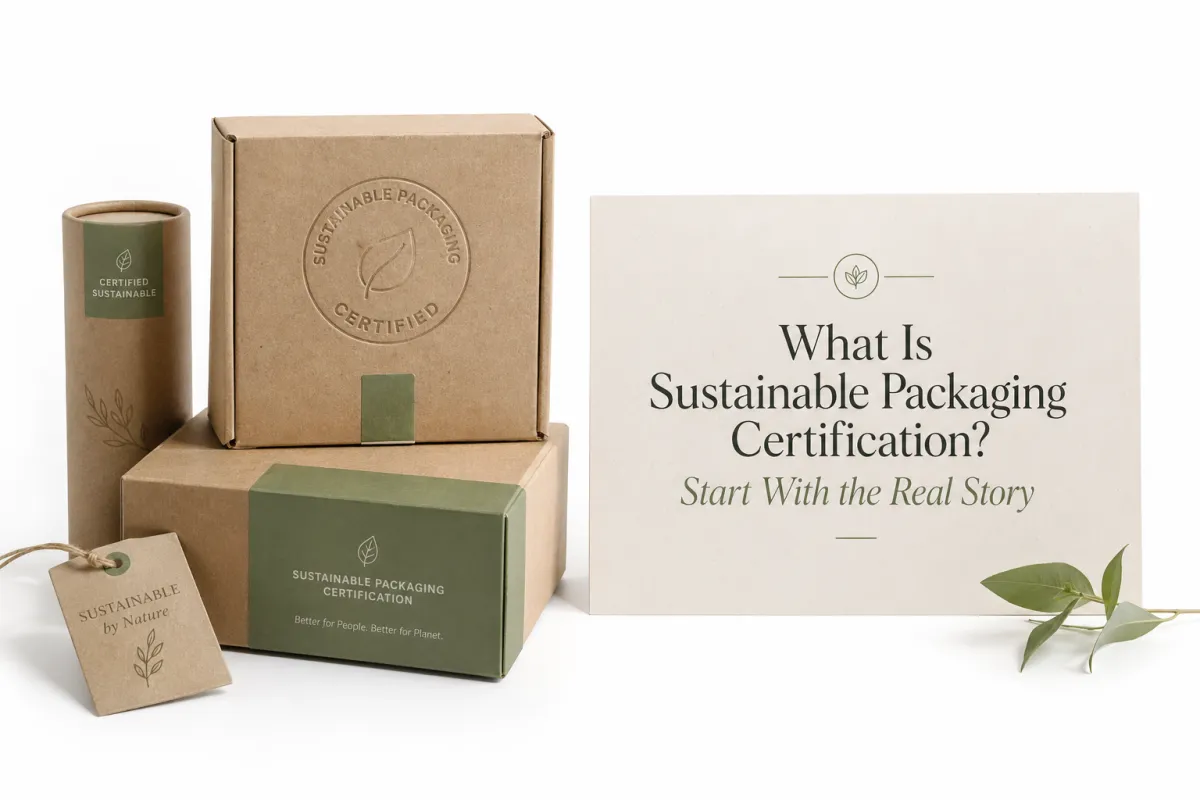
What is sustainable packaging certification at the most useful level? A promise with a paper trail. It is a third-party check that your packaging claim is tied to a standard, a material, and a supply chain you can actually defend. That might mean FSC certification for fiber sourcing, chain-of-custody tracking for paperboard, a recycled-content verification for cartons, or compostability certification for a limited set of materials that truly meet the test. The words on the pack are the headline; the certification is the evidence file behind it.
The reason this question matters is simple. Claims have gotten louder while the tolerance for sloppy support has gotten much smaller. A retailer in the U.S. may accept one form of evidence, while a compliance team in the EU asks for another. What is sustainable packaging certification in that environment? It is a common language between packaging teams, legal teams, and suppliers who may be working across three continents and one very impatient launch calendar. Without that language, a claim turns into a guessing game with better typography.
There is also a psychological trap here. A badge feels finished. A certificate feels official. But what is sustainable packaging certification if the underlying materials do not match the approved spec? It is only an ornament. I have seen teams celebrate a green icon on the carton while the wrong board thickness, wrong lot code, or wrong resin content sat in the file. That kind of mismatch is not rare, and it is one reason sustainable packaging certification keeps showing up in procurement conversations instead of just in design reviews.
What Is Sustainable Packaging Certification in Practice
What is sustainable packaging certification in practice? A chain of steps, each one dependent on the last, and each one easier when someone writes the dates on a calendar instead of hoping for the best. You choose the standard, review the material specs, collect supplier documentation, submit samples or product data, and finish with an audit, third-party review, or claims verification. Teams often spend three days debating foil colors and 20 minutes on the actual evidence, which is backward in the way packaging projects often are. I say that with affection, but the invoice usually says it louder.
A typical project starts with a packaging engineer in Minneapolis, then procurement, then the supplier rep in Dongguan, then a test lab, then the certification body. Retailer compliance may step in late and ask for one more declaration nobody mentioned at kickoff, often on a Thursday at 4:30 p.m. What is sustainable packaging certification in a real supply chain? Paperwork with teeth. Every document has to match the exact SKU, the exact converter, and the exact substrate, whether that is a 24-pt carton, a 450gsm mailer box, or a 60-micron film sleeve. If one number drifts, the whole story starts wobbling.
On a visit to a Shenzhen facility converting paper mailers for a skincare brand, the line looked spotless until the mill certificates came out. One resin declaration covered a different coating weight, and one pallet label carried the wrong lot code on a 16,000-piece run. That mismatch alone would have delayed launch by 10 business days and cost about $1,200 in resampling and courier fees. What is sustainable packaging certification for a factory floor? A discipline of matching numbers, not a photo opportunity. The room went quiet in the way only a prepress team can understand, with everyone suddenly studying the floor like it had something useful to say.
There is also a difference between product certification, facility certification, and claims verification. Product certification looks at the item itself: a carton, label, tray, or insert, often against a documented spec such as 350gsm C1S artboard or 100% recycled corrugated board. Facility certification examines the site that makes or handles the material, whether the plant sits in Vietnam, Poland, or Mexico. Claims verification is narrower and asks whether the sentence on the box can be defended. What is sustainable packaging certification when those terms get blurred? A headache with an invoice attached, usually followed by one more round of revised artwork.
For a grounded starting point, I usually point people to the Sustainable Packaging Coalition resources at packaging.org and chain-of-custody guidance from fsc.org, especially FSC-STD-40-004 for custody tracking. They will not do the work for you, but they will keep you from inventing your own private definition of proof. That hobby shows up often in packaging, and it gets expensive fast, especially when a brand is trying to support a launch in California, Texas, and Ontario with one loose spreadsheet.
What is sustainable packaging certification doing at the end of the line? It tells sales what they can say, tells legal what they need to review, and tells the printer whether the art file can go to press. I have sat in meetings where a brand owner had a launch date, a retailer requirement, and a half-finished supplier file for 25,000 units due in 11 business days. The certifier was not the bottleneck. The missing paper trail was. That part is almost never glamorous, but it is usually the part that decides whether the launch happens on time or costs another $3,800 in freight and rework.
Key Factors That Affect Approval, Pricing, and Claim Strength
What is sustainable packaging certification going to cost? The answer depends on five things: the number of SKUs, the number of facilities, the number of packaging substrates, the testing requirements, and whether your suppliers already have clean documents. A basic documentation review can be cheap; a recycled-content claim on one paperboard carton may run $750 for a simple file check, while compostability testing can jump to $4,800 once lab work and sample prep are included. The bills climb faster than people expect, especially when there are three converters, two mills, and one missing certificate buried in an inbox from last November.
I once worked with a beverage client that had four carton styles, two corrugated shipper sizes, and one rushed retail packaging rollout across New York, Toronto, and Vancouver. The certifier quoted a manageable review fee, but the real cost came from rework: new dielines, revised iconography, and a second proof cycle at $180 per file because the claim changed after legal review. What is sustainable packaging certification worth in that moment? More than the first quote, less than a failed launch. That is the awkward math nobody wants to put in the deck, especially when the print slot is already booked for Thursday morning.
Material complexity matters too. Paperboard is usually easier to document than mixed-material structures. A plain kraft mailer is simpler than a soft-touch laminated sleeve with foil stamping, spot UV, and a window film nobody remembered during planning. Once coatings, adhesives, or barrier layers enter the picture, recyclability claims become harder to support, especially if the board is 350gsm and the laminate is a 12-micron PET layer. What is sustainable packaging certification in mixed-material packaging? A test of whether the supply chain can explain every layer without improvising. And improvising, in this context, is just another word for trouble.
Here is a practical way to think about pricing and scope. These ranges come from projects I have seen, not promises from a polished sales deck.
| Certification Path | Best For | Typical Cost Range | Typical Timeline | What Usually Slows It Down |
|---|---|---|---|---|
| Documentation review | Simple recycled content or sourcing claims | $750-$2,500 | 2-4 weeks | Missing supplier letters, wrong lot numbers |
| Lab testing plus review | Compostable or performance-sensitive claims | $1,200-$6,000 | 3-8 weeks | Sample prep, retesting, substrate changes |
| Full audit or site verification | Chain-of-custody or multi-site programs | $3,500-$12,000+ | 4-12 weeks | Factory scheduling, document gaps, corrective actions |
| Multi-region rollout | Brands selling in several markets | $8,000-$20,000+ | 6-16 weeks | Different rules, different artwork, different approvals |
What is sustainable packaging certification really buying you in that table? Claim strength. A cheap path with weak evidence can cost more later if a retailer questions the label or a competitor files a complaint in a market like California, Quebec, or the UK. Brands choose the lower fee and then pay for a reprint, a legal review, and overnight freight because the claim does not survive scrutiny. That is not savings. That is theater, and the audience usually includes finance, legal, and one very annoyed operations lead.
Brand risk is the part people underprice. A $2,000 documentation review can be a smart move if the claim is narrow and the files are complete. It can also be a false economy if the packaging design is built around a badge the material cannot support, like a compostability icon on a PET-laminated sleeve or a recycled claim on a board with no traceable mill certificate. What is sustainable packaging certification worth if it gives you a weak claim? Not much. Maybe a nice-looking problem. Maybe a very polished headache.
Step-by-Step Guide to Getting Sustainable Packaging Certification
What is sustainable packaging certification if you are starting from scratch? A project plan with dates, owners, and a lot less room for improvisation than most people expect. You do not buy it off the shelf and hope for the best. You map the claim, map the supply chain, collect evidence, then build the artwork and launch around that evidence. Brands that skip the first step usually pay for it later in proofs, delays, and awkward legal emails, especially when the press time is already locked for a 14,000-unit run.
1. Audit the claim first
Start by writing the exact sentence you want on the pack. Not the vague version. The exact one. Recycled content, recyclable, compostable, responsibly sourced, or chain-of-custody tracked each means something different, and the difference matters more than a mood board in a kickoff meeting. What is sustainable packaging certification at this stage? A filter that tells you whether the claim is supportable before your designer drops it into a layout for a 250g folding carton or a 100-micron mailer.
If the claim says "recyclable," define where and under what conditions, such as curbside programs in Canada or specific MRF guidance in the U.S. If it says "responsibly sourced," define the standard, such as FSC chain-of-custody or PEFC tracking. If it says "contains 30% post-consumer recycled fiber," define the measurement method and who verified it, whether the batch was 5,000 pieces or 50,000. One client avoided an entire reprint by changing "fully recyclable" to "widely recyclable in many municipal programs" after legal reviewed the substrate. That single edit saved about $4,200 in plates and press time.
2. Map the supply chain
Pull paperwork from every supplier, not just the obvious one. Mills, converters, coating vendors, resin providers, adhesive suppliers, and print houses all matter. What is sustainable packaging certification without a paper trail from each of them? A guess wrapped in a brand promise. Ask for mill certificates, chain-of-custody records, resin declarations, test reports, and lot-specific references. If the answer arrives as a screenshot, press harder. Screenshots age badly, especially when a compliance team asks for the original file six months later.
Look for mismatches between the spec sheet and the supporting documents. A supplier may say the carton is 100% recycled fiber, but the certificate covers a different grade or a different production period. A converter may describe the same board as 350gsm while the mill letter lists 340gsm, which is enough to trigger questions in a strict review. What is sustainable packaging certification if the numbers do not line up? Not much. It is like trying to weigh a parcel on a scale that only tells you the color of the box.
3. Match the standard to the substrate
Not every standard fits every material. Paperboard, corrugated, flexible film, molded fiber, and bioplastic each come with different test methods and claim boundaries. What is sustainable packaging certification without that match? A mismatch that can force a restart. Compostability certification makes sense only if the whole structure is designed for it. FSC certification makes sense for fiber. Recycled-content claims need traceability. Recyclability claims need evidence tied to a defined collection system and a specific end-of-life pathway.
This is where packaging teams get into trouble by treating all sustainability claims as interchangeable. They are not. A 450gsm mailer box may be easy to defend as recycled content, but that does not automatically mean the same package is recyclable in every market. A carton could be sourced responsibly and still fail compostability expectations because of adhesive choices or printed coatings. What is sustainable packaging certification in that context? A map, not a slogan. The map has to match the road.
4. Build review into artwork timing
Do not save certification review for the last proof. That decision turns a routine sign-off into a rush fee. What is sustainable packaging certification worth if the artwork is already at press and the claim has to be rewritten? Less than the cost of the rush. Align the legal review, the certification review, and the print approval so the badge, claim line, and supporting language all land together. That keeps the printer from producing a very expensive version of a mistake.
I once watched a launch get delayed because the legal team approved "made with recycled fiber," while the certification file supported "contains recycled content," which is close enough for a marketing brainstorm and not close enough for packaging compliance. The fix was simple. The timing was not. One revised proof, two approvals, one overnight courier, and a new print slot. That is the rhythm of sustainable packaging certification when the process starts too late.
5. Keep records SKU-specific
What is sustainable packaging certification good for if the records cannot be traced to a specific SKU? Not much. Save the claim statement, substrate spec, supplier documents, proof numbers, and approval emails in one place. Tie them to the item code, not just the brand name. A brand often has several cartons, sleeves, and shippers with similar artwork but different materials. One missing file can contaminate the whole line if the records are too generic. SKU-level discipline sounds fussy until you need it, and then it sounds like survival.
That is especially true for multi-region brands. A carton sold in the U.S. may have one claim structure, while the same carton in Canada needs another. The core artwork may stay similar, but sustainable packaging certification still depends on region, program, and regulator expectations. A single folder labeled "green packaging" is how teams create future arguments for themselves.
Common Mistakes Brands Make With Sustainable Packaging Certification
What is sustainable packaging certification most often derailed by? Assumptions. The first mistake is treating a vendor statement like a certificate. A supplier saying a carton is recycled does not make the claim defensible unless the paperwork, scope, and dates line up. A second mistake is choosing a badge because it looks good on the pack, then trying to make the material fit later. That reverses the order of truth, and packaging does not forgive that easily.
The third mistake is ignoring the difference between source control and product control. FSC certification may cover chain-of-custody for the fiber, but it does not automatically clear every adhesive, coating, or ink. Recycled content verification may be clean for the board and messy for the laminate. Compostability certification can be especially unforgiving because one non-compostable layer can undo the entire structure. What is sustainable packaging certification if the structure itself is not designed for the claim? A very expensive misunderstanding.
The fourth mistake is failing to check regional rules. A claim that is acceptable in one market may need different wording elsewhere. What is sustainable packaging certification in a multi-market rollout? A translation problem as much as a technical one. A brand can spend weeks perfecting a claim for one geography, then discover that the same phrase creates risk in another. The fix is not always dramatic. Sometimes it is just a different sentence and a better file.
The fifth mistake is waiting for the printer to flag issues. Printers are good at ink, substrate behavior, registration, and finish. They are not always the last word on sustainability claims. What is sustainable packaging certification supposed to catch? The gap between production reality and claim language. By the time a printer notices the issue, artwork may already be locked, supply ordered, and launch dates announced. Then everyone is having the same conversation in a more expensive room.
The sixth mistake is confusing a clean-looking mockup with an approved claim. A mockup can hide a lot: wrong resin, wrong board, wrong percentage, wrong standard. What is sustainable packaging certification if not a way to interrogate the parts that a render cannot show? It is the slow, unglamorous check that prevents a beautiful box from becoming a legal problem. That may not help a pitch deck, but it helps a business.
Expert Tips for Choosing the Right Certification Path
What is sustainable packaging certification worth if it is overbuilt for the claim? Too much. What is sustainable packaging certification worth if it is underbuilt? Even more, but in the form of risk. The right path sits between those two mistakes. Start by asking whether the claim is about material content, source control, end-of-life behavior, or factory process. Then match the certification path to the question, not to the trend.
If the packaging is fiber-based and the claim is about sourcing, FSC certification or PEFC chain-of-custody may be the right lane. If the claim is about post-consumer content, the path may hinge on recycled content verification and supplier documentation rather than a full audit. If the claim is compostability-related, the standards become stricter and the testing more expensive. What is sustainable packaging certification in that case? A decision tree that rewards precision and punishes wishful thinking.
My practical rule: choose the narrowest credible claim that still supports the brand story. A claim that says "made with responsibly sourced fiber" can be easier to defend than a broad environmental promise that invites questions about every layer, coating, and adhesive. What is sustainable packaging certification doing for a narrow claim? It creates headroom. A narrower claim is often more durable, especially when the packaging has to work in a hurry across multiple retailers.
Another useful habit is to ask your supplier for the document before you ask for the badge. The document reveals the likely path. A clean mill certificate suggests one route. A fuzzy resin declaration suggests another. If a supplier stalls, that delay is a signal, not background noise. What is sustainable packaging certification without supplier cooperation? A project that spends most of its time waiting. Strong programs are less about finding the perfect standard and more about getting honest paperwork from people who know they will be asked twice.
Also, build one internal owner for the claim. Not five. One. What is sustainable packaging certification when everyone owns it? Usually nobody does. The best teams assign one person to hold the file, the dates, and the final wording. That person becomes the anchor between procurement, legal, design, and the plant. It is not glamorous, but it cuts confusion in half. And yes, that kind of boring discipline is usually what saves the launch.
Next Steps for Sustainable Packaging Certification
What is sustainable packaging certification next for a brand that already has packaging in market? Usually a cleanup exercise, then a standardization project. Start with the top-selling SKUs, the highest-risk claims, and the packaging structures that travel into regulated markets. Pull the artwork, the specs, the supplier letters, and the test reports into one system. Then identify the gaps. The gaps are where cost hides, and they are often smaller than teams fear if they are found early.
If you are launching a new line, build sustainable packaging certification into the first packaging brief. Not after the dieline. Not after the proof. In the brief. Put the claim requirements, required documents, and expected standard in writing before design starts. What is sustainable packaging certification doing in the brief? Preventing a redesign later. That one step can save weeks, which matters more than almost any polished claim line ever will.
For existing packaging, run a claim audit quarterly or at least twice a year. Standards change. Suppliers change. Artwork changes. Even a stable-looking carton can drift if the resin source, mill grade, or plant location changes. What is sustainable packaging certification if not a living record? It is not a one-time trophy. It is a maintained system that keeps the claim aligned with the product as it moves.
The brands that get this right usually treat certification as part of packaging operations, not a side quest for marketing. That mindset shift matters. It turns sustainable packaging certification from a late-stage check into a design constraint, much like print finish, cost, or transit durability. Once that happens, the process gets faster, cleaner, and a lot less dramatic. And that is usually a sign the work is finally being done well.
If you only do one thing this quarter, do this: audit one hero SKU, one claim, and one supplier file. What is sustainable packaging certification for that SKU? A test case. If the file is clean, expand the process. If it is not, fix the weakest link before the next print run. Packaging rarely rewards optimism, but it does reward order. That is the part teams can actually control, and it is the part worth getting right first.
FAQ
What is sustainable packaging certification for a small brand?
What is sustainable packaging certification for a small brand? Usually a simpler, narrower process focused on one claim and one product line. Small brands often start with recycled content verification, FSC certification, or a claims review rather than a full audit. The key is to keep the evidence tight and the wording modest. If the paper trail is clear, the process gets a lot less painful.
Do all packaging claims need certification?
No. But if the claim is environmental, material-based, or likely to be questioned by retailers or regulators, third-party support is smart. What is sustainable packaging certification doing here? It provides defense for claims that could otherwise be challenged as vague or misleading. A claim can be true and still be hard to defend if the documents are thin.
Is FSC certification the same as sustainable packaging certification?
No. FSC certification is one type of chain-of-custody certification for fiber sourcing. What is sustainable packaging certification as a broader idea? It includes FSC, recycled-content verification, compostability certification, and claims verification depending on the material and the statement on the pack. FSC is a piece of the puzzle, not the whole thing.
How long does the process take?
Timelines vary. A simple documentation review may take 2-4 weeks, while lab testing or site audits can take much longer. What is sustainable packaging certification in practice? A timing exercise as much as a compliance exercise, because missing documents or sample changes can stretch the schedule quickly. If the file is messy, the calendar usually gets messy too.
What if my supplier cannot provide complete records?
Then the claim may need to change, narrow, or wait. What is sustainable packaging certification without supplier records? A weak file and a risky launch. The better move is to solve the documentation gap before the artwork is finalized, even if that means revising the claim line. That is annoying, sure, but it beats explaining a bad claim later.
Can one certification cover every SKU?
Rarely. Different substrates, suppliers, and regions often require different support. What is sustainable packaging certification across a portfolio? A SKU-by-SKU discipline. One badge may work across a family of products, but only if the underlying materials and documents are genuinely consistent. The moment the structure changes, the evidence may need to change too.


