Buyer Fit Snapshot
| Best fit | Recycle Printed Poly Mailers Without Guesswork projects where brand print, material claims, artwork control, MOQ, and repeat-order consistency need to be specified before quoting. |
|---|---|
| Quote inputs | Share finished size, material target, print colors, finish, packing count, annual reorder estimate, ship-to region, and any compliance wording. |
| Proofing check | Approve dieline scale, logo placement, barcode or warning zones, color tolerance, closure strength, and carton packing before bulk production. |
| Main risk | Vague material claims, crowded artwork, missing packing details, or unclear freight terms can make a low unit price expensive after revisions. |
Fast answer: Recycle Printed Poly Mailers Without Guesswork: Film, Print, MOQ, and Carton Packing should be specified like a repeatable production item. The safest quote records material, print method, finish, artwork proof, packing count, and reorder notes in one written spec.
Production checks before approval
Compare the actual filled-product size with the drawing, then confirm tolerance on folds, seals, hang holes, label areas, and retail display edges. Reserve space for logos, QR codes, warning copy, and material claims before decorative graphics fill the panel.
Quote comparison points
Review material grade, print process, finish, sampling route, tooling charges, carton quantity, and freight assumptions side by side. A quote is only useful when the supplier can repeat the same color, closure quality, and packing count on the next order.
I learned how to recycle Printed Poly Mailers on a production floor in Shenzhen, standing beside a line pushing 120 bags a minute and a stack of 25,000 finished mailers waiting for carton packing. The bags were printed in three colors, run on 2.5 mil LDPE #4 film, and sealed with a 12 mm peel-and-seal strip. That detail changed the way I looked at the problem. How to recycle printed poly mailers is not really a question about the logo on the outside. It is a question about the film, the adhesive, the labels, and the collection system waiting at the far end. I remember thinking, rather uncharitably, that packaging had managed to make itself look complicated on purpose.
Most people see a branded mailer and assume it is doomed, especially when the artwork includes a matte black field or a foil accent printed in Dongguan or Suzhou. The instinct makes sense. A glossy black bag with a silver logo looks nothing like the clean plastic film people picture when they hear the word recyclable. Reality is messier, and honestly a bit annoying. Some printed poly mailers belong in a film drop-off bin, some should be reused, and some have layers or coatings that make recycling a bad fit. Anyone trying to understand how to recycle printed poly mailers has to start with the material, not the marketing copy, because the marketing copy loves to leave out the inconvenient parts.
That disconnect shows up everywhere, from factory audits in Shenzhen to brand strategy meetings in New York and Chicago. A company orders 50,000 units, adds a bold print, includes a peel-and-seal strip, then assumes the recycling symbol will solve the afterlife of the bag. It rarely works that way. The teams that handle this well treat how to recycle printed poly mailers as a design decision, an operations issue, and a customer instruction set all at once. Honestly, I think that is the part most brands skip because it is less glamorous than a shiny new package render and harder to approve in a 20-minute meeting. For brands comparing options, how to recycle printed poly mailers should be part of the buying brief, not a footnote.
How to Recycle Printed Poly Mailers: What They Are
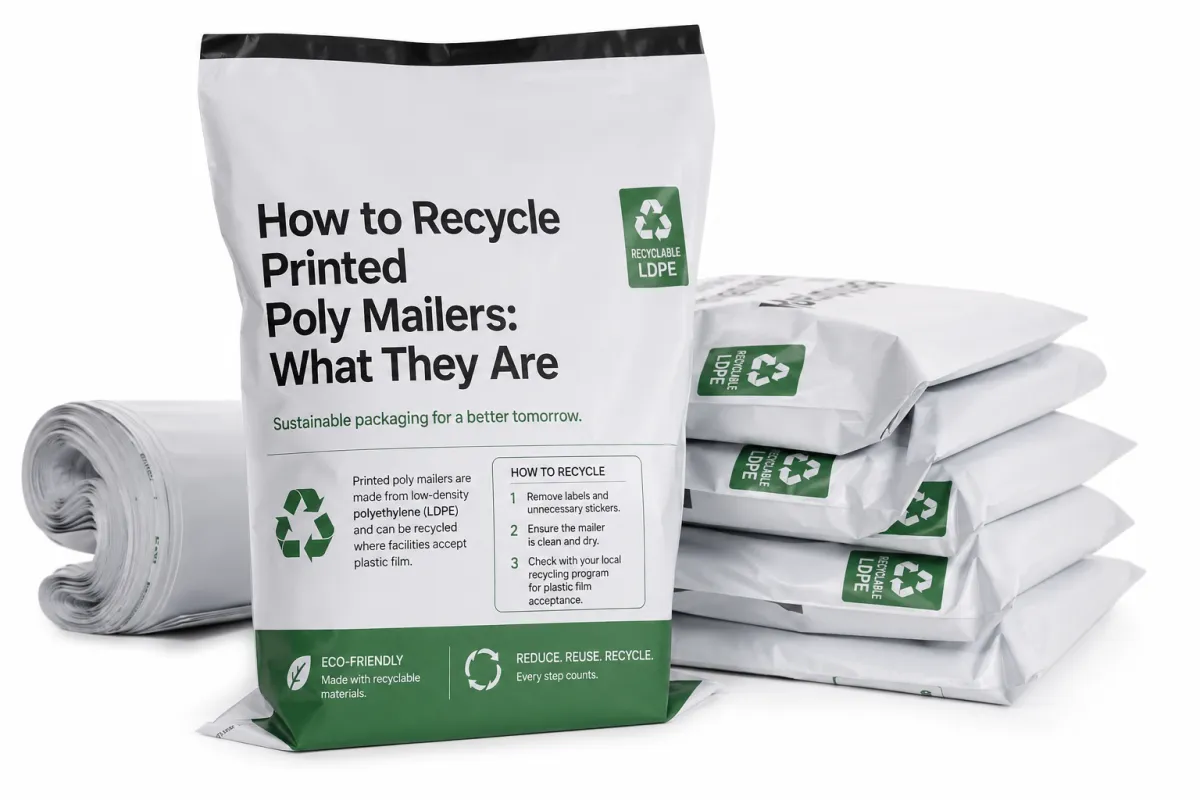
Printed poly mailers are flexible shipping bags made from plastic film, usually LDPE or a related film-grade resin, then finished with ink, labels, or a surface treatment so the package can carry brand graphics. They show up in apparel, cosmetics, supplements, books, replacement parts, and subscription shipments that carry one or two items. The print changes the appearance, not always the recovery route, which is why how to recycle printed poly mailers begins with the film itself. I have seen people stare at a heavily printed bag as if the ink were radioactive. It usually is not the ink. It is almost never the ink.
On a spec sheet, you will often see 1.5 mil, 2 mil, or 3 mil thickness, plus notes about seal strength, opacity, and slip additives. A common short-run quote for 5,000 pieces might land around $0.11 to $0.15 per unit for a standard 2.5 mil LDPE mailer, while a more controlled recyclable build can rise to $0.14 to $0.19 depending on print count and film finish. Those lines matter more than most brand teams realize. A mailer can feel sturdy in hand and still be a single-material film that works in a store drop-off stream. I have watched teams obsess over the artwork while overlooking the real troublemakers: hidden adhesive strips, mixed-material zippers, and coatings that make recovery harder. That is the first practical lesson in how to recycle printed Poly Mailers Without guesswork. The file is in the details, and the details are usually the ones that are boring in a meeting deck.
Flexible plastic does not behave like a bottle. Bottles and jugs are rigid, easier to sort, and easier to bale in many curbside systems in cities like Austin, Portland, and Toronto. A mailer is light, soft, and prone to wrapping around screens like ribbon caught in a conveyor. So a bag can look recyclable and still need a dedicated collection stream. If you want a clear answer on how to recycle printed poly mailers, think like the sorter, not like the shopper. The sorter is the one who has to deal with the mess when the assumption turns out to be wrong.
I remember a client sample review in Los Angeles where the marketing group had fallen in love with a metallic finish. The prototype looked expensive, and the supplier had built it with a metallized layer over clear film in a factory near Ningbo. The recycling partner rejected the material during a test run because it behaved like a composite, not a clean film. That mistake was expensive, and the reprint added roughly 9 days to the launch calendar. It also became a useful rule of thumb: how to recycle printed poly mailers is part chemistry, part collection logistics, and part discipline. If any one of those goes missing, the whole plan gets wobbly.
"We assumed the recyclable label solved it," a fulfillment manager in Chicago told me while we stood beside a pallet of 8,000 returns. "The line kept jamming, and only then did we realize the issue was the film structure, not the logo."
For brands trying to cut packaging waste, the real question is not whether a printed mailer can ever be recycled. The useful question is where it can be recycled, how clean the stream needs to be, and which program actually accepts it. That is the starting point for how to recycle printed poly mailers in a way that keeps contamination low and trust intact. For packaging options designed with end-of-life in mind, see Custom Packaging Products and our Custom Poly Mailers. A typical custom order is ready in 12-15 business days from proof approval, which gives brands time to tighten the recycling instructions before cartons ship from Shenzhen or Dongguan.
How Recycling Printed Poly Mailers Works in Practice
Ask ten people how to recycle printed poly mailers and most will sketch a simple path: collect the bags, sort them, clean them, and send them to be reprocessed. That outline is right, but it hides the parts that matter. First, the mailers are gathered from a store bin, a back-room collection point, or a consolidation area in a warehouse near Dallas, Rotterdam, or Melbourne. Then a facility separates flexible film from rigid plastics, cardboard, and trash. After that, the film gets baled, shipped to a reclaimer, washed, shredded, and turned into pellets or flake. The chain is straightforward on paper and fussy in real life. The paper version is always nicer. Real life tends to show up with dust on its shoes.
Sorting is where confusion tends to start. Recyclers do not care about brand promises; they care about feedstock that will melt at the right temperature and hold together under extrusion. Ink is usually not the main obstacle. Heavy adhesive, a laminated paper layer, a metallic finish, or a multi-layer construction can be. I have seen a whole batch rejected because every third bag still carried a thick shipping label and a 2-inch tape strip from a fulfillment center in Phoenix. A small inconsistency like that can push the bale out of spec. It takes surprisingly little to ruin a stream. Recycling is picky in the same way a very tired person is picky: one more unnecessary thing and the whole mood changes.
Curbside recycling and film drop-off are not interchangeable, and the mix-up causes avoidable mistakes. Many municipalities tell residents to keep film out of curbside carts because soft plastic tangles screens and contaminates other lines. Store drop-off programs, by contrast, are built for film and usually have narrower acceptance rules. The EPA lays out recycling categories and the importance of local program rules at EPA recycling guidance. That local-rule mindset is exactly what you need for how to recycle printed poly mailers. If you ignore the local part, the rest of the advice becomes theoretical very quickly, especially in regions where the downstream buyer only wants clear, unprinted LDPE.
The best programs behave like manufacturing systems. They define the incoming material, set contamination limits, and train the people touching the stream. A film recycler wants consistency more than anything else. Receipts, snack crumbs, bubble wrap scraps, and strips of kraft paper tape all lower the value of the bale. That is why how to recycle printed poly mailers keeps coming back to the same principle: the cleaner and more uniform the stream, the better the recovery. I have said that sentence in Shanghai, Warsaw, and San Diego, and it still surprises people because it sounds obvious only after someone explains the economics.
Packaging performance matters too. The International Safe Transit Association focuses heavily on shipment integrity because a package that fails in transit creates waste before it ever reaches a customer. Better design reduces damaged mailers, replacement shipments, and the amount of packaging moving through the system. That matters when sustainability and shipping performance need to coexist, and it matters even more when how to recycle printed poly mailers is part of the larger packaging plan. A bag that survives shipping is already doing part of the recycling job by avoiding replacement waste, which is why a 2.5 mil film often outperforms a 1.5 mil version in real distribution tests.
Key Factors That Affect How to Recycle Printed Poly Mailers
Resin type is the first variable. LDPE film is the most familiar starting point, especially for flexible shipping bags that feel soft and stretch before tearing. A mailer that is truly single-material LDPE has a much better chance of fitting into a film recycling stream than a bag built from several bonded layers. I tell teams to ignore the print for a moment and ask for the resin declaration. If you are trying to figure out how to recycle printed poly mailers, that single line on the spec sheet carries a lot of weight. It is not glamorous, but it is usually the truth.
Construction comes next. A mono-material film behaves differently from a bag with a paper exterior, plastic lining, and a peel strip along the seal. Some mailers use a matte finish, a soft-touch coating, or an opaque ink layer that makes them feel premium but harder to process. I have negotiated over a half-millimeter adhesive strip because it changed how the bag fed through the recycling line in a facility outside Guangzhou. Small on a drawing. Very real on a baler. The drawing never gets tangled in the machine, of course. The drawing always looks innocent.
Contamination matters, even when it looks minor. Food residue is the obvious offender, yet I have seen more film rejected because of dry labels, metal staples, and loose inserts than because of grease. A single packing slip inside a mailer may not ruin an entire load, but repeated habits like that lower stream quality. Anyone trying to master how to recycle printed poly mailers should treat every extra material as something that has to be removed before the bag enters the clean stream. One tiny insert can turn into a surprisingly expensive annoyance, especially in a 30-bale weekly pickup.
Local processing rules can override everything else. One store drop-off may accept printed film, while another location a few miles away turns it away because the downstream buyer only wants clear film. The same mailer can be recyclable in one ZIP code and rejected in another. People dislike that answer because it feels inconsistent, but it is the honest one. How to recycle printed poly mailers is local first and national second, since the recycler's contract often decides the acceptance rules. I wish the system were more intuitive. It is not. It is a patchwork, and pretending otherwise helps nobody.
Behavior is the last piece of the puzzle, and it gets overlooked too often. If the bag carries simple instructions near the flap, customers are more likely to sort it correctly. If the only guidance is a vague recyclable claim, people guess. Guessing creates contamination. In factory audits, the strongest mailers were the ones that said exactly what the film is, where it goes, and what to remove before drop-off. That kind of clarity makes how to recycle printed poly mailers much easier for the person holding the package. I have seen that single line of instruction save a whole batch from being sorted wrong.
Reuse deserves attention too. A strong 2.5 mil LDPE mailer with a tear strip can often survive a return shipment or a warehouse transfer from Atlanta to Nashville. A flimsy, overprinted bag may fail on the second use and become waste anyway. If you are evaluating how to recycle printed poly mailers, ask whether the package can be reused once before recovery. That question can reduce total material use more than a minor change in ink coverage. Sometimes the smartest environmental choice is simply not to throw a perfectly decent bag into the bin after one trip.
How do you recycle printed poly mailers step by step?
The simplest way to handle how to recycle printed poly mailers is to follow a basic decision path. Check the bag, check local rules, then decide whether the mailer should be reused, dropped off, or discarded. That sounds plain because it is plain. A lot of waste comes from skipping the first two checks and assuming every flexible package belongs in the same bin. The number of people who toss something somewhere because it "looks recyclable" would probably fill a warehouse in Phoenix, one roll-up door at a time.
Start with the bag itself. Look for a resin code, a How2Recycle label, or a brand instruction printed near the seal. LDPE, film plastic, or a store-drop-off symbol are all signs that a film path may exist. If the mailer is coated, laminated, or mixed with paper, slow down and read the instructions carefully. A glossy printed outer surface is not enough to settle how to recycle printed poly mailers, because the construction underneath matters more than the appearance. It is a little like judging a suitcase by the sticker on it. The sticker is not doing the heavy lifting.
Prep the bag next. Empty it completely, remove products, and pull out loose inserts, receipts, or packing slips. If a label peels away cleanly, remove it. If it tears the film, do not turn prep into a rescue mission. Keep the mailer dry, because wet paper inserts or sticky residue can turn a clean load into a problem load. I have seen a facility reject a strong batch because one tote of film got mixed with coffee cups from the break room in a warehouse near Columbus. Clean habits sit at the center of how to recycle printed poly mailers. Coffee cups, by the way, are the office equivalent of a small disaster with a lid.
Sort the item into the right path after that. If the bag is still strong and presentable, reuse it for a return, a transfer, or a secondary shipment. If the mailer matches the film rules and your local drop-off accepts it, place it in the film collection bin. If your municipality explicitly includes flexible packaging in curbside recycling, follow that rule exactly. Most people who ask how to recycle printed poly mailers are better served by a dedicated store drop-off program than by a guess at the curb. Guessing feels convenient right up until the recycling truck hates your decisions.
Build the habit into the space where the packaging gets handled. A small film collection box near the packing station or in a utility closet works better than a long policy sheet nobody reads. Three short rules usually do the job: empty, clean, dry. In an office or a small fulfillment room, that routine does more for how to recycle printed poly mailers than a dozen reminder emails. You can send the nicest email in the world, but if the box is in the wrong place, people will still do what is easiest.
Here is the short version I give customers who want something practical enough to use the same day:
- Check the resin and the recycling label before you decide anything.
- Remove products, slips, stickers, and loose tape.
- Reuse the mailer if it is still strong and clean.
- Use a film drop-off program if the local rules allow it.
- Keep it out of curbside recycling unless your municipality explicitly accepts film.
That process sounds modest, but it is the difference between actual recovery and contamination. I have watched teams improve recycling performance in a month just by posting one page near the shipping bench in Minneapolis and another near the return station. Once people understand how to recycle printed poly mailers, the bag stops being a mystery item and starts being a known material stream. Familiarity helps. So does not overcomplicating it with six shades of green language and a vague icon nobody can decipher.
How to Recycle Printed Poly Mailers Without Raising Costs
Brands often worry that making mailers easier to recycle will automatically raise costs. Sometimes the unit price does go up. Extra print coverage, specialty coatings, and multi-layer structures are harder to source and harder to process. For a 5,000-piece order, I have seen simple printed LDPE mailers come in around $0.11 to $0.15 per unit, while carefully designed mono-material options may land closer to $0.14 to $0.19 depending on thickness, print count, and seal style. Understanding how to recycle printed poly mailers helps explain where those differences come from. The price swing is real, but it is not random.
Still, the cheapest quote on the sheet is not always the cheapest packaging decision. A better-designed mailer can reduce transit damage, lower replacement shipments, and cut the amount of packaging that gets discarded because it is too hard to sort later. I have seen brands pay a penny or two more per unit and save money overall because complaint volume dropped and returns got cleaner. If you are serious about how to recycle printed poly mailers, look at the total system cost, not just the bag price. Procurement tends to notice this late, after everybody has already had an opinion, which is very on-brand for procurement.
There is a sweet spot for many ecommerce brands: a mono-material LDPE mailer with restrained print coverage, clear recycling instructions, and a seal that survives normal shipping abuse. That combination keeps operations simple and gives the bag a better chance of fitting into more film programs than a laminated or metalized version. If your team is developing a new line, compare options side by side before approving art. Our Custom Poly Mailers show how print, thickness, and material selection can be tuned together instead of treated as separate decisions. A simple insert card can also carry the recycling message without changing the mailer structure.
To make the cost discussion concrete, I often show clients a comparison like this:
| Mailer Option | Typical Build | Typical Unit Cost at 5,000 Pieces | Likely End-of-Life Path | Best Fit |
|---|---|---|---|---|
| Standard printed LDPE mailer | 2.5 mil single-film, 1-3 color print | $0.11-$0.15 | Film drop-off where accepted | General ecommerce shipping |
| Mono-material recyclable mailer | 2.5-3 mil LDPE, limited coatings, clear instructions | $0.14-$0.19 | Better film recovery potential | Brands prioritizing how to recycle printed poly mailers |
| Multi-layer premium mailer | Film blend with barrier or metallic effect | $0.16-$0.23 | Often restricted or rejected | Short-run marketing campaigns |
| Paper mailer with seal strip | Kraft-based, sometimes lined or reinforced | $0.22-$0.32 | Curbside or paper stream, depending on coatings | Mixed packaging programs |
The table does not solve every case, but it shows why the cheapest material and the easiest-to-recycle material are not always the same thing. For many brands, the better move is a design that supports shipping performance and recovery at the same time. In packaging conversations over the years, the teams that ask how to recycle printed poly mailers early usually end up with fewer surprises than the teams that wait until artwork is final and cartons are already booked. Late changes are expensive. Early questions are cheap, especially when a reprint in Shenzhen or Yiwu adds 10 to 14 business days.
Labor matters too. Warehouse staff spend time sorting returns, handling damaged bags, and moving waste. A mailer that can be reused once or dropped into a clean film bin without extra steps keeps labor costs low. A mailer that requires stripping off a paper label, a heavy tear strip, and three layers of tape drives labor up fast. That is why how to recycle printed poly mailers should sit inside operations planning, not just sustainability messaging. The best sustainability plan in the world is not much help if the people on the floor have to fight with it every afternoon.
The best pricing conversations usually happen when operations, procurement, and brand sit at the same table. Procurement sees the unit price. Operations sees the handling time. The brand team sees customer perception. Once those groups understand how to recycle printed poly mailers, the packaging choice stops being a tug-of-war and starts becoming a process decision. That is usually where the savings show up. Not in a magical discount, but in fewer mistakes, fewer returns, and less time spent untangling preventable problems.
Process and Timeline: What Happens After Collection
Once a printed mailer leaves your hands, the timeline depends on the collection system, the recycler, and the local volume of film. In some regions, store drop-off bins are emptied into consolidated bales every 3 to 7 days. In others, the material waits until there is enough volume to justify a freight pickup. After that, the film is sorted again, washed, shredded, melted, and turned into pellets or regrind. That process can take days or weeks before the material is ready for a new use, which is one reason how to recycle printed poly mailers is partly about patience as well as prep. The bag is gone from your desk, but not from the system. It has a whole second life of logistics ahead of it.
People sometimes expect recovered film to become another mailer right away. That is not always how the market works. Recycled film can end up in composite lumber, garbage bags, pallet wrap, or agricultural film, depending on feedstock quality and buyer demand. Cleaner, more uniform input raises the odds of a higher-value product. If you are serious about how to recycle printed poly mailers, the goal is not only diversion. The goal is usable material at the other end. Recycling that only shifts the mess somewhere else is not the same thing as recovery, no matter how cheerful the brochure looks.
Collection systems are not equally mature, which changes the timeline again. A retailer with a take-back program may have a weekly pickup and a trained back-room crew. A small municipal drop-off point may depend on volunteers, limited truck routes, or mixed loads from several material types. That variation is exactly why local acceptance rules matter so much. I have seen one region with a strong film market process material quickly while another area with weak downstream demand stored bags for much longer. The same question, how to recycle printed poly mailers, can produce very different timelines depending on where you live. Recycling is not one machine. It is a chain of very different machines trying to cooperate.
For brands, the chain after collection is part of trust. Customers want to know the effort they made in cleaning and sorting the bag was not wasted. Clear instructions, honest material claims, and realistic expectations all help. If the package is only accepted in a store drop-off stream, say that plainly. If the material needs to stay dry and label-free, explain why. The more people understand how to recycle printed poly mailers, the more likely they are to follow the steps that improve the final bale. I have a strong opinion on this: vague sustainability language is lazy, and customers can tell.
I once sat in a supplier meeting in Guangzhou where someone wanted to place a huge "recyclable" badge on a bag that was only recyclable through one specific film stream. I pushed back. A vague claim would have created confusion rather than trust. We rewrote the artwork so the instruction was short, accurate, and tied to the actual collection path. That kind of honesty protects the consumer and the recycler at the same time. It is a small correction that helps how to recycle printed poly mailers work in the real world instead of only on a sales sheet. The room was quiet for a second, which is usually a sign that somebody has just been told a truth they were hoping to skip.
How to Recycle Printed Poly Mailers: Common Mistakes and Next Steps
The most common mistake is also the most predictable one: people toss flexible film into curbside recycling because the bag says "plastic" and they assume that is enough. It usually is not. Flexible film can tangle equipment, slow down sorting lines, and contaminate other bales. The second mistake is leaving labels, receipts, or product scraps inside the mailer. The third is treating every printed bag as recyclable everywhere. None of those habits match how to recycle printed poly mailers in a way that supports the actual system. The machine does not care what the bag looked like in a product photo.
A better habit starts with three questions. What is the material? What does my local program accept? Can this bag be reused before it is recovered? Answer those in order and the rest gets easier. At the warehouse level, teams often create a bin for clean film, a separate bin for trash, and a one-sheet guide for prep. At home, the same structure works with a small collection box and a monthly drop-off run. Consistency matters more than perfection when you are learning how to recycle printed poly mailers. I would rather see a decent routine than a perfect policy nobody follows.
If you are choosing new packaging now, ask your supplier to show the resin specification, print coverage options, and the expected collection path after use. Ask whether the design can stay mono-material, whether the tear strip is removable, and whether the recycling message can be printed clearly without overwhelming the bag. Those questions cost nothing and save a lot of confusion later. In the packaging projects I have overseen, brands that asked early ended up with cleaner operations and fewer disposal complaints. The ones that waited until the end often got a very expensive lesson in compromise, especially if the first production run shipped from a factory in Shenzhen and needed a correction order.
Test the package in real use before you commit to a full run. A mailer that looks beautiful on a render may crack at the corners, scuff in transit, or arrive with adhesive half detached. If it fails, customers are less likely to reuse it and more likely to throw it into the wrong stream. That is why I always push teams to connect print, film thickness, and shipping performance before final artwork is approved. If your goal is to make how to recycle printed poly mailers simple for customers, the package has to survive first. Beauty that disintegrates in transit is just expensive disappointment.
For brands that want to make the choice easier for shoppers, place the recycling instruction in the same visual zone as the return address or seal line. A short note like "empty, clean, dry, store drop-off for film" does more good than a paragraph of vague sustainability language. That kind of instruction helps especially with ecommerce packs that include inserts and promotional cards. The cleaner the message, the less likely people are to misread how to recycle printed poly mailers and place the bag in the wrong bin. Clarity beats cleverness almost every time.
My honest advice is simple: do not chase perfection on the first run. Start with a material your recycler actually accepts, print the instructions plainly, and build the collection habit into your warehouse or office workflow. Improve the design on the next order. That is how real packaging programs get better. If you build every order around how to recycle printed poly mailers instead of treating recycling as an afterthought, the whole system becomes simpler, cleaner, and more reliable over time. And yes, it may feel a little less exciting than a flashy metallic mailer, but the planet does not appear to care about your foil finish.
If you are weighing a few packaging paths right now, choose the one that makes recovery practical rather than theoretical. The simplest construction, the clearest label, and the fewest mixed materials usually win. Too many brands make the bag prettier at the expense of disposal clarity. Better to align appearance, performance, and recovery so how to recycle printed poly mailers is obvious to the person holding the bag after shipment. That is the real test. Not the mockup. Not the pitch. The person at the end of the chain who just wants to do the right thing without needing a decoder ring.
Before your next reorder, review the resin spec, confirm the local film acceptance rules, and make sure the label on the mailer matches the way the bag is actually collected. If those three pieces do not line up, redesign the mailer now, while the change is still cheap. That is the most practical way to handle how to recycle printed poly mailers, and it is the only approach that keeps the system honest.
Frequently Asked Questions
Can you recycle printed poly mailers at home?
Usually not in curbside recycling unless your local program specifically accepts plastic film. In most neighborhoods, how to recycle printed poly mailers means using a store drop-off or film collection stream, as long as the bag is clean, dry, and free of loose inserts. If your city in Texas or British Columbia lists flexible film separately, follow that local rule instead of the general one.
Do printed poly mailers go in curbside recycling?
In most places, no, because flexible film can tangle sorting equipment and disrupt the line. Local rules decide the final answer, so the best way to handle how to recycle printed poly mailers is to check your municipality or hauler first and use a dedicated film bin if that option is available. A curbside cart in Seattle can accept very different material than one in Atlanta, even when the bags look identical.
How do you know if a printed poly mailer is recyclable?
Look for an LDPE or film-plastic designation, along with a How2Recycle label or brand instruction that points to a store drop-off program. Single-material film is far more likely to fit how to recycle printed poly mailers than a layered, laminated, or coated version. A spec sheet that says 2.5 mil LDPE with no metalized layer is a far better sign than a glossy finish alone.
What should you remove before recycling a printed mailer?
Take out packing slips, products, receipts, and anything loose inside the bag. Peel off labels and extra tape if they come away cleanly. A normal amount of printing is fine, but food residue, mixed materials, and inserts make how to recycle printed poly mailers much harder for the recycler. One loose invoice or a strip of kraft tape can matter more than a lot of brands expect.
Is it better to reuse or recycle printed poly mailers?
Reuse is the better choice when the mailer is still strong, clean, and fully functional. Recycle it only through the correct film stream once reuse is no longer practical. For future orders, choosing a design that makes how to recycle printed poly mailers easier also tends to make reuse easier. A 2.5 mil bag with a clean tear strip can often survive a second trip from warehouse to customer without failing at the seams.