Buyer Fit Snapshot
| Best fit | Poly Mailers Unit Price projects where brand print, material claims, artwork control, MOQ, and repeat-order consistency need to be specified before quoting. |
|---|---|
| Quote inputs | Share finished size, material target, print colors, finish, packing count, annual reorder estimate, ship-to region, and any compliance wording. |
| Proofing check | Approve dieline scale, logo placement, barcode or warning zones, color tolerance, closure strength, and carton packing before bulk production. |
| Main risk | Vague material claims, crowded artwork, missing packing details, or unclear freight terms can make a low unit price expensive after revisions. |
Fast answer: Poly Mailers Unit Price: What Actually Drives Cost should be specified like a repeatable production item. The safest quote records material, print method, finish, artwork proof, packing count, and reorder notes in one written spec.
Production checks before approval
Compare the actual filled-product size with the drawing, then confirm tolerance on folds, seals, hang holes, label areas, and retail display edges. Reserve space for logos, QR codes, warning copy, and material claims before decorative graphics fill the panel.
Quote comparison points
Review material grade, print process, finish, sampling route, tooling charges, carton quantity, and freight assumptions side by side. A quote is only useful when the supplier can repeat the same color, closure quality, and packing count on the next order.
Poly mailers unit price looks tidy on a quote. Almost suspiciously tidy. Real buying is not that clean. The number on the page rarely tells the whole story, and the cheapest option can turn into the most expensive order once freight, waste, reprints, and a bad fit start adding up.
From a packaging buyer’s seat, the better question is not, “What is the poly mailers unit price?” It is, “What does each shipped order actually cost after the bag protects the product, fits properly, and survives transit without drama?” That is the gap between a smart purchase and a cheap mistake with a nice spreadsheet.
If you are comparing Custom Poly Mailers or broader Custom Packaging Products, this breakdown walks through material, print, MOQ, lead time, and the hidden cost drivers that usually stay buried until somebody opens a damaged carton.
Poly Mailers Unit Price: The Hidden Cost Trap
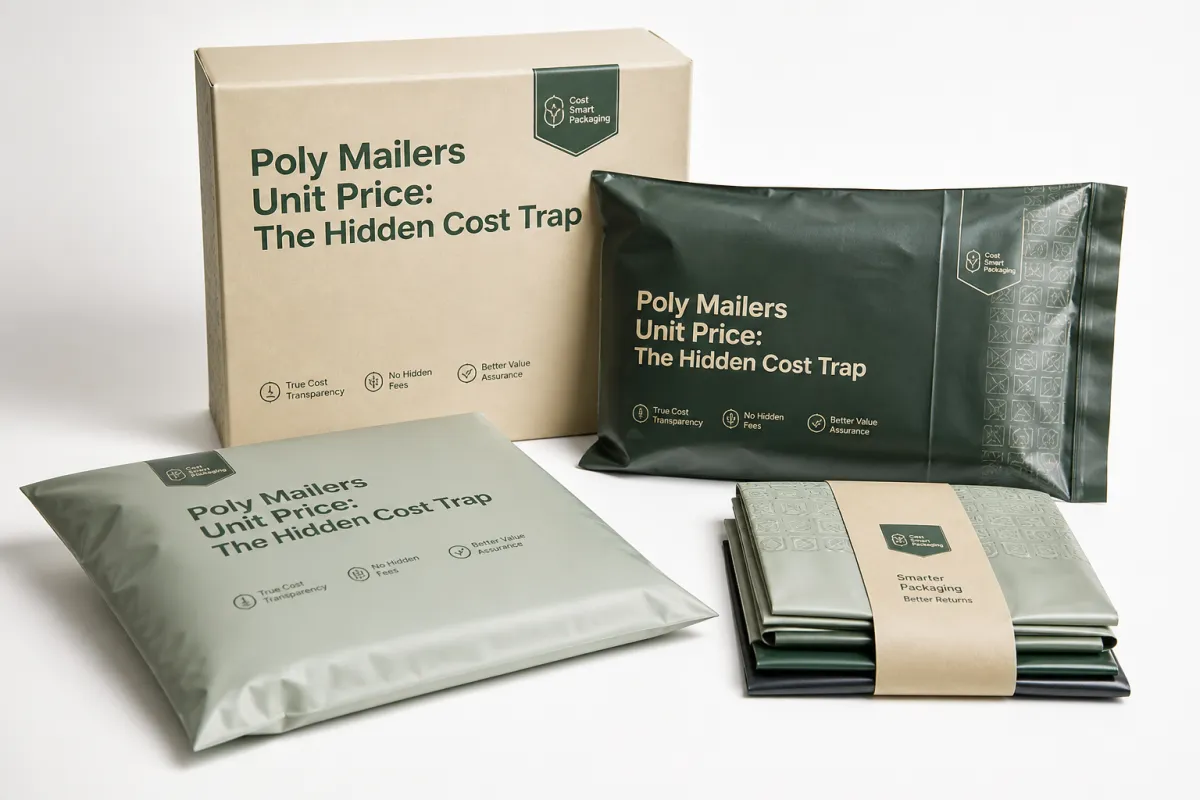
The lowest poly mailers unit price is often not the lowest landed cost. Buyers still get caught by that all the time. A quote can look great on paper and still cost more after freight, oversizing, product returns, and the mess that comes from choosing a film too light for the load.
Here is the practical problem. A mailer that saves you $0.01 per unit sounds like a win. If that bag is oversized, your parcel dimensions go up, your carrier rate rises, and you may also pay more for void fill or replacement packaging. If it tears in transit, the “savings” disappear fast. That is not theory. That is arithmetic with a bad ending.
Say you are shipping folded apparel in a 9 x 12 mailer. One supplier quotes a lower poly mailers unit price on a thin bag that looks fine for light tees. Another supplier offers a slightly higher price for a heavier film and a better seal strip. If the thin bag splits on corners, or the fit is sloppy enough to raise postage, the lower quote loses. Every time.
Buyers care about unit price. Smart buyers care about cost per shipped order. That includes the bag, freight, labor, waste, and the cost of fixing avoidable problems later.
That is why the best comparison starts with the actual shipment. What is the product weight? Does it have sharp edges? Does the customer expect a clean retail feel? Is the order going by parcel service or a more controlled fulfillment flow? Once those questions are answered, the poly mailers unit price starts making sense instead of just looking pretty on a spreadsheet.
Small orders create their own trap. A buyer sees a low per-unit number and assumes the whole project is efficient. Not always. On a small run, setup and shipping overhead eat a bigger share of the budget. Two quotes with similar poly mailers unit price numbers can land in very different places once total spend enters the picture.
I have seen buyers chase a rock-bottom quote and then spend more replacing damaged orders than they saved on the bag itself. That is the kind of math nobody wants to do twice.
What You Get in a Poly Mailer Order
A poly mailer is not just “a plastic bag.” It is a small engineered package. Most are made from co-extruded polyethylene film, which gives you a balance of strength, printability, and moisture resistance. The outer layer carries the print and takes the scuffs. The inner layer supports structure. The seal strip matters more than most people expect, because weak adhesive turns a shipping bag into a complaint machine.
Most buyers compare plain mailers, custom-printed mailers, and branded mailers with multiple color options. Plain bags are usually the cheapest way to keep the poly mailers unit price down. They work well for low-risk shipments, internal fulfillment, or brands that care more about speed than presentation. Custom-printed mailers cost more, but they turn the bag into part of the brand experience. Branded mailers with extra colors, edge-to-edge artwork, or specialty finishes move the number up again.
The product choice should match the use case. Apparel is the obvious one. Soft goods, socks, accessories, swimwear, and lightweight home textiles fit too. If the item has corners, hardware, zippers, or anything that can poke, the film spec matters more than the design file. A low poly mailers unit price is useless if the package fails on the first rough ride through a carrier network.
There is a simple tradeoff here: lighter construction usually keeps the quote down, while stronger film increases the poly mailers unit price but lowers the chance of failure. That tradeoff is worth paying attention to because “cheap” mailers are only cheap if they can actually do the job. Otherwise you are just buying future headaches at a discount.
For most e-commerce shipments, buyers are choosing among these basic parts:
- Exterior film for strength, print, and surface finish.
- Inner layer for structure and opacity.
- Seal strip for closure security.
- Optional features like tear strip, dual adhesive, recycled content, or tamper evidence.
That is also where price starts moving. A small change in film gauge, print finish, or seal style can shift the poly mailers unit price more than a lot of buyers expect. If you want the quote to be useful, specify the bag like a packaging buyer, not like someone ordering office supplies.
Poly Mailers Unit Price by Size, Thickness, and Print
Size is one of the biggest drivers of poly mailers unit price. Larger bags use more film, more ink coverage if printed, and usually add more freight weight. Bigger mailers can also make shipping more expensive if the package ends up oversized for the contents. So yes, the bag size affects the quote twice: once at purchase and once at shipping.
Thickness matters just as much. In practical terms, lighter films are fine for low-risk, soft items. Heavier films make sense for shipments with corners, rough handling, or a higher chance of abuse in transit. A 1.5 mil bag and a 3 mil bag are not the same product, and the poly mailers unit price should not pretend they are.
Print changes the equation again. A one-color logo on a standard bag is usually cheaper than multi-color artwork or full-surface print. Short runs feel print setup costs more sharply because the prepress work gets spread over fewer units. On larger runs, that setup gets diluted and the poly mailers unit price becomes more attractive.
Special finishes and custom options can move the number too. Matte film, recycled content, extra strong adhesive, custom sizing, or tamper-evident closure all change the economics. None of those features are bad. Some are exactly what you need. They just do not leave the poly mailers unit price untouched, which is fine if the added value is real.
Here is a simple way to think about the main cost drivers:
- Bag size raises film usage and freight exposure.
- Film thickness raises material cost and often improves durability.
- Print complexity raises setup and production time.
- Quantity spreads fixed costs across more units.
- Shipping destination affects landed cost even when the factory price looks fine.
For compliance-minded buyers, shipping performance is not just a nice extra. Industry testing methods like the ones discussed by the International Safe Transit Association exist for a reason. If your mailers need to survive parcel handling, the spec should reflect the real journey, not the best-case scenario on your desk.
If you want a rough pricing frame, these are common patterns, though exact quotes vary by art, quantity, and destination:
| Mailing Option | Typical MOQ | Common Unit Price Range | Best Fit |
|---|---|---|---|
| Plain stock mailer | 500-1,000 | $0.06-$0.12 | Low-risk, fast-moving shipments |
| Custom 1-color printed mailer | 1,000-3,000 | $0.10-$0.22 | Branding without heavy print spend |
| Custom 2-4 color mailer | 3,000-5,000 | $0.16-$0.32 | Retail presentation and stronger brand presence |
| Heavy-duty or recycled-content mailer | 3,000+ | $0.18-$0.40 | Higher abuse resistance or sustainability targets |
The range is wide because there is no single poly mailers unit price that fits every spec. A 6 x 9 plain mailer and a 14 x 20 printed mailer are different animals. Same family. Different bills.
Pricing, MOQ, and Where the Breakpoints Hit
MOQ changes the math more than many buyers expect. On small orders, the poly mailers unit price usually looks higher because setup, tooling, artwork handling, and production overhead are spread across fewer bags. That is not a supplier being difficult. That is fixed cost math.
The useful question is not “Can I buy fewer?” Of course you can, if the supplier offers it. The real question is whether the higher poly mailers unit price on a smaller run makes sense versus ordering a larger tier and reducing the price per bag. If you use the mailers quickly, a higher MOQ may be the better buy. If your designs change often or cash is tight, a smaller batch may still be the smarter move.
In practice, pricing often falls in steps. A 1,000-piece order may sit at one tier, 3,000 pieces drops the unit cost, and 5,000 or 10,000 pieces may unlock the next break. The breakpoints are not magic. They are just the points where production efficiency starts improving enough that the supplier can lower the poly mailers unit price without wrecking margin.
Here is the part buyers should compare side by side, with no hand-waving:
- Bag size and finished dimensions.
- Film thickness and material type.
- Print method and number of colors.
- Quantity tier and total run size.
- Freight terms, duties, and destination.
That last line matters. A quote with a beautiful poly mailers unit price can still lose if freight is expensive or if the supplier has padded the carton count with inefficient packing. Landed cost is the score that counts. Anything else is just a conversation starter.
For sustainable packaging decisions, many buyers also check environmental claims more carefully now. If the bag uses recycled content or the program includes waste reduction goals, the EPA has useful background on materials and recycling considerations at EPA recycling guidance. That does not set your bag price, but it does help you ask better questions before you approve a spec.
There is also a cash-flow question hiding inside the MOQ decision. Paying slightly more on the poly mailers unit price at a lower MOQ can be better than tying up money in excess inventory that sits in a warehouse for months. I have seen buyers chase a lower unit number and end up with more dead stock than they planned for. That is not efficiency. That is storage with optimism.
So what is a sensible breakpoint strategy? Request at least two tiers, often three if the project is serious. Compare the per-unit quote, the total spend, and the shipping cost for each tier. Then estimate how long the stock will last. If the larger order only saves a fraction of a cent on the poly mailers unit price but doubles your inventory exposure, the lower tier might be the better operational choice.
And if the supplier only gives you one number, push for the rest. Otherwise you are comparing guesses, not pricing.
Ordering Process and Realistic Lead Times
Most order delays happen before production starts. That is the annoying truth. The quote-to-order flow is usually simple: request specs, confirm artwork, review proof or sample, approve, then move into production. Problems show up when dimensions are vague, the art file is wrong, or the shipping details are incomplete. That is where the poly mailers unit price discussion turns into schedule damage.
For simple stock orders, production can move quickly. For custom printed runs, a realistic timeline often lands around 12-18 business days after proof approval, with transit added on top. Depending on quantity and destination, that can stretch. If someone promises a full custom run in three days without caveats, they are either describing a tiny stock order or leaving out the part where they apologize later.
The cleanest way to shorten the cycle is to send complete specs the first time. That means finished dimensions, thickness, print colors, quantity, shipping zip code, and whether you need a sample or digital proof before production. The better your information, the easier it is to quote a true poly mailers unit price instead of a placeholder number that gets revised later.
A good order file usually includes:
- Finished bag size in inches or millimeters.
- Material thickness or gauge target.
- Artwork in vector format if possible.
- Print count and ink colors.
- Quantity with a backup tier if you are unsure.
- Shipping destination and any delivery constraints.
That level of detail protects the budget. It also protects the poly mailers unit price from getting distorted by rework. If the bag size changes after proofing, or if the design needs extra revisions, the factory has to retool or reprocess the order. Someone pays for that. Usually it is the buyer.
There is one more timing detail that gets ignored too often: production time and transit time are not the same thing. A supplier may quote 10-15 business days for production, but your total receipt time can be longer once the shipment crosses borders or moves through a busy carrier lane. Buyers who only track the manufacturing window often overestimate how fast the order will land, then panic when stock runs low.
That is why a realistic plan starts with the order calendar, not the quote sheet. If your reorder point is close, a slightly higher poly mailers unit price on a faster, cleaner spec can save the account. Late packaging is expensive packaging.
Why Buyers Stick With Our Poly Mailers
Repeat buyers usually stop shopping only for the lowest number. They care about consistency. A stable poly mailers unit price, clear specs, dependable print, and fewer receiving surprises matter more than saving a few cents on a single run. That is not romance. That is procurement with memory.
What they want is boring in the best way. The same color every time. The same seal strength. The same fit. The same proof process. When the packaging arrives the way it was approved, the team does not lose hours checking, sorting, or explaining defects to operations. That saved labor is part of the real value behind the poly mailers unit price.
Quality control also matters because packaging errors tend to multiply. A small print shift, a weak adhesive strip, or an off-spec dimension may not look dramatic at first. Then the fulfillment team starts seeing splits, returns, or customer complaints. One bad run can erase the savings from several clean ones.
That is why buyers who reorder regularly focus on the things that reduce surprises:
- Clear artwork proofing before production.
- Stable size and thickness specs across reorders.
- Packaging consistency in cartons and pallet counts.
- Responsive communication if a spec needs adjustment.
I also value honest pricing. If the spec is underbuilt, say so. If the print coverage raises the poly mailers unit price, say that too. Buyers can handle a number. What they do not tolerate is a cheap quote that turns expensive after the details surface.
That approach is why many buyers stay with the same packaging partner instead of rebidding every cycle. Fewer surprises. Better planning. Less drama in receiving. Frankly, that is what the customer is paying for, even if nobody writes it down that bluntly.
Next Steps to Lower Poly Mailers Unit Price
If you want a better poly mailers unit price, start by sending a complete request. Include the finished size, thickness target, print colors, quantity, shipping location, and monthly reorder estimate. That gives the supplier enough information to price the job without padding the quote for unknowns.
Compare at least two quantity tiers. If you only ask for one number, you miss the breakpoint. A 3,000-piece run may be a little more expensive per unit than 5,000 pieces, but the lower inventory commitment might be the smarter move. Or the opposite may be true. The point is to see the spread before you commit.
Also, tighten the spec only where it matters. Overspecifying a mailer is one of the fastest ways to pay more than necessary. Do you really need a heavy film if the item is soft and low-risk? Do you need full-coverage print if a clean logo panel does the job? Those choices directly affect the poly mailers unit price.
Here is a simple ordering checklist:
- Confirm finished dimensions for the product.
- Choose the lightest film that still protects the item.
- Decide whether plain, one-color, or multi-color print is enough.
- Request pricing at multiple quantity tiers.
- Ask for freight terms and total landed cost.
- Approve artwork only after the proof is checked line by line.
If you want to move faster, use the quote process to your advantage. Ask for a plain version, a branded version, and a higher MOQ tier in the same request. That way you can see how the poly mailers unit price shifts before the order is locked. It is a small step, but it saves a lot of back-and-forth later.
And if you are comparing options across different packaging types, keep the broader system in view. The bag is only one part of the shipping cost. Carton size, pick-pack time, defect rate, and customer return experience all change the real cost of the package. Packaging never lives by itself. It is always attached to operations.
Bottom line: the right poly mailers unit price is the one that fits the product, the order volume, and the shipping reality without paying for fluff you do not need. If you want a quote that reflects the actual job, send the specs cleanly, compare the tiers, and judge the bag by landed cost, not by the prettiest number on the page.
FAQ
What affects poly mailers unit price the most?
Size, film thickness, and print complexity usually move the poly mailers unit price more than anything else. MOQ also matters because fixed setup costs get spread across fewer bags on small orders. Shipping location can change the landed cost even if the factory price looks low.
Why is the unit price higher on small poly mailer orders?
Small runs absorb a larger share of setup, tooling, and production handling costs. Custom printing is especially sensitive to low quantities because press setup does not shrink with the order. Higher MOQ tiers usually unlock a lower poly mailers unit price.
How do I compare poly mailers prices correctly?
Compare the exact same size, thickness, print method, and quantity tier. Ask whether freight, duties, or packaging are included in the quote. Use landed cost per shipped order, not just the factory poly mailers unit price.
Can custom printed poly mailers still have a low unit price?
Yes, but usually only when the quantity is high enough to dilute setup costs. Simple one-color prints are more cost-efficient than complex multi-color artwork. Standard sizes and common film gauges are easier to price competitively, which helps keep the poly mailers unit price in check.
What should I send for an accurate quote on poly mailers?
Send finished dimensions, material thickness, print colors, and order quantity. Include your shipping zip code and whether you need samples before production. Add your monthly usage estimate so the supplier can suggest the right MOQ tier and a more realistic poly mailers unit price.


