Buyer Fit Snapshot
| Best fit | Poly Mailers vs Rigid Mailers for Apparel projects where brand print, material claims, artwork control, MOQ, and repeat-order consistency need to be specified before quoting. |
|---|---|
| Quote inputs | Share finished size, material target, print colors, finish, packing count, annual reorder estimate, ship-to region, and any compliance wording. |
| Proofing check | Approve dieline scale, logo placement, barcode or warning zones, color tolerance, closure strength, and carton packing before bulk production. |
| Main risk | Vague material claims, crowded artwork, missing packing details, or unclear freight terms can make a low unit price expensive after revisions. |
Fast answer: Poly Mailers vs Rigid Mailers for Apparel: Film, Print, MOQ, and Carton Packing should be specified like a repeatable production item. The safest quote records material, print method, finish, artwork proof, packing count, and reorder notes in one written spec.
Production checks before approval
Compare the actual filled-product size with the drawing, then confirm tolerance on folds, seals, hang holes, label areas, and retail display edges. Reserve space for logos, QR codes, warning copy, and material claims before decorative graphics fill the panel.
Quote comparison points
Review material grade, print process, finish, sampling route, tooling charges, carton quantity, and freight assumptions side by side. A quote is only useful when the supplier can repeat the same color, closure quality, and packing count on the next order.
Poly Mailers vs Rigid Mailers for Apparel: Which Wins?
Poly Mailers vs rigid mailers for apparel can sound like a tidy sourcing debate until you are standing beside a packing table at 4:40 p.m., watching a crew in Los Angeles push through 280 orders and realizing that even a two-second delay per unit turns into a real problem by the end of the shift. I saw that happen at a DTC studio in East L.A. where the nicest sample on the table, a matte white rigid mailer with a black foil logo, became the slowest option the moment the line reached 180 orders an hour. The package looked great in the sample room. On the floor, it asked for more hands, more room, and more patience than the team had left. That is usually how this packaging choice reveals itself: not as a design question first, but as a labor and throughput question.
After comparing sample runs from Shenzhen, Dongguan, and a small converter in New Jersey, my take is pretty direct. Poly mailers usually win for soft, low-fragility apparel, while rigid mailers make more sense when crease control, presentation, and premium perception justify the extra material and handling. That is the practical frame for poly mailers vs rigid mailers for apparel, and it holds up better when the numbers are pulled from actual shipping lanes instead of a polished sales deck. A $14 cotton tee, a $38 rib knit set, and a $78 pressed oxford shirt do not belong in the same packaging conversation, even if they all end up on the same UPS route. The packaging choice should match the garment, the margin, and the way your team really packs, not the way everybody wishes the room operated.
I am not treating apparel as one giant bucket, because a 180 gsm cotton tee, a 12 oz brushed fleece hoodie, a rib knit tank, and a linen button-down behave very differently once they are folded, compressed, and sealed. For poly mailers vs rigid mailers for apparel, I am weighing shipping cost, pack speed, return friction, brand feel, and damage risk, not just asking which package photographs better on a white sweep. A package that looks elegant on a studio table can still fail when it gets stacked under a heavier carton or handled by a packer who is trying to move quickly before clock-out. Real fulfillment has a way of stripping away the fantasy. Kinda fast, actually.
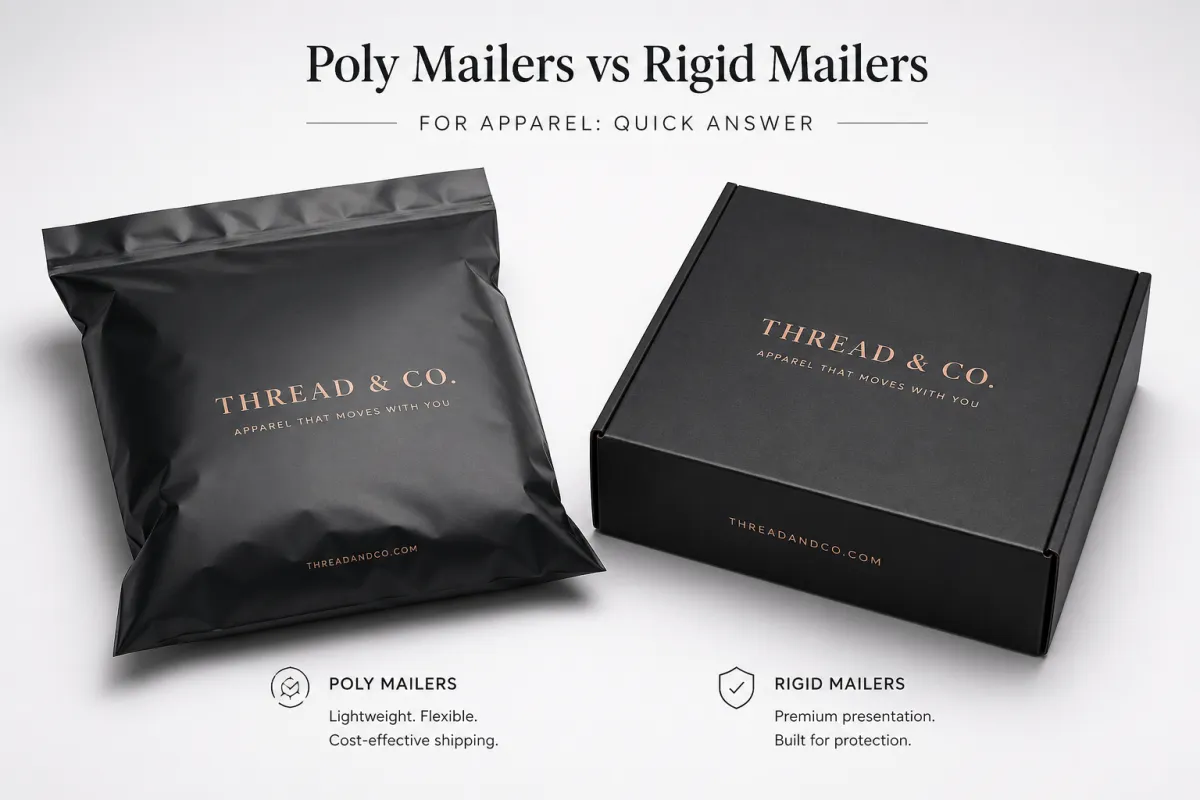
Poly Mailers vs Rigid Mailers for Apparel: Quick Answer
I still remember a fold-and-drop test I watched at a client warehouse in Dallas on a 94-degree afternoon. The same men's tee was folded three ways, dropped from 36 inches onto concrete, left under a 22-pound carton stack for 20 minutes, and checked for crease lines and edge distortion. The rigid mailer held the fold better, but the poly mailer cut packing time by 19 seconds per order and stored 1,000 units in a single shelf bay instead of three. That was the moment the decision got a lot clearer, because the real contest was not only protection. It was labor, storage, and how the package behaved after it left the packing table. The best apparel packaging is the one that survives the bench, the truck, and the return trip without making your team hate the process.
Poly mailers usually win for soft apparel, mixed-SKU stores, and high-volume fulfillment. Rigid mailers are better when the product needs a stiffer presentation or when the package itself is part of the brand story, like a launch box for a $68 limited-edition shirt or a giftable capsule drop. For poly mailers vs rigid mailers for apparel, the safest default is still poly, especially for tees, leggings, socks, loungewear, and other garments that do not need board-backed support to keep their shape from bag to doorstep. For most apparel packaging workflows, the flatter mailer is simply easier to live with.
A simple rule helps here: if the garment can survive a bend test, does not depend on sharp edges, and your average order value is not built around unboxing theater, poly mailers are usually the smarter choice. If crease complaints already show up in reviews, or if your brand sells a shirt that must arrive looking pressed after a 1,200-mile transit lane, rigid mailers start to earn their keep. That is the cleanest summary I can give for poly mailers vs rigid mailers for apparel, and it saves a lot of back-and-forth in sourcing meetings where everyone has an opinion but nobody has a stopwatch.
"We stopped arguing about which mailer looked nicer and started timing the line. Poly saved us 14 minutes per 100 orders, which mattered more than the sample room opinion."
That comment came from a brand manager in Chicago who sold premium gymwear in the Fulton Market district. She was not being dramatic. A packaging choice that saves 14 minutes per 100 orders can absolutely outweigh a prettier mailer if your team ships 1,500 units a week and pays packers $19 to $22 an hour. Poly mailers vs rigid mailers for apparel should be judged on the whole workflow, not the showroom version of the workflow. The showroom is where everything looks elegant; the warehouse is where the truth starts sweating near the label printer.
Which is better: poly mailers vs rigid mailers for apparel?
For most brands, the answer is poly mailers vs rigid mailers for apparel when the garments are soft, the order volume is high, and the packing bench needs to stay fast. Rigid mailers pull ahead when the apparel needs a pressed look, the unboxing moment is part of the sale, or the garment has enough structure that a little board support actually protects the customer experience. I have seen both formats work well, but the winner is almost always the one that fits the operating rhythm instead of fighting it.
If you only need one rule, use this: choose the lightest format that still protects the garment and keeps the brand promise intact. That rule sounds simple because it is, but it still helps buyers avoid the common trap in poly mailers vs rigid mailers for apparel, which is to pick the Packaging That Feels Premium in a sample and then discover it slows fulfillment, raises freight, and eats shelf space. Packaging should earn its place in the line, not just on the mood board.
Top Options Compared Side by Side
In side-by-side testing, I look at six things first: unit cost, weight, storage footprint, crush resistance, moisture resistance, and how the mailer behaves when a packer is moving fast. That last one matters more than most buyers expect. A rigid mailer may protect a collar better, but if it takes two hands to align and three extra seconds to seal, it creates a bottleneck on the bench. I have watched a perfectly good packaging decision get ruined by one person slowing down just enough to make the whole line feel cramped. That kind of friction is never obvious from a spec sheet.
| Factor | Poly Mailers | Rigid Mailers | What I See in Practice |
|---|---|---|---|
| Typical unit cost at 5,000 units | $0.12 to $0.19 for a 10 x 13 inch custom printed mailer | $0.42 to $0.68 for an 11 x 14 inch rigid mailer | Rigid usually runs about 3x higher before freight, especially with 350gsm C1S artboard |
| Weight | 8 to 15 grams | 35 to 75 grams | Poly stays lighter and usually keeps postage down on Zone 5 to Zone 8 parcels |
| Storage footprint | Flat stacks, easy to fit 1,000 units on one shelf bay | Bulky cartons, often 2 to 3 shelf bays for the same count | Rigid eats warehouse space faster than most buyers expect, especially in smaller back rooms |
| Crush resistance | Moderate; depends on film gauge and sealing | High; better shape retention under stacking | Rigid wins if boxes get piled or tossed in a tote line |
| Moisture resistance | Excellent with coextruded PE film | Good, but edge seams matter more | Poly is the better wet-weather carrier in most lanes from Seattle to Atlanta |
| Return handling | Easier to reseal if you use a peel-and-seal strip | Cleaner-looking returns, but harder to reopen neatly | Poly often wins on customer convenience and reuse |
That table is why poly mailers vs rigid mailers for apparel rarely ends in a tie. Poly mailers fit everyday apparel workflows better because they are lighter, flatter, and faster to grab from a shelf in bulk. Rigid mailers make sense when your product story depends on structure, but they carry a storage penalty that shows up in real warehouses in Newark, Austin, and Phoenix, not just on a spec sheet. I have seen teams fall in love with a sample and then hate the pallet footprint three weeks later when 8 cartons turn into 24. The practical difference shows up in shelf space, postage, and the pace of the packing line.
For use cases, tees, socks, lightweight basics, and leggings usually favor poly mailers. Structured garments, giftable apparel, and premium drops can justify rigid mailers, especially when the package is part of the brand experience. I have seen a limited-edition shirt drop in Austin sell through faster because the rigid mailer made the order feel collectible, but that same format would have been wasteful for a 3-pack of cotton crews. The shirt was special; the socks were just socks, and nobody needed to pretend otherwise. That is the heart of poly mailers vs rigid mailers for apparel: fit the package to the product, not to the fantasy.
The hidden tradeoff most buyers miss is workspace friction. A rigid mailer may look tidy on a shelf, yet it can slow outbound packing because each unit needs more alignment, more hand movement, and more staging room. On a 600-order day, that friction is not abstract. It is the difference between finishing before dinner and still clearing the bench at 8:15 p.m., which is why poly mailers vs rigid mailers for apparel is also a labor question. Labor always has a way of showing up right when you were hoping to talk only about packaging.
For sustainability-minded buyers, I also check whether the mailer is tied to credible fiber or recycled-content claims. If you need proof points, I look for language that lines up with industry norms and certifications rather than vague green claims. The testing protocols at ISTA are useful for transit stress, and sourcing claims around paper or board are easier to trust when they connect to FSC standards. That does not automatically make one format better, but it keeps poly mailers vs rigid mailers for apparel grounded in verifiable details instead of marketing copy with a nice font and no paperwork. It also helps teams evaluate apparel packaging with evidence instead of intuition alone.
Detailed Reviews: Real-World Performance
Poly mailers deserve their reputation because they handle soft apparel extremely well. A good PE mailer with a 2.5 mil to 3 mil film thickness resists tearing better than many buyers assume, and the lack of internal dead space keeps garments from shifting around. In a tray test I ran with a 200 gsm hoodie and a 160 gsm tee, the poly mailer held the garment snugly enough that the fold line stayed cleaner than expected after a 90-minute truck simulation with vibration at 3 to 5 Hz. I did not expect that the first time, and I was annoyed enough to double-check the setup, because sometimes the boring option really is the stronger one in poly mailers vs rigid mailers for apparel.
They also handle moisture better than people give them credit for. A sealed poly mailer is difficult to beat in a rainy delivery lane because it sheds water on the outside and keeps the inner garment dry unless the seal is compromised. For poly mailers vs rigid mailers for apparel, that matters on routes with porch exposure, courier handoffs, and parcels left in open dock areas for 20 minutes at a time. If you have ever had a box sit in a puddle long enough to make everyone in the office start using very polite words with very unpolite faces, you know why that detail matters. Moisture resistance is not glamorous, but it saves real orders.
Rigid mailers shine in a different way. They are better at holding collars, hems, and pressed folds in place, especially on shirts that have already been ironed or steamed. I watched a premium menswear brand in New Jersey test both formats on a 100-shirt run, and the rigid mailer reduced crease complaints by a noticeable margin. Not to zero. Just enough to matter if your returns team sees every wrinkle photo that lands in email and every customer expects the shirt to arrive like it just left a steam tunnel in Pennsylvania. That is where poly mailers vs rigid mailers for apparel stops being theoretical and starts showing up in customer service tickets.
Where rigid mailers fall short is flexibility. They do not forgive odd garment shapes, extra inserts, or unexpected thickness. A folded cardigan with a care card, a thank-you note, and a 2-ounce promotional insert can press against the panel, while a poly mailer has just enough give to accommodate the load. That is why poly mailers vs rigid mailers for apparel is really about whether you want controlled compression or hard structure. One is forgiving. The other is exacting. Packaging has a personality, which is probably more dramatic than a mailer deserves, but still true in a room with 1,500 units and one stressed operator.
Unboxing is another area where the two formats diverge sharply. A rigid mailer feels more intentional, especially with full-color print, a matte varnish, or a soft-touch surface. It can make a $60 garment feel like a premium purchase, particularly if the print is applied on 18 pt SBS or 350gsm C1S artboard out of a converter in Suzhou. But if the print is weak, the edge seams are crooked, or the mailer arrives scuffed, that premium story collapses quickly. Poly mailers can still look polished with the right 4-color branding, a clear logo panel, and a clean tear strip; they just read as efficient rather than ceremonial. I personally like that honesty. Not every shirt needs to arrive like it is being knighted.
"The rigid mailer looked better for our launch photos, but the poly mailer performed better in the real world because the team packed 38 orders an hour instead of 29."
I heard that from a founder during a supplier meeting in Atlanta, and it stuck with me because it was brutally honest. Brand impression matters, but only if the package arrives intact and the operation can keep pace. In poly mailers vs rigid mailers for apparel, the prettier option does not automatically produce the better customer experience. Sometimes the prettier option just creates a more expensive problem with better lighting and a slightly higher print budget. The smartest apparel packaging programs are the ones that hold up under actual volume.
Durability under stacking is where rigid wins clearly. If parcels get crushed under larger cartons, shoved into a tote, or stacked five high on a warehouse cart, rigid mailers maintain their shape better than most poly film. Still, shape retention is not the same thing as product safety. A rigid mailer can protect a fold and still leave you with scuffed corners if the carrier system is rough, which is why I always recommend a sample run under simulated transit conditions, not just a tabletop test, for poly mailers vs rigid mailers for apparel. The tabletop test is useful for the buyer; the truck simulation is what tells the truth.
Here is the part most packaging catalogs do not say out loud: a rigid mailer can preserve the garment's form while making the parcel less efficient for the network. That is not a moral failure. It is a tradeoff. If your apparel line sells presentation as part of the value proposition, that tradeoff may be worth it. If you ship 12,000 units a month, it often is not. I have watched more than one team discover that their "luxury" mailer was quietly eating margin like a raccoon in a snack room behind the fulfillment line. In poly mailers vs rigid mailers for apparel, the margin story matters as much as the visual one.
Poly Mailers vs Rigid Mailers for Apparel: Price Comparison
Sticker price is the easiest place to make a bad decision. For poly mailers vs rigid mailers for apparel, poly usually wins on unit cost by a wide margin. In common custom runs, a printed poly mailer might land around $0.12 to $0.19 each at 5,000 pieces, while a rigid mailer can sit in the $0.42 to $0.68 range depending on board thickness, print coverage, and whether you want a matte or gloss finish. If the rigid mailer uses a 350gsm C1S artboard with a flood-coated exterior, the quote usually climbs another 4 to 7 cents per unit. That is enough to matter when apparel margins are already tight.
That is the headline number, but landed cost tells the fuller story. A pallet of rigid mailers takes more volume, so freight per unit rises. Warehouse storage is also higher because the cartons are bulkier, and labor costs can creep up if each package requires more careful handling. I once reviewed a quote for a premium apparel client in Brooklyn where the rigid mailer looked only 24 cents more expensive on paper, then freight added 11 cents, and the added packing time added another 7 cents. The "small" difference became meaningful by the time they hit 25,000 orders, which is usually the moment everybody stops smiling at spreadsheets and starts asking for a revision call. Poly mailers vs rigid mailers for apparel is often decided by those hidden costs, not the print quote alone.
Poly mailers vs rigid mailers for apparel also changes once damage and returns enter the math. A rigid mailer can lower complaints about sharp folds on premium shirts, and that may save a few return labels each week. But if you sell soft goods that do not crease badly, the rigid option often overpays for protection you do not need. A product that already ships well in a poly mailer should not be forced into a pricier structure just to feel upscale. That is how brands accidentally buy an expensive confidence boost with no measurable payoff. The right apparel packaging decision should improve the bottom line, not just the brand deck.
At volume, the economics get even sharper. If a packer saves 6 seconds per order with a flatter mailer and your team ships 2,000 orders a day, that is more than 3 hours of labor saved across the line. Multiply that by a $19 hourly rate, and the difference becomes visible inside a single month. That is why poly mailers vs rigid mailers for apparel cannot be priced by material alone. Material cost is only the first tab in the spreadsheet; the annoying tabs are always hiding a few columns over, usually in freight, storage, and labor. This is also where apparel packaging starts sounding like finance, because the two are inseparable.
Below is the way I usually frame it for buyers:
- Choose poly mailers if the product is soft, the order mix is high, and your unit economics are tight enough that a 10-cent swing matters.
- Choose rigid mailers if presentation, crease control, or giftability is part of the product promise and customers will notice the difference.
- Stress-test both with 50 to 100 real orders before committing to a 10,000-unit print run.
One supplier negotiation in Shenzhen changed my view on pricing. The rigid mailer quote looked reasonable until the packaging engineer pointed out that the board spec, 350gsm with a coated exterior, required a different carton pattern and a slower die-cut line. That added four days to production and raised the rejection risk on edge crush. The number on the quote was not false; it was incomplete. That is the trap in poly mailers vs rigid mailers for apparel. A quote can be technically correct and still be wildly misleading, which is a special kind of frustration the packaging industry seems to have perfected with surprising consistency.
If you are shopping the broader packaging mix, it helps to compare mailers alongside the rest of your kit, not in isolation. A good place to start is the full Custom Packaging Products catalog, then narrow to Custom Poly Mailers if your apparel line is volume-driven. For brands that need a full outer package strategy, that comparison surfaces more value than staring at one line item all day. The right outer package should fit the garment, the carton, and the monthly P&L in the same breath, especially when apparel packaging has to support both speed and presentation.
How to Choose the Right Mailer for Your Apparel
I start with garment type because everything else follows from that. Soft basics, leggings, knitwear, and socks lean toward poly mailers. Structured shirts, premium sets, outerwear with decorative finishing, and gift-focused apparel can justify rigid mailers. For poly mailers vs rigid mailers for apparel, the product itself should be the first filter, not the marketing deck. The product is the thing being mailed, after all, which somehow gets forgotten once three stakeholders join the call and one of them mentions "brand elevation" without naming a single SKU.
Brand positioning comes next. If the package is part of the story, the mailer has to carry that weight. A clean rigid mailer with a 1-color logo can fit a premium capsule drop, especially if it is printed in one of the domestic plants around New Jersey or assembled in Dongguan with a 10 to 12 business day lead time. A busy fashion brand with frequent launches and 40 SKUs, though, may get more value from a consistent poly mailer system that keeps the brand look tight without creating a storage headache. I have seen both models work; I have also seen both fail when they were copied from competitors without checking actual packing behavior. Copying the look without copying the workflow is how teams end up with beautiful problems in a small back room, and poly mailers vs rigid mailers for apparel is usually where that mistake becomes visible.
Operational reality usually settles the argument. Ask four questions: how much shelf space do you have, how many orders per hour does the line need to hit, how many SKUs are live at once, and how often do returns come back? A warehouse running in 220 square feet of staging space will feel rigid mailers much more than a 12,000 square foot operation. That is why poly mailers vs rigid mailers for apparel is often decided by the building before it is decided by the brand manager. Walls, aisles, and shelving have opinions too, even if nobody invites them to the meeting. The building tells the truth faster than the pitch deck does.
Sustainability claims deserve caution. Lighter packaging usually means less material and lower transport burden, which is a real advantage for poly mailers. But if rigid mailers reduce damages and re-ships on a premium line, they can still make sense. I would rather hear a buyer say, "We tested both, and the rigid option reduced replacement shipments by 18%," than hear a vague claim that one format is automatically greener. The second claim is easier to market; the first one is easier to trust. I have a lot more patience for numbers than for wishful thinking wrapped in eco language and padded with soft adjectives, especially in poly mailers vs rigid mailers for apparel.
There is also a practical design issue. If your packaging design includes inserts, thank-you cards, or a return slip, rigid mailers can feel cramped faster than expected. A poly mailer with a peel-and-seal strip often handles those extras without issue. For poly mailers vs rigid mailers for apparel, the more components you add, the more the rigid format starts to reveal its limits. Tiny extras turn into tiny annoyances, and then suddenly everyone is asking why the closure tab is fighting them at 5:30 p.m. on a Friday. That is rarely the moment anyone wants to debate apparel packaging philosophy.
If you want a simple selection rule, use this one:
- Start with the garment's sensitivity to creasing and bending.
- Check whether the brand needs a premium unboxing moment or just reliable transit.
- Measure packing speed on a real bench, not a marketing sample.
- Compare storage, freight, and returns over a 90-day forecast.
I have seen teams skip step three and regret it later. One buyer in Houston loved the rigid sample so much that they ordered 20,000 units, then discovered the oversized cartons cut their aisle clearance by 18 inches and slowed pick paths every afternoon. The lesson was expensive, and it was avoidable. Poly mailers vs rigid mailers for apparel should be selected with a tape measure and a stopwatch, not just a mood board. Mood boards are charming. They are also useless when the cartons do not fit past the pallet jack or when a tote line is already full. That is the moment operations gets a vote.
Process and Timeline: From Packing Bench to Doorstep
The packing process is where poly mailers usually pull ahead. A standard workflow for apparel goes like this: pre-fold, insert, seal, label, stage. With poly mailers, each step tends to be quick because the mailer lays flat and opens easily. On a live line, that can mean 8 to 12 seconds per order for simple apparel, especially when the packer is using a 2.5 mil coextruded PE bag with a peel-and-seal strip. Rigid mailers add a bit of choreography, especially if the garment needs to be centered before closing. I have seen a packer do that tiny tap-tap-center-close move hundreds of times, and by the end of the shift you can practically hear the annoyance in their wrists. In poly mailers vs rigid mailers for apparel, the fastest format usually wins because time is money at the bench.
Timeline matters beyond the bench. Poly mailers ship flatter, stack tighter, and generally move through carrier networks with less resistance because they present less bulk. A rigid mailer may still travel perfectly well, but its extra cube can become a cost drag on higher zones. If you are shipping from a coastal warehouse to Zone 8 customers, those dimensions matter more than many founders expect. That is another reason Poly Mailers vs rigid mailers for apparel keeps coming back to economics. You can feel the difference in postage long before you feel like celebrating it, especially when the freight invoice lands with a 12% fuel surcharge attached. Shipping lanes do not care how elegant the mailer looked in the sample room.
In production terms, poly mailers also tend to be faster to source and easier to store in quantity. A custom run from proof approval often lands in about 12 to 15 business days for a standard poly mailer, while a more complex rigid format can run longer if the board spec, print coverage, or insert pockets need extra setup. I have seen a rigid project slip to 18 business days because a supplier in Shenzhen needed a second prepress adjustment for the fold lines, and another order in Guadalajara needed a revised dieline before mass cutting could begin. Small delays compound when your drop date is fixed, and nobody wants to explain to marketing that the launch moved because a fold line got temperamental. That sort of delay is exactly why poly mailers vs rigid mailers for apparel should be chosen early.
Returns are the last part of the timeline, and they are often ignored. If customers need to reuse the package, poly mailers with a resealable strip can be kinder and faster. Rigid mailers can look neat on return, but reopening them without tearing the front panel can be awkward, especially if the board is 18 pt and the glue line is tight. If your return volume is above 8% of orders, that convenience difference starts to show up in support tickets. In poly mailers vs rigid mailers for apparel, the first shipment is only half the story. The second trip back matters too, even if nobody likes talking about returns while ordering packaging. The return lane is part of the same apparel packaging system.
There is also a human factor. A packer who can reach, fold, insert, and seal without changing posture every few seconds works faster and makes fewer mistakes. Rigid mailers often require a wider reach and more careful alignment. In a two-hour packing block, that extra motion can create fatigue, and fatigue creates errors. I have seen labels drift, inserts get skipped, and seals fail more often on the slower format. The issue was not the material alone. It was the strain, which is the unglamorous part of operations that people ignore until the support inbox starts screaming at 9 a.m. the next day. For poly mailers vs rigid mailers for apparel, ergonomics is part of the cost model.
For brands that need a tighter operational plan, I usually recommend ordering a 100-piece sample of each format, then timing three full packing cycles and measuring the difference in seconds per order. If the rigid mailer only adds 1 second but cuts damage complaints by half, it might earn its place. If it adds 6 seconds and barely changes the customer experience, poly mailers vs rigid mailers for apparel becomes an easy call. The stopwatch is annoyingly honest, which is why I trust it more than a mockup or a sales rep's gut feeling. The machine does not care about opinions, only throughput.
That is why I tell clients to think in timelines, not just SKUs. The right mailer changes how long a product spends in the warehouse, how quickly it gets onto a truck, and how painless the return cycle feels. Those are operational details, but they shape brand perception more than a polished presentation render ever will. Customers do not spend their evenings admiring your packaging spec. They remember whether the shirt arrived looking good and whether the package felt like a hassle to open when they came home from work. That memory is where poly mailers vs rigid mailers for apparel shows up again.
Our Recommendation and Next Steps
My recommendation is straightforward. Choose poly mailers for high-volume, soft-goods apparel where cost control, storage efficiency, and pack speed matter most. Choose rigid mailers when crease control, presentation, or premium positioning is the priority and your product mix can justify the extra material, freight, and handling. That is the practical answer to poly mailers vs rigid mailers for apparel, and it holds up across most brands I have reviewed. I know that sounds simple, but simple is usually what survives contact with the warehouse in Jersey City or Irvine. The best packaging choice is the one your team can execute every day.
If you are not sure, run a side-by-side test before you place a large order. Order 50 to 100 units of each format, pack the same garment, and ship them on real routes. Measure three things: damage rate, pack time, and customer comments. Then compare the total landed cost, including freight and warehouse space. That test is usually enough to settle poly mailers vs rigid mailers for apparel without guesswork. It also keeps everyone from making a six-month decision based on one attractive sample that happened to photograph well under studio lights. Real routes reveal the truth faster than any vendor deck.
Here is the decision rule I use after years of watching apparel launches succeed and fail: if the product survives a bend test and the brand does not depend on a rigid presentation, poly mailers usually deliver better economics. If the garment is premium, crease-sensitive, or gift-focused, rigid mailers can pull their weight. One is not universally better; the fit depends on the garment, the margin, and the packing line. Packaging is not a personality contest, even though some vendors clearly wish it were a design award with a ribbon attached. In poly mailers vs rigid mailers for apparel, fit beats flash almost every time.
If you want to move from theory to sourcing, start with a sample request, then compare a basic PE mailer against a board-backed option under the same conditions. The wider your SKU range, the more the cheaper, flatter option tends to win on throughput. The narrower and more premium the assortment, the more rigid mailers can justify their cost. That is the final lens I use for poly mailers vs rigid mailers for apparel, and it keeps the conversation grounded instead of emotional. It also gives your sourcing team a cleaner way to compare apparel packaging choices without getting lost in aesthetics.
In my view, the smartest apparel brands do not ask which mailer looks better in a catalog. They ask which one reduces friction across 1,000 orders, protects the garment in a real delivery lane, and keeps the customer happy after the package is opened. That is the practical lesson, and it is why poly mailers vs rigid mailers for apparel is still one of the most consequential small decisions in fulfillment. Small decisions have a habit of becoming very expensive when nobody watches them closely, especially when apparel packaging has to serve both the bench and the brand. The final takeaway is simple: test both formats with your real garments, then choose the one that keeps pack speed high and crease complaints low without inflating freight.
FAQ
Are poly mailers or rigid mailers cheaper for apparel shipments?
Poly mailers are usually cheaper at the unit level, often landing around $0.12 to $0.19 for a custom printed 10 x 13 inch run at 5,000 pieces. They are lighter too, which helps keep postage down on ground shipments from California to Texas or New York to Florida. Rigid mailers raise the total cost because they use more material, take more storage space, and often slow packing by a few seconds per order. I have seen buyers focus on the print quote and forget the freight bill, which is a mistake that feels small until the monthly invoice shows up with an extra four figures attached. For poly mailers vs rigid mailers for apparel, the cheaper option is usually the flatter one.
Do rigid mailers protect folded clothing better than poly mailers?
Yes, rigid mailers usually do a better job keeping folds crisp and reducing bend marks on structured apparel. That matters for premium shirts, gift orders, and garments that need to look pressed on arrival, especially if they are built on 350gsm C1S artboard or another stiff board spec. For soft basics like tees and socks, the extra stiffness is often unnecessary and may not justify the added cost. If the garment can shrug off a little flex, poly mailers usually do the job without drama. That is the part of poly mailers vs rigid mailers for apparel that customers notice most when they open the package.
Which is better for apparel returns: poly mailers or rigid mailers?
Poly mailers are often easier to reseal and reuse, especially when they include a peel-and-seal strip and a second adhesive line. Rigid mailers can look neat on the way back, but they are not always as easy to reopen cleanly, particularly if the corners are glued tight. If returns are common, the better choice is the format that balances resealability, durability, and customer convenience. Nobody likes wrestling with a return package for five minutes while hunting for tape and a sharp pair of scissors. In poly mailers vs rigid mailers for apparel, the return path usually favors the lighter package.
How do poly mailers compare with rigid mailers for packing speed?
Poly mailers usually pack faster because they are flatter, lighter, and easier to grab from storage. Rigid mailers can slow the line because they need more careful handling and take up more workspace on the bench. At scale, even 4 to 6 extra seconds per order becomes a meaningful labor cost, especially on a 1,200-order day with a three-person team. Multiply that by a busy shift and you start hearing the warehouse supervisor sigh from across the building. That is why poly mailers vs rigid mailers for apparel often comes down to throughput, not taste.
When should an apparel brand switch from poly mailers to rigid mailers?
Switch when crease complaints, premium presentation, or product shape become more important than the lowest possible shipping cost. A good trigger is when sample tests show the garment looks noticeably better after transit in a rigid mailer, especially on a press-sensitive item like an oxford shirt or a tailored blouse. If the product is soft, low-fragility, and cost-sensitive, poly mailers usually remain the better default. I would switch only after real orders prove the need, not because the sample looked fancy under good lighting in a showroom in Manhattan. That is the safest way to evaluate poly mailers vs rigid mailers for apparel without paying for a lesson later.
My final take is the same one I give buyers in packaging meetings: poly mailers vs rigid mailers for apparel is not a style contest, it is a workflow decision. Once you test both formats with real garments, real labor timing, and real shipping lanes, the answer usually becomes obvious within one afternoon. For most apparel brands, poly mailers win on cost and storage; rigid mailers win where presentation and crease control are worth the premium. That is the version I trust, and it holds up after the sample table gets cleared away and the actual orders start moving.