Buyer Fit Snapshot
| Best fit | poly mailers with custom artwork design for packaging buyers comparing material specs, print proof, MOQ, unit cost, freight, and repeat-order risk where brand print, material, artwork control, and repeat-order consistency matter. |
|---|---|
| Quote inputs | Share finished size, material target, print colors, finish, packing count, annual reorder estimate, and delivery region. |
| Proofing check | Approve dieline scale, logo placement, barcode or warning zones, color tolerance, and any recyclable or compostable wording before bulk production. |
| Main risk | Vague material claims, crowded artwork, or missing packing details can create delays even when the unit price looks attractive. |
Fast answer: Poly Mailers with Custom Artwork Design: Film, Closure, Print, and Fulfillment should be specified like a repeatable production item. The safest quote includes material, print method, finish, artwork proof, carton packing, and reorder notes in one written spec.
What to confirm before approving the packaging proof
Check the product dimensions against the actual filled item, not only the sales mockup. Ask for tolerance on folds, seals, hang holes, label areas, and retail display edges. If the package carries a logo, QR code, warning copy, or legal claim, reserve that space before decorative graphics fill the panel.
How to compare quotes without losing quality
Compare board or film grade, print process, finish, sampling route, tooling charges, carton quantity, and freight assumptions side by side. A lower quote is only useful if the supplier can repeat the same color, closure quality, and packing count on the next order.
Poly mailers with custom artwork do more than keep a shipment closed. They carry a brand from the warehouse to the doorstep, and sometimes into a return request, a photo on social media, or a very quick first impression that either feels intentional or feels forgotten. That outer layer often becomes the first physical touchpoint a customer sees, which makes it a quiet but powerful part of package branding before the product is even visible.
For a DTC apparel label, a beauty brand, a subscription offer, or an accessories line, poly mailers with custom artwork can turn a simple shipping envelope into a recognizable piece of branded packaging. The artwork is not just decoration on film. When it is handled well, it gives the order more context, more consistency, and a more finished presence. When it is handled poorly, even a strong product can feel less polished than it should.
That is why packaging buyers keep asking the same practical question: how do poly mailers with custom artwork affect the look, cost, durability, and timeline of an order? The answer sits across design, production, and logistics. All three matter, and each one can change the final result in a meaningful way.
What Poly Mailers With Custom Artwork Actually Do
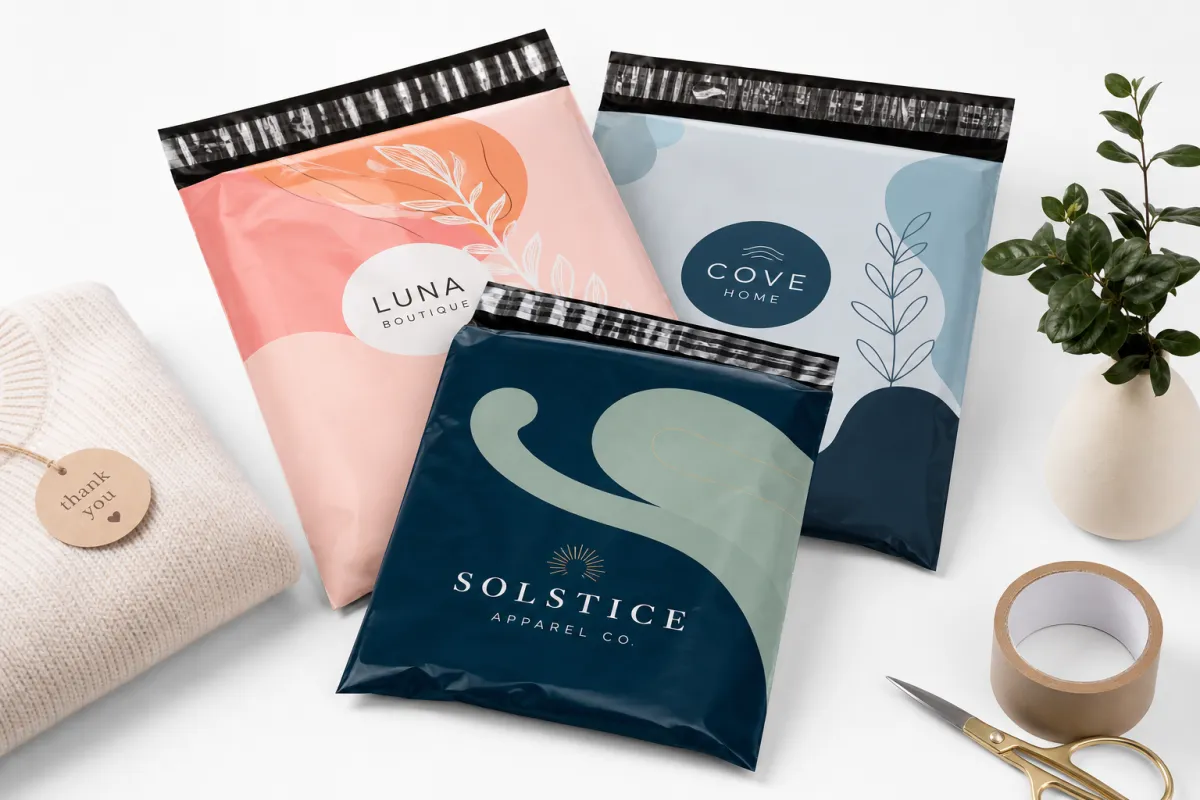
A plain mailer fades into the background. A branded one can act like a moving billboard. The difference is easy to see, while the commercial impact is less obvious until the orders start moving. Poly mailers with custom artwork give a shipment a visual identity that starts at pickup and keeps showing up through sortation, last-mile delivery, and the unboxing moment. For many brands, that outer shell is the first proof that the package came from a business with a deliberate packaging design, not a shipment assembled with tape and good luck.
At a basic level, poly mailers with custom artwork are lightweight shipping envelopes made from polyethylene film and printed with graphics such as logos, repeat patterns, color blocks, product cues, campaign messages, or seasonal artwork. The artwork can stay minimal or cover the surface more aggressively. It can feel loud, restrained, playful, or premium. The real test is whether the visual language fits the product packaging and the broader retail packaging strategy.
From a packaging buyer’s point of view, the real job of poly mailers with custom artwork is recognition. Customers should be able to identify the brand quickly, even if the parcel is sitting in a stack of other shipments or moving through a crowded mail stream. That kind of recognition helps with repeat orders, return handling, and the small but important sense of professionalism that a plain envelope rarely delivers on its own.
There is a practical side too. A well-printed mailer can reduce confusion in a shared warehouse, support campaign-specific promotions, and create a more cohesive presentation when paired with tissue, labels, or Custom Packaging Products. Some brands use poly mailers with custom artwork to match a launch theme. Others treat them as a steady, always-on part of package branding. Either way, the goal is consistency, because consistency builds trust faster than novelty does.
A mailer does not need to be elaborate to work well. It needs to look intentional, travel cleanly, and tell the customer whose package it is within a second or two.
That is where these mailers become especially useful for apparel, beauty, accessories, and subscription programs. Those categories usually ship items that are small, light, and repeatable, which makes the outer mailer the stage rather than a background detail. In that setting, poly mailers with custom artwork can be less expensive and quicker to produce than custom printed boxes, while still delivering strong brand visibility. For many programs, they are the most cost-efficient branded packaging option in the mix.
There is another point worth making. poly mailers with custom artwork are not reserved for premium brands. Plenty of cost-conscious sellers choose them because the branding lift is large relative to the unit cost. A mailer with a clean graphic can make a $25 order feel much more considered without adding the weight, freight cost, or material expense of heavier structures. That balance is one reason they show up so often in modern packaging strategies.
I have seen the difference firsthand in packaging reviews: a simple two-color design on a matte mailer can look more deliberate than a busier layout with too many competing elements. The cleaner option is not always the prettier one on a screen, but it often reads better in a real shipping lane. That matters.
How Poly Mailers With Custom Artwork Are Printed
The production flow is usually more predictable than first-time buyers expect, as long as the artwork is prepared correctly. With poly mailers with custom artwork, the process typically starts with a design file, then moves through proofing, print setup, press production, inspection, and shipment. If one of those steps is vague, the final output can drift from the approved design faster than most buyers realize.
Here is the simple version. The printer reviews the layout, film size, and color count. Then the artwork is prepared for the chosen print method. Depending on the supplier and the order size, that may mean flexographic printing, gravure-style setup, or a digital process for shorter runs. For poly mailers with custom artwork, flexographic printing remains common because it handles spot colors efficiently and works well for larger runs where unit economics matter.
Short runs can follow a different path. Some suppliers offer digital print options, especially when the artwork has more color variation or when the brand wants a smaller test order. The tradeoff is direct: more flexibility usually means a higher unit price. For larger quantities, poly mailers with custom artwork printed with conventional plate-based methods often become more attractive because the setup cost is spread over more pieces.
Technical setup matters more than most buyers realize. A good proof should show the safe zones, bleed, seam placement, and the areas that may shift during sealing or folding. On a mailer, even a clean design can become tricky if important text sits too close to an edge or if a logo lands where a seam will cover it. If the logo is parked too close to that fold line, it is gonna get clipped. That is why poly mailers with custom artwork need more than a polished file; they need a production-aware layout.
A few details deserve attention:
- Bleed should extend past the trim area so the artwork does not stop in a hard white edge.
- Safe zones keep logos, URLs, and fine type away from cut or seal lines.
- Film color changes the look of the ink, especially on translucent or tinted mailers.
- Ink coverage affects both cost and final appearance; heavy coverage often looks richer but can add complexity.
- Seam placement can hide or distort details if it is not handled early in the proof stage.
Proof approval is one of the most important parts of ordering poly mailers with custom artwork. A production proof gives buyers a chance to catch obvious mistakes: misspelled text, incorrect sizing, off-center logos, color mismatches, and artwork that ignores the dieline. It also catches the less obvious problems, like design elements that look balanced on a monitor but lose their rhythm once they wrap around a flexible shipping surface.
For brands comparing Custom Poly Mailers against other formats, the printing method can become the hidden decision-maker. A more complex illustration may justify a digital route for a small launch. A simple two-color logo pattern may fit much better with a higher-volume flexographic run. In both cases, the print method should follow the artwork, not force the artwork to follow the print method.
A useful checkpoint is simple: ask whether the graphic is being designed for a flat file or a moving package. That one question improves results. Poly mailers with custom artwork are not poster boards. They fold, seal, shift, and move through automated handling. The design should reflect that reality from the beginning.
Key Factors That Shape the Final Mailer
The best artwork in the world still falls short if the mailer itself is wrong for the product. That sounds obvious, yet it is one of the most common misreads in packaging design. With poly mailers with custom artwork, size comes first. Too loose, and the package feels sloppy and can shift in transit. Too tight, and the seal area gets stressed or the item becomes awkward to pack. A mailer that looks strong but behaves badly usually creates more problems than it solves.
Fit is not only about dimensions. It is about the product mix. If a brand ships one item size, the choice is simple. If it ships a range of folded garments, soft goods, or accessory bundles, the mailer has to handle variability. That is why many buyers specify more than one size when ordering poly mailers with custom artwork. One size rarely covers every use case cleanly.
Then comes the film itself. Film thickness is often measured in mils, and the difference between 2.5 mil and 3 mil can matter more than the price suggests. A standard lightweight mailer may work well for soft apparel. A thicker option can bring better puncture resistance, more confidence in seal strength, and a more substantial hand feel. For poly mailers with custom artwork, the material becomes part of the brand story even when the customer never thinks about the gauge directly.
Opacity is another practical detail. Some orders benefit from a fully opaque exterior because it hides contents and gives the print a cleaner background. Others work better with a lower-opacity or matte finish for a softer look. Seal strength matters too, especially for returnable shipments or heavier SKUs. If the adhesive closure fails, the artwork does not rescue the order. It simply makes the failure look better for a moment.
Finish changes the mood of the piece. A gloss finish reflects light and tends to make colors feel louder. A matte finish can feel more restrained and modern. Some brands want poly mailers with custom artwork to stand out with energy. Others want them to feel calm and refined. Both directions can work. The right choice is the one that matches the product category and the broader package branding.
Sustainability belongs in the same conversation, not as an afterthought. There is no single answer here. Recycled-content films, downgauged structures, mono-material designs, and store-drop-off compatibility all play different roles depending on region and recycler guidance. If shipping profiles include rough handling or wet weather, material choice may need to prioritize protection over the lightest possible structure. The EPA’s recycling guidance is a useful reality check for what is and is not commonly accepted in household systems: EPA recycling guidance.
For high-volume operations, it also helps to think about how the mailer behaves in the shipping environment. A parcel that rides through heat, abrasion, or cold storage may need a different film blend than one traveling a short distance. That is where standards and test methods matter. Organizations such as ISTA outline transport testing approaches that help compare performance under simulated shipping conditions: ISTA transport testing standards. Not every order needs formal lab testing, yet the discussion should still be grounded in how the package actually moves.
Brands often compare poly mailers with custom artwork to custom printed boxes, and the better option usually comes down to the product more than the style. Boxes make sense for fragile, rigid, or premium kits. Mailers suit flat, soft, lightweight goods. The right choice is not the one with the most decoration. It is the one that fits the product, the shipping lane, and the customer expectation.
The strongest results usually come from matching structure to use case first, then layering artwork on top. That order matters. Poly mailers with custom artwork should reinforce the packaging system, not fight it.
Pricing Poly Mailers With Custom Artwork: What Changes Cost
Price is where a lot of buyers get surprised, and usually for understandable reasons. Poly mailers with custom artwork have more moving parts than stock mailers because the design is tied to production setup. That means the quoted unit cost is only part of the story. The other part is setup, proofing, and the level of control needed to print the artwork cleanly.
The biggest cost drivers are usually quantity, number of print colors, custom sizing, print coverage, and whether the design is printed on one side or both sides. A simple logo on a standard mailer is much easier to produce than a full-coverage patterned piece with multiple inks. More coverage usually means more ink, tighter registration, and more attention to process control. That is why poly mailers with custom artwork can vary so much from one quote to another.
Setup cost is the part many buyers underestimate. Plates, screens, prepress work, file cleanup, and proofing can all create entry costs that make small orders look expensive. Once the run grows, those same costs are spread over more units and the picture changes quickly. A quote of $0.40 per unit on a small run may fall much lower at scale, while a highly detailed order may stay higher because the design itself demands tighter production control. There is no magic number, only the math behind the production method.
Artwork complexity matters in a very literal way. Fine lines, gradients, photo-style art, tight color matching, and layered patterns are harder to manage on flexible film than a bold one- or two-color layout. If the brand wants a premium appearance, the printer may need a more controlled setup to keep the image crisp. For poly mailers with custom artwork, that extra control can absolutely be worth it, but it needs to be in the budget from the start.
Here is a practical comparison for common buying scenarios. The ranges are illustrative, not fixed, because supplier structure, geography, and artwork density will move the numbers.
| Option | Typical Order Profile | Approximate Unit Price Range | Why It Costs What It Costs |
|---|---|---|---|
| Simple logo mailer | 5,000+ units, one or two colors, standard size | $0.18-$0.28 | Lower ink usage, simpler setup, faster proof cycle |
| Full-coverage pattern | 5,000+ units, multiple colors, custom print background | $0.24-$0.42 | More coverage, tighter registration, more production control |
| Premium finish mailer | Custom size, richer film, matte or special surface treatment | $0.30-$0.55 | Material upgrade, finish complexity, higher quality expectations |
| Short-run test order | Smaller quantity, launch sample, higher customization | $0.45-$0.90 | Setup is spread over fewer units, so unit price rises sharply |
Those numbers only make sense in context. A smaller run can be expensive per piece and still be a smart move if it lowers risk. A larger run can be cheaper per piece and still be the wrong move if the artwork has not been approved or the size is off. That is why poly mailers with custom artwork should be priced against the business goal, not against unit cost alone.
It also helps to ask what is being optimized. If the goal is the lowest landed cost, keep the artwork simple and the print area focused. If the goal is stronger branding, a fuller graphic may be worth the spend. If the goal is speed, reduce color count and simplify revisions. If the goal is durability, upgrade the film before expanding the print budget. Those tradeoffs are normal. In packaging procurement, clear decisions usually matter more than dramatic ones.
One useful comparison is between a straightforward logo mailer and a fully designed campaign mailer. The first is easier to approve and easier to keep on budget. The second can feel more memorable, especially when it ties into a product launch or a seasonal retail packaging theme. Both can be the right call. The key is knowing what you are buying before you request pricing for poly mailers with custom artwork.
The Ordering Process and Timeline From Proof to Delivery
The ordering path is usually predictable, but only if the brand arrives prepared. The typical flow for poly mailers with custom artwork starts with a quote request, moves through dimension confirmation and file review, then continues into proofing, approval, production, inspection, and shipment. The fuller the initial brief, the fewer delays later. That sounds obvious, yet it still gets missed constantly.
Start with the basics: product dimensions, target quantity, artwork files, preferred finish, closure style, and shipping deadline. If those items are missing, the supplier has to guess or send follow-up questions. That does more than slow things down. It also creates room for mismatched expectations. For poly mailers with custom artwork, the initial file review should be treated as part of production, not as a polite formality.
Where do delays usually happen? Artwork revisions are the big one. Files arrive with low resolution, unoutlined fonts, missing bleed, or unclear color definitions. Dimensions also get rechecked more often than buyers expect because people picture the product, not the folded pack-out size. A mailer that looks generous on paper can feel tight once the item is folded, bagged, and inserted. That is exactly why proofing matters.
Timeline expectations depend on complexity. A repeat order with the same approved file and size can move quickly because the supplier already knows the setup. A first-time custom run takes longer because it needs proofing and often one or more revision rounds. For many buyers, poly mailers with custom artwork take somewhere in the neighborhood of 12-15 business days from proof approval for straightforward production, though complex projects, seasonal congestion, or freight constraints can extend that. The actual number depends on the supplier’s schedule and the size of the job.
Seasonal demand can change everything. Launch periods, holiday shipping peaks, and campaign timing all add pressure to production slots and freight capacity. If a brand is coordinating with custom printed boxes, labels, inserts, or fulfillment changes, the packaging timeline should be built backward from the ship date, not forward from the order date. That matters even more when poly mailers with custom artwork are part of a larger package branding rollout.
Freight planning gets overlooked often. A production order may finish on time and still miss the launch if shipping lanes are congested or if the receiving dock is backed up. It sounds boring because it is boring, and boring logistics is where schedules tend to hold together. Brands with more than one ship-to location should account for that early. So should anyone ordering poly mailers with custom artwork for a campaign with a fixed go-live date.
As a rule, a cleaner order is a faster order. That means one point of contact, one complete spec sheet, one approved dieline, and one internal sign-off path. Every extra decision-maker can be useful, but only if the approval structure is clear. Otherwise the package sits in limbo while everyone agrees the design is almost right.
For brands that also buy retail packaging or Custom Packaging Products, it helps to align all artwork approvals before anything goes to print. A mailer that launches with one logo version and a box that launches with another creates a small inconsistency that becomes visible quickly. Repetition matters in package branding. Even a minor mismatch can weaken the sense of polish that packaging is supposed to create.
That is the real timeline lesson: poly mailers with custom artwork move fastest when the business has already made its decisions.
Common Mistakes That Hurt Custom Artwork Results
The most expensive mistake is not the one with the highest line item. It is the one that makes the mailers unusable or ineffective after they arrive. With poly mailers with custom artwork, the most common issue is still simple artwork discipline. Low-resolution logos, tiny text, and crowded layouts tend to look acceptable on a screen and weak on a physical shipping surface. Once printed across a flexible envelope, small flaws become much easier to see.
Ignoring bleed and safe zones is another frequent problem. If the artwork runs too close to the edge, a margin can appear where none was intended. If it sits too close to the seam, part of the design may be hidden or distorted. A lot of first-time buyers assume the print area works like a flyer or postcard. It does not. Poly mailers with custom artwork wrap, seal, and stretch in ways flat paper never does.
Color mismatch shows up often too. Screens are backlit, calibrated differently, and usually more vivid than the final film. That does not mean the print is bad. It means the file was never translated into production terms. A proof exists to bridge that gap. Brands that skip a close proof review are usually the ones that later say the color feels “off.” Off compared with what? Usually a monitor, not the actual production process.
Structural mistakes can be just as damaging as visual ones. Choosing the wrong thickness can lead to punctures. Underestimating tear risk can make the mailer fail in transit. Picking a style that does not fit the product can make the pack-out slower and more expensive. Even the strongest artwork will not rescue a mailer that opens too easily or does not suit the shipping method. Poly mailers with custom artwork have to perform before they persuade.
There is also a bigger brand mistake: using a design that feels trendy but does not fit the actual business. A playful campaign graphic can work for a launch. It is less useful as a long-term identity if the company wants consistency across poly mailers with custom artwork, custom printed boxes, inserts, and labels. Packaging design is not only about what looks fresh this week. It is about building a repeatable visual system that customers recognize again and again.
One useful check is to compare the mailer against the rest of the packaging stack. Does it feel like the same brand as the box, insert card, or label system? Does the typography match? Do the colors belong to the same family? Are the claims and URLs readable from arm’s length? When the answer is no, the artwork may need another pass before production. That is a much better outcome than discovering the problem after the shipment is already moving.
Another issue is overdesign. Not every mailer needs to become a crowded billboard. Sometimes a clean logo, a sharp color field, and a small supporting pattern do more work than five competing graphics. In fact, some of the best poly mailers with custom artwork are simple enough that the packaging feels calm rather than noisy. That restraint can look more premium than a full-coverage print, especially in apparel and beauty.
Finally, do not ignore handling and returns. If the package needs to be opened, reused, or scanned quickly, the design should not block those functions. Good branded packaging supports operations instead of fighting them. That is the line between decoration and useful package branding.
Expert Tips and Next Steps for a Cleaner Order
The cleanest orders are usually the most boring ones on paper, and that is a compliment. A short brief, a clean file, and a clear target save time at every step. Before requesting quotes for poly mailers with custom artwork, write down the product dimensions, target order quantity, preferred finish, artwork version, ship date, and whether you need one-side or two-side printing. That simple list removes a surprising amount of friction.
If color accuracy matters, ask for a sample or swatch. If the material hand feel matters, ask for that too. A buyer comparing glossy and matte finishes should not rely on an on-screen image. Neither should a brand that cares about seal performance or opacity. Poly mailers with custom artwork are tactile products, and a sample often answers questions that a spec sheet cannot.
It also helps to decide what matters most before the quote arrives. Is the goal lowest unit cost? Fastest turnaround? Strongest branding? Better durability? More sustainable material use? You can optimize for several of those at once, but not all of them with equal force. That is true in packaging design generally, and it matters especially with poly mailers with custom artwork.
For brands with broader packaging programs, this is the moment to align the mailer with the rest of the system. If you are also sourcing retail packaging, consider whether the color palette should echo your Custom Packaging Products or remain distinct. If you already use a minimalist box design, the mailer can either extend that language or provide a stronger campaign-specific surface. There is no single correct choice. The right choice is the one that supports the product and the customer journey.
If you need a shortlist of practical next steps, use this:
- Gather product dimensions and pack-out details.
- Prepare a vector artwork file with outlined fonts and clear colors.
- Confirm whether your design needs full coverage or a restrained logo layout.
- Request a proof and review seam areas, safe zones, and bleed carefully.
- Compare two or three quotes against quantity, finish, and timeline, not price alone.
- Approve production only after you have checked the proof against the actual product.
That process sounds methodical because it is. Good packaging work usually is. The brands that treat poly mailers with custom artwork as a strategic piece of branded packaging, instead of a last-minute commodity, tend to get better visual results and fewer fulfillment headaches. They also make clearer decisions about how the package should feel, how much it should cost, and how quickly it needs to arrive.
There is real value in that clarity. It turns package branding from guesswork into a repeatable system, and it makes the entire shipping presentation feel more deliberate. If you are comparing mailers, boxes, or a mixed packaging set, start with the customer experience you want, then work backward into the material, print method, and budget. That is the most reliable way to order poly mailers with custom artwork without surprises.
For many brands, that is the real win: a mailer that protects the product, supports the launch, and looks like it belongs to the brand from the moment it leaves the dock. That is what poly mailers with custom artwork should do, and when they are planned well, they do it very effectively.
The clearest takeaway is simple: lock the size, artwork, finish, and proof details before you price the order, because those decisions drive both cost and print quality. Once those pieces are settled, poly mailers with custom artwork become a dependable branding tool rather than a moving target.
FAQ
How are poly mailers with custom artwork made?
The artwork is prepared as print-ready files, then transferred to the mailer through a production print process matched to the order size and design complexity. A proof is usually reviewed before full production so layout, color, and placement can be corrected early. Final mailers are inspected after printing to confirm the artwork, seals, and dimensions match the approved spec for poly mailers with custom artwork. In practice, the supplier should also confirm seam location and any areas where the design may shift during sealing.
What affects the price of custom artwork poly mailers?
Quantity, number of colors, custom size, and print coverage are usually the biggest price drivers. Setup work such as plates, screens, and proofing can raise the entry cost on smaller orders. More complex artwork and tighter color matching can add cost because they require more production control. In practice, poly mailers with custom artwork with full coverage and multiple inks cost more than a simple logo version. Film thickness, finish, and whether printing happens on one side or both sides can also move the quote.
How long do poly mailers with custom artwork take to produce?
The timeline depends on whether the artwork is ready, how many revisions are needed, and whether new production setup is required. First-time orders usually take longer because proofing and approvals must happen before production starts. Repeat orders with the same specs are typically faster because the file, dimensions, and setup are already approved. For many straightforward jobs, poly mailers with custom artwork may move from proof approval to shipment in roughly 12-15 business days, though that can vary. Seasonal demand, freight capacity, and rush requirements can stretch that window.
What file format should I use for custom artwork on poly mailers?
Vector files are usually the safest starting point because they keep logos and text sharp at large scale. Artwork should be supplied with clear colors, outlined fonts, and any requested bleed or safe-zone setup. If you are unsure, ask the printer for a dieline or template before finalizing the design. That step reduces rework for poly mailers with custom artwork and helps keep the proof closer to the final output. A clean PDF, AI, or EPS file is often the most useful starting point, while low-resolution raster files usually create extra back-and-forth.
Are poly mailers with custom artwork recyclable?
It depends on the film structure and local recycling rules, not just the printed artwork. Some mailers may be accepted through store drop-off programs, while others are not accepted in curbside bins. If recyclability matters, confirm the exact material and disposal guidance before ordering. The printed design on poly mailers with custom artwork does not determine recyclability by itself; the substrate and local collection rules do. That is why material selection should be reviewed alongside the artwork, not after it.

