Buyer Fit Snapshot
| Best fit | Price for Custom Hologram Labels projects where brand print, material claims, artwork control, MOQ, and repeat-order consistency need to be specified before quoting. |
|---|---|
| Quote inputs | Share finished size, material target, print colors, finish, packing count, annual reorder estimate, ship-to region, and any compliance wording. |
| Proofing check | Approve dieline scale, logo placement, barcode or warning zones, color tolerance, closure strength, and carton packing before bulk production. |
| Main risk | Vague material claims, crowded artwork, missing packing details, or unclear freight terms can make a low unit price expensive after revisions. |
Fast answer: Price for Custom Hologram Labels: What Drives Cost Today should be specified like a repeatable production item. The safest quote records material, print method, finish, artwork proof, packing count, and reorder notes in one written spec.
Production checks before approval
Compare the actual filled-product size with the drawing, then confirm tolerance on folds, seals, hang holes, label areas, and retail display edges. Reserve space for logos, QR codes, warning copy, and material claims before decorative graphics fill the panel.
Quote comparison points
Review material grade, print process, finish, sampling route, tooling charges, carton quantity, and freight assumptions side by side. A quote is only useful when the supplier can repeat the same color, closure quality, and packing count on the next order.
Price for Custom Hologram Labels: What Drives Cost Today
slug: price-for-custom-hologram-labels-what-drives-cost-today
Could a sticker-like item carrying your brand logo really be worth more than a few cents? That is the question procurement teams usually ask when they reach the final quote stage and see the Price for Custom hologram labels. A glossy sample can look premium and still be the wrong engineering choice. A plain-looking build can cost more because the substrate, adhesive, inspection standard, or tamper response function adds hidden complexity. The real cost is rarely "sparkle"; it is what the label has to survive after it leaves the supplier and enters distribution.
In the reviews I have sat through, the teams that define the specification late tend to lose more than money. They lose schedule certainty, comparison clarity, and sometimes the chance to catch a mismatch before production starts. The fastest route to a reliable Price for Custom hologram labels is to read the cost structure like a production planner: setup, material behavior, security function, finishing, and post-print handling. Once those line items are visible, supplier quotes stop looking mysterious and start behaving like decisions.
There is also a small but costly psychological trap. Buyers often compare the shimmer first, then the bill second. That order feels natural. It is also backwards.
Why can the price for custom hologram labels vary so much?
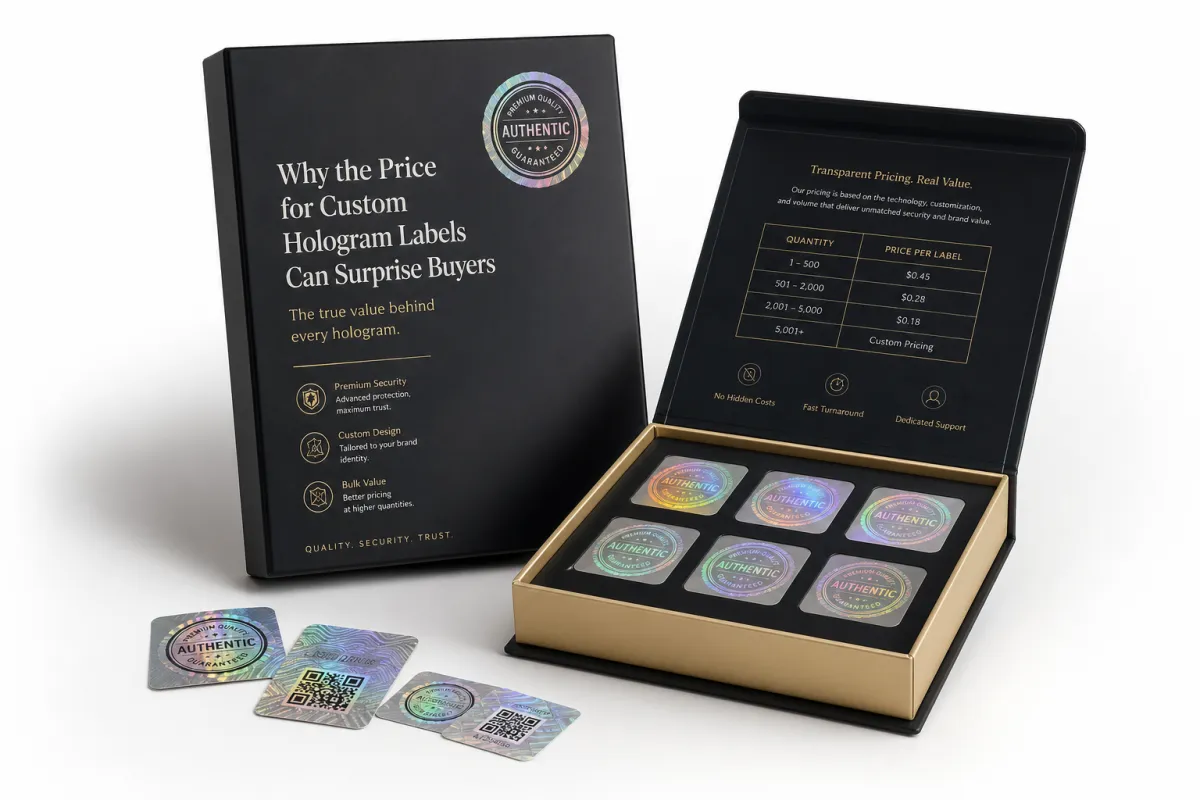
Brand managers compare aesthetics, not engineering
Most procurement teams open a quote and scan the artwork thumbnail first. That instinct is normal, and it is also where the misunderstanding starts. The Price for Custom hologram labels often reflects unseen build elements before it reflects visible design. Two suppliers can produce near-identical-looking holograms, and the quote can still move because adhesive chemistry, liner behavior, and die-cut precision are different.
The trap is in the layers beneath the surface. Holographic film gets the attention, while the bigger cost drivers are often the parts nobody photographs: laminate architecture, release-liner control, inspection discipline, and tolerance management. A custom foil accent may move cost slightly. A tighter anti-counterfeit layer can move it far more, especially when traceability and authenticity checks are mandatory. Add a serialized labeling module, and the price for custom hologram labels can jump by 30% to 70% before anyone notices the change in the file checklist.
Think in terms of packaging risk, not ornamentation. If your product faces counterfeit exposure, the lowest unit cost can become the wrong decision once returns, audits, and relabeling are included. Cosmetics, supplements, and consumer electronics face this mismatch the most. A slightly higher price for custom hologram labels can be cheaper than a launch recall, a quality dispute, or a batch pulled from distribution because labels failed in channel.
Reprints are often the quiet budget killer. They look manageable during quote review, then become expensive once inventory has moved and deadlines are fixed. A replacement run of 10,000 pieces with revised specs can quickly cost the equivalent of two standard runs once freight, expedited handling, and missed launch windows are included. The smarter comparison is not unit cost alone; it is landed cost plus the cost of failure. That is where pricing clarity replaces sticker shock.
Buyers usually assume print complexity drives the bill. Design shape matters, yet the expensive variables are often security requirements, substrate compatibility, registration precision, and proof control. If anti-counterfeit performance is the goal, shimmer is not the headline feature. Function is.
I have seen teams save a few hundred dollars on the front end only to spend several thousand cleaning up application failures later. That is a rough trade, and honestly, a pretty avoidable one.
A practical transaction mindset
Good buyers ask one question before discussing price: what problem is this label solving? A decorative label in retail packaging may need high gloss and clean optics. A closure seal may need stronger adhesion, heat resistance, and tamper-evident cues. Both are price for custom hologram labels decisions, but they are built on different cost logic.
Use a simple quote frame: unit price, total job cost, rework risk, and failure points per 1,000 pieces. A cheaper-looking supplier can be more expensive if proof corrections drag on or if the first production run misses real application conditions. The right pricing survives procurement scrutiny when assumptions are explicit, inspection is defined, and freight treatment is consistent.
A strong quote should say whether you are paying only for visible aesthetics or for the whole system: adhesive performance, environmental fit, and repeatability across reorder batches. That distinction protects brand integrity over time and makes the price for custom hologram labels easier to defend in a board-level review.
One more thing: if a quote is vague about finish, substrate, or inspection, the vendor is not "being flexible." They are leaving room for surprise charges later. That kind of flexibility usually helps only one side.
What this guide breaks down next
- How materials and construction move a quote from decorative to authenticated.
- Which specifications trigger the largest setup and finishing charges.
- How MOQ and finish tiers affect both unit cost and lead time.
- What timeline details you need on day one to avoid revision delays.
By the end, you will have a structured way to decide what a fair price for custom hologram labels should look like for your project, instead of reacting to a single number on a spreadsheet and hoping everything else fits.
Hologram Label Materials, Construction, and Security Options
Label stack fundamentals: face stock, adhesive, liner, and film
Every custom label discussion should start at the layer level. First comes the face stock, then the adhesive, then the liner, then the holographic film stack and any overlay. Face stock options are often paper-based, PP, PET, or specialized films for harsher environments. A paper face with standard pressure-sensitive glue behaves very differently from PET designed for tear resistance in cold-chain conditions. That difference is mechanical, not decorative.
Clear overlay is where visual goals and performance meet. A transparent layer can improve gloss and protect print, yet it can also increase cycle time and waste if the artwork is dense or tolerance windows are narrow. Metallic sheen and brushed effects improve shelf appeal, while rainbow films usually demand tighter inspection. That is why cost can rise even when design changes look minor on screen.
Adhesive choice is where silent failures often begin. A permanent acrylic adhesive can suit glass and metal closures, while freezer or cold-chain applications may need a low-temperature formula with less cracking risk. Removable adhesives have legitimate use cases, especially when consumer convenience is essential, but they are typically weaker for tamper-focused packaging. If adhesion is treated as a late detail, post-production labor often rises through complaints, returns, and relabeling.
In practice, adhesive testing is one of the few areas where a short pilot can save a lot of grief. A 48-hour lab guess is not the same as a week in a humid warehouse, and the warehouse usually wins the argument.
Decorative versus security-first constructions
Decorative label architecture aims at attention. Security-first construction aims at control. The difference matters more than style. Security builds can include microtext, hidden motifs, custom diffraction patterns, serial numbering, and variable data modules. Variable data may appear as text, encoded symbols, or QR-linked traceability fields. Each added element increases prepress burden, approval complexity, and production discipline.
On a similar footprint, a security build can cost 25% to more than 80% above a decorative version depending on data handling. If the label authenticates, the extra spend can be justified quickly. If the same label is used only to upgrade shelf look, the added cost becomes unnecessary noise in your unit economics. Cosmetics and supplements with counterfeit pressure often need lot codes and serial ranges. Hospitality or short-life promotional packages usually do not.
Some teams confuse "looks premium" with "harder to copy." The two ideas overlap, but they are not equivalent. A package that needs anti-counterfeit assurance in a high-risk channel should prioritize pattern complexity, tamper evidence, and edge behavior before optical intensity. A sharper build can lift the price for custom hologram labels yet still lower cost per protected shipment.
That distinction matters because counterfeiters do not care whether your label looks expensive. They care whether it is easy to imitate. Those are very different problems.
Application compatibility and substrate impact
Label behavior changes with the surface it sits on. Glass, coated cartons, plastic bottles, and curved metalized wrappers each push different engineering decisions. Glass tolerates smooth release and punishes edge lift. Coated cartons can reject some pressure-sensitive formulas in humid warehousing. Plastic bottles may require edge-seal control to avoid bubbling on curves. Every substrate has its own failure pattern.
Curved surfaces are where many budgets get damaged. A rigid backing on a curved bottle can show skipping, stress marks, or partial lift unless the film and liner are matched carefully. If artwork arrives without curvature or use-condition notes, the quoted price for custom hologram labels may become irrelevant once production starts. Inconsistent adhesion on that type of run commonly creates rework, while final bills absorb freight, downtime, and delayed stock-in.
For teams balancing brand image and practicality, compare label decisions against Custom Printed Boxes. If package architecture is constrained, a more stable hologram build can be cheaper over product life than a cheaper-looking label that repeatedly fails in channel. One visual upgrade can cost less than one recurring defect response if you measure total impact.
Specifications That Affect the Price for Custom Hologram Labels
Geometry, coverage, and setup efficiency
Size and shape decide where waste starts. A simple circle with generous margins usually yields better output than a tight die-cut with narrow appendages. Rounded corners are often less costly than star-shaped edges when die changes become complex. Registration marks become important when microtext sits near edges; they increase setup time and raise reject risk.
Artwork coverage matters too. Full-bleed hologram print with heavy color overlap can require extra passes and more prepress scrutiny. Spot treatment may be simpler and cheaper, but it still has to align with your packaging design intent. Costs rise when machines handle odd geometry, multiple punch operations, or nested color tolerances on a short run.
Yield changes the economics quickly. A 25% scrap rate is not unusual in short, irregular jobs. The same 1,000-piece requirement can move from a comfortable budget to a strained one simply because layout nesting cannot be optimized. Before it becomes a design problem, it is a math problem.
That is why experienced buyers ask for a layout proof, not just a price. The proof shows whether the quoted build can actually be nested cleanly, and that is where real cost begins to show its face.
Colors, registration, data, and proofing
More inks do not always increase cost proportionally, but tighter color control usually does. A four-color process with varnish can be less expensive than expected if the palette is controlled. The expensive part is often getting every color to land exactly against the hologram pattern. Tight registration around serial zones, legal text, and traceability marks increases inspection burden.
Variable data and serialization are major multipliers. If each label carries a lot number or serial range, the supplier must manage secure files, approval flow, and usually additional verification. Buyers often discover this only after the first proof, when the change sounds tiny. The price for custom hologram labels then includes data handling, verification, and secure workflow steps.
Prepress review is not a favor; it is cost control. Catching line-weight mistakes, reversed text, or poor clear-space decisions before print is cheaper than fixing a full lot. Proofing adds time up front yet often lowers total cost by reducing rework. On high-security jobs, a controlled proof cycle can still be cheaper than a rushed correction that destroys a full batch.
From the buyer side, treat proofing as part of the cost model. Clean proofing means fewer surprises, fewer overtime charges, and more trustworthy comparisons between suppliers for the price for custom hologram labels.
Adhesive selection and protective layers as performance requirements
Permanent, removable, freezer-grade, and tamper-evident adhesives should be selected like process-critical components. Low-cost formulas can look attractive until they hit humidity, cold storage, or repeated handling. Tamper-evident adhesives may need special edge chemistry and tighter curing control. That is not a premium add-on; it is a performance requirement for anti-counterfeit labels and high-sensitivity applications.
Protective layers move cost too. A thin clear coat can improve hand feel and scuff resistance, but if applied poorly it can reduce optical readability. High abrasion resistance often means thicker structures and slower run speeds on certain equipment. A low upfront price may look good, then long-term cost rises through shelf wear and field complaints.
For labels that must survive warehouse handling or outdoor exposure, this is where the price for custom hologram labels begins to reflect industrial standards thinking. Ask whether peel and shear performance are tested with methods like ASTM D3330. Then verify whether transport trials follow a structured stress model. Once those questions are answered, quote line items become easier to defend.
I would also push for a plain-English note on how the supplier interprets "pass" and "fail." Technical standards are useful, but only if both sides are speaking the same dialect.
Durability expectations and standards checks
Longer shelf-life products, especially chilled goods, need performance thinking before the order is placed. Retail distribution exposes labels to abrasion, temperature swings, and UV drift. When those conditions are missing from the specification, the quote can appear deceptively low.
A credible supplier should ask about ambient handling, chilled storage, and movement through the channel, then map that to process assumptions. A tougher film and higher-clarity adhesive may cost more, while a lighter option may work if the environment is mild. The correct choice is not aesthetics. It is fit-for-application. That is where package branding survives beyond launch instead of breaking down in distribution.
In one packaging audit, the most expensive label was not the one with the highest unit price. It was the one that stayed on the bottle through cold storage, condensation, and three rounds of warehouse handling. The cheaper version peeled at the corner and turned the entire pallet into a relabeling job. That is the kind of hidden math people miss.
Price for Custom Hologram Labels: MOQ, Volume Breaks, and Budgeting
Why smaller runs usually cost more per piece
Small runs are not penalized by design; fixed costs simply do not spread out. Tooling, plates, dies, and prepress setup can stay high while quantity stays low. That is why a 500-piece run can show a high per-unit cost even when the material spec matches a 5,000-piece order.
For decorative projects, typical ranges often look like:
- 500 labels: around $0.45 - $0.90 each depending on complexity
- 1,000 labels: around $0.32 - $0.65 each
- 5,000 labels: around $0.22 - $0.45 each
- 10,000 labels: around $0.18 - $0.38 each
These ranges are realistic, not promotional. Add security features, serialized tracking, or custom foil effects and cost moves upward. The goal is not to win the lowest per-label figure. The goal is understanding total landed cost for the launch batch and comparing on equal terms.
There is no magic bulk threshold where pricing suddenly becomes generous. The curve usually bends gradually, and then flattens. That is the boring truth, but it is the useful one.
Read the quote structure before you calculate savings
Ask for a full line-item quote, or you will compare mismatched offers. A useful breakdown usually includes artwork prep, die setup, face material, holographic film, adhesive system, finishing, inspection, packing, and freight. The price for custom hologram labels becomes transparent only when hidden pieces are visible early.
Below is a common commercial comparison format:
| Quantity Range | Typical Unit Price Range | Main Cost Driver | What to Watch |
|---|---|---|---|
| 500-1,000 | $0.45 - $0.90 | Setup and approval time | Look for die complexity and first-pass acceptance risk. |
| 1,000-5,000 | $0.32 - $0.65 | Material and finish efficiency | Check yield from die nesting and color registration. |
| 5,000-10,000 | $0.22 - $0.45 | Volume dilution | Monitor whether variable data or security adds hidden line items. |
| 10,000+ | $0.18 - $0.38 | Production optimization | Ensure finish and adhesion remain correctly specified at scale. |
| Security-focused custom jobs | +20% to +80% add-on | Serialization, tamper-evident features, inspection burden | Do not accept unverified unit-cost assumptions. |
The savings curve is not always linear. When anti-counterfeit logic dominates the design, doubling volume may not reduce cost the way it does for decorative-only labels. In that scenario, the price for custom hologram labels bends toward adhesive stability and inspection cost, not only raw materials.
Like-for-like comparison is the only fair comparison
"A clean quote for this category is useful only when every cost driver is matched: same die, same adhesive behavior, same security layer, same quantity, same freight lane."
If one supplier includes freight and another leaves it out, the price for custom hologram labels is already skewed. If one includes QA and another bills it later, the same problem appears. Compare like with like: shape, quantity, adhesive, finish, security features, and tolerance requirements.
When budgets are tight, ask for alternatives up front. Option A can be the full rainbow hologram with custom microtext and tamper strip. Option B can reduce the finish set while keeping anti-copy logic. Option C can shift from decorative to utility-first construction. That gives a practical budget ladder while preserving brand integrity where it matters.
Buyers who request alternatives often spend less and control more. The reason is simple: the price for custom hologram labels stops being a binary negotiation and starts showing where it delivers value.
External validation and sourcing confidence
Before final approval, verify whether supplier claims match your reliability expectations and recognized frameworks. For shipping and distribution stress expectations, references from ISTA can help provide context. For packaging stewardship and industry direction, Packaging.org is a useful consultation point. These sources do not replace production testing, but they ground the pricing discussion in real conditions instead of sales language.
The Cost of Custom hologram labels becomes negotiable only after requirements are anchored. Once the specification is clear, suppliers can optimize inside defined limits, and the risk of surprise adjustments after proof approval drops sharply.
Production Process and Timeline for Custom Hologram Labels
Workflow from spec to shipped carton-ready labels
Most schedules slip because of misunderstanding, not machine speed. A typical sequence is: specification review, artwork precheck, proof generation, proof approval, material staging, production, in-process inspection, finishing, packing, and dispatch. In a disciplined operation, each stage has a checkpoint and an owner. Teams that skip the first checkpoint often pay for fixes at the most expensive checkpoint.
For straightforward decorative runs, timeline can sit around 12-15 business days from approved proof in many plants. Add serial data, custom micro-patterns, or high-security overlays, and lead times commonly stretch by 3-7 business days. Add international shipping and customs, and calendars can expand by another 7-12 days depending on route and lane congestion.
Complex die-cut and high-precision registration can increase tooling setup by 15% to 30% versus standard contours. That is why rushed quotes fail so often: the fastest path usually comes from complete inputs on day one.
Speed is not just a factory issue. It is a paperwork issue, a proof issue, and sometimes an approval-chain issue. That is the unglamorous part of the job.
Where projects stall most often
- Dimensions missing on the first file: if die width is unclear, production cannot finalize the layout.
- Artwork unresolved: low-resolution logos or text below minimum size increase back-and-forth.
- Unclear application notes: no substrate, no adhesive direction, no edge constraints.
- Slow proof turnaround: one unresolved clarification can hold the full job.
Avoid these by treating the quote as a technical task, not a design critique session. Even when the price for custom hologram labels is stable, the label that spends fewer days in review is usually cheaper in true business terms after labor and freight are counted.
What to submit before asking for a quote
Send complete specs up front and the timeline steadies quickly. At minimum, include exact shape, finished size, substrate type, adhesive requirement, finish profile, quantity, and security feature list. Add usage conditions too: temperature bands, expected sunlight exposure, peel direction, and storage environment. Those details directly influence the price for custom hologram labels and reduce revision churn.
If your product involves pharmaceuticals, high-value electronics, beauty, or nutrition, include packaging compatibility requirements and anti-counterfeit policy. Curved bottles may need test notes before a die is finalized. Chilled products need adhesive and edge stability notes. In effect, that turns a variable timeline into a managed timeline.
When the package specification is complete, standard and rush can be evaluated honestly. A rush surcharge is fair when technical work is fully ready. It is not fair when the file is incomplete and creative updates remain unresolved.
Why Choose Custom Logo Things for Hologram Labels
Decision support, not just production
At this stage, the commercial question is straightforward: which partner improves decision quality under pressure. The right team should explain tradeoffs clearly, especially around price for custom hologram labels. If you get a number without constraints or fallback options, you are effectively buying uncertainty.
Custom Logo Things is often used as a practical partner when buyers need technical interpretation fast. Teams frequently want both branded optics and security resilience, and those goals can conflict. A partner that can tell you whether the anti-counterfeit layer is over-built for that packaging line of retail packaging is worth a stronger conversation.
Repeatability matters after the pilot. Many brands get a clean first batch and then see drift in adhesion or registration on later runs. That inconsistency creates uncertainty for marketing and operations, even if the original unit price looked favorable. A supplier with repeatability discipline can protect package branding across replenishment cycles, which is itself a cost advantage.
I am cautious about any vendor that treats first-run success as proof of long-term stability. A one-off run is easy. Keeping the second and third run inside the same window is where the real discipline shows up.
Application fit across packaging categories
One common mistake is assuming one construction fits all use cases. A cosmetic closure label does not behave like a boxed supplement insert, and electronics security labels face stricter field conditions. The price for custom hologram labels should reflect actual use class, not an average assumption.
For teams scaling retail packaging, custom logo integration helps only if the label applies at line speed, survives handling, and supports replenishment without delay. Custom Logo Things can help by including print registration expectations, adhesive durability, and production pacing in one coherent conversation.
If your roadmap includes custom printed boxes or broader branded packaging programs, request one spec logic across categories. A unified package design language reduces ambiguity and avoids extra charges that appear when each category is sourced in isolation.
That kind of alignment sounds boring. It is. It also saves money. Boring is underrated in procurement.
Measured outcomes over vague differentiation
In buying terms, this is not about who has the best wording. It is about who ties price for custom hologram labels to measurable outcomes. Lower risk, tighter budget control, and field performance are all measurable if the right gates are written in advance.
That can mean a documented acceptance test for peel strength, a tolerance window for edge lift, and a proof protocol with revision limits. In procurement terms, those guardrails reduce disputes later. They also signal an execution mindset in the supplier selection process.
Good partners also support Custom Labels & Tags planning and broader campaign structure through Custom Packaging Products. That reduces fragmentation and makes the price for custom hologram labels easier to forecast across launches.
Next Steps to Get the Right Price for Custom Hologram Labels
Build your order brief before you request a quote
Most teams are closer to the right answer than they think. Start with these fields: final label dimensions, first-run quantity, shape and die tolerance, packaging substrate, adhesive preference, hologram finish, and security requirements. Add one more line: expected storage and application conditions. That one line can narrow quote variance more than people expect.
Use a checklist format like this:
- Finished label size in mm with tolerance.
- Quantity split by SKUs and expected reorder frequency.
- Substrate map: glass, carton, plastic bottle, blister, or mixed.
- Adhesive class: permanent, removable, freezer, tamper-evident.
- Finish: clear overlay, metallic sheen, brushed, rainbow, etc.
- Security features: hidden code, microtext, serial range, variable data.
Once this is complete, suppliers can produce a reliable estimate, and the price for custom hologram labels discussion moves from speculation to comparison.
Ask for options, then compare correctly
Request two or three spec variations and keep non-price assumptions fixed. Option one can be the brand-forward version. Option two can remove one finish layer and keep anti-tamper logic. Option three can shift from decorative to utility-first construction. The aim is not the lowest sticker price. The aim is best value for the intended use case.
Ask every supplier to itemize proof steps, lead-time assumptions, and freight treatment separately. Hidden freight and packing differences can represent 10% to 20% of total landed cost. If one supplier includes expedited inspection and another bills it later, the price for custom hologram labels comparison is already distorted.
When budgets are tight, request a fast production pilot for one SKU and one substrate, then scale only after performance is confirmed. That approach is often the most cost-efficient path for high-stakes launches because it proves the selected stack can survive the real environment.
Final validation checklist before final approval
Do not approve until you can answer three questions quickly: Does this label survive the application surface? Does it meet the packaging security expectation? Does the supplier understand your launch failure threshold for timing and performance? If the answer is yes, pricing is usually aligned. If the answer is no, the price for custom hologram labels will likely drift upward through change cycles.
For real-world confidence, test on actual surfaces: a curved bottle, a coated carton edge, and cold-storage exposure when relevant. Confirm proofing and sign-off cadence with your team before production starts. The fastest path to an accurate quote is complete specification and a like-for-like comparison sheet. That is the highest-value step before any order is issued.
If you only remember one thing, make it this: compare the label system, not the sparkle. A label that fits the substrate, survives the route, and meets the security need is the one that earns its price. Everything else is noise.
FAQ
What affects the price for custom hologram labels the most?
MOQ and setup costs are usually the first major lever. Security features, adhesive type, and die-cut complexity follow, especially when registration and verification are strict. Another significant factor is whether the build requires anti-counterfeit patterns that demand extra inspection and data handling.
Are custom hologram labels cheaper at higher quantities?
Usually, yes, because fixed setup costs spread across more units. The drop is not always linear, though. If material complexity rises with higher quantity tiers, the cost curve can flatten. Ask for explicit tiered pricing at your target order sizes so you do not extrapolate from the wrong base.
How long do custom hologram labels usually take to produce?
Time depends on proof quality at the outset, production volume, and the complexity of security features. Decorative runs are often faster. Tamper-evident, serialized, or variable-data projects usually need longer planning and inspection windows. Complete information at the start remains the best timeline-control tool for reliable price for custom hologram labels and lead-time commitments.
Can custom hologram labels be used on cosmetics, supplements, or electronics?
Yes, if adhesive and film selection match the packaging surface and storage conditions. Curved surfaces, coated cartons, or chilled environments often require different constructions. A full application-level test is recommended before scaling to the full run.
What should I ask for in a quote for custom hologram labels?
Ask for clear details on size, shape, quantity, finish, adhesive, and substrate compatibility. If your package branding requires security features, include serial and tamper requirements in the first request. Also ask for proofing workflow, lead-time stages, and freight terms in writing so the price for custom hologram labels comparison remains fair.

