Buyer Fit Snapshot
| Best fit | Custom Cork Gift Box Packaging Bulk projects where brand print, material claims, artwork control, MOQ, and repeat-order consistency need to be specified before quoting. |
|---|---|
| Quote inputs | Share finished size, material target, print colors, finish, packing count, annual reorder estimate, ship-to region, and any compliance wording. |
| Proofing check | Approve dieline scale, logo placement, barcode or warning zones, color tolerance, closure strength, and carton packing before bulk production. |
| Main risk | Vague material claims, crowded artwork, missing packing details, or unclear freight terms can make a low unit price expensive after revisions. |
Fast answer: Custom Cork Gift Box Packaging Bulk: Specs, Pricing, MOQ should be specified like a repeatable production item. The safest quote records material, print method, finish, artwork proof, packing count, and reorder notes in one written spec.
Production checks before approval
Compare the actual filled-product size with the drawing, then confirm tolerance on folds, seals, hang holes, label areas, and retail display edges. Reserve space for logos, QR codes, warning copy, and material claims before decorative graphics fill the panel.
Quote comparison points
Review material grade, print process, finish, sampling route, tooling charges, carton quantity, and freight assumptions side by side. A quote is only useful when the supplier can repeat the same color, closure quality, and packing count on the next order.
Cork box packaging in bulk matters because it can carry a brand signal and a structural role at the same time. In my experience, teams that treat it as both often cut fewer corners than they think. Custom Cork Gift Box Packaging bulk keeps showing up in retail, gifting, and promo plans because the surface looks premium without feeling loud. The real decision is not whether cork is “trendy,” but whether the whole system can survive transit, display stress, and repeatable launch schedules.
Most buyers start at the mood board stage and stop before the engineering conversation even begins. The result is common: it photographs beautifully, then gets dented, warped, or expensive to rebuild after the first shipment. I usually push clients to lock structure first, then print, then finishing details. That order sounds boring until you are standing on a warehouse floor with 2,000 mismatched units and no backup stock.
Buying in volume changes the equation faster than people expect. Unit pricing drops, planning becomes less chaotic, and quality appears more stable across seasons. But one weak structural choice can wipe out all of that. If inserts are wrong, if tolerances drift, or if the finish is not aligned with production flow, the rework bill can erase any “bulk discount.” That is why custom cork Gift Box Packaging bulk has to be spoken about in execution terms, not just style.
Here is an honest rule from field work: if your team is still debating “does it look premium?” while the brief is missing closure force, target weight, and insert constraints, you are one step away from a preventable production delay. With cork, the margin is often made in small controls, not big promises.
Why custom cork gift box packaging bulk makes sense
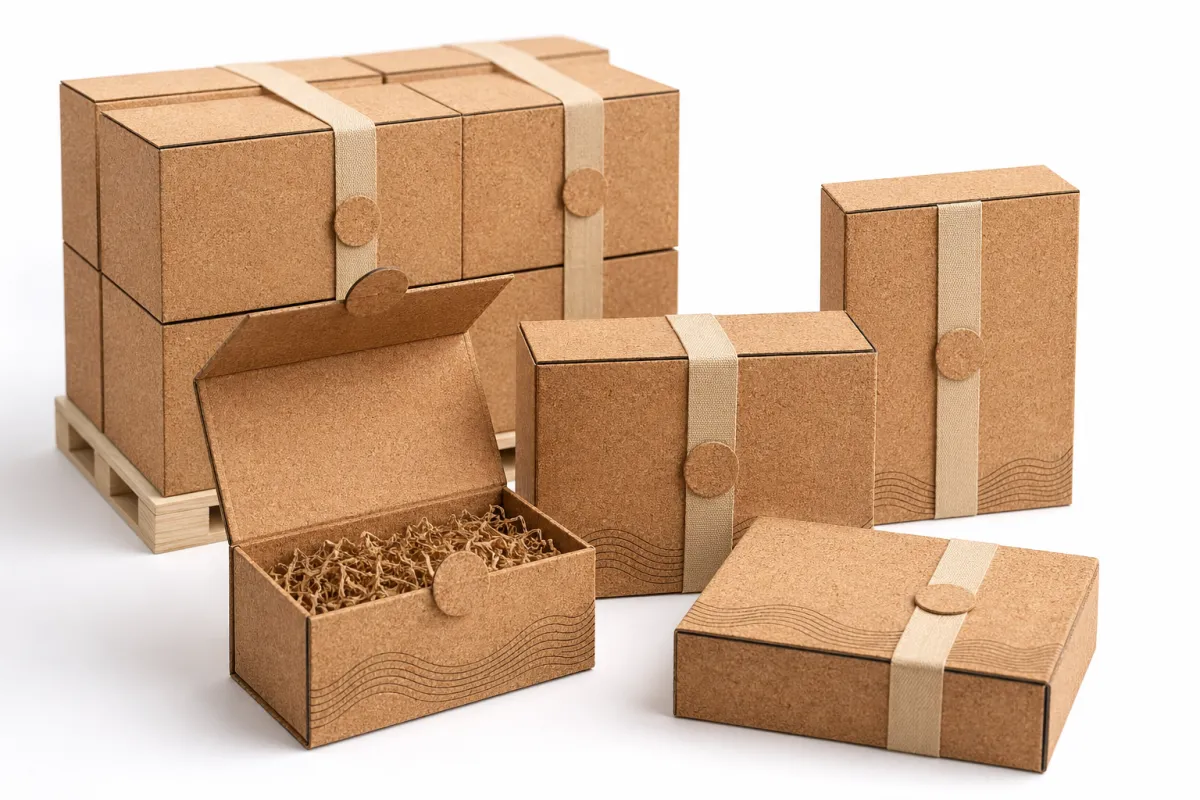
Cork gives a tactile language that is hard to imitate. It looks controlled, natural, and premium without sliding into loudness. In custom cork gift box packaging bulk, this matters for brands that want quality cues but hate overdone gloss finishes. When the outer face feels intentional, the customer’s trust starts before the product is opened.
I have seen two different launch decks with almost identical visuals but wildly different outcomes because one had a sound board, and one did not. Cork is not a magic layer. A thin substrate can still fail in drop tests and shipping, while a slightly heavier structure feels almost expensive at once. The trick is to treat cork as the visible layer of a full engineering decision, not a shortcut around it.
The practical value is plain: cork generally handles edge wear, gives a warmer hand-feel, and does not scream. If your story includes eco-conscious language, cork can support it, but it will not hide poor architecture for inserts or closure. A box that looks refined but bends at one corner in handling is a bad business decision, not an aesthetic one.
Repeatability is where bulk orders really shine. Retail drops, gift campaigns, influencer launches, and corporate runs all need the same quality expectation over time. You can run three separate campaigns and still maintain visual continuity if tolerances, board grade, and print workflow are locked from the start in custom cork gift box packaging bulk. If they aren’t, you get that annoying “different box every time” effect, and customers notice even when they can’t explain it.
Cross-category use is where many teams discover the hidden value. A good cork system can move from candles to jewelry to desk accessories without looking disconnected. That consistency reduces complexity in warehouse planning and helps merchandising teams keep a coherent shelf story across SKUs. It is a practical packaging strategy, not a design trick.
If a package has to travel, protect, and still look good under store lighting, structure wins the battle. Cork can set the tone, but structure handles the risk.
When eco-claims are part of the brief, ask for auditable proof before approving wording. FSC status, supplier disclosures, and clear sourcing flow matter more than marketing adjectives. For transport resilience, I always ask how the design was validated for handling stress and whether it aligns with ISTA guidance relevant to the route. Without this, custom cork gift box packaging bulk can become a beautiful concept with weak reliability.
One honest note: cork helps, but it is not universally better for every product mix. It can still be a bad match for ultra-light high-volume utility items where low-cost stackability and aggressive compression metrics matter more than premium surface feel. Know what your bottleneck is before you push MOQ.
Custom cork gift box packaging bulk: product details and use cases
Different forms behave differently when run at scale. If you skip this step, you risk buying the wrong platform for your product weight and handling cycle. Tuck-top formats are fast, practical, and often the best point of entry for lighter SKUs. Magnetic closures add a premium and improve reseal confidence, though they do add cost and assembly care. Two-piece rigid shells stay dependable for daily handling, while drawer designs are ideal when unpacking cadence is part of the brand experience.
Sleeve-and-tray combinations still deserve a place in serious programs, especially when shelf information and internal organization both matter. I use them when the outside needs a clean, repeatable exterior identity but the inside must protect irregular contents. That combo is common in beauty gift sets, accessory bundles, and premium kits where you want a clear brand face and disciplined inner layout.
Common use cases that we see in actual production include:
- Jewelry boxes with velvet, satin, or paper-lined inserts
- Candle gift sets with divider trays
- Skincare and self-care kits with branded insert architecture
- Small electronics and accessory kits where retention matters
- Corporate gifting collections and internal promotion kits
- Seasonal retail launches with repeated campaign cycles
Brands typically choose one of three cork approaches, and it is rarely a design-only decision. A full exterior wrap gives the strongest tactile impression but also drives material cost and finishing time. Partial paneling on lid edges or flanks often preserves the cue while saving budget. A hybrid with paperboard or grayboard is practical when performance and scheduling must stay stable. For many programs, that hybrid approach is the right balance in custom cork gift box packaging bulk.
Finishes are easy to overdesign. Embossing gives a durable signature and can carry a tactile brand mark through shelf time. Debossing offers a subtler signature when depth control is tight. Foil works, but too much can flatten the natural character that cork already gives you. Screen print handles robust graphics well. Spot UV can be useful, just don’t blanket it with heavy area coverage or texture disappears under a shiny layer. In bulk projects, sample approvals must confirm finish behavior before approval lock on custom cork gift box packaging bulk.
A simple decision filter prevents expensive confusion. Fragile goods should prioritize closure behavior and insert geometry. Shelf-led SKUs should prioritize color control, print registration, and repeatable edge quality. The two can work together, but I see too many teams flipping the order, and that usually hurts both outcomes. Pretty packaging that collapses in handling is not premium packaging. It is expensive risk.
Teams that compare family structures early can avoid brand drift. Review Custom Packaging Products for available structures and Wholesale Programs to match demand profiles. That cross-check gives you a realistic comparison between custom cork gift box packaging bulk and other Custom Printed Boxes before finalizing a production path.
Specifications for custom cork gift box packaging bulk
Specifications determine whether a project scales cleanly or spirals into revisions. Start with the exterior system: pure cork wrap, cork-textured laminate, or cork accents. Then lock board thickness by weight and load profile, not by guesswork. A 1.5–3 mm grayboard range is common in rigid formats, but the exact grade should reflect stack height, handling path, and corner stress. Smaller structures can use lighter board; heavier SKU families usually need stronger support to avoid deformation.
Internal insertion choices usually end up making or breaking the total cost. Paperboard inserts are straightforward and often easiest for lighter goods. EVA foam can solve irregular or brittle product geometry, but thickness must be controlled or the package can become overbuilt and pricey. Molded pulp is a good sustainability option, though the tooling and geometry must be designed before sign-off. Insert type should be treated as a core design decision in custom cork gift box packaging bulk, not an afterthought.
Fit discipline is where margin leaks. Too much clearance means extra filler, bigger cartons, and higher freight. Too little clearance adds assembly friction and product movement, then leads to damage claims. The practical method is always the same: measure the actual product dimensions with tolerance margin, then add only the clearance needed for closure and handling. Everything else becomes risk.
Finish selection affects perceived quality, durability, and line-side effort. Matte lamination and soft-touch coatings can feel excellent in person, though high-touch retail can expose wear sooner. Natural cork textures stay visually consistent, but they require early tolerance decisions so production does not drift. Ribbon pulls can improve drawer usability, while magnetic lids often raise perceived value but need strict alignment and stronger quality checks. Every finish choice in custom cork gift box packaging bulk is tied to a production cost and a handling tradeoff.
Artwork should be prepared for manufacturing, not only for design review. Vector files remain the most reliable format for scaling and reprints. If color accuracy is important, lock references with approved Pantone codes and print targets before approval. Bleed and safety zones need to be visible in the dieline, and any very fine typography should be tested against surface texture because cork grain can soften edge detail in production. A pretty approved mock-up does not guarantee final behavior on a production line.
Quality checks should be part of the spec package, not a final panic action. Compression resistance matters for long storage stacks. Corner strength matters for transport. Surface abrasion matters for open retail presentations. Print adhesion matters where ink sits over texture and ridges. These are not fancy controls, they are basic controls to keep defects from repeating across multiple thousand-piece runs.
For sustainability claims, only use verifiable language. Request clear documentation of cork and board sourcing, FSC records, and recycled-content percentages where relevant. The EPA recycling guidance helps communication framing, but supplier traceability still drives trust. In custom cork gift box packaging bulk, weak claims are costlier than a slightly slower finish decision because they can damage buyer confidence fast.
One hard rule I repeat to every team: closure behavior beats surface drama. Weak magnets, soft hinges, or inconsistent edge fits fail in stores and during shipping. In custom cork gift box packaging bulk, closure quality needs to be tested as seriously as print and insert fit; that’s how you keep quality stable when demand spikes.
How much does custom cork gift box packaging bulk cost?
Pricing for custom cork gift box packaging bulk shifts with multiple layers: size, board grade, cork format, print method, inserts, closure type, and freight assumptions. Setup and sampling are the second-order costs that quietly shape your total budget. If an initial quote looks too low, it usually means one of these components is under-allocated rather than eliminated.
MOQ behavior can be surprising if you only follow headlines. A 500-unit run often validates a concept but has a meaningful setup share per piece. A 1,000-piece run usually starts making sense for marketing cadence planning, while 3,000+ runs can create stronger unit economics if the design stays stable. That stability is the main reason bulk planning beats repeated micro-runs for most recurring lines in custom cork gift box packaging bulk.
Tiered quotes are usually the clearest window into supplier capability. If 500 to 1,000 units barely moves pricing, the supplier is likely passing setup risk downstream. If 3,000 units show a stronger break, tooling, material yield, and handling costs are likely being optimized. Teams with longer-running programs use these tiers to decide when scale actually pays off instead of guessing based on one price point.
Here is a practical benchmark table for custom cork gift box packaging bulk:
| Order Size | Typical Unit Price Range | Best For | Notes |
|---|---|---|---|
| 500 units | $1.80-$3.40 | Launches, test runs, short campaigns | Higher setup burden per unit; good for validation |
| 1,000 units | $1.40-$2.80 | Small retail releases, corporate gifting | Often the first tier where pricing becomes programmatic |
| 3,000 units | $1.05-$2.10 | Repeat SKUs, seasonal retail packaging | Usually the best balance of cost and flexibility |
| 5,000+ units | $0.88-$1.75 | Stable programs, larger distribution runs | Best unit economics if design stays fixed |
Compare these prices only when all costs are included. A plain rigid shell with cork wrap and paperboard inserts usually costs less than a complex magnetic, high-foam, foil-heavy format. Landed cost—unit pricing plus setup, sampling, shipping, duties, and potential revisions—is the metric that actually decides whether the order is economical.
When evaluating offers, ask for three cost buckets immediately: unit price, setup, and shipping. Then ask for sampling and change-management fees separately. A reliable supplier will answer directly; a vague one will bury uncertainty in notes. Custom cork gift box packaging bulk decisions should be made by total cost model, not by lowest starting figure.
Regional material volatility and freight spikes can move landed cost by double-digit percentages, especially in Q4 campaigns. A supplier with stable conversion control and transparent lead-cost assumptions is usually a safer bet than one who quotes low and adjusts later. A disciplined workflow usually matters more than one-off negotiation wins.
Rule of thumb: if design and structure are stable, larger runs will reward you. If design keeps changing, closure types rotate, and insert geometry is unsettled, the savings from scale fade fast. In custom cork gift box packaging bulk, operational discipline beats lowball unit pricing.
Production process and timeline for bulk orders
Reliable timelines in custom cork gift box packaging bulk start with a simple sequence and stick to it. Most programs run through this chain: request and quote review, dieline sign-off, artwork build, sampling, approval, production, inspections, then shipment. Break one stage and you usually inherit delays in the next two, so ownership should be named before moving forward.
Sampling windows generally sit around 5 to 10 business days after final design approval, assuming structure and finish are stable. Full production often starts within 15 to 25 business days after sample acceptance. Color revisions, finish tuning, or repeated stakeholder approvals can push this out. I’ve seen structural changes after sample review become the biggest hidden delay trigger in custom cork gift box packaging bulk.
Most practical delay points are easy to prevent:
- Artwork that is not production-ready at submission
- Insert depth or dimension changes after prototyping
- Late finish tweaks after sample acceptance
- Unresolved color corrections after the first approval round
- Approval chains with too many decision handoffs
Decision flow matters as much as technical execution. One owner on structure and one on visual review usually works better than committee-heavy approvals, especially when launches are time-bound. Too many signatures can create the same bottleneck as too little planning: rushed sign-offs, missed shipment slots, and stress on both teams.
Shipping mode influences both budget and timing. Sea freight can cut unit transport cost in high quantity scenarios, but it needs stronger timeline planning. Air freight shortens lead-time risk, which may be non-negotiable for campaign windows, but it can erase margin gains from low unit rates. The right choice for custom cork gift box packaging bulk depends on campaign urgency and storage planning.
Quality checks should happen before dispatch, not after. Validate print registration, closure pull consistency, insert retention, abrasion response, and compression behavior. For large volumes, random and batch-by-batch verification with signed inspection records catches repeat defects early and saves inventory-level losses later. If a flaw repeats at scale, it becomes an expensive operational problem.
Real-world testing beats desk-side testing every time. I still ask teams to fill samples with final product, stack them, move them, and hand them to someone outside the design team. If the opening motion feels awkward or the closure drifts under handling, customers will feel the same friction at shelf or doorstep. A strong design has to be usable first and beautiful second, especially in custom cork gift box packaging bulk.
Why choose us for custom cork gift box packaging bulk
Direct production exposure changes the outcome in meaningful ways. Middle layers can help with simple requests, but they also add interpretation steps that can blur technical details. In custom cork gift box packaging bulk, even small details repeat hundreds or thousands of times, so small drift becomes expensive fast.
Quality in this category is not about one-off photos; it is about repeatability over long runs. Cork tone should remain stable across batches. Edges should hold shape without seam inconsistency. Magnets need predictable pull. Inserts should remain true to dimensions every cycle. Those checks are what turn a branded concept into a sellable retail package.
My preferred workflow is practical customization: strict dieline support, structure recommendation, insert logic, and finish choices tied to product constraints. A rendered mock-up proves direction, but only factory-ready files plus controlled sampling prove performance. That is a hard-earned industry reality in custom cork gift box packaging bulk.
When clients compare production partners, the same questions keep coming back: can pricing stay transparent, are response times realistic, and does sample-to-production matching hold? A practical quote with clear scope usually beats a flashy one with hidden costs. A slightly higher unit number can still be smarter if it prevents reprints, rushed freight, and late-stage fixture changes.
For teams handling multiple campaigns, the planning layer matters. Custom Packaging Products helps map available structures and capacities, while Wholesale Programs supports demand planning and recurring pricing logic. That structure is particularly useful because reorder behavior drives long-term cost more than first-run aesthetics for custom cork gift box packaging bulk.
Cork should carry personality without creating complexity for no reason. Used well, it reinforces premium without masking weak content; used poorly, it feels like a texture garnish. The difference sits in board strength, closure reliability, and dimensional fit, not in adjectives on a style board.
Before full production, test one physical sample with actual product and handling conditions. Screen renders are useful for sign-off, but they miss subtle touch cues that customers perceive instantly, especially with tactile materials. If it feels off in hand, it will perform poorly in market. That simple check has saved me more than one team from a pallet of mismatched units.
If your first run is still a guess, ask for a pre-production sample sooner rather than later. You will catch issues while they are still cheap to correct, before they show up in freight and return lines.
What should you send for a quote?
A solid quote starts with a complete package of input, not a vague mood concept. Share exact product dimensions, target quantity, preferred structure, logo files, finish direction, insert constraints, and destination early. Include a reference photo or physical sample whenever possible. Teams that send complete files usually get faster responses and fewer change cycles in custom cork gift box packaging bulk.
After estimates arrive, ask for tiered pricing, dielines, material callouts, sample images, and timeline assumptions for your exact requirement. Ask what happens if you change insert depth or finish after sample sign-off; that answer often reveals real manufacturing maturity. If answers are defensive or vague, treat it as a warning sign before committing schedule.
Any fragile or premium item should stay in sample mode until approved. One controlled test protects you from mismatch in closure, retention, print behavior, and handling feel. For custom cork gift box packaging bulk, one proper validation beat a full rerun every single time.
Do not over-engineer variation in the first pass. Too many finishes, too many colorways, too many SKUs, and too many exceptions can explode cost and extend lead time. The point is not stripped-down packaging. The point is strategic detail that supports function, usability, and brand memory.
For many programs, the best decision is less glamorous and more disciplined: lock design, structure, and approval points before volume. That gives custom cork gift box packaging bulk a better shot at consistency, less waste, and more predictable performance across campaign cycles.
Clear takeaway: treat custom cork gift box packaging bulk like a production system, not a design exercise. Define structure and insert fit first, verify with physical samples, and compare landed cost with setup, shipping, and revision risk included; if those three are controlled, your packaging is likely to work from launch to replenishment.
What is the usual MOQ for custom cork gift box packaging bulk?
Most standard programs start between 500 and 1,000 units, depending on structure and finish complexity. Heavier products, advanced inserts, foil effects, or specialty closures can push MOQ higher because setup effort must be spread over fewer pieces. To Choose the Right tier, compare 1,000, 3,000, and 5,000-unit pricing against your landed cost model for custom cork gift box packaging bulk.
Can I add my logo to custom cork gift box packaging bulk?
Yes. Common methods include embossing, debossing, foil stamping, screen print, and labeled inserts. Vector artwork is still the safest base file format for repeated use and detail retention. If your logo includes very fine lines, test it in the proof stage because cork texture can soften micro details on production runs.
How long does custom cork gift box packaging bulk take to produce?
Sampling is typically around 5 to 10 business days after design approval, with production often finishing in 15 to 25 business days after sample sign-off. Complex finishes, insert tooling, and delayed approvals can extend this. Final timing depends on how early structure and artwork are locked, which is why teams usually get better results when they avoid late changes in custom cork gift box packaging bulk.
Is cork packaging strong enough for shipping and retail display?
Yes—when the build is matched to product weight and handling. The determining factors are board grade, insert fit, and closure method, not cork look alone. For heavier or fragile goods, run a sample handling test before volume production and confirm storage and transport assumptions before launch.
What should I send to get a quote for custom cork gift box packaging bulk?
Share exact dimensions, quantity range, style preference, logo files, finish direction, insert requirement, and delivery destination in one brief. Add photos or samples if possible so interpretation stays tight. The more complete your initial file pack, the cleaner and faster the quote path for custom cork gift box packaging bulk usually is.

