Buyer Fit Snapshot
| Best fit | Price for Algae Based Packaging projects where brand print, material claims, artwork control, MOQ, and repeat-order consistency need to be specified before quoting. |
|---|---|
| Quote inputs | Share finished size, material target, print colors, finish, packing count, annual reorder estimate, ship-to region, and any compliance wording. |
| Proofing check | Approve dieline scale, logo placement, barcode or warning zones, color tolerance, closure strength, and carton packing before bulk production. |
| Main risk | Vague material claims, crowded artwork, missing packing details, or unclear freight terms can make a low unit price expensive after revisions. |
Fast answer: Price for Algae Based Packaging: Production Spec, Color Control, and Delivery Risk should be specified like a repeatable production item. The safest quote records material, print method, finish, artwork proof, packing count, and reorder notes in one written spec.
Production checks before approval
Compare the actual filled-product size with the drawing, then confirm tolerance on folds, seals, hang holes, label areas, and retail display edges. Reserve space for logos, QR codes, warning copy, and material claims before decorative graphics fill the panel.
Quote comparison points
Review material grade, print process, finish, sampling route, tooling charges, carton quantity, and freight assumptions side by side. A quote is only useful when the supplier can repeat the same color, closure quality, and packing count on the next order.
Price Guide for Algae Based Packaging: Costs, MOQ for Buyers
I still remember a sourcing floor in Hong Kong's Kwun Tong district where a buyer lifted a pouch sample, turned it under a desk lamp rated at 5000K, and asked for the price guide for algae based packaging as if the answer lived in one neat column. It did not. The sample looked polished, the presentation deck looked even more polished, and then the quote came back with a tighter oxygen barrier that pushed the price up by $0.14 a unit on a 5,000-piece order. The buyer cared about that number far more than the algae story printed on the mockup, which is exactly how real buying decisions usually go.
The price guide for algae based packaging only starts making sense once the material, the format, and the product sit in the same frame. A 70-micron algae-blend film that works for a dry snack can fail quickly on a greasy accessory, while a 350gsm C1S artboard sleeve for a gift set can pass shelf tests but miss the moisture target in a humid warehouse in Singapore. A low-MOQ sleeve can look cheap until you add a custom die cut, ASTM D6400 documentation, print proofing, and freight from Shenzhen or Dongguan. I have watched teams compare two quotes that looked close on paper, only to realize one was missing tooling and the other had a hidden certification cost tucked in like it was doing a magic trick. Buyers who skip those pieces usually end up comparing slogans instead of costs.
That is the point of this price guide for algae based packaging: unit cost, tooling, sampling, lead time, and the trade-offs that sit underneath a quote. If you are sourcing retail packaging, dry goods packs, or protective inserts, the real difference is usually in the spec sheet. A 12-micron barrier layer, a 38mm zipper, or a 1-color flexo print can change the quote by cents per unit, while a 48-hour humidity test can change the launch plan by weeks. The brochure is the easy part. The spec sheet is where the bill starts to breathe. A useful price guide for algae based packaging also helps buyers compare algae-derived films, compostable packaging options, and bio-based packaging structures without pretending they all behave the same way.
What Does a Price Guide for Algae Based Packaging Include?
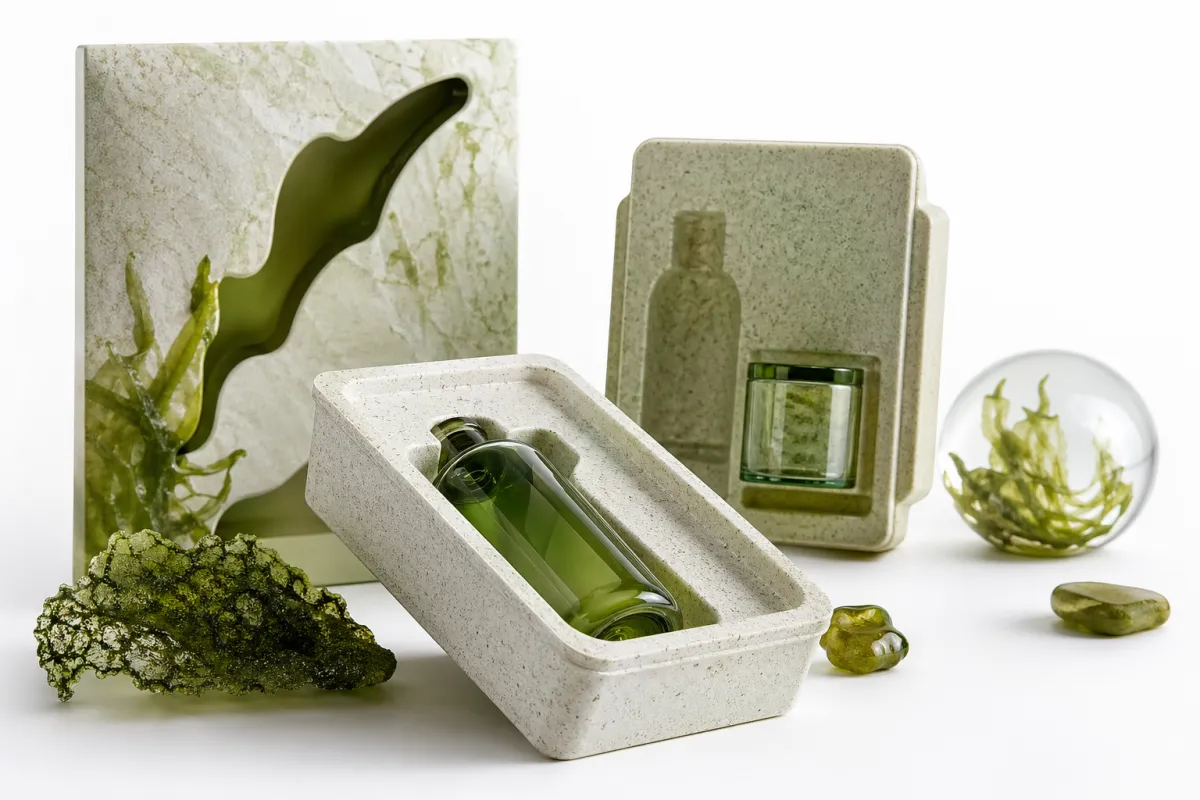
A strong price guide for algae based packaging should include more than a line item for unit cost. Buyers need the material family, the conversion method, the MOQ, the test plan, the lead time, and the hidden charges that can quietly change the final landed cost. The best quotes read like a map. The weakest ones read like a guess with a logo on top.
In practice, that means a price guide for algae based packaging should cover whether the structure is an algae-derived film, a blended fiber paper, a coated paperboard sleeve, or a molded fiber insert. It should also show whether the pack is intended for food contact, retail packaging, shipping protection, or a display-first presentation box. If the supplier cannot explain the structure in plain language, the pricing will probably be fuzzy too. And if the answer sounds polished but vague, that is usually a warning sign, not a feature.
It also helps to ask whether the quote includes tooling, print plates, barrier coating, certification paperwork, and freight. Those details matter because an algae-based pouch for a tea brand in Osaka and a molded insert for a skincare box in Berlin can look similar in a deck while living in different cost worlds. The more precise the brief, the more useful the price guide for algae based packaging becomes.
What buyers miss first is usually not the sustainability story. It is the math behind the sustainability story. A slightly higher quote can be the cheaper option if it reduces damage in transit, cuts waste, or shortens the approval cycle. That is why a real price guide for algae based packaging should be read as a commercial tool, not a marketing note.
Price Guide for Algae Based Packaging: What Buyers Miss First
The first mistake in a price guide for algae based packaging is assuming algae-based means one simple material. It does not. Buyers run into algae-derived films, blended papers, coated wraps, liners, and molded formats, all priced differently and all behaving differently under heat, pressure, and humidity. A 60% algae blend in a sachet for a tea brand in Osaka will not price or perform like a fully algae-derived mailer for a skincare box shipped from Rotterdam to Berlin. I have seen a team walk into a quote review expecting one family of materials and walk out with five completely different cost profiles. That is the kind of moment where everyone nods seriously and then quietly asks for a second meeting.
The second mistake is ignoring performance until late in the process. At a trade show in Shenzhen, a procurement manager spent twenty minutes on shelf appeal and two minutes on moisture resistance, then asked why the sample failed after a 1-meter drop test and 72 hours at 38 C and 80% RH. The strongest quote in the price guide for algae based packaging conversation came from the supplier who could show a 12 to 15 business day sample cycle, an 8 mm seal window, and a defined humidity test plan. That mattered more than the sustainability pitch, which is inconvenient if you were hoping the sustainability pitch would carry the whole thing by itself.
Brand value belongs in the equation too. A good price guide for algae based packaging does not stop at landed cost. If the pack helps the brand look cleaner on shelf, cuts damage in transit from 4.2% to 2.7%, and gives sales a stronger front-panel story, a higher unit price can still win. I have watched a 9% packaging cost increase get approved because the new structure reduced breakage by 18% and removed an entire reprint cycle from the launch plan in Los Angeles. Finance grumbled, operations smiled, and the brand team suddenly found religion.
Buyers often compare algae-based packaging to commodity plastic too quickly. That comparison hides the real decision tree. A better price guide for algae based packaging weighs material cost, conversion cost, compliance work, marketing lift, and the risk of a failed launch. On a pilot order of 5,000 units, the gap between a $0.22 pouch and a $0.31 pouch can disappear if the more expensive pack passes transit testing in Guangzhou and saves one correction run. I know that sounds annoyingly practical, but there it is.
I usually frame the choice in plain terms. Dry, low-abuse, visually led products can make strong use of algae-based structures. Moisture-heavy, oily, or long-shelf-life products narrow the field fast, especially if the fill weight is over 250g or the product ships in summer lanes through Bangkok or Miami. A useful price guide for algae based packaging shows that limitation instead of hiding it. A narrow list of viable options is not a weakness. It is the cost of matching a material to a real job instead of a trend line. Honestly, I trust a supplier more when they say, "This one is not a fit," than when they promise everything can do everything.
"The green story was easy. The hard part was proving the pouch would hold a 38% moisture formula through a 1-meter drop test, a 48-hour humidity cycle, and a 25 C to 40 C warehouse swing."
I have also learned that buyers remember the ugly details. The dented corner on a carton after a 600 km truck ride. The seal that looked fine until the warehouse in Ho Chi Minh City hit 85% humidity. The print that scuffed because someone approved artwork before the structure was tested on a Tuesday afternoon. A price guide for algae based packaging should account for those boring, expensive failures, because that is where margins quietly vanish.
Product Details: Where Algae Based Packaging Fits
A serious price guide for algae based packaging starts with product fit. The main material families I see are algae-derived films, blended fiber papers with algae content, coated paperboard, and bio-based composite structures. A 90-micron film and a 280gsm board sleeve may sound similar in a pitch deck, but they react very differently to heat, pressure, humidity, and print. That means the format you choose changes both the quote and the failure points. If you have ever watched a pack buckle under a heat sealer set at 120 C, you know why I keep saying this with a slightly haunted expression.
Common formats include pouches, sachets, wraps, labels, liners, and protective inserts. On a factory visit in southern China, near Dongguan and the Pearl River Delta supply base, I watched a line move from a flat wrap to a gusseted pouch, and the quote climbed 27% before the printer even touched the job. That kind of jump is why any price guide for algae based packaging should separate flat stock from formed packs and secondary packaging from primary product packaging. Otherwise the comparison is basically theater with spreadsheets.
Practical use cases today include premium retail packaging, dry snacks, tea, coffee accessories, personal care samples, and some protective shipment components. I would be cautious with moisture-sensitive or long-shelf-life products unless the structure comes with documented barrier data, such as WVTR under 10 g/m2/day or an oxygen transmission rate below 30 cc/m2/day at 23 C. A good price guide for algae based packaging makes one thing clear: not every algae-based option can stand in for a high-barrier laminate. That is not a moral failing. It is just physics, which tends to be a bit rude.
The cost swings are not subtle. Simple sleeves or wraps often sit far below multi-layer pouches, and custom shapes can add mold or tooling expense fast. A client once asked why two algae-based quotes were separated by $0.19 a unit. The answer was print coverage, zipper style, and a barrier layer that added two extra conversion steps in a plant outside Guangzhou. That is normal. An honest price guide for algae based packaging should say it plainly, not hide behind polished adjectives and a mood board.
One more distinction matters: fully algae-derived content versus partially algae-based blends. A 60% algae blend may deliver a better cost position and easier conversion, while a 100% algae claim can raise price and documentation requirements, especially if the buyer needs compostability paperwork for the EU or North America. I always push buyers to ask for the exact formulation, not just the marketing language, because the price guide for algae based packaging shifts sharply once the content claim changes. The label on the quote can be lovely and still tell you almost nothing useful.
For broader sourcing, I often compare the algae structure against our Custom Packaging Products lineup so the buyer can see where custom printed boxes, retail packaging, and package branding alternatives sit on the same cost curve. A 350gsm C1S artboard carton in a set from Zhejiang may cost less than a specialized algae composite insert from Taiwan, and that comparison keeps the conversation grounded. It also stops teams from paying a premium for a material that misses the actual pack format. I like that kind of clarity because it saves everybody from fake certainty, which is usually expensive.
Specifications for Algae Based Packaging Buyers
A serious price guide for algae based packaging begins with specs, because specs move the quote faster than any sustainability claim. Before requesting pricing, define thickness, barrier target, seal strength, print method, shelf-life target, and whether the pack will face heat sealing or cold fill. A brief that says "eco pouch" will get a vague response, while one that says 85-micron film, 4-color CMYK, and a 120 C seal window usually gets a precise number from a converter in Shenzhen or Quanzhou. Leave those items vague and suppliers will pad the quote for risk. I do not blame them, either; vague briefs are basically an invitation to guess, and guessing is expensive.
For many dry-goods applications, buyers ask for moisture resistance, oxygen barrier, and grease resistance as separate targets. I have seen a snack brand reduce spoilage risk simply by replacing an "eco pouch" request with a sheet calling for WVTR under 10 g/m2/day and a stable seal at 120 C, then tightening the fill spec to 180g instead of 200g. That level of detail is the backbone of a useful price guide for algae based packaging. It is also the difference between a real quote and a flattering promise.
Compliance matters just as much. Food-contact suitability, compostability claims, and recyclability claims all depend on the exact construction and the market where the product is sold. ASTM D6400 and ASTM D6868 remain common reference points for compostable structures, while FSC matters for paper-based components and chain-of-custody documentation. If transit durability sits in the brief, I also ask whether the pack has been checked against ISTA test methods; the standard library at ISTA is the first place I look when a buyer needs shipping confidence for a route from Shanghai to Chicago or from Valencia to Paris.
Testing should feel practical, not theatrical. A credible price guide for algae based packaging includes seal testing, drop testing, humidity exposure, migration testing where needed, and accelerated aging for sensitive products. I have watched a project stumble because artwork was approved before the structure was tested, and the ink scuffed after 72 hours in a warm carton stored at 32 C. That mistake cost more than the sample round would have. There is always a moment like this where someone says, "We assumed it would be fine," and everyone else stares at the floor.
Procurement teams should compare each algae-based sample against the current pack structure under the same conditions. Put both packs through the same 1-meter drop, the same 48-hour humidity exposure, and the same visual inspection at 30 cm viewing distance. That turns the price guide for algae based packaging into a measurable decision tool instead of a branding exercise. I am far more interested in those side-by-side results than in any glossy rendering with a leaf in the corner.
If the structure includes paper fiber, I also check the source. The FSC chain-of-custody framework matters when a buyer wants credible sourcing language for branded packaging or product packaging claims. A few documents in the file can save a sales team from having to explain a vague sustainability statement later, especially if the package is being sold in Canada, the UK, or Germany. And if you have ever sat through that meeting, you know how much everyone wishes those documents existed five days earlier.
Pricing and MOQ for Algae Based Packaging Buyers
The heart of any price guide for algae based packaging is the cost structure. I break it into raw material availability, formulation complexity, print coverage, tooling, certification work, and order size. A supplier in Jiangsu, for example, may quote differently from one in Penang because pigment access, labor, and film extrusion capacity all change the base rate. Shift any one of those variables and the unit price moves with it, sometimes by more than the sustainability premium buyers expected. That is the part many teams dislike hearing, which tells me it is probably the most useful part.
For a rough buyer benchmark, simple algae-based wraps or sleeves can sit around $0.07-$0.18 per unit at 10,000 pieces, while algae-blend pouches often land around $0.18-$0.42 per unit at 5,000 pieces. Barrier-heavy custom builds can move to $0.35-$0.85 per unit, especially if the print is full coverage and the spec includes a zipper, window, or reinforced seal. If the order is only 2,000 pieces, the same structure might cost 20% to 35% more per unit because setup is spread over fewer packs. That is the part of the price guide for algae based packaging most teams need in writing. Verbal estimates are lovely until someone asks where the number actually came from.
MOQ follows the same pattern. A stock-like structure may start at 1,000 to 3,000 units if tooling already exists in a facility near Shenzhen or Ningbo. Custom shapes, specialty barriers, or multi-color branded packaging usually begin closer to 5,000 to 20,000 units. In one negotiation, I watched MOQ drop by 30% only after the buyer accepted a standard size and a 2-color print instead of a custom die cut. The price guide for algae based packaging rarely improves without some compromise on structure. That is not a defect in the market; it is the market telling you how much complexity it is willing to carry.
Here is a simple comparison I use during sourcing calls. It is not perfect, because every converter prices differently, but it is enough to show the commercial pattern before anyone burns a week on revisions.
| Format | Typical MOQ | Prototype Price | Buyer Notes |
|---|---|---|---|
| Flat wrap or sleeve | 1,000-3,000 units | $120-$280 per sample round | Best for lightweight retail packaging and low-barrier use cases; often built on 350gsm C1S artboard for folded presentation packs |
| Algae-blend sachet | 3,000-5,000 units | $180-$420 per sample round | Works well for dry goods and small personal care items; common test spec includes 85-micron film and 48-hour humidity screening |
| Stand-up pouch | 5,000-10,000 units | $250-$650 per sample round | Print coverage, zipper style, and barrier layers move the quote quickly; proof approval to first production often runs 12-15 business days |
| Molded insert or tray | 3,000-8,000 units | $300-$900 per sample round | Useful for protective packaging and shipment presentation; tooling is often made in Dongguan or nearby Foshan |
Hidden costs deserve as much attention as the unit rate. Tooling can add $250 to $1,800 depending on shape, setup can add another $80 to $300, and compliance testing can land anywhere from $150 to $900 if the buyer needs documentation before launch. Freight from Vietnam to the West Coast can add $0.03 to $0.11 per unit on a 10,000-piece order, and a rush fee may add 8% to 15% if the calendar gets tight. A clear price guide for algae based packaging should ask suppliers to separate tooling, setup, freight, and testing from the per-unit price so margin does not disappear inside a bundled quote. I have seen too many teams discover the "final" price after the excitement is already scheduled on the calendar.
Ask for price tiers by volume too. I like to see prototype pricing, first production pricing, repeat-order pricing, and annual-volume pricing on one page. That view often reveals the real leverage. A client once shaved 11% off a second order simply by moving from 6,000 units to 15,000 units and accepting a standard print plate from a plant in Zhejiang. That is the kind of detail a usable price guide for algae based packaging should surface early. If the supplier will not lay out the tiers, I get suspicious. Not dramatic-suspicious, just the kind of calm suspicion that has saved a lot of budget over the years.
Process and Timeline for Algae Based Packaging Orders
The buying process matters because timeline often decides the final cost. A practical price guide for algae based packaging should map discovery call, quote, sample approval, production, and delivery in sequence. If a supplier in Guangdong needs 3 business days to review artwork, 7 to 10 business days for samples, and 15 to 25 business days for production, that schedule should be visible before the PO is signed. Skip the sample stage and the quote may look lower, but the launch risk usually rises by at least one round of corrections. That is how "saving time" becomes spending two more weeks fixing what rushed everyone in the first place.
I start with a spec sheet that includes dimensions, fill weight, barrier target, artwork files, and annual volume. That cuts the back-and-forth dramatically. On one project for a beverage accessory launch, we reduced the sampling cycle by 6 business days simply by sending the fill type, seal requirement, carton size, and target ship date in the first email. The price guide for algae based packaging is more useful when the supplier can quote against a complete brief, not a half-finished idea that keeps changing every time someone opens a new tab.
Timeline expectations vary by structure. Stock-like or semi-standard formats may move through sampling in 7 to 12 business days and production in 15 to 25 business days after approval. Custom algae-based formats can take longer because tooling, print proofing, and validation all add time, and a supplier in Dongguan may need an extra week if the die needs to be remade. The buyer who understands this part of the price guide for algae based packaging can plan launch calendars more accurately and avoid expediting fees. Those fees have a way of appearing right after someone says the campaign "really cannot move."
Most delays come from predictable places. Artwork approvals stall while a team waits on legal review. Certification checks slow down when a supplier cannot provide full documentation. Spec changes after sampling are another common trap, and I have seen them add 10 to 14 days in a single move, especially if the buyer changes from a matte finish to a gloss lamination after the first proof. A disciplined price guide for algae based packaging should warn buyers that every revision has a time cost as well as a unit cost. I wish this were more glamorous, but supply chains are rarely glamorous. They are usually just very busy and slightly annoyed.
One way to shorten lead time without cutting corners is to share product photos, carton dimensions, target climate, desired shelf life, and the compliance list on day one. I did that on a personal care launch tied to a plant in Taichung, and the supplier came back with a 4-option quote instead of the usual one-shot guess. That saved enough time to test two structures side by side, which is exactly how a price guide for algae based packaging should Work in Practice. The quote became a decision tool instead of a mystery document.
If the pack is going into retail packaging, remember that the production line must also handle the outside carton and not just the pouch itself. Custom printed boxes, inner trays, and outer shippers can push the lead time out by another week, especially if the box is built from 350gsm C1S artboard and needs foil or spot UV in addition to the algae-based insert. Buyers often forget that product packaging is a system, not a single component, and the price guide for algae based packaging works best when the whole system is mapped before the PO is issued. I know that sounds obvious, but obvious things are the ones people skip right before they regret it.
Why Choose Us for Algae Based Packaging
I have worked with enough buyers to know they do not need more hype; they need a supplier who explains the numbers. That is the approach we take with every price guide for algae based packaging conversation. We document material construction, sample timing, MOQ, and pricing drivers so a buyer can judge whether the proposal fits the product instead of just the sustainability narrative. That sort of honesty does not make for flashy marketing copy, but it does make for better purchases.
In practice, that means clearer communication on finish, thickness, seal performance, and print method. It also means we are direct when a spec is too aggressive for the budget or the timeline. A client once wanted a high-barrier algae-based pouch with metallic print, a 2,000-piece MOQ, and delivery in 14 calendar days from proof approval. We explained why that combination would be expensive, and the buyer reset the brief to a simpler structure that matched the launch budget. That is the kind of practical support a good price guide for algae based packaging should give you. I would rather tell a buyer the uncomfortable truth than watch them discover it after approval, which is a spectacularly annoying place to be.
We also pay attention to sourcing consistency and QC. If a run needs repeatability across a 6-month reorder cycle, the supplier has to hold tolerances, not just quote a low first order. That matters for branded packaging, package branding, and retail packaging programs where the second and third orders must look like the first one. A 0.3 mm fold variance on a sleeve or a 2% color shift on a logo can turn into a real problem by the third shipment from a plant in Guangdong. When buyers compare our process with a generic eco-pack vendor, they usually notice the difference in detail within the first call. The questions get better, and so do the answers.
For broader packaging programs, I often point teams to our retail packaging options and custom printed boxes page so they can compare algae-based structures against other product packaging formats without losing sight of cost. That comparison is especially useful for companies balancing sustainability language with print quality, shelf presence, and actual conversion economics. A 350gsm C1S artboard carton from a supplier in Zhejiang may outperform a more exotic structure on shelf, and a plain recycled insert may beat an algae composite on price by $0.09 a unit. A material should earn its place, not just borrow it from a trend deck.
The goal is not to force algae-based material into every project. The goal is to place the right material in the right structure. That is the only honest way to use a price guide for algae based packaging. If a client needs a primary pack for a dry snack, the conversation looks one way. If they need a protective insert with a display finish, it looks another. Same market, different economics. Same buzzword, very different bill.
Next Steps to Buy Algae Based Packaging
The cleanest way to use this price guide for algae based packaging is to prepare a complete RFQ before asking for numbers. I recommend collecting pack dimensions, product type, target barrier level, artwork files, annual volume, and any compliance requirement you already know. That gives the supplier enough detail to quote a realistic MOQ instead of a speculative placeholder. It also saves you from the conversational loop where everyone asks, "Can you estimate it?" and nobody means the same thing by estimate.
If the application is new, start with a pilot order or sample round. I have seen too many teams skip that step and then spend twice the budget fixing a structure that looked fine on screen but failed in transit from Ningbo to Dallas. A two-stage approach is smarter: sample first, validate against the real fill, then request a production quote. That is where the price guide for algae based packaging becomes a purchasing tool instead of a research note. It becomes evidence, which is much more useful than optimism.
Before internal approval, I suggest a short checklist: sustainability claims review, cost comparison against current packaging, shelf-life test results, and supply-chain risk review. If you can compare two structures side by side, do it. I have watched teams choose the slightly higher-priced option because it reduced waste, improved shelf appeal, and simplified package branding, which made the whole launch easier to defend. A strong price guide for algae based packaging should help you make that kind of decision, not just check the "eco" box and move on.
When you are ready for a formal quote, ask for separate line items for unit cost, tooling, sampling, freight, and testing. Then ask for one more thing: a note explaining what Drives the Price up or down by 10%. That single question saves time in supplier negotiations and makes the final number easier to trust. If you are building a launch brief, this price guide for algae based packaging gives you the right questions to ask and the right details to demand. I know from experience that the best negotiations are the ones where nobody has to pretend they understand a fuzzy quote.
Frequently Asked Questions
How much does algae based packaging cost per unit?
Unit cost depends on blend, structure, print coverage, and order size, so the price guide for algae based packaging can range widely. Simple wraps may sit near $0.07-$0.18 per unit at 10,000 pieces, while barrier-heavy custom pouches can move above $0.35 per unit. A supplier in Guangdong may quote a lower base rate than one in Japan or the Netherlands, but freight, testing, and plate costs can erase that gap fast. Ask for a breakdown that includes tooling, setup, and freight so the comparison is fair. If a supplier only gives you one all-in number, I would ask for the parts again.
What is the minimum order quantity for algae based packaging?
MOQ usually drops when the structure is simpler and the supplier can use standard tooling, but custom shapes and high-barrier builds raise the floor. In a practical price guide for algae based packaging, pilot runs may begin around 1,000 to 3,000 units, while production orders often start at 5,000 to 20,000 units. A pouch with a zipper, spot UV, and a custom hang hole will almost always carry a higher MOQ than a flat sleeve from a standard die in Dongguan. It is smart to request both a pilot MOQ and a production MOQ so you can compare how the economics change across phases.
Is algae based packaging suitable for food contact?
It can be, but the exact construction has to support the intended use. Food-contact suitability depends on coatings, inks, migration testing, and regional compliance, all of which affect the price guide for algae based packaging. A dry snack in a 70-micron algae blend is a very different case from an oily bar in a high-barrier pouch. Always confirm the exact SKU and request documentation before you place a food-related order. A nice sustainability claim is not the same thing as a passing test report.
How long does sampling and production take for algae based packaging?
Sampling often takes longer than buyers expect because material testing and artwork proofing need coordination. In a real price guide for algae based packaging, custom structures usually take longer than stock-like formats because tooling and validation add steps. Typical timing is 7 to 12 business days for samples and 15 to 25 business days for production after approval, with another 3 to 7 days for freight depending on the route. If you send dimensions, fill type, and compliance needs early, you can shorten the timeline by several days. That tiny bit of discipline usually saves a lot of unnecessary panic later.
Can algae based packaging replace plastic in all applications?
No single algae-based option replaces plastic across every use case, and anyone selling it that way is oversimplifying the market. The most useful price guide for algae based packaging treats it as a fit-for-purpose material for controlled environments, dry goods, and selected protective uses. For moisture-heavy or long-shelf-life products, test it against the current pack before switching, ideally with a 48-hour humidity cycle and a 1-meter drop test. I know that answer is less exciting than "yes for everything," but reality tends to keep the receipts.
The best price guide for algae based packaging is the one that helps you compare performance, MOQ, lead time, and total landed cost in the same view. If the numbers feel too tidy, they probably are. A real sourcing decision asks a simpler question: does this structure protect the product, support the brand, and land inside budget once tooling, testing, and freight are counted? If the answer is yes, you have a packaging choice. If the answer is maybe, the quote is still doing too much talking.
For a buyer, the most practical next move is to send a brief that includes exact dimensions, fill type, target barrier, annual volume, and market-specific compliance needs, then request unit pricing and hidden-cost line items separately. That gives you a clean comparison against your current pack and avoids the classic trap of treating an algae-based sample like a finished commercial plan. It is a little more work up front, kinda annoying if you are in a hurry, but it is the difference between a quote you can defend and one that folds the minute finance asks for the backup.


