Buyer Fit Snapshot
| Best fit | Review Algae Based Packaging Films projects where brand print, material claims, artwork control, MOQ, and repeat-order consistency need to be specified before quoting. |
|---|---|
| Quote inputs | Share finished size, material target, print colors, finish, packing count, annual reorder estimate, ship-to region, and any compliance wording. |
| Proofing check | Approve dieline scale, logo placement, barcode or warning zones, color tolerance, closure strength, and carton packing before bulk production. |
| Main risk | Vague material claims, crowded artwork, missing packing details, or unclear freight terms can make a low unit price expensive after revisions. |
Fast answer: Review Algae Based Packaging Films: Material, Print, Proofing, and Reorder Risk should be specified like a repeatable production item. The safest quote records material, print method, finish, artwork proof, packing count, and reorder notes in one written spec.
Production checks before approval
Compare the actual filled-product size with the drawing, then confirm tolerance on folds, seals, hang holes, label areas, and retail display edges. Reserve space for logos, QR codes, warning copy, and material claims before decorative graphics fill the panel.
Quote comparison points
Review material grade, print process, finish, sampling route, tooling charges, carton quantity, and freight assumptions side by side. A quote is only useful when the supplier can repeat the same color, closure quality, and packing count on the next order.
Review algae based packaging films the way a production buyer would, not the way a sales deck would like you to. I learned that lesson in a Shenzhen sample room in March, after a supplier swore a film was fully compostable, then watched the seam split into three clean strips during a 120 C heat seal test on a $38 hand sealer. I still remember the operator's face, half embarrassed and half "well, that escalated quickly," while the QC sheet sat there with a bright red fail mark at the 12 mm seal width. One bad seal saved a client from committing to 25,000 sachets that would have landed on a shelf looking polished and performing like a mistake.
Since then, I have learned to review algae based packaging films with a tester's eye, not a brochure's eye, because the material has to earn trust long before it earns a place on a shelf. If the package has to hold its shape after a 60-day warehouse stay in Ningbo or Rotterdam, the material needs to survive seal trials, humidity swings, and the quirks of the converting line. A pretty roll image never carried a shipment through a distribution center, and frankly, I have never seen a pallet care about a marketing deck. A roll that looks perfect at 23 C and 50 percent RH can still curl hard at 32 C after two days in a trailer.
For packaging buyers and brand teams, I treat algae film like any other product packaging material and review algae based packaging films against the same baseline as paperboard or conventional barrier film. It has to protect the item, present the brand well, and survive the trip from press to pallet to shelf, whether the carton is 350gsm C1S artboard or 1.5 mm E-flute board with a matte aqueous finish. If it misses one of those jobs, the sustainability story turns into expensive decoration. I would rather disappoint a pitch meeting than disappoint a retail customer, and I say that with love for the pitch meeting crowd (they do try).
How Do You Review Algae Based Packaging Films?
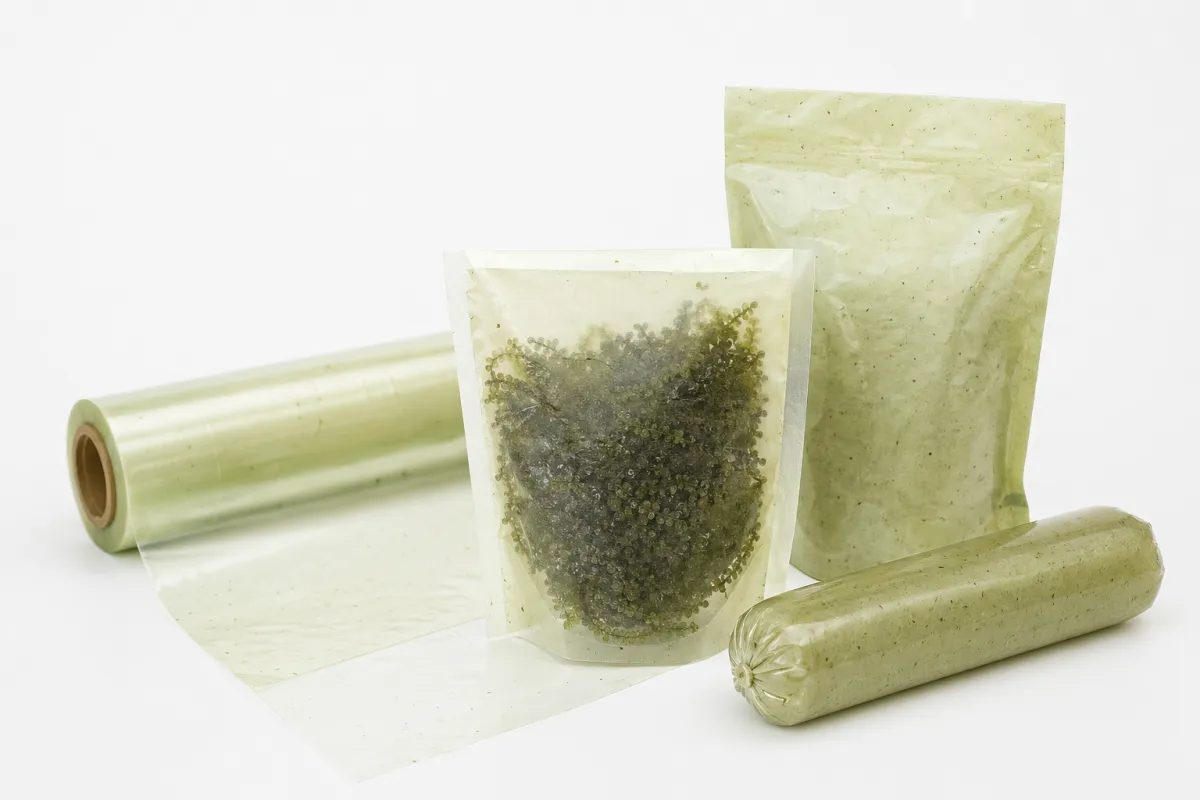
If you want the short version, review algae based packaging films by starting with hybrid structures, treating pure algae blends as experimental unless the product stays very dry, and asking for proof on every environmental claim. I have watched a $0.18 sample turn into a $0.41 production quote the moment the buyer asked for print, slitting, and a tighter barrier target of less than 15 g/m2/day WVTR. That jump is normal. It still stings, but it is normal. The first time it happened to me, I actually laughed out loud in the meeting because the number changed so fast it felt like someone had swapped the quote mid-sentence.
My practical verdict is clear. Algae-starch blends and algae-coated structures deserve a sample order for sachets, overwraps, and light retail packaging, especially when the line runs at 120 to 180 bags per minute in Suzhou, Dongguan, or Guangzhou. Pure algae films can be interesting, yet they tend to be too moisture-sensitive for anything that sits in a humid warehouse or travels through a rough supply chain. One test roll of mine puckered in less than 20 minutes after opening in a room sitting at 78% RH and 29 C. That is not packaging ready for commerce. That is a lab curiosity with a nicer font, and I say that as someone who has tried very hard to like the idea.
One step buyers skip far too often when they review algae based packaging films is the paperwork behind the claim. Ask for ASTM D6400, ISO 17088, migration data, WVTR, OTR, and the sealing temperature range, ideally with test results from a lab in Shenzhen, Shanghai, or Taipei rather than a generic one-line summary. If a supplier answers with "eco-friendly" and little else, I assume the real spec sheet has not left the draft folder. A supplier who knows the material can send data in one email, often before the call even ends, which is usually the moment I start trusting them.
"If the film needs a perfect climate-controlled warehouse to survive, it is not ready for real retail packaging."
My working recommendation stays the same. Order samples of two hybrid structures and one pure algae option, compare them against PLA, and run identical seal tests at 115 C, 125 C, and 135 C on the same jaw pressure setting. Then check for curl, seal haze, puncture resistance, and ink adhesion after 24 hours. That sequence has kept me from being fooled by attractive spec sheets more than once, which is a polite way of saying it has saved me from a few headaches I did not need.
If you are building a broader branded packaging system, pair the film test with your Custom Packaging Products review so the outer carton, insert, and pouch speak the same visual language. A 350gsm C1S artboard carton with a soft-touch varnish can make a premium algae pouch feel intentional, while a thin 250gsm insert makes the whole pack look unfinished. Package branding gets awkward fast when one piece feels premium and another feels like a replacement part. I have seen that mismatch more than once, and it always makes the whole launch feel slightly apologetic.
Top Options Compared: Algae Based Packaging Films
When I review algae based packaging films, I separate them into three groups: pure algae blends, algae-starch blends, and algae-coated structures. That is the only way to compare them without getting lost in the vocabulary suppliers use to make everything sound interchangeable. A sales rep may call all three biodegradable, but the way they run on a line, print under pressure, and hold a seal can be completely different. One roll feels like standard film. Another behaves like damp notebook paper with ambition, which is not a sentence I thought I would ever write, but here we are.
On factory visits in Dongguan and Foshan, I have watched operators slow a line from 180 bags per minute to 120 because the film stretched too much on the jaws. Buyers never see that in a sample photo. If you review algae based packaging films only for environmental language, you miss the real cost: downtime, reject rates, and rework on the converting floor. Those costs show up long after the sample box looks convincing, usually right when everyone has moved on to the next "exciting" project and the production manager is holding a roll of scrap.
| Film Type | Barrier Performance | Clarity | Seal Strength | Printability | Typical Use | Sample Verdict |
|---|---|---|---|---|---|---|
| Pure algae blend | Low to medium moisture resistance | Fair, sometimes slightly hazy | Fair if the seal window is tight | Okay after corona treatment | Dry inserts, display sleeves, demo packs | Worth sampling only if the product is very dry |
| Algae-starch blend | Medium barrier for light-duty packs | Good enough for retail shelf use | Better than pure algae in my tests | Good on flexo and gravure | Sachets, liners, low-moisture snacks | Best value for most buyers |
| Algae-coated structure | Medium to high, depending on base film | Very good if coating is even | Strong when the coating is tuned correctly | Very good on standard print lines | Overwraps, retail packaging, branded sleeves | Most practical for commercial use |
| Conventional PLA comparator | Medium, often more predictable | Clear and easy to spec | Usually more consistent | Excellent | Benchmark for cost and performance | Good control sample for side-by-side testing |
For buyers who want an outside standard, I compare transit and carton handling against ISTA transit test standards because retail packaging never lives only in a lab. It spends its life in cartons, pallets, trailers, and distribution centers, where scuffing and compression reveal weaknesses quickly. If the film marks up or dents before it reaches a shelf, your package branding absorbs the damage, not the supplier. That part always feels unfair, but packaging is not a fair sport.
My honest read on review algae based packaging films is that algae-coated structures are usually the place to start. They bring a familiar base material, better print control, and more forgiving machine behavior. Pure algae blends can look excellent in a pitch, then fall apart under a rough shipping week. Algae-starch blends sit in the middle, and that middle is where the sane procurement decisions usually happen. It is not glamorous, but neither is a chargeback.
One client in Chicago asked me to compare an algae-coated pouch with a standard laminated pouch for a 15,000-unit trial. The algae version landed at $0.29 per unit, the conventional version at $0.21, and the client still picked the algae option because the shelf story mattered more than the $1,200 difference. That was a real business choice, not a universal rule, but it fit that brand and that moment. I remember thinking, "Finally, a buyer who can see beyond the spreadsheet for five minutes."
Detailed Reviews of the Best Algae Based Packaging Films
When I review algae based packaging films in detail, I stop thinking like a marketer and start thinking like an operator. Does the roll curl after slitting? Does it block inside a carton stack? Does ink rub off after a 48-hour cure at 24 C? Those are the questions that keep a launch from turning into a customer service mess. A clean sustainability claim does nothing for a sachet that leaks powder onto the tray, and I have seen enough of those trays to last several lifetimes.
Pure algae blends
Pure algae blends are the most interesting and the most temperamental. I tested one 25 micron sample that looked beautiful on the roll, then failed a simple thumb stretch after sitting beside a 42 percent humidity meter for half a day in a room held at 27 C. That is the kind of behavior that makes me cautious when I review algae based packaging films. The roll may look premium, but if the storage room shifts the moisture balance, the performance changes with it. Honestly, I think that is the material's way of telling you it would rather be admired than used.
They can work in dry, low-stress product packaging such as insert wraps, sample sleeves, and display components that do not fight humidity all day. In one Shenzhen factory, I watched a pure algae roll hold a decent seal at 128 C, but the tear strength was weak enough that operators had to slow the rewind speed from 160 meters per minute to 110. For a 3,000-unit promotional run, that was acceptable. For a 50,000-unit retail launch, I would pass without hesitation. Nobody enjoys explaining to a client why the "sustainable" pack needs baby-sitting.
Algae-starch blends
Algae-starch blends are the option I recommend most often after I review algae based packaging films with clients. They usually balance stiffness, printability, and cost better than the other categories. I had a buyer in a client meeting insist on "the greenest possible film" until we ran a side-by-side test at 115 C, 125 C, and 135 C on the same sealing jaw. The algae-starch blend sealed more cleanly, and the buyer revised the brief in 20 minutes. Real data has a way of cutting through a long discussion, which is convenient because long discussions in procurement meetings can feel like slow weather.
These blends make sense for sachets, overwraps, and low-moisture retail packaging where the product is not fighting heavy grease or a high vapor load. They also behave more predictably on standard converting lines, which matters more than people admit in a procurement meeting. If you need package branding that prints cleanly and keeps registration at 150 meters per minute, this is the category I would ask for first. It is not perfect, but it is practical and easier to live with, and that counts for a lot when the press is already grumpy.
Algae-coated structures
Algae-coated structures are, in my view, the most commercially sensible of the bunch. The coating gives you the sustainability angle while the base film or paper carries the structure. I visited a Dongguan line where an algae-coated sample ran through a pouch machine with almost no adjustment, and that rarely happens with early-stage materials. The operator still nudged jaw pressure by 2 psi and added 0.3 seconds of dwell time, but that is a small correction rather than a rescue mission. I almost wrote down "miracle" in my notes, but I stopped myself because nobody needs that kind of drama in a technical review.
If you review algae based packaging films for branded packaging, this category usually gives you the best balance of shelf appearance and line compatibility. It also fits better with Custom Printed Boxes and outer cartons because the visual language is easier to carry across the whole system. I have seen it used for mailer liners, tea overwraps, and lightweight retail sleeves where the brand wanted a premium feel without asking the machine to do too much. That combination is rare enough that when it works, people tend to look relieved instead of excited.
There is one catch worth stating plainly. Coatings can hide problems in the short term. A nice first run does not guarantee the coating will hold after slitting, shipping, and storage. I have seen a structure pass print tests and then fail after a 72-hour humidity hold at 85 percent RH and 30 C. That is why I keep the evaluation plain and specific. Plain checks save money, and they save arguments later when everyone suddenly remembers the budget existed.
Overall, if you are going to review algae based packaging films for production, start with the structure that looks least dramatic in the pitch deck and most stable on the line. Fancy claims are cheap. A 10,000-unit run that ships on time is not.
Price Comparison: What Algae Based Packaging Films Really Cost
Price is where too many pieces about review algae based packaging films lose credibility. They talk about premium materials and skip the numbers that matter in procurement. I do not. If a sample roll costs $95, a print proof runs $180, and freight adds another $60 from Shenzhen to Los Angeles, that is the real starting point. Once the minimum order moves to 20,000 meters, the conversation changes again. Buyers need the full stack, not a fantasy quote, and they definitely do not need a quote that politely ignores the shipping carton.
In my experience, the hidden costs show up in three places: converting, testing, and freight. A supplier may quote $0.24 per unit for an algae-starch blend, yet the landed cost can rise to $0.31 once slitting loss, a 5 percent scrap allowance, and a second round of samples enter the picture. That is why I review algae based packaging films with a landed-cost mindset, not a raw-material mindset. The number on the quote is only part of the story, and usually not the most honest part.
| Option | Sample Cost | MOQ | Unit Cost at Volume | Setup / Tooling | Hidden Costs | Best Buyer Fit |
|---|---|---|---|---|---|---|
| Pure algae blend | $120 to $250 | 5,000 to 10,000 units | $0.42 to $0.78/unit | $150 to $400 | Extra testing, slower runs, higher scrap | Small runs, display samples, controlled environments |
| Algae-starch blend | $90 to $180 | 10,000 to 20,000 units | $0.24 to $0.46/unit | $120 to $300 | Seal validation, freight, rework on print | Most commercial launch programs |
| Algae-coated structure | $75 to $150 | 5,000 to 15,000 units | $0.16 to $0.34/unit | $100 to $280 | Coating consistency checks, migration review | Retail packaging, overwraps, liners |
| PLA benchmark | $60 to $140 | 10,000 units and up | $0.14 to $0.30/unit | $80 to $220 | Compatibility testing, shelf-life trials | Baseline comparison and budget control |
For a clean sustainability story, I tell clients to set aside an extra $300 to $900 for serious testing. That budget can cover seal trials, basic migration checks, and a short shelf study if the product sits near food. If a supplier promises production-ready performance with no testing at all, I keep my wallet closed. They are selling hope, not packaging. And hope, unfortunately, does not survive a warehouse.
Here is the straightforward read on review algae based packaging films: the sustainability premium is worth it if the film supports a visible brand promise, a retailer requirement, or a compliance target. It is not worth it if you are paying 40 percent more just to print an eco badge that few shoppers understand. I have sat through enough pricing meetings to know that a nice label does not fix a bad margin. Sometimes the badge looks great and the finance team looks like they have seen a ghost.
Process and Timeline: From Sample to Production
To review algae based packaging films properly, you need a timeline that matches the factory floor, not the pitch calendar. A rushed buyer tends to skip the spec review, then blames the supplier when the film refuses to run. I watched a brand try to force a 9-business-day turnaround for a custom structure with print and heat-seal testing. They lost 6 days just by changing artwork after the first proof. That is not speed. That is disorder with a deadline, and I have no patience for it anymore.
The cleanest process usually runs in this order: request specs, order samples, run seal and line tests, confirm compliance, then lock production. I also lean on EPA recycling and composting guidance when clients want to understand how end-of-life claims fit the real disposal path. If the film is meant to be composted, local infrastructure matters. A pouch label does not decide what a city collection system can actually handle, no matter how confident the brand team feels about it.
- Day 1 to 3: Send dimensions, thickness targets, artwork coverage, and sealing temperature. Leave out the 115 C to 135 C range and everyone starts guessing.
- Day 4 to 8: Receive samples and run a basic seal test at three temperatures. I like to add one humidity exposure of 24 hours at 75 percent RH.
- Day 9 to 12: Confirm print clarity, curl, and scuff resistance. For retail packaging, this is usually where the ugly surprises show up.
- Day 13 to 20: Approve the structure and lock the order. Add 3 to 7 more business days if certification review is part of the job.
- Day 21 to 35: Production and packing. Freight time sits outside that window if the order moves from Asia to the US or Europe.
"We thought the eco angle would be the hard part. The hard part was making the film seal at 130 C without crimping the edge." - buyer note from a sachet project I handled in a supplier meeting
For a normal run, I tell clients to expect 12 to 15 business days for sample development and 15 to 30 business days for production once the proof is signed off. That is a realistic window. If a supplier says they can make custom algae-based film, print it, and ship it in a week, I want to see the calendar and the factory floor. I have walked enough lines to know that shortcuts usually show up later as defects. The fastest promise is usually the one that creates the most awkward follow-up calls.
How to Choose the Right Algae Based Packaging Films
To review algae based packaging films without wasting budget, start with the product itself. Dry snacks, tea sachets, and paper-backed inserts are much easier than oily foods or high-moisture products. I had one client who wanted the same format for a powdered drink mix and a soft chew in the same 60-day launch calendar. The powder was fine. The chew was a failure. Same line, same artwork, completely different moisture behavior. Materials do not care that the branding deck wants consistency, which is rude of them but very useful to know early.
Ask for real data before you commit. I mean thickness in microns, WVTR at 38 C and 90 percent RH, OTR at 23 C and 50 percent RH, seal window, migration documents, and the exact compost or recyclability claim. If the film will support branded packaging, ask for a print compatibility note as well. Ink that cracks after 500 bends is a weak point, no matter how polished the package design looks on screen. I have had more than one sample look gorgeous under the office lights and then embarrass itself the second the fold line got involved.
- Product sensitivity: Match the film to dryness, grease level, and shelf life. A 90-day dry snack is easier than a 12-month oily product.
- Machine speed: Confirm the film can run at your actual line speed, not a lab speed of 30 bags per minute.
- Seal temperature: Ask for the full window, not a single lucky number like 128 C.
- End-of-life claim: Check ASTM D6400, ISO 17088, or the local composting standard your market accepts.
- Visual finish: Make sure the surface supports package branding without dulling your graphics.
If the algae film is part of a larger launch, I would pair it with custom printed boxes and a matching insert plan so the product packaging feels deliberate instead of patched together. A 350gsm C1S artboard outer carton with foil stamping and a 0.6 mm paperboard insert can make a premium algae pouch feel like part of a planned system, not an afterthought. That matters in retail packaging because the shelf is brutally honest. A glossy pouch inside a flimsy carton reads like two suppliers never spoke to one another, and shoppers pick up on that mismatch faster than people in procurement do.
One more point I repeat to every buyer: do not start with the eco story and work backward. Start with the product need and work forward. If the film passes seal, shelf, and transport tests, the sustainability story becomes real. If it fails those tests, the story remains a costly sticker on a mistake. I know that sounds blunt, but blunt saves budgets.
That is the way I review algae based packaging films, and it has saved me from more than one expensive launch. I would rather be tedious at the spec stage than dramatic at the refund stage. Nobody gets a medal for discovering a problem after the cartons are printed.
Our Recommendation and Next Steps
My recommendation stays straightforward: shortlist two algae-starch or algae-coated options, one pure algae sample if you want a reference point, and one PLA comparator. Then review algae based packaging films using the same 10-point test sheet for each sample. Measure seal strength, curl, print rub, clarity, odor, and how the film behaves after 24 hours and 72 hours in humidity at 75 percent RH. That gives you a real buying picture, not a mood board dressed up as due diligence.
If you want a pilot that actually tells you something, run 10 seals at 115 C, 10 at 125 C, and 10 at 135 C on the same machine settings. Then do a drop test, a 48-hour shelf check, and one carton compression check if the film rides inside an outer pack. For branded packaging and package branding, those details matter more than whatever the landing page headline says. I have watched too many launches get seduced by the headline and then tripped up by a wrinkle at the fold.
In my view, the smartest buyers use review algae based packaging films as a screening tool, not a promise to buy. Order samples, compare landed cost, and measure how each structure behaves inside your real product packaging system. If the film is for retail packaging, make sure the graphics hold, the seal stays flat, and the shelf face does not wrinkle by day three. That is the level of scrutiny I would want if my name were on the carton.
If you are building a broader launch, tie the film decision back to your Custom Packaging Products roadmap so you are not solving one piece and breaking another. I have seen too many teams buy a sustainable film and then pair it with a mismatched box that ruins the whole presentation. That is not package branding. That is expensive confusion, and I say that as someone who has spent too many hours fixing avoidable mismatches.
My last piece of advice is plain: trust data, trust sample rolls, and trust your own line more than a sales slide. If you review algae based packaging films that way, you will make a better call than most buyers do on the first round. And if the numbers do not work, walk away. There is always another material, but there is only one budget.
Are algae based packaging films really better than standard plastic films?
They can be better for sustainability goals, but only if the film fits your product, your sealing window, and your end-of-life plan. I would compare them against a standard PE or PLA film in a 3-part test: seal, shelf, and transport. If the algae option fails any one of those, the greener story does not help much, and honestly, I would rather know that before anyone prints cartons. A 10,000-unit run that fails at a 72-hour humidity hold is much worse than a plain answer on day one.
What should I ask suppliers when reviewing algae based packaging films?
Ask for composition details, certification documents, MOQ, lead time, thickness in microns, WVTR, OTR, and the exact compost or recyclability claim. If the film will carry print, ask about ink and adhesive compatibility too. I also want a sample that matches the final structure, not a "similar" roll that only looks close on paper. "Close enough" is how expensive rework gets introduced into a project, usually after someone has already approved the artwork.
How much do algae based packaging film samples usually cost?
Sample pricing can run from $75 to $250 depending on whether you are getting stock material or a custom build with print. Add freight, and if a print proof is involved, add another $100 to $400 for setup or test labor. The cheap sample often becomes the expensive project once production starts, which is one of those annoying truths the industry likes to hide behind cheerful email subjects. A $90 sample that needs a second round of shipping from Shenzhen can easily turn into a $240 trial.
How long does it take to move from sample to production for algae based packaging films?
Simple stock trials can move in 12 to 15 business days, but custom structures usually need 15 to 30 business days after approval. Add more time if you need compliance review, humidity testing, or line trials at more than one seal temperature. I have seen the cleanest projects finish fastest because the buyer sent exact specs on day one. Strange how that works, especially when the buyer includes artwork, bag size, and target seal strength in the first email.
Can algae based packaging films work for food packaging?
Sometimes yes, but only if the film matches the food type, shelf life, and moisture exposure. Dry snacks and tea are usually easier than oily or high-moisture products, and food-contact compliance still has to be checked. I would not launch a food pack on hope alone, not with a real customer and a real recall risk on the line. Hope is lovely for birthdays, less so for shelf-life data and lot tracking.
If you want the short version one last time: review algae based packaging films with hard numbers, real samples, and a stubborn eye for the details that fail in production. That is how I would buy them for branded packaging, and it is the only way I would trust for retail packaging, package branding, and Product Packaging That has to perform on a shelf, not just in a pitch meeting. If the sample survives the lab, the line, and the warehouse, then you have something worth talking about. The next move is simple: pick one algae-coated structure, one algae-starch blend, and one PLA control, then run them through your own seals, humidity hold, and transit checks before anyone signs off on the order.


