Buyer Fit Snapshot
| Best fit | Vacuum Insulated Shipping Boxes projects where brand print, material claims, artwork control, MOQ, and repeat-order consistency need to be specified before quoting. |
|---|---|
| Quote inputs | Share finished size, material target, print colors, finish, packing count, annual reorder estimate, ship-to region, and any compliance wording. |
| Proofing check | Approve dieline scale, logo placement, barcode or warning zones, color tolerance, closure strength, and carton packing before bulk production. |
| Main risk | Vague material claims, crowded artwork, missing packing details, or unclear freight terms can make a low unit price expensive after revisions. |
Fast answer: Vacuum Insulated Shipping Boxes: How They Work in Practice should be specified like a repeatable production item. The safest quote records material, print method, finish, artwork proof, packing count, and reorder notes in one written spec.
Production checks before approval
Compare the actual filled-product size with the drawing, then confirm tolerance on folds, seals, hang holes, label areas, and retail display edges. Reserve space for logos, QR codes, warning copy, and material claims before decorative graphics fill the panel.
Quote comparison points
Review material grade, print process, finish, sampling route, tooling charges, carton quantity, and freight assumptions side by side. A quote is only useful when the supplier can repeat the same color, closure quality, and packing count on the next order.
Vacuum Insulated Shipping Boxes: How They Work in Practice
The first time I watched a pallet of vacuum insulated shipping boxes come off a freight line in Shenzhen, Guangdong, the stack looked almost too engineered to be practical, like someone had taken a 2-8 C validation brief and wrapped it in corrugated board, VIP panels, and a very serious attitude toward cold chain control. I remember standing there with a clipboard, a five-channel data logger, and that skeptical look people get when a sample appears more theoretical than useful. Then we ran a four-hour hot-delay test at 30 C after the cartons sat on a dock for 45 minutes, and the cheaper foam shipper lost temperature control first by 2.5 C. That one result changed the way I talk about cold-chain packaging. A shipper is never just a carton with insulation; it is a control point, and if the control point fails, the product pays for it in wasted inventory, replacement freight, and a quality report nobody is thrilled to write.
At Custom Logo Things, I hear the same question from pharma buyers in New Jersey, specialty food brands in Chicago, and lab teams near Cambridge, Massachusetts: do vacuum insulated shipping boxes justify the higher price, or are they just expensive packaging wearing a technical costume? My honest answer is that the right decision lives inside the lane, not inside a polished sales sheet. A short, forgiving route can make foam look clever, while a longer route with airport dwell at Atlanta Hartsfield, summer tarmac heat in Dallas, or a late courier pickup in Los Angeles makes better thermal engineering look economical by comparison. I have seen a $31 shipper save a $900 biologic sample, and I have also seen a team overspend on overbuilt packaging because nobody mapped the route before placing the order. Both mistakes show up in real life, usually before the first coffee refill, which is inconvenient but predictable.
What Are Vacuum Insulated Shipping Boxes?
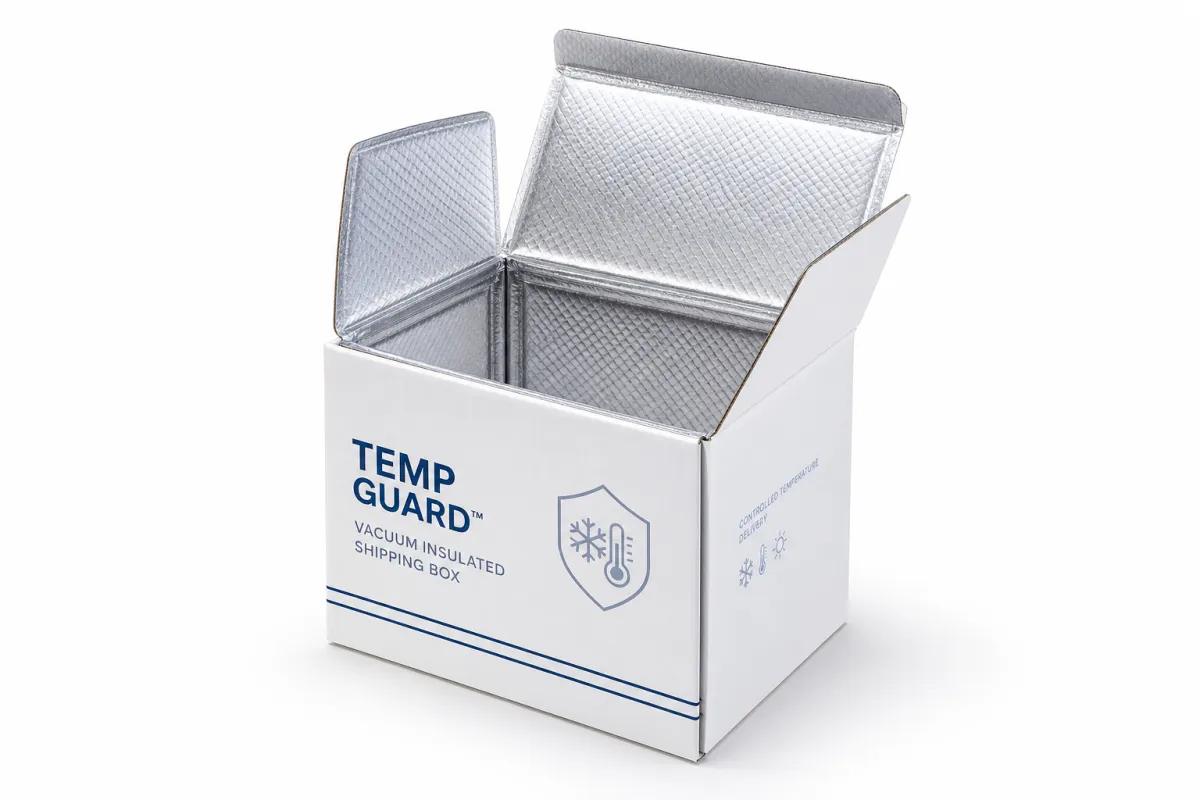
In plain language, vacuum insulated shipping boxes are temperature-controlled shippers built around vacuum insulated panels, or VIPs, that resist heat transfer far better than ordinary foam alone. Think of them as a tighter, more efficient transit package for lanes where a 2 C drift matters and guesswork is expensive. Instead of relying only on expanded polystyrene, molded pulp, or corrugated inserts to slow the outside world down, the box uses panels with extremely low thermal conductivity, then surrounds the payload with liners, gel packs or phase-change materials, and dunnage that keeps the product from shifting like loose hardware in a metal tray. The difference is measurable: a 20 mm VIP panel can outperform a much thicker foam wall, especially when the panel is paired with a 350gsm C1S artboard sleeve or a 3-layer corrugated outer carton in Shanghai or Dongguan.
I remember a client meeting in Suzhou where the dock crew laughed at the sample because it looked smaller than the old EPS shipper they had used for years. Same payload. Less bulk. Lower dimensional weight. Less wasted space in ecommerce shipping and air freight. After a 72-hour validation run with a 32 C chamber profile and a 5 C payload start temperature, the smaller format performed better than the larger foam shipper because the VIP panels were doing the heavy thermal lifting. That is the part people miss when they compare packaging by volume alone. Bigger does not automatically mean better. In cold-chain work, a large empty cavity is often just an expensive way to move air from one warehouse to another.
Vacuum insulated shipping boxes show up most often for pharma, biologics, specialty food, diagnostic kits, cell and gene therapy components, and lab samples that cannot drift outside a narrow temperature band. I have seen them specified for 2-8 C products, frozen payloads at -20 C, and controlled ambient lanes where the product must stay below 25 C for 48 hours. They also appear in order fulfillment programs for high-value cosmetics, enzymes, and reagents, where one temperature excursion can turn a profitable shipment into a refund, a replacement, and a very awkward call with operations in the middle of a Monday morning review. That call, by the way, never sounds as calm as the quote approval did.
Three truths usually matter more than the sales pitch. First, these shippers can deliver better thermal performance in a smaller footprint, which helps when a carrier bills by dimensional weight. Second, the unit cost is higher than basic foam, especially if the build includes a printed outer sleeve, foil-lined pouch, or a custom PCM map. Third, the setup process rewards testing and punishes guessing. If a supplier skips validation at 30 C, 38 C, and 40 C profiles, the buyer is not purchasing a smarter shipper. The buyer is purchasing a prettier gamble, and the gamble usually gets expensive once freight hits the ledger.
I see a lot of buyers blur the line between insulated and controlled. A standard insulated shipper may buy time, especially on a 6-hour regional route out of Atlanta or Minneapolis. Vacuum insulated shipping boxes buy more time with less material, but only when the lane, the packout, and the handoff process are disciplined from the start. Without that discipline, the premium disappears faster than the savings ever arrive, and the finance team ends up asking for the same explanation twice. Nobody wants that meeting. I mean, nobody.
How do Vacuum Insulated Shipping Boxes Keep Payloads Cold?
The science is not glamorous, but it is dependable. Vacuum insulated shipping boxes reduce heat transfer because the vacuum layer removes most of the air molecules that normally carry heat by conduction and convection. That is why a VIP panel can outperform a thick foam wall that is three or four times bulkier. The cold does not last forever inside the box; the box simply slows the rate at which heat gets in. That slower transfer is what creates hold time, and hold time is the whole conversation in cold-chain shipping, whether the route is 18 hours from Newark to Dallas or 52 hours through a weekend handoff in Phoenix.
Most builds follow a familiar pattern: an outer carton or hard shell for crush protection, vacuum insulated panels around the cavity, an inner liner that shields the panels, phase-change material or gel packs to stabilize the payload zone, and dunnage to stop rattling during transit. The exact stack changes by lane and payload mass. A 2-8 C biologic flying from Newark Liberty to Dallas-Fort Worth needs a different thermal recipe than a frozen dessert sample moving by regional courier to Miami, especially if the Miami lane includes a 3-hour warehouse hold and a 15-minute curbside transfer. Same family of shipper. Different handling conditions. Different failure points. Different ways to make everyone on the program suddenly care about the validation spreadsheet.
What the layers actually do
The outer shell takes the abuse first. It handles stacking, conveyor belts, forklift corners, and the handler who treats every carton like a practice shot. A good outer carton might use 32 ECT or even 44 ECT board, while a premium printed version can use 350gsm C1S artboard over a corrugated sleeve when appearance matters for retail fulfillment. The VIP layer is the thermal engine. The liner protects the VIP from puncture and crush damage. The phase-change material sets the temperature plateau, often around 2-8 C or -20 C depending on the lane. Use the wrong PCM and the box may look successful while the payload crosses into the wrong range. That is not success. That is a clean-looking failure with paperwork attached, which is somehow even more annoying.
In one factory visit in Dongguan, I watched a converter test the same carton with two pack patterns: one left a 12 mm air gap on the top panel, the other packed a 300 g payload flush against the lid and used 2 x 400 g gel packs on the sides. The flush pack held temperature about 6 hours longer in a 32 C chamber. Same box. Same materials. Different result. That is why I never trust a product sheet by itself. I trust the sheet, the data logger, and the thermal report together, because only the three of them tell the full story. If one of them is missing, I start asking questions that make people suddenly remember they have another meeting in ten minutes.
Where the cold gets lost
The limits matter. Vacuum insulated shipping boxes do not correct a bad handoff at the airport, a truck that sits unpowered for 3 hours, or a warehouse that stages pallets under a skylight in July. If the payload starts at 10 C instead of 4 C, the shipper has less margin. If ambient temperature jumps from 18 C to 38 C, hold time falls. If the route adds a Saturday hold or a Sunday delivery attempt, the numbers change again. Cold-chain packaging is a system, not a magic trick, and I wish I had a dollar for every time someone hoped a premium box could repair a sloppy process after the fact.
For thermal validation, I want the conversation tied to a real test method. The teams who take this seriously usually compare profiles against ISTA testing standards and check materials against lab protocols such as ASTM D4169. That does not make the shipper perfect. It just makes the claim less theatrical and a lot easier to defend when somebody asks for proof after a shipment arrives warm in a Portland receiving bay or a Houston distribution center. And somebody always asks for proof, usually after the first spreadsheet with a red cell lands in their inbox.
Payload prep matters just as much. If a sample leaves the fridge at 9 C instead of 4 C, the box is already losing ground. If the packer leaves the lid open for 90 seconds while hunting for tape or a missing temperature logger, the clock starts bleeding immediately. The box is not the hero. The process is. I say that a lot because it keeps being true, even when people wish it were less true.
Key Factors That Affect Performance and Hold Time
The first decision driver is hold time. Not theoretical hold time. Actual required hold time in hours, plus a cushion. If a lane normally takes 18 hours but your product can only tolerate 24, the extra time needs to account for a missed scan, a warehouse delay, or the inevitable message that says the truck is running late from Indianapolis. I like to see 20 to 30 percent buffer beyond the normal transit window, and more when airport dwell or cross-dock handoffs show up in the route map. That margin is the difference between a program that breathes and a program that keeps everybody nervous on Thursday afternoon.
Lane conditions matter just as much. A summer lane through Phoenix is not the same animal as a winter lane through Minneapolis. Airport tarmac delays can add 2 to 6 hot hours. Last-mile delivery in a dense city can be smooth, or it can turn into a two-story walk-up with no temperature control and a tired driver who has apparently made peace with disappointment. Warehouse staging deserves its own warning label. I have watched good vacuum insulated shipping boxes fail because they sat on a dock for 5 hours waiting for a late carton count in Louisville. The packaging was fine. The schedule was not. Packaging cannot fix a calendar, no matter how politely you ask.
Payload mass and fill ratio are sneaky variables. A heavier product changes the thermal inertia inside the shipper. A half-empty cavity leaves too much dead space, which can speed up temperature drift and create uneven cooling. I like the packout tuned to the exact product size, not stuffed with random filler because somebody found extra dunnage on the shelf in the back room. Improvisation feels harmless until the first excursion lands on your desk. I have seen a buyer spend $18,000 on validation and then ship launch inventory with 40 grams of the wrong gel pack. That kind of mistake is preventable, which makes it sting even more.
Starting temperature is another giant factor. If the payload enters the box at 4 C, the system has a full thermal runway. If it enters at 8 C, the shipper may still work, but the hold time shrinks. I once worked with a specialty food client shipping enzyme-based ingredients from a refrigerated room in Newark that cycled between 2 C and 10 C every afternoon. Morning packouts passed easily. Late-afternoon packouts drifted out of range because the starting temperature kept changing. Repeatability vanished, and with it went confidence in the whole program. You could feel the mood change in the room, which is never a great sign.
Testing should reflect reality, not wishful thinking. I want vibration, tilt, door-open events, and realistic ambient profiles in the trial. A clean chamber test at 25 C tells you very little if the real lane sees 38 C on a loading dock and 15 minutes of courier van time in July. I also like to compare pack patterns: one gel pack on top, two on the sides, or PCM at the base. Those choices can shift hold time by 4 to 10 hours depending on box size, payload mass, and the quality of the closure system. If a supplier cannot show that level of detail, I assume they have not run the box hard enough.
If you are comparing vacuum insulated shipping boxes for ecommerce shipping, ask how the design behaves under load, not just in a lab sitting politely on a shelf in a climate-controlled room. Real freight gets dropped, stacked, tipped, and delayed. That is the environment you are paying to survive, and it does not care how nice the prototype looked in a meeting in Santa Monica.
Vacuum Insulated Shipping Boxes: Cost and Pricing Breakdown
Money usually gets discussed backward. The quote is not the cost. The quote is the opening line. Vacuum insulated shipping boxes can vary widely based on panel material, size, closure style, print, and validation support. A small single-use build might land at $18 to $34 per unit at 1,000 pieces. A reusable VIP case can run $42 to $95 depending on the shell, latch system, and return logistics. A custom build using a 350gsm C1S artboard outer wrap and standard VIP inserts can drop the carton component to about $0.15 per unit for 5,000 pieces, but the assembled shipper still costs much more once panels, PCM, and labor are included. Custom dimensions, branded outer cartons, and specific PCM inserts push the number up quickly. I have seen teams react to a unit price like it is the whole answer, then quietly discover there are six other answers hiding in freight, labor, and sample approval.
The pricing reality I see most often is straightforward: material quality drives the base price, but order volume changes everything. At 500 units, the per-unit cost usually looks ugly. At 5,000 units, it gets more civilized. At 20,000 units, die changes, panel nesting, and freight math start to improve. Even at volume, vacuum insulated shipping boxes still do not behave like ordinary shipping materials. You are paying for thermal performance, not just cardboard and glue. That difference matters, especially when a single excursion can eat the savings from an entire quarter or force a replacement order out of a warehouse in Secaucus on the same day.
| Option | Typical Unit Price | Best Use Case | Main Trade-Off |
|---|---|---|---|
| Single-use vacuum insulated shipping boxes | $18-$34 at 1,000 units | Pharma samples, lab kits, one-way cold-chain freight | Lower return burden, higher per-trip spend |
| Reusable VIP case | $42-$95 | Repeated lanes with controlled reverse logistics | Better long-term cost, more handling complexity |
| EPS foam shipper | $4-$12 | Short, forgiving lanes with modest temp risk | Bulkier footprint and lower thermal efficiency |
| Hybrid printed outer carton with VIP liner | $22-$41 | Branded ecommerce shipping and premium cold-chain programs | More design work and more components to source |
The hidden costs are where buyers get surprised. Packing labor matters. If the box takes a 3-step closure and 90 seconds of assembly, that labor is real. Temperature loggers cost money too, usually $8 to $25 per shipment depending on type and memory range. Freight adds another layer because dimensional weight hits harder on larger shippers, especially on routes from Chicago O'Hare to West Coast customers. Storage space matters as well; a reusable case can consume 3 to 5 times the shelf space of a flat-pack carton. Returns handling creates another cost center when the shipper is reusable, and reverse flow is never just a footnote. It always turns into a process, a spreadsheet, and eventually a meeting nobody enjoys.
I have compared quotes where the unit price looked $4.50 lower, but the so-called cheaper supplier left out validation support, gave a 9-week lead time, and expected the buyer to source the PCM separately from a supplier in Kunshan. By the time freight, assembly labor, and logger costs were counted, the landed cost ended up about $11.20 higher per shipment. That is why I tell buyers to compare the whole system, not the sticker. Stickers are good for groceries. They are not much help here, especially when a product is worth ten times the packaging that protects it.
If you are building out branded logistics, the outer carton should still do real work. I would rather see a smart printed shipper from Custom Shipping Boxes than a plain carton with a logo pasted on as an afterthought. For secondary kits or internal pack components, Custom Poly Mailers can keep accessories separated without adding unnecessary box volume. And if your team is sourcing broader packaging support, the full range of Custom Packaging Products is usually where the better total-cost conversation starts, especially once freight and storage in places like Dallas or Nashville enter the math.
One last pricing note: if a supplier will not break out the VIP panel cost, the liner cost, the outer carton cost, and the validation fee separately, I get suspicious. Not rude. Just suspicious. Transparency costs less than a surprise invoice and usually saves time later. It also tends to mean the project will be less dramatic, which is a gift to everybody involved, especially the person who has to explain the PO variance to finance in month-end close.
Vacuum Insulated Shipping Boxes: Process and Timeline
The sourcing process should feel organized, not ceremonial. For vacuum insulated shipping boxes, I like it to move through five stages: spec sheet, concept sample, thermal validation, revision, and production. If somebody tries to jump straight to mass production because the dimensions look close enough, I slow the room down. Close is not a spec. Close is a promise to lose product later. And I have learned, sometimes the hard way, that "close enough" is usually how expensive lessons begin.
Stage one is the spec sheet. You need product dimensions, target temperature range, hold time, payload weight, shipping mode, origin, destination, and average ambient profile. A buyer once sent me a one-line email that said, "Need cold shipper for berries." No lane, no dwell time, no summer temp, no ship date. We spent 48 minutes just extracting the basics, and then another 20 minutes confirming that the origin was Fresno and the destination was Boston. Good input saves weeks. Vague input creates them. I have never met a packaging project that got better after an unclear kickoff.
Stage two is the prototype. A simple spec change may move in 12 to 15 business days from proof approval, especially if the outer carton print is straightforward and the VIP inserts are standard sizes. A fully custom build can take 3 to 6 weeks for the first usable sample, depending on panel lead time and tooling. If the box needs unusual dimensions, a hard-shell format, or a custom insert made in Shenzhen or Foshan, I would budget 6 to 8 weeks before anyone starts acting surprised. That is normal. Packaging does not care about optimism, and honestly, optimism does not negotiate with lead times.
Stage three is validation. This is where the box earns its keep. A good thermal test run includes at least three chamber runs, one worst-case ambient profile, and a simulated packout that matches the real assembly line. I also want the team to document how long the box sits outside refrigeration before dispatch, ideally measured with a stopwatch and not a memory guess. If the launch lands in a hot season, add another round. I have watched a program pass in April and fail in August with the same materials. The weather had a vote, and it used it without asking permission.
Stage four is revision. Maybe the PCM mass is 12 percent light. Maybe the lid seal needs another 1.5 mm of compression. Maybe the outer carton flutes need better crush resistance because the freight lane is rough between Memphis and Phoenix. Those are not failures. They are the point of prototype work. The mistake is assuming the first sample should be final. That is how people end up paying twice, then acting offended that physics did not show more flexibility.
Stage five is production planning. Book freight early. Lock the launch window around the supplier's lead time. If your season starts in September, do not approve artwork in late August and then act shocked when your vacuum insulated shipping boxes arrive after peak demand has already started. I have seen that movie, and the ending is always expensive. There is usually a rushed email thread too, which somehow makes it worse, especially when the packaging factory in Dongguan is already booked for a run of medical kits and custom mailers.
Seasonal spikes matter too. Around summer, cold-chain demand rises and factories get backed up on thermal packaging, gel packs, and panel materials. A project that looks like 4 weeks in March can become 7 weeks in June if capacity is not reserved early. I tell buyers to build their launch calendar backward from ship date, not forward from the quote date, because the supply chain never shares your sense of urgency. It is deeply committed to its own calendar, which is not the same thing, and it rarely apologizes for the mismatch.
Common Mistakes That Wreck Temperature Performance
The biggest mistake is treating vacuum insulated shipping boxes like a magic fix instead of one part of a disciplined system. I have seen people buy the premium box, skip packer training, and then lose product because the team left the lid open while counting vials in a 28 C staging room. The box did its part for 45 minutes. The process blew it in 90 seconds. Cold-chain packaging is unforgiving that way, which is exactly why the boring details matter.
"We spent more on the shipper than on the product's packaging, then lost the shipment because the packout team used the wrong gel pack temp." That line came from a client meeting in Chicago, and I still remember it because the room went quiet right after. Nobody knew where to look, which was probably the most honest moment of the whole project, especially after the logger showed a 3.2 C spike at hour six.
Another mistake is choosing the wrong size. If the cavity is too large, dead space grows and temperature control gets less stable. If the cavity is too tight, the packout can crush the panel or leave no room for the PCM to do its job. I like to see at least 5 to 10 mm of design clearance where the structure needs it, but that number changes with the product, the panel thickness, and the exact box format. There is no universal good enough, which is irritating if you want a shortcut and comforting if you want a real answer.
Skipping validation in the actual lane is a classic error. Lab numbers in a clean chamber are not the same as road vibration, airline dwell, and a courier van with a busted door seal. I always ask for lane testing with data loggers at the origin and inside the payload cavity. If the recorded curve shows a 2-hour heat spike on transfer through a hub in Atlanta or Charlotte, that spike matters. Real shipping materials do not behave in ideal conditions, and neither do people. If they did, my job would be much shorter and a lot less interesting.
Another miss is forgetting the boring stuff. Temperature loggers, SOPs, return plans for reusable units, and disposal plans for single-use materials all matter. If the product is expensive, you want a plan for excursions, quarantine, and reverse logistics before launch, not after the first loss. The same goes for packer training. A 15-minute video is not training if the box takes 7 steps to assemble and every step can go wrong. I know that sounds harsh, but I have seen enough bent corners, misapplied tape, and misplaced gel packs to earn the tone.
Buyers also ignore dimensional weight and then wonder why the freight bill jumps 28 percent. If the shipper uses a larger outer shell than needed, the courier charges for volume, not vibes. That is a brutal lesson, but a useful one. Better to learn it on a sample run than in the middle of order fulfillment, where every mistake seems to arrive with its own invoice from a carrier hub in Harrisburg or Ontario, California.
Expert Tips for Choosing Vacuum Insulated Shipping Boxes
Start with a lane map. I mean a real one: origin zip code, destination zone, average transit duration, dwell points, ambient highs and lows, weekend risk, and the exact hold time you need. I once helped a client map a lane from a refrigerated facility in Secaucus, New Jersey, to a clinic network in Austin, Texas. The route looked simple until we counted a 4-hour airport delay, a 2-hour tarmac window, and a 6 p.m. receiving cutoff. Suddenly the box had to perform like a champ, not a brochure. That is the sort of detail that turns a spec into an actual program.
Order samples and run worst-day tests, not sunny-day tests. If your hottest lane is 38 C in August, test at 38 C. If the shipment may sit for 3 hours in a warehouse, simulate those 3 hours. The cost of a few prototype units is tiny compared with a product recall or a replacement run out of a plant in Monterrey. I would rather spend $600 on extra samples than absorb a $12,000 loss because somebody trusted a clean-room run that never saw real heat. Maybe that sounds cautious. I call it staying employed.
Build a supplier scorecard. Mine usually includes thermal performance, lead time, MOQ, assembly complexity, print quality, support response time, and landed cost. I also check whether the supplier can explain the difference between a liner spec and a panel spec without reading from a script. That sounds snarky because it is. If a supplier cannot explain their own box, they are going to be useless when a validation run drifts by 1.8 C. I want the person on the other end to know the product well enough to answer without wandering through a PDF like it is a haunted house in the industrial park.
- Thermal performance: Ask for chamber data, not just a promised hold time.
- Lead time: Get the production estimate in business days, not "soon."
- MOQ: Confirm the minimum before you fall in love with the sample.
- Support: Ask who helps when the first validation fails by 2 C.
- Total cost: Count freight, logger fees, and packing labor.
For sustainability, ask whether the outer board can be sourced with FSC-certified paper and whether the structure can be separated for recycling. The label matters less than the actual construction, so I always prefer a supplier who can answer with specifics. If you want the certification side, check FSC's material standards and compare them to the board grade on the spec sheet, whether that is 350gsm C1S artboard or a heavier double-wall corrugate. That conversation is more useful than another vague green claim printed in teal ink. I say that with affection for the design team, but only a little affection.
I also advise buyers in ecommerce shipping to think about the full transit packaging system, not just the cold box. If the kit includes inserts, instructions, return labels, and accessory packs, coordinate all of it together. That is how you avoid paying twice for fulfillment changes. A clean packout process, a sensible outer carton, and the right internal components will protect margin as much as product, especially when orders are leaving a hub in Columbus or a 3PL in Reno.
My practical take? Vacuum insulated shipping boxes deserve serious attention if your lane is tight, your payload is valuable, or your failure rate has become too expensive to ignore. Test them, measure them, and ask for quotes that show the full landed cost. That is the adult version of buying packaging. Everything else is wishful thinking with a purchase order number, and the PO number does not help much when a cold-chain excursion lands in quality review.
Vacuum insulated shipping boxes are not the cheapest option, and I would never pretend otherwise. But if your product needs tighter temperature control, smaller dimensional weight, and more reliable package protection across a rough lane, they can be the right answer. My rule is simple: run the worst-case test, compare the total cost, and do not approve anything you have not seen under heat, delay, and real packing conditions. If that sounds a little strict, well, cold-chain work has a funny way of rewarding strictness in warehouses from Newark to Oakland.
Frequently Asked Questions
How long do vacuum insulated shipping boxes hold temperature?
Hold time depends on panel thickness, payload size, packout design, and ambient conditions, not just the product name on the spec sheet. Many vacuum insulated shipping boxes are built for multi-hour or multi-day protection, but the real answer comes from lane testing with data loggers and a realistic profile, such as 30 C ambient for 24 hours with a 2-hour dock delay. If your route includes airport tarmac time, warehouse delays, or 35 C summer heat, build in extra margin of at least 20 percent. I like to say the box is only as strong as the messiness of the route you are asking it to survive.
Are vacuum insulated shipping boxes better than foam shippers?
Usually yes when you need higher thermal performance in a smaller footprint, especially for sensitive products and longer transit windows. Foam can still win on simplicity and cost for short, forgiving lanes, such as a 6-hour regional trip with no weekend hold. The better choice depends on product risk, shipping time, and total landed cost, not just the quote line for the outer carton. I have defended foam when the lane was easy, and I have pushed VIPs when the lane was rude. The right tool depends on the route, not the sales pitch.
What affects the price of vacuum insulated shipping boxes?
Price is driven by materials, box size, custom engineering, order volume, and whether the shipper is reusable. Labor, validation, monitoring devices, and freight can push the real cost higher than the unit quote, especially if the build includes a custom print run in 350gsm C1S artboard or a specialized liner from a plant in Jiangsu. A good comparison looks at cost per successful delivery, not just cost per box, because one excursion can erase the savings from a cheaper build. I would rather see a supplier show me the full math than make the price look tidy and hope nobody notices the missing pieces.
How long does it take to source custom vacuum insulated shipping boxes?
A simple spec change may move quickly, but custom builds often need sampling, testing, and revision rounds before production. Plan for supplier review, prototype approval, and thermal validation before you set a launch date. In my experience, 12 to 15 business days from proof approval is a sane target for a straightforward printed carton change, while more complex projects with new VIP tooling can take 8 to 12 weeks. If someone promises much faster without asking questions, I start looking for the catch, because there is always a catch hiding somewhere.
Can vacuum insulated shipping boxes be reused or recycled?
Some designs are reusable, but only if the structure, seals, and cleaning process support repeated cycles. Recyclability depends on the materials mix, so check whether the outer shell, liners, and inserts can be separated. If sustainability matters, ask suppliers for take-back, reuse, or recycling options Before You Buy, and confirm the plan in writing. I like clear plans here because "we should be able to figure that out later" usually turns into a warehouse headache nobody wants, especially when pallets are already stacked in a 10,000-square-foot facility in Nashville.