Buyer Fit Snapshot
| Best fit | Price for Antimicrobial Poly Mailers projects where brand print, material claims, artwork control, MOQ, and repeat-order consistency need to be specified before quoting. |
|---|---|
| Quote inputs | Share finished size, material target, print colors, finish, packing count, annual reorder estimate, ship-to region, and any compliance wording. |
| Proofing check | Approve dieline scale, logo placement, barcode or warning zones, color tolerance, closure strength, and carton packing before bulk production. |
| Main risk | Vague material claims, crowded artwork, missing packing details, or unclear freight terms can make a low unit price expensive after revisions. |
Fast answer: Price for Antimicrobial Poly Mailers: Material, Print, Proofing, and Reorder Risk should be specified like a repeatable production item. The safest quote records material, print method, finish, artwork proof, packing count, and reorder notes in one written spec.
Production checks before approval
Compare the actual filled-product size with the drawing, then confirm tolerance on folds, seals, hang holes, label areas, and retail display edges. Reserve space for logos, QR codes, warning copy, and material claims before decorative graphics fill the panel.
Quote comparison points
Review material grade, print process, finish, sampling route, tooling charges, carton quantity, and freight assumptions side by side. A quote is only useful when the supplier can repeat the same color, closure quality, and packing count on the next order.
Price Guide for Antimicrobial Poly Mailers: Costs & MOQ
A price guide for antimicrobial poly mailers is most useful when it shows where the money actually goes: film structure, antimicrobial additive, print coverage, closure design, and the realities of minimum order quantity. A mailer that looks inexpensive on paper can turn into a costly choice if the seal is weak, the print lands unevenly on a darker film, or the packing team has to slow down to wrestle with a bag that does not open or close the way it should.
For a packaging buyer, the real job is not simply ordering a mailer. It is balancing protection, brand presentation, packing speed, and unit economics so the shipping line stays efficient and the customer receives a package that looks clean and deliberate. That is why this price guide for antimicrobial poly mailers focuses on the practical pieces that change the final value, not on polished sales talk. If you are gonna spend the money, it helps to know exactly what you are buying.
One common mistake is treating antimicrobial mailers like a plain commodity. They are priced by much more than size. Gauge, seal strength, print method, order volume, artwork coverage, and custom features all move the quote, and even a small specification change can shift the number more than buyers expect.
If you are comparing options for ecommerce, healthcare-adjacent shipments, apparel, or subscription fulfillment, the smartest way to read a price guide for antimicrobial poly mailers is to start with a simple question: what does each shipment cost once labor, damage risk, and presentation are included? That view usually reveals the better value very quickly.
Price Guide for Antimicrobial Poly Mailers: What Really Drives Value
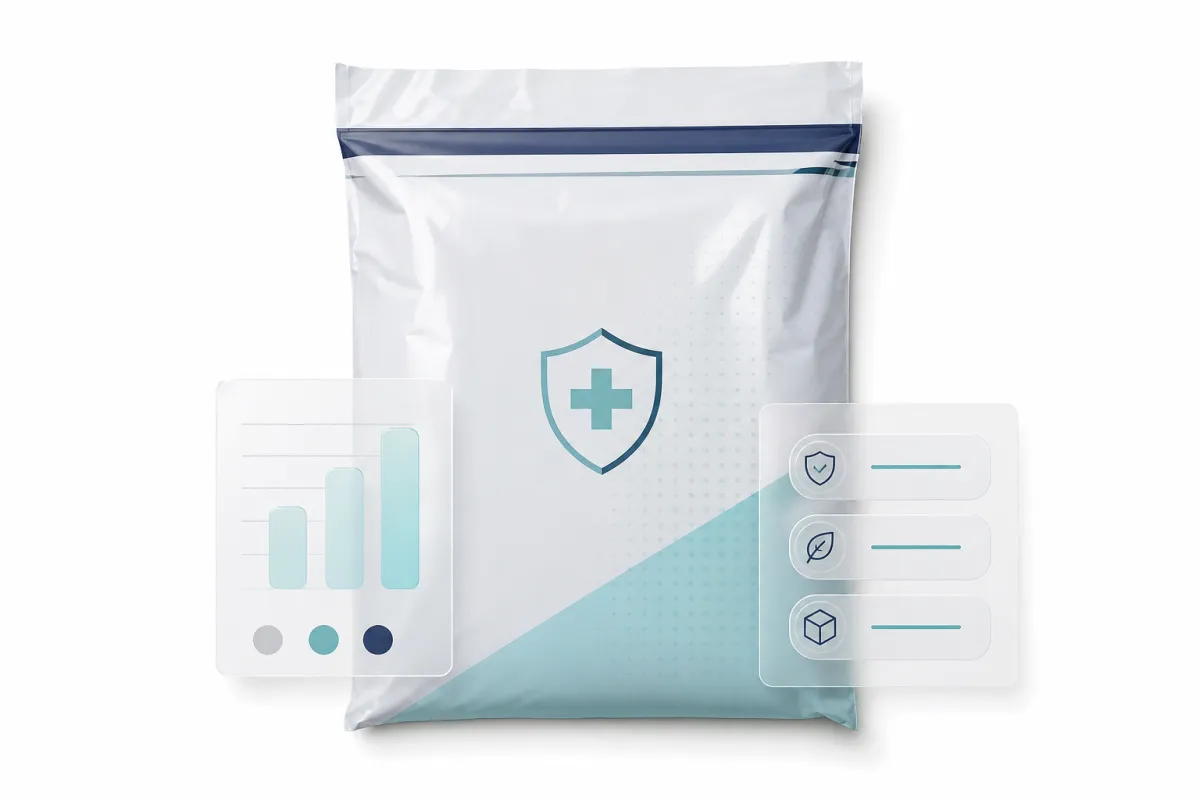
The best price guide for antimicrobial poly mailers starts with a straightforward idea: two mailers that look similar on a quote sheet can behave very differently in the warehouse. One may use a lighter film with a basic antimicrobial treatment, while another may use a thicker co-extruded structure, a stronger adhesive flap, and tighter print registration. The first can be cheaper per unit, yet the second may save money by reducing splits, returns, and pack-out delays.
The value of antimicrobial packaging shows up in the small operational details. Fulfillment teams want a mailer that opens cleanly, seals quickly, stays opaque enough for branding and privacy, and feels dependable in the hand. The antimicrobial feature plays a supporting role. It is there to help inhibit microbial growth on the mailer surface; it does not sterilize the package and it does not replace careful handling in the packing area.
A price guide for antimicrobial poly mailers also has to account for how orders move through a warehouse. If your team packs hundreds of orders an hour, a stiff, well-sized mailer can reduce hesitation at the station. That time savings can be worth more than a few cents trimmed from a thinner spec. When the bag fits correctly, the flap seals more consistently, the parcel stacks better, and the finished shipment looks intentional rather than rushed.
Another piece buyers often miss is the downstream effect of better construction. A slightly stronger film can reduce punctures during transit, and fewer damaged shipments mean fewer replacements, fewer support tickets, and less friction for the customer. That cost rarely shows up in the quote, though it shows up plainly in operations.
A cheaper mailer that splits at the seam or prints unevenly is not a bargain; it is a rework line waiting to happen.
In pricing these bags, I have seen teams save a little on unit cost only to spend more on packing labor and replacements a few weeks later. That is the part that makes a quote look good and the P&L look annoyed. A thoughtful price guide for antimicrobial poly mailers should help you compare the mailer, the print, the closure, and the life of the package in actual use. That approach tends to produce better purchasing decisions than chasing the lowest number on the page.
Product Details: What Antimicrobial Poly Mailers Are Made Of
Most antimicrobial poly mailers begin with a polyethylene film structure, often built as a mono-layer or multi-layer blend chosen for opacity, stiffness, and seal performance. The antimicrobial element is usually introduced through an additive package or a treated surface designed to help inhibit microbial growth on the mailer exterior. That does not change the fact that the bag is still a flexible shipping mailer, and the base film still has to do the hard work of resisting stretching, puncture, and abrasion.
In a practical price guide for antimicrobial poly mailers, the base material matters because it drives both cost and handling feel. A 2.0 mil bag may be enough for flat apparel or soft goods, while a 3.0 mil or heavier structure may suit items with corners, inserts, or mixed product loads. Buyers sometimes focus on the additive alone, yet the film itself often has the bigger effect on durability and the way the bag moves through the pack line.
Common features include self-seal closures, tear strips, tamper evidence, and opaque film for privacy and brand presentation. Some programs add printed return information, packing instructions, or a branded exterior design. Each of those choices changes how the bag is built and how it is priced, which is why the price guide for antimicrobial poly mailers should always be read together with the spec sheet, not in place of it.
It also helps to separate antimicrobial treatment from broader contamination control. The bag surface may help reduce microbial growth, but it does not replace clean packing practices, proper storage, or regulated barrier packaging where those standards are required. Buyers in medical, laboratory, or controlled environments should confirm whether the application is appropriate for the shipment and whether any claims need review before use.
These mailers fit a wide range of uses: ecommerce apparel, subscription kits, retail replenishment, sample shipments, and healthcare-adjacent outbound orders where a clean, branded exterior is valued. A good price guide for antimicrobial poly mailers gives equal weight to appearance and practicality, because the package is often the first physical touchpoint the customer sees.
For readers who need a broader packaging comparison, our Custom Packaging Products hub is useful for reviewing adjacent formats, while the Custom Poly Mailers category can help you compare standard and custom-built options side by side.
Specifications That Affect Performance and Printability
A useful price guide for antimicrobial poly mailers has to break the spec into pieces. Size, film thickness, seal width, usable flap, and print area all affect the final quote, and they also affect how the bag behaves in real packing conditions. If a spec sheet leaves any of those items vague, the quote will be less reliable and the production job will usually take longer to approve.
Start with dimensions. The nominal width and length are only part of the story. The usable interior space needs to fit the product plus any inserts, and the flap must remain large enough for a dependable seal after the bag is packed. Oversizing can waste film and freight, while undersizing can create wrinkles, strain the seal, or make the package look crowded.
Gauge changes the hand feel as well as the protection level. A lighter film can be easier to stock and cheaper to ship, but it may feel flimsy once packed. A heavier film improves puncture resistance and can improve print opacity, especially on darker substrates, though it adds material cost. In a price guide for antimicrobial poly mailers, this remains one of the most important cost-versus-performance decisions.
Printability matters just as much. One-color logos are usually the least expensive custom route, while two-color, three-color, or full-coverage graphics increase setup and press time. Printing on white or light film is usually simpler than printing on darker film. Add antimicrobial treatment into the build, and the surface finish or ink adhesion may need a bit more attention during proofing to keep the artwork crisp.
Here is a practical way to think about spec clarity:
- Width and length: Confirm the finished product, not just the outside dimension.
- Flap depth: Leave enough closure area for a clean seal after packing.
- Film thickness: Match the mailer to product weight, edges, and handling speed.
- Print coverage: Full coverage costs more than a small logo, especially on custom colors.
- Closure type: Standard self-seal is simplest; specialty closures can increase unit cost.
Good specification work also reduces quote revisions. A buyer who submits the target product dimensions, shipping method, artwork dimensions, and quantity range is much more likely to get a clean quote the first time. That is one reason the best price guide for antimicrobial poly mailers always reads like a buying tool instead of a generic marketing page.
Price Guide for Antimicrobial Poly Mailers: Pricing, MOQ, and Unit Cost
The pricing model is simple once the parts are visible. Raw polyethylene film, antimicrobial additive, print setup, order quantity, and custom features combine to create the final unit cost. A solid price guide for antimicrobial poly mailers should show how those pieces interact instead of quoting one number as though every mailer were built the same way.
MOQ is where many first-time buyers feel the most pressure. Lower volumes are possible in some programs, but the per-bag price is usually higher because setup costs, material sourcing, and press preparation are spread across fewer units. If a supplier accepts a very small run, the unit cost may look convenient at first glance, yet it often reflects fixed costs being absorbed by a smaller order.
For a practical price guide for antimicrobial poly mailers, the ranges below are a useful starting point for custom orders at common volume levels. Actual pricing will move with print coverage, film thickness, and market conditions, but the table gives a realistic framework.
| Spec Type | Typical MOQ | Approx. Unit Price at 5,000 pcs | Notes |
|---|---|---|---|
| Stock-style antimicrobial mailer, no print | 1,000-3,000 | $0.14-$0.24 | Best for simple fulfillment needs and lower branding requirements |
| Custom 1-color logo print, standard gauge | 3,000-5,000 | $0.18-$0.30 | Common entry point for branded ecommerce programs |
| Custom 2-color print, heavier film | 5,000-10,000 | $0.24-$0.38 | Better for higher-touch branding and improved puncture resistance |
| Double-sided print or special finish | 10,000+ | $0.30-$0.50+ | More setup and press time; best for high-volume branded shipments |
Those ranges matter because they show how quickly cost rises as features stack up. A bag with a larger size, heavier gauge, and double-sided print will almost always land above a plain one-color version. If a quote includes resealable features, specialty colors, or extra finishing steps, the unit price may climb again. That is not a warning sign by itself; it usually means the build is more involved.
To compare quotes fairly, look at the total landed price. Does the quote include freight, proofing, plates, or sample charges? Is one supplier listing tooling separately while another folds it into unit cost? A price guide for antimicrobial Poly Mailers only helps if the comparison uses the same basis across vendors. Otherwise, the lowest quote can be misleading.
Here are the most common ways to lower unit cost without cutting into real performance:
- Standardize one or two sizes instead of running many small formats.
- Use a clean one-color logo instead of full-coverage art where possible.
- Choose a practical film gauge that matches the product instead of overspecifying.
- Increase order quantity enough to cross a meaningful price break.
- Keep artwork stable so repeat runs avoid new setup work.
From a purchasing angle, the best savings usually come from clarity, not compromise. A well-built price guide for antimicrobial poly mailers shows the buyer how to simplify the spec while preserving the function that matters most.
How quote lines are usually built
A quote may list the mailer price, setup, print plates, sampling, freight, and sometimes packaging or carton fees. Each line matters. If you are comparing multiple suppliers, make sure the same items are included in each quote so the numbers stay honest.
Where small runs become expensive
Short runs tend to absorb more fixed cost per bag. Proofing, press setup, and material preparation do not shrink just because the order is small. That is why a price guide for antimicrobial poly mailers often shows the steepest unit cost on the lowest-volume tiers, especially on the first order.
Process, Timeline, and Lead Time for Custom Orders
The order process for custom antimicrobial mailers usually follows a familiar path: inquiry, spec review, pricing, artwork submission, proof approval, production, inspection, and dispatch. A good supplier should make each step visible so the buyer knows what is happening and what is still waiting on approval. That kind of structure matters, especially if the package is tied to a launch window or a retail reset.
Lead time depends on a few practical details. First-time orders generally take longer because the artwork, dimensions, closure, and film structure all need to be confirmed before production starts. Repeat orders are usually faster because the key decisions have already been approved. A realistic timeline for many custom jobs is often 12-15 business days from proof approval, though more complex builds or heavier order volumes can extend that window.
In a price guide for antimicrobial poly mailers, the timeline belongs in the cost conversation because delays can create hidden expense. If a launch slips, the team may need to pay for expedited freight, emergency inventory, or temporary packaging. That is why it pays to request a sample or digital proof early rather than waiting until the last minute.
Common delay points are usually predictable. Incomplete artwork files create back-and-forth. Unclear size requirements trigger a new round of questions. Slow proof approvals hold the job in place. Last-minute changes to copy, placement, or color can add another production cycle. None of these are unusual, but each one moves the schedule.
Two references are worth keeping in mind as you plan packaging tests and material choices. For transit durability and handling performance, the procedures outlined by ISTA are a useful benchmark for identifying weak points before a package reaches customers. For recycling and material recovery guidance, the U.S. EPA's recycling resources are a practical place to confirm local handling expectations for polyethylene film.
A simple planning checklist can save a lot of time:
- Confirm the exact product dimensions and target mailer size.
- Decide whether one-side or two-side branding is needed.
- Prepare vector artwork and any required copy for the print area.
- Choose a preferred sample or proof path before production begins.
- Build in shipping time so the final delivery date stays realistic.
When a buyer treats the process as part of the price guide for antimicrobial poly mailers, the whole job becomes easier to manage. Fewer surprises, fewer revisions, and fewer rush costs usually mean a better outcome for everyone involved.
Why Choose Us for Antimicrobial Poly Mailers
At Custom Logo Things, the practical goal is to help buyers balance protection, presentation, and cost without making the process complicated. A good supplier should be able to explain why one film structure costs more than another, why a particular size packs better, and where a small spec change can save money without hurting the finished result.
That matters because antimicrobial mailers are not bought only for looks. They are part of a shipping system. If the closure is weak, the seal can fail during transport. If the print is inconsistent, brand presentation suffers. If the size is wrong, packers waste time forcing product into a mailer that never should have been specified in the first place. A useful price guide for antimicrobial poly mailers should address all of that, and so should the supplier behind it.
We also know that buyers need straight answers during quoting. What is included in the price? What is optional? What changes the MOQ? What is the likely lead time if artwork is approved on time? Clear answers help teams plan inventory and avoid surprises later. That kind of communication is especially valuable on custom jobs, where the difference between a good run and a frustrating one often comes down to details that should have been settled at the quote stage.
If the project needs branding, we can help customers choose a print approach that fits the budget instead of forcing oversized artwork into a format that does not need it. If the priority is handling speed, we can recommend a size and gauge that is comfortable for the pack line. If the issue is supply stability, we can talk through order planning so the buyer is not placing tiny emergency runs every few weeks.
A few things separate a useful partner from a generic seller:
- Technical guidance: Help with gauge, size, closure, and print coverage.
- Consistent quality: Reliable sealing and repeatable print output across production runs.
- Transparent quoting: Clear separation of unit price, setup, freight, and sampling.
- Practical planning: Order quantities and lead times that match real shipping schedules.
That is the standard we aim for. Buyers do not need hype. They need a price guide for antimicrobial Poly Mailers That leads to a dependable order, a sensible MOQ, and a package that performs the way the spec promised.
Next Steps: Request a Quote, Sample, and Production Plan
The cleanest way to move forward is to turn the project into a short decision list. Confirm the product size, estimate monthly volume, decide whether the mailer needs custom print, and gather artwork before requesting pricing. A complete brief usually gets a faster and more accurate response than a vague one.
Ask for a sample pack or a spec sheet if you are still choosing between two formats. It is hard to judge closure strength, opacity, or hand feel from a screen alone. A sample often reveals whether the mailer fits smoothly, seals neatly, and supports the kind of presentation your brand expects. That is a small step that can prevent bigger mistakes later.
If you are unsure about the spec direction, compare at least two versions: a standard option and a heavier-duty option. Sometimes a modest upgrade improves damage resistance enough to justify the difference in unit price. Sometimes the lighter bag is the better call because the product is flat and stable. The only way to know is to compare the right options against the real product.
Use a decision checklist before you sign off:
- Exact mailer dimensions and flap depth.
- Target MOQ and any tiered pricing breaks.
- Print coverage and color count.
- Lead time from proof approval to shipment.
- Freight method and any extra setup charges.
- Approval timing for artwork and sample review.
If you are still building out a broader packaging program, our Custom Packaging Products page can help you compare formats, and the Custom Poly Mailers category is a natural next stop for teams focused on mailer-based shipping. That side-by-side view often makes the final decision easier.
For the buyer who wants the shortest path to an accurate quote, the next move is simple: send exact dimensions, artwork, target quantity, and any performance goals you already know. That is the fastest route to a useful price guide for antimicrobial poly mailers, a clean approval cycle, and a production plan that holds together in real use.
Frequently Asked Questions
What affects the price of antimicrobial poly mailers most?
The biggest cost drivers are film thickness, mailer size, antimicrobial additive type, print coverage, and order quantity. Setup work and custom features can raise the unit cost more than many buyers expect on smaller runs. Freight and proofing also affect the total landed price, so a price guide for antimicrobial poly mailers should always be read against the same quote basis.
What is a normal MOQ for antimicrobial poly mailers?
MOQ depends on the print method, size, and whether the bag is a standard stock item or a fully custom build. Smaller runs are often possible, but they usually carry a higher per-bag price because setup costs are spread across fewer units. If volume is uncertain, ask for tiered pricing so you can compare entry quantities against better break points.
Can antimicrobial poly mailers be custom printed?
Yes, most can be printed with logos, care messaging, brand colors, and shipping instructions. Artwork quality matters because clean, vector-based files usually reduce proofing delays and improve print sharpness. If antimicrobial treatment is part of the spec, confirm print compatibility during quoting so the finish and ink system are matched correctly.
How long does production usually take for custom antimicrobial poly mailers?
Timing depends on artwork approval, quantity, print complexity, and current material availability. First-time orders usually take longer because proofing and spec confirmation add extra steps. Repeat orders are often faster, especially when the size, artwork, and film structure have already been approved and kept on file.
Are antimicrobial poly mailers recyclable?
Many are made from polyethylene, which may be recyclable where thin-film collection is available, but local rules vary. The antimicrobial additive does not automatically make the mailer recyclable or non-recyclable, so the full material structure matters. If sustainability is a priority, ask for the exact film composition and recycling guidance before placing an order.
For buyers comparing suppliers, the right price guide for antimicrobial poly mailers should do more than list a unit price. It should explain MOQ, print setup, lead time, and the material choices that affect real shipping performance, because that is where the value of the order is usually won or lost. If you keep the brief tight and the spec honest, the quote gets easier to trust and the finished mailer is far more likely to do its job without drama.