Buyer Fit Snapshot
| Best fit | Price of Carbon Neutral Shipping Cartons projects where brand print, material claims, artwork control, MOQ, and repeat-order consistency need to be specified before quoting. |
|---|---|
| Quote inputs | Share finished size, material target, print colors, finish, packing count, annual reorder estimate, ship-to region, and any compliance wording. |
| Proofing check | Approve dieline scale, logo placement, barcode or warning zones, color tolerance, closure strength, and carton packing before bulk production. |
| Main risk | Vague material claims, crowded artwork, missing packing details, or unclear freight terms can make a low unit price expensive after revisions. |
Fast answer: Price of Carbon Neutral Shipping Cartons: Real Costs should be specified like a repeatable production item. The safest quote records material, print method, finish, artwork proof, packing count, and reorder notes in one written spec.
Production checks before approval
Compare the actual filled-product size with the drawing, then confirm tolerance on folds, seals, hang holes, label areas, and retail display edges. Reserve space for logos, QR codes, warning copy, and material claims before decorative graphics fill the panel.
Quote comparison points
Review material grade, print process, finish, sampling route, tooling charges, carton quantity, and freight assumptions side by side. A quote is only useful when the supplier can repeat the same color, closure quality, and packing count on the next order.
I still remember the first time a buyer called me furious about the price of carbon neutral shipping cartons. She thought the quote had “randomly” jumped 18%, and she was ready to blame the supplier, the freight forwarder, and maybe the weather over Columbus, Ohio. The real change was simpler, and a little less dramatic: the carton moved from a 350gsm single-wall spec to a heavier 44 ECT build, while the outer size stayed at 230 x 160 x 90 mm. That one adjustment altered board cost, compression strength, and pallet count in one afternoon. The price of carbon neutral shipping cartons usually looks mysterious until you separate the carton spec from the carbon-neutral paperwork and the freight math.
That is the part most buyers miss, and I say that with sympathy because packaging looks uncomplicated until it starts costing money in three places at once. The price of carbon neutral shipping cartons is not a neat tag on a plain brown box. It is a packaging system price: board, flute, print, emissions accounting, documentation, and freight after the cartons leave the factory. I have stood on a line in Shenzhen while a production manager re-ran a die layout because a buyer changed one dimension by 6 mm. The unit cost moved, the master carton count moved, and the export pallet count shifted from 48 to 52 cartons per pallet. Everyone felt the ripple except the supplier, who had already done the math.
Price of Carbon Neutral Shipping Cartons: What I Learned on the Factory Floor
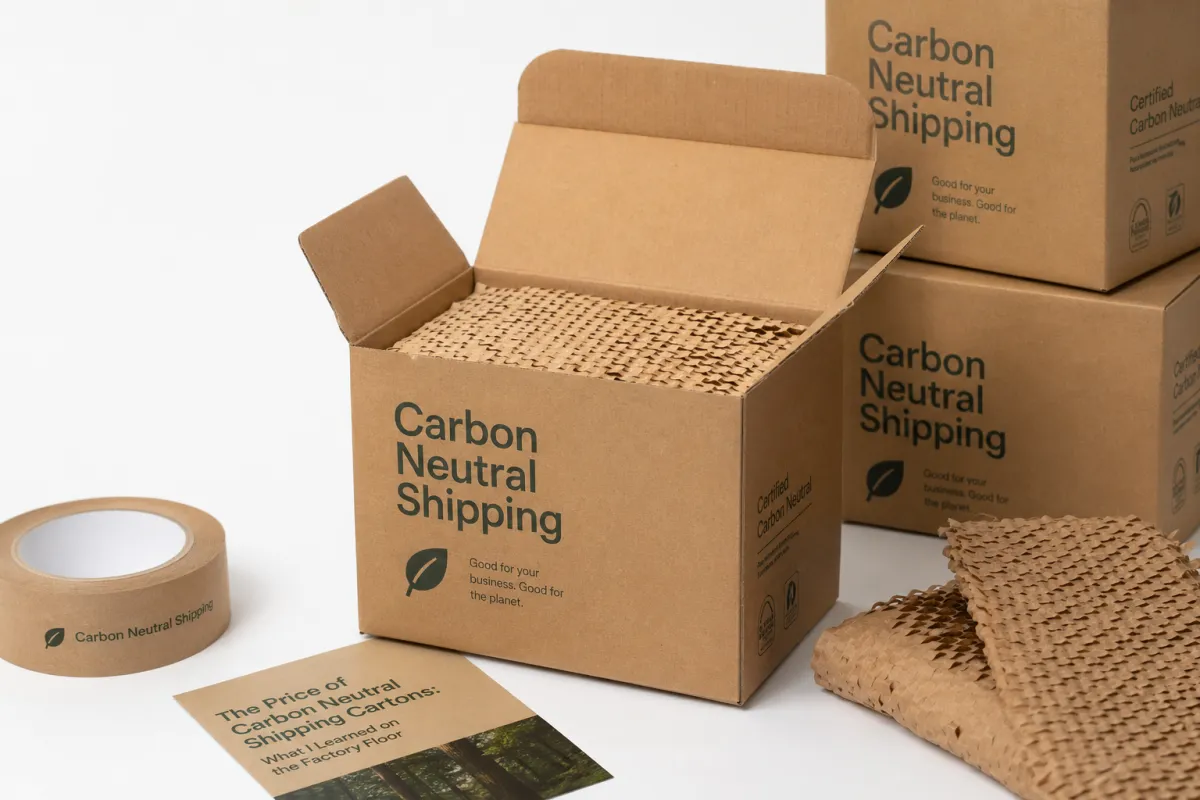
The price of carbon neutral shipping cartons usually starts with a misunderstanding: buyers compare them to a standard kraft carton and assume the difference is only a green label. It is not that simple. A real carbon-neutral program usually involves measured production emissions, a documented offset or insetting path, and proof that the carton spec matches the claim. In Dongguan, I saw a run of 20,000 cartons held for 18 hours because the supplier could not match the FSC chain-of-custody paperwork to the invoice batch numbers. When that happens, the claim is not a program; it is a slogan printed on a box.
Here is the factory-floor version. I once watched a quote move by 18% because a buyer switched from a 14 E flute to a heavier B flute, not because the carton got bigger. The carton still fit the same 230 x 160 x 90 mm product set, but the board change increased raw material usage and altered the die-cut schedule on a line in Ningbo. That is why the price of carbon neutral shipping cartons has to be read like a spec sheet, not a headline. One buyer sees “same size.” I see liner weight, flute profile, compression strength, and whether the box will survive one truck move or three. That difference is not academic. It is the difference between a clean delivery and a stack of crushed corners on a receiving dock in Newark.
Another time, a cosmetics brand from Brooklyn came in convinced they needed premium print finish on every outer shipper. They wanted soft-touch lamination, full-coverage ink, and a black flood on 8,000 cartons. I told them to pause. Their real problem was package protection during ecommerce shipping, not shelf presence. We moved them to a 2-color printed single-wall carton with a reinforced seam and kept the carbon-neutral documentation intact. The price of carbon neutral shipping cartons dropped by $0.19 per unit, and their damage rate stayed under 1.2% across the first 2,400 shipments. That was a good day; the operations lead looked like someone who had just found the last charger cable in a warehouse the size of a football field.
If you are buying for order fulfillment, do not pay for design drama you will never see after the carton hits a warehouse shelf. The price of carbon neutral shipping cartons should reflect what the box does in transit packaging, how much dimensional weight it adds, and how much documentation your team needs for sustainability reporting. A 350gsm C1S artboard insert can look polished in a sample kit, but if it adds 48 grams to every parcel and moves you into a worse shipping zone, the “premium” finish becomes a quiet surcharge. That is the real buying decision. Everything else is marketing noise, and packaging marketing can get strange fast; I once saw a carton described as “forest-inspired,” which apparently meant brown ink and expensive feelings.
“We can hit $0.58 a carton if you stop asking for 420gsm when 350gsm passes the drop test.” That was a procurement manager in California, and he was right on a 5,000-piece run.
Product Details: What Carbon Neutral Shipping Cartons Actually Include
To understand the price of carbon neutral shipping cartons, you have to define what is actually being sold. At minimum, the carton should include the physical box, the material spec, and the carbon-neutral claim support behind it. That usually means production data, emissions coverage, and a supplier record that can survive audit questions from a sustainability team in Toronto or Amsterdam. For some buyers, especially in ecommerce shipping, it also includes the right print format, pallet configuration, and carton count per shipping master so the warehouse team does not waste an hour repacking every pallet. I have watched that kind of waste turn into a whole week of irritation in a fulfillment center outside Dallas.
The build choices are practical. A single-wall carton is the common starting point for lighter products, especially apparel orders under 3.5 lb. A double-wall carton makes sense for heavier loads, sharper corners, or rougher transit packaging routes such as cross-border lanes from Guangdong to Los Angeles. You can order them printed or unprinted, with custom die lines, standard RSC styles, or specialty designs that match your internal shipping materials system. The price of carbon neutral shipping cartons rises as soon as you add more board, more ink, or more finishing steps. That is not philosophy. It is labor and fiber, and the invoice will show both.
Carbon-neutral packaging can sit in different places in the supply chain. I have seen it used as a branded ecommerce shipper, a B2B replenishment box, a retail distribution carton, and a secondary pack inside a mixed-SKU warehouse. The box may be carrying apparel, candles, supplements, or industrial parts. The carbon-neutral part does not change the use case; the use case changes the spec. That is why the price of carbon neutral shipping cartons starts with product weight, carton footprint, and route risk. A 2.1 lb candle set needs a different box than a 9.8 lb hardware kit, even if both leave the same fulfillment center in Phoenix.
For claim credibility, I always ask for two references. First, the fiber source, ideally tied to FSC chain-of-custody documentation. Second, the transit test logic, which I often cross-check against ISTA methods like 3A or 3E depending on the package profile. Those two checks do not set the price of carbon neutral shipping cartons by themselves, but they tell you whether the box is being built like a real shipping component or just dressed up for a pitch deck. I trust paperwork less than test data, which has saved me from more than one expensive mistake in Los Angeles and Rotterdam.
The product details that matter most are simple, and if a supplier avoids them, I assume the quote will wander later:
- Dimensions: outside size, inside size, and the clearance needed for inserts or void fill.
- Board grade: E flute, B flute, BC double-wall, or another specified combination.
- Print coverage: none, 1-color, 2-color, or full coverage with a coating.
- Material source: recycled content, virgin liner, or FSC-certified paper.
- Fulfillment use: ecommerce shipping, retail replenishment, or heavier B2B transit packaging.
What affects the price of carbon neutral shipping cartons?
The price of carbon neutral shipping cartons is driven by specs in the same way a car price is driven by engine size, trim, and tires. The board weight matters. The flute type matters. The outside dimensions matter. Print coverage matters. If someone quotes you before they know those four things, they are guessing. I have seen buyers lose three days because they sent a mood board instead of a spec sheet. Pretty photos do not tell me whether the carton needs a 32 ECT or a 44 ECT build, and they definitely do not tell me whether it will hold up after three carrier handoffs and a warehouse floor in Atlanta that behaves like a bus station at 6:15 p.m.
Board weight is the first lever. A 32 ECT single-wall board can work for a lightweight apparel shipper, while a 44 ECT or double-wall spec is better for denser products, longer routes, or rougher package handling. The price of carbon neutral shipping cartons often jumps more from a board upgrade than from the carbon-neutral claim itself. I once watched a buyer save 11% by moving from a 400gsm liner to a 350gsm liner after drop testing showed no package protection loss. The box looked identical from ten feet away, but the invoice changed by $0.07 per unit on a 6,000-piece order. That is the kind of detail that makes procurement people look mysterious and slightly exhausted.
Flute type changes the compression profile and the freight math. E flute is cleaner for print and tighter sizing. B flute offers better crush resistance. Double-wall builds cost more, but they can reduce damage claims when the shipment is moving through multiple handoffs. That matters in ecommerce shipping because the box is not just a box. It is a piece of transit packaging that may ride a conveyor in Shenzhen, a truck in Chicago, a sortation hub in Pennsylvania, and a porch drop in Seattle. Every step adds stress. The price of carbon neutral shipping cartons should reflect that reality, not a fantasy of gentle logistics.
Carton dimensions can quietly make or break the quote. A change of 5 mm or 10 mm may not sound dramatic, but it can alter the die layout, increase scrap, and shift the number of boxes per master carton or pallet. I saw a brand in Austin pay an extra $0.03 per unit because their new inserts forced a 12 mm outer-width increase, which then pushed the parcel into a worse dimensional weight band. That is where the price of carbon neutral shipping cartons gets ugly. You are not only buying fiber. You are buying the right to avoid waste. And yes, sometimes a tiny design change becomes a budget problem with a very large attitude.
Print coverage and coatings are the next cost layer. One-color black on kraft is cheap compared with full-bleed graphics and soft-touch lamination. Water-based ink costs less than specialty coatings, and both are easier to approve than a heavy matte finish that slows drying on a line in Guangzhou. A lot of buyers want the box to feel premium, but they forget the warehouse team has to stack 600 of them on a pallet without smudging anything. The price of carbon neutral shipping cartons should include the print finish only if the finish serves the shipment. If it is just there to make the box look expensive in a mood deck, I would rather spend the money on better board and sleep better at night.
Recycled content and FSC-certified material can change both cost and availability. In some months, the recycled liner is easy to source and barely affects the price of carbon neutral shipping cartons. In other runs, the same spec adds a 6% to 9% premium because mills are tight and lead times stretch. A 350gsm C1S artboard wrap, for example, might be simple to source in Shenzhen in April and suddenly tight in September if holiday demand pulls paper capacity toward premium retail packaging. If a supplier promises you a fixed price without telling you whether the liner is recycled, virgin, or FSC-certified, they are hiding a detail that will show up later in the production schedule. The bill always finds a way to show up, usually at the least convenient moment.
There is one more technical point that saves arguments later: ECT and gsm are not the same thing, and suppliers should not blur them together. ECT measures edge crush strength; gsm measures paper weight. They may correlate in some constructions, but they are not interchangeable in a clean quotation. If the vendor uses both labels casually, I get cautious. Very cautious, honestly.
Here is the spec checklist I ask for before I quote anything:
- Outside dimensions in mm or inches, with insert clearance noted.
- Board grade and flute type, such as 32 ECT, B flute, or BC double-wall.
- Print details, including number of colors and whether any coating is required.
- Quantity, target ship date, and destination country for freight planning.
- Whether carbon-neutral documentation is required for the shipment and invoice set.
That checklist makes the price of carbon neutral shipping cartons far easier to compare. Without it, you are comparing three guesses and one optimistic spreadsheet. I have been handed those spreadsheets. They are usually color-coded, which is a tell, and they often leave out the one line item that matters most: the 10 to 14 business day production window after proof approval in a real factory in Dongguan or Ningbo.
Price of Carbon Neutral Shipping Cartons: How to Read a Real Quote
The price of carbon neutral shipping cartons is made up of more than the carton itself. A real quote usually includes unit price, sampling, tooling, documentation, and freight terms. If you only look at the carton number, you miss half the story. I have had buyers celebrate a $0.41 quote, then panic when freight, samples, and documentation added another $1,100 to the order. That is not a bad supplier. That is a sloppy quote review. I say that kindly because I have made the same mistake, and it was not a lovely afternoon in a conference room with bad coffee.
MOQ matters just as much. For simple unprinted cartons, MOQ can sit around 1,000 to 2,000 pieces if the size is close to an existing die line. For custom printed cartons, 3,000 to 5,000 pieces is more realistic, and a heavy double-wall build can push higher. The price of carbon neutral shipping cartons usually drops at larger volumes because die setup, press setup, and board waste spread across more units. If you are buying 500 pieces and expecting factory pricing, the math is not on your side. The factory is not being dramatic; it is just being a factory in Guangdong with a calendar and a cutting schedule.
Below is the way I normally frame the quote ladder. These are working examples, not promises, because paper mills in Zhejiang, freight lanes through Long Beach, and printing schedules in Shenzhen move every month. Still, it gives buyers a clean view of how the price of carbon neutral shipping cartons behaves across volume tiers.
| Spec Path | Typical MOQ | Unit Price Example | Best Use |
|---|---|---|---|
| Stock size, unprinted, carbon-neutral documentation included | 1,000 | $0.34 at 1,000 pcs / $0.15 at 5,000 pcs | Pilot runs, sample launches, light ecommerce shipping |
| Custom size, single-wall, 1-color print, FSC liner | 3,000 | $0.58 at 3,000 pcs | Brand-forward order fulfillment and repeat shipments |
| Double-wall, 2-color print, heavier compression target | 5,000 | $0.89 at 5,000 pcs | Denser products, rougher routes, stronger package protection |
| Premium print, coated finish, custom inserts, documented carbon coverage | 10,000 | $1.28 at 10,000 pcs | High-visibility retail shipping and premium unboxing |
That table is why the price of carbon neutral shipping cartons looks confusing until you split the quote into parts. A buyer may think the carton is “expensive” at $0.58, but if the same order would cost $0.79 after freight, repacking, and damage, the lower sticker price was a trap. The landed cost is what counts. Not the first number your inbox shows you, and definitely not the one someone blurts out in a meeting before anyone has checked the freight lane.
Tooling and sampling deserve their own line. A simple sample set may cost $35 to $90 depending on the dieline and whether you need a printed proof from a plant in Shenzhen or Dongguan. New tooling can run $120 to $450 depending on complexity, especially if the carton has unusual cutouts or nested tabs. The price of carbon neutral shipping cartons often looks higher on first order because those startup costs sit on the initial run. On the second or third production batch, the per-unit number usually settles down. That is why the first quote and the repeat quote often feel like they came from two different planets.
Freight terms matter too. EXW, FOB, and DDP are not decorations. They change what you actually pay. I have seen one client compare three quotes and choose the cheapest carton price only to discover the freight lane to California added 17% because the shipment was quoted on the wrong incoterm. A better supplier will state whether the price of carbon neutral shipping cartons includes export packing, palletization, ocean freight, customs work, or door delivery. If those words are missing, ask twice. Then ask once more, because the first answer is sometimes a guess with excellent posture.
“Show me the carton spec, the MOQ, and the freight term in the same email,” I tell buyers. “If those three things are separate, the price of carbon neutral shipping cartons is still unfinished.”
There is one more buyer mistake I see constantly: they ask for a quote without naming the destination. A carton shipped to Los Angeles, Toronto, or Hamburg will not land at the same number because pallet builds, transit time, and customs handling change the bill. For carbon neutral shipping cartons, that matters even more because documentation and claims support may need to match the destination market. A quote without a destination is not a quote. It is a daydream dressed up as procurement.
Process & Timeline: From Spec Sheet to Shipment
The fastest path to the price of carbon neutral shipping cartons is a clean brief. Send the dimensions, quantity, board grade, print requirements, destination, and due date in one message. If you scatter that information across four emails, the quote slows down by a day or two and usually comes back with assumptions. I have watched simple projects lose 48 hours because the buyer forgot to mention that the inserts were already approved, and that delay came straight out of a 15-day launch calendar.
My normal process is simple. First comes the brief and die-line review. Then sample approval. Then production scheduling. Then inspection. Then shipping. A stock-size unprinted run can move in 10 to 14 business days after proof approval, depending on volume and current line load. A fully custom printed carton with carbon-neutral documentation can take 15 to 25 business days, especially if there is a certification step or a revised carton test. The price of carbon neutral shipping cartons does not buy time. Time comes from clean planning, which sounds boring until a launch date is breathing down your neck.
Late artwork changes are where schedules go to die. I once had a client in a subscription box program swap a logo panel after sampling, then ask why the revised run lost a week. Because the cutting layout had already been locked. Because the print plates had already been confirmed. Because the factory in Foshan was not sitting around waiting for someone to rediscover margins. One artwork change can trigger a new proof, a new plate check, and a new QC step. The price of carbon neutral shipping cartons will not rescue a late brief. It will only make the delay more expensive.
Buyers can speed things up by sending five specific items at once:
- Exact outside dimensions and any insert clearance.
- Board preference, such as 32 ECT single-wall or double-wall.
- Print detail, including color count and logo placement.
- Quantity, destination, and whether the carton is for ecommerce shipping or B2B transit packaging.
- Target delivery date and whether carbon-neutral documentation is needed for the final invoice set.
That five-point brief reduces the back-and-forth that usually inflates the price of carbon neutral shipping cartons by padding in “just in case” assumptions. I would rather quote one tight spec than three vague ones. The tight spec usually wins on price, timeline, and package protection. It also keeps everyone from writing one more “quick check” email at 7:48 p.m., which somehow always arrives right after dinner.
When a buyer already has a carton sample, I can usually move faster. A physical sample tells me more than six screenshots ever will. I can measure the seam, check the crush, look at the flute, and catch the weird little issues that do not show up in a PDF. That kind of hands-on review is the difference between an okay run and a run that feels planned by someone who actually ships boxes for a living. And yes, that sounds obvious; it still gets skipped all the time.
Why Choose Us for Carbon Neutral Shipping Cartons
Custom Logo Things is the kind of partner I wish more buyers had. We do not hide behind airy sustainability language and call it strategy. We talk about board grades, transit testing, and freight terms because that is what actually controls the price of carbon neutral shipping cartons. I have spent enough time in supplier meetings to know that vague sales talk gets expensive fast. Clear specs save money. Clear specs also reduce mistakes on the floor, which is where the real pain shows up.
I learned that the hard way during a negotiation in Guangdong, where a supplier tried to upsell a recycled liner that added $0.06 per unit on a 12,000-piece run. I asked for the compression test data, the pallet count, and the replacement lead time. Once the numbers were on the table, we switched to a different liner and kept the same drop-test performance. That is the kind of decision that keeps the price of carbon neutral shipping cartons honest. You do not need the fanciest board. You need the right board. I have a strong opinion about that now because I have seen the cost of “fancy” in too many spreadsheets.
We also help buyers avoid paying for the wrong format. A brand that needs an outer shipper for retail replenishment may be better served by Custom Shipping Boxes. A lightweight campaign may work better with Custom Poly Mailers. If you need to compare several packaging paths, our Custom Packaging Products page gives you a broader starting point before you lock in the carton spec. That matters because the cheapest box is not always the cheapest system, and I have never met a warehouse manager in Chicago who was thrilled by “cheap” once the returns started climbing.
The value is in the details: cleaner communication, faster quote turnarounds, clearer MOQ guidance, and documentation that does not get lost between sales and production. If you need carbon-neutral claims supported properly, we ask for it upfront. If you need a stronger box for package protection, we say so. If the price of carbon neutral shipping cartons can come down by changing flute type or trimming 8 mm from the width, we will say that too. Honest numbers beat polished nonsense every time. I know that sounds blunt, but packaging is one of those places where blunt is useful.
One more thing. I would rather tell a buyer they are over-specifying a box than sell them an expensive overbuild that looks impressive on paper and wastes 14% of the budget in practice. The price of carbon neutral shipping cartons should reward smart decisions, not fear-based purchasing. Fear is a terrible purchasing strategy. It tends to produce thick boxes, long emails, and buyers who regret everything by Tuesday.
We also stay honest about the limits. Carbon-neutral claims do not make a weak carton strong, and they do not erase freight emissions from the lane you choose. If a route needs double-wall protection, that is the box you should buy. If a lighter build passes the drop test and saves money, great. The point is to match the carton to the shipment, not dress up a bad spec with a sustainability badge.
Next Steps: Get the Right Quote Fast
If you want a clean quote, prepare the spec before you ask for the price of carbon neutral shipping cartons. Send the carton dimensions, quantity, board grade, print needs, destination, and delivery target in one message. If you already know the carton must fit a certain fulfillment line or warehouse shelf, include those measurements too. A 2 mm error on the inside width can become a 2,000-piece headache if the inserts stop fitting, and that kind of mistake is easier to catch in a spreadsheet than in a warehouse.
Then compare two or three spec options instead of one. I usually recommend a baseline, a stronger option, and a premium option so you can see where the money goes. That is the fastest way to balance cost, durability, and carbon-neutral requirements without overbuying. The price of carbon neutral shipping cartons often drops when the buyer stops asking for features that do not affect shipment performance. It sounds obvious, but obvious is not always what lands in the inbox, especially on a Monday morning in a busy procurement queue.
Send the full spec sheet, ask for landed cost, and request the carbon-neutral documentation in the same quote. That is the direct route. If you do that, you will get a real answer instead of a guessed one, and the price of carbon neutral shipping cartons will be tied to a carton that actually fits your product, your warehouse, and your budget. Which, frankly, is what every buyer wanted in the first place before the spreadsheet started acting up.
The practical takeaway is simple: define the carton first, then judge the carbon-neutral premium against the landed cost. If you send a precise spec, ask for freight terms in writing, and require proof of the claim, you will usually get a better box and a cleaner number. That is the path that keeps procurement calm and avoids the kind of surprise that turns a small packaging order into a very long week.
FAQ
What affects the price of carbon neutral shipping cartons the most?
Board grade, carton size, print coverage, and order quantity usually move the price more than the carbon-neutral claim itself. Certification, freight, and sampling can add cost if they are not included in the quote. On a 5,000-piece order, shifting from 32 ECT single-wall to 44 ECT double-wall can add roughly $0.12 to $0.18 per unit, so the cleanest way to lower the price of carbon neutral shipping cartons is to tighten the spec before asking for bids.
What is the usual MOQ for carbon neutral shipping cartons?
MOQ depends on size, board type, and print setup, but custom runs often start higher than stock packaging. Simple unprinted cartons usually support lower MOQs than printed cartons, and a supplier in Shenzhen may quote 1,000 pieces for a stock dieline while a custom printed run in Dongguan starts at 3,000 or 5,000 pieces. Ask for tiered pricing so you can see whether a slightly larger order drops the price of carbon neutral shipping cartons enough to matter.
Are carbon neutral shipping cartons more expensive than standard cartons?
Often yes, but not always by much if the supplier already has the right material and emissions process in place. The premium usually comes from documentation, offsets or verified accounting, and tighter sourcing requirements. On a 10,000-piece run, that premium might be $0.04 to $0.11 per unit. The real question is total landed cost, not just the carton unit price, especially if the carton is part of ecommerce shipping or wider transit packaging. In many cases, the price of carbon neutral shipping cartons is easier to justify once you compare damage rates and freight weight, not just the quote line.
How long does it take to produce custom carbon neutral shipping cartons?
Timelines vary by spec and quantity, but sampling, approval, and production all need to be planned together. Simple runs move faster than fully custom cartons with print and special finishes. In practical terms, a stock unprinted order can ship in 10 to 14 business days after proof approval, while a custom printed carton with carbon-neutral documentation usually takes 15 to 25 business days. A complete spec sheet is the fastest way to avoid delays and keep the price of carbon neutral shipping cartons from being padded with rush charges.
What information should I send to get an accurate quote?
Send dimensions, quantity, board grade, print details, destination, and target delivery date. If you need carbon-neutral documentation, say that upfront so it is included in the quote. If the carton must work with a 350gsm C1S artboard insert, a 32 ECT single-wall body, or a 44 ECT double-wall build, include that too. The more precise the spec, the less padding you will see in the price of carbon neutral shipping cartons. That one detail alone can remove a surprising amount of guesswork from sustainable packaging bids.


