Buyer Fit Snapshot
| Best fit | Shipping Supplies Premium Quality projects where brand print, material claims, artwork control, MOQ, and repeat-order consistency need to be specified before quoting. |
|---|---|
| Quote inputs | Share finished size, material target, print colors, finish, packing count, annual reorder estimate, ship-to region, and any compliance wording. |
| Proofing check | Approve dieline scale, logo placement, barcode or warning zones, color tolerance, closure strength, and carton packing before bulk production. |
| Main risk | Vague material claims, crowded artwork, missing packing details, or unclear freight terms can make a low unit price expensive after revisions. |
Fast answer: Shipping Supplies Premium Quality: Quote Scope should be specified like a repeatable production item. The safest quote records material, print method, finish, artwork proof, packing count, and reorder notes in one written spec.
Production checks before approval
Compare the actual filled-product size with the drawing, then confirm tolerance on folds, seals, hang holes, label areas, and retail display edges. Reserve space for logos, QR codes, warning copy, and material claims before decorative graphics fill the panel.
Quote comparison points
Review material grade, print process, finish, sampling route, tooling charges, carton quantity, and freight assumptions side by side. A quote is only useful when the supplier can repeat the same color, closure quality, and packing count on the next order.
Shipping Supplies Premium Quality: What Buyers Need
I remember standing beside a stretch-wrap station in a Milwaukee fulfillment center where the cartons looked immaculate, the pallet pattern was tight to within half an inch, and the budget tape passed a quick visual check. The line still kept failing at the same spot: the center seam. A low-cost 1.8 mil tape looked respectable on the roll, then split at the edge of the carton after 6 hours in a trailer that had sat at 118 degrees Fahrenheit on a July dock. That is why shipping supplies premium quality has to be judged by performance, not shine, print, or whatever the product photo suggests. I have seen a $0.21 roll of tape waste a $14.80 shipment faster than anyone could say “cost savings,” which is exactly the kind of math that makes operations managers stare into the middle distance.
Buyers who source shipping supplies premium quality usually want three outcomes at once: fewer damages, faster pack-out, and a cleaner customer experience after delivery. I have seen all three improve when a team stops buying by unit price alone and starts testing boxes, tape, mailers, labels, and void fill as one system. That system view matters because a 275# test carton can still fail if the tape is weak, and a strong mailer can still fail if the product rattles around inside with 1.75 inches of empty space. One warehouse manager in Columbus told me, half laughing and half exhausted, “The box wasn’t the problem. The box was hanging out with the problem.” He was right, and the carton size was off by exactly 1.25 inches.
What Shipping Supplies Premium Quality Really Means
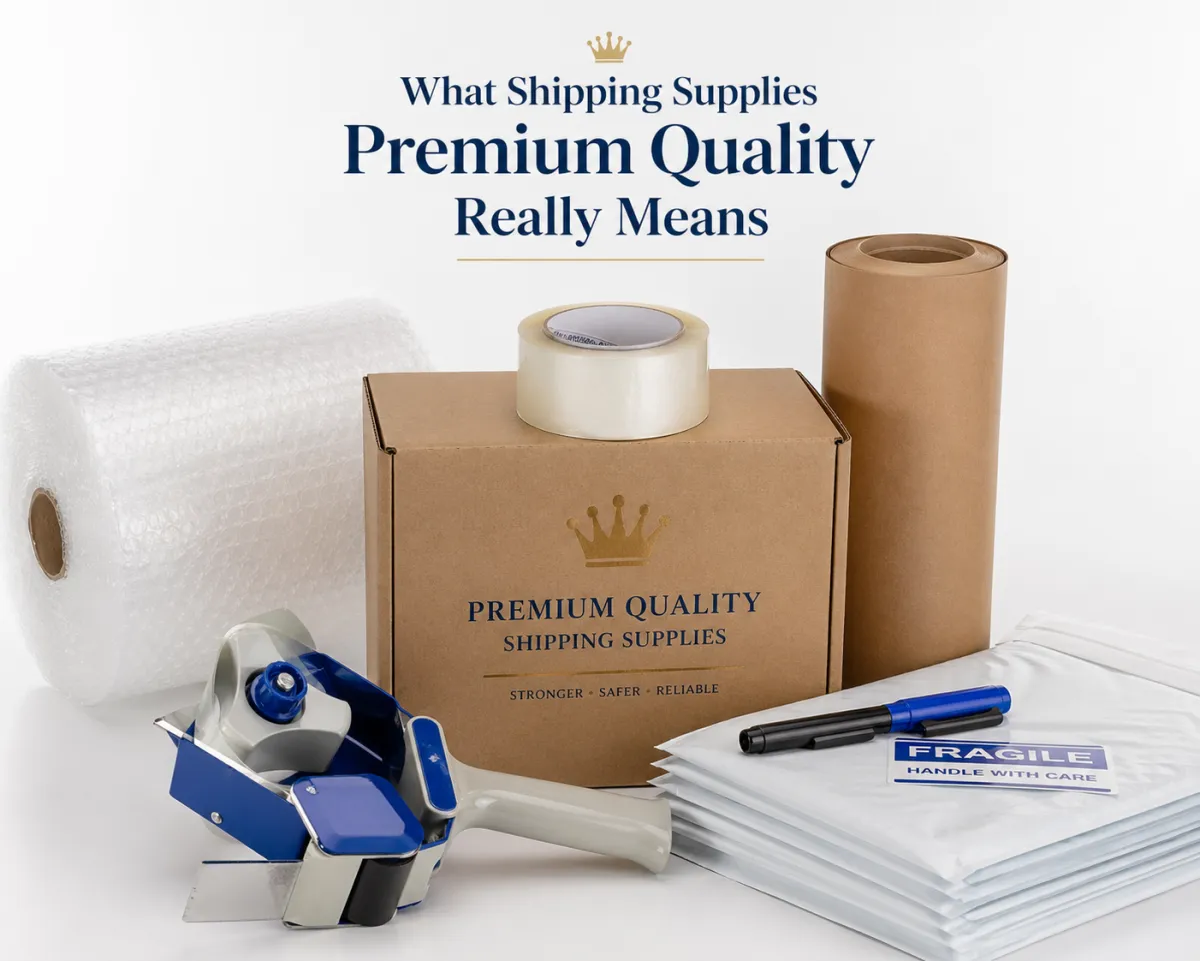
Shipping supplies premium quality means the materials do their job consistently, not just once on a clean workbench in a test lab. In a corrugated plant I visited outside Atlanta, the operators showed me a run of 44 ECT cartons made from 350gsm kraft liner and a medium flute that held its compression within a narrow band all morning, which is exactly the kind of repeatability buyers should want. The real difference is a mix of stronger materials, tighter tolerances, and performance that stays steady across storage, packing, and transit, whether the order ships from a warehouse in Savannah or a co-packer in Reno.
People often assume premium means thicker or prettier. It does not always. A glossy poly mailer with bright print can still tear at the seal if the adhesive bead is only 3/8 inch wide, and a heavy-duty box can still crush if the flute profile is wrong for the load. I have seen a 32 ECT carton outperform a heavier-looking but inconsistently made 200# burst-rated board because the 32 ECT run had steadier moisture content at 7.8% and cleaner score lines. That is why shipping supplies premium quality should be defined by testable performance, not appearance. If a carton looks like it belongs in a product photo but folds under real freight, it is decoration with shipping labels.
Premium also means the components work together as a system. A carton, a strip of tape, a liner, a label, and a little void fill each carry part of the load, and if one part is weak, the entire pack becomes fragile. I learned that lesson during a client meeting for a candle brand shipping 12-ounce glass jars from Charlotte to the Northeast. We did not fix the damage rate of 4.3% by buying a fancier box alone; we changed the carton size by 0.75 inch, upgraded the tape to a 2.8 mil acrylic, and added Molded Pulp Inserts, which cut breakage to 0.9% in the first month. That is the kind of change that makes finance stop frowning at me for once.
"The box was fine, but the seam was not. Once we changed the tape spec to 2.8 mil acrylic, the complaints stopped within 500 orders." A dock lead in Indianapolis told me that after we swapped a bargain roll for a higher-tack tape rated for 32 pounds per inch of adhesion.
That is the practical promise of shipping supplies premium quality: lower claim volume, faster order fulfillment, fewer packing headaches, and a better first impression when the customer opens the carton. For buyers building a packaging program, the goal is not to buy the most expensive item in every category. The goal is to buy the right item where it matters, then document it so purchasing, warehouse, and finance all stay aligned. That part is dull in the way a good gasket is dull, but a 1.2% claim rate looks a lot better on a monthly report than a 4.8% claim rate does.
How Shipping Supplies Premium Quality Performs in Transit
Once a parcel leaves the pack bench, it enters a rough chain of handling: conveyor transfer, sortation, truck loading, line-haul vibration, and final-mile drops. Shipping supplies premium quality has to survive all of that. In ISTA 3A-style testing, packages can see repeated impacts from 30-inch drops, compression stacking that mimics 48 hours on a pallet, and vibration that loosens weak seals long before the customer ever opens the box. If the supply only looks good in the warehouse, it is not premium enough. You can read more about transit testing standards on the ISTA website.
Corrugated strength matters because stacked freight does not behave politely. A carton on the bottom of a pallet may carry several hundred pounds for 8 to 12 hours, and if humidity rises above 60% RH, the board can lose 20% or more of its compression strength. Tape adhesion matters because a seal that passes a 10-second hand check may still peel after a 36-inch drop onto a conveyor corner or after a 140-mile line-haul run. Cushioning matters because a product that floats 1.5 inches inside a box can build momentum and strike the wall at every turn. That is why shipping supplies premium quality is really about how each material performs under stress, not how it behaves while sitting still like it is on its best behavior.
I saw this firsthand in a parts distribution center outside Nashville that shipped small cast-metal components weighing 2.4 pounds each. Their old setup used thin void fill and a low-tack tape, and they were paying for it in carrier claims and customer calls. After they moved to a tighter-fit carton, a stronger seal, and a denser paper void fill, the number of repacks fell sharply because the boxes stopped opening in transit and the parts stopped shifting inside the carton. The savings were not dramatic in one order, but across 18,000 monthly parcels, even a $0.09 reduction per shipment adds up to $1,620 a month. Packaging always tries to hide its cost until the week returns spike, and then it becomes very visible, very quickly.
Shipping supplies premium quality matters even more for fragile, heavy, or high-value items because those products have less tolerance for movement and more expensive consequences when something fails. A 4-ounce serum bottle, a 6-pound brake component, or a ceramic mug with a 2.25-inch handle each needs different protection, but the principle stays the same: build layers. One layer protects the product, another stabilizes it, and another protects the seal. Single-point protection almost always costs more later in returns, rework, and customer service time. I would rather spend $0.32 more on the right carton than spend an afternoon explaining broken items to angry customers, which is a hobby that should be illegal after 3 p.m.
That layered mindset is why I always ask how the package will be handled after it leaves the dock. Will it ride 900 miles in a trailer from Dallas to Chicago? Will it pass through a sortation hub with 30-inch drops and metal chutes? Will it sit in a humid porch locker in Miami for 6 hours at 87 degrees Fahrenheit? Those details shape the real answer to shipping supplies premium quality, and they explain why one supplier’s heavy-duty claim may not match another supplier’s actual field performance. The word heavy-duty gets tossed around a lot, and some of those claims are as useful as a raincoat with three holes in it.
Key Factors That Define Premium Shipping Supplies
Material grade is the first place I look. For corrugated boxes, flute selection changes the whole behavior of the carton: B flute gives a tighter profile, C flute adds more stacking strength, and E flute is often useful for print quality and lighter ecommerce shipping applications. A 32 ECT carton may be perfect for a lightweight apparel order, while a 44 ECT or double-wall carton may fit a heavier industrial part. Shipping supplies premium quality starts with matching the grade to the load, not guessing based on carton size alone. I have watched a buyer choose a box by instinct and then act surprised when physics did not care about confidence.
Consistency matters just as much as raw strength. A tape roll that varies in coating thickness by 0.002 inch can create one good seal and one bad seal on the same production run. A mailer that varies in seal width by 1/8 inch can leave a weak edge right where the operator grips it. That is why I pay attention to tolerances, unwind quality, edge crush variation, and adhesive chemistry. Premium quality is the ability to get the same result on order number 1 and order number 10,001. If a supplier cannot hold that standard, I do not care how nice the brochure looks or whether the samples arrived in a matte black box.
Compatibility with the product is the next filter. Lightweight ecommerce apparel, fragile glass, temperature-sensitive foods, and greasy industrial parts all need different shipping materials and different transit packaging choices. For apparel, a 2.75 mil poly mailer with a 1-inch peel-and-seal strip may be enough. For fragile goods, I prefer a corrugated shipper with inserts, often built from 350gsm C1S artboard for retail-ready inner cartons or a 44 ECT shipper for outer protection. For parts with oily residue, I want packaging that resists contamination and still seals cleanly. If the supply and the product are not matched correctly, shipping supplies premium quality becomes an expensive label instead of a useful standard. For broader product options, many buyers start with Custom Packaging Products and then narrow down the carton or mailer spec by weight and lane.
Sustainability is part of quality too, and I say that as someone who has watched buyers ignore it until freight costs or customer complaints forced the issue. Recycled fiber content, FSC-certified sourcing, and right-sizing can all improve the package without making it weaker. The Forest Stewardship Council is a useful reference if your team needs to verify fiber sourcing language. When a carton is sized correctly, you can often reduce void fill, lower dimensional weight, and use less material per shipment, which is better for the budget and the waste stream. It is also better for the people in the warehouse who would prefer not to drag a 24-inch roll of bubble wrap across a concrete aisle at 6:15 a.m.
- Corrugated grade: 32 ECT, 44 ECT, or double-wall depending on weight and stacking load.
- Tape chemistry: acrylic for aging resistance, hot-melt for fast grab, rubber-based for tougher surfaces.
- Void fill: paper, air pillows, or molded pulp based on product fragility and cube efficiency.
- Storage conditions: keep cartons 6 inches off the floor and away from 70% RH spikes.
- Automation fit: make sure the material works on case sealers, print-and-apply systems, and auto-baggers.
Those five factors are where shipping supplies premium quality either holds up or falls apart. I have watched a plant in Texas lose an entire pallet of premium mailers because they were stored too close to a loading door in August heat, and I have watched another operation improve pack-out speed by 14 seconds per order just by moving to cleaner-opening tape and better carton sizing. Small details matter because fulfillment is built from small details. A lot of people want big strategic answers; the warehouse usually rewards the person who notices the one-inch mistake nobody else bothered to check.
How to Choose Shipping Supplies Premium Quality Step by Step
The safest way to buy shipping supplies premium quality is to start with the product, not with the catalog. I tell buyers to audit the real item mix first: weight, fragility, dimensions, surface finish, and the most common ship method. A 9-ounce candle, a 3-pound bottle set, and a 14-pound machine part should never be forced into the same packaging logic. If you do that, you end up paying for overpacking in one lane and paying for damage in another. I know that sounds obvious, but obvious advice is usually there because someone made a $24,000 mistake first.
Once the product mix is clear, build a sample list that includes the box sizes, tapes, mailers, labels, and void fill you actually need. Then test those samples with the same pack-out motions your team uses every day. I prefer real benches over lab theater. If the operator seals 250 orders per shift, then the sample should be tested by that same hand motion, with the same 18-inch tape pull, the same folded flap sequence, and the same stretch-wrap workflow. That is the only way shipping supplies premium quality can be judged honestly. I have seen polished lab results fall apart the second they meet a tired operator and a busy Monday morning.
- Measure the risk: record product weight, drop sensitivity, and average dimensions for at least 30 SKUs.
- Sample three sources: ask for at least 2 or 3 supplier samples for each critical item.
- Run validation: use compression, drop, and vibration checks on the exact pack configuration.
- Pilot one lane: test 100 to 500 orders on a single shipping lane before full rollout.
- Document the spec: publish one approved bill of materials so every buyer orders the same thing.
That process sounds simple, but it prevents a lot of expensive confusion. I once worked with a subscription brand that had four different box sizes within a 1-inch range, and every packer had a favorite. The result was waste, inconsistency, and a tape problem because some boxes had too much empty space. After they standardized the kit and locked the spec, shipping supplies premium quality stopped being a debate and became a repeatable warehouse process. There was real relief in the room too, which makes sense; no one enjoys arguing about cardboard before lunch.
If you want to move faster, start with one high-risk product lane and one clearly defined success metric, such as a damage rate below 1%, a pack-out time under 45 seconds, or a tape usage target of 1.2 strips per carton. That keeps the trial grounded in numbers instead of opinions. I have found that teams adopt shipping supplies premium quality more quickly when they can see the result in a simple spreadsheet, especially if purchasing and operations both sign off before the rollout. Opinions tend to get quieter when the numbers are staring back at them.
Shipping Supplies Premium Quality: Cost and Pricing
People often ask whether shipping supplies premium quality is worth the higher price, and my answer is simple: compare the cost of the supply against the cost of failure. A carton that costs $0.18 more can save you from a $9.00 replacement, a $6.50 reshipment, and 8 minutes of customer service time. That math gets ugly for cheap materials very quickly, especially once return labels, restocking labor, and lost repeat orders enter the picture. I have yet to meet a CFO in Minneapolis who gets excited about paying twice for the same order.
Pricing depends on material grade, print complexity, custom sizing, minimum order quantity, and freight. A plain 12 x 10 x 8 single-wall carton produced in Charlotte or El Paso might land near $0.62 to $0.88 at volume, while a custom printed version with 44 ECT board and tighter tolerances can move into the $1.05 to $1.55 range. A batch of 5,000 Branded Poly Mailers from Dongguan can come in near $0.15 per unit for a 2.75 mil stock style, though a custom size or matte finish can raise that by $0.04 to $0.08 each. Tape shifts too: a basic acrylic roll may be $2.60 to $3.10, while a higher-adhesion roll for tougher closures may run $3.25 to $4.10. Shipping supplies premium quality costs more on the invoice, but it often costs less across the whole shipment. That is not marketing talk; that is just arithmetic with a warehouse budget attached.
| Option | Typical Unit Cost | Best Use | Main Trade-Off |
|---|---|---|---|
| 32 ECT corrugated box | $0.62 - $0.88 | Light ecommerce orders up to about 10 lb | Lower stacking margin than heavier board |
| 44 ECT or double-wall box | $1.05 - $1.95 | Fragile, dense, or higher-value goods | Higher material cost and more storage cube |
| 2.7 mil poly mailer | $0.15 - $0.34 | Apparel and soft goods | Not ideal for sharp edges or breakables |
| Premium carton sealing tape | $3.25 - $4.10 per roll | Cartons that see long transit or hot docks | More expensive than commodity tape |
| Dense paper void fill | $0.04 - $0.11 per shipment | Mixed-SKU ecommerce shipping | Can slow pack-out if dispensed poorly |
That table is exactly why I push buyers to compare cost per shipment, not cost per item. A box that is $0.15 cheaper but requires 20 extra seconds of packing time can cost more than the premium version after labor. A box that is 0.5 inch too large on each side can also push dimensional weight up enough to raise the parcel rating by a full shipping tier. In parcel work, shipping supplies premium quality often saves money by trimming wasted cube. It is the unglamorous kind of savings, which is probably why so many teams miss it.
"We thought the nicer box was the expensive choice until we tracked the numbers for 6 weeks across 12,000 orders. The lower damage rate paid for it." That came from a purchasing manager in Nashville after they compared reshipments, labor, and carrier claims.
For brands balancing margin and protection, I usually suggest spending more on the items that carry structural responsibility, then standardizing the low-risk consumables. Upgrade the box and seal first. Then look at inserts, void fill, and labels. If your team sells apparel, a premium mailer may matter more than a premium carton. If you ship glass or electronics, the opposite is usually true. Custom Shipping Boxes and Custom Poly Mailers are good starting points when you want to compare the product path by ship lane and price band, especially if your production window is 12 to 15 business days from proof approval.
Common Mistakes When Buying Shipping Supplies Premium Quality
The biggest mistake is buying from a catalog description without testing against the actual product and the actual carrier lane. I have seen a heavy-duty mailer fail on the first seam because the edge hit a metal conveyor guide at 11:40 a.m., and I have seen a premium-looking carton buckle because the board grade was fine but the flute direction was wrong for the pack orientation. Shipping supplies premium quality only means something after it survives your own path to delivery. Otherwise, it is just a fancy sentence attached to a disappointing outcome.
Another mistake is over-specifying everything. I understand the instinct, especially after a damage problem, but not every item deserves the most expensive version. A low-risk accessory shipped in a premium double-wall carton may be safe, yet the extra material cost and dimensional weight may erase the benefit. I watched one catalog brand overspend $0.29 per order on void fill for a product that needed only 0.07 cubic feet of stabilization. They were protecting air, not merchandise, and the warehouse looked like it was packing clouds.
Storage conditions are ignored far too often. A corrugated carton left in a humid corner near a dock door can lose performance before it is even assembled. Tape stored above 90 degrees Fahrenheit may unwind differently, and adhesive strength can change if the rolls cycle through cold mornings and hot afternoons. That is why premium quality is not only about the purchase order; it is also about how the warehouse stores and handles the material. Shipping supplies premium quality can be undermined by a bad backroom setup in a week, which is frustrating because the failure looks like a product issue when it is really a storage issue.
The fourth mistake is changing box sizes without updating the rest of the pack system. If the carton gets smaller but the void fill stays the same, the operator may overpack the box and crush the product. If the carton gets larger but the tape pattern stays the same, the seam may not hold across the wider flap span. A packaging change needs to be treated as a system change, not a one-line item on a spreadsheet. I have said that in meetings more times than I can count, and somehow it still feels like news to somebody every quarter.
I also worry when I see buyers switch vendors every quarter just to chase a slightly lower quote. In one Northeast distribution center, the team bought tape from three suppliers in a single season, and each roll behaved differently on the sealer. That made quality control almost impossible because the failures were not repeatable. Shipping supplies premium quality should feel stable from one shipment to the next, with the same unwind, the same seal, and the same board behavior every time. Stability sounds dull, but dull is lovely when you are trying to keep a line running at 700 orders a day.
Expert Tips and Next Steps for Shipping Supplies Premium Quality
My best advice is to create a packaging scorecard and review it monthly for the first quarter after any change. Track damage rate, pack-out time, tape usage per carton, customer complaints, and the number of rework cartons. If the metrics improve after you switch to shipping supplies premium quality, you will have proof that the change is paying for itself. If the numbers slide, you will know fast enough to fix the spec before the problem spreads. I like proof because it cuts through the hand-waving and the “we’ve always done it this way” speeches.
I also recommend a quarterly review because products, carriers, and order mixes drift over time. A box that worked well for a 1.5-pound product last spring may be too large once the SKU changes to a denser fill or a new insert shape. A tape that was fine for winter shipping may behave differently in August heat in Phoenix. Teams that revisit their packaging every 90 days tend to stay ahead of those small shifts, and small shifts are often where damage starts. The frustrating part is that the small shifts usually look harmless right up until the claims hit.
- Standardize one spec: keep one approved carton, one approved tape, and one approved void fill for each core product family.
- Trial two samples: compare at least two supplier samples side by side before locking a new source.
- Train packers: give the warehouse team a one-page guide with flap fold order, tape strip length, and fill amount.
- Audit shelf life: check adhesive, labels, and film stock every 60 to 90 days in storage.
One of the cleanest rollouts I ever saw came from a small beauty brand in Portland that tested two carton suppliers, two tape suppliers, and one paper void fill over a 3-week pilot. They started with 300 orders on a single lane, then expanded to 2,400 orders after damage held below 0.8% and pack-out stayed under 40 seconds. Their custom cartons were produced in Monterrey, and the printed inserts came from Dongguan, with proofs approved on a Tuesday and first shipment landing 14 business days later. That is the kind of measured process that makes shipping supplies premium quality more than a slogan. It becomes a warehouse standard, which is a much less glamorous phrase but a far more useful outcome.
If you are ready to act, start with the lane that causes the most loss, not the lane that is easiest to fix. Audit the current materials, test one product family with real ship methods, and standardize the best performer across the operation. That is usually the fastest route to better package protection, steadier order fulfillment, and cleaner economics. For teams building out their sourcing list, shipping supplies premium quality is the place to begin because it affects both the parcel and the margin on the same day, especially when a spec is locked before the next 5,000-piece purchase order.
What Should You Look For in Shipping Supplies Premium Quality?
Start with the product weight, the carrier lane, and the failure mode you can least afford. The best shipping supplies premium quality should match the load, hold its seal in heat and cold, and keep the item from moving inside the carton. If a material only performs on a clean bench, it is not the right choice for parcel shipping, ecommerce packaging, or high-value shipments. A good test is simple: can the box, tape, mailer, or void fill survive your worst route and still look respectable when the customer opens it?
What makes shipping supplies premium quality different from standard supplies?
Shipping supplies premium quality usually means tighter manufacturing consistency, stronger materials, and better real-world performance under compression, vibration, and temperature swings. In practical terms, that shows up as fewer crushed cartons, fewer torn mailers, and fewer seal failures after a 24- to 72-hour transit cycle. The difference is measurable protection, not just a cleaner-looking package. I tend to trust the materials that survive rain at 38 degrees Fahrenheit in Cleveland and heat at 96 degrees in Dallas, because those are the conditions that matter.
Are premium shipping supplies worth the higher price?
They are often worth it when damage, labor, or reship costs are already high, because a small reduction in failures can save more than the extra unit cost. I prefer to compare total landed cost, which includes replacements, claims, and customer service time, not just the invoice line. If a better supply prevents even 1 out of every 50 shipments from failing, the payback can be fast. That is not theory; that is the kind of math that shows up in the monthly close after 2,000 or 20,000 orders.
Which materials are best for shipping supplies premium quality?
The best material depends on the product, but premium corrugated boxes, high-adhesion tape, and fit-for-purpose void fill are common upgrades. For fragile items, many teams move to stronger board grades and denser cushioning that resists compression after the parcel is stacked 5 or 6 high. For apparel and soft goods, a durable 2.75 mil poly mailer can be the right answer if the seam and thickness are specified correctly. I would rather see a well-chosen mailer than an overbuilt box used for the wrong reason.
How long does it take to switch to premium shipping supplies?
A simple change can happen in 3 to 5 business days if you are only sampling and approving standard stock items from a domestic warehouse in Ohio or Illinois. A careful rollout usually takes several weeks because it includes sample requests, internal testing, training, and a short pilot shipment run. Custom sizes or printed materials can take 12 to 15 business days from proof approval, and offshore production from places like Dongguan or Ho Chi Minh City can add 21 to 28 days of transit time. Rushing it tends to create the kind of mess that people later call a supply problem, though usually it is a planning problem wearing a supply problem costume.
How do I test shipping supplies premium quality before ordering at scale?
Test with the actual product, the actual pack-out steps, and the actual shipping method whenever possible. Use drop, compression, and vibration checks, then run a pilot of 100 to 500 orders so you can see how the materials behave in the field. Review seal strength, damage rate, and consistency across multiple samples before you commit to a full buy. If the test setup is too clean, too slow, or too controlled, it will tell you less than the warehouse floor does, especially if the warehouse floor is moving 1,200 cartons before lunch.
If you want packaging that performs the way it should in a real warehouse, start with shipping supplies premium quality, then verify it with samples, a short pilot, and a written spec your whole team can follow. The right boxes, tape, mailers, and void fill make ecommerce shipping calmer, reduce waste, and protect the customer experience all the way to the doorstep. That is the standard I would set for any operation serious about shipping supplies premium quality. And if the first test box survives the route from the dock to the doorstep without a seam split, that is a small victory worth celebrating, especially when the proof took 14 business days and cost less than one returned order.


