Buyer Fit Snapshot
| Best fit | price of printed mailing bags for packaging buyers comparing material specs, print proof, MOQ, unit cost, freight, and repeat-order risk where brand print, material, artwork control, and repeat-order consistency matter. |
|---|---|
| Quote inputs | Share finished size, material target, print colors, finish, packing count, annual reorder estimate, and delivery region. |
| Proofing check | Approve dieline scale, logo placement, barcode or warning zones, color tolerance, and any recyclable or compostable wording before bulk production. |
| Main risk | Vague material claims, crowded artwork, or missing packing details can create delays even when the unit price looks attractive. |
Fast answer: Price of Printed Mailing Bags: What Really Drives Cost should be specified like a repeatable production item. The safest quote includes material, print method, finish, artwork proof, carton packing, and reorder notes in one written spec.
What to confirm before approving the packaging proof
Check the product dimensions against the actual filled item, not only the sales mockup. Ask for tolerance on folds, seals, hang holes, label areas, and retail display edges. If the package carries a logo, QR code, warning copy, or legal claim, reserve that space before decorative graphics fill the panel.
How to compare quotes without losing quality
Compare board or film grade, print process, finish, sampling route, tooling charges, carton quantity, and freight assumptions side by side. A lower quote is only useful if the supplier can repeat the same color, closure quality, and packing count on the next order.
The Price of Printed mailing bags can look neat on a quote sheet, but the number printed there rarely tells the full story. A bag that appears to cost $0.14 per unit on a 5,000-piece run can land closer to $0.19 once setup, cartons, inland freight, and one spec correction are added in. I have had buyers call me thinking they found the bargain of the quarter, only to find out the "cheap" bag was quietly expensive in all the places that show up after purchasing signs off. At Custom Logo Things, that gap is exactly where smarter packaging buying starts, because the price of Printed Mailing Bags is shaped by material grade, print method, pack-out, and the way the bag moves through a warehouse in Shenzhen, Dongguan, or Ningbo.
I remember one procurement review where the team spent twenty minutes debating a $120 setup fee, then lost $480 in oversize freight because the bag width was 20 mm too large for the carton pack. Not a theory. A real order. Five thousand apparel bags, one oversized spec, and a lot of awkward silence around the table afterward, which, honestly, was kind of deserved. The price of printed mailing bags is a commercial decision, not a decorative one, and the right spec can reduce damage, improve the unboxing experience, and keep parcel costs under control from Guangdong to the final delivery depot.
Most people compare custom mailers the wrong way. They ask for a unit price, then ignore film gauge, print coverage, and the minimum order quantity that actually drives the economics. If you are pricing the price of printed mailing bags for a subscription box, a fast-fashion drop, or a wholesale rebrand, the real question is whether the bag saves money across 3,000 to 30,000 shipments, not whether it looks cheap on a spreadsheet. I have seen spreadsheets lie with a straight face, especially when the cartons are still counted as "miscellaneous."
There is also a human side to all this. The buyer wants a clean number, the warehouse wants bags that do not split, and finance wants the landed cost to behave. When those three goals line up, the project usually gets approved without drama. When they do not, somebody ends up chasing a reprint after the first delivery window, and nobody feels clever about it.
Price of Printed Mailing Bags: Why the Cheapest Quote Often Costs More
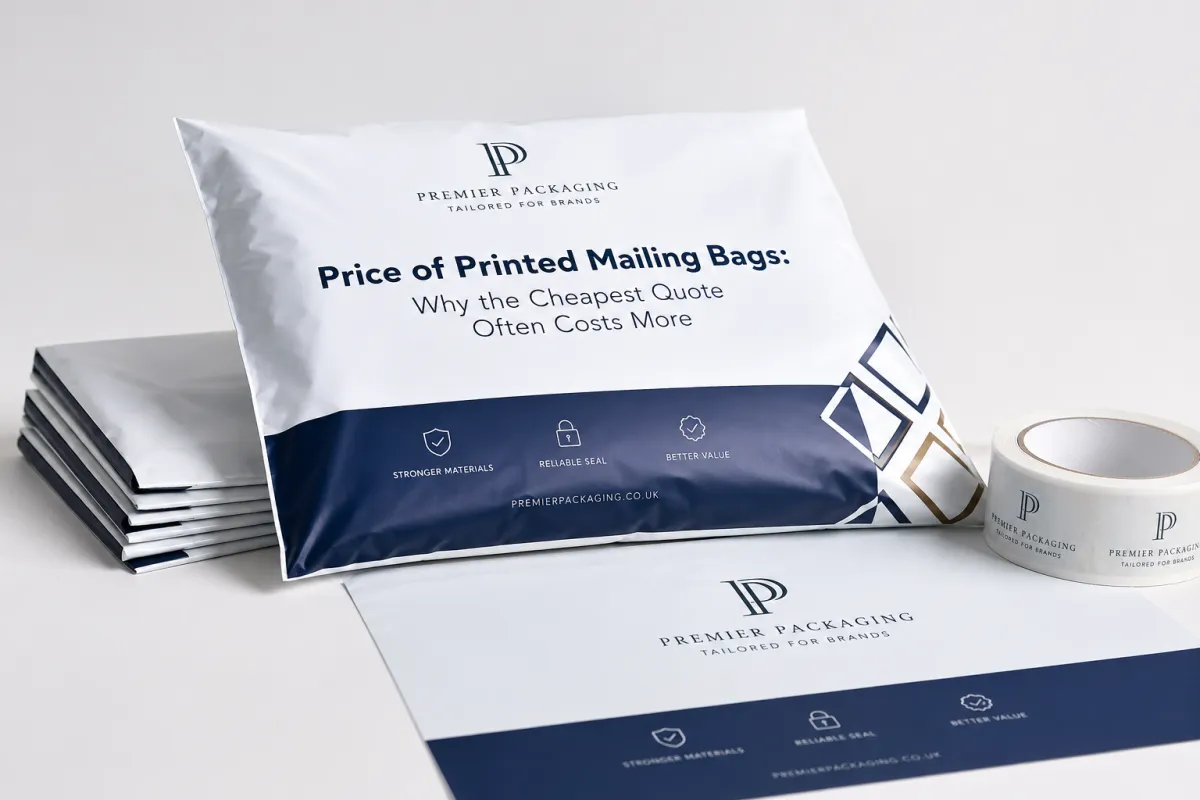
The price of printed mailing bags often gets judged by the lowest line item, and that is where buying teams get trapped. A quote that saves $0.01 per bag on 10,000 pieces looks smart until the film turns out to be 55 microns instead of 70 microns, the print is limited to one side, and the freight carton count adds two extra pallets. I have seen that pattern in apparel, cosmetics, and lifestyle goods from factories in Shenzhen and Foshan. In each case, the cheapest quote ended up costing more because the buyer paid for rework, re-delivery, or a second run. Saving a penny and spending a dollar is a special kind of corporate hobby.
The comparison breaks down when people assume every supplier is quoting the same construction. One factory may include a 60-micron co-extruded PE film, a standard 30 mm peel-and-seal strip, and a 1-color print. Another may use a thinner substrate, a shorter adhesive strip, and a narrower print panel. Those changes matter. A 10 mm shift in print width can alter ink use, plate layout, and machine speed, which is how one quote lands at $0.16 and another at $0.22 for what looks like the same bag. Same-looking bags, very different invoices. I have had to explain that more times than I would like, usually after the sample box is already on the buyer's desk.
"We thought we were saving money by choosing the lowest quote, then the mailers split at the bottom seam on our first 800 shipments." That came from a client who bought 12,000 units for a denim launch, and the replacement run cost more than the original setup.
The price of printed mailing bags also changes with how the bag is used. A cosmetics brand shipping 180 g cartons needs a different puncture profile than a T-shirt seller mailing 120 g soft goods. If the bag fails once in every 500 parcels, the loss is not just one bag. It is the item inside, the reshipment label, the customer service hour, and sometimes the refund. That is why I treat printed mailing bags as a cost-control tool first and a branding tool second. Pretty is nice. Fewer complaints is better, especially when the warehouse is processing 2,000 parcels a day.
One thing buyers sometimes overlook is how the bag behaves after it leaves the machine. A glossy exterior may photograph well, but if the surface scuffs easily in carton packing, the presentation can look tired before it even reaches a customer. That is not a design failure; it is a specification issue. The right film and print choice should survive the route, not just the mockup.
- Low quote: often means thinner film, fewer colors, or a less efficient carton pack, such as 55 microns instead of 70 microns.
- Better quote: can raise the price of printed mailing bags slightly while reducing damage, split seams, and freight waste.
- Best value: usually comes from a spec that matches the actual product weight, such as 150 g garments or 250 g accessory kits, not the wish list.
One more practical point: the price of printed mailing bags is shaped by reorder behavior. If you know you will reorder every 8 to 10 weeks, a slightly higher MOQ can lower your per-bag cost enough to beat the flexible supplier by a wide margin. I have seen 20,000-piece orders price out 14% lower per unit than 5,000-piece orders, and the larger run paid for itself on the second replenishment. That is the part nobody wants to hear in the first meeting, but finance tends to get overruled by math eventually, especially when the same bag is used across a six-month selling season.
Product Details: What You Are Actually Paying For
To understand the price of printed mailing bags, You Need to Know what sits inside the quote. A printed mailer is not just a plastic envelope. It is usually a co-extruded outer film, an inner layer for strength, a pressure-sensitive adhesive strip, and a fold or gusset that determines how much real volume the bag can carry. Change one layer thickness from 50 microns to 70 microns and the unit price, puncture resistance, and pack weight all move together. Packaging people love to say "just a bag" until they have to pay the freight bill for 12 pallets out of a port in Shenzhen.
I remember standing on a conversion line in Shenzhen's Bao'an District while a production manager ran three adjacent specs: a standard poly mailer, a courier bag with a stronger seal, and a branded bag with full-bleed print. The difference between them was not cosmetic. The courier bag used a heavier 70-micron gauge, the branded version needed tighter registration, and the standard mailer packed 18% more units per carton. That one carton change alone altered the price of printed mailing bags enough to influence the buyer's landed cost. I was there with a coffee going cold in my hand, watching a "simple" packaging quote turn into a lesson in materials engineering.
For apparel, cosmetics, and lightweight accessories, the main formats are usually standard poly mailers, courier bags, and Branded Mailing Bags. If you are comparing the price of printed mailing bags across those formats, ask three questions: what is the film thickness, what is the seal strength, and how much of the surface is printed? A 1-color logo on 30% coverage is one thing. Edge-to-edge art on both sides is a different production job entirely, with different waste and different setup time. I am biased, but this is where most buyers underestimate the job by a mile, especially when the artwork has thin text and a reverse print panel.
The material itself matters in a very plain, practical way. A co-extruded PE film with a stable outer layer and tougher inner layer tends to print more cleanly and hold up better in the courier stream than a low-grade blend that looks fine for five minutes and then starts showing handling marks. If a supplier cannot tell you the film structure, the print process, and the seal style in plain language, the quote deserves a second look.
| Format | Typical Use | Common Spec | Illustrative Unit Price | Notes |
|---|---|---|---|---|
| Standard poly mailer | T-shirts, accessories, lightweight e-commerce parcels | 60 micron, 1-color print, 5,000 MOQ | $0.14-$0.18 | Lowest entry point for the price of printed mailing bags |
| Courier bag | Multi-item orders, moderate protection needs | 70 micron, 1-2 color print, 10,000 MOQ | $0.18-$0.24 | Better puncture resistance, stronger seal, and added privacy |
| Branded mailing bag | Fashion, premium retail, repeat customers | 70-80 micron, 2-color print, 10,000-20,000 MOQ | $0.22-$0.32 | Higher branding value and stronger presentation |
These numbers are illustrative, not a promise. Freight lane, carton count, and print coverage still matter, whether the bags are moving out of Zhejiang or Guangdong. They do show the pattern behind the price of printed mailing bags: the unit cost climbs when the bag carries more material, more ink, or more handling complexity. Buyers who understand that pattern can compare quotes like-for-like instead of reacting to the first low number in their inbox. That alone can save a lot of back-and-forth and a few headaches, particularly when the supplier is quoting EXW in Dongguan and the buyer needs landed cost to Rotterdam.
Seal strength is another hidden driver. A 30 mm adhesive strip may be fine for a 200 g garment, but if the order carries sharp accessories or returns are common, a 40 mm strip and tamper-evident closure can save money later. The price of printed mailing bags is not just about appearance; it is about whether the bag survives a courier belt, a warehouse toss, and a customer opening it at home without a split seam. I have seen one weak seal ruin a whole batch of customer goodwill before lunch, and the replacement labels alone cost more than the original adhesive upgrade.
Specifications That Change the Price of Printed Mailing Bags
The quickest way to move the price of printed mailing bags is to change the dimensions. A standard 10 x 13 inch bag is almost always cheaper than a fully custom 11 x 15.5 inch format because the film width, cutting waste, and carton nesting are all easier to optimize. Once you ask for a bespoke size, the supplier has to rework material yield, and that lost yield shows up in your quote. On a run of 8,000 bags, a 12 mm change in width can move the unit price by $0.01 to $0.03. Tiny dimension changes have a nasty habit of becoming very real money, particularly when the cartons must fit a 600 mm pallet grid.
Thickness matters just as much. For low-risk shipping, 50 to 60 microns can be enough. For heavier apparel, returns-heavy retail, or parcels with zippers and hardware, 70 to 80 microns is safer. The price of printed mailing bags rises with the gauge, but not in a straight line. A thicker film may cost more per kilo, yet it can reduce damage, lower claims, and improve the bag's feel, which matters if your customer is opening 1,000 parcels a week in a fulfillment center or unpacking a premium order at home. A flimsy bag can make a decent product feel a little too cheap, and nobody likes that first impression.
Print area and color count are where many quotes drift. One side, one color is the easiest run. Two sides, two colors, plus a white underbase for dark film is a different job entirely. The price of printed mailing bags will also climb if you ask for full-bleed graphics, metallic ink, or tight registration around a logo with thin strokes. Clean vector artwork reduces prepress time, and that matters more than most teams realize because every artwork correction costs scheduling time, not just design time. A fuzzy JPG file can cause enough grief to make a grown operations manager stare into the middle distance.
Finish and extras can add or subtract value. Matte film looks more premium in a retail setting, while glossy film can make colors pop and hide scuffs better during transport. Tamper-evident seals, tear-off return strips, and dual-adhesive closures all affect the price of printed mailing bags, but they also change the customer experience and the returns workflow. I usually ask clients one blunt question: do you want the bag to look expensive, or do you want it to perform like an operations tool? Sometimes the right answer is both. Sometimes it is "please just stop the complaints" after the third reshipment week.
There is a trade-off here that seasoned buyers know by heart. A more premium finish can improve perceived value, but if the finish complicates printing or packing, the quote moves up and the lead time can stretch. That does not mean you avoid the finish. It means you decide on it early, before the factory is cutting film and the artwork team is still arguing about the shade of black.
For brands shipping through audited supply chains, standard references such as Packaging and Packaging Associations resources can help teams frame material selection and structural choices. For parcel performance, ISTA packaging test methods are useful when a buyer wants to compare mailers against drop, vibration, and compression scenarios such as ISTA 3A or ISTA 6A. Those standards do not set the price of printed mailing bags directly, but they do help you avoid paying for a spec that fails in transit. I would rather argue about a test report now than read angry customer emails later.
Price of Printed Mailing Bags: Pricing, MOQ, and Volume Breaks
The price of printed mailing bags usually has four moving parts: setup, print preparation, unit price, and freight. Setup covers plates or digital prepress, proofing, and machine calibration. Unit price covers the actual bag, ink, labor, and packing. Freight can be carton, pallet, or full-container depending on the order size. If you only compare the per-bag number, you miss the cost that arrives on the truck. I have watched a buyer celebrate a $0.02 discount per unit, then pay more in freight because the order was packed on 12 pallets instead of 8. The smile fades pretty quickly after that, especially once the forwarder adds a $65-per-pallet handling charge.
MOQ matters because fixed costs have to be spread across the run. If a supplier spends $180 on setup and prints 3,000 bags, that cost alone adds $0.06 per bag before film, ink, and labor. If the same setup is spread over 15,000 bags, it adds $0.012. That is why the price of printed mailing bags usually drops sharply when you cross a volume break. The exact break point depends on machine width, print colors, and carton packing, but the math is consistent: more units dilute the fixed cost. Not fancy. Just accounting refusing to cooperate with wishful thinking.
Here is a practical comparison I use with buyers when they ask for the price of printed mailing bags across different tiers. These are factory-style examples, not a universal rate card, but they show why it pays to ask for three quantities at once instead of one.
| Quantity | Spec | Estimated Setup | Estimated Unit Price | Landed Cost Signal |
|---|---|---|---|---|
| 3,000 pieces | 10 x 13 in, 60 micron, 1-color print | $180 | $0.21-$0.26 | Best for design testing, higher per-bag cost |
| 10,000 pieces | 10 x 13 in, 60 micron, 1-color print | $180 | $0.15-$0.18 | Usually the sweet spot for the price of printed mailing bags |
| 20,000 pieces | 11 x 15.5 in, 70 micron, 2-color print | $220 | $0.13-$0.16 | Lower unit price, higher commitment, stronger economics |
If your brand is seasonal, smaller may be smarter. If you reorder every month, the larger run often wins. That is the hard truth behind the price of printed mailing bags: volume breaks can make the larger order cheaper even if the headline invoice is higher. On a 20,000-piece run, I have seen the buyer save 11% on unit cost versus a 10,000-piece run, then recover the extra cash within two replenishments. That is the kind of thing nobody brags about on social media, but it looks beautiful in a cost review, especially in a spreadsheet that tracks landed cost by region and lane.
There is also a strategic side. A brand launching 12 SKUs may need flexibility more than scale, while a subscription seller shipping the same size box for 6 straight months can lock in a better tier. The price of printed mailing bags should reflect that operational rhythm. If your sales are unstable, a low MOQ may be worth the premium. If your volumes are steady, pay the setup once and let the volume break work for you. The trick is not pretending those two situations are the same, because a June launch in London does not behave like a September restock in Guangzhou.
I will add one honest caveat here: the numbers above are directional, not a promise you can paste into a finance deck. Paper-thin assumptions about freight or duty can distort a quote faster than most teams expect. If your destination is inland, if your cartons are unusually large, or if the bags ship in a tight pre-holiday window, the landed cost can move more than the base bag price suggests. That is normal, just not convenient.
Process and Timeline: From Artwork Approval to Delivery
Good buying starts with a clean workflow. The price of printed mailing bags is easier to quote accurately when the brief includes bag size, material thickness, print colors, print position, delivery postcode, and target in-hand date. In our quoting process, the first step is usually a brief, then a price check, then artwork proofing, then production approval. If the buyer sends incomplete artwork, the quote may still be accurate, but the schedule can slip because someone has to recreate the dieline or clarify the Pantone reference. Those little gaps are where calendars go to die, especially when the factory slot in Dongguan is already booked for the week.
Delays usually show up in the same places. Missing vector logos add 1 to 2 business days. Unclear color specs can add another day. A buyer who says "make it black and gold" without a Pantone reference can trigger a second proof, and that extra round can change the price of printed mailing bags if the schedule needs to be rebooked. I have seen a launch slip from Thursday to the following Wednesday because one brand sent a JPG file instead of an editable AI or PDF. That is a six-day problem caused by a 300 KB attachment. I still shake my head at that one, mostly because the file name was "final_final_v7.jpg."
A realistic timeline separates three clocks. Proof approval can take 1 to 3 business days if artwork is ready. Production may take 10 to 15 business days for a standard printed mailer run, and the most common factory window is 12 to 15 business days from proof approval. Ocean or road transit can take another 3 to 25 days depending on destination. The price of printed mailing bags often rises on rush orders because the factory has to push the job into a shorter window, and courier freight can add materially to the landed cost. A rushed order is not automatically bad; it just needs a higher budget and a more exact plan, especially if the bags are moving from Shenzhen to an inland distribution center.
For buyers who want a structured test before a full rollout, the right comparison is not just a quote. It is a performance check against the same delivery route and handling pattern. Some teams even use basic ISTA-style parcel simulation before scaling up, because a mailer that survives one lane may fail on another. The price of printed mailing bags is easier to defend internally when the spec has been tied to performance evidence instead of guesswork. That is a conversation finance usually respects more than "it felt like the cheaper option."
- Send logo files in vector format, ideally AI or editable PDF.
- Confirm bag size in inches or millimeters, plus gusset depth if needed.
- State print colors, finish, and one-side or two-side coverage.
- Provide quantity, destination address, and target in-hand date.
- Ask for the price of printed mailing bags at two or three volume levels.
One factory-floor lesson has stayed with me. A buyer once approved a proof at 9:40 a.m., then called back at 2:15 p.m. to change the artwork text by two words. The change itself was small. The scheduling impact was not. The press had already been set up, and the run had to be moved behind a 30,000-piece order. The price of printed mailing bags did not change much, but the delivery date did, and that mattered more than the invoice. Everyone in the room learned a fresh appreciation for getting the proof right the first time.
Another practical point: if your supply chain crosses multiple time zones, build a little cushion into the schedule for proofing and sign-off. A two-hour delay in feedback can turn into a full day once the factory line changes shift. That is not drama; it is just how plant schedules work when several buyers are competing for the same machine time.
Why Choose Us for Printed Mailing Bags
At Custom Logo Things, we focus on the parts of the job that buyers actually feel in the warehouse: consistent print registration, predictable lead times, and cartons that arrive packed for efficient picking. The price of printed mailing bags is only useful if the bags show up ready to use. If a carton contains warped seals, mismatched colors, or random count variance, the cheapest quote becomes a headache for the operations team. I have seen that problem erase an entire quarter's savings on a single apparel account, and nobody was thrilled about the extra calls from the receiving dock.
We also quote the spec as a system, not as disconnected lines. That means size, film gauge, print area, adhesive style, and packing method are reviewed together. The price of printed mailing bags often improves when a buyer lets us optimize the carton count or choose a standard width that trims waste by 3% to 5%. A good quote is not just lower; it is cleaner, easier to explain, and easier to repeat the next time you reorder 8,000 or 18,000 pieces. And yes, the clean quote usually wins the internal argument too, especially when purchasing has to present it to finance on a Friday afternoon.
Quality control matters because the hidden cost of failure is brutal. We check film thickness, print alignment, seal integrity, and carton packing before dispatch. On larger jobs, we add random sampling so the buyer is not left guessing whether the run held tolerance across the full lot. The price of printed mailing bags looks different when you know the bags were checked against the same spec from the first carton to the last. That is the commercial advantage of working with a supplier that treats packaging as an operational input, not a loose commodity.
Here is the point I make in supplier negotiations: a few cents on paper can be meaningless if the bag causes a complaint rate, a return surge, or a brand perception problem. I learned that from a premium accessory client who moved from plain mailers to branded bags and saw customer photos rise by 27% in social posts over three weeks. The price of printed mailing bags went up by $0.03 per unit, but the visual consistency did more for repeat orders than the ad spend they had planned for that launch. Sometimes the bag is doing more marketing work than the marketing team, which is a little uncomfortable and also true.
If you are comparing options, it helps to look at the broader packaging stack too. Our Custom Poly Mailers are a good reference point when you want to compare film thickness, seal style, and print coverage before making a final decision. And if you want to see how our packaging range fits together, the Custom Logo Things homepage is the fastest way to move from one spec to the next without losing the original quote context. That matters because the price of printed mailing bags is easiest to control when the whole spec is built in one place, from the first dieline to the final carton count.
We are also upfront when a spec is not the right fit. If a bag needs unusually heavy abuse resistance, or if the brand is chasing a luxury finish that pushes the budget beyond the shipping value, we will say so. That honesty saves everyone from a polished quote that falls apart in operations. I would rather lose a sale than hand over a spec that is going to cause trouble in week two.
Next Steps: Lock In the Price of Printed Mailing Bags Fast
If you want an accurate quote, send six things first: bag size, quantity, print colors, artwork file, delivery postcode, and target delivery window. The price of printed mailing bags becomes far more precise when those six details are locked. A quote without them is usually just a rough estimate, and rough estimates are where budget overruns begin. I would rather quote one clean spec than three vague ones, because the clean spec saves time on both sides and exposes the real savings points immediately.
The smartest next move is to ask for like-for-like tiers: for example, 5,000 pieces, 10,000 pieces, and 20,000 pieces of the same bag spec. That shows how the price of printed mailing bags falls as the fixed setup is spread across more units. It also shows whether the break point is worth the cash tied up in extra inventory. On a steady reorder cycle, the bigger tier often wins by a clear margin. On a launch test, the lower tier can still be the right call. I know which option makes the spreadsheet prettier, but the business answer depends on your timing and demand.
If the bag will carry premium apparel, fragile cosmetics, or a heavy returns flow, ask for a sample spec before you commit to scale. A 1-color 60-micron mailer may be perfect for one product line and too light for another. The price of printed mailing bags should reflect performance, not vanity. Choose the spec that protects the item, keeps the shipping lane efficient, and matches the brand presentation you want customers to remember. The bag is part of the product journey, whether anyone in the boardroom wants to admit that or not.
One last practical note: decide early whether you need stock colors, custom printing, or both. That choice affects timing and price on day one. A stock white mailer with a 1-color logo is faster and cheaper than a full custom color blend. The price of printed mailing bags should be viewed in the same way you would view a freight quote or a carton spec: accurate inputs create accurate costs, and accurate costs are the only ones worth presenting to finance. Everything else is just an argument waiting to happen.
If you are ready to move, send the spec sheet now and we will calculate the price of printed mailing bags with the right MOQ, the right film gauge, and the right print method for your shipment profile. That is how you avoid costly revisions later, keep the landed cost honest, and order with confidence instead of hoping the cheapest quote works out. Hope is not a sourcing strategy. Good data is. The clearest takeaway is simple: lock the size, film thickness, print coverage, and quantity before you compare suppliers, because that is where the real savings sit.
What affects the price of printed mailing bags?
Bag size, film thickness, print colors, MOQ, and freight usually move the price of printed mailing bags more than small artwork edits. Setup cost is the biggest issue on low-volume runs because the fixed fee is spread across fewer bags. Carton packing and pallet count can also change the final landed cost by a noticeable amount, especially if the order ships in full pallets instead of mixed cartons. I have seen freight make a tidy quote look a lot less tidy very quickly, particularly when the shipment leaves Guangdong on a tight booking window.
How do printed mailing bag prices change with larger quantities?
The unit price usually drops as quantity rises because setup costs are diluted across more pieces. In many cases, the price of printed mailing bags falls at clear volume breaks such as 5,000, 10,000, and 20,000 units. The best way to see the real savings is to ask for two or three quantities at once, then compare both the unit price and the total spend. A bigger order can look scary at first, but the per-bag math often tells a different story, especially when the second reorder lands inside the same quarter.
Is there a minimum order quantity for printed mailing bags?
Yes, most custom runs have an MOQ because print setup, machine calibration, and material preparation need to be covered. Smaller MOQs are possible, but the price of printed mailing bags is usually higher per unit when the run is short. If you are testing a design, ask for the lowest viable quantity and a scale-up quote so you can see the economics before committing to a larger order. That way you are not guessing and hoping the numbers behave themselves, which is usually a bad plan in procurement.
How long does it take to produce printed mailing bags?
Timing starts after artwork approval, not after the first inquiry. Proofing, production, inspection, and shipping all need separate time allowances, and the price of printed mailing bags can rise if you need a rush schedule. A standard run may take 10 to 15 business days in production, with 12 to 15 business days from proof approval being a common factory window, then a few more days for transit depending on the destination and freight mode. Rushed jobs are possible, but they usually need a firmer budget and fewer late changes.
Can I lower the price of printed mailing bags without changing quality?
Yes. Standard sizes, fewer print colors, and clean vector artwork usually reduce the price of printed mailing bags without weakening the bag. Ordering a larger quantity can also reduce the unit cost while keeping the same film gauge and seal strength. If you send accurate specs from the start, the quote often reveals savings that do not affect performance at all. That is the sweet spot, and it is usually hiding in plain sight inside the carton math and print coverage.
In my experience, the best buying decisions come from comparing the price of printed mailing bags against the full operational picture: unit cost, freight, carton count, and how often you will reorder. If you send the spec sheet now, you can stop guessing, quote the right number, and lock in the price of printed mailing bags before the next production window fills up. And if a supplier tries to sell you a bargain that sounds too neat, ask one more question. It usually pays off.


