Buyer Fit Snapshot
| Best fit | Price of Recycled Mailer Boxes projects where brand print, material claims, artwork control, MOQ, and repeat-order consistency need to be specified before quoting. |
|---|---|
| Quote inputs | Share finished size, material target, print colors, finish, packing count, annual reorder estimate, ship-to region, and any compliance wording. |
| Proofing check | Approve dieline scale, logo placement, barcode or warning zones, color tolerance, closure strength, and carton packing before bulk production. |
| Main risk | Vague material claims, crowded artwork, missing packing details, or unclear freight terms can make a low unit price expensive after revisions. |
Fast answer: Price of Recycled Mailer Boxes: Factors, MOQ, and Value should be specified like a repeatable production item. The safest quote records material, print method, finish, artwork proof, packing count, and reorder notes in one written spec.
Production checks before approval
Compare the actual filled-product size with the drawing, then confirm tolerance on folds, seals, hang holes, label areas, and retail display edges. Reserve space for logos, QR codes, warning copy, and material claims before decorative graphics fill the panel.
Quote comparison points
Review material grade, print process, finish, sampling route, tooling charges, carton quantity, and freight assumptions side by side. A quote is only useful when the supplier can repeat the same color, closure quality, and packing count on the next order.
The Price of Recycled mailer boxes can look straightforward on a quote sheet, then shift once the real packaging spec starts to take shape. Board grade, print coverage, closure style, dimensions, and freight all influence the final number, and two boxes that look almost identical in a mockup can behave very differently once they are converted, packed, and shipped. One may need heavier flute stock, another may ask for tighter die tolerances, and a third may require a print build that adds time at every step of the run.
Packaging buyers usually get better results when the conversation begins with the product, not with a guess at the unit price. Finished size, product weight, artwork, and closure style give the supplier enough detail to quote the job accurately, and that makes the price of recycled mailer boxes much easier to compare against other packaging options. A spec-first review also helps avoid the usual back-and-forth that happens when a quote is built from rough dimensions and half-finished artwork notes.
I have seen more than a few projects where a buyer assumed recycled content would automatically mean a lower cost, only to find the board choice or print layout changed the math pretty quickly. That is not a flaw in recycled packaging; it is just how corrugated production works. Once you account for tooling, waste, and shipping weight, the real number starts to make a lot more sense.
Price of Recycled Mailer Boxes: The Hidden Cost Traps
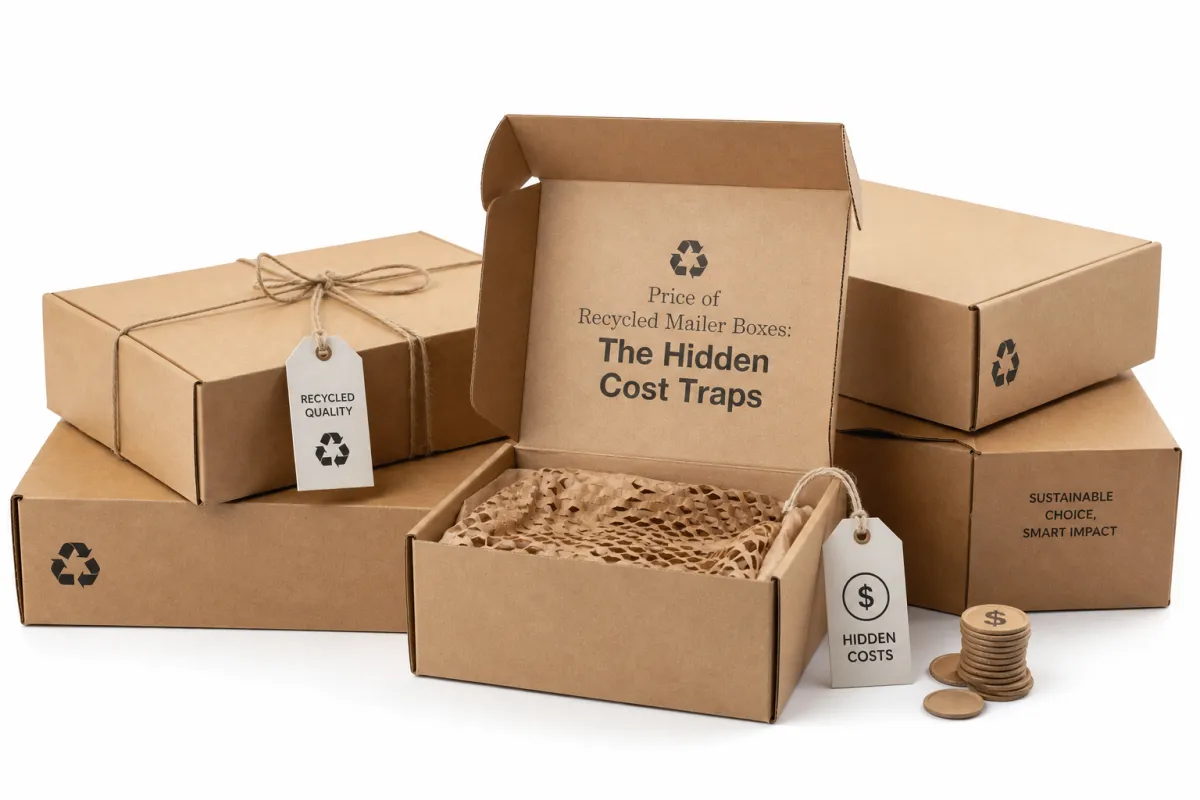
Recycled content does not automatically produce the lowest unit cost. The price of recycled mailer boxes is shaped by how much fiber goes into the structure, how efficiently the sheet nests on press, and how many converting steps the carton needs before it is ready to pack. A plain Recycled Kraft Mailer with a clean tuck closure can be very economical at volume, while a heavier board build with full-panel graphics may end up costing more than a simpler virgin-fiber mailer that uses less print and fewer finishing operations.
Small orders create one of the easiest traps to miss. Setup, die preparation, press make-ready, and quality checks still happen on short runs, so those costs are spread across fewer cartons. A 500-piece order can therefore carry a much higher price of recycled mailer boxes than a 5,000-piece order with the same artwork and dimensions. Special cutouts, internal print, and custom inserts follow the same pattern, since every added step has to be justified by the job instead of assumed as a free upgrade. That part gets overlooked kinda often, especially when a team is only looking at the box itself and not the work behind it.
Freight can get overlooked just as easily. Oversized mailers use more board, take up more pallet space, and can raise outbound shipping charges because dimensional weight climbs with the footprint. A box that is too tight brings another kind of cost, since crushed corners, added dunnage, and customer returns can erase whatever the packaging saved on the front end. The price of recycled mailer boxes is rarely just a material number. It is a landed-cost discussion that includes waste, handling, damage risk, and the labor needed to pack the order without friction.
If two quotes do not match on inside dimensions, flute type, print coverage, and delivery terms, they are not truly comparable. The lowest line item can become the most expensive box once waste, freight, and product damage are added back in.
From a buyer's point of view, the best quote is the one that fits the actual use case. Apparel, lightweight kits, and subscription refills need a different build than glass, electronics, or products with sharp corners. A realistic view of the price of recycled mailer boxes keeps the order from overspending on strength or decoration while still avoiding failure in transit. That balance matters more than chasing the lowest number on the page.
If you are weighing recycled options against other formats, it helps to look at the full carton family rather than one SKU in isolation. Many brands pair mailers with Custom Packaging Products for a more complete packaging system, and that broader view often reveals where the real savings live. A mailer that costs a little more on paper can still lower total spend if it reduces fill material, speeds up packing, or cuts damage claims.
One more practical point: when a mailer is being used as the outer shipper and the presentation box at the same time, the design has to do two jobs well. If the product is only protected in theory, the box is not actually saving money. The better pricing conversation looks at protection, presentation, and pack speed together.
Recycled Mailer Box Product Details: Materials, Closure, and Print
The phrase recycled mailer box covers a few different constructions, and each one behaves differently on the line. The most common option is recycled corrugated board with kraft liners and an E-flute or B-flute core. E-flute is thinner and smoother, which helps with print detail and keeps the mailer compact for retail-style shipping. B-flute gives more cushion and compression strength, which can help with heavier kits or parcels that need extra protection. Recycled paperboard mailers are also used for lighter goods and presentation-focused packaging, although they usually do not match corrugated performance when a shipment gets rough treatment.
Closure style matters just as much as board choice. A tuck-in mailer is quick to assemble and easy to open, but it may need closer attention to locking strength if the parcel sees rough handling. A self-locking mailer uses tabs and slots to hold the structure together without tape, which is useful on a packing line because workers can close it quickly and consistently. Some flap structures add a front lock or double-wall edge to make the box feel more secure, and that can improve presentation while adding a small amount to the cost. The price of recycled mailer boxes shifts with these details because every extra fold, score, and lock point adds converting time.
Printing is another major variable. A one-color logo on kraft board is usually the most economical branded option, especially when the art uses a single pass and no heavy ink coverage. A full-surface design changes the cost picture because it asks for more press time, tighter registration, and more control over color consistency on recycled fibers, which can vary slightly from sheet to sheet. Inside printing adds another layer of value for unboxing, yet it also increases make-ready and proofing time. Rich solids, gradients, and fine text all move the price of recycled mailer boxes upward because waste allowance and press control become more important.
These boxes show up in several different settings. E-commerce brands often want a sturdy mailer that looks clean on arrival, stacks well in a warehouse, and does not need excess void fill. Subscription shipments need a structure that opens neatly and gives the customer a clear branded reveal. Retail-ready shipments may ask for stronger print coverage or a firmer feel so the outer package supports the product story. In each case, the right recycled mailer is a balance of protection, pack speed, and presentation, not just a route to the lowest price of recycled mailer boxes.
If your line also uses flexible outer packs, it can be useful to compare the mailer spec against Custom Poly Mailers for certain lightweight shipments, because the best format is not always the box. A recycled mailer wins on rigidity, shelf appearance, and perceived value; a poly mailer can win on weight and speed. The right choice depends on product fragility, branding goals, and how the parcel moves through the network.
In practice, the material choice usually comes down to what the customer will notice and what the parcel will endure. A good recycled mailer feels sturdy in the hand, opens the way it should, and survives the trip without turning the inside of the box into a mess. That is the kind of performance that justifies the spec.
Specifications That Shape Performance and Cost
The most useful spec sheet starts with the finished inside dimensions, not a rough outside guess. Inside size tells the converter how the product will fit, how much board will be consumed, and whether the mailer can nest efficiently on a sheet. That choice has a direct effect on the price of recycled mailer boxes because a poor size wastes fiber, increases trim loss, and can create a larger shipping footprint than the job really needs.
- Inside dimensions: length, width, and depth after folding, not approximate product size.
- Board thickness: E-flute, B-flute, or recycled paperboard depending on protection needs.
- Print area: outside only, inside only, or full wrap with one or more ink colors.
- Closure style: tuck-in, self-locking, tab lock, or tape-assisted fold.
- Inserts or dividers: used when the product shifts, scratches, or ships as a set.
- Performance target: stacking strength, crush resistance, and parcel survivability.
Board thickness and flute profile matter more than most buyers expect. A lighter item may ship perfectly in a recycled E-flute mailer, while a ceramic set, a candle kit, or a printed catalog pack may need the added stiffness of B-flute or an internal insert. The package can look attractive on a sample table and still fail if it bows under stack pressure. That is where the price of recycled mailer boxes should be judged alongside performance, because a cheap box that opens in transit is not cheap at all.
Product weight is another practical filter. A 4-ounce apparel kit has a different shipping profile than a 3-pound bundle with glass or dense hardware. For higher-risk shipments, many teams reference test methods aligned with ISTA distribution standards so the package can be checked against real handling conditions instead of guessed at from a desk. That does not mean every carton needs lab testing, but it does mean the mailer spec should be chosen with shipping stress in mind rather than visual appeal alone.
Sustainability details also belong in procurement. Buyers often ask for recycled content claims, yet those claims should be clear and supportable. A box can be recyclable and still include features that complicate end-of-life handling, such as plastic windows, heavy coatings, or mixed-material closures. If your brand needs a cleaner sustainability story, ask whether the carton uses recyclable construction, recycled liners, and plastic-free closure features. The price of recycled mailer boxes may move slightly upward for those choices, but the packaging story becomes easier to defend. For broader recycling context, the EPA recycling guidance is a useful reference point for teams building a procurement checklist.
One more detail is worth checking early: whether the mailer needs to fit a shelf, a retail shipper, or a postal rate target. A fraction of an inch can affect carton yield, pallet density, and how many units fit into a case pack. That is why a quote request that says only "custom mailer" usually leads to revisions. If the spec is clear from the start, the price of recycled mailer boxes is easier to trust and easier to defend internally.
When the spec is written well, the rest of the job gets simpler. The converter can quote with fewer assumptions, the art team can build to the actual dieline, and the warehouse team can plan around a carton that fits the process instead of fighting it.
Price of Recycled Mailer Boxes: MOQ, Unit Cost, and Add-Ons
MOQ is one of the biggest drivers of the price of recycled mailer boxes. A manufacturer has to cover setup, tooling, plate creation, press calibration, and labor before the first finished carton is packed, so the first few hundred units carry more overhead than a later run in the thousands. That is why a unit price should always be read together with the order quantity rather than on its own. A lower MOQ can help a launch move forward, but it usually comes with a higher per-box cost.
It helps to break the quote into clear buckets. Base material, converting, printing, finishing, packaging, and delivery should all be visible. If one supplier gives you a single total and another itemizes the build, the second quote is usually easier to compare because you can see exactly which part of the price of recycled mailer boxes comes from board grade, which part comes from print, and which part comes from shipping. That transparency matters when you are deciding whether to order a simple mailer now and upgrade later, or place a larger first run to reduce cost per unit.
| Build | Typical MOQ | Approx. unit price at 1,000 | Approx. unit price at 5,000 | Best fit |
|---|---|---|---|---|
| Plain recycled kraft E-flute mailer, no print | 500 to 1,000 | $0.42 to $0.70 | $0.24 to $0.38 | Basic protection, lower branding needs, efficient shipping |
| One-color branded self-locking mailer | 1,000 to 2,000 | $0.58 to $0.95 | $0.30 to $0.52 | E-commerce apparel, subscription packs, clean logo presentation |
| Full-color printed mailer, outside only | 2,000 to 3,000 | $0.95 to $1.65 | $0.48 to $0.88 | Brand-led unboxing, retail mailers, richer graphics |
| Mailer with insert or divider set | 3,000 to 5,000 | $1.10 to $1.90 | $0.60 to $1.05 | Fragile kits, sets, gift packs, product separation |
Those ranges are examples, not a fixed offer. The real price of recycled mailer boxes depends on dimensions, board availability, print method, and shipping terms. A small box with heavy coverage can cost more than a larger plain mailer if the production path is simpler. Buyers are sometimes surprised by that, but it makes sense once the job is broken down into material, press time, and converting steps.
Add-ons can change the price faster than expected. Custom inserts, window cutouts, special inks, inside print, matte varnish, or a more complex locking structure all push the quote upward. Even something that sounds minor, such as shifting from one-color outside print to two-color print with tighter registration, can affect setup waste and press time. If you are comparing vendors, make sure every quote uses the same dimensions, the same board grade, the same print method, and the same freight assumption, or the price of recycled mailer boxes will not be apples-to-apples.
It also helps to ask where the breakpoints are. Sometimes the jump from 1,000 to 2,500 units is modest, because the extra volume spreads the setup cost across enough cartons to matter. Other times the jump is larger because the job needs a new die, an extra press pass, or a manual handwork step. A good quote should show those breakpoints clearly so you can choose between a tighter launch quantity and a lower long-run price of recycled mailer boxes.
If a supplier cannot explain the jump between price tiers in plain language, that is a red flag. A clear answer usually means the quote is built on real production steps, not a vague estimate. That kind of honesty is worth a lot when procurement needs to defend the spend.
Process and Timeline for Recycled Mailer Box Orders
The order flow is usually simple, but each step affects the final price and timing. First comes the spec review. That means inside dimensions, board choice, print coverage, and quantity. Then comes quote confirmation, dieline approval, artwork proofing, production, and packing. If any of those items changes late in the process, the price of recycled mailer boxes can move because the production team may need to rework plates, revise the dieline, or extend scheduling time.
- Review the brief: confirm product size, shipment weight, and required box style.
- Approve the dieline: check folds, tabs, and print boundaries before artwork starts.
- Proof the art: confirm color, logo placement, and any inside-panel messaging.
- Sample if needed: request a physical sample for fit, not just a digital proof.
- Run production: converting, printing, die-cutting, and folding happen in sequence.
- Pack and ship: case pack, palletize, and dispatch based on the agreed delivery plan.
Typical timing depends on artwork readiness and sampling. A clean job with final files approved early can move faster than a project that needs several art changes or a custom prototype. For many recycled mailer box orders, 12 to 15 business days from proof approval is a realistic production window, though the schedule can stretch if materials are scarce or if the job needs special finishing. Freight and warehouse receiving should be planned separately, because a finished run that sits in transit can affect launch dates just as much as a slow press schedule.
Request a physical sample whenever the fit is tight, the product is fragile, or the customer is asking for a specific unboxing feel. A digital proof is fine for checking logo position and general layout, but it cannot tell you whether a tuck flap closes cleanly or whether the insert holds the product upright. If your mailer has a brand-critical outside print, a sample also helps verify that the color holds up on recycled stock, where natural fiber variation can slightly affect tone. That is another reason the price of recycled mailer boxes should be tied to the proofing path, not just the board spec.
Delivery planning deserves as much attention as production planning. If the boxes are needed for a launch, a seasonal promotion, or a subscription rollout, the receiving date should include buffer time for transit, pallet handling, and QA checks at your warehouse. Rushing a box order usually costs more than placing it on a cleaner schedule. A well-planned order gives the team time to catch art issues, confirm case counts, and lock in a stable price of recycled mailer boxes before the launch window gets tight.
There is also a practical rhythm to these projects that only shows up after you have handled enough of them. The smooth ones are rarely the fanciest ones; they are the ones where the spec is clean, the approval chain is short, and nobody is trying to change the art after proof signoff. That kind of discipline saves both time and money.
Why Choose Custom Logo Things for Recycled Mailer Boxes
Custom Logo Things is a practical partner for buyers who need a box that works, not just one that photographs well. The right conversation starts with your actual product, your pack flow, and your shipping channel, then moves into the material and print decisions that shape cost. That approach keeps the price of recycled mailer boxes grounded in facts, which is exactly what a procurement team needs when comparing multiple packaging options.
Clear communication matters a great deal here. A good supplier should be able to talk through tolerances, board strength, print coverage, and carton fit without burying the buyer in jargon. If a design choice adds a few cents per unit but saves time on the packing line or lowers the damage rate, that tradeoff should be visible. If it does not add value, it should be questioned. That is the sort of straightforward guidance that helps keep the price of recycled mailer boxes honest from the first quote to the final shipment.
A useful packaging partner does not just ask for artwork. They ask what the product weighs, how it ships, how it is packed, and what the brand expects the customer to feel when the box opens.
That kind of support is especially valuable for custom dimensions and mixed packaging programs. Many buyers are not sourcing one carton in isolation; they are building a family of packaging that includes shipper boxes, branded sleeves, mailers, and flexible outer packs. In those cases, a coordinated spec review can prevent mismatched materials and avoid last-minute rework. If your line uses more than one packaging format, it may be worth comparing the mailer against the broader range of Custom Packaging Products so you can keep materials, branding, and cost targets aligned.
Guided quoting also matters. A buyer may know the product dimensions but not realize the box can be trimmed slightly without hurting protection, or that a small shift in print coverage can reduce ink cost without changing the visual impact much. That kind of detail keeps the price of recycled mailer boxes from drifting upward for no reason. The goal is a box that assembles cleanly, survives parcel handling, and still looks like it belongs to the brand.
From a manufacturing standpoint, a strong spec shortens the path from inquiry to production. Fewer revisions mean fewer chances for miscommunication and fewer chances for delay. Whether the order is a launch quantity or a repeat purchase, the best result is the same: a recycled mailer that fits the product, stays on schedule, and lands at a sensible price of recycled mailer boxes for the volume being ordered.
That is the real value of an experienced packaging contact: not a slick pitch, but fewer surprises. When the numbers line up with the physical package, procurement can move with more confidence and less rework.
Next Steps: Get an Accurate Quote on Recycled Mailer Boxes
If you want a quote that is actually useful, start with the finished inside dimensions, the product weight, the quantity, the print requirement, and the target delivery date. Those five details let a supplier narrow the material choice and price the job with much better accuracy. If you leave them out, the first number you see is usually a placeholder, not a dependable price of recycled mailer boxes.
It also helps to gather the artwork files, sample photos of the product, and any retailer or marketplace packaging rules before you send the brief. A simple mailer for apparel has different expectations than a carton for electronics or a gift kit, and those differences show up in the board grade, the closure style, and the print setup. The more complete the brief, the less likely the quote will be revised later. That keeps the price of recycled mailer boxes easier to approve internally.
When you request pricing, ask for two or three scenarios side by side. Compare a plain recycled mailer, a one-color branded version, and a full-print upgrade. That comparison makes the value of each step visible, and it helps you decide whether the added presentation is worth the extra spend. It also reveals the real breakpoints in the order, so you can see whether a higher quantity lowers the price of recycled mailer boxes enough to justify a larger buy.
Here is the cleanest path: send the exact spec, not a rough guess, and ask for a quote that shows board grade, print method, MOQ, and delivery terms. That is the fastest way to get a reliable price of recycled mailer boxes and the best way to avoid surprise costs after the order is already in motion. A sharp quote is usually built from sharp inputs.
Before you sign off, compare the quoted box against the way your team actually packs and ships. If the carton saves a little on material but slows down assembly, the labor cost may cancel the savings right out. Pick the version that works in the warehouse, not just in the spreadsheet.
What affects the price of recycled mailer boxes the most?
Board grade and box size usually drive the base cost first, because they determine how much material goes into each unit and how efficiently the sheet can be converted. MOQ has a major effect because setup is spread across each box, and print coverage, inserts, and specialty finishes can raise the total quickly. If the spec is tight and the art is simple, the price of recycled mailer boxes stays much more predictable.
Are recycled mailer boxes cheaper than standard mailers?
Not always, because recycled content can still use the same converting and printing steps as other mailers. A simple recycled mailer can be very competitive at higher quantities, but low-volume orders may cost more per box regardless of material choice. The better question is whether the recycled format gives you the right balance of performance, branding, and the price of recycled mailer boxes.
What MOQ should I expect for recycled mailer boxes?
MOQ depends on box size, print complexity, and the production method used. Smaller runs are possible, but the unit price is usually higher because setup costs are spread across fewer cartons. Ask for pricing at multiple quantities so you can compare breakpoints clearly and understand how the price of recycled mailer boxes changes as the order grows.
Can I get recycled mailer boxes with custom printing?
Yes, most orders can include one-color or multi-color branding, and many buyers choose outside print, inside print, or both. Print coverage affects cost, proofing time, and color consistency, especially on recycled stock where natural fiber variation can slightly influence the final tone. Provide final artwork early to keep the price of recycled mailer boxes and the timeline under control.
How do I estimate recycled mailer box pricing for a new product launch?
Start with the finished product dimensions and the number of items per box, then add the target order quantity, print requirements, and any insert needs. Request quotes for standard and upgraded versions so you can compare cost against presentation and protection. That simple comparison gives you a practical read on the price of recycled mailer boxes before the launch budget is locked.
The safest next move is simple: lock the spec, compare at least two build levels, and choose the version that protects the product without adding unnecessary packaging weight or labor. That is how you get a fair price of recycled mailer boxes and a box your team can actually use with confidence.


