Buyer Fit Snapshot
| Best fit | Compare Minimalist vs Premium Packaging projects where brand print, material claims, artwork control, MOQ, and repeat-order consistency need to be specified before quoting. |
|---|---|
| Quote inputs | Share finished size, material target, print colors, finish, packing count, annual reorder estimate, ship-to region, and any compliance wording. |
| Proofing check | Approve dieline scale, logo placement, barcode or warning zones, color tolerance, closure strength, and carton packing before bulk production. |
| Main risk | Vague material claims, crowded artwork, missing packing details, or unclear freight terms can make a low unit price expensive after revisions. |
Fast answer: Compare Minimalist vs Premium Packaging: What Pays Off should be specified like a repeatable production item. The safest quote records material, print method, finish, artwork proof, packing count, and reorder notes in one written spec.
Production checks before approval
Compare the actual filled-product size with the drawing, then confirm tolerance on folds, seals, hang holes, label areas, and retail display edges. Reserve space for logos, QR codes, warning copy, and material claims before decorative graphics fill the panel.
Quote comparison points
Review material grade, print process, finish, sampling route, tooling charges, carton quantity, and freight assumptions side by side. A quote is only useful when the supplier can repeat the same color, closure quality, and packing count on the next order.
Compare Minimalist vs Premium Packaging: What Pays Off
Compare minimalist vs premium packaging, and the conversation stops being about taste pretty quickly. It becomes about margin, freight, protection, and the first ten seconds a customer spends turning a box over in their hands. I still remember a skincare project in Toronto where a carton change added $0.14 per unit on a 5,000-piece run, but the product suddenly felt closer to a $38 item than a $22 one because the spec moved from thin 250gsm folding board to a tighter 350gsm C1S artboard with cleaner folds, a better score on the lid, and print that held its registration under harsh light. There was no magic in it. Just a sturdier board, a calmer layout, and a closure that behaved like it had a job to do. I have seen the same shift make a plain retail tray feel like branded packaging someone wanted to keep on a desk, which is flattering for the brand and mildly annoying if you were hoping the tray would disappear after delivery.
My take is pretty direct. Compare minimalist vs premium packaging and you are really comparing two operating models, not two moods. Minimalist usually protects margin, shortens production, and keeps replenishment moving without much drama. Premium earns its place only when the retail price, category, and unboxing moment can absorb the extra spend without making COGS look silly. If a $14 supplement or a $19 candle needs a $3.80 box to justify itself, the packaging is usually doing work the product should be doing. That realization tends to make people sit back and blink a little, especially after the third quote from a factory in Dongguan.
How Do You Compare Minimalist vs Premium Packaging?
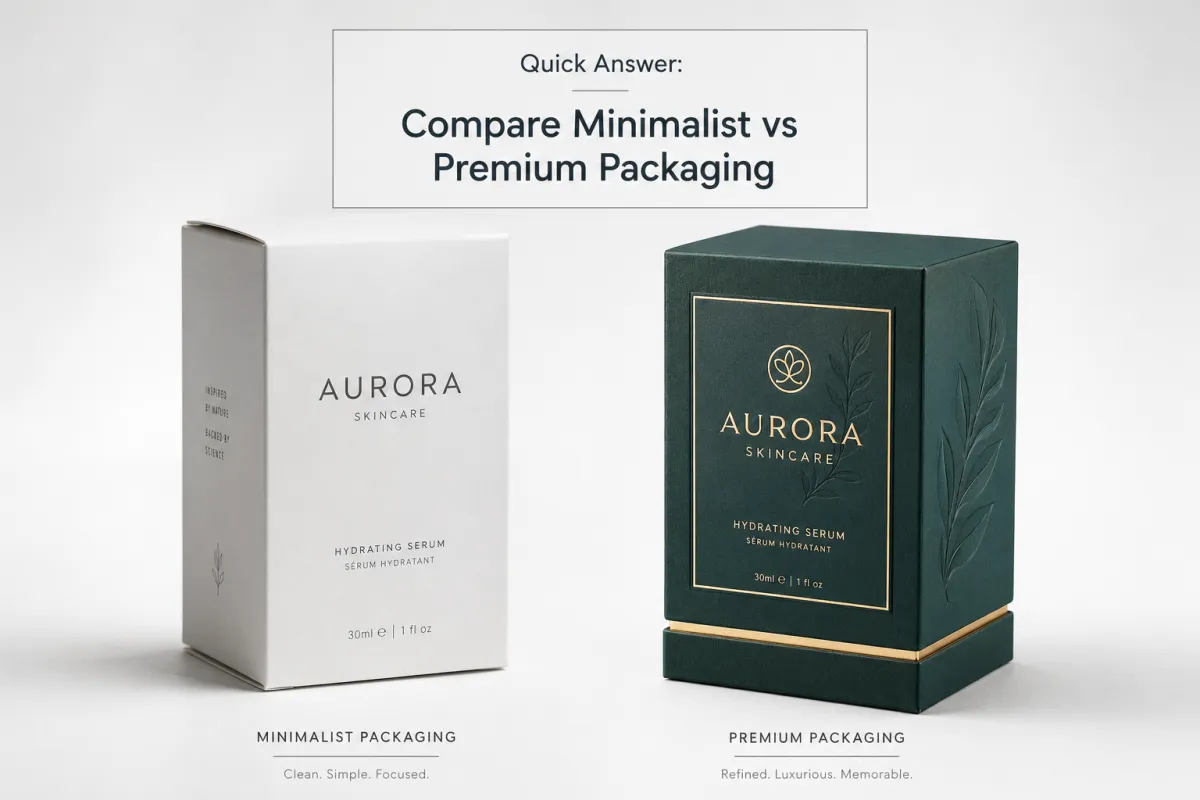
Compare minimalist vs premium packaging by asking one grounded question first: what job does the box need to do on day one, and what job does it need to do after the customer takes it home? If the answer is "protect the product, ship cleanly, and keep the brand readable on a shelf in Chicago or Dallas," minimalist usually wins. If the answer is "signal luxury, support gifting, and make the buyer feel value before they touch the product," premium can earn its keep. I once stood on a factory floor in Shenzhen while a converter changed a basic white folding carton to a tighter die-cut and a heavier 350gsm C1S board, and the cost moved by about $0.16 per unit on a 10,000-piece run. The buyer later told me the product started showing up in customer photos with ribboned gifts and handwritten notes beside it. Same formula, different signal. That is the part people underestimate right up until the sales report lands on their desk.
That is the simplest way to compare minimalist vs premium packaging. Minimalist keeps the count low: fewer inks, fewer components, simpler construction, less hand work. Folding cartons, kraft mailers, one-color print, and a logo that stays calm instead of shouting all fit that lane well. Premium is the opposite in process, not necessarily in taste. Rigid boxes, specialty wraps, foil stamping, embossing, soft-touch lamination, Molded Pulp Inserts, and extra assembly steps all add time and labor in places where the invoice is easy to miss. Both approaches can work. Both can fail too, usually because the brand picks the wrong lane for its price point or tries to fake luxury with finishes that look cheaper than the product inside. I have seen a matte black box with low-coverage foil get opened, paused over for three seconds, and set aside like a bad blind date in a hotel lobby.
Compare minimalist vs premium packaging and the math changes along with the look. Minimalist tends to improve margin and replenishment speed because it uses less material, less freight volume, and fewer hours at the packing table. Premium usually lifts perceived value and creates a stronger first impression, but it can crush COGS if the item itself sells for only $18 or $24. A $60 serum, a $120 candle set, or a $250 watch can carry premium packaging without strain if the retail math is healthy. Supplements and fast-moving DTC goods usually do better with a lighter box that moves quickly through a fulfillment center in Ohio or Nevada. No theater, just arithmetic. And yes, some teams still want theater anyway; the numbers usually end up being the adult in the room.
"A good box should earn its rent. If it costs more than the story the product can tell, you are decorating a problem."
Once you compare minimalist vs premium packaging through landed cost, turnaround, protection, shelf presence, sustainability, and repeat sales, the decision gets a lot clearer. That is the checklist I use after a quote lands on my desk. Unit price matters, but freight, rework, and storage can quietly add another 12% to 28% if the project is messy or the supplier is 7,000 miles away in the wrong season. I have watched buyers celebrate a low quote, then lose the savings because the cartons arrived late, needed hand sorting, and had to be repacked before launch. It is an expensive lesson for a box, and one that usually comes with a few choice words in the warehouse.
Top Options Compared: Minimalist, Premium, and Hybrid
Compare minimalist vs premium packaging without forcing a false either-or outcome. There are really three paths on the table: clean minimalist, fully premium, and hybrid packaging. Hybrid is the one I suggest most often because it keeps the discipline of minimalist design while placing money into one memorable detail instead of five expensive ones. I have seen too many brands stack foil, embossing, spot UV, and a magnetic closure the way some people fill a cart at 11:47 p.m. after a rough week in Q4. That is not strategy. That is just a larger invoice with a nicer font.
Minimalist fits subscriptions, supplements, cosmetics refills, accessories, and fast-moving Retail Packaging That gets opened and discarded quickly. Premium fits jewelry, fragrance, high-end skincare, whiskey accessories, and gifting lines where presentation is part of the product packaging itself. Hybrid works for brands that want polish without wrecking margins: a rigid lid with one-color print, a folding carton with a soft-touch panel, or a kraft mailer paired with a carefully designed insert. Compare minimalist vs premium packaging less as a style fight and more as a question of which layer of the customer experience deserves the spend. A $0.09 kraft sleeve can often do the job of a $1.90 rigid shell if the product itself is already strong.
Operationally, compare minimalist vs premium packaging and the differences show up fast. Minimalist is easier to source, store, and ship. The cartons nest better, the boxes take less warehouse space, and fulfillment teams move faster because there are fewer components to match and fewer ways to make a mistake. Premium brings design approvals, print proofs, foil plates, insert tolerances, and more quality checkpoints. I once worked with a Dongguan rigid-box supplier who promised "luxury quality" at a sharp price. The sample looked excellent, then the first production batch arrived with a lid gap that wandered by 1.5 mm across the front edge, which turned into three days of sorting in a warehouse outside Shanghai. Fancy does not cancel bad process. If it did, packaging would be a lot less stressful than it is.
Shoppers also notice different things depending on the structure. In minimalist packaging, structure and print clarity do more work than a random decorative finish ever could. In premium, weight, texture, opening sequence, and the way the lid closes matter more than an aggressive graphic. That is why compare minimalist vs premium packaging should be judged by cost, lead time, protection, shelf impact, sustainability, and brand fit, not by a mood board. Mood boards do not pay freight from Ningbo to Long Beach, and they certainly do not pay storage for 2,000 cubic feet of boxed inventory. They do, however, make people feel productive for about twenty minutes.
For brands that want a catalog of starting points, Custom Packaging Products is a practical place to compare structures before you commit to a custom printed box. I also tell clients to keep an eye on the wider packaging design system, because package branding works best when the mailer, insert, and inner carton share the same visual language instead of competing for attention. A kraft outer mailer, a 1-color inner sleeve, and a 350gsm C1S insert can often tell a stronger story than three unrelated surfaces with different finishes and no shared discipline.
- Minimalist: lower cost, faster turn, easier storage, best for practical products with 5,000-piece or larger runs.
- Premium: higher perceived value, more hand assembly, best for gifting and display-led product launches.
- Hybrid: one premium touch, controlled COGS, usually the safest middle ground for brands under $50 AOV.
Detailed Review: Minimalist Packaging That Still Sells
Compare minimalist vs premium packaging and people often translate that into "cheap vs expensive." That reading misses the point by a mile. Good minimalist packaging is not bare because the brand ran out of ideas. It is disciplined. The core pieces are usually a folding carton, a kraft mailer, a clean insert, and one or two print colors that line up with the brand instead of fighting it. If the typography is sharp and the board choice is honest, minimalist can look deliberate rather than stripped down. I had a client in Toronto move from a four-color carton on 300gsm SBS to a one-color matte black print on 350gsm C1S artboard, and the product looked more refined because the design finally stopped shouting at everyone in the room.
The money side is real. Minimalist packaging uses less material, weighs less in freight, and takes less warehouse space. A 9 x 6 x 3 folding carton can weigh around 35 to 50 grams; a rigid magnetic box with inserts can land at 150 to 220 grams before the product even goes in. That gap matters on a 5,000-unit run in Los Angeles, Rotterdam, or Melbourne, where pallet count and freight class can shift the invoice by hundreds of dollars. Compare minimalist vs premium packaging, and one of the easiest margin wins usually lives on the lighter side. I have seen more than one buyer stare at that difference and quietly say, "Well, that stings." Correct. It does sting, but the shipping team will thank you later.
The downside is just as real. Minimalist can read as cheap if the paper stock feels flimsy, the dieline is sloppy, or the brand tries to save money by putting a logo on a generic shipping carton and calling it design. I have seen that mistake in supplier meetings in Guangzhou and Hanoi more times than I care to count. A rep promises "clean and modern," then sends a sample with weak glue lines, muddy gray ink, and corners that open after one fold test. That is not minimalist. That is underbuilt. In product packaging, people know the difference the second they pick up the box. Fingers are brutally honest.
If you want minimalist packaging to feel premium without torching the budget, spend in three places: better paper, tighter die-cutting, and one tactile finish. A 350gsm C1S artboard with a matte varnish and crisp edges beats cheap board loaded with five gimmicks every time. One solid emboss, one restrained foil logo, or one soft-touch panel can carry more weight than a pile of noisy effects. Compare minimalist vs premium packaging, and the real question becomes restraint, not deprivation. I learned that in a meeting with a paper merchant from Guangzhou who said, very dryly, "If the board is weak, the finish is just makeup." He was right, and I wish more people in packaging said things that directly.
Minimalist also wins on flexibility. If copy changes, regulatory text updates, or a new offer needs testing, a simpler structure lets you move faster. That matters for retail packaging and subscription boxes where inventory turns quickly and SKU changes happen every 60 to 90 days. It matters again when you want custom printed boxes in smaller batches, such as 1,000-piece test runs for a Shopify launch. I have seen a brand save nearly $1,900 on a quarterly reprint by sticking with a plain white insert instead of a full-coverage custom tray. The box still felt premium enough because the proportions were right and the branding stayed disciplined.
Minimalist is not the boring option. Compare minimalist vs premium packaging and the minimalist side only looks weak when the designer treats white space like an excuse instead of a decision. Done well, minimalist feels modern, precise, and confident. Done poorly, it feels like procurement won and everyone else left the room early. That is usually the point where the brand manager starts staring at the ceiling over a late lunch in the conference room, which I completely understand after enough packaging rounds to know better.
Detailed Review: Premium Packaging When the Price Is Worth It
Compare minimalist vs premium packaging takes a different shape the moment the box becomes part of the product promise. Premium packaging usually means a rigid box, magnetic closure, specialty wrap paper, foil stamping, embossing, soft-touch lamination, and custom inserts cut to hold the product at a specific angle. That opening sequence matters. I watched a fragrance buyer in Shanghai test three samples on a table in front of me while a factory rep from Suzhou measured the lid fit with a caliper. The formula stayed the same. The box changed. The premium version made the fragrance feel like a gift before anyone lifted the cap, and that is not a small thing because people absolutely judge with their hands first and their spreadsheets later.
The value drivers are easy to name. Premium packaging raises perceived value, supports gifting, and can improve protection because rigid walls and fitted inserts reduce movement. It also creates better social content because the unboxing moment looks deliberate on camera. If you are selling luxury skincare, jewelry, candles, or a limited-edition set, compare minimalist vs premium packaging with the full customer journey in view rather than staring only at carton cost. A $4.20 box on a $120 product is not strange if the packaging helps conversion and repeat purchase. A $4.20 box on a $16 item usually signals a habit, not a strategy. I have seen that decision defended with a straight face, which is its own kind of performance art.
The drawbacks are blunt. Premium packaging ships heavier, costs more to make, and often needs more hand assembly. That means longer sample cycles and more opportunities for delay. A soft-touch wrap can scuff in transit from Ningbo to Seattle. A foil stamp can drift by 0.8 mm and look wrong under retail lighting. A magnet can weaken a closure if the supplier specs are loose. I have seen a premium run fall apart because the inserts were specified in the wrong board thickness, which made the product rattle inside the box at the corner of a warehouse in Melbourne. Expensive does not mean immune from bad planning. Sometimes it just means the mistakes are pricier and harder to explain.
Fake luxury is the worst trap in the whole discussion. Compare minimalist vs premium packaging, and you quickly learn that shiny finishes do not rescue a weak structure. A crowded layout, bad alignment, and cheap-looking print on a rigid shell still feels cheap. That is the part teams miss when they rush. Premium is a system. Structure, material, finish, and assembly all have to move together. If one piece is off by 2 mm, the whole package starts looking like a compromise nobody wanted to own. I once saw a lid sit crooked enough to make the product feel suspicious, and that was on a sample the team had already called "final" after a 20-minute review. Final is a strong word for something that still wobbles.
For brands that care about provenance, certified paper matters here too. FSC-certified board does not magically make a box beautiful, but it does strengthen the sustainability story and clean up sourcing from mills in Canada, Finland, or Zhejiang. If that sits inside your branded packaging pitch, I would rather see a premium box built from verified material than a flashy one with no chain-of-custody story behind it. The FSC site is useful for understanding the certification path: FSC. Compare minimalist vs premium packaging, and there is room for trust in the decision, not just aesthetics.
I also like premium packaging when the product is being sold as a gift or display piece. A rigid lid-and-base box with a paper ribbon pull can help the buyer feel like the item deserves to be shown off at a wedding, a product launch, or a holiday counter display in San Francisco. That does not mean every luxury brand needs six finishes. In truth, a lot of premium packaging looks worse because the team spent money on everything except discipline. One sharp texture, one restrained logo, and a box that closes cleanly can beat a gold-foil circus any day of the week. I say that with love, because I have watched too many beautiful concepts get buried under decorative excess and a budget that should have been cut in half.
If you want a practical reference point, premium rigid packaging often lands somewhere around $1.90 to $5.80 per unit on 3,000-piece runs, depending on size, insert complexity, and the number of finishes. A lid-and-base box with one foil stamp and a paperboard insert might sit near $2.15 per unit, while a magnetic closure with a velvet tray can move past $5.00 per unit quickly. Compare minimalist vs premium packaging, and the question is not whether premium looks beautiful. It is whether that beauty pays for itself through pricing, positioning, and conversion.
Price Comparison and Ordering Timeline
Compare minimalist vs premium packaging more cleanly once cost is broken into pieces instead of argued over as a single shiny number. I always ask for design cost, setup or plates, material, finishing, assembly, freight, storage, and a damage allowance. If a supplier gives only a bottom-line figure, the weak spots are usually hidden in that number. A quote that looks $0.23 cheaper can become the more expensive order after palletization, sorting, and air freight from Asia to the U.S. West Coast. I have seen that exact trick play out more than once, usually right when a buyer is under launch pressure and trying to get a carton approved before lunch in a conference room with cold coffee and no natural light.
| Option | Typical Unit Cost | Lead Time | Best Fit | Main Risk |
|---|---|---|---|---|
| Minimalist folding carton | $0.18 to $0.62 at 5,000 pieces | 8 to 15 business days after proof approval | Subscriptions, supplements, fast-moving DTC | Can look generic if paper and print are weak |
| Hybrid packaging | $0.55 to $1.40 at 3,000 pieces | 12 to 18 business days after sample sign-off | Brands that want polish without high COGS | Easy to overdesign and lose the savings |
| Premium rigid box | $1.90 to $5.80 at 3,000 pieces | 18 to 30 business days after final sample approval | Luxury, gifting, display-led product packaging | Higher freight, more assembly, more QC risk |
Those figures move with size, board grade, and finish count, but they are close enough to guide a decision. Compare minimalist vs premium packaging, and source location matters too. Domestic production in Ohio, Texas, or California can reduce transit time and shrink communication gaps, while the unit price usually runs higher. Overseas manufacturing in Shenzhen, Dongguan, or Ningbo can lower the base cost, sometimes by 18% to 35%, while adding sampling time, ocean freight, customs risk, and a little more patience than most buyers enjoy. That trade-off is real. A cheap quote from a factory that cannot ship on time is not cheap at all. It is just a more polished disappointment.
Timeline is where many projects slip. A minimalist run might move through brief, dieline, sample, one revision, production, quality check, shipping, and receiving. That can land in 3 to 5 weeks if everyone replies quickly and the print buyer signs off within 24 hours. A premium project can stretch to 6 to 10 weeks because the structure, wrap paper, insert fit, and finish alignment all need extra approvals before the factory cuts a full run. Compare minimalist vs premium packaging, and speed often turns out to be the hidden decision sitting beneath the design discussion. Once the launch date is fixed for a trade show in Las Vegas or a retail drop in New York, there is no infinite runway to chase perfection. People still try, of course. They usually discover that deadlines are much less impressed by ambition than by calendars.
I recommend testing to a shipping standard before ordering either option in volume. ISTA has useful guidance for package testing, and the point is simple: do not assume the box will survive just because it looked good in the sample room. If the product is fragile, ask for drop, vibration, and compression checks that reflect the real distribution route, such as 24-inch drops for a smaller DTC shipper or compression loads that mimic a stacked pallet in a third-party warehouse. The standards page at ISTA is a good starting point. Compare minimalist vs premium packaging with abuse testing in the mix, because customers do not care how elegant the sample looked. They care whether the product arrived intact, which is a much less glamorous but far more useful standard.
One more practical note: the real cost of premium is not just materials. Storage matters too. A rigid box can take up two to four times the cubic volume of a flat folding carton before assembly, which changes how many units fit on a standard 48 x 40 pallet and how much a warehouse in New Jersey or California charges to hold them. That means more pallet space, more warehouse handling, and more chances for scuffing. If your fulfillment operation charges by cubic foot, compare minimalist vs premium packaging with storage in the model, not just print and board. That is where a lot of beautiful decisions get exposed, usually right beside the shipping dock.
How to Compare Minimalist vs Premium Packaging and Choose
Compare minimalist vs premium packaging the right way, and the answer usually shows up in the numbers before it shows up in the mood board. My decision rule is simple. Choose minimalist if margins are tight, the product is practical, and speed matters more than theater. Choose premium if average order value, gifting potential, or the brand promise can absorb the extra cost. For most brands, the smart middle is hybrid packaging: one memorable tactile detail, not a full luxury build that inflates COGS. I have seen that approach save a client $14,000 across a quarter while improving customer photos because the box still felt intentional and the insert was trimmed properly at the factory in Dongguan.
If you want a clean decision matrix, start with a few direct questions. Is the product sold mainly for utility or for display? Does the packaging need to protect glass, metal, or fragile inserts? Can the customer pay $3 to $5 more without resistance? Do you need custom printed boxes with a specific opening ritual, or do you need retail packaging that stacks cleanly on a shelf in Seattle or Atlanta? Compare minimalist vs premium packaging becomes obvious once the question changes from "which looks nicer" to "which makes money without creating operational headaches." That shift sounds simple, but I have watched entire teams spend two meetings avoiding it while discussing Pantone swatches and closure styles.
- Audit current COGS: include board, print, finishing, freight, and spoilage on a 5,000-unit or 10,000-unit run.
- Request two quotes: one minimalist, one premium, plus a hybrid option if possible from the same supplier.
- Order physical samples: touch the paper, close the lid, and inspect the corners under daylight and warehouse light.
- Run shipping abuse tests: check real box performance, not render quality, using drop and vibration checks.
- Compare to revenue: look at conversion, repeat purchase, and giftability against the added $0.14 to $4.60 per unit.
That list sounds ordinary because it works. Compare minimalist vs premium packaging is not won by the prettiest mockup. It is won by the box that survives production, ships on time, and supports package branding after it reaches the customer's hands in one piece. If you need help narrowing the structure choices, the range on Custom Packaging Products is a useful benchmark before you ask a supplier to quote something custom and expensive.
One lesson from a supplier negotiation in Ningbo still sticks with me. The factory wanted me to approve a premium sample with a gold foil border, emboss, and a velvet tray. I asked them to quote the same structure with one foil logo and a better board. The revised sample cost $1.11 less per unit and looked more expensive because the design finally had breathing room. That is the sort of thing most people miss. Compare minimalist vs premium packaging, and the winner is often subtraction rather than addition. If a design feels nervous when you remove one decoration, it probably needed fewer decorations in the first place.
So here is the blunt takeaway on compare minimalist vs premium packaging: compare sample units, landed cost, shipping abuse, and unboxing impact before you place a bigger order. If the product can carry a premium story, pay for the parts customers actually touch, such as the lid, the insert, or the outer wrap. If it cannot, keep the structure clean, keep the print disciplined, and let the product carry the rest. I have seen both routes work in factories from Shenzhen to Toronto. I have also seen both routes waste money. The difference is usually not taste. It is restraint.
Is minimalist packaging always cheaper than premium packaging?
Usually yes, though not in every case. Compare minimalist vs premium packaging can flip if the minimalist version needs a heavy insert, rush freight, or a tiny production run that wipes out the setup savings. I have seen a simple carton become unexpectedly expensive because the buyer ordered 800 units in a rush and then paid more in air freight from Shenzhen to Chicago than they saved on board. Ask for full landed cost, not just unit cost, or the quote will look nicer than it behaves.
How long does it take to produce minimalist vs premium packaging?
Minimalist packaging usually moves faster because it uses fewer materials, fewer finishes, and less hand assembly. In a clean factory flow, I have seen minimalist custom printed boxes finish in 8 to 15 business days after proof approval, especially for 5,000-piece runs. Premium packaging takes longer because sample rounds, structural approvals, and assembly checks add time before production even begins, and a rigid box from Dongguan or Ningbo can easily take 18 to 30 business days after final sample approval. Compare minimalist vs premium packaging, and timing often turns out to be the real decision hidden beneath the styling discussion.
Which works better for luxury brands: minimalist or premium packaging?
Premium usually wins when the box is part of the brand promise and the product is meant to be gifted or displayed in a retail case, hotel suite, or high-end showroom. That said, compare minimalist vs premium packaging is not permission to make everything shiny. Minimalist can still work for luxury if the paper stock is strong, the typography is calm, and the structure feels intentional instead of stripped down and lazy. I have seen a simple white rigid box beat a flashy gold one because it felt more confident, which is a rare but satisfying outcome.
Can minimalist packaging still feel premium?
Yes. Use better paper, cleaner structure, sharper print, and one tactile detail instead of stuffing the box with unnecessary finishes. Compare minimalist vs premium packaging is where people learn that restraint can look expensive if the materials are right. A disciplined design system usually beats a box loaded with random effects. Fancy does not equal premium. I learned that the hard way after approving a sample from a Guangzhou supplier that looked like it was trying too hard and then wondering why the sample table felt embarrassed on my behalf.
What should I ask suppliers before choosing between the two?
Ask for physical samples, MOQ, lead time, landed cost, finish specs, and the exact assembly method. Also ask how the box will ship, how many units fit per carton, and what happens if the first sample needs revisions. Compare minimalist vs premium packaging gets much easier when the supplier puts every number in writing, including the quoted price for a 3,000-piece or 10,000-piece run and the production city, such as Shenzhen, Dongguan, or Ningbo. If they dodge the freight question, that is not a detail. That is a warning sign, and usually not a subtle one.


