Buying printed apparel plastic bags bulk is not about making plastic feel fancy. It keeps garments clean, makes presentation consistent, and prevents packaging from becoming an afterthought. A plain poly bag protects the shirt. A printed one also protects margin, brand recall, and the first impression the customer actually sees.
For apparel brands, retailers, fulfillment teams, and event merch programs, the real question is not whether packaging matters. It is whether the bag does useful work or just takes up shelf space. The best bulk orders solve a practical problem: they fit the garment, print clearly, hold up under handling, and keep bagging costs under control at scale.
That is why this category keeps selling even in a market full of minimalist branding. A bag does not need to be dramatic. It needs to be right. When it looks organized, loads quickly, and arrives without defects, it has already done more than many packaging choices that cost twice as much.
Why apparel brands still buy bulk printed bags
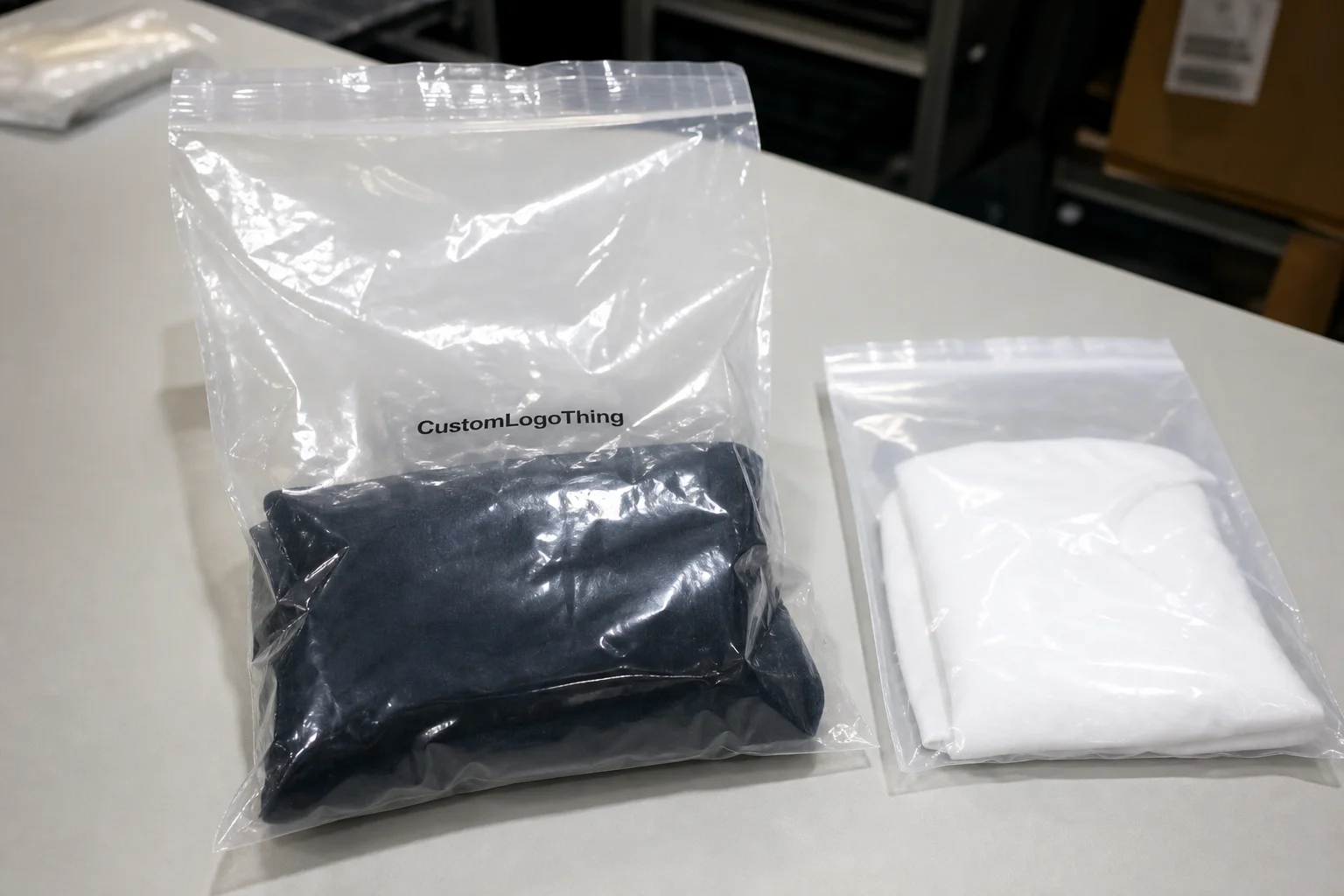
Plain packaging does the bare minimum. That works when an item is just moving from point A to point B with no customer in sight. Apparel is different. Shirts, hoodies, leggings, and sets are often seen before they are worn, and the bag becomes part of the product presentation. A wrinkled or generic bag can make even a well-made garment look less considered.
Bulk printing makes sense when the same packaging needs to repeat across many orders or locations. Multi-store retail chains, seasonal drops, trade show merchandise, subscription shipments, and warehouse fulfillment operations all benefit from one spec instead of a patchwork of near-identical substitutes. Standardization saves time in packing, reduces mistakes, and makes replenishment easier to forecast.
The cost advantage is real too. A buyer who orders in volume spreads setup fees, plate costs, and freight more efficiently than someone placing small ad hoc orders every few weeks. The savings show up in per-unit pricing, fewer emergency purchases, and less labor spent correcting packaging mismatches.
- Lower unit cost at volume compared with smaller repeated buys.
- Brand consistency across stores, warehouses, and events.
- Fewer packaging emergencies because stock is planned instead of improvised.
- Cleaner presentation without adding much time to the packing line.
From a buyer’s point of view, the best bag is the one that disappears into the workflow. It should fit the garment without excess slack, print cleanly, and survive handling without making the package look sloppy. A branded bag that slows down packing or arrives scuffed is not saving money. It is moving the problem downstream.
“A branded bag does not need to be elaborate. It needs to fit, print cleanly, and survive handling without making the order look unfinished.”
There is also a quiet operational benefit. When every package looks the same, store staff and warehouse teams spend less time guessing which bag belongs to which item. That sounds minor until a holiday shipment or store reset rolls in and every wasted second multiplies.
Bag styles, film options, and print methods that fit apparel
Not every apparel bag serves the same purpose. A folded tee in a retail display has very different needs from a hoodie being shipped across the country. The right choice depends on how the package is handled, how visible the garment needs to be, and how much protection the bag must provide before it reaches the customer.
Common bag formats
- Flat poly bags - Simple, low-cost, and good for folded tees, leggings, and lightweight basics.
- Resealable garment bags - Useful for boutique presentation, returns, and items that may be reopened.
- Patch handle shopping bags - Better for retail carryout and event branding.
- Mailer-style poly bags - Built for shipping apparel with a closure suited to transit.
- Garment bags with adhesive flaps - Practical when you need a secure seal without extra tape.
LDPE is the common choice when flexibility matters. It feels softer, stretches more, and is often easier for staff to load by hand. HDPE is crisper, usually less expensive, and can feel thinner even when the gauge is similar. That difference in hand-feel matters because buyers often mistake stiffness for thickness and softness for weakness. They are not the same thing.
For heavier hoodies, sweatshirts, sweatpants, or bundled sets, a heavier film is usually the safer move. Thin film can wrinkle badly, split at the seal, or puncture around zippers, snaps, or hang tags. If the package looks underpacked, the product inside often looks less valuable, even if the garment itself is fine.
| Bag style | Best use | Typical strengths | Watch-outs |
|---|---|---|---|
| Flat poly bag | Folded tees, basics | Low cost, simple print, fast packing | Less structure for bulky garments |
| Resealable garment bag | Boutique retail, hang-dry items | Reusable feel, tidy presentation | Higher unit cost, more handling steps |
| Mailer-style poly bag | E-commerce shipping | Secure closure, transit-friendly | Less premium appearance than retail bags |
| Patch handle shopping bag | In-store carryout, events | Strong branding surface, easy carry | More material and print area cost |
For printing, flexographic printing remains the standard workhorse on larger runs. It is efficient for spot colors and crisp logos, especially when the artwork is clean and uncomplicated. One-color and two-color designs usually deliver the best mix of cost and print quality. Once artwork leans on tiny gradients, fine detail, or dense text, the production margin gets tighter and the risk of inconsistent results rises.
Finish matters too. Clear film shows the garment and keeps product visible. Frosted film softens the look and can feel more premium, but it reduces transparency. Matte and glossy finishes change the shelf impression, although glossy surfaces tend to show scuffs more easily. Add hang holes if the bag will be displayed. Add suffocation warnings if your market or retail channel requires them. Skip those details and you may end up paying for rework or compliance corrections later.
Packaging World / PMMI resources are useful for operational standards and industry references. For shipping applications, ISTA testing methods help confirm whether a thin film will survive sorting equipment, carton compression, and rough handling in transit.
Specs that affect fit, durability, and shelf presentation
Most bag problems start with sizing. Buyers often think in garment sizes: small, medium, large, XL. That is not enough information. The better starting point is the folded garment dimension. A medium hoodie can take more room than a large lightweight shirt. A tee with a thick front print can also need more height than the blank version because the fold sits differently.
Before placing an order, confirm these specs:
- Width - The flat dimension across the bag.
- Height - Enough room for insertion and closure.
- Gusset - Needed for bulky garments or bundled sets.
- Film thickness - Usually measured in mils or microns.
- Seal type - Bottom seal, side seal, adhesive flap, or zip seal.
- Print area - Critical for logo placement and copy.
- Load direction - Affects how fast packing moves and how the garment settles.
The fastest way to miss a good fit is to assume one bag size covers every style in a line. A stacked tee pack and a heavyweight fleece are not the same load. Measure the actual folded product, then compare that against the bag’s usable interior space, not just the outer flat dimension.
Durability also depends on how the bag is stored and handled before use. Heat, friction, and repeated folding can weaken a thin film long before the customer sees it. If bags are going to sit in a warehouse for months, ask about storage conditions and shelf life. A spec that works on paper can still fail on the packing line if the film is too light or the seal is too narrow.
Shelf presentation matters in retail. A bag that lies flat, keeps the fold crisp, and shows the logo cleanly can make a basic garment feel more intentional. If the bag is too large, the garment slides around. If it is too small, the package bulges and looks rushed. Either way, the presentation starts working against the product.
Cost, pricing, MOQ, and what changes your unit cost
Price in bulk packaging is rarely about one number. It changes with size, film gauge, print coverage, number of colors, bag style, and order volume. MOQ matters because setup time is usually the biggest fixed cost in the run. The more bags you order, the more that fixed cost gets spread across each unit.
Simple artwork keeps pricing predictable. One-color logos, repeated patterns, and standard film types are easier to run and easier to keep consistent. The moment a job needs special sizing, custom closures, or more print stations, the cost moves up. That does not make the order bad. It just means the spec is asking for more.
- Order volume - Higher quantities usually bring better per-unit pricing.
- Film thickness - Heavier material costs more and can increase freight weight.
- Print complexity - More colors, more coverage, and finer detail add cost.
- Bag size - Larger bags use more material and often cost more to ship.
- Special features - Adhesive flaps, reseal closures, and handles change tooling and labor.
Freight can be the part buyers underestimate. A bag run that looks affordable on paper may land higher once cartons, pallet count, and transit distance are included. Storage also matters. If the order is large enough to last through several seasons, the lower unit price usually makes sense. If the order will sit too long or change with the next product line, smaller buys may be the cleaner choice.
Budgets go further when the spec is stable. Reorders are usually smoother than first-time buys because the artwork, dimensions, and material choices are already settled. That cuts down on back-and-forth, reduces proofing time, and keeps production moving.
Process and timeline: from artwork to delivery
The process starts with the product, not the artwork. A clear size spec, folding method, and intended use give the supplier a lot more to work with than a logo file alone. Once those basics are set, the artwork can be placed where it will print cleanly and stay readable in real use.
Good files save time. Vector logos, clean spot colors, and simple type reduce the chances of line breaks, fuzzy edges, or color drift. If the design needs a custom layout, a proof is where the early mistakes usually surface. That is the place to check spacing, copy, logo scale, and the way the bag closes.
- Send the garment dimensions, bag style, and artwork.
- Review the proof for print area, color count, and size.
- Confirm the material, thickness, and closure type.
- Approve the sample or preproduction mockup if one is needed.
- Move into production and schedule freight.
Lead time depends on the spec and the size of the run. Standard jobs move faster. Custom sizes, special print requirements, or large volumes need more time in the queue. The safest way to keep a launch on track is to lock the packaging before the product ships to the warehouse. Last-minute packaging changes usually create more cost than they save.
Shipping should be planned with the packout, not after it. If the bags are going straight into fulfillment, coordinate arrival with inventory intake. If they are headed to multiple locations, make sure the cartons are labeled in a way that makes distribution simple. Packaging that arrives on time but in the wrong place still slows the operation down.
How we handle quality control, consistency, and repeat orders
Consistency is where bulk packaging proves its value. The first run sets the standard, but repeat orders are where the supplier has to match it again and again. A good process checks film thickness, seal integrity, print registration, and color consistency before the order leaves the floor.
Small defects can become big problems in apparel. A weak seal, a smear in the print, or a film wrinkle across the logo changes how the package reads to the customer. Tight quality control catches those issues early and keeps them from becoming warehouse headaches.
- Incoming checks verify the material, size, and print spec before production starts.
- In-line checks catch registration, seal, and film issues during the run.
- Final checks review count, carton condition, and print consistency before shipping.
- Repeat-order records keep prior specs close so reorders match the original job.
Repeat business is easier when the spec stays documented. File names, artwork versions, bag dimensions, and print notes should all stay tied to the order history. That reduces the chance of a silent spec change months later. If the original run worked, the next one should look and perform the same way unless the buyer asks for a change.
We also look for packing problems that show up outside the press room. Bags that stick together, tear at the fold, or trap static can slow fulfillment even when the print looks fine. Catching those issues before shipment saves the customer time and keeps the packaging from becoming a bottleneck.
Best next steps before you request a quote
The easiest way to get an accurate quote is to send the actual use case. A garment type, folded size, target quantity, and preferred bag style tell the supplier far more than a rough description. If the bags are for retail display, shipping, or a mixed program, say that up front. The answer changes the spec.
Before you request pricing, gather the basic details:
- Garment type - Tee, hoodie, set, or other folded item.
- Folded dimensions - Width, height, and any bulk that affects fit.
- Bag style - Flat, resealable, mailer, or shopping bag.
- Print needs - Logo, color count, placement, and coverage.
- Quantity - Expected first order and likely reorder volume.
- Timeline - Launch date, fulfillment window, or seasonal deadline.
If there is uncertainty, start with the product sample. A sample bag or mockup can reveal whether the fold is too tight, the closure is awkward, or the print area feels crowded. That small step often saves time later, especially when the order is going into a retail launch or a warehouse rollout.
Clear specs lead to cleaner pricing. They also cut down on revision loops and make the proofing stage easier to approve. When the use case is defined, the quote usually comes back faster and with fewer surprises.
FAQ
What is the best bag for folded apparel?
Flat poly bags work well for tees and lightweight basics. Hoodies and bundled sets usually need a larger size or a heavier film.
Are printed apparel bags only for retail?
No. They are also used in fulfillment, subscription shipments, trade shows, and warehouse programs where consistent presentation matters.
Which print method is most common for bulk orders?
Flexographic printing is the standard choice for larger runs because it handles spot colors and simple logos efficiently.
How do I Choose the Right size?
Start with the folded garment dimensions, not the clothing label size. Bulk, fold style, and closure method all affect fit.
What affects the price the most?
Volume, film thickness, bag size, print complexity, and special features all have a direct effect on unit cost.
Can I reorder the same bag later?
Yes. Reorders are usually smoother when the original specs, artwork, and material details are documented clearly.


