Buyer Fit Snapshot
| Best fit | Printed Box Partitions Wholesale projects where brand print, material claims, artwork control, MOQ, and repeat-order consistency need to be specified before quoting. |
|---|---|
| Quote inputs | Share finished size, material target, print colors, finish, packing count, annual reorder estimate, ship-to region, and any compliance wording. |
| Proofing check | Approve dieline scale, logo placement, barcode or warning zones, color tolerance, closure strength, and carton packing before bulk production. |
| Main risk | Vague material claims, crowded artwork, missing packing details, or unclear freight terms can make a low unit price expensive after revisions. |
Fast answer: Printed Box Partitions Wholesale: Fit, Protection, Value should be specified like a repeatable production item. The safest quote records material, print method, finish, artwork proof, packing count, and reorder notes in one written spec.
Production checks before approval
Compare the actual filled-product size with the drawing, then confirm tolerance on folds, seals, hang holes, label areas, and retail display edges. Reserve space for logos, QR codes, warning copy, and material claims before decorative graphics fill the panel.
Quote comparison points
Review material grade, print process, finish, sampling route, tooling charges, carton quantity, and freight assumptions side by side. A quote is only useful when the supplier can repeat the same color, closure quality, and packing count on the next order.
Printed box partitions wholesale can sit low on a purchase order and still carry a lot of weight. A carton may leave the dock looking fine, then arrive with scuffed coatings, bruised corners, or product that has shifted just enough to rub itself raw on the way to the customer. The outer box is only one layer of protection. Inside it, the partition decides whether the load stays separated or turns into a small collision course.
That is the practical reason buyers keep coming back to separators in bulk for fragile, polished, coated, or tightly arranged goods. A partition is not filler. It is structure, separation, and a bit of field logic all in one piece. It holds product in place, gives the packer a clear visual cue, and helps the warehouse identify what belongs where without opening every shipper. In that sense, printed box partitions wholesale is a packaging decision with operational consequences, not just a line item.
I have watched otherwise clean pack-out programs unravel because the interior layout was a little too loose. One bad fit, a rough trailer ride, and suddenly a customer service rep is explaining why a product that looked perfect at the dock arrived with a nicked finish. The lesson is boring but true: the inside matters. A lot.
Buyers who reorder the same pack-out all year feel the benefit quickly. The same fit, the same fold pattern, the same compartment layout. Fewer surprises. Fewer repacks. Fewer claims that started with a carton being "almost right" and ended with a damaged return. If you are building a recurring program, our Wholesale Programs page is a useful place to shape the broader buying plan.
The real work here is not the quote sheet. It is the match between product, carton, and handling path. Materials, print, cost, lead time, and quantity all matter, but they only matter after the spec fits the job. That is where the wholesale program earns its keep.
Printed Box Partitions Wholesale: A Small Part That Prevents Big Losses
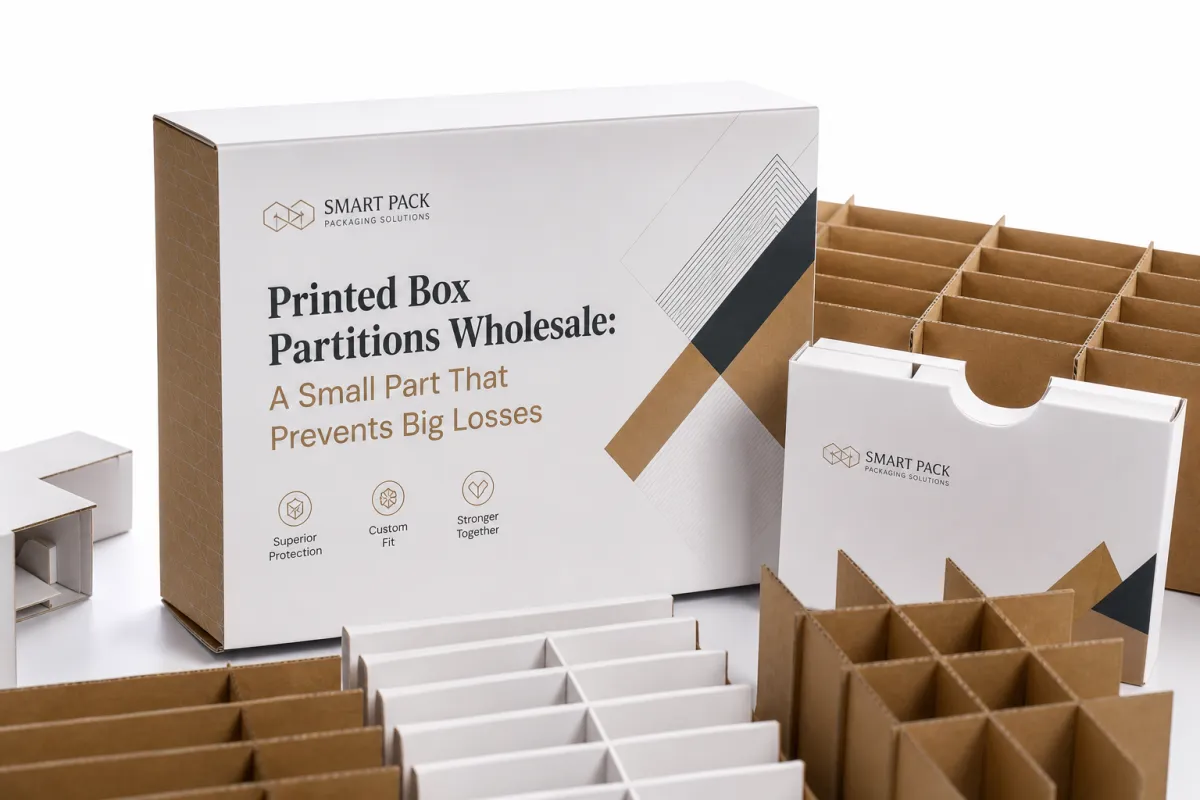
Think about a carton that passes inspection on the outside and still fails on arrival because the contents moved just enough to rub against each other during transit. The damage may be small at first: a marred finish, a dented edge, a cracked coating. Multiply that by hundreds or thousands of shipments and the loss becomes real money. That is the failure mode printed box partitions wholesale is designed to stop.
The shipping environment is rarely calm. Forklift turns, conveyor transitions, pallet pressure, truck vibration, hand sorting, and repeated stacking all add motion. A good partition turns that motion into a controlled space by isolating each unit in its own cell. Less contact. Less abrasion. Less point loading. In that sense, the insert is less about presentation and more about controlling physics in a very ordinary, very expensive environment.
Wholesale volume makes the case stronger because the value multiplies across every repeat order. If the same carton size, compartment count, and handling instruction are used over and over, consistency becomes a cost control tool. A stable spec gives the pack line one fewer thing to correct. Operators learn the fold. Receivers see the marking. Supervisors catch a mismatch before it becomes a damaged shipment. Printed box partitions wholesale works best when the layout is repeatable enough to train around.
"If the partition does not hold the product, the outer carton is only half the story." That line saves a lot of grief on the receiving dock.
Standardization is another quiet advantage. The program can be defined around measurable pieces: compartment count, tolerance, board grade, print copy, and reorder quantity. Those details matter because they make the next run easier to compare against the last one. A buyer can see drift before drift becomes waste. Claims drop. Rework drops. Packing becomes more predictable.
The question, then, is not whether partitions are useful in theory. The question is whether the carton needs separation, identification, or both. If the answer is yes, bulk printed inserts are usually a cleaner answer than loose fill or improvised inserts pretending to do a structural job they were never meant to do.
That is the thread running through the rest of the piece: a small insert can protect product, speed packing, and lower claims when it is specified with care. Simple? Yes. Casual? No. This kind of packaging rewards the buyer who treats the details seriously.
How Printed Box Partitions Wholesale Improve Shipping Performance
Separation is the main gain. A partition gives every item a boundary, so the load does not lean into itself every time the truck brakes, the pallet shifts, or the carton hits a corner. That reduces abrasion, edge wear, and the little impacts that are hard to see in transit but easy to see when the customer opens the box. For many programs, printed box partitions wholesale is less about looking neat and more about surviving normal motion without damage.
Printed information adds another layer of value. SKU marks, compartment numbers, orientation arrows, and handling notes help people move faster with fewer mistakes. A worker who can read the insert at a glance does not need to stop, rotate the carton, or pull a sample to confirm what goes where. That kind of clarity matters during a busy shift. In a warehouse, seconds become labor cost. Small confusion becomes a missed order. A clean insert program trims both.
That same visibility helps receiving teams when one outer carton size supports multiple product variants. A partition printed with clear identifiers can guide sorting, replenishment, and verification without opening every shipper. The value is easy to miss because it looks like a tiny detail. The labor savings are not tiny. A well-managed package specification can quietly remove a surprising amount of handling time from routine checks.
Testing tells the same story. Vibration, shock, and compression are the hazards packaging engineers watch because those are the forces most likely to expose a weak interior pack-out. The outer carton may pass a basic drop test and still fail in the field if the contents move too freely inside. ISTA methods are built around that idea. A sturdy exterior with a loose interior is still a bad package. Bulk printed partitions address the weak spot before it becomes visible in returns.
I have seen teams assume that a heavier outer box would solve everything. It rarely does. If the product can bounce inside the pack, the stronger carton just gives the failure a nicer shell. Kinda backwards, really. Fit comes first, then board strength, then print.
The business result usually shows up in several places at once. Fewer returns. Fewer repacks. Less damage write-off. Fewer complaints from the customer service team that has to explain why the item inside the box looked like it had already been through a season of shipping. Once the spec is stable, the operation settles down. The carton behaves the same way every time. That consistency is one reason the format has real value beyond the unit price.
Fit still decides the outcome. Too much room invites movement. Too little room crushes product or slows the packing line. The best result comes from matching the product shape, carton size, and cell layout to the actual load rather than guessing from a generic catalog description.
Printed Box Partitions Wholesale Specifications and Material Options
Corrugated board is the usual starting point, and the best board is the one that matches product weight, compartment depth, and shipping abuse. Thicker is not automatically better. A lighter load may only need a slim single-wall insert that folds easily and ships economically. A heavier item or a taller stack may need a stronger flute profile or a double-wall build. Those are the decisions that make printed box partitions wholesale work in production instead of just on paper.
Board Grades and Flute Choices
E flute often makes sense when print quality and compactness matter. B flute offers a useful step up in compression resistance. C flute is a common choice when the insert needs more cushioning and crush strength. BC double-wall can support larger cells or heavier product loads. There is no universal winner. A partition program should be chosen for the item, the carton, and the way the boxes are stacked in storage and transit.
| Option | Typical Use | Relative Strength | Print Readability | Notes |
|---|---|---|---|---|
| E flute single-wall | Lighter products, tighter carton fit | Light to medium | Very good | Useful when you want a slimmer insert and sharp print |
| B flute single-wall | General-purpose partitioning | Medium | Good | A balanced choice for many bulk insert programs |
| C flute single-wall | More compression resistance | Medium to high | Good | Useful when cartons are stacked or handled roughly |
| BC double-wall | Heavier or taller loads | High | Fair to good | Chosen when the insert must hold up under more pressure |
These ranges are directional. Freight lanes, humidity, pallet height, and finishing needs can push a program up or down in real use.
Construction style matters just as much as board. Slotted partitions are common because they are simple to convert and easy to assemble. Die-cut styles can offer better precision around odd shapes or tighter inside dimensions. Scored and glued partitions may be used when the program needs faster assembly or a more rigid presentation. A good spec respects the operator as much as the engineer. If the line fights the insert, the insert is wrong.
Print should stay practical. One-color flexographic print is often enough for SKU numbers, orientation marks, and handling instructions. Two-color print can help separate product families or compartment groups when the warehouse needs a stronger visual signal. Small type and heavy ink coverage can work against durability. In most cases, bulk printed inserts perform best with bold copy, high contrast, and a layout that reads quickly under warehouse lighting.
Fit, Cell Size, and Product Geometry
Fit is where the spec either solves a problem or creates one. Inside carton dimensions matter more than outside dimensions, and product measurements have to be checked with the same care. Clearance for loading matters too. If a cell is too loose, the product moves. If it is too tight, the operator struggles or damages the item while inserting it. That is why the sizing process starts as a fit exercise and only later becomes a print exercise.
Recycled fiber sourcing may also matter for some buyers. If documentation is part of the buying standard, the FSC framework is one common reference for chain-of-custody and fiber sourcing claims. Not every program needs that paperwork, but when it is needed, it is better to define it before production starts than to chase records later. That belongs in a proper wholesale quote.
The best spec connects board, structure, and workflow into one answer. Enough rigidity to protect the product. Enough precision to pack quickly. Enough print clarity to help the warehouse move fast. That is the shape of a reliable order.
Pricing, MOQ, and What Drives Cost in Bulk Orders
Price is shaped by far more than the board itself. For printed box partitions wholesale, the cost moves with board grade, flute profile, cell count, die-cut complexity, print setup, kitting, and freight. A straightforward slotted insert with one-color identification is usually easier to quote than a highly customized layout with tight tolerances and multiple assembly steps. Two quotes can look close at first glance and still end up far apart once the details are lined up.
Minimum order quantity usually follows converting efficiency, setup time, and the need to spread tooling or print prep across enough pieces to make the run economical. It is not only about artwork. A custom geometry, an unusual score pattern, or a partition with many small cells can raise the minimum just as fast. With a bulk insert program, the cleanest comparison comes from identical specifications, not similar-looking samples.
Volume helps. Buyers who can forecast repeat demand across shipments, facilities, or seasonal replenishment usually get better unit economics because the manufacturing run becomes more efficient. That is especially true when the same insert is reordered against the same carton size. A steady program tends to beat emergency buying because the converting plan is cleaner and the production run is easier to manage.
| Program Type | Typical Unit Range | What Usually Drives the Price | Best Fit |
|---|---|---|---|
| Simple unprinted partition | $0.12-$0.22 | Board grade, cell count, carton size | Basic separation with no labeling need |
| One-color printed partition | $0.18-$0.30 | Setup, ink coverage, quantity tier | Common bulk orders with SKU marks or arrows |
| Heavier board or tighter tolerance build | $0.24-$0.42 | Strength requirements, converting complexity | Fragile or heavier products |
| Custom kitted multi-part program | $0.35-$0.65 | Special assembly, packing, freight staging | Programs with several insert versions or line-side kits |
Those numbers are estimates, not promises. Freight, samples, and special packing requirements can move landed cost more than buyers expect. A fair comparison starts with the same quantity, the same board grade, the same print count, and the same delivery assumption. That is the right way to buy packaging inserts in bulk.
Tooling, proofing, and delivery points should also be clear. If a supplier is quoting a partially assembled insert or a special kitting step, that labor should be visible in the structure of the quote. Hidden assumptions are where budget surprises begin. A disciplined bid should spell out those pieces before approval.
One useful rule: if demand is steady and the carton format repeats, ask for price breaks at realistic reorder levels rather than only at the highest volume tier. That reveals where the unit cost actually becomes useful for planning. For many buyers, that is the difference between a quote that looks attractive and a wholesale price that truly fits operations.
What should you check before ordering printed box partitions wholesale?
Ask for the inside carton dimensions, product measurements, board grade, flute profile, cell count, print copy, and delivery point. Confirm the shipping environment too: vibration, compression, pallet stacking, and any moisture exposure. If the product is fragile or coated, say so early. That checklist keeps the quote tied to the real pack-out instead of a generic insert.
For the fastest approval, send one clear spec sheet, one proof target, and one reorder assumption. The more stable the inputs, the more predictable the production run. That is usually the difference between a tidy wholesale program and one that keeps circling back for revision.
Process and Timeline for Printed Box Partitions Wholesale Orders
A clean order starts with complete information. The most useful quote request includes the inside carton length, width, and height, the product dimensions, the product weight, the number of items per cell, and the shipping method. If the product is fragile, coated, glass, or otherwise sensitive, say so directly. Those details help determine whether the packaging needs only separation or more serious load control.
Proofing comes next. Artwork or print copy should be checked for legibility, orientation, and placement before production begins. If the print is only for SKU marks or handling cues, the design can stay simple and durable. If the insert needs brand presence, the layout still has to work under warehouse lighting and quick inspection. A good approval is usually about clear copy, not decorative extras.
Production moves through material allocation, converting, print verification, quality checks, packing, and shipment scheduling. The main variable is usually how much setup the new order requires. Repeat runs with an approved spec move faster because the dimensions, layout, and print logic are already locked. A first-time order takes more coordination, and that is normal when the goal is to get the fit right the first time.
Teams that shorten lead time tend to do a few things consistently. They send accurate measurements early. They keep the artwork simple. They avoid last-minute changes after proof approval. They decide in advance whether the order is going to one distribution center or several, because freight routing and pack-out timing can matter more than people expect. A well-run schedule is usually a documentation problem before it is a factory problem.
Industry thinking supports that approach. Packaging groups such as packaging industry resources often emphasize fit, material efficiency, and verification because those are the levers that affect real shipping performance. That same mindset makes bulk ordering easier to manage and easier to reorder.
For buyers who want a simple timeline, repeat orders with a finalized spec are usually much faster than new custom work. First runs need extra time for measurement review, proofing, and sample signoff. The fastest way to reduce delay is to provide complete information at the start. That keeps the production schedule moving instead of wandering through revision cycles.
Why Choose Custom Logo Things for Printed Box Partitions Wholesale
Custom Logo Things focuses on the practical side of packaging buying, and that matters because not every insert should be treated as a generic commodity. A strong bulk partition program starts with the carton, the product, and the handling path. That is more useful than pushing a one-size-fits-all separator that looks acceptable in a quote but fails to support the pack-out on the line.
Consistency across reorders is a major advantage. When the same insert has to fit the same carton across multiple runs or distribution points, even a small variance can slow packing or create avoidable damage. A repeatable spec lowers that risk because everyone works from the same measurements, the same print copy, and the same assembly method. That consistency matters when operations are moving quickly.
The communication side matters too. Clear, readable print helps with product identification, orientation, and handling without overcomplicating the design. A warehouse team does not need decorative copy. It needs information that is obvious at a glance. That is where a disciplined layout earns its place. The best partition is usually the one that makes the job easier, not the one that tries to impress from a distance.
If you are comparing suppliers, the simplest way to judge value is to look at how each quote handles fit, print, repeatability, and landed cost. Our Wholesale Programs page is built for buyers who want to standardize these details instead of starting over on every order. Wholesale packaging only works well when the specification stays stable enough to reorder with confidence.
Printed box partitions wholesale also depends on cost discipline. Overbuilt inserts waste material and money. Underbuilt inserts create claims and rework. The right answer usually sits in the middle, where the board grade and cell geometry are strong enough for the product but not so heavy that the packaging becomes expensive or awkward to use. That kind of judgment comes from packaging experience, not guesswork.
From a buyer's point of view, that is the real service: a partner who can match the insert to the shipment without adding unnecessary complexity. When the program is handled that way, the results are easier to measure, easier to repeat, and easier to defend internally.
Next Steps for Ordering Printed Box Partitions Wholesale
Start with measurements that describe the real pack-out, not only the outer shipping carton. Send the inside carton dimensions, the product dimensions, the product weight, and the number of items that must fit in each cell. If the product has a coated surface, fragile finish, or irregular shape, include that too. The more accurately the load is defined, the better the insert can be matched to it.
Then decide what matters most. Some buyers need simple separation and crush control. Others need printed SKU marks, orientation cues, or branding that helps the warehouse move faster. A few need all three. That decision shapes the partition structure, the board grade, and the print layout. Without that clarity, the quote can drift into vague assumptions that do not help anyone make a final decision.
- Confirm the inside carton size and the exact cell count.
- Choose whether the priority is separation, labeling, branding, or a mix of all three.
- Approve a simple proof before production so the print stays legible and correctly placed.
- Set a realistic delivery window that allows for sampling, signoff, and freight timing.
A short approval checklist saves time later. It should confirm the board grade, flute profile, partition style, print copy, quantity, and delivery destination. It should also note whether the order is going to one facility or multiple sites, because that affects how the shipment is staged. A careful order is usually the one that moves cleanly from specification to production without needing backtracking.
The buying path is straightforward: measure the package correctly, define the handling need clearly, and ask for a quote that shows the full cost structure instead of only a headline unit price. That is the best way to source printed partitions with confidence and avoid rework on the next run.
What information do you need for printed box partitions wholesale quotes?
Provide the inside box length, width, and height, not just the outside carton size. Include product dimensions, weight, and how many items must fit in each cell or compartment. Share whether the partitions need print, special cut lines, or a specific board grade so the quote reflects the real pack-out.
Can printed box partitions wholesale be customized for different carton sizes?
Yes, partitions can be built around standard cartons or custom inside dimensions when the product needs a tighter fit. If you ship several box sizes, it may be more efficient to standardize around common master cartons. The best custom option depends on product weight, fragility, and how often the packaging changes in your program.
What print style works best on printed box partitions wholesale?
Simple one-color print is often the most practical choice for SKU marks, orientation cues, and handling instructions. Keep the artwork bold and readable so it survives warehouse lighting, fast packing, and quick inspection. Avoid overly fine detail unless the partitions are used for presentation as well as protection.
How do I compare wholesale pricing on printed box partitions?
Compare quotes using the same board grade, cell count, print requirements, and quantity tier. Check whether freight, setup, tooling, and proofing are included so the total landed cost is clear. Ask for price breaks at realistic reorder levels to see where the best unit cost starts for the program.
How long does a printed box partitions wholesale order usually take?
Lead time depends on design approval, material availability, order volume, and freight method. Repeat orders with an approved spec usually move faster than fully custom inserts with new tooling. The fastest way to reduce delay is to send complete measurements, clear print copy, and a realistic delivery window for your schedule.
Takeaway: If you want printed box partitions wholesale to pay off, treat the order like a fit-and-flow problem first and a pricing exercise second. Lock the inside dimensions, choose the board that matches the load, keep the print useful, and confirm the landed cost before you commit. That is the shortest path to fewer claims, cleaner packing, and a reorder program that actually behaves the same way every time.