Buyer Fit Snapshot
| Best fit | Printed Compostable Stickers with Logo projects where brand print, material claims, artwork control, MOQ, and repeat-order consistency need to be specified before quoting. |
|---|---|
| Quote inputs | Share finished size, material target, print colors, finish, packing count, annual reorder estimate, ship-to region, and any compliance wording. |
| Proofing check | Approve dieline scale, logo placement, barcode or warning zones, color tolerance, closure strength, and carton packing before bulk production. |
| Main risk | Vague material claims, crowded artwork, missing packing details, or unclear freight terms can make a low unit price expensive after revisions. |
Fast answer: Printed Compostable Stickers with Logo: Material, Adhesive, Artwork, and MOQ should be specified like a repeatable production item. The safest quote records material, print method, finish, artwork proof, packing count, and reorder notes in one written spec.
Production checks before approval
Compare the actual filled-product size with the drawing, then confirm tolerance on folds, seals, hang holes, label areas, and retail display edges. Reserve space for logos, QR codes, warning copy, and material claims before decorative graphics fill the panel.
Quote comparison points
Review material grade, print process, finish, sampling route, tooling charges, carton quantity, and freight assumptions side by side. A quote is only useful when the supplier can repeat the same color, closure quality, and packing count on the next order.
Printed Compostable Stickers With Logo: Key Buying Guide
Printed compostable Stickers With Logo look small on a spec sheet. In real packaging, they carry more weight than people expect. On a box, pouch, jar, or sleeve, a sticker can make the whole package feel considered or make it look like the budget ran out halfway through the job. The wrong label says, "We cared enough to print something green." The right one says, "We checked the materials and we did not guess."
That difference matters. The phrase printed compostable stickers with logo gets used loosely, and the label on the front is not always the truth. A face stock can be compostable while the adhesive, liner, coating, or ink stack quietly weakens the claim. Some products are built for industrial composting. Some are only partially aligned with that story. Some are just paper with better marketing. Buyers who skip the details usually pay for it later, either in weak claims, product complaints, or a label that peels before the package reaches the customer.
There is another reason brands care. These stickers sit right where sustainability claims meet retail reality. A kombucha brand may need labels that survive condensation. A bakery may want something that looks clean on kraft boxes without introducing plastic into the story. A meal-prep brand may need barcode readability and chilled performance first, then compostability. The materials have to support the use case, not just the pitch.
A label earns its place when it survives shipping, looks right on shelf, and still fits the disposal story you are telling.
What Printed Compostable Stickers with Logo Really Mean
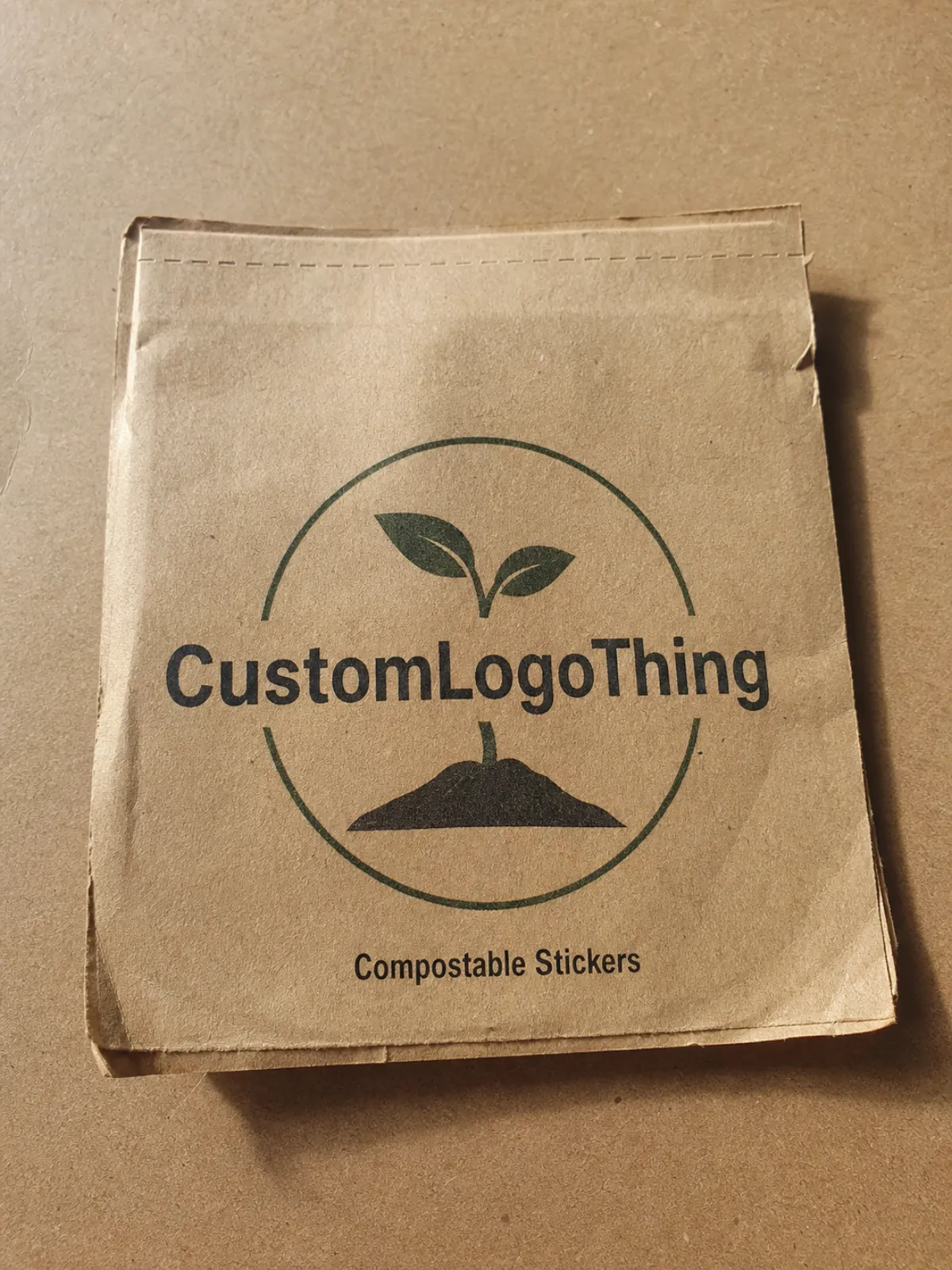
Start with the plain version: printed compostable stickers with logo are branded labels made to break down under composting conditions, not just look eco-friendly from three feet away. That sounds simple. It is not. A compostable sticker is a stack of parts, and every part counts. The face stock might be compostable paper. The adhesive might be the weak point. The liner can add waste. The ink can matter more than people expect. The visible layer is rarely the whole story.
Compostable, biodegradable, recyclable, and plastic-free are not synonyms. They are not even close. A recyclable label can still contain plastic film. A biodegradable label can take a long time to break down, with no clear end point. Plastic-free sounds nice in a presentation, then the coating shows up and complicates the claim. Compostable is stricter. It points to defined conditions, tested breakdown, and a standard that says the material should convert into biomass, carbon dioxide, water, and inorganic compounds without leaving a mess behind.
For brands, the real question is blunt: what disposal path does this label support? If your customers use commercial organics pickup, the answer may be straightforward. If your packaging ends up in landfill, the story changes fast. The label does not control the waste stream. It only fits, or does not fit, the system around it. That is the part people skip when they rush to print something "sustainable."
Printed compostable stickers with logo show up on more packaging formats than most buyers expect. They work on:
- Paper sleeves and folding cartons
- Kraft pouches and mailers
- Glass jars and bottles
- Compostable film bags
- Takeaway containers and deli packaging
They are often a better fit than vinyl labels when a brand wants a cleaner disposal path, lower visible plastic content, or packaging that matches a zero-waste positioning. They also make sense for short shelf-life products, seasonal promotions, and limited runs where the label does not need to survive a year in a warehouse. For a wider look at substrates and label formats, our Custom Labels & Tags page is a useful starting point.
One thing to keep in mind: compostable stickers are not magic. They are not tougher than standard pressure-sensitive labels, and they are not automatically brighter or more weatherproof. They are a tradeoff. Sometimes a very good tradeoff, if the materials match the job. The best results come from pairing the right face stock, the right adhesive, and artwork that does not fight the material.
How the Printing and Composting Process Works
A compostable label usually has three layers: a compostable or compost-compatible face stock, an adhesive suited to the target surface, and a liner that should not add more waste than necessary. The face stock is often paper-based, though some compostable films exist for special uses. The adhesive is where projects either hold together or fall apart. Too much tack, and the label stays put but resists breakdown. Too little, and it curls up in transit or lifts in cold storage. The liner gets ignored a lot, which is convenient right up until the waste report shows up.
Printing method depends on quantity, art, and finish. Digital printing works well for shorter runs, variable graphics, and fast turnaround. Flexographic printing fits higher volumes and repeat orders. Both can produce strong results. They just solve different problems. Digital usually gives more flexibility for detail and small type. Flexo can be the better fit when the unit price needs to come down at scale. Ink coverage matters too. Deep solids and dark backgrounds can look rich, but they also expose every inconsistency in a natural-fiber stock. Cute on screen. Less cute on press.
After disposal, the material does not vanish into a nice marketing cloud. Heat, oxygen, moisture, and microbes drive the breakdown. That is why industrial composting is usually the relevant benchmark. Commercial facilities run hotter and more controlled than a backyard pile, which means a label approved for industrial composting may behave very differently at home. Same word. Different reality.
For buyers who need standards, ASTM D6400 and ASTM D6868 are common in the U.S., while European buyers often look at EN 13432. Those standards do not guarantee that every facility will accept a product, but they do give the claim some backbone. For general packaging background, the Sustainable Packaging Coalition at packaging.org and the EPA composting resources at epa.gov are solid references.
Home composting is a separate lane. Some materials labeled compostable are only intended for industrial systems. If home compostability matters, ask for written proof, not a vague promise from a sales deck. Real-world home compost piles vary a lot. Temperature swings, moisture, and the mix of kitchen scraps all change the result. One person's "it broke down fast" is another person's moldy sticker after six months.
Printing inks deserve a quick mention too. Low-migration and compost-compatible inks are not interchangeable terms, and not every supplier explains the difference clearly. If the package touches food, skincare, or other sensitive products, the conversation has to include the ink set, not just the paper. A label spec that ignores ink chemistry is incomplete.
Key Factors That Affect Performance and Appearance
The nicest-looking compostable label can still fail if the surface, climate, or artwork is wrong. Buyers should test it the same way they would test a closure or carton board: under the conditions the package will actually face. Surface texture is one of the biggest variables. Natural kraft grips labels differently than coated paperboard. Glass can be forgiving, but it also makes edge lift obvious. Metal containers are cleaner and more consistent, yet temperature swings can expose adhesive weakness. Compostable films and flexible pouches create another problem because they move during filling, shipping, and handling.
Cold storage deserves special attention. Condensation and low temperatures cut the margin for error. If the label goes on refrigerated goods, it may need extra tack or a different adhesive chemistry built for lower temperatures. Curved surfaces matter too. A flat sample can look perfect, then fail on a jar shoulder or pouch seam because the geometry is different. Add shipping abrasion and the label has already been through more drama than the product itself.
Artwork can make a compostable label look sharp or muddy. Bold logos usually print better than ultra-thin scripts. Strong contrast helps, especially on cream, tan, or unbleached stocks. Tiny reversed text often disappears. Heavy full-bleed backgrounds can highlight natural fiber texture instead of hiding it. That is not always bad, but the buyer should see it on a proof before approving the job. A logo that depends on razor-thin lines may look elegant on a laptop and shaky on compostable stock.
Finish matters too. Matte usually suits compostable materials because it fits the material story and hides small texture differences. Gloss can make graphics pop, but it can also fight the character of the substrate or add coating complexity. If the brand story is built around minimal waste and circular packaging, the finish should support that message, not work against it.
There is also a practical issue with color management. Compostable papers and films often have a warmer base tone than synthetic labels. A bright white logo may look slightly muted. Soft neutrals may disappear. Buyers who care about brand consistency should check the artwork on the actual stock, not rely on a screen preview that flatters everything.
Sustainability claims need more discipline than most marketing teams want to admit. A credible label story usually includes:
- Certification details where applicable, such as ASTM or EN standards
- Substrate description, including paper source or film type
- Adhesive information that clarifies compostability or compatibility
- End-of-life messaging that matches the actual disposal path
If fiber sourcing matters to your brand, FSC-certified paper can strengthen the story. The Forest Stewardship Council's site at fsc.org is useful for checking how forest product claims are structured. It does not replace compostability proof, but it helps round out a cleaner green packaging brief.
The best label is usually the one that balances appearance, adhesion, and disposal behavior instead of trying to win every category. A label that uses less ink may look more restrained, but it can show the substrate more honestly and keep the environmental profile cleaner. That kind of choice is common in eco-friendly packaging: not perfect in theory, better in the field.
Practical testing tip: test on the actual package, not just on a sample sheet. Use the same container, same fill temperature, same dwell time, and the same storage conditions. Then leave it through shipping and handling. Packaging that looks fine on day one can behave very differently after a week in refrigeration or one rough truck ride.
Process and Timeline for Printed Compostable Stickers with Logo
The production path is simple on paper and more annoying in practice. A typical order starts with a brief, then moves into material selection, artwork review, proofing, production, finishing, and shipping. Each step shifts the result a little. Put them together and the job either feels clean or turns into a budget surprise. The more specialized the material, the more important the first two steps become.
- Inquiry and brief - Share size, quantity, application surface, storage conditions, and whether you need industrial or home compostability.
- Material recommendation - Compare face stock, adhesive, and liner options based on the package substrate.
- Artwork check - Confirm bleed, safe zones, color count, and logo scaling for the chosen stock.
- Proofing - Review a digital proof or, when needed, a physical sample.
- Production - Print, cut, and finish the order.
- Quality check and delivery - Inspect edge quality, color consistency, and adhesion before shipment.
Lead times depend on complexity. Standard sizes on common compostable stocks can often move through production in roughly 10-15 business days after proof approval. Custom sizes, special die cuts, certification questions, or supply limits for specialty adhesives can stretch that window. If the labels have to land before a launch or seasonal packaging change, build in extra time. A missed label deadline has a talent for becoming a missed product deadline too.
One thing that slows projects is fuzzy end-of-life language. A supplier may need to know whether the label should be sold as compostable, industrial-compostable, or simply printed on a compostable substrate. Another slowdown comes from custom sizing. Standard dimensions move faster because the tooling already exists. Odd shapes, corner radii, and window-style cutouts often need new dies or extra setup. That may be worth it for the brand look, but it should be planned, not discovered on a Thursday afternoon before launch.
For brands with a broader packaging program, split the label rollout from the full redesign. A new sticker can be tested on a small run of cartons or pouches before it is pushed across every SKU. That cuts waste and gives the team actual data instead of assumptions. If your packaging mix includes boxes, shipping cases, and secondary labels, your Custom Labels & Tags partner can usually help align the label spec with the rest of the pack format.
Planning note: seasonal packaging is where teams lose time. The bottleneck is rarely print capacity alone. It is the three-way argument between compliance, artwork, and procurement. A simple sample approval matrix keeps that circus from getting too loud.
Shipping matters too. Labels do not sit still after production. They go through distribution. If the package will face drop, vibration, compression, or long transit, it is smart to match label testing to the broader packaging checks, including ISTA-style transit thinking. A label that survives a desk test may fail once pallets get stacked and temperature swings do their thing.
Cost, Pricing, MOQ, and Quote Factors
Cost is usually the first hard question, and the honest answer is that price depends on how much risk the label needs to absorb. Material grade, adhesive chemistry, print coverage, finishing, order quantity, and die-cut complexity all affect the number. In compostable sticker work, the adhesive and substrate often move the quote more than the artwork. A simple one-color logo on the wrong stock can cost more in rework than a richer design on the right material.
For planning, rough ranges help more than vague promises. A short-run custom compostable label might land around $0.12-$0.30 per piece depending on size, colors, and finish. At higher quantities, unit pricing can drop meaningfully, especially if the format is standard. A 2 x 3 inch printed label in a run of 5,000 will not price the same as a 1 x 1.5 inch seal in a run of 25,000. The market rewards consistency. Small runs usually carry a higher per-piece cost because setup time gets spread across fewer labels.
MOQ changes the economics in a way many first-time buyers underestimate. A low minimum order quantity feels flexible, and it is, but the tradeoff is usually a higher unit price. That can still be the right call if you are validating a new product line or testing a compostable format for the first time. Paying more per label is cheaper than being stuck with a spec that misses the mark.
To get a quote that means something, suppliers usually need:
- Label dimensions and shape
- Artwork file or mockup
- Quantity by SKU
- Application surface, such as glass, kraft paper, or compostable film
- Expected storage conditions, including chilled or humid environments
- Required certification level or compostability claim
- Delivery deadline
A good quote should separate the value of the label from the value of the message it carries. The cheapest option is rarely the cheapest over the life of the package. If the label lifts, mars the artwork, or creates questions about disposal claims, the brand pays again in replacements, customer service, or reputation damage. That is why packaging teams look at total cost of ownership instead of sticker price alone.
Buyers also need to account for hidden costs. A low-priced label that requires a longer setup, more proofs, or a second production round can end up more expensive than a cleaner spec that works the first time. If the design team keeps changing the logo size, or if procurement switches substrates late in the process, the job gets slower and pricier very quickly.
| Option | Best For | Typical MOQ | Indicative Unit Cost | Notes |
|---|---|---|---|---|
| Compostable paper label | Kraft boxes, sleeves, paper pouches | 1,000-5,000 | $0.08-$0.18 | Good balance of price, print quality, and end-of-life story |
| Higher-tack compostable label | Chilled packs, glass jars, curved surfaces | 2,500-10,000 | $0.12-$0.25 | Better adhesion, often with tighter material constraints |
| Custom die-cut compostable label | Premium branding, shaped logos, limited editions | 5,000+ | $0.14-$0.30 | Setup and tooling can raise the quote, but branding impact is stronger |
| Short-run test batch | Launch testing, sample packs, pilot programs | 250-1,000 | $0.18-$0.40 | Useful for validation before scaling up |
Those ranges are not a promise. They are a planning lens. A label with a stricter sustainability claim, a special certification request, or a difficult substrate can move outside them. Still, the ranges give buyers a better starting point than one random quote with no context attached.
Common Mistakes Brands Make With Compostable Logo Stickers
The first mistake is assuming every green-looking sticker is compostable. Buyers often stare at the face stock and ignore the adhesive or liner, which is exactly where the claim can go sideways. A sticker may look like paper and still contain enough synthetic material to complicate disposal. If the brand messaging leans on zero waste or circular economy language, that gap shows fast.
The second mistake is using artwork that fights the material. Thin fonts, weak contrast, and oversized solid blocks can make the label hard to read or visually messy on natural stock. Compostable materials often have a warmer, less uniform surface than coated vinyl. The design has to work with that texture, not pretend it is printing on glossy film. The logo should still look deliberate when the material has a little character.
The third mistake is skipping real-package testing. A label that looks perfect on a flat sample can lift on a curved jar, wrinkle on a chilled pouch, or scuff against corrugated transit packaging. A brand may save a few days by skipping trials, but those days often come back later as replacement costs and customer complaints. That hits especially hard for takeaway packaging and refrigerated goods, where moisture and handling are normal, not edge cases.
The fourth mistake is vague claim language. "Eco-friendly" is too soft to support a buying decision. So is "sustainable" without context. Better wording is specific: compostable face stock, industrial compostability, FSC paper, or an adhesive tested for the intended substrate. Precision helps the customer and keeps the brand out of trouble.
There is also a strategic error that shows up in procurement meetings. Some teams buy a compostable sticker because it feels like a cheap sustainability win, then stick it onto a package that is otherwise not recyclable or not compostable. That can still be a valid choice, but it should be clear. A label alone does not turn a bad package system into a good one. The environmental story has to match the full package, not one convenient component.
One more issue: teams sometimes chase a perfect claim before they have a practical one. A label that is technically compostable but unreadable, unstable, or incompatible with the container does not help the brand. If the package is for a local farmers market, a chilled food case, or a shipping mailer, utility comes first. Sustainability still matters. It just has to survive contact with the actual product.
Better practice: write the packaging claim from the disposal path backward. If the packaging is designed for industrial composting, say that clearly. If it is paper-based with a compostable label, explain how the layers fit together. Honest detail usually beats broad green packaging language.
Expert Tips and Next Steps for Better Results
Short runs are your friend. If the sticker is going on a new product, a new substrate, or a new climate zone, order a sample roll or a pilot quantity first. That gives you a chance to check adhesion, color, edge quality, and scuff resistance before you commit. A small test order can tell you more than a giant specification sheet ever will.
Build a simple test matrix. It does not need to be fancy, and it should not turn into paperwork theater. Track the actual package, temperature, surface texture, and handling conditions. For instance: glass jar at refrigerated temperature, kraft pouch at room temperature, compostable film sleeve after 48 hours in humidity. Those notes give you usable data instead of opinions that change depending on who had coffee.
Ask suppliers for substrate details in writing. Request the paper or film description, the adhesive type, and any certification claim tied to the material. Then align that language with your internal sustainability messaging. If marketing says the label is compostable, procurement should know whether that means industrial compostability, home-compost compatibility, or a specific third-party standard. Ambiguity loves a delay.
It helps to treat the label as one part of a larger packaging audit. If you are revising cartons, stickers, inserts, and shipping labels at the same time, compare how each item affects waste, Cost, and Shelf Impact. Sometimes the smartest move is to improve one visible component first and phase in the rest later. That lowers risk while still moving the packaging program toward better eco-friendly packaging.
For teams under pressure, the next steps should stay practical:
- Compare two material options side by side.
- Request a formal quote with your actual dimensions and quantity.
- Test the sticker on one real package style under real storage conditions.
- Refine the artwork so the logo stays clear on natural stock.
- Scale only after the label survives use, transit, and disposal expectations.
If the goal is to cut waste without blurring the brand, printed compostable stickers with logo can do that job. They are not magic, and they are not the answer to every packaging problem. But when the substrate, adhesive, artwork, and disposal story line up, the result is a label that supports the package instead of fighting it.
Actionable takeaway: before approving a run, verify three things in writing: the exact substrate, the exact adhesive, and the exact compostability claim. Then test one batch on the real package through storage and transit. If any of those three fails, fix the spec before you scale.
FAQ
Are printed compostable stickers with logo really compostable in home bins?
Many are made for industrial composting, so home-bin performance depends on the exact substrate, adhesive, and conditions in the pile. Home composting is usually cooler and less controlled than commercial composting, which can slow breakdown or stop it short. If home compostability matters, ask for documentation that says so plainly and test a small batch before ordering in volume.
What artwork works best for printed compostable stickers with logo?
Simple logos, bold type, and strong contrast usually print best on compostable materials. Thin scripts, tiny reversed text, and big ink-heavy blocks can look muddy on natural stock. A proof on the final material is the best way to check color, legibility, and edge detail before production starts.
How long do printed compostable stickers with logo take to produce?
Lead time depends on quantity, stock availability, die-cut needs, and how quickly proofs are approved. Standard formats can often move in roughly 10-15 business days after approval, while custom sizes, certification checks, or supply limits can extend the schedule. If the labels need to arrive before a launch or seasonal packaging change, build extra time into the plan.
What affects the price of printed compostable stickers with logo the most?
Material choice and adhesive type usually drive the biggest cost difference, followed by order quantity and print complexity. Custom shapes, extra colors, and tighter tolerances can raise the quote. Higher MOQ often lowers the unit price, so total spend and per-piece cost should be reviewed together.
Will printed compostable stickers with logo stick to chilled or curved packaging?
They can, but performance depends on the adhesive and the exact surface. Cold storage, condensation, and curvature are common stress points. The safest approach is to request a sample and apply it to the actual packaging under real conditions before ordering in bulk.
Do compostable stickers require special storage before application?
They can. Like most pressure-sensitive labels, compostable stocks and adhesives are sensitive to heat, humidity, and poor handling. Keep them in the supplier's recommended range and avoid leaving cartons in hot trucks or damp stockrooms. Bad storage can make a good spec look defective.

