Buyer Fit Snapshot
| Best fit | Printed Labels for Corrugated Boxes projects where brand print, material claims, artwork control, MOQ, and repeat-order consistency need to be specified before quoting. |
|---|---|
| Quote inputs | Share finished size, material target, print colors, finish, packing count, annual reorder estimate, ship-to region, and any compliance wording. |
| Proofing check | Approve dieline scale, logo placement, barcode or warning zones, color tolerance, closure strength, and carton packing before bulk production. |
| Main risk | Vague material claims, crowded artwork, missing packing details, or unclear freight terms can make a low unit price expensive after revisions. |
Fast answer: Printed Labels for Corrugated Boxes: Material, Adhesive, Artwork, and MOQ should be specified like a repeatable production item. The safest quote records material, print method, finish, artwork proof, packing count, and reorder notes in one written spec.
Production checks before approval
Compare the actual filled-product size with the drawing, then confirm tolerance on folds, seals, hang holes, label areas, and retail display edges. Reserve space for logos, QR codes, warning copy, and material claims before decorative graphics fill the panel.
Quote comparison points
Review material grade, print process, finish, sampling route, tooling charges, carton quantity, and freight assumptions side by side. A quote is only useful when the supplier can repeat the same color, closure quality, and packing count on the next order.
Printed labels for corrugated boxes can turn a plain shipping case into a branded, scan-ready, lot-traceable package before the carton ever leaves the pack-out table. On a busy shipping floor, that matters a lot more than many buyers expect, because one well-built label can handle branding, inventory control, routing, and compliance without forcing changes to the carton itself.
For packaging buyers, printed labels for corrugated boxes sit in a practical middle space. They offer more flexibility than direct box printing, more control than a generic sticker, and far better traceability than a handwritten label that was never meant to carry real production data. That flexibility is often the reason a label program keeps working long after the first launch, even when the product mix changes and the line gets busier than planned.
Use this page to understand how printed labels for corrugated boxes are built, how they behave on rough kraft board or coated liner, what drives cost, and where trouble usually starts. If you are comparing Custom Shipping Boxes, Custom Labels & Tags, or a broader mix of Custom Packaging Products, the details below can help narrow the right route before you place an order.
Printed Labels for Corrugated Boxes: What They Are and Why They Matter
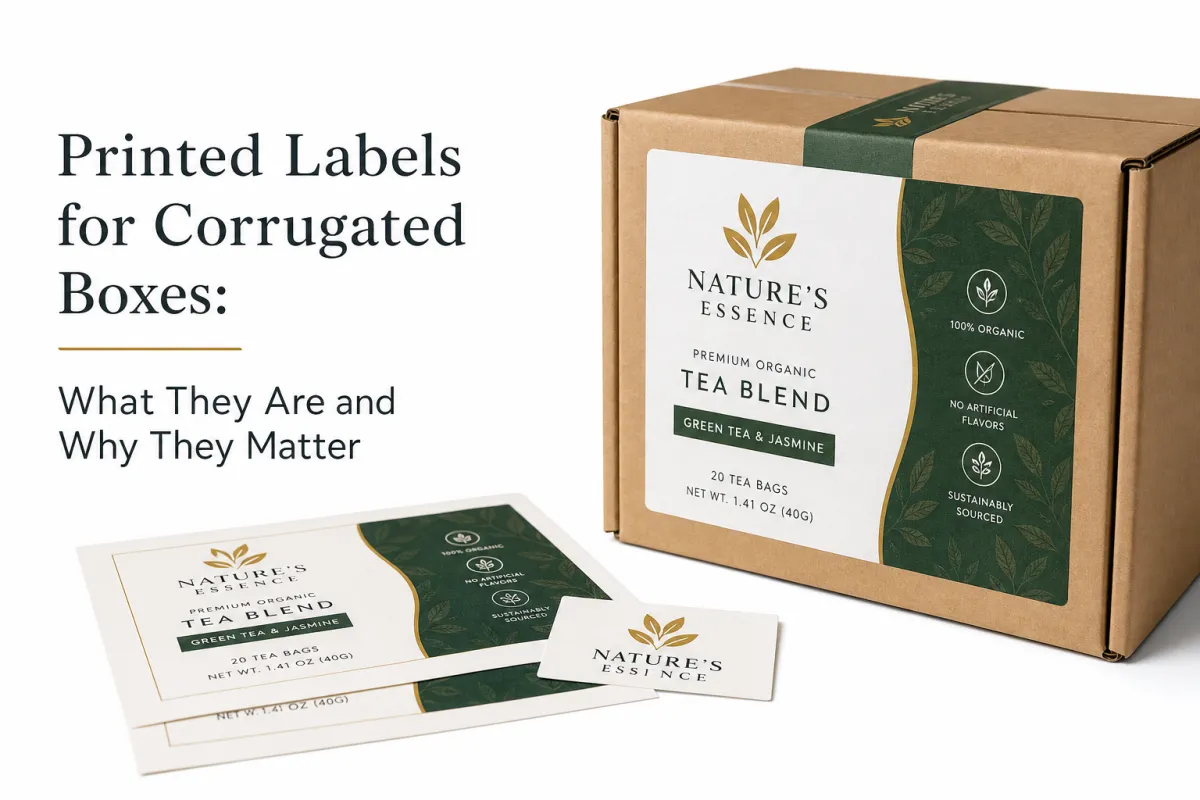
Printed labels for corrugated boxes are pressure-sensitive labels made to adhere to corrugated cartons and carry information in a format people and scanners can read quickly. That information might be a logo, a GS1 barcode, a routing number, a lot code, a handling instruction, a customer PO, or all of those at once. The point is not decoration alone. The point is to make the box easier to identify, move, scan, and trust.
On a shipping floor, a plain corrugated case can look identical to twenty others lined up beside it. One label changes that. Printed labels for corrugated boxes help the carton announce what it is, where it is going, and how it should be handled. In practice, that can reduce picking mistakes, improve inventory accuracy, and save time at receiving docks where nobody wants to open every box just to confirm contents.
They also matter because corrugated packaging often has to serve more than one purpose. A carton may need a clean branded look for the end customer, while still surviving warehouse handling, pallet wrap, forklift traffic, and scan checks along the way. Printed labels for corrugated boxes give you a way to put all of that into one controlled area on the box, rather than trying to force the carton structure itself to do everything.
That is a real difference from generic stickers or handwritten labels. A generic sticker may stick, but it is often not built for print quality, abrasion resistance, or barcode accuracy. Hand-applied shipping labels can work for parcel movement, yet they rarely fit well when a carton needs branded information, lot traceability, or customer-specific routing. Printed labels for corrugated boxes are usually planned for the carton, not borrowed from another use. I have seen plenty of jobs where that distinction made the difference between a clean launch and a week of relabeling headaches.
Direct printing on the box is another path, and it can fit high-volume programs with fixed designs. Still, it becomes less forgiving when artwork changes, when multiple SKUs share one carton style, or when variable data needs to update without rebuilding the whole box print file. That is why printed labels for corrugated boxes stay popular across food, beverage, consumer goods, industrial parts, and fulfillment operations.
"If the label looks cheaper but causes one extra relabel or one scan miss per case, it is not cheaper in practice."
That is the piece people miss. Printed labels for corrugated boxes are not only a branding decision. They are a workflow decision. A better label lowers friction for shipping, storage, and audit trails, which is why many operations keep returning to them after trying something simpler. And yes, it is kinda boring when a label just does its job, but boring is exactly what most shipping departments want.
How Printed Labels for Corrugated Boxes Work on the Line
The workflow is straightforward, though the details decide whether the job runs cleanly. Artwork or variable data is prepared, the label is printed in rolls or sheets, and the finished labels are applied by hand or with automated equipment. Printed labels for corrugated boxes can be static labels, where every piece is identical, or variable-data labels, where each label changes for a specific order, lot, or destination.
Most corrugated box labels use a pressure-sensitive construction. The adhesive is already on the label when it is produced, so no separate glue step is needed on the line. The face stock might be paper, polypropylene, or another film depending on the environment and the appearance you want. Paper remains common because it prints cleanly and keeps costs under control, while film stocks are often chosen when moisture, rubbing, or cold conditions create problems for standard paper labels.
Adhesives vary much more than many buyers expect. A standard permanent acrylic adhesive may work well on dry, fairly smooth corrugated board. A freezer-grade or high-tack adhesive may be the better choice for rough recycled board, chilled storage, or dusty cases. Printed labels for corrugated boxes only perform properly when the adhesive matches the surface, the temperature, and the handling pattern.
Rolls, sheets, and application methods
Labels are usually supplied in rolls for automated or semi-automated application, though sheet format still makes sense for small runs or manual pack stations. Rolls feed more consistently, especially when the operation wants a fixed placement point on each carton. Printed labels for corrugated boxes in roll form are also easier to standardize across multiple lines, which helps when one job has to scale from a small run to a larger one.
Manual application can work well if the team has a defined placement location and a repeatable process. The design still needs to respect that reality. A label that is easy to peel, easy to orient, and easy to place in the same spot each time tends to perform better than a design that looks impressive on screen but slows the line. Nobody wants a beautiful label that makes the packout crew mutter under their breath all afternoon.
Placement and scanability
Placement matters more than many design teams expect. Printed labels for corrugated boxes are usually positioned on a flat, visible panel where scanners can read without fighting wrinkles, seams, or stretch wrap. If the label ends up too close to a flap, corner, fold line, or tape seam, you can lose legibility or create a barcode that never scans cleanly.
For cartons that will be palletized, the label may need to sit higher on the case so it stays visible after wrap. For cartons that will sit in storage, the label may need to be placed where forklift rub or shelf contact is less likely. The best placement is not always the prettiest one. It is the one that still works after the box moves through the real warehouse, gets bumped, stacked, wrapped, and scanned one more time.
Variable data is another reason printed labels for corrugated boxes are so useful. One carton style can support many SKUs, destinations, or customer-specific instructions as long as the label carries the right code set. Common examples include barcodes, lot numbers, expiration dates, ship-to information, routing codes, and internal item numbers. If you are running multiple versions of the same base carton, the label becomes the flexible layer that keeps the operation organized.
For teams that care about transit performance, simple validation is better than guesswork. The International Safe Transit Association, or ISTA, has well-known test frameworks that help packaging teams simulate shipping abuse; see the organization at ista.org. That mindset helps with printed labels for corrugated boxes because a label that looks fine on a table can behave very differently after vibration, stacking, and temperature shifts.
Key Factors That Affect Performance, Durability, and Readability
If printed labels for corrugated boxes fail, the cause usually traces back to a few predictable issues. The box surface was rough or dusty. The adhesive did not match the environment. The print was too small or too low-contrast. Or the label had to survive more handling than anyone expected. Those are not rare edge cases. They are ordinary corrugated packaging conditions.
Corrugated board is not one single surface. Kraft liner, coated white board, recycled board, and heavily textured board all behave differently. Printed labels for corrugated boxes can hold well on one and fight you on another. A rough recycled carton may need a stronger adhesive bond and a face stock that still prints sharply on an uneven texture. A coated liner may give beautiful print quality while producing a different tack profile than a raw kraft case.
Durability factors that change the outcome
Adhesive strength is only one part of the story. Print durability, scuff resistance, and moisture resistance all affect how long printed labels for corrugated boxes stay readable. If a carton rides through a humid dock, sits in cold storage, or gets rubbed repeatedly during pallet build, the label needs more than a good first impression. It needs to keep its shape and contrast after handling.
Cold-chain conditions deserve special attention. Condensation can weaken bond performance quickly, especially when the label is applied to a cold or damp carton. That is one reason many suppliers recommend testing labels on the actual board at the actual temperature range, rather than assuming room-temperature success will carry over to production. A label that performs in a dry office is not automatically ready for a refrigerated warehouse.
Warehouse dust, stack pressure, and long dwell times can also create trouble. Printed labels for corrugated boxes that sit for weeks face different challenges than labels that move out the door the same day. The adhesive may cure differently, the face stock may discolor, and the barcode may become less forgiving if dirt builds on the label surface. In the field, those small changes add up, even if they seem minor when the box is still sitting on a sample table.
Barcode and text readability
Readable data is not a design preference. It is an operations requirement. Barcodes need proper contrast, size, quiet zones, and placement away from seams or folds. Printed labels for corrugated boxes that carry barcode data should be checked at the proof stage, not after a warehouse scan failure. If the code is too small, too crowded, or too close to a cut edge, scanners may read it inconsistently even if it looks fine to the human eye.
Text follows the same rule. Batch numbers, handling notes, and customer identifiers should stay large enough to be read at arm's length by a dock worker. The label should not force people to guess. For packaging buyers, that is part of the value: fewer guesses, fewer manual corrections, fewer avoidable delays.
Environmental variables are often the hidden piece. Temperature swings, humidity, dust, vibration, and pallet wrap can all affect how printed labels for corrugated boxes behave. Because corrugated cases are often stored, stacked, and shipped in imperfect conditions, the safest approach is to test under realistic conditions instead of assuming a label spec on paper is enough.
FSC-certified paper can matter when the buyer also needs a sourcing story tied to responsible fiber management. If that is part of your spec, the Forest Stewardship Council is a useful reference point; its materials and standards are available at fsc.org. That does not solve adhesion or scanability, of course, but it does help when printed labels for corrugated boxes are part of a broader packaging sustainability program.
The short version is simple: the best printed labels for corrugated boxes are the ones matched to the board, the climate, and the handling path. Anything less is a gamble. Most of the time, the right answer is not the fanciest label; it is the one that survives real use without drama.
Printed Labels for Corrugated Boxes: What Drives Cost and Pricing
Pricing for printed labels for corrugated boxes usually comes down to a mix of size, material, adhesive, quantity, print complexity, and whether the order is static or variable. A small label with one color and simple copy will usually cost less than a larger label with multiple colors, specialty adhesive, barcode serialization, and protective finishing. That holds true whether the job is 5,000 pieces or 50,000.
In practical terms, the unit price can shift a lot based on construction. A basic paper pressure-sensitive label for a dry, standard carton may sit in a lower cost bracket, while a freezer-grade film label with stronger adhesive and higher abrasion resistance will cost more. Printed labels for corrugated boxes often land in the middle, because buyers need enough durability to survive the route without paying for performance they will never use.
Typical cost drivers
- Label size: Larger labels use more material and more press time.
- Face stock: Paper is usually less expensive than film or specialty stocks.
- Adhesive: Standard permanent, high-tack, removable, and freezer-grade options all price differently.
- Print complexity: More colors, heavier coverage, foil-like effects, or fine detail increase cost.
- Quantity: Higher volume usually lowers the unit price, especially on repeat jobs.
- Variable data: Serialization, different SKUs, and lot coding add setup and workflow complexity.
There is also the comparison to direct box printing or preprinted cartons. For short runs, frequent artwork changes, or a program with many SKUs, printed labels for corrugated boxes often win on flexibility and total cost of change. Direct printing can make sense when the artwork is fixed and the volume is high enough to justify the setup. Preprinted cartons work well for stable programs, but they lock up inventory and make changeovers more expensive.
| Option | Best For | Typical Cost Range | Strengths | Tradeoffs |
|---|---|---|---|---|
| Printed labels for corrugated boxes | Short to medium runs, variable data, frequent artwork updates | $0.12-$0.45 per label at common volumes, depending on size and construction | Flexible, easy to update, good for branding and scanning | Requires application step and correct adhesive choice |
| Direct box printing | High-volume, fixed design, stable SKU programs | Often lower per-unit at scale, but setup can be meaningful | No separate label application step, clean presentation | Less flexible when artwork or data changes |
| Preprinted cartons | Large repeated runs with consistent branding | Can be economical at scale, but inventory carrying cost rises | Fast pack-out, consistent appearance | Artwork changes create waste and storage burden |
Hidden costs matter just as much as the line item on the quote. If printed labels for corrugated boxes peel up in transit, you may spend more on relabeling rejected cases, slowing the line, or fielding customer complaints than you saved on the label purchase. A label that costs a few cents more but sticks correctly on the first pass is often the better buy.
The same is true for scan failures. A barcode that reads poorly can trigger manual keying, rework, or extra dock time, which is rarely visible in a simple quote comparison. It helps to think of printed labels for corrugated boxes as part of operational cost, not just print cost. That is the difference between a cheap label and a cheap process.
One simple way to control cost is to standardize label sizes across several box families. Another is to keep color usage practical instead of adding every possible design effect. If a single black or two-color build gives you the brand presence and data clarity you need, there is no benefit in paying for more. Printed labels for corrugated boxes should match the application, not the mood board.
Step-by-Step Process and Timeline for Ordering the Right Labels
The strongest orders start with a clear discovery step. Before anyone quotes printed labels for corrugated boxes, the supplier should know the box dimensions, board finish, storage temperature, expected humidity, application method, label placement, barcode requirements, and the exact information that must appear on the label. If those details stay fuzzy, the quote may look fine and still miss the real job.
From there, artwork and proofing begin. A good proof should do more than show the design. It should confirm the label size, copy hierarchy, barcode placement, quiet zones, data fields, color usage, and any regulatory or customer-specific routing information. For printed labels for corrugated boxes, proofing is where many expensive errors can still be prevented cheaply.
What to confirm before approval
Check whether the barcode format matches the scan system on your line. Verify that the lot number or expiration date has enough room to print cleanly and still stay readable after shipping. Make sure the label does not cross a fold, tuck flap, or seam line on the carton. These are small details, but they are the kind that separate printed labels for corrugated Boxes That Work from labels that only look ready.
If your program requires variable data, the data file also needs close review. A simple spreadsheet error can send the wrong serial number or routing code into production, which is much harder to unwind after printing starts. That is why teams often ask for a preflight check before the label file is released. It is a practical habit, not an extra formality.
Sampling and validation
Sample production is where theory meets the real carton. Ask for samples that use the same face stock and adhesive intended for the live run, then test them on the actual corrugated box. Printed labels for corrugated boxes should be checked for tack, edge lift, print contrast, and barcode scan performance after the carton has been handled, stacked, and moved around for a bit.
For better confidence, some buyers run their samples through the same conveyor, packing table, or pallet build process they use in production. If the job carries more risk, consider transit simulation aligned to ISTA-style thinking, even if you are not doing full formal certification. The goal is simple: find the problem in a sample room, not on a customer floor.
Lead times vary with the job. A repeat order with the same artwork and a standard construction can move quickly once approval is in place. New artwork, specialty adhesives, or variable-data setups often need more coordination, proof cycles, and validation. In practice, printed labels for corrugated boxes may ship in a relatively short window for repeat work, while more customized programs usually need extra days for proofing and sampling.
It helps to treat ordering as a process instead of a single purchase. The cleanest programs usually follow this path: define the spec, confirm the proof, test the sample, release the run, then verify the first cartons coming off the line. That sequence keeps printed labels for corrugated boxes aligned with actual operations rather than just design intent, which is where things tend to drift if nobody owns the details.
Common Mistakes to Avoid with Corrugated Box Labels
One of the most common mistakes is choosing adhesive based on price alone. Printed labels for corrugated boxes face very different conditions depending on the board, the room temperature, and the route the carton takes. A cheap adhesive may look fine on a sample box and then fail on dusty recycled board or in a chilled environment. That is a frustrating way to save money.
Another mistake is overdesigning the label. Oversized graphics, tiny text, and low-contrast barcode treatment can make the label harder to use even if it looks polished in a mockup. Printed labels for corrugated boxes should be readable first and attractive second. The best label is the one a dock worker can read quickly, scan reliably, and trust without a second look.
Skipping line trials is risky, especially when the cartons will face conveyors, stretch wrap, refrigeration, or repeated handling. A label can appear solid on one box and still show edge lift after a few hours in a cold room. That is why real-condition testing matters so much. Printed labels for corrugated boxes are a packaging decision, but they are also a logistics decision.
Placement mistakes are just as common. Do not place the label over a seam where it can bridge a fold and peel. Do not put the scan-critical area where stretch wrap will blur visibility. And do not forget that the carton may be rotated in transit, which means a label on only one face may not stay visible when it matters. Good placement is about behavior, not just appearance.
Workflow mistakes that cost time
Some teams also overlook the application step itself. If the operator has to wrestle with the liner or reposition the label repeatedly, throughput drops. Printed labels for corrugated boxes should be easy to apply in a consistent way, whether that means a manual bench, a print-and-apply unit, or a semi-automatic station. A clean process is usually a faster process.
It is also a mistake to assume all corrugated board behaves the same. Recycled content, dust, compression, and surface roughness can change the bonding behavior quite a bit. If your supplier is not asking about board grade and storage conditions, that is a sign the label spec may be too shallow. The better the upfront data, the better the label choice.
Finally, do not forget the customer perspective. If the box is branded but the data is hard to read, the carton still creates work for someone downstream. Printed labels for corrugated boxes should solve problems for your team and for the person receiving the box. When the label does both, it earns its keep.
Expert Tips for Printed Labels for Corrugated Boxes and Next Steps
After years of seeing box programs succeed and stumble, the smartest move is to standardize a few proven label sizes across your carton families. That keeps artwork more consistent, simplifies purchasing, and reduces the chance that someone picks a label format that is too small for the information it needs to carry. Printed labels for corrugated boxes work best when the whole process is repeatable.
It also helps to ask for real-condition samples, not just clean bench samples. Run them through the same conveyor, scan, pallet wrap, and storage conditions the carton will actually face. If the box lives in a cool room, test it there. If it sits in a dusty warehouse, test it there too. Printed labels for corrugated boxes are easy to approve in a sample room and much harder to troubleshoot after launch, so this step is worth the time.
A simple spec sheet saves a lot of back-and-forth
A one-page specification sheet can make quotes much more accurate. Include the board type, label dimensions, application method, barcode requirements, placement instructions, temperature range, dwell time before shipment, and monthly volume. When a supplier sees that level of detail, printed labels for corrugated boxes can be priced and built with far less guesswork. It also makes apples-to-apples comparisons much easier if you are reviewing multiple quotes.
It is equally useful to think about the carton, not just the label. If the base box is still changing, maybe the right answer is to settle the carton spec first and then build the label system around it. If you need help on the box side, start with a stable carton format from Custom Shipping Boxes, then layer in the label spec after the mechanical and storage questions are answered. That sequence usually produces cleaner results.
For teams juggling branding, compliance, and fulfillment at the same time, printed labels for corrugated boxes are often the most practical way to keep moving without locking the operation into one rigid print setup. They are flexible enough for fast changes, but only if the construction is chosen with care. That means a label that suits the board, the adhesive that suits the climate, and the print that suits the scan requirement.
Here is the habit I would recommend most often: audit one high-volume carton, pilot one label construction, check the scan performance, and then scale the winning setup across similar printed labels for corrugated boxes. That keeps the risk small and gives you real data before you roll the program out more widely. If you want to broaden that thinking into a larger packaging system, Custom Labels & Tags and Custom Packaging Products can help tie the pieces together without forcing you into a one-size-fits-all format.
Printed labels for corrugated boxes are about making a carton work harder without making the operation harder. The best versions look simple, but they are built on careful choices about material, adhesive, print method, placement, and testing. Get those parts right, and printed labels for corrugated boxes can carry branding, traceability, and shipping data with very little drama. Miss one of those parts, and the label can turn into a small but annoying bottleneck that keeps showing up at receiving, packing, and inventory counts.
The most practical next step is straightforward: write down the real carton conditions, test one label build on the actual box, and approve the version that scans cleanly after handling rather than the one that merely looks good in a proof. That is the setup most likely to hold up in the warehouse, and it is the clearest path to a label program you can actually live with.
What are printed labels for corrugated boxes used for?
They identify the carton and can carry shipping data, barcodes, lot numbers, branding, and handling instructions in one readable format. Printed labels for corrugated boxes are especially useful when the same base box is used for many SKUs, customers, or shipping routes, and they help reduce manual labeling errors while making warehouse scanning faster and more consistent.
Are printed labels for corrugated boxes better than direct printing?
Printed labels for corrugated boxes are often better for short runs, frequent artwork changes, or cartons that need variable data. Direct printing can be efficient for very high-volume, fixed-design packaging, but it is less flexible when information changes often. The better option depends on volume, lead time, board finish, and whether the label must be replaced or updated easily.
How long do printed labels for corrugated boxes last in transit?
A well-matched label can stay legible through normal handling, stacking, and shipping, but durability depends on the adhesive, face stock, and environment. Cold storage, condensation, abrasion, and rough recycled board can shorten label life if the construction is not chosen carefully. Testing the label on the actual carton and route is the best way to confirm performance before full production.
What affects the cost of printed labels for corrugated boxes the most?
The biggest drivers are material choice, adhesive type, size, print complexity, quantity, and whether the job includes variable data. Special finishes, tight tolerances, or performance requirements for moisture or cold chain conditions can raise the price. Poorly matched printed labels for corrugated boxes can also create hidden costs through rework, relabeling, and line delays.
How do I choose the right adhesive for corrugated box labels?
Start with the board surface, then factor in temperature, humidity, dust, and how long the carton will sit before use. Recycled or rough corrugated board often needs a different adhesive than smooth, coated, or refrigerated packaging. Ask for samples and test them on your actual box before approving production, because adhesive behavior can change a lot in real conditions.


