Buyer Fit Snapshot
| Best fit | Printed Mailer Inserts with Logo projects where brand print, material claims, artwork control, MOQ, and repeat-order consistency need to be specified before quoting. |
|---|---|
| Quote inputs | Share finished size, material target, print colors, finish, packing count, annual reorder estimate, ship-to region, and any compliance wording. |
| Proofing check | Approve dieline scale, logo placement, barcode or warning zones, color tolerance, closure strength, and carton packing before bulk production. |
| Main risk | Vague material claims, crowded artwork, missing packing details, or unclear freight terms can make a low unit price expensive after revisions. |
Fast answer: Printed Mailer Inserts with Logo: Film, Print, MOQ, and Carton Packing should be specified like a repeatable production item. The safest quote records material, print method, finish, artwork proof, packing count, and reorder notes in one written spec.
Production checks before approval
Compare the actual filled-product size with the drawing, then confirm tolerance on folds, seals, hang holes, label areas, and retail display edges. Reserve space for logos, QR codes, warning copy, and material claims before decorative graphics fill the panel.
Quote comparison points
Review material grade, print process, finish, sampling route, tooling charges, carton quantity, and freight assumptions side by side. A quote is only useful when the supplier can repeat the same color, closure quality, and packing count on the next order.
Printed mailer inserts with logo do a small job that matters more than most people expect: they make a shipment feel considered. A customer opens the mailer, handles the product, and forms an opinion in a matter of seconds. The insert is often the piece that stays on the desk or the counter because it answered a question, offered a next step, or simply felt worth keeping. That is not branding theater. It is packaging doing real work with a little more care than usual.
From a shipping and fulfillment standpoint, printed mailer inserts with logo are one of the most affordable ways to add a brand touch after the sale. They live inside the parcel, so they do not need to compete on a shelf or carry the weight of a storefront display. They only need a few seconds of attention to reinforce the brand, explain the product, or point the buyer toward the next order.
Used well, printed mailer inserts with logo can support repeat purchases, cut down on support questions, and make the unboxing feel finished instead of improvised. Used poorly, they turn into colorful waste. The hard part is not making the insert look nice. The hard part is making it fit the shipment, the workflow, and the next action you actually want the customer to take.
Why Printed Mailer Inserts with Logo Get Kept
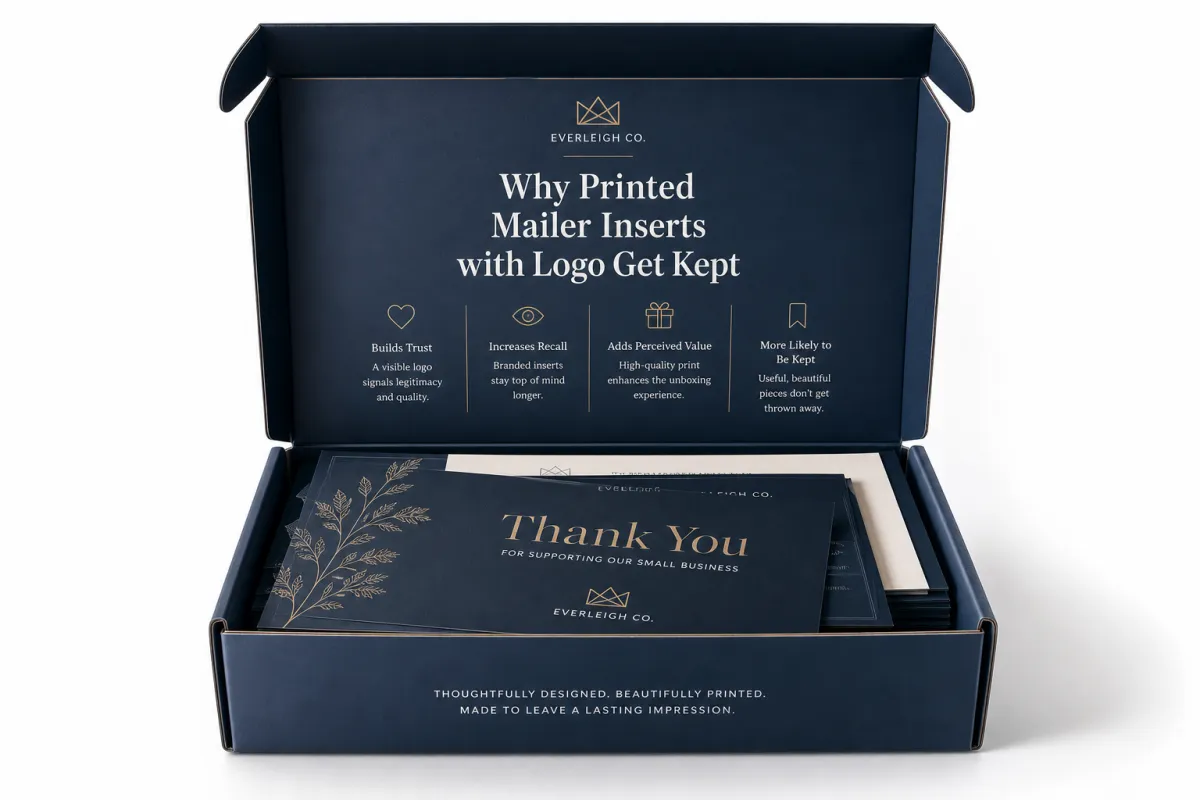
Most packaging has one brief chance to matter. The outer mailer carries the product, the customer opens it, and the rest of the experience either feels deliberate or forgettable. Printed mailer inserts with logo survive that moment because they are compact, easy to read, and usually tied to something practical: care instructions, a discount, a thank-you, a reorder reminder, or a QR code that leads somewhere useful.
That is the simple reason printed mailer inserts with logo get kept. They do not ask for much. They do not need a massive print budget or a long brand manifesto. They just make the package feel like someone planned the experience instead of stuffing a product into a box and hoping the rest would sort itself out. That alone already puts a shipment ahead of a lot of ordinary mail.
A branded insert can be a card, a folded sheet, a coupon, a product guide, a referral card, a return policy note, or a short thank-you. The strongest printed mailer inserts with logo usually solve a post-purchase problem in a plain, useful way. "How do I use this?" "How do I wash this?" "What should I do next?" Answer that clearly, and the insert earns its spot.
This matters because shipping is often the last direct contact before the customer decides whether the brand feels premium, cheap, or somewhere in between. A blank package can still deliver the order, sure, but printed mailer inserts with logo help the shipment feel complete, and that sense of completion leaves an impression that lasts longer than a lot of businesses realize.
They also support goals that go well beyond the opening moment. Better retention. Fewer repetitive support emails. More direct reviews and referrals. More repeat orders. Those are practical returns, not theory. A small piece of printed stock can do useful work inside the parcel every single day.
If the insert is not useful, it becomes trash. If it is useful, it becomes a reminder that the brand understood the customer well enough to make the package worth keeping. That is the whole point of printed mailer inserts with logo.
Material choice should match the message. A simple 14pt C1S card fits many single-purpose inserts. A 100# text sheet makes more sense for a folded guide. A premium soft-touch finish can help when the goal is a higher-end feel, but it should never get in the way of reading. Pretty is welcome. Readable is better, every time.
There is also a sustainability angle worth paying attention to. If the insert uses FSC-certified paper and is designed to be kept or recycled cleanly, it does more work and creates less waste. For paper sourcing and certified forest standards, the FSC framework is the obvious reference point. For shipments that need to survive rough handling, ISTA testing methods help teams think about inserts as part of the travel system, not just as a decorative layer.
That is why printed mailer inserts with logo are more than decoration. They are a low-cost, high-frequency brand touch that lives inside the shipment, right where the customer is already paying attention.
How Printed Mailer Inserts with Logo Work in the Shipping Flow
Printed mailer inserts with logo only work if they fit the fulfillment process. That sounds obvious until a brand designs an insert in isolation and then discovers it slows the line, creates pack errors, or shows up in the warehouse at the wrong time. Packaging is not a mood board. It is a process with deadlines, labels, and people trying to move orders out the door.
The sequence usually begins with artwork approval. Then the insert is printed, trimmed, scored if needed, folded if needed, bundled, and sent to the warehouse or 3PL. During pack-out, the insert goes into the outgoing order before the carton is sealed and the shipping label is applied. The order of those steps matters. Too early, and the insert may get damaged. Too late, and it gets missed altogether.
There are a few common ways printed mailer inserts with logo are integrated. Manual insertion is the simplest: a packer takes one card and drops it into each order. Semi-automatic workflows use a small staging station where inserts are stacked by line or by SKU. Kit-building operations may pair the insert with a product set before final packing. Each method can work. The better question is which one adds the least friction.
Busy warehouses do better with fewer decisions. One insert per order is easier than choosing among five versions. A clear stack location works better than loose pieces scattered around the workbench. A clean size that slides into the package without curling is better than something that needs folding gymnastics just to survive the mailer.
Different insert types behave differently in transit. A loose card is simple and cheap, but it can shift around if the package has extra headspace. A folded brochure gives more room for copy, though it may need score lines so it does not crack. Belly bands can wrap bundled products, but they need careful alignment. Multi-page cards look polished, but they also require better paper handling and tighter trim control.
Printed mailer inserts with logo should also be designed alongside the outer packaging. If the shipment uses a flexible poly mailer, the insert may need a heavier stock so it does not crease. If the outer carton is rigid, a lighter insert can work well. That is one reason many brands pair inserts with Custom Poly Mailers that already support the brand color palette and the visual tone of the shipment.
From a logistics angle, the insert has one job: fit into the workflow without becoming a workflow problem. If it needs constant explanation, it is too complicated. If the team can add it in a second or two, it is probably sized and specified correctly.
For more demanding shipments, transit stress deserves a little attention. Inserts that ride inside a kit with cosmetics, jars, or rigid components need to tolerate friction and compression. If the shipment is tested under ISTA-style distribution conditions, the insert should not smear, crack, or shed coating. That is not fancy thinking. It is simply avoiding avoidable mess.
In real operations, printed mailer inserts with logo should be planned with the same discipline as the rest of the pack line. The clearer the insert fits the shipping flow, the less likely it is to create errors, extra labor, or customer confusion.
Printed Mailer Inserts with Logo: Cost, Pricing, and MOQ
Price is where people either stay realistic or drift into wishful thinking. Printed mailer inserts with logo can be very affordable, but only if the size, stock, color count, and finish stay under control. Add folds, heavy coverage, soft-touch lamination, foil, or variable data, and the quote rises quickly. Not because printing is mysterious. Because setup and labor are real.
The main cost drivers are straightforward: size, paper stock, print sides, color coverage, finishing, folds, and quantity. A small single-card insert with one or two colors is far cheaper than a full-color folded brochure with coating on both sides. If the artwork also needs barcode placement, personalization, or a custom die-cut shape, the price moves again.
MOQ matters as well. Smaller runs usually cost more per piece because press setup and finishing are spread across fewer units. Larger runs reduce unit cost, but they tie up more cash and create storage pressure. That tradeoff matters for printed mailer inserts with logo because the insert often changes after a promotion ends or a product line shifts. Old inventory is not always savings. Sometimes it is just tomorrow's write-off.
Here is a practical range that reflects how printed mailer inserts with logo are often bought for mid-size brand programs:
| Insert Type | Typical Stock | Unit Cost at 5,000 | Best Use | Main Tradeoff |
|---|---|---|---|---|
| Single-sided card | 14pt C1S or 16pt C2S | $0.08-$0.18 | Thank-you note, simple offer, QR code | Limited message space |
| Folded insert | 100# text or 80# cover | $0.16-$0.35 | Product guide, care instructions, multi-step CTA | More handling and folding steps |
| Premium branded handout | 16pt stock with matte, soft-touch, or spot UV | $0.35-$0.90 | High-end unboxing, VIP offers, launch kits | Higher setup cost and lead time |
| Special finish piece | Thicker board with foil or custom die-cut | $0.60-$1.50+ | Campaigns, luxury categories, limited drops | Best reserved for the cases that justify it |
Those numbers are not universal. They are practical ranges. Final pricing depends on coverage, press method, paper availability, and whether the printer is building the job efficiently or fighting the file. A clean standard size like 4 x 6 in. or 5 x 7 in. usually prints more economically than an odd custom dimension. Every custom request is not a crisis, but every custom request does add friction.
Unit price is only one part of the picture. Total landed cost matters too: freight, warehousing, kitting labor, spoilage, and version control. A lower print quote can still end up more expensive if the supplier ships late, overpacks badly, or leaves you with a box of outdated inserts that nobody can use. Cheap is not always cheap. Packaging people learn that lesson once and remember it for a long time.
Printed mailer inserts with logo also get pricier when rush timing compresses the job. Last-minute artwork changes after proofing, unusual sizes, spot colors, special coatings, and tight registration requirements can all push the quote upward. If the insert is meant to support a launch, it is usually cheaper to lock the spec early than to pay for urgency later.
For brands that need to balance the outer mailer and the inner insert, it often makes sense to spend a little more on the outer package and keep the insert simple. A strong outer system plus a clean insert can outperform a lavish insert paired with weak packaging. If you want a coordinated system, start with the shipping format first, then build the printed mailer inserts with logo around it.
Printed Mailer Inserts with Logo Process, Timeline, and Lead Time
Lead time is where optimism and scheduling usually part ways. Printed mailer inserts with logo move through a clear sequence, but every step can slip if the input is messy. The typical path is brief, quote, dieline review, artwork setup, proofing, print, finishing, packing, and shipment. If the artwork is ready and the spec is simple, the job can move quickly. If not, the calendar starts getting loud.
For a clean digital run, production might take 3-5 business days after proof approval, with another few days for freight depending on the destination. Offset jobs or inserts with folding, coating, or specialty finishing often land in the 10-15 business day range, and more complex work can stretch to 15-20 business days. That is normal. Not dramatic. Just normal print production timing.
Turnaround and lead time are not the same thing. Turnaround usually means how long the printer needs once the order is approved. Lead time includes the whole chain: approval delay, production, and transit. If you need printed mailer inserts with logo before a product launch or subscription cycle, the full schedule matters more than the press time. Too many buyers ask, "How fast can you print it?" and forget that shipping still has a say.
Most delays show up in predictable places. Slow approvals. Missing bleed. Low-resolution art. Copy changes after proofing. Ignored comments on the proof. And the classic move where someone changes the logo placement after the printer has already set the file. A little discipline up front saves days at the end. Print production is not glamorous, but missing a launch window is worse.
Build in cushion whenever the order has a hard date. If the inserts must arrive before a seasonal push, ship them early. If the order goes to a 3PL, confirm receiving hours and carton labels. If the warehouse kits by SKU, make sure the insert version is documented clearly. Printed mailer inserts with logo are small, but they can still create big delays if nobody knows which one belongs in which order.
If the insert has to survive rougher distribution, check the testing side too. The ISTA standards are helpful because they remind teams that packaging is a transport system, not only a display piece. An insert that looks fine on screen can still crack, crease, or scuff once it moves through a real shipping chain. Better to learn that before orders go out.
Printed mailer inserts with logo work best when the timeline stays boring. That may sound plain, but boring is good in production. Boring means the approvals were clean, the specs were final, and the warehouse got the right quantity on time.
Step-by-Step Guide to Ordering Printed Mailer Inserts with Logo
Ordering printed mailer inserts with logo goes more smoothly once the insert has a job before the design begins. Does it sell? Educate? Reassure? Drive reviews? Reduce returns? Get customers to scan a QR code? One insert can do more than one thing, but trying to make it do everything usually ends in cluttered copy and weak results.
Start with the purpose. Then choose the format. A thank-you card works well for simple appreciation and one clear call to action. A care guide fits textiles, accessories, and products that need post-purchase instructions. A referral or upsell card can support a sales-driven brand. A QR-code sheet can move customers toward registration, support, or a reorder page. Printed mailer inserts with logo should follow the purpose, not the other way around.
Once the format is set, specify the print details with exactness. That means dimensions, paper stock, finish, color count, printed sides, fold style, and whether you need variable data, barcode placement, or writable space. If the insert is going into a mailer, check the room available in the package. A 5 x 7 card can be perfect in one setup and awkward in another.
Artwork setup matters more than people expect. Use proper bleed. Keep text inside safe margins. Make sure logos are vector or high-resolution. If the design includes a QR code, test it at the final size. If the insert includes tiny legal copy, remember that tiny legal copy is not a design feature. It is a nuisance. Printed mailer inserts with logo should be readable at arm's length, not only under studio lighting.
Here is a simple ordering sequence that avoids most nonsense:
- Define the goal for the insert.
- Pick the insert size based on the mailer or carton.
- Choose stock and finish based on handling and brand tone.
- Set the copy and artwork with bleed and safe margins.
- Approve the proof carefully and check the actual package fit.
- Release the final quantity in time for fulfillment.
A proof is not a formality. It is where bad spacing, odd color shifts, and cut-line mistakes reveal themselves. Print the proof if possible. Drop it into the real mailer. See whether it curls, disappears, or crowds the product. Printed mailer inserts with logo should feel intentional inside the package, not like a scrap added by someone rushing through a rough afternoon.
It also helps to match the insert to the outer packaging system. If the brand already uses a consistent mailer style, the insert can echo the same visual language and layout rhythm. For a lot of brands, a coordinated outer pack and a clean insert make the whole shipment feel more premium without adding much cost. If the outer package needs an update too, it makes sense to compare the insert with branded poly mailer options and build the system together.
For FSC-certified paper or recycled-content requests, ask about the substrate early. That keeps the supplier from quoting a stock that looks right but fails the brand's sustainability criteria. Printed mailer inserts with logo are easier to source cleanly when the spec is locked before production starts. Late changes are where good ideas go to slow everybody down.
Common Mistakes With Printed Mailer Inserts with Logo
The first mistake is overloading the piece. People try to cram too much text, too many offers, and too many design elements onto a single insert. The result is a crowded page nobody reads. Printed mailer inserts with logo work best when the message is narrow and obvious. One goal. One action. One reason to keep it.
The second mistake is weak brand alignment. A logo that looks copied from a random template, mismatched colors, off-tone messaging, or stock imagery that does not belong in the brand world can make the insert feel cheap. The irony is that the insert is often meant to make the package feel more premium. If the design misses the mark, it can do the opposite.
Poor sizing is another common problem. Too large, and the insert buckles inside the mailer, bends the product, or makes the pack feel crowded. Too small, and it reads like a leftover scrap instead of a deliberate brand touch. Printed mailer inserts with logo should fit the package with a little room to breathe. Not a lot. Just enough.
Chasing the lowest quote is risky too. A low price can hide thin stock, sloppy trimming, weak folding quality, or proofing that is barely supervised. If the supplier cannot explain the proof process, the project will probably become your problem later. Print buyers do not need luxury. They do need predictable output. That is a much lower bar than the sales deck would suggest.
Logistics mistakes are just as common. Printing too late. Ordering too few. Forgetting that insert inventory needs storage. Forgetting that version control matters when copy changes. Printed mailer inserts with logo are small, which makes them easy to underestimate. That is exactly how brands end up with 8,000 inserts that still mention a promo that expired months ago.
Here are the mistakes I see most often, and all of them are avoidable:
- Too much copy and too little white space.
- Artwork approved without a real package fit test.
- Paper stock chosen for appearance only, not handling.
- Late changes that force a rush reprint.
- Ordering a promo insert without a clear end date.
Another subtle problem is expecting the insert to fix a weak product or a clumsy fulfillment experience. It will not. Printed mailer inserts with logo can improve perception, but they do not rescue bad basics. If the product arrives damaged or the order is wrong, nobody cares how pretty the thank-you card was.
So yes, the insert matters. It is still not a magic trick. It works best as part of a package system that already has the essentials under control: the right stock, clear labeling, stable fulfillment, and a message worth reading.
Expert Tips and Next Steps for Printed Mailer Inserts with Logo
If the advice had to stay short, it would be this: use one insert, one message, one action. Printed mailer inserts with logo perform better when they do not compete with themselves. Ask the customer to scan a QR code, register the product, redeem an offer, read a guide, or leave feedback. Just one. If you ask for four actions, most people will do none of them.
Choose the paper and finish based on handling, not vanity. A matte stock often reads clean and premium without glare. A coated stock may hold color better and survive bulk pack-out more comfortably. Soft-touch can feel excellent, but it should only be used when the tactile effect is worth the extra cost and production complexity. Printed mailer inserts with logo are not the place to show off every finish in the catalog.
Test two or three versions before you commit to a full run if the insert is tied to revenue. Compare response rate, repeat order behavior, support questions, and whether the card actually gets noticed. The difference between a decent insert and a strong one can be surprisingly measurable. A lot of brands guess here, and guessing gets expensive quickly.
One smart move is to treat the insert as a campaign asset, not only as a print item. Give each version a clear code. Note the run size, the stock, the launch date, and the intended action. Then watch what happens. Printed mailer inserts with logo improve over time when the business treats them as something to learn from instead of something to toss in a drawer and forget.
If you are planning a new run, gather the dimensions first. Then decide the message goal. Then request a quote. Then review the proof against the actual package. Then confirm the final quantity against the fulfillment schedule. That order saves headaches. It also makes it easier to compare options with your outer packaging, including Custom Poly Mailers that match the same brand look and shipping needs.
For sustainability-minded brands, keep paper sourcing clean and the design easy to recycle. The simplest path is often the best one: a single stock, minimal coatings, and print that does the job without making recycling harder than it needs to be. If the insert needs certification support, ask for FSC documentation upfront. Printed mailer inserts with logo should feel responsible, not performative.
There is also a buying lesson buried in all of this. The best insert is not the fanciest one. It is the one that prints cleanly, lands on time, fits the mailer, and gets the customer to take the next step. That is the whole equation. The rest is decoration.
For brands that want to tighten the full unboxing system, it can make sense to pair the insert with coordinated outer mailers and a simple repeat-order path. If the inner piece is doing its job and the packaging fits the shipment, the result feels polished without needing a lot of extra spend. That kind of practical polish is what lasts.
Printed mailer inserts with logo are one of those packaging pieces that look minor until you measure the effect. Then the little card starts pulling its weight. Keep the next order simple, measurable, and easy to pack. That is how printed mailer inserts with logo get better instead of just more expensive.
Frequently Asked Questions
What are printed mailer inserts with logo used for?
They reinforce branding inside the package and can drive repeat purchases, product education, reviews, referrals, or support deflection. They are most useful when the unboxing moment matters and the outer mailer alone does not explain the product or the next action.
How much do printed mailer inserts with logo usually cost?
Simple single-card inserts are usually the least expensive, while folded pieces, premium stocks, coatings, and special finishes raise the price quickly. Unit cost drops as quantity rises, but storage and leftover inventory matter, so the lowest quote is not always the best buy.
How long does production take for printed mailer inserts with logo?
Timeline depends on proof approval speed, paper availability, print complexity, and shipping method. Straightforward jobs move faster; custom sizes, folds, and rush requests usually add extra days. A clean approval process is the easiest way to keep the schedule under control.
What file format should I send for printed mailer inserts with logo?
A print-ready PDF is usually safest, with proper bleed, safe margins, and outlined fonts if required by the supplier. High-resolution linked artwork and clear brand colors help avoid proofing delays and color surprises, which is exactly the kind of problem nobody needs at the end of a production cycle.
What is the best size for printed mailer inserts with logo?
The best size matches the mailer and the message; it should fit cleanly without bending, shifting, or crowding the product. A useful test is simple: if the insert feels easy to handle and easy to read, it is probably the right size.
What should I do before placing the final order?
Lock the insert purpose, confirm the finished size against the mailer, and approve a physical proof inside the real package. If those three pieces are in place, the job usually moves faster, costs less to manage, and lands with fewer surprises.


