Buyer Fit Snapshot
| Best fit | Printed Mailing Bags Quote projects where brand print, material claims, artwork control, MOQ, and repeat-order consistency need to be specified before quoting. |
|---|---|
| Quote inputs | Share finished size, material target, print colors, finish, packing count, annual reorder estimate, ship-to region, and any compliance wording. |
| Proofing check | Approve dieline scale, logo placement, barcode or warning zones, color tolerance, closure strength, and carton packing before bulk production. |
| Main risk | Vague material claims, crowded artwork, missing packing details, or unclear freight terms can make a low unit price expensive after revisions. |
Fast answer: Printed Mailing Bags Quote: Pricing, Specs, and Next Steps should be specified like a repeatable production item. The safest quote records material, print method, finish, artwork proof, packing count, and reorder notes in one written spec.
Production checks before approval
Compare the actual filled-product size with the drawing, then confirm tolerance on folds, seals, hang holes, label areas, and retail display edges. Reserve space for logos, QR codes, warning copy, and material claims before decorative graphics fill the panel.
Quote comparison points
Review material grade, print process, finish, sampling route, tooling charges, carton quantity, and freight assumptions side by side. A quote is only useful when the supplier can repeat the same color, closure quality, and packing count on the next order.
printed mailing bags Quote: Pricing, Specs, and next steps
A printed mailing bags quote is often the first honest checkpoint in a packaging budget. Size, film thickness, print coverage, closure style, and freight can move the landed cost more than buyers expect, especially once an order shifts from a few hundred parcels to a steady weekly run. A mailer looks small on the packing table, but one oversized spec or one weak film choice can quietly add weight, waste space, and force a reorder before the season is even over.
Good pricing starts with exact details. A useful printed mailing bags quote should be built from the finished dimensions, the artwork file, the delivery address, the target quantity, and the way the bags will be packed for shipment. Anything less is an estimate with a polite label on it. The lowest-looking number is kinda useless if freight, replacement stock, and avoidable waste eat the savings before the bags even hit the dock.
Brands shipping apparel, accessories, soft goods, and subscription items usually want two things from a mailer: protection and presentation. A printed bag can do both if the construction matches the product and the route. A bad fit shows up fast in the packing room, at the delivery dock, or in the customer experience. That is why a printed mailing bags quote should be treated as a spec review as much as a price request.
In the packaging reviews I have done over the years, the biggest cost mistakes usually came from the same place: someone asked for a “mailing bag” without saying what the product weighed, how sharp the edges were, or whether the team cared more about speed, print quality, or shelf feel. Once those details are pinned down, the quote tends to make a lot more sense.
Printed mailing bags quote: what really drives the price
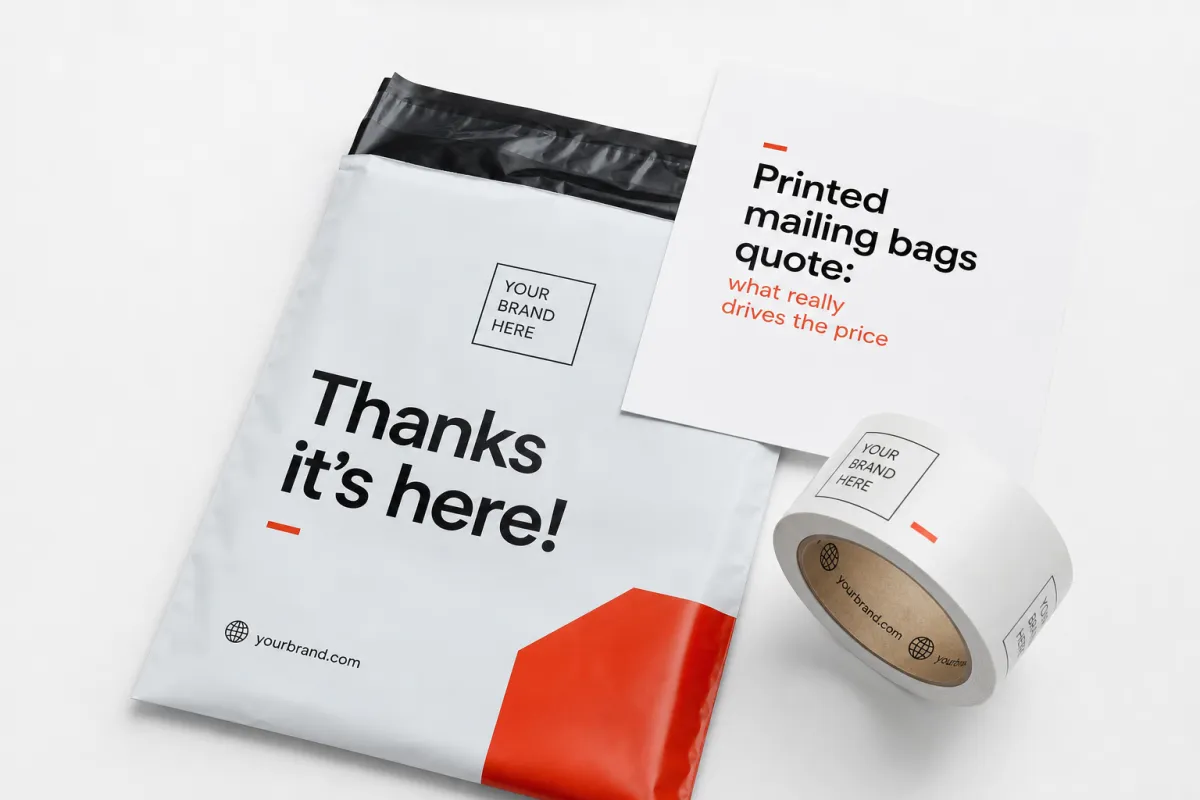
The main drivers behind a printed mailing bags quote are easy to list, but each one carries real weight. Material grade, bag size, film thickness, print colors, print coverage, closure type, and order quantity all shape the final number. Change any one of them and the quote changes with it. That is not a sales tactic. It is the packaging math showing up as it should.
Material choice is one of the first places pricing moves. A standard poly mailer works well for many lightweight apparel orders, while recycled-content film, heavier gauge film, or a co-extruded structure adds cost because the material itself costs more and often needs tighter process control. Size plays a similar role. A bag that is larger than necessary uses more resin, more ink coverage, and more freight space, and those costs repeat on every single unit.
Thickness is another quiet factor. Many retail mailers sit in the 50-75 micron range, which roughly translates to about 2.0-3.0 mil depending on construction. Thin film lowers material cost, but puncture resistance drops with it. Thicker film improves the feel in hand and can handle rougher parcel handling, yet the unit price rises. The right choice depends on the product, the route, and how much risk sits between the packing bench and the customer door.
Print coverage changes the economics quickly. A small logo in one corner is not the same as a full flood print across both sides of the bag. More ink, more setup, and more press time all add cost. Extra colors do the same thing. A printed mailing bags quote looks sharper when the artwork is honest about what the printer is actually being asked to do. Complicated artwork can be beautiful, but it should be priced like complicated artwork.
Shipping destination and real monthly volume matter too. A single-warehouse shipment is one job, while a split delivery that crosses regions or borders is another. Freight, duties, storage, and handling all have their own effect on the total. A printed mailing bags quote that ignores those pieces may look attractive on paper and still miss the mark once the bags arrive.
A quote is only useful when it matches the actual bag, not a flattering number built around a different spec.
For buyers who want a reliable reference point on packaging terms and industry basics, Packaging.org is a good place to cross-check materials and definitions. If parcel performance matters, ISTA test methods are worth reviewing, since a mailer should survive real shipping conditions rather than just look tidy in a presentation.
The short version is plain: a printed mailing bags quote should tell you what the bag is, what it costs, and what it will cost to get it to your dock. Anything else is a teaser with extra punctuation.
Product details: choosing the right poly mailer for your order
A printed mailing bags quote only makes sense when the product type is clear. Plain poly mailers, printed mailing bags, recycled-content mailers, and compostable-style options each behave differently in production, storage, and shipping. Buyers sometimes ask for “just a mailer,” then wonder why the pricing drifts. The issue usually begins with a vague brief.
For high-volume apparel brands, a standard poly mailer remains the workhorse. It is light, compact, economical to ship, and easy to pack at speed. A printed version earns its keep when presentation matters, since a simple logo, a brand line, or a clean color block makes the parcel feel deliberate instead of generic. That visual consistency does more for brand memory than many teams expect.
Printed mailing bags quote requests often show up when a business has outgrown plain stock. That is usually the right moment to switch. If staff are handwriting notes, overfilling bags, or using mailers that are too large for the product, the operation is already paying for the mismatch somewhere else. Better branding is a bonus. Better process is the real gain.
Not every product needs the same level of finish. Accessories, lightweight tees, socks, and subscription inserts often do well in standard printed mailing bags as long as the film is strong enough and the seal holds through transport. Cosmetics, fragile kits, and products with sharp packaging edges need more care. Those jobs usually call for stronger opacity, better puncture resistance, and a closure that stays secure from packing to delivery.
The practical checks are straightforward:
- Seal strength: The adhesive strip should hold through parcel handling, not just on the packing bench.
- Opacity: Thin film can reveal the shape of the contents, which is a problem for premium or sensitive goods.
- Puncture resistance: Tags, corners, hard edges, and mixed handling can split a weak bag.
- Tear behavior: A bag that tears too easily creates returns, complaints, and avoidable waste.
A printed mailing bags quote for a lightweight apparel order rarely matches the needs of a mixed soft-goods kit. The first may work at 50-60 micron, while the second may need 65-75 micron along with a stronger adhesive strip. Same product family, very different performance.
If you are still comparing constructions, our Custom Poly Mailers page is a useful place to review typical options before you request a printed mailing bags quote. It saves time and cuts down on the back-and-forth that usually starts when the size is still only a rough guess.
Appearance alone can be a trap. Gloss can look sharp, but matte may hide scuffs better during transit. A lighter bag can look efficient, yet if it fails in the parcel network, the savings disappear fast. A printed mailing bags quote should help you choose the bag that fits the route and the product, not the one that merely sounds cheaper in a spreadsheet.
Printed mailing bags quote specifications: sizes, film, and print options
This is the point where a printed mailing bags quote either becomes dependable or starts drifting into guesswork. The more exact the specification, the fewer surprises later. The main data points are flat width, gusset if needed, length, thickness, seal style, and any extra features such as dual adhesive strips or tear-off lines.
Bag dimensions should come from the packed product, not from the most convenient version of it. A folded t-shirt in tissue behaves differently from a hoodie packed with a rigid insert card, and both differ again from a bundle of mixed items. Leave enough room for loading, sealing, and a little manufacturing tolerance, but do not overdo it. Oversizing wastes material and can make the parcel look loose. Undersizing creates bulging seams and weak seals, which is a quick route to damage and rework.
A clean printed mailing bags quote should explain the print method as clearly as the bag size. One-color artwork is usually more economical than multi-color work, and logo-only printing costs less than a full-coverage flood print. Front-only is simpler than front-and-back. Matte and glossy finishes can both work, although matte tends to hide handling marks more effectively while gloss pushes color contrast harder. Each choice has a tradeoff, and the quote should show it.
Artwork is where many buyers lose time. Vector files make the process faster, and Pantone references help when color accuracy matters. Tiny text, thin lines, and hairline borders can be risky on a flexible film surface that stretches and shifts under pressure. If the design depends on fine detail, ask for a proof, set a realistic minimum line thickness, and check the file before production begins.
For a serious printed mailing bags quote, I would want these details in hand:
- Final bag size or packed product dimensions.
- Film preference, such as standard, recycled-content, or heavier gauge.
- Print colors, logo placement, and coverage area.
- Closure type, including standard peel-and-seal or dual-strip closure.
- Target quantity and whether the order is a test run or a repeat program.
- Shipping destination and delivery deadline.
Tolerances matter as well. A bag can be made to a nominal size, yet manufacturing variation still exists. A few millimeters can decide whether a product slides in neatly or has to be pushed through the opening, and that has a direct effect on packing speed and damage risk. A printed mailing bags quote that ignores tolerance leaves too much room for trouble.
The branding side deserves attention too. A simple logo on a clean field often looks stronger than a crowded design that tries to cover every inch. Some buyers want more print coverage because it feels premium. Sometimes that is true. Sometimes it only makes the bag busier and more expensive. A tighter printed mailing bags quote usually rewards restraint, especially when the artwork already carries a clear brand voice.
If the order will move through a parcel network with rough handling, think beyond appearance. Distribution testing using ISTA methods makes sense for products that need to survive drops, vibration, and compression. A mailer is still a shipping component. It has a job to do, and a printed mailing bags quote should reflect that job rather than pretending the bag only needs to photograph well.
Printed mailing bags quote pricing and MOQ ranges
This is the section most buyers scan first. A printed mailing bags quote often gets cheaper per unit as quantity rises, but setup, plates, proofing, and freight can shift the real comparison. Unit price is one line. Landed cost is the number that matters when the invoices start landing.
For rough planning, plain stock mailers can sit around $0.06-$0.18 per unit depending on size and thickness. A simple one-color custom bag often lands in the $0.12-$0.28 range at mid-volume quantities. Full-coverage or multi-color printed mailing bags can move into the $0.18-$0.40+ range, especially if the size is large or the structure is heavier. Recycled-content or specialty film usually sits toward the higher end of those bands. These ranges help with budgeting, but the final spec still controls the price.
MOQ is where some buyers get caught off guard. A smaller brand may only need 1,000 to 3,000 units for a test run, while established stores often order 5,000 to 20,000 units to improve unit cost and reduce reordering frequency. A printed mailing bags quote should show where those thresholds sit. If a supplier waits until the last minute to mention MOQ, the comparison process becomes harder than it should be.
| Option | Typical MOQ | Typical unit price range | Best for | Main tradeoff |
|---|---|---|---|---|
| Plain stock poly mailer | 500-1,000 | $0.06-$0.18 | Fast replenishment and lowest upfront spend | No branding and limited differentiation |
| One-color custom printed mailer | 3,000-5,000 | $0.12-$0.28 | Branding with controlled cost | Needs artwork setup and proofing |
| Full-coverage multi-color mailer | 5,000-10,000 | $0.18-$0.40+ | Premium presentation and stronger shelf appeal | Higher print and setup cost |
| Recycled-content mailer | 3,000-5,000 | $0.14-$0.32 | Brands balancing cost and sustainability claims | Material availability can affect timing |
| Compostable-style mailer | 3,000-5,000 | $0.20-$0.45 | Programs with strict material-positioning goals | Needs careful claim validation and storage control |
That table gives a practical starting point. The actual printed mailing bags quote can move based on film type, print coverage, destination, and special features like tear notches or dual adhesive strips. Setup charges matter more on smaller runs because they are spread across fewer units. A quote that looks expensive at 3,000 pieces can look far more sensible at 10,000.
Hidden costs deserve a direct mention. Sampling can add both time and money. Artwork cleanup can add a small one-time fee if the file is messy. Customs clearance and inland delivery can add more than buyers expect, especially on urgent shipments. Storage also matters if six months of inventory is landing at once. A strong printed mailing bags quote should show where those costs sit so the total does not come as a surprise.
The cleanest comparison comes from reviewing at least two or three quotes using the same size, same film, same print count, and same delivery terms. Otherwise you are not comparing prices. You are comparing assumptions, and assumptions are how packaging budgets get bent out of shape.
Printed mailing bags quote process and timeline
The smoother the process, the less time gets wasted. A solid printed mailing bags quote usually follows a simple path: send specifications, receive a preliminary quote, review artwork, approve a digital proof or sample, then confirm production. Any missing piece tends to stretch the timeline, sometimes more than the buyer expects.
Most delays begin with incomplete information. A buyer may only know the rough bag size. The artwork might be a low-resolution JPEG. The delivery date may be fixed, while the quantity is still changing. Each of those issues triggers another round of questions. The fastest printed mailing bags quote is usually the one built from complete inputs the first time.
Typical quote turnaround can be fast once the details are clear, often within 24-48 hours for straightforward jobs. Proofing usually takes another 1-3 business days, depending on how many revisions are needed. Production often runs 12-15 business days after approval for standard jobs, while more complex print work can take longer. Shipping time depends on the route and freight method, and that is where many schedules become less predictable.
The most common delay points are easy to spot:
- Vague dimensions: “Medium mailer” does not help anyone price the job correctly.
- Missing print files: Raster art often needs cleanup and can slow proofing.
- Color changes: Revising brand colors after approval can reset the schedule.
- Late spec changes: A different film thickness or closure style changes both price and timing.
A buyer who wants a clean printed mailing bags quote should think like a production planner. Lock the bag size first. Lock the print coverage next. Confirm the adhesive style. Review the proof only after the text, color placement, and safe zones all look right. That sequence reduces rework and keeps the order moving.
Lead time also depends on how far the finished goods need to travel. Domestic trucking may be simple. Export shipments or split deliveries can add documentation, transit time, and more coordination. A printed mailing bags quote should clearly separate production lead time from freight time. Mixing them together causes confusion, and confusion is how a job ends up sounding late when it is still on schedule in transit.
When timing is tight, ask for a staged answer. First, request the printed mailing bags quote with the production lead time and freight estimate. Second, approve the proof quickly. Third, confirm whether the bags can ship in one lot or need partial deliveries. Clear communication is faster than a pile of rushed emails, and it usually produces a better result.
Why choose us for printed mailing bags quotes
Buyers do not need more marketing language. They need a printed mailing bags quote that reflects the real job, not a headline number built to look attractive before add-ons appear. A practical packaging supplier earns trust by checking the spec carefully, explaining MOQ clearly, and pricing the order around the actual construction.
We focus on the details that change the final order. If the size is off, the quote is off. If the artwork is not ready for press, proofing slows down. If the film is too light for the route, replacement costs later may erase the savings from the first order. A printed mailing bags quote should prevent those problems rather than create them.
Repeat orders matter just as much. Plenty of buyers get caught when the first run goes smoothly, then the second run turns into a fresh negotiation for no good reason. That wastes time and makes planning harder. A cleaner spec sheet lets the same printed mailing bags quote logic carry forward, which keeps the next order from becoming a new puzzle.
Buyers usually care most about these points:
- File checks: We catch obvious print problems before they become production problems.
- Proofing guidance: You get a clear review path instead of vague approval language.
- Sample options: A sample is often worth the time for premium launches or color-sensitive brands.
- Realistic lead times: A true schedule is more useful than a promise that cannot hold.
- Specification discipline: The same printed mailing bags quote should produce the same order every time.
The best packaging process is usually the most uneventful one. The mailers arrive on time. The print matches the proof closely. The bags fit the product. The packing team does not have to improvise. That is what a well-built printed mailing bags quote is meant to buy.
If you need help narrowing the options, a short conversation is often quicker than another round of emails. Contact Us with your size, artwork, and target volume, and we can help you tighten the spec before you commit. That is often the fastest path to a usable printed mailing bags quote.
Next steps to request a printed mailing bags quote
The fastest way to move forward is to send complete information the first time. Gather the bag size, quantity, film preference, print colors, shipping destination, and artwork files before you request a printed mailing bags quote. If you already know the product dimensions, include them too. One clear measurement can prevent a long chain of clarifying questions.
If you are unsure about size, say so directly. A good supplier can recommend a workable structure based on the packed product, the expected fill level, and the room needed for sealing. A rough estimate is still better than a vague request. The point of a printed mailing bags quote is to reduce uncertainty, not add another layer to it.
Before placing the order, compare the same spec across two or three suppliers. Make sure each quote includes the same material, same print coverage, same closure style, and same delivery terms. If one price comes in far lower, ask why. Sometimes the answer is a smaller bag, a thinner film, or freight that never made it into the number. That kind of surprise is avoidable when the brief is clean.
A sample or proof is a smart move for color-sensitive designs, premium customer orders, or brand standards that need to be held tightly. The small delay is worth it. Reprinting the wrong bag is neither fun nor cheap. A careful printed mailing bags quote should make room for proofing instead of pretending it can be skipped.
Use this checklist before you request pricing:
- Final dimensions or product measurements.
- Expected order quantity and reorder frequency.
- Film type and thickness target.
- Artwork files and color references.
- Delivery address and timeline.
- Any need for recycled-content, tamper-evident, or dual-strip closure features.
Once that is ready, the process stays simple. Send the spec, review the printed mailing bags quote, confirm the proof, and lock the production window. If you want an easier start, begin with our Custom Poly Mailers page and send the details from there. A clear brief gets a better answer, and that holds true in packaging and almost everywhere else.
For teams that want fewer surprises and a cleaner handoff to production, the next move is straightforward: get the dimensions right, keep the artwork tidy, and ask for a printed mailing bags quote that matches the actual bag instead of a placeholder. That is how you protect margin without making the process harder than it needs to be.
FAQ
What details do I need for a printed mailing bags quote?
Provide bag size, quantity, thickness, print colors, artwork files, and delivery location so the quote reflects the real job. If you are unsure about size, include the product dimensions and a brief note on how the item is packed. The more exact the spec, the fewer pricing surprises later on the printed mailing bags quote.
How much do printed mailing bags cost per unit?
Unit price depends on size, film thickness, print coverage, and order volume. Smaller runs usually cost more per bag, while larger runs lower the unit price but increase total spend. Freight, setup, and artwork adjustments can change the landed cost, so a printed mailing bags quote should always be reviewed as a full order cost, not just a unit number.
What is the minimum order quantity for printed mailing bags?
MOQ varies by size, material, and print complexity. Simple single-color jobs usually support lower MOQs than full-coverage or multi-color designs. If you need a test run, ask for the smallest viable quantity before scaling. That keeps the printed mailing bags quote practical for launch orders and less risky for first-time designs.
How long does a printed mailing bags order take?
Timeline depends on proof approval, production load, and shipping method. The fastest orders are the ones with complete artwork and fixed specs from the start. Rush orders are possible in some cases, but they usually cost more and reduce flexibility. A clean printed mailing bags quote should separate production time from freight time so you know what is actually happening.
Can I change the design after I get a printed mailing bags quote?
Yes, but even small artwork changes can affect pricing, proofing, and production timing. If the bag size or print coverage changes, the quote should be updated before you approve anything. Lock the final design before production to avoid delays and rework. That is the least glamorous part of ordering, and also the part that saves the most money on a printed mailing bags quote.
If you want a printed mailing bags quote that is genuinely useful, send the exact size, material preference, artwork, quantity, and delivery details first, then compare the result against your shipping route and budget. That is the difference between a tidy order and a messy one. The clearest takeaway is simple: lock the spec, check the proof, and ask for a number that matches the bag you actually plan to ship.

