Buyer Fit Snapshot
| Best fit | Printed Poly Mailers Comparison projects where brand print, material claims, artwork control, MOQ, and repeat-order consistency need to be specified before quoting. |
|---|---|
| Quote inputs | Share finished size, material target, print colors, finish, packing count, annual reorder estimate, ship-to region, and any compliance wording. |
| Proofing check | Approve dieline scale, logo placement, barcode or warning zones, color tolerance, closure strength, and carton packing before bulk production. |
| Main risk | Vague material claims, crowded artwork, missing packing details, or unclear freight terms can make a low unit price expensive after revisions. |
Fast answer: Printed Poly Mailers Comparison: Materials, Cost, Quality should be specified like a repeatable production item. The safest quote records material, print method, finish, artwork proof, packing count, and reorder notes in one written spec.
Production checks before approval
Compare the actual filled-product size with the drawing, then confirm tolerance on folds, seals, hang holes, label areas, and retail display edges. Reserve space for logos, QR codes, warning copy, and material claims before decorative graphics fill the panel.
Quote comparison points
Review material grade, print process, finish, sampling route, tooling charges, carton quantity, and freight assumptions side by side. A quote is only useful when the supplier can repeat the same color, closure quality, and packing count on the next order.
Printed Poly Mailers Comparison: Materials, Cost, Quality
I still remember a Printed Poly Mailers comparison that settled an argument faster than any spreadsheet I have ever seen. It happened on a packing bench in Shenzhen, where two mailers sat side by side in the same carton: matte black logos, white film, nearly identical dimensions, and quotes that differed by less than two cents. On paper, they looked interchangeable. Then we dropped them from a meter and watched the thinner one scuff at the corner seam while the co-extruded bag stayed flat and held its seal. That was the entire lesson in one ugly little moment. Packaging can look persuasive and still be wrong, and the error usually shows up after the order is already paid for.
A Printed Poly Mailers comparison is really a comparison of systems, not artwork. These bags are flexible shipping mailers made from polyethylene film, usually LDPE, LLDPE, or a co-extruded blend selected for stretch, puncture resistance, and moisture control. The print lives on the outer film, which means the logo, return instruction, or campaign graphic becomes part of the shipping experience instead of a separate label stuck on at the end. I have watched a polished proof fail as soon as a conveyor belt got involved, which is annoying in the moment and useful later. It tells you the bag was judged by the wrong standard.
Buyers usually begin with color and stop there. That is the trap. Seal strength, film gauge, opacity, and corner durability matter just as much, especially if the parcel carries a garment box, a folded insert, or a small accessory with an awkward edge. A good Printed Poly Mailers comparison answers four questions at once: what the bag is made from, how it is printed, how long it will take to produce, and what it truly costs once freight, setup, and waste are counted. That matters for a startup ordering 3,000 units and for a larger apparel brand replenishing quarterly from a facility in Zhejiang or Jiangsu. The bag is not just carrying a logo; it is carrying expectations. And those are a lot harder to replace.
Printed Poly Mailers Comparison: What Buyers Miss First
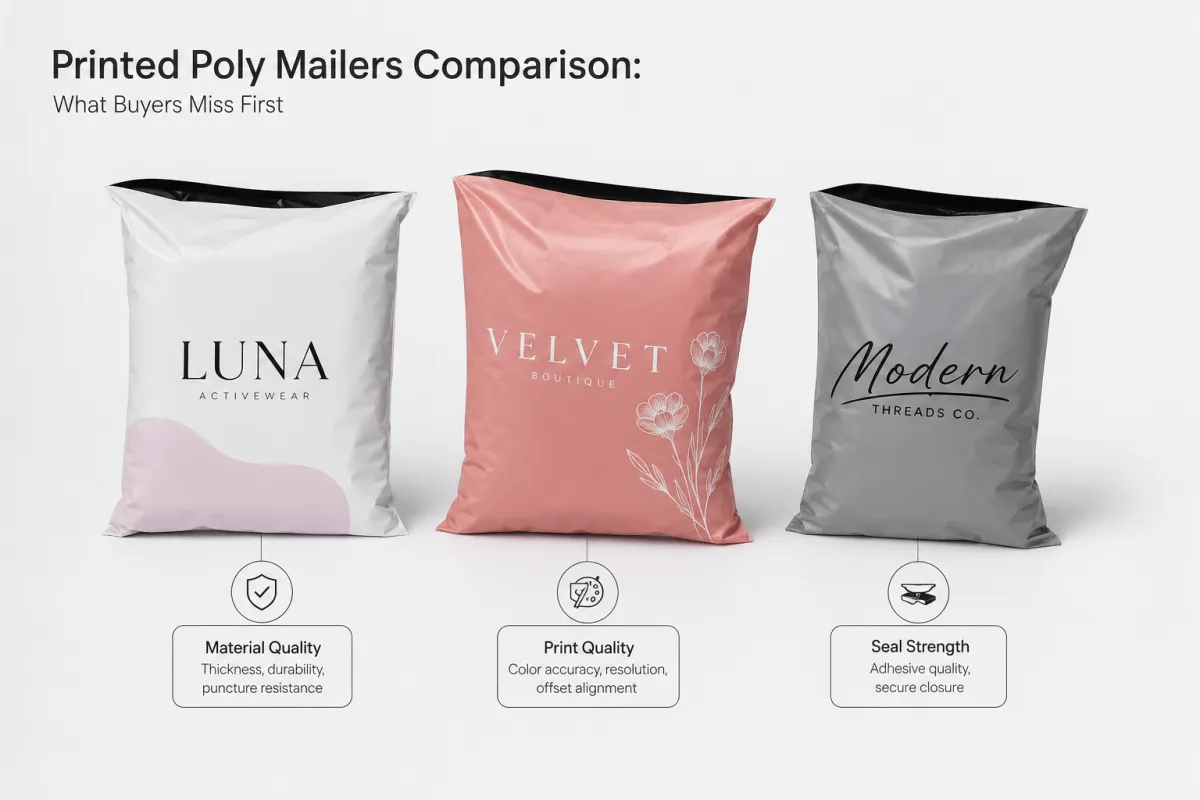
Most people compare mailers by eye and assume the bags are the same. They usually are not. A careful printed poly mailers comparison starts with details the eye ignores: actual film thickness, seal geometry, gusset style, and how the bag handles abrasion after rubbing against corrugated cartons for a long regional route. I once watched a 2.5 mil bag and a 3.0 mil bag go through the same carton test. The thinner one still looked fine on the table, but the conveyor left stress lines at the fold, and by the end of the day that was the bag everyone wanted to replace. The room got very quiet after that. No one likes being told the spec sheet was the thing they should have trusted.
Printed poly mailers look simple, which is exactly why they get misread. They are shipping bags, yes, but they are also presentation surfaces. In a printed poly mailers comparison, the branded side is only half the equation. The other half is whether the bag can survive moisture splash, rough sorting belts, and the occasional sharp edge from a polybagged garment tag or a compact accessory box. Fashion brands learn this quickly. A mailer can arrive with a polished look and still lose trust if the seal splits after a busy week in a distribution center in New Jersey or a 40,000-unit operation in Ho Chi Minh City. I have seen buyers forgive a slightly off-center print. They do not forgive a torn hem and a damp parcel. Not once the damage claim lands.
I push buyers to treat the choice as a packaging-system decision because the print does not carry the shipment by itself. The film and sealing do that work. A thoughtful printed poly mailers comparison weighs the bag as a complete unit: graphics, barrier, seal, handling, and the customer’s first touch. Soft goods, cosmetics, subscription kits, and light home goods all benefit from this kind of scrutiny because the bag shapes the brand impression before the product appears. If the shipment also includes a folded care card or a heavy insert, that extra thickness changes the inside volume and the pressure on the seal. My bias is plain: if the bag feels flimsy in my hands, the customer is gonna feel it too.
"The mailer is not a sticker on a shipment. It is the shipment's first handshake." A buyer said that during a plant audit in New Jersey, right after we watched two styles fail under the same pack-out conditions and saw one split at 18 pounds of compression.
For that reason, the first step in a printed poly mailers comparison is not pricing. It is defining the use case: the product weight, the shipping route, whether the order leaves a clean packing bench or a high-volume fulfillment line, and whether the brand wants a retail look or a tougher industrial finish. Once those details are pinned down, the rest of the decision gets sharper and a lot less theatrical. It also becomes less likely that someone falls in love with a shiny sample that behaves like a diva under pressure on a Monday morning.
How Printed Poly Mailers Are Made and Why They Differ
A serious printed poly mailers comparison gets easier once the manufacturing flow is clear. The process usually starts with film extrusion, where polyethylene resin is melted and formed into a flat film or a blown tube. That film is then slit to width, printed, converted into bag form, sealed on the sides and bottom, and packed for shipment. Every step leaves a mark on the final product. A film with uneven thickness can print cleanly and still fail earlier in transit because one section stretches more than another under load. I have watched attractive bags fail exactly there, which is a very annoying kind of honesty, especially when the extrusion line was running at 180 meters per minute.
Printing method changes more than buyers expect. Flexographic printing is common for long runs, especially when a brand wants lower unit cost and repeat consistency. Rotogravure can deliver deep detail and stable color across very large volumes, although the cylinder investment usually makes sense only at scale. Digital printing has a different cost structure: lighter setup, faster artwork changes, and a better fit for shorter runs or seasonal designs. In a printed poly mailers comparison, the print method influences color and detail, but it also shapes minimum order quantity, setup time, and waste during press make-ready. A lot of buyers get caught here because the quote looks simple while the business model is not.
I still remember a negotiation with a film supplier near Guangzhou where the argument centered on a 0.2 mil gauge difference. On paper, that seemed tiny. On the line, it changed seal confidence, pallet compression behavior, and how much the bag stretched around a folded sweatshirt packed beside an insert. That is why two vendors can quote the same artwork and still deliver very different mailers. Press type, resin blend, sealing knife temperature, and converting tolerance all show up in the final result, even when the proof looks identical. I was annoyed at the time, but that annoyance was useful. It forced everyone to stop pretending the number was close enough.
Ink adhesion is another detail buyers often miss in a printed poly mailers comparison. If the ink sits on the film without a strong bond, the logo can scuff during bag insertion or rub off against another carton in transit. Better suppliers test adhesion with tape pull checks and rubbing tests, often after 24 hours of cure time at 25 C and 50% relative humidity. Some will also discuss corona treatment on the film surface, which improves the bond between ink and polyethylene. That sounds technical for its own sake, but it often decides whether a bag arrives crisp or faded where a conveyor did its work. And yes, nothing ruins a branded unboxing faster than a logo that looks like it lost a fight in a loading bay.
Printed Poly Mailers Comparison: Cost, Pricing, and Value
Price usually starts the conversation, but a smart printed poly mailers comparison starts with cost drivers, not the final quote. Bag size, film thickness, print colors, the number of printed sides, and special finishes all affect the number on the page. A 10 x 13 inch bag in 2.5 mil film with one-color printing is a very different job from a 14 x 19 inch bag in 3.0 mil film with full-coverage printing on both sides. For reference, a 5,000-piece run at one factory in Shenzhen came in at $0.15 per unit for the simpler spec, while the heavier two-sided version landed closer to $0.21 per unit. Even with straightforward artwork, the material and converting choices can move the price by several cents per bag. That sounds minor until you multiply it by a quarter-million shipments and suddenly everyone is in the finance office with a calculator and a headache.
Setup costs deserve close attention because they distort the economics of smaller orders. Plates, cylinders, and prepress work often sit outside the unit price, which means a quote at $0.18 per bag for 5,000 pieces may look better than $0.16 per bag elsewhere until plate charges, freight, and a higher overage are added. I have seen a buyer celebrate a low unit quote only to discover the landed cost was 14% higher because the supplier charged extra for split cartons, pallet wrap, and a rush freight lane from a warehouse in Dongguan to a distribution center in Ohio. That is not savings. That is a lesson wrapped in a spreadsheet. I say that with affection, but only because I have been the person reading that spreadsheet at 10:40 p.m.
Here is the practical way I frame a printed poly mailers comparison: compare like for like, then compare total landed cost. A bag that is cheaper by a cent or two may still be more expensive if it creates damage claims, slows packing, or forces a reprint because the color drifted. Value includes what happens after the shipment leaves the dock. If a stronger 3.0 mil film cuts returns, if better opacity protects the brand, or if cleaner print removes the need for belly bands and inserts, the higher unit price can still be the better buy. That part is easy to miss if you only stare at the bottom line and ignore the rest of the trip from factory gate to porch.
| Option | Typical Specs | Approx. Unit Price | Best Fit | Trade-Off |
|---|---|---|---|---|
| Lightweight flexo mailer | 2.0-2.5 mil LDPE, 1-2 colors, single-side print | $0.12-$0.18 | High-volume apparel shipping | Less puncture margin |
| Standard branded mailer | 2.5-3.0 mil co-extruded PE, 2-3 colors, front and back print | $0.16-$0.24 | Retail-ready unboxing | Higher setup and print complexity |
| Premium short-run digital mailer | 2.5-3.0 mil PE, variable artwork, fast changeovers | $0.24-$0.40 | Launches, limited editions, small brands | Higher per-unit cost |
Freight can surprise buyers who shop internationally or across long domestic lanes. A crate of mailers is light, but the volume can be large, so dimensional freight charges matter. Storage is another hidden line item if a buyer wants a supplier to hold inventory and release it in partials. In a printed poly mailers comparison, I ask for the total delivered cost to a specific ZIP code, with all setup charges listed separately. That gives the finance team a real budget number instead of a quote built for marketing comfort, especially if the supplier is in Shanghai and the consignee is in Dallas or Toronto.
If you want to see where these mailers sit among other branded packaging choices, our Custom Packaging Products page is a useful starting point, and our Custom Poly Mailers details page shows the product style options buyers usually narrow down first. A clear printed poly mailers comparison often gets easier once the packaging family is visible in one place, whether the team is comparing a 2.5 mil courier bag or a heavier 3.0 mil bag for a winter apparel launch.
For buyers who need third-party testing language in sourcing documents, I also point teams toward the ISTA test library and the material standards used by their logistics partners. Those references do not choose the bag, but they keep the discussion grounded in repeatable methods instead of guesswork. I like that kind of boring precision; it saves everyone from fake certainty, and it makes a procurement memo easier to defend in a room full of skeptical operators.
What Should You Compare in a Printed Poly Mailers Comparison?
A printed poly mailers comparison gets sharper when the checklist is simple: strength, print quality, lead time, and landed cost. Start with the material itself. A 3.0 mil bag is not automatically better than a 2.5 mil bag, because resin blend, sealing quality, and film orientation can matter just as much as thickness. Still, for apparel with zippers, boxes with sharp corners, or subscription kits with multiple components, that extra margin often pays for itself in fewer punctures and fewer customer complaints. I have never met a returns queue that got smaller because the bag was prettier, even when the artwork cost $4,000 to prepare.
Seal integrity is practical, not theoretical. In one warehouse audit in New Jersey, I watched an operator overfill a mailer by half an inch, and the stress at the top seal turned a neat shipment into a return before it reached the customer. That is why I ask suppliers to discuss seal width, seal placement, and the tolerance they hold on side seals and bottom seals. A good printed poly mailers comparison treats those details as production variables, not decorative notes in a spec sheet. If the seal looks like an afterthought, that is usually because it was treated like one.
Branding quality matters too, especially if the mailer will be visible on social media or sitting on a doorstep. Color match, registration, logo sharpness, and the way the surface handles scuffs all shape the customer experience. A black logo on a white bag may look simple, yet poor screening or unstable ink can turn it gray after a single slide across a conveyor in a fulfillment center processing 12,000 parcels a day. If you are deciding between suppliers, ask for a side-by-side view under warehouse lighting, because fluorescent light exposes flaws that soft office lamps hide. I have ruined my own optimism in that lighting more than once.
Sustainability claims need careful handling in a printed poly mailers comparison. Recycled content, downgauged film, and lighter structures can reduce material use, but they should be backed by real performance data. I have seen buyers assume a greener option must be weaker, which is not always true. Some recycled-content films perform very well if the blend and sealing window are controlled, and some lighter-gauge virgin films perform worse because the resin selection was poor. If your company tracks packaging claims for procurement or ESG reporting, ask for the supplier’s documentation, not just a verbal promise. The FSC site is useful when paper components or printed insert components are part of the broader packaging program, especially for brands that want chain-of-custody discipline around a care card or recycled paper thank-you note.
Do not ignore how the bag fits the product on the packing line. A mailer that is too loose can look cheap and waste material; one that is too tight slows packers and puts pressure on the seal. Manual fulfillment gives an operator a little room to compensate. Faster lines with scanning, labeling, and batching do not. In that setting, fit becomes part of throughput. A solid printed poly mailers comparison compares the completed bag on the line, not just the flat size in a catalog. I have watched teams debate print shade while the real problem was a bag that fought the packer every single time. That kind of mistake is expensive because it hides in plain sight.
Step-by-Step Process and Timeline for Comparing Samples
The cleanest printed poly mailers comparison I have helped run followed a plain process, and it saved the buyer from ordering the wrong bag twice. Start by defining the actual use case: product weight, product shape, whether the shipment is retail-facing or warehouse-only, and what kind of abuse the parcel will see in transit. Then request samples that match the same size, film gauge, and print style across every supplier. If one vendor sends a 2.5 mil bag and another sends a 3.0 mil bag, you are comparing a motorcycle to a sedan. Both can move, yes, but that is not the same thing.
After that, review the spec sheets carefully. You want the exact film thickness, seal style, print process, color count, and any added features such as tamper-evident adhesive strips or perforation. A worthwhile printed poly mailers comparison also checks the proofing timeline: artwork submission, digital proof, revisions, production slot, manufacturing, and shipping. On a standard run, I usually see 2-4 business days for proofing, 7-12 business days for production, and 5-18 business days for freight depending on whether the bags are moving from Shenzhen to Los Angeles or from a warehouse in Poland to Paris. If a supplier promises much faster, ask what they are skipping. Speed is great, but not if it is being paid for with invisible corners cut.
- Define the product and shipment weight, usually to the ounce or gram.
- Request two or three comparable samples with identical dimensions.
- Inspect print registration, seal lines, and film clarity under bright light.
- Run pack-out tests with real products, not empty bags.
- Test a short transit route with at least 10 to 20 parcels.
- Compare landed cost, not just quoted unit price.
I also recommend a short field trial before full approval. Put the mailer on your actual line, let the normal packers use it, and note whether the adhesive strip is easy to close, whether the film resists folding, and whether the customer-facing graphics stay sharp after handling. In one apparel project in Ho Chi Minh City, a beautiful mailer with a glossy finish looked excellent in proofs but slid too much on the packing table, which cost the team nearly 11 seconds per order across a 9,000-order week. That sounds small until it is multiplied by 8,000 shipments a week. My reaction was basically: great, now we are paying for extra time with every bag.
For the buyer who needs a disciplined sourcing calendar, a good printed poly mailers comparison ends with an approval sheet that names the exact specs, the expected tolerance, the repeat order lead time, and the backup supplier. If one source is local and another ships from a larger converting facility overseas, make sure the timeline includes customs, port handling, and inland delivery. That detail alone can decide whether replenishment feels calm or becomes a late-night scramble. I have lived both versions, and only one of them lets you sleep before a 6:00 a.m. warehouse call.
Common Mistakes in a Printed Poly Mailers Comparison
The most common mistake in a printed poly mailers comparison is comparing quotes that are not actually comparable. One supplier may quote a 2.5 mil bag with one-color print, another may quote a 3.0 mil bag with two colors, and a third may include freight while the others do not. On paper, the numbers look close. In practice, the packages are built to different standards. I have seen procurement teams spend two weeks arguing over a two-cent spread that disappeared once we normalized size, gauge, and shipping method for a run of 20,000 pieces. That is not strategy; that is a slow-motion headache.
Another error is focusing on unit price alone and ignoring damage rate, labor time, and brand impression. A cheap mailer that tears one shipment out of fifty is not cheap once replacements, customer service time, and negative reviews are counted. A more expensive mailer that seals well and speeds the pack line can reduce total cost. That is why I keep steering buyers back to the same logic in a printed poly mailers comparison: compare value across the full journey, from pressroom to doorstep. The math gets less romantic, but much more useful, especially when a 3-cent difference turns into a $1,500 claims line by quarter-end.
Skipping sample testing is a fast route to regret. A bag may look fine in the office and still fail under a real product mix. I once worked with a subscription brand that loved the artwork but had not tested the bag with the curved edges of its add-on gift box. The first production lot looked good on the bench, then the box corner pressed through the sidewall during a parcel drop test from 1 meter. The fix was not complicated, but the delay cost a full reprint window and two weeks of freight pressure. A good printed poly mailers comparison always includes drop tests, seal checks, and an actual pack-out run. Otherwise you are gambling with a very glossy coin.
Replenishment timing gets overlooked too. Buyers place the first order, celebrate the launch, and then discover the next run needs to start four weeks earlier than planned because the lead time includes proof review, film procurement, printing, converting, and ocean transit. That is how rush fees appear. That is how stockouts happen. A stronger printed poly mailers comparison includes not just the first order but the second and third as well, because packaging success is really a supply rhythm problem dressed up as a design decision. I wish that were dramatic; it is mostly just true, especially for brands shipping 50,000 units a month from Asia to North America.
There is one more mistake I see often: assuming all eco claims mean the same thing. Recycled content, downgauged film, and source-reduced structures are not identical, and the performance profile can vary by supplier. Honest sourcing asks for the percentage, the test method, and the expected trade-offs. A trustworthy printed poly mailers comparison leaves room for those details instead of hiding them behind broad language. If a vendor cannot explain the difference without waving their hands, I get suspicious fast, because precision usually has a paper trail and a lab report.
Expert Tips and Next Steps for a Better Printed Poly Mailers Comparison
If I were helping a brand make the final call this week, I would use a simple scorecard for the printed poly mailers comparison: material strength, print clarity, cost transparency, lead time, and communication. Each category gets a 1-to-5 score, and the notes column should include specific details like "good seal, slight color drift in black" or "excellent price, weak freight clarity." That kind of record makes the decision easier to defend later if the team grows or the packaging line changes. It also keeps people from relying on memory, which is a charming but unreliable system when a reorder lands 90 days later.
My next-step sequence is straightforward. Order two or three samples, test them with real products, and then run a pilot order before scaling up. If the bag is going to carry 250 grams of knitwear, pack it that way. If the customer usually opens the parcel in a wet climate, test moisture exposure. If the line uses a hand sealer or an auto bagger, make sure the adhesive and film behave the same way in the real process. A practical printed poly mailers comparison should feel more like a factory trial than a design review. I trust it more when it gets a little messy, especially if the line operators in the room point out the weak spot in under 30 seconds.
Ask every supplier for the same core documents: spec sheet, print method, film gauge, tolerance, sample images, production timeline, and what happens if artwork changes after proof approval. I also like to ask whether a supplier can hold your repeat artwork on file and how they handle color matching on reorders. On a busy plant floor, repeatability matters as much as the first run. I have seen a plant manager in Ho Chi Minh City keep a binder of approved mailer specs, and it saved him from three separate rework events because the records were clear and the vendor knew exactly what had to be repeated. That binder looked boring. It also looked like money, line by line.
For brands that want packaging choices aligned with the wider assortment, our Custom Packaging Products page can help with the broader lineup, while our Custom Poly Mailers page helps narrow the field to the bag styles most teams actually buy. That broader view often improves the printed poly mailers comparison because it shows where the mailer sits alongside labels, inserts, and secondary packaging, including whether a care card belongs in the same shipment or should be moved to a separate pack-out.
My honest view is simple: the best mailer is rarely the cheapest one, and it is not always the thickest one either. It is the mailer that balances protection, presentation, and total cost with enough discipline that operations can trust it month after month. If the supplier can show stable print quality, a clean seal, a realistic lead time, and a landed cost that matches the budget, you are probably looking at the right partner. A disciplined printed poly mailers comparison is what gets you there. And if someone on the team still insists all bags are basically the same, I would hand them the sample set and tell them to run the pack-out themselves for ten minutes. That usually fixes the opinion pretty fast.
FAQ
How do printed poly mailers compare to plain poly mailers for branding?
Printed mailers create a stronger first impression because the package itself becomes part of the brand experience, especially when the logo, return message, or care note is visible the moment the parcel lands. They can also reduce the need for extra inserts or labels when the message is already built into the bag, which keeps packing a little faster on a busy bench in a facility processing 5,000 orders a day. I have seen a plain bag do the job just fine, but it rarely does any favors for the story you want the customer to remember.
What should I look for in a printed poly mailers comparison for durability?
Compare film thickness, seal strength, puncture resistance, and opacity using the same bag size across suppliers, then test those bags with the products you actually ship. I always push for a sample pack and a short transit trial, because an empty bag in an office tells you very little about how a loaded parcel will behave in a courier network. If the supplier hesitates here, that tells you something useful too, especially if they cannot explain the difference between 2.5 mil and 3.0 mil film without talking in circles.
How does pricing usually work in a printed poly mailers comparison?
Pricing usually depends on order volume, print colors, number of sides printed, film gauge, and setup charges, and those differences can move the quote more than people expect. A lower unit price can still cost more overall if freight, tooling, or reprint risk is higher, so I always ask for a landed-cost view rather than a single line number. For a 5,000-piece order, a quote at $0.15 per unit may beat a $0.17 quote only if the freight, cartons, and plates are already included; otherwise the comparison is misleading from the start.
What lead time questions belong in a printed poly mailers comparison?
Ask how long proof approval, production, and shipping each take so you can plan inventory realistically, and make sure the supplier names the assumptions behind the timeline. If artwork revisions are allowed or if the order needs special packaging, that can add days, and those days matter when a launch date is already fixed. For many standard runs, I see 2-4 business days for proofing and 12-15 business days from proof approval to finished goods, with freight adding another 3-10 business days depending on the lane.
What sample tests should I run before choosing printed poly mailers?
Run pack-out tests, seal tests, drop tests, and a short transit trial with your real product mix so the sample reflects actual use. Check whether the graphics stay sharp and whether the bag still protects the shipment after handling, because a sample that looks good in a photo can still fail once it sees a conveyor belt or a rough sort line. If you can, put the bag in the hands of the people who will actually pack it; they spot problems fast and without mercy, often in under one minute.
If you use this printed poly mailers comparison with real samples, real specs, and a real landed-cost check, the choice becomes much clearer. The process saves time, reduces damage, and improves the unboxing experience without pushing the budget out of line, especially when the team compares 2.5 mil and 3.0 mil bags side by side under the same light. That is the kind of printed poly mailers comparison that helps a brand ship smarter, not just prettier. The practical takeaway is simple: define the use case, test the bags on the actual line, and approve the option that holds up under pack-out, transit, and repeat ordering. Anything less is just guessing with nicer artwork.