Buyer Fit Snapshot
| Best fit | Printed Poly Mailers Wholesale Price projects where brand print, material claims, artwork control, MOQ, and repeat-order consistency need to be specified before quoting. |
|---|---|
| Quote inputs | Share finished size, material target, print colors, finish, packing count, annual reorder estimate, ship-to region, and any compliance wording. |
| Proofing check | Approve dieline scale, logo placement, barcode or warning zones, color tolerance, closure strength, and carton packing before bulk production. |
| Main risk | Vague material claims, crowded artwork, missing packing details, or unclear freight terms can make a low unit price expensive after revisions. |
Fast answer: Printed Poly Mailers Wholesale Price: Costs, MOQ & Specs should be specified like a repeatable production item. The safest quote records material, print method, finish, artwork proof, packing count, and reorder notes in one written spec.
Production checks before approval
Compare the actual filled-product size with the drawing, then confirm tolerance on folds, seals, hang holes, label areas, and retail display edges. Reserve space for logos, QR codes, warning copy, and material claims before decorative graphics fill the panel.
Quote comparison points
Review material grade, print process, finish, sampling route, tooling charges, carton quantity, and freight assumptions side by side. A quote is only useful when the supplier can repeat the same color, closure quality, and packing count on the next order.
Printed Poly Mailers Wholesale Price: Costs, MOQ & Specs
Printed Poly Mailers wholesale price is not one neat number. It is a stack of choices pretending to be one number. Size, film thickness, print coverage, bag color, seal quality, freight, and timing all move the total. I have seen buyers celebrate a low per-bag quote, then watch the landed cost climb once shipping, cartons, and a rushed reprint show up. That is not savings. That is a bill with better branding.
From a packaging buyer's point of view, the number that matters is landed cost. Not the flashy quote. Not the first price that sounds safe enough to send to finance. Landed cost. Once you know what drives it, the Printed Poly Mailers wholesale price stops feeling random and starts looking like arithmetic. Not pretty arithmetic. Just useful arithmetic.
Printed Poly Mailers Wholesale Price: What Actually Drives It
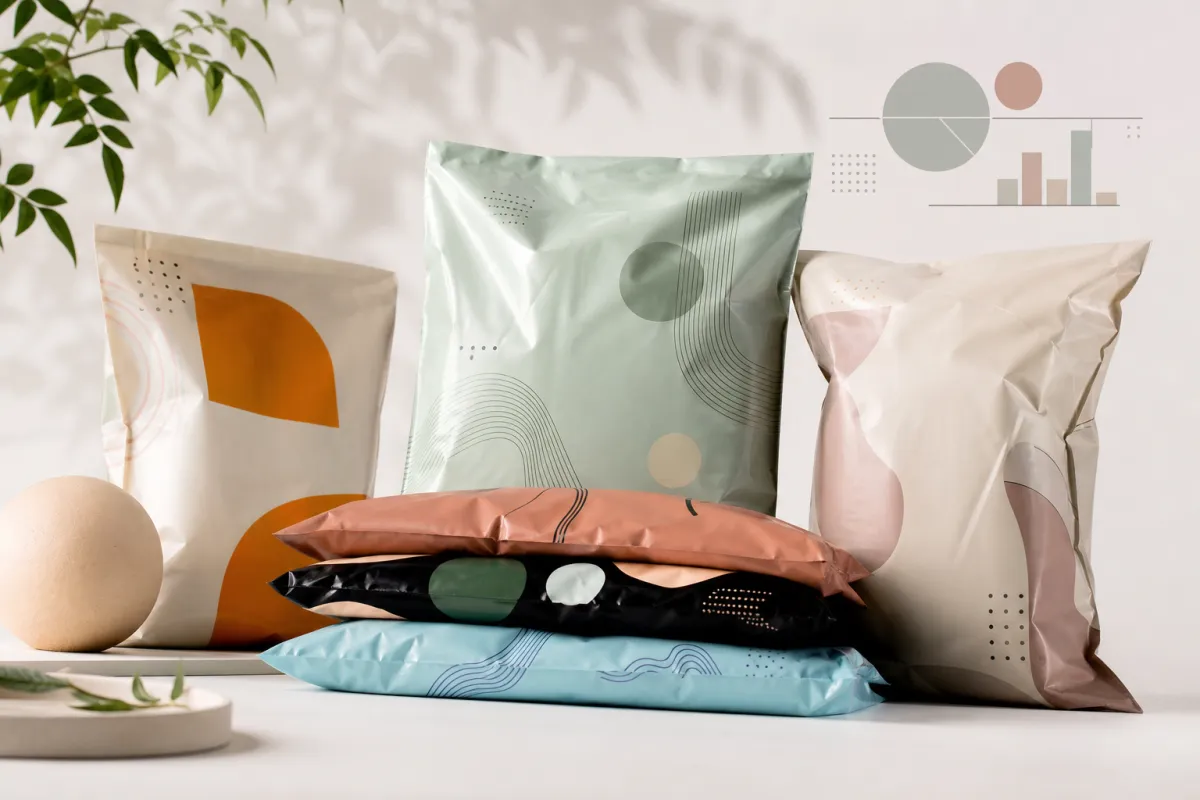
The printed poly mailers wholesale price comes down to ordinary specs that are easy to ignore until they bite: size, film thickness, number of print colors, coverage area, bag color, adhesive quality, and whether the order uses stock dimensions or a custom build. Packaging is not supposed to be exciting. It is supposed to arrive intact and keep fulfillment moving.
Size usually sets the first price bracket. A 10 x 13 mailer and a 14.5 x 19 mailer do not use the same amount of resin, ink, or freight space, so they do not belong in the same cost bucket. Add a wider seal flap or heavier film and the printed poly mailers wholesale price shifts again. That is normal. What is not normal is a supplier acting like every bag should land in the same range.
Film thickness affects both material use and failure risk. A lighter bag can work fine for soft apparel. It can also fail fast if the shipment includes hardware, boxes, folded cartons, or anything with a sharp edge. Thicker film usually raises the printed poly mailers wholesale price a little, but that extra spend can save money by cutting damage, reships, and the kind of customer complaints that make operations people stare at the ceiling. Cheap mailers are only cheap when they survive the trip.
Print complexity pushes cost too. One-color logos are usually the cleanest and least expensive option. Two, three, or four colors mean more setup and tighter registration. Full-bleed artwork, large coverage, and edge-safe layout requirements add another layer of handling. If the brand can live with a simple mark, keep it simple. Every extra ink color should earn its place.
Bag color sneaks into pricing in less obvious ways. White and gray base films are common. Black-out privacy liners improve opacity, but they can raise the printed poly mailers wholesale price if the film structure changes. A dark logo on a light bag may also need a different base film than the cheapest stock option. That is not a tiny detail. That is the spec.
Adhesive quality deserves more respect than it gets. A weak peel-and-seal strip leads to returns, repacks, and customer emails nobody wants to answer. Better adhesive can lift the quote slightly, but usually not enough to matter once volume is real. The better question is not whether to save a cent. It is whether the seal stays closed from warehouse to doorstep.
Freight can distort the printed poly mailers wholesale price more than buyers expect. A low unit quote from far away can turn into a weak landed cost after cartons, palletization, duty, and shipping are added. The supplier may have given you a lovely number. The carrier rarely cares. That is why a quote should be treated as the starting point, not the final answer.
“If the quote looks great but the freight is ugly, you did not save money. You just moved the cost to another line.”
If you want a reality check on packaging requirements and material claims, the resources at packaging.org are a solid place to start. Transit testing matters too. ISTA standards are not decorative. A mailer that looks fine on a desk can behave differently once it gets tossed around in the carrier network, and the carrier network is not gentle.
Printed Poly Mailers: Product Details That Affect Buying
A printed poly mailer is usually a simple build: an outer polyethylene film, an inner privacy layer or dark co-extrusion for opacity, a peel-and-seal adhesive strip, and sometimes a tear strip or tamper-evident finish. Simple does not mean identical. The construction changes the printed poly mailers wholesale price, the print result, and how the mailer behaves after it leaves your dock.
Buyers often ask about the printed poly mailers wholesale price before the spec sheet is even finished. That is backwards. The price only means something after the product spec is locked. If the film gauge, seal type, and print area are still floating around in email threads, the quotes are just dressed-up guesses.
Film thickness is one of the easiest specs to understand. Lightweight mailers are more economical and often fine for low-risk apparel shipments. Midweight options add durability without going overboard. Heavy-duty mailers cost more, but they help when the product has corners, zippers, accessories, or anything else that likes to punch through thin film. The right thickness is not the thickest one. It is the one that fits the product.
Recycled and co-extruded options also show up in buying decisions. Recycled content can support sustainability goals, and some brands need that for retail requirements or internal targets. Co-extruded film often gives better opacity and a more premium feel. Both can affect the printed poly mailers wholesale price, though usually not by a dramatic amount. The real question is whether the material fits the shipment.
Print variables deserve more attention than they usually get. The main cost drivers look like this:
- One-color logo printing is the most economical and easiest to reproduce consistently.
- Multi-color artwork costs more because setup and registration are tighter.
- Front-only print is cheaper than full coverage or back printing.
- Full-bleed designs need more care and can create waste if the art is not set up correctly.
- Edge-safe layouts help avoid cut-off logos and production delays.
Size choice hides a lot of cost. A bag that is too large wastes material, uses more freight volume, and slows packing. A bag that is too small risks damaged goods or a seal that barely closes. The right size leaves room for inserts, tissue, or a return label, but not so much room that you are paying to ship air. Nobody should be shipping air unless they are in aerospace.
If you are building a broader packaging program, it helps to review the whole lineup instead of one SKU at a time. Some buyers move into a coordinated program through Custom Packaging Products so the mailer spec matches inserts, labels, and retail packaging. That is usually where the operational savings show up.
For buyers comparing material claims, independent standards are useful. ISTA test methods help confirm whether the mailer survives drop and distribution stress. You can review the organization at ista.org. I trust a supplier who can point to tested performance more than one who throws around vague adjectives like they were free.
Printed Poly Mailers Wholesale Price by Size, Film, and Print
The printed poly mailers wholesale price changes fast once size bands, thickness levels, and print complexity start moving. That is why a generic “mailer price” is close to useless. A 10 x 13 apparel mailer, a 14.5 x 19 e-commerce mailer, and a large boutique shipping bag each sit in different cost lanes, even if the branding looks almost identical from a distance.
A practical way to think about it: smaller standard mailers with simple one-color branding usually sit at the lower end of the printed poly mailers wholesale price range. Larger sizes, thicker film, and multi-color print push the price up. Custom dimensions, special finishes, and high-opacity film add another layer. The quote changes because the build changes. Shocking, I know.
| Common Mailer Type | Typical Spec | Estimated Wholesale Price Range | Best Fit |
|---|---|---|---|
| Small apparel mailer | 10 x 13, 2.0 mil, 1-color print | $0.12-$0.22 per unit at 5,000+ | Light clothing, accessories, low-damage risk items |
| Mid-size branded mailer | 12 x 15.5, 2.5 mil, 1-2 colors | $0.16-$0.30 per unit at 5,000+ | Standard e-commerce apparel and soft goods |
| Large premium mailer | 14.5 x 19, 3.0 mil, 2-4 colors | $0.22-$0.42 per unit at 5,000+ | Bulky garments, bundles, higher protection needs |
| Custom size mailer | Custom dimensions, custom artwork, special film | Quote-based, usually higher than stock sizes | Brands with exact fit or retail presentation requirements |
Those numbers are ranges, not promises. Freight, order volume, print method, and destination all influence the final printed poly mailers wholesale price. A buyer in one region can pay less for the bag and more for shipping. Another buyer can get a slightly higher unit price and still end up with a better landed cost because the supplier is closer or packs more efficiently. That is why comparisons need the full picture, not just the headline number.
Higher quantities usually unlock better pricing, but the breakpoints matter. A jump from 3,000 to 5,000 pieces may not save enough to justify extra inventory. A jump from 5,000 to 10,000 often makes more sense because setup cost gets spread over more units. If you are looking at Wholesale Programs, ask where the real thresholds sit. Good tier pricing should show the step-downs clearly, not hide them in a murky spreadsheet nobody wants to open.
Print coverage is a major swing factor. A tiny centered logo is faster and simpler. A full-front design with background graphics takes more ink and more control. Back printing adds another pass or another setup. If the goal is premium branding, fine. Price it honestly. Do not compare a minimalist one-color bag to a full-surface artwork bag and pretend the numbers mean the same thing.
Color choice can also nudge the printed poly mailers wholesale price in less obvious ways. Black, white, and gray are common. Specialty base colors may require different film batches, which can lift the price. If the bag needs to hide product outlines or create a privacy effect, the film spec may need to change. That is not a minor upgrade. That is a different product category wearing the same name tag.
One more practical point: many buyers undercount packaging labor. A mailer that is easy to load, easy to seal, and easy to stack can reduce packing time by seconds per order. That sounds small until a warehouse processes thousands of parcels a day. The cheapest printed poly mailers wholesale price is not useful if the bag slows fulfillment or creates rework on the line.
Pricing and MOQ: How to Compare Quotes Without Getting Burned
MOQ means minimum order quantity, but the label hides the real reason it exists. MOQ is tied to print setup, material run length, waste allowance, and how efficiently the factory can produce the job. The press does not spin up for free. The line does not care about your budget spreadsheet. MOQ is not a punishment; it is a production reality.
When a buyer chases the lowest printed poly mailers wholesale price at a tiny quantity, the quote can look great until the hidden pieces show up. Plate charges, freight, sample costs, color-change fees, and rush production can make a supposedly cheap order look average or worse. That is why a clean quote format matters more than a polished sales pitch.
Use a simple comparison method. Match the exact same size, the same film gauge, the same number of colors, and the same shipping destination. Then calculate the landed cost per usable mailer. If one quote leaves out freight and another includes it, the comparison is worthless. If one quote is for 2.0 mil and another is for 2.5 mil, the comparison is also worthless. Apples to apples. No tricks.
Very low MOQs can be useful for testing a design, but they usually come with a higher per-unit cost. That is not a scam. It is the price of shorter runs and more manual handling. If the artwork is still changing, a short run may be the right move. If the size and layout are already settled, ask for pricing at the next volume tier and see whether the savings justify a slightly larger buy. The printed poly mailers wholesale price often drops harder than buyers expect once a threshold is crossed.
To keep quote review sane, I like a simple checklist:
- Confirm the exact bag size.
- Confirm the film thickness in mil.
- Confirm how many print colors are included.
- Confirm whether the quote includes freight, duty, and packaging.
- Confirm the MOQ and the next pricing tier.
- Confirm the production method and estimated lead time.
If the supplier cannot answer those six points clearly, the printed poly mailers wholesale price is not clear either. Vague pricing usually means vague execution later. That is the kind of surprise nobody wants during peak season.
For buyers who want a broader purchasing plan, a direct Custom Poly Mailers program can help line up size, branding, and reorder logic without starting from scratch every time. That saves time, and time still costs money even when nobody wants to put it on a spreadsheet.
Some buyers also ask whether recycled options are worth the premium. Sometimes yes. Sometimes no. If sustainability is part of the brand promise, the higher printed poly mailers wholesale price can be easy to defend. If not, I would rather see recycled content chosen because it fits the product strategy, not because somebody saw a buzzword and got excited.
Process and Timeline: From Artwork to Shipment
The path from quote to shipment is usually straightforward, as long as the buyer gives clean information. First comes the spec sheet. Then artwork review. Then a digital proof. Then approval. Then production. Then quality check. Then packing and freight. That is the real workflow behind the printed poly mailers wholesale price, even if the sales email only shows a single number and a cheerful sign-off nobody asked for.
The biggest delay is usually not machine time. It is paperwork and approvals. Unclear artwork files, missing logo versions, slow brand sign-off, and last-minute size changes can all stretch the timeline. If the design file is low resolution or the colors are not defined, the supplier has to ask more questions and guess less. That is how a “simple” order turns into a slow one.
For repeat orders, lead times are often shorter because the basic setup is already approved. For first-time custom work, buyers should expect extra time for proofing and production setup. A realistic range is often 12-18 business days after proof approval for a standard custom run, though larger or more complex jobs can take longer. If someone quotes much faster than that without explaining how, I would keep asking until the answer stops sounding magical.
Physical samples matter when the order depends on color match, seal feel, or film thickness. Digital proofs are useful, but they do not tell you how the adhesive feels or how the bag behaves once packed. For tighter brand requirements, a sample can save a lot of guesswork. A low printed poly mailers wholesale price means very little if the final bag feels flimsy or closes badly.
Rush orders are expensive for a plain reason: they compress labor, reduce flexibility, and leave less room for quality control. That can mean higher setup charges, limited shipping choices, and tighter proof deadlines. If your launch date is fixed, build in buffer time early. Packaging should support the launch, not hold it hostage like a grumpy intern with a calendar invite.
Quality control deserves real scrutiny. Ask how the factory checks film gauge, seal strength, print alignment, and carton packing before shipment. Some suppliers do a quick visual pass and call it QC. Others measure, sample, and document. I know which one I trust more. A better process does more than reduce defects; it keeps the printed poly mailers wholesale price meaningful because the bags you pay for actually arrive usable.
Transit testing belongs in the conversation too. ISTA-style distribution testing helps expose weak seals, scuff-prone print, and corner damage before a full rollout. That is a much cheaper lesson to learn on a sample batch than after a 10,000-piece order lands on your dock and starts causing problems before lunch.
Why Choose Us for Wholesale Printed Poly Mailers
Buyers usually do not need more hype. They need control. Better pricing comes from tighter control over materials, print consistency, and packaging format, not from vague promises or shiny language. That is the real value behind a reliable printed Poly Mailers Wholesale Price: fewer surprises, fewer corrections, and fewer reorders that should never have been needed in the first place.
We focus on the details that actually affect the job. That means confirming size, film thickness, print count, and artwork setup before production starts. It also means keeping reorders consistent so the second run looks like the first one. Plenty of packaging suppliers can talk fast. Fewer can hold a spec steady over time. That matters more than most people admit out loud.
Factory-direct production usually helps because it removes handoffs and hidden markups. When a buyer works through too many intermediaries, the printed poly mailers wholesale price gets padded at every step and accountability gets thinner. Direct manufacturing keeps the chain shorter, which makes it easier to confirm what is being made, what it costs, and where it is in the schedule.
Artwork support matters too. Many buyers have a logo file, but not a print-ready layout. They need help with bleed, safe zones, color count, and placement. That support should not turn into a surprise fee machine. A good spec check reduces waste and protects the printed poly mailers wholesale price from avoidable revisions.
We also pay attention to quality control basics: film gauge checks, adhesive performance, and print alignment. Those are not glamorous tasks, yet they are exactly what keeps a mailer from failing in the field. A bag that seals cleanly and prints correctly is worth more than one that merely looks cheap on the quote sheet.
If you want to see the broader packaging mix around your mailers, our Custom Packaging Products page is a sensible place to compare options. If you already know you need recurring supply, the Wholesale Programs route gives a cleaner path for pricing, reorders, and volume planning.
Honestly, the goal is simple: quote clearly, produce consistently, and ship on schedule. That is not flashy. It just works. In packaging, “works” is a very good word.
Next Steps: Get an Accurate Quote for Printed Poly Mailers Wholesale Price
If you want a clean printed poly mailers wholesale price, send complete specs from the start. That means bag size, quantity, print colors, film thickness, artwork file, shipping destination, and target delivery date. Leave out any of those pieces and the quote slows down or tilts the numbers in the wrong direction. Complete information gets you a better answer. Simple.
Ask for two quotes side by side if you can: one at your target quantity and one at the next pricing tier. That shows whether it makes sense to buy a little more now and lower the unit cost, or stay tight and keep inventory light. The printed poly mailers wholesale price usually reveals its best breakpoints only when volume is compared honestly.
If color, finish, or seal strength matters, request a sample or proof before the run is approved. A lower price means nothing if the final mailer does not fit the job. Do not fall in love with a quote and ignore the product. That is how buyers end up paying twice, which is a terrible hobby.
Before you sign off, confirm the landed cost. Not just the bag price. Not just the freight estimate. The whole number. That includes packaging, shipment, and any extra handling tied to the order. Once the complete picture is in front of you, the printed poly mailers wholesale price is much easier to judge.
Send the specs, compare the tiers, and choose the build that fits your product instead of the one that merely looks cheaper. If you want the fastest path to a real printed poly mailers wholesale price, give the supplier complete information and insist on apples-to-apples quotes. That saves money, time, and a lot of back-and-forth that nobody enjoys.
FAQ
What affects printed poly mailers wholesale price the most?
Size, film thickness, and print complexity usually have the biggest impact on printed poly mailers wholesale price. Freight and setup charges can matter just as much as the bag itself, especially on smaller orders. Higher quantities usually lower unit cost, but only after the right pricing tier is reached.
What is the usual MOQ for printed poly mailers wholesale orders?
MOQ depends on the print method, size, and whether the design is stock or fully custom. Short-run orders are possible, but they normally carry a higher per-unit price. If you need the lowest cost, ask for the next volume tier and compare it against your target quantity.
Are recycled printed poly mailers more expensive?
Often yes, but not always by much, depending on material availability and print requirements. The price gap is usually easier to justify when sustainability is part of the brand promise. Ask for a side-by-side quote so you can compare cost against customer-facing value.
How long does production take for printed poly mailers?
Simple repeat orders are usually faster than first-time custom jobs. Artwork approval is often the biggest variable, not the actual press time. Build in extra time if you need samples, special colors, or a tight launch date.
How do I get the best printed poly mailers wholesale price without sacrificing quality?
Lock down the exact size, thickness, and print count before requesting quotes. Compare landed cost, not just unit price. Ask for pricing at multiple volume tiers, then choose the point where the savings justify the inventory.
Best move: lock the exact bag spec, ask for landed-cost quotes at two volumes, and only compare suppliers that include freight, film thickness, print count, and approval lead time in writing. That is how you get a printed poly mailers wholesale price you can actually use.