Buyer Fit Snapshot
| Best fit | Printed Shelf Ready Packaging projects where brand print, material claims, artwork control, MOQ, and repeat-order consistency need to be specified before quoting. |
|---|---|
| Quote inputs | Share finished size, material target, print colors, finish, packing count, annual reorder estimate, ship-to region, and any compliance wording. |
| Proofing check | Approve dieline scale, logo placement, barcode or warning zones, color tolerance, closure strength, and carton packing before bulk production. |
| Main risk | Vague material claims, crowded artwork, missing packing details, or unclear freight terms can make a low unit price expensive after revisions. |
Fast answer: Printed Shelf Ready Packaging: Design, Cost, and Setup should be specified like a repeatable production item. The safest quote records material, print method, finish, artwork proof, packing count, and reorder notes in one written spec.
Production checks before approval
Compare the actual filled-product size with the drawing, then confirm tolerance on folds, seals, hang holes, label areas, and retail display edges. Reserve space for logos, QR codes, warning copy, and material claims before decorative graphics fill the panel.
Quote comparison points
Review material grade, print process, finish, sampling route, tooling charges, carton quantity, and freight assumptions side by side. A quote is only useful when the supplier can repeat the same color, closure quality, and packing count on the next order.
Printed shelf ready packaging has a simple job and a sneaky number of ways to fail. It needs to protect product in transit, open cleanly at store level, and put a strong branded face on the shelf without extra repacking. Easy to say. Not always easy to build. I have watched a retail team wrestle with a bad tear line for five minutes while the aisle backed up behind them. That is the kind of thing that turns a clever format into an annoyance. Good printed shelf ready packaging does the opposite. It moves from carton to shelf with minimal handling and still looks intentional, not like a box that got drafted into retail duty at the last minute.
That is why buyers care. It is not just packaging with a logo on it. It is a working retail tool that has to survive shipping, support merchandising, and still look like it belongs on the shelf. Get the structure wrong, and the graphics will not save it. Get the graphics wrong, and the pack can still lose the sale. Packaging is rude like that. It does not care what the render looked like.
What Printed Shelf Ready Packaging Is and Why It Wins Shelf Space
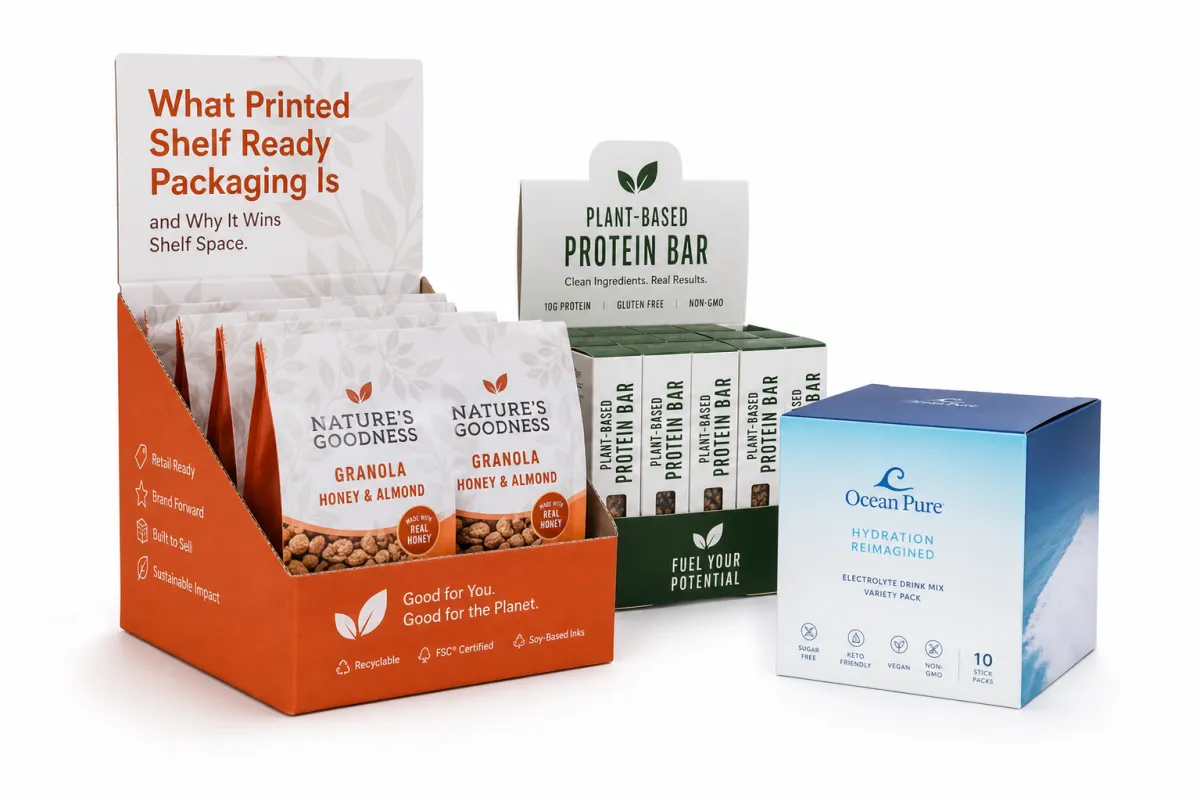
Printed shelf ready packaging is built to do three things at once: protect the product during transport, open cleanly for display, and show a finished printed face once it reaches the shelf. In plain language, it ships closed and becomes part of the retail presentation after opening. That is why you see it so often in grocery, health and beauty, snacks, household goods, and other fast-moving categories where shelf speed matters more than drama.
Retailers like it because it cuts labor. Staff do not need to unpack every unit, sort them, and rebuild the display from scratch. A good tray or case can go straight onto the shelf after the front panel is opened, which means fewer loose cartons, fewer mistakes, and less mess in the aisle. From a buyer's point of view, printed shelf ready packaging also lowers the chance of stock sitting in the back room because the pack is already designed for presentation.
The real value sits in the mix of structure and branding. A plain tray can handle the mechanical part, but it does nothing for shelf presence. A strong packaging design uses the front panel, side panels, and opening method as part of the brand story. That is why printed shelf ready packaging usually sits between standard transit packaging and premium retail packaging. It has to work hard, and it has to look deliberate while doing it.
In practice, the format wins shelf space because it makes replenishment faster and presentation more consistent. A retailer can face up a section in less time, which matters when labor is expensive and shelf resets are tight. It also keeps clutter down because the pack holds product in a neat block instead of letting individual units drift across the shelf. If you have ever seen a category with random loose cartons, bent price strips, and half-open cases, you already know why printed shelf ready packaging is the better option.
There is a catch. Not every pack that looks sharp in a render behaves well in store. The opening method, board strength, and visible print area all affect whether the pack helps sales or just looks clever on screen. Printed shelf ready packaging only pays off when structure, graphics, and retail behavior all line up. If one part fails, the whole thing starts costing money instead of saving it.
"A shelf ready pack that opens badly is just expensive corrugated with opinions."
That blunt truth is why experienced buyers ask about the opening method early. They want to know if the front panel tears cleanly, whether the pack fits the shelf depth, and if the printed face still reads after the retail team opens it. Smart brands treat printed shelf ready packaging as product packaging plus merchandising plus logistics. That mindset usually saves more money than chasing the lowest quote and hoping for luck.
How Printed Shelf Ready Packaging Works From Die Line to Store Floor
Printed shelf ready packaging starts with the die line. That flat template defines score lines, glue flaps, tear-away panels, perforations, cutouts, and locking points that make the pack behave correctly. The materials are usually corrugated board for heavier loads or carton board for lighter retail units. In some cases, you will see a litho-laminated structure when the brand wants sharper graphics and a more polished face, especially for higher-value branded packaging.
The construction has to match the product and the route to shelf. A factory fills the pack, closes it, and ships it flat or pre-glued depending on the design. Once it reaches the store, staff remove the top or front section, sometimes along a perforated tear line, and place the pack directly on the shelf or display fixture. That is the point of printed shelf ready packaging: it handles transport first, then becomes an organized shelf tray with minimal effort.
Print method matters more than many first-time buyers expect. Flexographic printing works well for efficient runs and simpler graphics. Litho-lamination is better when the surface needs finer detail, richer coverage, or a more premium finish. Digital print can make sense for shorter runs or faster sampling, though the economics shift fast as quantity rises. The right choice depends on the artwork, order size, and how much surface area needs ink coverage. That is packaging reality, not brochure fantasy.
There are a few failure points that show up again and again. Weak tear lines can rip too far or not far enough. Panels can be unbalanced, so the tray leans forward after opening. Graphics can disappear when the front panel is removed, leaving the shelf facing a blank structural wall. And yes, dimensions get botched more often than people like to admit. If the footprint is off by even a small amount, the pack may jam against the shelf lip or leave awkward gaps that make the presentation look sloppy.
For transit testing, check distribution standards and real handling conditions. The ISTA testing framework is useful if the pack needs to survive drops, vibration, compression, or mixed shipping routes before it ever reaches retail. If material sourcing matters to your brand, the Forest Stewardship Council is the right place to verify responsible fiber options. That said, FSC certification does not magically make a weak structure strong. It just helps with sourcing credibility. Performance still has to be proven.
Think of the die line as the skeleton, the print as the face, and the opening method as the behavior. When those three pieces line up, printed shelf ready packaging becomes a practical retail package instead of a glorified carton. When they do not line up, the pack may still ship, but it will fail the moment a store employee has to open it under pressure and keep moving.
Printed Shelf Ready Packaging Cost: What Actually Drives Price
Cost is where people get surprised, and printed shelf ready packaging has more pricing variables than a basic shipping carton. The main drivers are board grade, print method, size, finish, tooling complexity, and whether the pack needs perforations, special cutouts, or glued reinforcements. If the structure is simple and the artwork is restrained, the price can stay reasonable. If the pack has premium graphics, complex opening features, and retailer-specific requirements, the number moves up fast.
Here is the thing: unit price is only one part of the equation. A slightly better structure may save labor at packout, reduce damage, and cut retailer complaints. That matters. A pack that costs a few cents more but reduces manual handling can be cheaper in practice than the bargain option that causes rework and shelf mess. For printed shelf ready packaging, the buyer should look at total cost of ownership, not just the quote line that shouts the loudest.
Volume changes everything. Small runs carry more setup pain because tooling, plates, samples, and press setup are spread across fewer units. Larger orders usually lower the per-unit cost because those fixed charges get diluted. If you order 2,000 units, you will feel every setup step. If you order 25,000 units, the economics usually behave better. That is why brands should ask for tiered pricing before making a final call.
There are also hidden costs people forget to ask about. Artwork revisions can trigger extra proofing time. Sampling may carry a charge. Plates, dies, and shipping can appear as separate lines. Retailer-specific requirements can force a different board caliper or print setup. None of this is unusual. It is just the part of printed shelf ready packaging pricing that gets glossed over when someone only compares headline numbers.
| Option | Best For | Typical Unit Range | What Drives the Price |
|---|---|---|---|
| Basic corrugated tray with flexo print | High-volume, value-led retail packaging | $0.18-$0.35 | Simple structure, limited ink coverage, efficient setup |
| Printed shelf ready packaging with perforated front panel | Most grocery and household shelf trays | $0.25-$0.55 | Perforation detail, stronger board, more precise die cutting |
| Litho-laminated shelf ready pack | Sharper graphics and stronger brand presentation | $0.40-$0.85 | Premium print finish, lamination, tighter visual requirements |
| Premium shelf ready display pack with special coating | High-visibility branded packaging | $0.65-$1.25 | Spot effects, soft-touch or gloss coating, complex structure |
Those numbers are broad ranges, not a promise. Actual pricing depends on quantity, region, board selection, and the amount of print coverage. A small brand might see tooling and sample costs become a big share of the budget. A large retailer program might spread those costs out enough that the per-unit number looks much healthier. That is why a quote should separate tooling, print, finishing, freight, and sampling. If it does not, you are comparing fog with fog.
One practical tip: ask for a cost split between the pack body and the print enhancement. Sometimes a cleaner structural design with less decoration is the smarter move. Other times, a stronger printed face helps the product sell faster, which justifies the extra spend. The right answer depends on margin, category, and how much competition sits on the shelf. There is no magic formula. There is only math, and math is rude that way.
If you are balancing price against presentation, start with a clear brief and then compare options through Custom Packaging Products or any supplier who can show you more than one structural route. You want to see what happens if the board weight changes, the coating changes, or the print method changes. That is the fastest way to avoid paying for features you do not need in printed shelf ready packaging.
Printed Shelf Ready Packaging Process and Timeline: What to Expect
The production path for printed shelf ready packaging is straightforward if the brief is clear and the dimensions are real. It usually begins with product measurements, pack quantity, shelf requirements, and a discussion of how the retailer wants the pack to open. Then comes the dieline, followed by artwork layout, proofing, sampling, production, finishing, and shipment. Skip one step, and the schedule starts wobbling. Packaging does not forgive vague input very well.
Good information speeds everything up. Suppliers need product dimensions, unit count per tray, stacking requirements, shelf depth, retail display rules, and finish preference. If the product is fragile, say so. If the shelf height is tight, say that too. If the retailer wants a front panel that tears to a certain line, include the spec. The more precise the brief, the fewer revision cycles. That is not theory. It is the difference between a controlled timeline and a pile of avoidable emails.
For a simple printed shelf ready packaging build, the process can move fairly quickly once artwork is approved. A standard structure may be ready for production in roughly 12-15 business days after signoff, though that depends on factory load, finishing, and shipping method. More custom work, especially with sample approval or retailer-specific folds, can push the timeline into the 3-5 week range. Add redesigns or late artwork changes, and you will feel every extra day.
Here is the usual sequence that keeps a project from drifting:
- Lock product dimensions and pack count.
- Confirm shelf constraints and opening method.
- Approve the dieline before designing graphics.
- Review a physical or hard-copy sample, not just a screen render.
- Sign off on the final proof.
- Release production only after the artwork and structure are both approved.
That sample step deserves more attention than it gets. A digital mockup can hide problems with tear strength, flap alignment, or panel balance. A physical sample shows you whether the shelf ready pack opens cleanly and whether the printed face still reads after opening. If the pack is going into a large retail program, sample-first is the safer path. Cheap mistakes become expensive once thousands of units are printed.
Retail packaging projects also benefit from checking transit performance early. If the pack will travel long distances or be stacked high, test it in a way that reflects actual handling. ASTM methods and ISTA guidance can help set a more realistic standard than "it looked fine in the office." The office is not a truck. The office is where bad ideas feel confident.
One more timing issue gets overlooked: retailer specs. Some chains care deeply about opening presentation, shelf footprint, pallet configuration, or display consistency. If those requirements arrive late, the whole project can slip. It is smarter to confirm the retailer format before design starts than to discover halfway through that the structure needs to be redone. Printed shelf ready packaging is easiest when compliance is handled at the beginning, not bolted on after the artwork is done.
Key Design Factors That Make Printed Shelf Ready Packaging Sell
Good printed shelf ready packaging is not just a structural problem. It is a visibility problem. On shelf, the shopper is usually reading from a few feet away while moving. That means the front panel has to communicate fast. The strongest designs use bold hierarchy, clear color contrast, and a short message that can be absorbed in seconds. Fancy typography does not help if the shopper cannot tell what the product is.
The front-facing area should carry the brand and the product name first. Secondary claims can sit below that, but they should not fight for attention. In many categories, the best package branding is the simplest one: logo, product type, variant, and one reason to care. If a shopper needs three seconds of mental decoding, you have already lost the easy sale. Shelf ready packaging is not a poster. It is a fast read.
Structural fit matters just as much as visual clarity. A shelf tray that bows, gaps, or tilts creates a cheap look even when the artwork is excellent. The pack should sit square, hold the product securely, and keep the opening edge clean. That is why custom printed boxes and tray structures need to be designed around the actual fill pattern, not around whatever size looks convenient in a spreadsheet. Product packaging lives or dies on fit.
Finishing choices should support the brand without draining margin. Matte coatings can feel more premium and reduce glare under retail lighting. Gloss can intensify color and help bright graphics pop. Spot UV or selective effects can work, but only if they add real value. Too many brands toss expensive finishes on printed shelf ready packaging because it looks nice in a mockup. In store, the shopper rarely notices the effect at the price level you paid for it. That is a hard lesson, but a useful one.
There is also a practical readability issue. Small copy gets lost once the front panel is opened and the pack sits at shelf height. If the brand relies on a long story, move most of that text elsewhere. The shelf face should carry the essentials. A clear message beats a crowded one every time. That is especially true in retail packaging where the eye is competing with a dozen other SKUs.
These are the details I would check before approving printed shelf ready packaging:
- Can the product name be read from 1.5 to 2 meters away?
- Does the opening edge stay straight after tear-away removal?
- Does the pack stay upright when half full?
- Does the color still look right under warm retail lighting?
- Does the front panel still feel like branded packaging, not leftover transit board?
If you want a sensible benchmark, compare the pack against how the brand already appears in other channels. Printed shelf ready packaging should feel like part of the same identity as e-commerce boxes, mailers, and other branded packaging pieces. The shopper does not separate those experiences as neatly as marketers do. They just remember whether the brand felt clear, credible, and easy to buy.
"If the pack only looks good in the render, it is not ready for the shelf."
That is why the best packaging design teams think in retail conditions, not just in screen layouts. Lighting, distance, shelf height, and handling all matter. A pack that survives those conditions while still looking clean has a real advantage. A pack that needs ideal circumstances is just expensive decoration.
Common Mistakes That Make Shelf Ready Packs Fail
The biggest mistake with printed shelf ready packaging is designing for the render instead of the shelf. A digital image can hide weak tear lines, awkward proportions, and unreadable graphics. In store, those flaws show up immediately. The pack may still open, but if the front face collapses or the product looks cramped, the customer notices. The retail buyer notices too, and neither of them cares that the artwork looked sharp on your laptop.
Another common problem is bad dimensional planning. The footprint may be too deep for the shelf, too shallow for the product count, or too wide for the bay. Then the pack either wastes space or jams against the fixture. On a single run that might look like a nuisance. On a chain rollout, it becomes a real cost problem. Shelf ready packaging has to fit the store, not just the product.
Print mistakes are just as damaging. Low contrast copy, busy artwork, and tiny legal text all get worse once the pack is opened and the shelf area is smaller than expected. A front panel that tries to say too much usually ends up saying nothing well. That is where retail packaging often slips into brand vanity. The pack wants to be everything. The shelf wants it to be readable.
Skipping testing is the most expensive error because it multiplies every other mistake. One weak die line can become thousands of unusable units. One bad opening tear can trigger retail rejection. One flimsy board choice can lead to damage in transit. The total cost is almost always higher than the cost of a sample run or a small pilot. Printed shelf ready packaging is not the place to save a few dollars and gamble with a full production run.
Here are the failure modes I see most often in printed shelf ready packaging:
- Front panels tear beyond the intended line.
- The tray bows under product weight.
- The graphics disappear after opening because the structure was not planned around the print.
- The shelf depth and pack depth do not match.
- The finish looks premium in print but reflects badly under retail lighting.
There is also a subtle but important issue: overcomplication. Brands sometimes add extra cutouts, windows, or decorative folds because they think more features equal more value. Usually, they just add cost and create more chances for failure. Simple, well-built printed shelf ready packaging often performs better than a complicated structure that looks clever and works poorly. Fancy is not the same thing as effective.
If you want a safer path, start with a structure that is as light as possible while still protecting the product and surviving retailer handling. That usually means fewer moving parts, cleaner tear lines, and a print layout that respects the opening sequence. The less the pack has to fight itself, the better it behaves on shelf. That is true for custom printed boxes, shelf trays, and almost every other retail package that needs to do two jobs at once.
Expert Tips and Next Steps for Printed Shelf Ready Packaging
If I were briefing a printed shelf ready packaging project from scratch, I would start with measurements, not visuals. Measure the product, the pack count, and the shelf space. Then define the opening method and the retail handling rules. After that, request the dieline and confirm the print method before anyone starts polishing artwork. That sequence saves time and prevents the classic "beautiful design, wrong box" problem.
For risky projects, sample first. That sounds obvious, but a lot of teams still skip it when the calendar gets tight. A sample lets you test opening behavior, shelf fit, graphics readability, and board strength before you commit to volume. If the pack is going into multiple stores or a national program, a sample is cheaper than fixing thousands of pieces later. In packaging, prevention is boring. It is also profitable.
Choose the lightest structure that still does the job. That usually means enough board strength for transit, enough rigidity for shelf presentation, and no extra decoration that does not earn its keep. A stronger spec is not automatically better. The right spec is the one that protects the product, survives handling, and supports the brand without padding the cost. That is the practical side of packaging design that buyers need more often than they admit.
One useful shortcut is to compare two or three quote options side by side. Ask for a basic version, a mid-tier version, and a premium version. Then compare board grade, print method, tooling charges, and timeline. This makes the tradeoffs visible. It also exposes whether a supplier is pushing a finish because it is useful or because it is profitable. Those are not always the same thing.
Before you scale, test the final structure in a real retail environment. Put it on the actual shelf height. Check it under the store lighting. See how staff handle it during opening and replenishment. That kind of check is worth more than ten internal opinions. If it works there, printed shelf ready packaging is doing its job. If it only works in a presentation room, it is not ready yet.
A good next step list looks like this:
- Write a short brief with product size, quantity, and shelf constraints.
- Ask for a dieline and board recommendation.
- Request a sample before release.
- Compare unit cost against labor savings and shelf presentation.
- Use a supplier who can talk honestly about structure, print, and timing.
For brands that need a broader packaging range, it helps to review a supplier's Custom Packaging Products before locking the spec. That gives you a better sense of what is realistic, what is overbuilt, and what can be adapted for printed shelf ready packaging without throwing budget into the gutter.
My last piece of advice is simple: do not treat printed shelf ready packaging like a decoration project. Treat it like a retail tool. The best packs are clear, compact, and easy to open. They save time, reduce damage, and make the shelf look organized. So keep the brief tight, insist on a physical sample, and make the structure earn its keep. If the pack does those three things, the rest gets a lot easier.
FAQ
What is printed shelf ready packaging in simple terms?
It is packaging designed to ship product safely and then open into a ready-to-sell retail display or shelf tray. The printed graphics stay visible after opening, so the pack works as both protection and branding. It also reduces extra handling for store staff because the product can move from carton to shelf with minimal repacking.
How much does printed shelf ready packaging cost per unit?
The unit price depends on board type, print method, size, finishing, and total order volume. Small runs usually cost more per piece because setup and tooling are spread across fewer units. Ask for a quote that separates tooling, samples, print, and freight so you can compare suppliers fairly. If a supplier only gives one lump sum, that is a red flag. Not a huge one. Just enough to make you ask better questions.
What do I need before requesting a quote for printed shelf ready packaging?
Have product dimensions, pack quantity, retail shelf size, and any required retailer specs ready. Share your expected order volume, target finish, and whether the pack must ship flat or pre-glued. If you already have artwork, send it. If not, provide logo files and brand guidelines so the supplier can plan the dieline properly. The better the brief, the fewer revisions you will sit through.
How long does printed shelf ready packaging take to produce?
Simple structures with approved artwork can move quickly, while custom designs with samples take longer. The biggest timing risks are dieline revisions, artwork changes, and sample approval delays. Plan extra time if the packaging must meet a retailer-specific format or requires special finishing. A project that feels "almost ready" in email can still be weeks away from a usable pack.
Is printed shelf ready packaging worth it for smaller orders?
Yes, if the packaging helps you reduce labor, improve shelf presentation, or protect a high-value product. For small runs, keep the structure simple and avoid expensive finishes unless they clearly support sales. The value is not just in the box price. It is in the time saved and the retail presentation you get. If the pack does not improve either of those, it is probably overdesigned.


