Buyer Fit Snapshot
| Best fit | Printed Shipping Envelopes for Brands projects where brand print, material claims, artwork control, MOQ, and repeat-order consistency need to be specified before quoting. |
|---|---|
| Quote inputs | Share finished size, material target, print colors, finish, packing count, annual reorder estimate, ship-to region, and any compliance wording. |
| Proofing check | Approve dieline scale, logo placement, barcode or warning zones, color tolerance, closure strength, and carton packing before bulk production. |
| Main risk | Vague material claims, crowded artwork, missing packing details, or unclear freight terms can make a low unit price expensive after revisions. |
Fast answer: Printed Shipping Envelopes for Brands: Material, Print, Proofing, and Reorder Risk should be specified like a repeatable production item. The safest quote records material, print method, finish, artwork proof, packing count, and reorder notes in one written spec.
Production checks before approval
Compare the actual filled-product size with the drawing, then confirm tolerance on folds, seals, hang holes, label areas, and retail display edges. Reserve space for logos, QR codes, warning copy, and material claims before decorative graphics fill the panel.
Quote comparison points
Review material grade, print process, finish, sampling route, tooling charges, carton quantity, and freight assumptions side by side. A quote is only useful when the supplier can repeat the same color, closure quality, and packing count on the next order.
Printed shipping envelopes for brands do a lot of work before a customer ever sees the product inside. They carry the order, sure, but they also shape the first physical impression, which is often the moment a customer starts deciding whether a brand feels thoughtful, priced with care, and worth remembering. A mailer with clean print, solid construction, and a clear visual language can make a modest shipment feel deliberate. A flimsy or generic one can make the same order feel like an afterthought. That is why printed shipping envelopes for brands deserve the same attention people usually reserve for box design, inserts, and retail packaging.
There is a practical side to the decision as well. The right printed shipping envelopes for brands need to move through fulfillment without slowing down the pack line, protect the product through carrier handling, and hold up under real-world conditions. A mailer that looks good in a render but tears on a conveyor belt is not doing its job. Material choice, seal performance, opacity, size, and transit durability all matter because packaging only earns its keep when it works in the shipping lane, not just in a presentation deck.
A mailer has to protect the product, keep packing fast, and carry the brand without creating friction.
That balance is where the smartest packaging decisions usually begin. Printed shipping envelopes for brands sit at the crossroads of visual identity, warehouse operations, and shipping economics. The brands that get the most from them usually define the pack-out, the product, and the delivery experience together instead of treating packaging as a final decoration added at the end.
What Printed Shipping Envelopes for Brands Actually Are
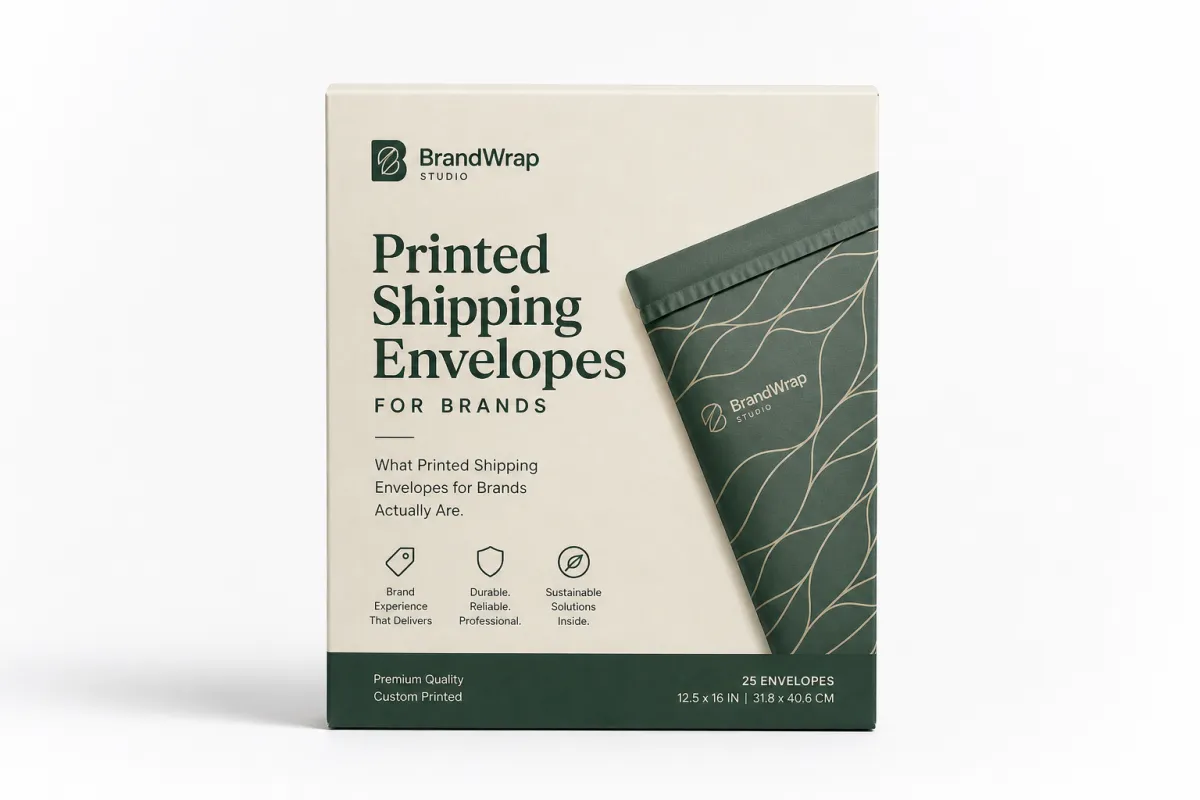
Printed shipping envelopes for brands are branded mailers made from poly film, kraft paper, coated paper, or hybrid constructions that protect goods in transit while displaying logos, colors, artwork, or messaging. They show up anywhere a brand wants the outside of the shipment to do more than disappear into a plain utility container. Apparel, beauty products, accessories, wellness goods, and promotional kits all use printed shipping envelopes for brands because the exterior package becomes part of the customer experience, not just a vessel for transport.
A plain mailer is functional. It closes, contains, and moves through carrier networks. A branded one does those same things while adding recognition. That difference matters because recognition compounds over time. A customer sees the same color system, pattern, or logo on a doorstep, in a studio, or in a photo shared online, and the brand starts to feel familiar in a way a plain envelope never can. With printed shipping envelopes for brands, that familiarity begins before the customer even reaches the product.
From a packaging buyer's point of view, the real question is rarely “Do I want a pretty envelope?” It is “What job should this envelope do?” Some printed shipping envelopes for brands are built for presentation first. Others are designed around privacy and moisture resistance. Some need stronger tear performance because they move through high-volume parcel networks. Others need to stay light because the product itself is small, and postage is sensitive to dimensional weight. The right answer depends on the item, the lane, and the way the pack-out is assembled.
That is where many teams misjudge the effect. A mailer that matches the brand palette and feels sturdy in the hand makes the shipment feel complete. A mailer that scuffs, tears, or feels thin does the opposite in a hurry. Printed shipping envelopes for brands often become a quiet signal of quality. They can strengthen the price point, or they can chip away at it.
Where they fit in the pack-out
Printed shipping envelopes for brands usually sit right at the front edge of the fulfillment workflow. Packing teams load them at the station, place apparel, sample kits, promotional items, or flat goods inside, and seal them before handing the parcel to the carrier. In some operations, they replace boxes entirely for lighter SKUs. In others, they act as an internal layer, such as a branded envelope nested inside a shipper box for a more layered unboxing sequence. That flexibility is one reason brands keep returning to printed shipping envelopes for brands.
If you are building a broader packaging system, it helps to think of the envelope as part of a larger family of Custom Packaging Products rather than a one-off purchase. A mailer often has to work alongside inserts, labels, and secondary packaging. For some brands, pairing Custom Poly Mailers with branded cartons creates a cleaner split between transit efficiency and presentation. Others use Custom Shipping Boxes for heavier items and reserve printed shipping envelopes for brands for softer, lighter goods that do not need crush protection from a box.
That is the operational logic. The brand logic is simpler: the outside of the shipment is marketing space that already has to move through the supply chain. If the packaging is going out anyway, it might as well say something useful. Done with care, printed shipping envelopes for brands make that message feel earned rather than forced.
How Printed Shipping Envelopes for Brands Work in Fulfillment
The production path for printed shipping envelopes for brands usually begins with artwork setup, moves through proofing, then print preparation, converting, and packing. That sounds tidy on paper, yet each step can shift color consistency, minimum order quantity, and lead time. A flexographic run behaves differently from a digital run. A paper mailer behaves differently from a poly mailer. The production method determines what is possible before the first envelope is even made.
Artwork setup is more technical than many teams expect. The supplier needs the correct dimensions, bleed, safe zones, color references, and print placement details. A file that looks perfect on a monitor can fail once it wraps around a gusset or folds along a seam. Strong printed shipping envelopes for brands are designed with the structure in mind, not just the flat layout.
Common print methods
Printed shipping envelopes for brands are commonly produced with flexographic, digital, or gravure-style printing, depending on volume and material. Flexographic printing usually fits medium to large runs with solid color blocks and repeatable branding. Digital printing works well for shorter runs, variable artwork, or lower minimums. Gravure can suit very long runs with rich coverage, though it tends to make sense only when volume is high enough to justify the setup. The right method comes down to quantity, artwork complexity, and how tightly the brand needs color to hold.
Color consistency is one of the quiet markers of quality. A logo that drifts from deep navy to slightly greenish navy can feel minor on a screen and obvious in a customer’s hand. For printed shipping envelopes for brands, the supplier’s ability to keep color stable across the run is often more valuable than a flashy finish. A brand with strict identity standards needs a print method that respects them.
Warehouse speed matters just as much. A mailer that seals in one motion, opens cleanly, and stacks neatly supports order fulfillment. A mailer with weak adhesive or a clumsy fold creates rework and slows the line. Across thousands of orders, even a few seconds per pack turns into real labor cost. That is why printed shipping envelopes for brands should be evaluated as working tools, not just as branded surfaces.
Printed shipping envelopes for brands also need to survive after they leave the packing table. They will be stacked, tossed into totes, slid across conveyor belts, and compressed in transit. A design that survives only a digital mockup is incomplete. The envelope should be tested for abrasion, edge wear, and seal integrity before a full production run gets approved.
For external reference, two useful standards and frameworks are worth keeping nearby: the ISTA test series for transit simulation and the FSC system for paper sourcing. Neither replaces supplier due diligence, but both help brands ask more precise questions about package protection and material claims.
Seal design deserves attention too. A peel-and-seal strip, a pressure-sensitive adhesive, or a tamper-evident closure changes how the team packs and how the customer opens the shipment. A strong seal supports transit performance. A weak one turns into a returns problem. With printed shipping envelopes for brands, small hardware decisions often affect outcomes more than the artwork itself.
What Drives Cost for Printed Shipping Envelopes for Brands
Pricing for printed shipping envelopes for brands usually breaks into a few predictable buckets: setup cost, material cost, print cost, finishing cost, freight, and sometimes storage or kitting. The most common mistake is comparing only the unit price. Two quotes that look close on paper can behave very differently once freight, overages, and the waste created by a weaker product are included.
Order quantity usually has the largest effect on unit price. Setup costs spread across more envelopes as volume rises, which is why larger runs often price better. A run of 5,000 may carry a noticeably higher unit cost than 25,000 even when the artwork stays the same. That is normal. The question is whether the savings justify the inventory commitment. With printed shipping envelopes for brands, buying more can lower the per-unit number, but it also ties up cash and storage space.
Material choice is another major cost driver. A basic poly film is usually cheaper than a heavy paper construction with extra coatings. Thicker film, higher opacity, recycled content claims, and specialty laminations all add cost. Custom sizing does too, especially if the envelope falls far from a standard die line. Brands often want a custom look, yet the economics tend to be friendlier when the size stays close to a common format. That is especially true for printed shipping envelopes for brands used at scale.
Print coverage matters as well. A one-color logo on a white mailer costs differently from a full-coverage design with multiple tones and background graphics. Matte or soft-touch finishes can lift the perceived value, though they also add price and production complexity. Special inks, metallic effects, and full-bleed graphics all need to be weighed against the brand objective. If the category is highly visual, the extra spend may be justified. If not, simpler printed shipping envelopes for brands can be the better purchase.
| Option | Typical MOQ | Approx. Unit Price | Best Fit | Notes |
|---|---|---|---|---|
| Plain stock poly mailer | 500+ | $0.08-$0.16 | Lowest-cost shipping materials | Functional, but not branded |
| Printed poly mailer | 1,000-5,000+ | $0.18-$0.42 | Most printed shipping envelopes for brands | Good balance of cost, speed, and branding |
| Printed paper mailer | 1,000-5,000+ | $0.24-$0.55 | Paper-forward positioning or retail-like presentation | Often preferred for certain sustainability narratives |
| Premium custom mailer with special finish | 5,000-20,000+ | $0.40-$0.90 | High-touch campaigns and premium unboxing | Higher cost, higher visual impact, more production variables |
Those ranges are planning numbers, not fixed quotes. Freight, location, print method, and material market swings all change the final price. Still, they give a better frame than vague language like “affordable.” For printed shipping envelopes for brands, value should be measured in more than unit cost. Damage rate, labor savings, brand lift, and the quality of the first impression all belong in the calculation.
There is also a shipping-cost angle that gets missed often. A larger or thicker mailer may improve protection, but it can also push the shipment into a higher dimensional weight band. That means the outer package can affect postage more than expected. If the product is light, even a small increase in size can erase part of the printing savings. For printed shipping envelopes for brands, the envelope is not just a container; it is part of the freight equation.
The best buyers compare the envelope cost to the cost of doing nothing. What does a damaged shipment cost? What does a reprint cost? What does a dull unboxing cost in repeat purchase rate or social sharing? Those numbers are harder to pin down, yet they are real. A well-chosen set of printed shipping envelopes for brands can reduce hidden costs elsewhere.
Process and Timeline for Printed Shipping Envelopes
The timeline for printed shipping envelopes for brands usually runs through quote request, artwork submission, proof approval, production, quality checks, and shipping. A straightforward order can feel routine. A launch-sensitive order does not have that luxury. The two biggest delays are usually proof corrections and late artwork changes, not the actual press time.
Most suppliers will want the envelope size, material preference, print colors, estimated quantity, shipping destination, and artwork files before they can quote accurately. A clean brief prevents back-and-forth. If the brand already knows whether it wants poly or paper, matte or gloss, and one-sided or two-sided print, the quoting stage becomes much faster. That kind of clarity matters when printed shipping envelopes for brands are tied to fixed launch dates.
Artwork review is where discipline pays off. Print-ready files are not the same as web graphics. Fonts should be embedded or outlined, bleeds should be correct, and color expectations should be realistic for the chosen method. The proof stage exists to catch those issues before ink hits film. If the proof is rushed, the final shipment inherits the mistake. With printed shipping envelopes for brands, one proof correction can save an entire order.
Typical lead time pattern
For planning purposes, many orders of printed shipping envelopes for brands land in a range of roughly 12-20 business days after proof approval, depending on complexity and quantity. Simpler digital runs can move faster. Large flexographic or specialty orders often move slower. Rush production is possible in some cases, but rushes usually narrow customization choices and raise cost. That trade-off is predictable: speed on one side, flexibility on the other.
Rush planning becomes especially important during seasonal spikes, product launches, and warehouse transitions. If the receiving team is already busy, incoming packaging can become a bottleneck even when the supplier ships on time. Brands should build a buffer not only for production, but also for receiving, sorting, and staging. The best printed shipping envelopes for brands arrive early enough to be tested in the warehouse before the customer ever sees them.
Quality checks belong in the schedule, not outside it. A supplier sample, a strike-off, or a pre-production proof can reveal issues in seal strength, opacity, or color alignment. A few units inspected at the right moment can prevent a much larger mistake later. For teams managing multiple SKUs, it also helps to test the envelope with the real pack-out, not an empty mockup. Actual product weight changes how printed shipping envelopes for brands behave.
A useful habit is to map the timeline backward from the launch date. If the campaign goes live on a Monday, the packaging should not be arriving that same week. Leave time for receiving, inspection, and a small pilot run. That gives the team space to fix issues before full-scale order fulfillment starts. It is a simple discipline, but it prevents expensive surprises with printed shipping envelopes for brands.
Key Factors That Decide Quality and Performance
Size and fit come first. A well-sized envelope protects the product better and looks more intentional than one that is too loose or too tight. Oversized mailers can slide around, which creates creasing and scuffing. Tight ones are harder to pack and may split at the seams. For printed shipping envelopes for brands, fit is not a cosmetic detail; it is a performance decision.
Material choice shapes almost everything else. Poly mailers are usually strong, lightweight, and moisture resistant, which makes them a common choice for apparel and flat goods. Paper-based mailers can feel more tactile and can align with certain sustainability stories, but they need the right construction to avoid tearing or losing shape. Hybrid structures exist too. A good supplier should explain opacity, basis weight, tear resistance, and closure performance in plain language instead of burying the answer in marketing language. That helps a lot when choosing printed shipping envelopes for brands that need to do real work in transit.
Material comparison at a glance
The table below shows how brands often compare printed shipping envelopes for brands by structure rather than by price alone.
| Material | Strength | Appearance | Typical Use | Watchouts |
|---|---|---|---|---|
| LDPE poly | High tear resistance, low weight | Clean, glossy or matte | Apparel, beauty, accessories | Recycle stream depends on local rules |
| Kraft paper | Moderate, depends on construction | Natural, tactile, matte | Eco-forward branding, retail-like shipping | Can scuff or weaken with moisture |
| Coated paper | Moderate to good | Smoother print surface, richer color | Premium presentation | Coating may affect recovery claims |
| Hybrid mailer | Varies by build | Balanced look and feel | Mixed product lines | Specification details matter more than the label |
Print placement and coverage matter too. Large background floods can look striking, but they can expose registration problems if the supplier is not set up for that type of run. Small logos are easier to control, yet they may not carry enough presence. Clean typography, enough white space, and a restrained layout usually age better than an overdesigned surface. In practice, printed shipping envelopes for brands should feel deliberate, not crowded.
Sustainability adds another layer. Recycled content, recyclability claims, water-based inks, and paper sourcing should all be verified with documentation. Brands should avoid vague green language unless they can support it. If a supplier claims FSC-certified paper, ask for the chain-of-custody information. If a mailer is described as recyclable, ask what that means in practice for the film, the inks, the adhesive, and any coatings. Honest detail matters more than easy claims, especially for printed shipping envelopes for brands used in public-facing ecommerce shipping.
There is also a design restraint that experienced buyers learn quickly: every added variable creates another chance for failure. Specialty finishes, unusually large artwork, and custom forms can be beautiful, but they should be justified by the product strategy. A restrained, well-executed mailer often performs better than an ambitious one that is difficult to manufacture. That principle holds true for most printed shipping envelopes for brands.
Package protection should never be traded away for appearance. If a mailer looks premium but splits during transit, the customer experience collapses immediately. The reverse is true as well: a tough mailer that looks generic may protect well, but it gives up brand value. The sweet spot is a structure that protects the product, supports the brand, and keeps the fulfillment process moving. That is the real standard for printed shipping envelopes for brands.
Common Mistakes Brands Make With Printed Shipping Envelopes
The first mistake is designing for a screen instead of designing for handling. A mockup can make printed shipping envelopes for brands look clean and premium, but the warehouse team will fold, stack, and seal the real thing under time pressure. If the design crosses seams in awkward places or depends on tiny details that disappear once the mailer is wrapped, the result can disappoint even when the artwork looks strong on a render.
The second mistake is getting the size wrong. Brands often forget the insert, the return card, the tissue, or the extra product sample that gets added later in the process. The envelope fits the base product but not the full pack-out. That creates overstuffed shipments, poor closure performance, and more damage claims. The right size for printed shipping envelopes for brands should be based on the full shipping setup, not the product alone.
Artwork quality is another weak point. Low-resolution logos, thin lines, weak contrast, and missing bleed are all common issues. Brand colors can also shift if the file is not prepared correctly for the chosen print method. A navy that leans teal on press can break the visual system quickly. For printed shipping envelopes for brands, file prep is not an administrative chore; it is part of quality control.
Then there is the cheap-quote trap. A low price can be tempting, especially if procurement is under pressure. The problem is that a lower quote sometimes hides weaker seal performance, less consistent color, poor conversion quality, or higher damage risk. If one supplier saves two cents per unit but creates even a small increase in returns or replacements, the apparent savings disappear quickly. That is why the best buying decisions for printed shipping envelopes for brands focus on total value, not just invoice cost.
Testing is often skipped because it feels slow. That is a mistake. A sample run can reveal whether the adhesive is too aggressive, whether the material scuffs, whether the graphics align after folding, and whether carrier handling will cause visible wear. In a full production order, those problems multiply. A short test run is cheap compared with correcting 10,000 pieces of printed shipping envelopes for brands that do not behave the way you expected.
Another hidden issue is forgetting the receiving environment. Some warehouses store packaging in hot, dry, or humid conditions. Adhesives and films behave differently under those conditions. A mailer that works well in a climate-controlled sample room may not perform the same way near a dock door in summer. If you are sourcing printed shipping envelopes for brands, ask how the material behaves in storage as well as in transit.
Finally, brands sometimes ignore the social side of the package. If the mailer is part of a customer-generated photo, it needs to hold up visually in bright light and in rough hands. Smudges, dull print, and flimsy seams can show up in ways the buyer never sees internally. Strong printed shipping envelopes for brands can reinforce a premium image. Weak ones can spread the opposite impression very quickly.
If you want proof that packaging decisions affect the larger brand story, review a few of the Case Studies on packaging performance and presentation. The pattern is usually the same: better-spec'd packaging reduces friction across the full ship-to-customer chain. The envelope is only one line item, but it often has outsized influence on how the shipment feels.
Expert Tips and Next Steps for Printed Shipping Envelopes for Brands
Start with samples. Not photos, not just mockups, but actual physical samples of printed shipping envelopes for brands. Check print clarity, seal strength, stiffness, and how the surface holds up after handling. Put your product inside. Seal it. Stack it. Pass it through the real pack-out flow. That one hour of testing often reveals more than ten rounds of email feedback.
Build a simple supplier scorecard. Price matters, but it should sit beside turnaround time, material options, communication quality, proof accuracy, and how well the supplier understands your category. A supplier who can explain the difference between a light cosmetic mailer and a heavier transit package is often a better long-term fit than the lowest bidder. For printed shipping envelopes for brands, the relationship should feel operationally useful, not just transactional.
Use real-world tests, especially if the product is fragile or moisture sensitive. A basic drop test, a rub test, and a short exposure to humidity or condensation can tell you whether the envelope belongs in the final shipping system. Some teams even compare carrier routes, because rough handling varies by lane. The point is not to create a lab for the sake of it. The point is to make sure printed shipping envelopes for brands survive the conditions they will actually face.
Roll out in stages if the catalog is broad. One product line, one region, or one fulfillment lane is often enough for a first run. That keeps risk manageable and makes it easier to isolate issues if they appear. Once the process is stable, expand to other SKUs. This staged approach is especially smart for printed shipping envelopes for brands because it lets the team refine artwork, sizing, and pack-out without tying up too much capital.
There is also a strategic angle that gets overlooked. A mailer can support seasonal campaigns, subscription launches, or a rebrand, but it still has to fit the operating model. If the design is too complex for reorder planning, it becomes a burden. If the structure is too weak for peak season, it becomes a liability. Good printed shipping envelopes for brands are not only attractive; they are repeatable, sourceable, and easy for the warehouse to use.
For teams still shaping the packaging mix, it is worth comparing mailers against other shipping formats in the context of the full product line. Some products need the extra crush protection of a box. Others are better served by a lighter envelope that reduces freight and speeds packing. That is where printed shipping envelopes for brands can win: not because they are universally better, but because they are the right answer for a specific SKU, a specific lane, and a specific customer expectation.
So the next move is straightforward. Gather the product dimensions, decide on the material, request quotes with real artwork, and compare lead times with your launch calendar. Ask for sample photos, ask for documentation on material claims, and ask how the supplier handles proof corrections. Those steps take some time, but they save much more later. The best printed shipping envelopes for brands usually come from careful specification, not last-minute improvisation.
What are printed shipping envelopes for brands used for?
They protect products during transit while turning the mailer into a branded touchpoint. They are common in ecommerce, apparel, beauty, and subscription shipments where presentation matters. They also help create recognition before the customer even opens the package, which is one reason printed shipping envelopes for brands keep showing up in modern fulfillment programs.
How much do printed shipping envelopes for brands usually cost?
Pricing depends on size, material, print coverage, order volume, and freight. Higher quantities usually lower the per-unit price because setup costs are spread out, while special finishes, custom sizing, and rush production can raise the quote quickly. If you are comparing printed shipping envelopes for brands, ask for a landed-cost estimate rather than a print-only number.
How long does production take for printed shipping envelopes?
Lead time usually includes proofing, production, quality checks, and shipping. Artwork approval is often the most common source of delay. Rush options may be possible, but they can narrow customization choices and increase cost. For printed shipping envelopes for brands, the safest plan is to build production time into the launch calendar early.
What artwork files do I need for printed shipping envelopes for brands?
Suppliers typically want editable vector artwork or high-resolution print-ready files. Files should include correct dimensions, bleed, safe zones, and brand color references. A clean proof stage helps prevent color shifts, clipping, and blurry logos. That preparation matters even more with printed shipping envelopes for brands because the artwork has to work on a real folded structure, not just a flat screen.
Are printed shipping envelopes for brands recyclable?
It depends on the material, coatings, inks, and sealing components used. Some options are more recyclable or use recycled content, but claims should be verified carefully. Brands should ask suppliers for exact material specs instead of assuming all branded mailers are the same. If sustainability is part of the brief, printed shipping envelopes for brands should be reviewed against the actual construction, not a generic label.


