Buyer Fit Snapshot
| Best fit | Printed Zipper Pouches Bulk projects where brand print, material claims, artwork control, MOQ, and repeat-order consistency need to be specified before quoting. |
|---|---|
| Quote inputs | Share finished size, material target, print colors, finish, packing count, annual reorder estimate, ship-to region, and any compliance wording. |
| Proofing check | Approve dieline scale, logo placement, barcode or warning zones, color tolerance, closure strength, and carton packing before bulk production. |
| Main risk | Vague material claims, crowded artwork, missing packing details, or unclear freight terms can make a low unit price expensive after revisions. |
Fast answer: Printed Zipper Pouches Bulk: Pricing, Specs, Process should be specified like a repeatable production item. The safest quote records material, print method, finish, artwork proof, packing count, and reorder notes in one written spec.
Production checks before approval
Compare the actual filled-product size with the drawing, then confirm tolerance on folds, seals, hang holes, label areas, and retail display edges. Reserve space for logos, QR codes, warning copy, and material claims before decorative graphics fill the panel.
Quote comparison points
Review material grade, print process, finish, sampling route, tooling charges, carton quantity, and freight assumptions side by side. A quote is only useful when the supplier can repeat the same color, closure quality, and packing count on the next order.
Printed zipper pouches bulk orders get judged fast. Open the carton, glance at the print, squeeze the zipper, check the seal. Five seconds later, the pouch has either earned trust or started a problem nobody wanted.
That is why printed zipper pouches bulk buyers should stop staring at unit price for a minute. A pouch has to protect the product, move cleanly through packing, survive shipping, and still look like it belongs on a shelf. If one of those jobs slips, the rest of the package starts looking cheap too. Packaging has a habit of tattling.
From a buyer's point of view, the real question is not, "What is the cheapest pouch?" It is, "Which printed zipper pouches bulk spec gives me the best mix of protection, presentation, and production speed?" The answer changes with product weight, storage conditions, filling method, and the margin you still need after everybody else takes their cut.
Cheapest quote on the page? Fine. Cheapest outcome? Usually not. A pouch that fails on the line or ships with weak seals does not save money. It just moves the cost into labor, waste, rework, and customer complaints. That bill always shows up. It just arrives late and annoyed.
Printed zipper pouches bulk: what buyers notice first
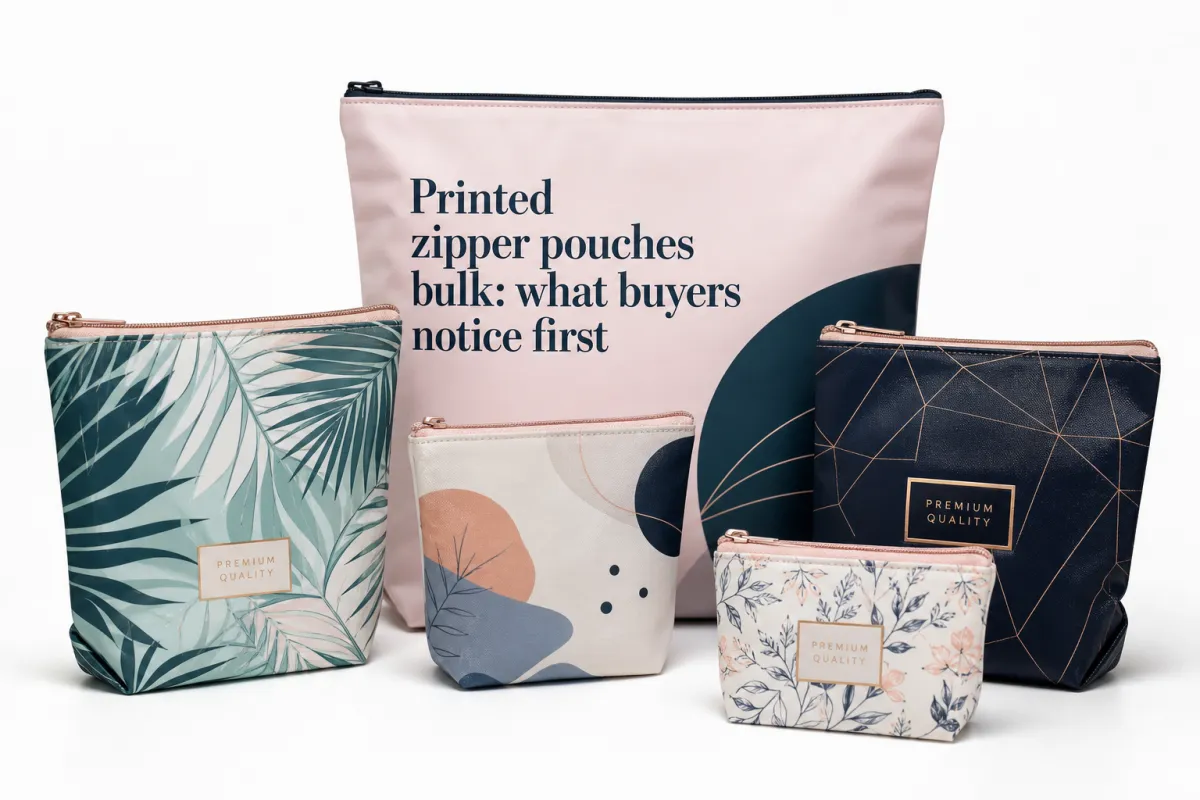
Most buyers notice three things first: appearance, closure feel, and structure. Sounds basic. It is not basic in practice. Printed zipper pouches bulk runs sit right between branding and function, which means the pouch has to do more than look polished. It needs to open cleanly, close the same way every time, and protect the contents through storage, handling, and shipping.
The first touch after checkout can change how the rest of the product is received. A sharp print job on a matte stand-up pouch can make a $12 product feel intentional. A blurred logo, off-register panel, or zipper that fights back sends the opposite message. Shoppers rarely separate the package from the product. They judge the product through the package, because that is what is in their hand.
That is why printed zipper pouches bulk orders deserve the same scrutiny as the product itself. A weak seal or sloppy print can cost more in repacks, damaged units, and lost repeat purchases than the savings from a cheaper pouch. At scale, a small failure rate turns into a real margin problem. Two percent of a 50,000-piece run is 1,000 units. That is not trivia. That is a pile of work.
Bulk buyers also care about line speed. A pouch with a narrow mouth, an awkward gusset, or a zipper that does not track consistently can slow filling. A few extra seconds per pack sounds harmless until you multiply it across thousands of units. Printed zipper pouches bulk sourcing should support the packing line, not just the marketing team trying to make everything look pretty on a mockup.
Then there is shelf presence. A pouch that stands well, stays upright, and keeps the front panel flat photographs better and displays better. That matters for ecommerce listings, retail shelves, and secondary packaging that has to do more work than it should. In plenty of categories, the pouch is doing the job a carton used to do: carrying the brand, the product story, and the signal of quality.
The cheapest pouch is not the lowest-cost pouch if it leaks, wrinkles badly, or slows your packing line.
From a buyer's perspective, the best printed zipper pouches bulk order is the one that matches the product's actual demands. A dry snack, a protein powder, a pet treat, and a hardware accessory do not need the same barrier, the same zipper, or the same film structure. Treating them like they do is how packaging programs get messy fast.
I have seen teams spend weeks polishing artwork for a pouch that was doomed by the wrong structure from the start. The print looked great. The bag still failed the job. That kind of miss is expensive, and kind of annoying in a way only packaging can be.
If you are comparing options, start with the use case, not the artwork. We cover more detailed buying support through our Wholesale Programs, which helps when you need a repeatable packaging plan instead of a one-off print order.
Printed zipper pouches bulk product details: styles, use cases, and print options
Printed zipper pouches bulk buyers usually start with pouch style. Stand-up pouches get the most attention because they sit upright and give the front panel room to work. Flat pouches are leaner, easier to ship, and often better for lighter fill weights or secondary packaging. Side gusset and quad-seal formats bring more internal volume and a different shelf shape, which matters when the bag needs to feel substantial instead of flimsy.
Surface finish changes the message too. Matte finishes tend to read as more premium and controlled. Gloss finishes catch light and make color graphics feel louder and more retail-driven. Clear windows help customers see the product, which works well for snacks, dried ingredients, pet treats, and accessory kits. The wrong finish is not usually a disaster, but it can make the product feel a little off-brand. Customers notice that faster than they should.
Different industries use printed zipper pouches bulk runs in different ways. Food brands care about freshness, aroma retention, and tamper resistance. Supplement brands care about cleanliness, barrier performance, and consistent recloseability. Pet treat brands need durability and a zipper that survives repeated handling. Beauty and personal care buyers often focus on shelf appeal, moisture resistance, and how the pouch pairs with cartons or inserts. Hardware and small parts sellers may care more about puncture resistance and visible labeling than a luxurious finish. Practical wins over pretty when the product has teeth.
Print options matter just as much as pouch shape. Spot colors help when brand consistency is non-negotiable. Full-coverage graphics give more room for gradients, photography, and larger design systems. White ink layers matter on clear or dark film because they keep logos from looking washed out. For printed zipper pouches bulk programs with multiple SKUs, the art system should be built so product names, flavors, or variants can change without rebuilding the whole design every single time.
Structural details change usability in ways people underestimate. A tear notch makes opening easier. Rounded corners reduce edge wear and improve hand feel. A hang hole supports peg display. A zipper can be standard press-to-close, a stronger double-track version, or a more specialized closure depending on category. None of those details sounds dramatic alone. Put them together and the pouch feels better in the hand, which is usually where the truth comes out.
Here is a simple way to think about printed zipper pouches bulk selection:
- Stand-up pouches work well for shelf visibility and ecommerce presentation.
- Flat pouches suit lighter fills, sampler packs, and shipping efficiency.
- Window pouches are useful when product visibility helps sell the item.
- Matte finishes suggest restraint and premium positioning.
- Gloss finishes emphasize color, contrast, and visual punch.
For larger runs, print consistency matters more than clever design tricks. A good pouch spec should make the branding easy to reproduce. If a supplier cannot hold color consistently across panels or across reorder lots, the packaging system loses trust quickly. That gets even uglier when the pouch is used for recurring replenishment instead of a one-time campaign.
Printed zipper pouches bulk specifications that affect performance
Printed zipper pouches bulk specs should be written down before anyone approves artwork. The core details are straightforward: dimensions, fill volume, film thickness, barrier level, zipper style, and seal width. Those details are also where most downstream problems begin. If the pouch is too small, the zipper line gets crowded. If the film is too light, the structure may not protect the contents. If the seal width is too narrow, failure risk climbs.
Material selection is the biggest technical decision. Higher-barrier structures protect aroma, freshness, and moisture-sensitive products better. Lighter structures can reduce freight cost and take up less storage space, which matters for printed zipper pouches bulk inventory. The tradeoff is simple. More protection usually means more material complexity and higher cost. The right answer depends on what the product actually needs to survive.
For food and supplement products, product compatibility matters as much as appearance. Confirm whether the material is appropriate for direct food contact, whether the product is sensitive to oxygen or moisture, and whether storage temperature could affect the seal or zipper performance. If the product contains oils, acids, or strong aromas, the pouch spec may need a stronger barrier than a dry, neutral product. Packaging chemistry is not glamorous, but it does have opinions.
Production variables can change the outcome even when the pouch design looks correct on paper. Artwork resolution should be high enough to hold type and logos cleanly, and vector files are preferable for brand marks. If the design uses fine gradients or dense black panels, expect more scrutiny during proofing. Color matching should also be discussed early, especially if brand consistency across multiple packaging formats matters.
Hand-filling and machine-packing are not interchangeable. A pouch that works well for manual filling may be awkward on a machine if the mouth is too narrow or the side seals do not run as cleanly as needed. If your product has sharp corners or irregular shapes, the pouch needs enough tolerance to avoid puncture or stress on the seal. Printed zipper pouches bulk programs should be designed around the filling reality, not just the render someone liked in a meeting.
Here are the specs buyers should confirm before placing printed zipper pouches bulk orders:
- Dimensions - width, height, and gusset depth.
- Fill volume - actual product weight or volume per pouch.
- Film thickness - enough for durability without unnecessary weight.
- Barrier requirement - moisture, oxygen, light, or aroma protection.
- Zipper type - standard, reinforced, or specialized closure.
- Seal width - enough margin for stable sealing.
- Finish - matte, gloss, or hybrid appearance.
- Packaging method - hand-filled or machine-packed.
If the product is fragile, aromatic, or moisture-sensitive, spec the pouch for protection first and decoration second. That rule is blunt because it needs to be. A beautiful pouch that cannot hold freshness is still a bad package.
Transit testing is another useful checkpoint. Buyers who ship across long distances or through multiple handling points should ask for validation against recognized transport test methods such as those published by the ISTA. A pouch that survives a short local delivery route may behave very differently in broader distribution. That is not academic. That is what the truck does to your inventory.
For sustainability claims, ask for proof instead of vague language. If your program includes paper cartons, inserts, or outer packaging alongside the pouch, FSC documentation may matter. The FSC system is widely used when buyers need traceability for paper-based components. The pouch itself may still be film-based, but the broader packaging set should line up with the claim.
In printed zipper pouches bulk sourcing, precise specs are not bureaucracy. They are risk control.
Printed zipper pouches bulk pricing, MOQ, and unit economics
Printed zipper pouches bulk pricing comes down to a handful of variables: size, material structure, print coverage, zipper type, finishing, and quantity. Bigger runs spread setup cost across more units, which is why unit price usually improves as order volume rises. It is also why a small shift in material or finish can move the quote more than buyers expect.
MOQ, or minimum order quantity, is not just a supplier preference. It reflects setup efficiency. Once plates, cylinders, print files, or machine settings are committed, the production line wants enough volume to justify the run. For printed zipper pouches bulk orders, higher quantities often lower the per-unit price and make the budget easier to forecast across replenishment cycles.
Watch total landed cost, not just the unit price. Freight, storage, spoilage, sampling, approval delays, and the labor effect of a pouch that is hard to fill can hide inside the final math. A pouch that costs less per unit but slows the line by several seconds can become the more expensive choice. The best printed zipper pouches bulk quote is the one that supports margin, not the one that looks low in a spreadsheet.
Here is a practical comparison of common printed zipper pouches bulk options. These are illustrative ranges, not fixed market prices, because size, print coverage, and material structure change the math fast.
| Option | Typical use | Indicative bulk price at 5,000 pcs | Strengths | Tradeoffs |
|---|---|---|---|---|
| Matte stand-up pouch with zipper | Snacks, supplements, retail goods | $0.18-$0.28 per unit | Strong shelf presence, broad use case, easy to brand | May need a higher-barrier spec for sensitive products |
| Window stand-up pouch with zipper | Foods, pet treats, visual product categories | $0.24-$0.38 per unit | Shows product clearly, helps shoppers judge contents | Window size and film choice can increase cost |
| High-barrier foil laminate pouch | Moisture-sensitive or aroma-sensitive products | $0.26-$0.44 per unit | Better protection, stronger freshness retention | Usually costs more and may feel less transparent to shoppers |
| Short-run digital printed pouch | Launches, test markets, multi-SKU orders | $0.35-$0.70 per unit | Lower setup burden, useful for limited quantities | Unit price is higher, especially at lower volumes |
Those ranges matter because they show how fast the economics move. A pouch that adds a few cents can still be worth it if it cuts returns, improves conversion, or removes the need for extra labeling. In printed zipper pouches bulk buying, the cheapest choice is often the wrong choice when the product is premium or sensitive. Cheap is a good word for inputs. It is a bad word for outcomes.
Think about freight too. A lighter structure can reduce inbound shipping cost, and a more compact pouch can improve carton efficiency. That matters more than many buyers expect. If the packaging program ships by the pallet, a small dimensional change can alter how many units fit per case and how cases stack on a pallet. A few millimeters can turn into a lot of annoyance.
Another overlooked cost is secondary packaging. Sometimes a better pouch can reduce the need for an extra label, an insert, or a protective outer wrap. Sometimes it cannot. The point is to calculate the packaging stack as a system. Printed zipper pouches bulk programs work best when the pouch, carton, and shipping format are planned together instead of being patched together one layer at a time.
Buyer rule of thumb: if two quotes are close, compare the structure that is less likely to fail, more likely to pack quickly, and more likely to keep the brand consistent across the next reorder. That is the version that protects margin over time.
If your company places recurring packaging orders, our Wholesale Programs can help frame the economics around repeat purchase volume rather than one-time buying pressure. That is usually the better way to evaluate printed zipper pouches bulk supply.
A quote that looks 8 percent cheaper can disappear fast if the pouch slows filling, ships poorly, or forces a reprint.
Printed zipper pouches bulk process and timeline
The printed zipper pouches bulk process is usually more orderly than buyers expect, but a few bottlenecks show up every time. The typical sequence is quote request, spec confirmation, artwork review, proof approval, production, quality checks, and shipping. Every step matters. The fastest projects are the ones where the buyer already has the product details and artwork files ready before the first call starts.
Artwork review is where many delays begin. Low-resolution logos, missing dieline references, and unapproved color changes can stop the job before production even starts. If a pouch uses multiple panels, a white underprint, or fine type near the seal area, the proof should be checked carefully. A clean file set can shorten proofing by 1-3 business days, which is worth more than it sounds when inventory timing is tight.
After proof approval, production timing depends on the order size and structure complexity. Simple repeat runs may move in about 10-12 business days from sign-off. More complex printed zipper pouches bulk jobs, especially those with custom windows, special finishes, or higher-barrier film, often run closer to 12-15 business days or longer. Shipping time sits on top of that and should be planned separately, not guessed at the last minute.
Quality control should not be a mystery. Before shipment, buyers should expect checks for zipper alignment, seal integrity, print accuracy, and dimensional consistency. A pouch can look fine in a flat proof and still fail if the zipper tracks are off or the seal width is inconsistent. For products packed automatically, dimensional accuracy becomes even more important because small variations can disrupt the line and make everybody grumpy.
Timeline risk usually comes from the same few places: peak season demand, custom material sourcing, and last-minute copy changes. If you need printed zipper pouches bulk supply for a launch, lock the art early and approve samples before production begins. The extra step often costs less than the delay it prevents.
Here is a practical timeline framework:
- Quote and spec confirmation - 1-2 business days if the inputs are complete.
- Artwork review and proofing - 2-4 business days, sometimes faster with clean files.
- Production - often 10-15 business days after approval.
- Transit - depends on carrier and destination, then add receiving time.
Sampling is worth the time when the product is new, premium-priced, or exposed to retail scrutiny. A sample can show whether the zipper closes cleanly, whether the pouch stands the way you expect, and whether the print tone matches the brand direction. For printed zipper pouches bulk buys, one prototype or sample run can prevent a very large mistake.
Some buyers ask whether they can skip samples to save time. Sometimes they can. If the product is fragile, high-value, or tied to a launch window, skipping samples is still a bad bet. The expected savings are usually smaller than the cost of a flawed run.
One more thing: if the timeline looks too good to be true, ask what is being skipped. Fast is nice. Fast with no proofing discipline is how a whole batch gets turned into a lesson nobody asked for.
Why choose us for printed zipper pouches bulk orders
Buyers do not need packaging slogans. They need a supplier who can explain the structure, quote it clearly, and reproduce it consistently. That is the standard that matters for printed zipper pouches bulk orders. Real value is not just print output. It is the ability to help the buyer choose a pouch that fits the product, the line, and the margin target without turning the process into a guessing game.
A consultative supplier reduces risk by asking the questions that prevent mistakes. What is the fill weight? Will the pouch be hand-packed or machine-packed? Does the product need barrier protection against moisture or aroma loss? Is the brand using this pouch for retail display, ecommerce, or both? Those questions sound simple because they are. They still decide whether the finished package performs.
Printed zipper pouches bulk programs also need repeatability. A pouch that works once but drifts in color, seal quality, or zipper performance on the reorder is not a reliable supply chain asset. Buyers should expect the supplier to explain tolerances, proofing steps, and practical tradeoffs in plain language. If a vendor cannot explain why one structure costs more than another, that is usually a warning sign wearing a friendly shirt.
Service matters just as much as manufacturing. Clear communication during proofing, responsive answers during revisions, and transparent lead times all signal that the supplier understands bulk packaging pressure. When a launch is tied to a ship date or a retail window, the difference between "maybe" and "confirmed" can be expensive.
We also recommend comparing suppliers on sample availability and spec discipline. Can they provide a sample that reflects the actual pouch build? Do they explain whether the print is full coverage, spot color, or white-ink dependent? Can they help compare multiple printed zipper pouches bulk configurations without making the process feel like a scavenger hunt? Those are the practical questions that reveal packaging experience.
For buyers managing ongoing volume, our Wholesale Programs can support reorder planning and give structure to larger purchasing decisions. That matters because a bulk packaging program should not reset from scratch every time inventory gets low.
Another useful signal is whether the team talks about tradeoffs honestly. A low-cost pouch may be fine for a dry, non-sensitive product. A high-barrier pouch may be overkill for a simple accessory kit. The right supplier should say that plainly. Real packaging advice saves money by matching the spec to the real job instead of dressing up every choice as genius.
When sustainability is part of the brief, ask for proof on the components that actually matter. If the program includes paper cartons, printed inserts, or outer wraps, ask for FSC-backed documentation where applicable. If the packaging will travel through rough distribution, ask whether transport testing is appropriate before you place a larger order. Those steps are not marketing extras. They are basic diligence.
For many buyers, the best reason to choose us is simple: we make printed zipper pouches bulk ordering feel controlled rather than risky. The goal is not to oversell the pouch. The goal is to get the pouch right, then repeat it without surprises.
Next steps for printed zipper pouches bulk buyers
If you are ready to source printed zipper pouches bulk, start with a tight spec sheet. Confirm product weight, pouch size, fill method, finish preference, barrier needs, and target quantity. The more exact the brief, the cleaner the quote. Vague requests usually come back with vague answers, and that is how mistakes get built into the price.
Prepare artwork files early. A proper dieline, vector logo files, and notes about color priorities can remove several rounds of revision. If your brand is sensitive to color shifts, say that upfront. If the product needs a clear window or a white underprint, say that too. Printed zipper pouches bulk buying moves faster when the supplier can review a complete package instead of chasing missing pieces like a detective with a deadline.
Samples are worth ordering when the product is new, fragile, or headed for a premium channel. A sample lets you check whether the zipper feels right, whether the pouch stands correctly, and whether the graphics match the brand tone. For many buyers, that small step is the difference between a controlled launch and an expensive correction.
When quotes arrive, compare them line by line. Match dimensions, film structure, finish, zipper type, and shipping assumptions before you compare price. A cheaper quote that changes one of those details is not the same product. For printed zipper pouches bulk buyers, that distinction matters more than most price tables admit.
Here is the clean decision path:
- Confirm the product specs and pouch size.
- Send complete artwork and dieline notes.
- Request samples if the product is new or premium.
- Compare complete landed cost, not only unit price.
- Approve the proof only after checking print, zipper, and dimensions.
That process sounds disciplined because it is. Bulk packaging rewards discipline. A well-planned order protects the product, supports the packing line, and presents the brand cleanly on first contact. Printed zipper pouches bulk sourcing should feel methodical, not improvised.
If you are comparing suppliers now, start with a clear brief, request a quote, review the proof, and move forward with the printed zipper pouches bulk configuration that fits the product and the margin. If the pouch spec protects the product, runs cleanly on the line, and still looks right after shipping, you picked the one that matters.
Common questions about bulk pouches
What is the usual MOQ for printed zipper pouches bulk?
MOQ depends on pouch size, print coverage, and material structure. In many bulk programs, the minimum is set to spread setup costs across enough units to keep pricing workable. Ask for the MOQ before you finalize artwork so you can confirm the run fits your launch volume or replenishment plan. If you need several SKUs, check whether quantities can be combined across designs or whether each design needs its own minimum.
How are printed zipper pouches bulk prices calculated?
Pricing usually reflects pouch size, film type, print complexity, zipper style, and total quantity. Freight, proofing, and special finishes can also change the final landed cost. That is why unit price alone is not enough. Higher quantities often reduce cost per pouch because setup and production overhead are spread across the run, but the best quote is still the one that matches the actual product need.
Which pouch material is best for printed zipper pouches bulk orders?
The best material depends on what the pouch must protect. Moisture-sensitive, aroma-sensitive, or fragile products usually need a higher barrier structure. Lighter films can work for dry goods with lower protection needs. The right move is to match the material to the product first, then choose finish and print style after that. That order of decisions usually prevents expensive over-spec or under-spec mistakes.
How long does production take after artwork approval?
Lead time depends on order size, pouch specification, and current production schedule. Clean files and fast proof sign-off can shorten the timeline, while custom materials or multiple revisions can extend it. A good timeline should separate proofing, production, and shipping so inventory planning stays accurate. For printed zipper pouches bulk orders, that breakdown is often more useful than a single date.
Can I order samples before placing a printed zipper pouches bulk order?
Yes. Samples are useful when you need to check seal strength, print quality, size fit, or shelf appearance. A sample run helps catch issues before a full bulk order goes into production. If your product is new, fragile, or premium-priced, sampling is usually worth the extra step because the risk of a bad full run is much higher than the cost of a sample.
For printed zipper pouches bulk buyers, the winning formula is plain: the right spec, the right price, and the right process. If all three line up, the pouch protects the product, supports the packing line, and shows up on shelf looking like it belongs there. Start with the spec sheet, pressure-test the structure, and only then decide whether the quote is actually a good deal. That is how you keep the bulk order from turning into a headache later.


