Private Label Buyer Apparel Poly Bags Logo Placement Guide
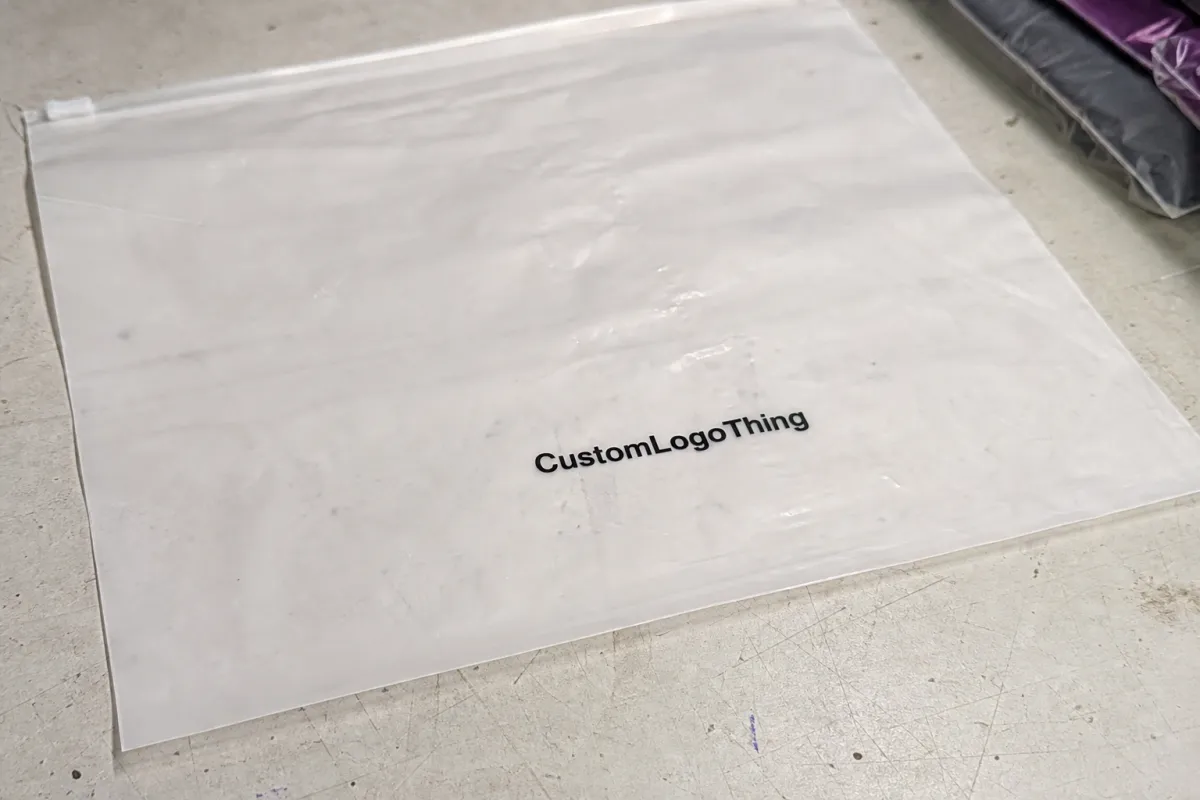
A poly bag does more than hold a folded garment. It affects first impression, protects the item in transit, and tells the buyer whether the program is organized or improvised. Logo placement matters because it changes shelf read, warehouse handling, barcode space, and the chance of a clean reorder later.
The placement decision is not only visual. A logo too close to a seal line can distort after packing. A mark that looks centered on a screen can land awkwardly once the garment is folded, compressed, and cartonized. That gap between mockup and production is where many costly mistakes start.
For retail-facing apparel, front-center placement usually gives the fastest recognition. For fulfillment-heavy programs, the logo often belongs where it will not interfere with scan zones, warning text, or size labeling. The safer sequence is to map the function first, then place the logo in the remaining space.
Simple branding usually ages better than dense graphics. One-color marks are easier to repeat across tees, socks, intimates, and basics than artwork that depends on tight registration. In private label packaging, the bag should read clearly, not fight for attention.
| Apparel type | Best logo zone | Why it works | Main risk |
|---|---|---|---|
| Folded tees | Front-center above the fold | Visible on shelf and during carton opens | Logo can collide with the fold if the bag is too short |
| Intimates | Lower corner or narrow side panel | Leaves room for size and compliance copy | Too much ink can make a small pack look cramped |
| Socks | Front-center or header-card zone | Supports small logos and hanging display | Artwork can disappear near the top seal |
| Folded basics | Front-center with a simple mark | Easy to repeat across sizes and colorways | Busy art slows approvals and muddies thin film |
If the bag is meant to sell on a shelf, the eye reads the widest open panel first. If it is meant to move through a warehouse, the logo should stay out of the data lane. That is the core tension in apparel packaging: one surface has to carry brand, safety, and logistics information without looking overloaded.
A practical rule is to set one placement system early and keep it consistent. One approved file. One safe zone. One repeatable layout. Buyers often spend more time fixing a clever layout than they would have spent approving a plain one that survives production.
For broader pack-out decisions, the rest of the Custom Packaging Products catalog can help align inserts, cartons, and secondary packaging around the same brand rules.
Product Formats That Work Best for Apparel Lines
Not every poly bag earns the same place in a line plan. Flat bags are the simplest and usually the least expensive to print. Resealable zipper bags add reclose value for ecommerce, returns, and premium basics. Header bags work well for hanging display. Gusseted bags give folded garments more room without turning the pack into a brick. Suffocation-warning styles remain common because they satisfy a practical safety requirement without forcing a redesign.
Film choice matters as much as structure. Clear film shows the garment and keeps the presentation light. Frosted film softens the look and hides handling marks better than perfectly clear stock. Tinted film can feel more premium or reduce visual clutter in warehouse-heavy programs, but contrast has to be checked carefully.
Thickness deserves more attention than it usually gets. Thin film saves money but telegraphs wrinkles and handling marks more easily. Heavier film improves perceived quality and durability, though the price rises with the gauge. In practice, many apparel buyers land around 1.5 to 2.5 mil for standard retail and DTC work, with thicker options reserved for heavier garments or longer transit chains. The right spec should match the product, not a generic category.
Print method changes both appearance and economics. Spot-color printing is usually the cleanest fit for a logo that needs sharp edges and repeatability. Multi-color art can look stronger for lifestyle brands, but it usually requires tighter registration control and more disciplined proofing. Flexographic printing is common for high-volume work, though suppliers may use different methods depending on quantity and bag construction.
A few structural extras should be decided before artwork starts:
- Euro holes or hang holes for retail display.
- Adhesive flaps for faster pack-out on warehouse lines.
- Tamper evidence for direct-to-consumer shipments.
- Ventilation features when airflow matters inside long transit cycles.
- Warning copy placement so safety text does not crowd the logo.
For programs that also use inserts, cartons, or sleeves, Custom Labels & Tags can solve the final branding gap more cleanly than forcing everything onto the bag. Packaging terminology also varies by supplier, so a shared baseline from Packaging.org helps keep the team aligned before the first proof.
A proof can hide a bad layout. The bag itself will not.
Print Specifications That Prevent Misaligned Logos
This is the section that saves buyers from rework. If the logo looks centered in the artwork file but lands too close to the seal line in production, the whole run feels off. The basic measurements every supplier needs are finished bag width, finished length, gusset depth if there is one, film thickness, print side, and the exact printable area. Leave out any of those and the quote becomes an estimate instead of a spec.
Safe-zone planning matters more than most teams expect. The logo should stay clear of seals, folds, zipper tracks, perforations, and hanger holes after conversion and packing. A mark that looks balanced on a flat PDF can become distorted once the bag is folded around a garment. A marked dieline with the artwork overlaid at full size usually prevents extra proof rounds.
Vector artwork is the baseline. If color accuracy matters, include Pantone references or a physical swatch standard. If the bag needs barcode space, size stickers, or a care-copy block, those elements should be treated as fixed objects, not decorative extras. On small bags, every quarter inch changes the layout. A center panel already committed to a barcode often leaves the logo in a corner or near the top, where it can still read without crowding the scan zone.
Registration tolerance deserves a written answer, not a casual promise. One-color work usually holds tighter than multi-color runs, but the supplier should state the realistic tolerance before the PO is released. The same is true for reverse-print decisions. If the design relies on an opaque white underprint, confirm the film color, ink stack, and whether the supplier can hold enough opacity on tinted stock.
For programs with several SKUs, keep the logo system stable enough to survive a reorder without redesign. If one size uses a front-center mark and another needs a lower-corner placement, document both on the spec sheet and in the proof notes. That keeps the next run from turning into a detective exercise.
It also helps to think like a shipping engineer. A bag that looks right on screen may still fail once it rides in a master carton. Compression, vibration, and handling pressure can shift the visual center enough to expose a weak layout. That is why testable specs matter more than polished mockups. ISTA is a useful reference because it forces the team to think beyond the rendering and into the transport environment.
Pricing, MOQ, and Quote Inputs That Move Unit Cost
Price is driven by film gauge, dimensions, closure style, print colors, packing configuration, and order volume. Thicker film costs more. A zipper costs more. A larger printable area can cost more if it requires a wider sheet or more ink coverage. None of that is mysterious; it is the arithmetic of material and setup.
MOQ depends on the bag format and print method. Simple stock-size flat bags usually support lower minimums than custom dimensions or multi-color branded packs. Tooling, plates, and setup charges also change the economically sensible run size. If a supplier says the minimum is higher than expected, ask whether the constraint is tied to film sourcing, press setup, or packing labor.
| Volume tier | Typical setup | Indicative unit range | What usually pushes cost up |
|---|---|---|---|
| 2,000-5,000 pcs | Stock size, one-color logo | $0.10-$0.22 | Setup charges, plate cost, heavier film |
| 5,000-20,000 pcs | One- or two-color print, standard closure | $0.08-$0.18 | Extra print colors, zipper tracks, higher coverage |
| 25,000+ pcs | Repeat program, stable spec, consolidated shipment | $0.06-$0.14 | Freight, carton specs, special packing instructions |
Those ranges are directional, not universal. A custom print on tinted zipper film can sit above them, and a simple one-color run on thin clear film can sit below them. The point is to compare the cost curve, not just the opening quote. A buyer who looks only at the first number can miss the better value at the next tier, especially if setup is spread across a larger order.
The fastest quote requests include the finished size, artwork file, number of colors, target MOQ, ship-to ZIP, and desired delivery window. If the order is for direct fulfillment, include carton count and pack-out requirements too. Freight can distort the headline if it is buried in the bag price, so ask for a line-item quote that separates material, setup, print, and logistics.
It is also worth comparing poly bags against a mailer program before locking the spec. For DTC shipments, sometimes a bag plus outer pack is less expensive and cleaner than a custom printed outer shipper; in other cases, the mailer wins on labor and corrugate cost. Benchmarking against Custom Poly Mailers keeps the decision grounded in total landed cost rather than one component.
Production Process and Lead Time From Proof to Freight
The production path should be boring: request for quote, artwork review, digital proof, sample or press proof if needed, production run, quality control, carton pack-out, shipment. If a supplier cannot describe that sequence clearly, the risk usually lands on the buyer later.
Most delays happen in two places: artwork sizing and proof approval. If the file is not aligned to the dieline, the proof round stretches. If the buyer changes the logo position after proof approval, the schedule resets. A small move on screen can mean new plates, new registration settings, or a revised pack-out sheet.
Lead time varies by order type. Stock materials and simple one-color printing often move faster, while custom sizes, multi-color branding, or new tooling take longer. As a practical range, many simple runs finish in roughly 12-15 business days after proof approval. More customized programs often need 18-25 business days or more. If the film must be specially sourced or the order is tied to a seasonal launch, build in extra time.
Approvals speed up the job more than most teams expect. When the buyer answers proof questions, color checks, and carton specs quickly, the order stays predictable. That is especially true for private label teams managing multiple SKUs. One delayed sign-off can hold a production queue, so it helps to assign one person to artwork, one to specification approval, and one to freight booking.
For shipments that will travel inside master cartons, think about handling stress instead of only visual approval. ISTA-style thinking helps because the question becomes simple: will the bag still look correct after compression, vibration, and line handling? That is a better question than whether the first proof looked attractive in a PDF viewer.
Inventory planning matters too. Many private label teams do better with a small buffer stock, often 10-20% above the immediate forecast, especially on evergreen basics. That buffer protects against reorders, color drift, and short-notice account adds. If the program is stable, the buyer can also plan freight consolidation to reduce landed cost.
Supplier Checks and Next Steps to Place the Order
Price matters, but supplier discipline matters more. Before you place an order, judge the vendor on prepress support, print consistency, seal quality, packaging accuracy, and documentation habits. A cheap quote from a supplier that cannot control artwork can turn expensive fast. A slightly higher quote from a supplier that catches errors early is often the better buy.
Ask for three things before you commit: a printed sample, a spec sheet, and a marked proof. The sample shows how the ink behaves on the actual film. The spec sheet shows dimensions, gauge, closure type, and carton pack information. The marked proof shows where the logo sits relative to the seal line, fold, hole, or barcode.
- Color match - confirm the brand color against a Pantone reference or approved swatch.
- Carton counts - verify how many bags ship per carton and whether the count is fixed or approximate.
- Transit protection - check whether the supplier uses inner liners, corner protection, or moisture barriers.
- Repeatability - ask whether the setup can be duplicated on the next reorder without rework.
The next steps are straightforward: finalize the bag size, mark the logo zone, confirm the MOQ, collect the artwork files, and request a line-item quote. If those five items are done before the first proof, the project moves faster and the first run is more likely to match the expectation. That is the practical value of this guide: it turns a vague packaging request into a specification a supplier can actually price.
For most buyers, the right order is not the flashiest one. It is the one that arrives on time, prints in the right spot, and reorders without drama. A good bag program disappears into the workflow in the best possible way: no chasing, no last-minute artwork corrections, no mystery about which version is approved.
Where should a logo go on private label apparel poly bags?
Front-center is usually the most visible choice when the bag is the main brand surface. Lower-corner or side-panel placement works better if barcodes, size labels, or care copy need the middle area. Keep the artwork clear of seals, folds, zippers, and holes so it still reads correctly after packing.
What file do I need for apparel poly bag logo placement approval?
Send vector artwork whenever possible, plus Pantone references if color matching matters. A marked dieline or print-zone map helps the supplier confirm safe margins before proofing. Include the finished bag size so the logo can be scaled correctly on the first pass.
What MOQ should a buyer expect for printed poly bags?
MOQ depends on bag size, film type, print color count, and whether tooling or plates are required. Simple stock formats usually carry lower minimums than custom dimensions or multi-color branding. Ask for tiered pricing so you can compare the real unit cost at different run sizes.
How long does production take after artwork approval?
The clock starts after the proof is approved, not when the first quote is sent. Stock materials and simple print setups are usually faster than custom sizes or new tooling. Quick approval from the buyer side is one of the biggest factors in holding the schedule.
Can I print near barcodes or care labels on apparel poly bags?
Yes, but the scan area and readability zone must stay clear. Place the logo far enough away that the barcode, size sticker, or care panel remains easy to scan and read. Always check the final proof at full size before releasing the order.
Use this guide as the final preflight check, and the rest of the process tends to get easier: cleaner quotes, fewer artwork corrections, and a first production run that lands much closer to spec.

