Buyer Fit Snapshot
| Best fit | Custom Die Cut Handle Bags projects where brand print, material claims, artwork control, MOQ, and repeat-order consistency need to be specified before quoting. |
|---|---|
| Quote inputs | Share finished size, material target, print colors, finish, packing count, annual reorder estimate, ship-to region, and any compliance wording. |
| Proofing check | Approve dieline scale, logo placement, barcode or warning zones, color tolerance, closure strength, and carton packing before bulk production. |
| Main risk | Vague material claims, crowded artwork, missing packing details, or unclear freight terms can make a low unit price expensive after revisions. |
Fast answer: Custom Die Cut Handle Bags: Materials, Cost, and Use should be specified like a repeatable production item. The safest quote records material, print method, finish, artwork proof, packing count, and reorder notes in one written spec.
Production checks before approval
Compare the actual filled-product size with the drawing, then confirm tolerance on folds, seals, hang holes, label areas, and retail display edges. Reserve space for logos, QR codes, warning copy, and material claims before decorative graphics fill the panel.
Quote comparison points
Review material grade, print process, finish, sampling route, tooling charges, carton quantity, and freight assumptions side by side. A quote is only useful when the supplier can repeat the same color, closure quality, and packing count on the next order.
Custom Die Cut handle bags have a way of looking simple while doing a lot of quiet work. A customer picks one up, carries it across a store, a lobby, or a busy sidewalk, and the bag has already done part of the branding job before anyone even opens the product inside. That is the real appeal of custom die cut handle bags: they feel polished, they pack neatly, and they carry artwork without needing rope handles, ribbon ties, or extra hardware to finish the job.
That combination matters in day-to-day operations, not just in a mockup. Fewer components usually mean easier packing, fewer assembly steps, and a cleaner retail-ready look for boutiques, seasonal promotions, trade shows, and gift programs. For brand owners building package branding into every customer touchpoint, the handle becomes part of the printed structure instead of a separate piece added later. Custom Die Cut handle bags fit that thinking well because they keep the form tidy while still leaving room for strong visuals and a comfortable carry experience.
Most buyers compare Custom Die Cut handle bags with other retail packaging choices and with custom printed boxes. Boxes protect product more aggressively, though bags often move faster at checkout, hand out more easily, and take less space in storage and shipping cartons. That mix of presentation and convenience explains why this format shows up so often in apparel, cosmetics, event kits, bakery packaging, and lightweight gift sets through Custom Packaging Products. It gives brands a practical middle ground without making the structure feel plain or temporary.
A bag that feels fine for a quick trip and one that stays comfortable after a longer walk are not the same thing, and handle shape, board thickness, and top-edge design all influence that difference.
What Are Custom Die Cut Handle Bags?
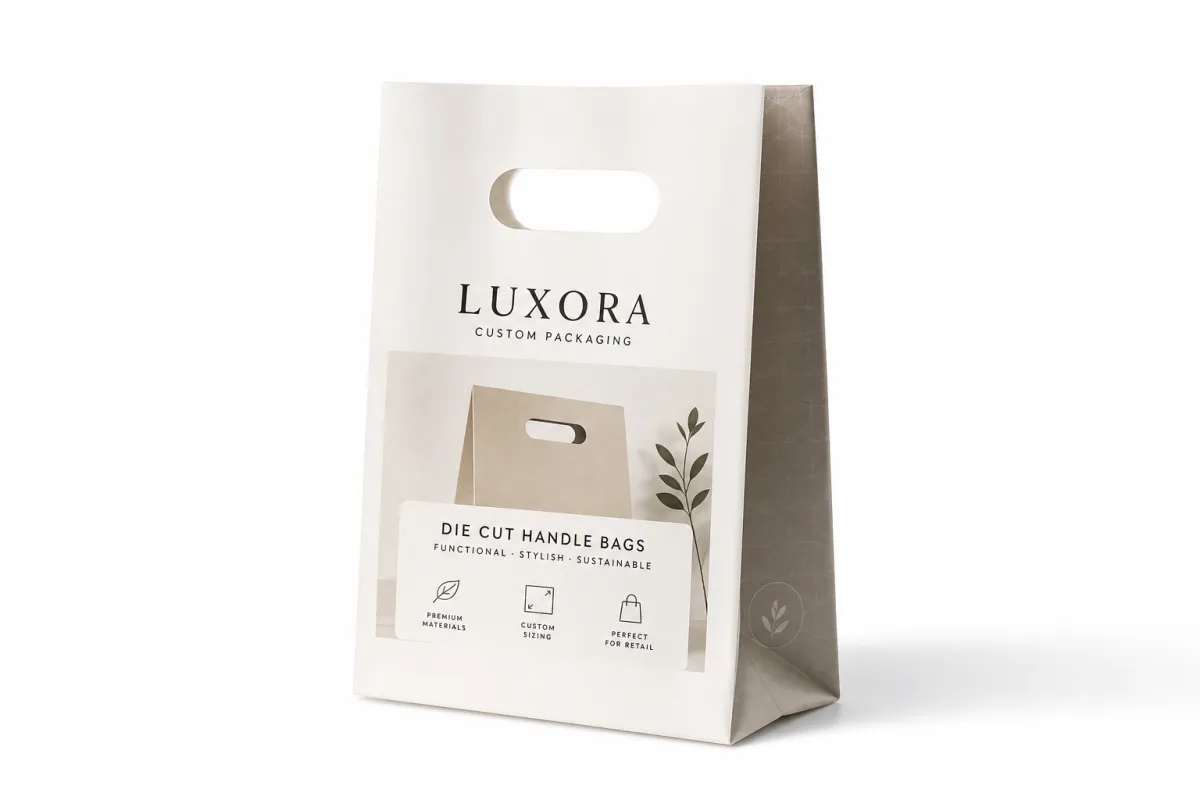
Custom die cut handle bags are bags with a handle opening cut directly into the material instead of attaching a separate handle piece. That opening can be rounded, oval, rectangular with softened corners, or shaped to distribute weight more evenly across the top panel. The defining feature stays the same either way: the handle belongs to the bag structure itself.
That sounds small on paper, yet it changes the look of the whole package. The profile appears cleaner, the top edge can stay neat, and the finished bag often reads as more deliberate than a bag with a cord or ribbon added later. For retailers focused on package branding, that difference can matter a great deal because the bag becomes another branded surface rather than a simple carrier.
Custom die cut handle bags work especially well for light to medium weight contents that need to look polished at the point of sale. They are common for folded apparel, beauty kits, event folders, sample sets, lighter bakery items, and gift bundles that benefit from a printed exterior. Kraft can give the bag a natural tone, full color printing can make a launch feel energetic, and coatings can push the presentation toward a more premium feel without changing the basic structure.
What many buyers appreciate is how direct the format feels. There are no loose handle pieces to source, no tying or threading steps, and no dangling hardware that can snag during packing or transit. That keeps production efficient and makes carton packing easier, which matters when product packaging needs to move quickly through a campaign with fixed shipping windows.
Used well, custom die cut handle bags serve presentation and utility at the same time. They are not built for every product, and that is part of the honesty buyers should expect. A dense boxed set may need a stronger carrier or a more rigid construction, but for many retail and promotional uses, custom die cut handle bags give a practical balance of appearance, function, and price.
How Custom Die Cut Handle Bags Work
The construction is straightforward at a glance. The artwork is printed first, the flat sheet is converted into the finished bag shape, and a die cuts the handle opening directly into the top panel. Depending on the build, the bag may then be folded, glued, reinforced, inspected, and packed into shipping cartons. The sequence sounds simple, though the handle area deserves real attention because every lift puts stress on that part of the bag.
For paper-based custom die cut handle bags, the body is often made from kraft paper, coated paper, or heavier paperboard. If the bag needs a more substantial feel, the top edge may be folded over, lined with an internal patch, or layered to keep the opening from tearing during use. That reinforcement can be as basic as a doubled fold or as intentional as a board insert bonded behind the handle zone.
The handle shape changes how the bag performs in hand. A narrow opening can look elegant, though it may bite into fingers if the contents are heavier than expected. A wider opening spreads pressure more evenly and usually feels easier to hold. Rounded corners help because they soften stress points at the ends of the cut. For a bag that will be carried more than once, comfort is not a decorative extra; it is part of the function.
In press checks and preproduction reviews, I have seen good artwork get overshadowed by a handle that was simply too tight for the intended load. That is why I tell buyers to treat the handle cut as a structural detail first and a design feature second. If the bag is going to carry a boxed item or a dense gift set, I am gonna be blunt: the top edge needs to earn its keep.
Manufacturing usually follows a familiar sequence:
- Artwork and finished dimensions are confirmed.
- The print file is checked for bleed, safe zones, and fold lines.
- The base material is printed and then dried or cured.
- The die cut shapes the handle opening and trims the outer form.
- Folding and gluing build the completed body.
- The bags are inspected for alignment, glue integrity, and clean edges.
- Finished units are counted, packed, and prepared for shipment.
That flow is one reason proofing deserves so much care. If the handle sits too close to a logo, or if the layout ignores the top fold, the finished bag can feel awkward even when the print quality is excellent. Good packaging design starts with the physical structure, then builds the artwork around it. That is true for custom die cut handle bags and for custom printed boxes alike.
The handle cut is not only a design feature. It is also the stress point. If the material is too light, or if the bag is expected to carry more than the build can handle, the top edge will show wear quickly. Matching material and handle style to the real product weight is the safest way to avoid disappointment later.
Key Factors That Shape Custom Die Cut Handle Bags
Three decisions drive most custom die cut handle bags projects: material, size, and finishing. Once those are set, the rest of the order becomes much easier to judge. Some buyers start with the print look, though in packaging work the structure has to earn the artwork.
Material choice changes almost everything. Kraft paper gives a natural, practical look and remains a familiar choice for retail packaging. Coated paper supports sharper graphics and richer color density, which helps when a brand wants a polished presentation for cosmetics or boutique launches. Rigid paperboard feels more substantial and can hold shape better, though it also adds cost and may require stronger reinforcement around the handle. Laminated or plastic-based builds can improve moisture resistance, yet they can complicate recycling and disposal.
Size and proportion matter just as much. A bag that is too shallow can crowd the product; a bag that is too tall can waste material and look awkward on the shelf. Gusset depth determines how much room the bag has to expand around boxed goods or bundled items. Opening width affects how easily the product can be inserted. Overall height changes both the visual balance and the amount of print area available for package branding.
Finish and decoration shape the brand voice. Matte coatings create a quieter, more refined look. Gloss finishes brighten color and can help graphics stand out under retail lighting. Spot color work is useful when brand standards require exact matching, and full-color graphics suit seasonal promotions or highly visual product packaging. Some buyers prefer tactile detail too, such as a soft-touch coating that changes the feel of the bag in the hand.
Here is a practical way to compare common build options for custom die cut handle bags:
| Build Option | Typical Feel | Indicative Cost Impact | Best Use | Notes |
|---|---|---|---|---|
| Kraft paper, 150-200 gsm | Natural, sturdy, familiar | Lower base cost | Apparel, events, everyday retail | Good for simple branding and recyclable presentation |
| Coated paper, 200-250 gsm | Cleaner print surface, brighter graphics | Moderate increase | Cosmetics, promotions, premium retail packaging | Better for strong color coverage and fine detail |
| Rigid paperboard, 300-400 gsm | Substantial, premium, box-like | Higher cost | Luxury gifts, boxed sets, higher-value items | Often needs stronger handle reinforcement |
| Laminated or hybrid build | Smoother, more moisture tolerant | Moderate to high | Bakeries, special events, display packaging | Recyclability depends on the full material stack |
Reinforcement deserves its own attention. Heavier items, sharp product corners, or repeated carrying can put surprising strain on the handle area. A well-built custom die cut handle bag may use folded edges, glued patches, or thicker board around the top panel so the opening does not elongate under load. That detail is not always visible from the outside, though it changes the user experience in a meaningful way.
Sustainability is another topic buyers raise earlier than they used to. Many paper-based custom die cut handle bags can be made with recycled content or FSC-certified paper, and the Forest Stewardship Council offers a useful benchmark for sourcing claims. Finish choices still matter. Heavy lamination, mixed materials, or certain coatings can alter the recycling path, so it pays to ask what the full structure contains before approving the final spec.
One point I keep coming back to with buyers is simple: do not let the artwork decide the build. Start with the product weight, the carry experience, and the retail environment, then shape the graphics around that structure. That approach usually leads to better custom die cut handle bags and fewer surprises once production starts.
Custom Die Cut Handle Bags Process and Timeline
The process for custom die cut handle bags usually begins with a brief that includes bag dimensions, product weight, artwork files, finish preferences, and the target delivery window. That may seem basic, though incomplete information is one of the main reasons timelines slip. A supplier cannot quote accurately if they do not know whether the bag needs to hold apparel, a boxed set, or a sample kit with unusual proportions.
After the brief comes artwork review. This stage checks image resolution, bleed, margins, fold placement, and handle clearance. If the logo sits too close to the top edge, the finished bag can feel cramped once the die cut and fold lines are added. Clean bag artwork starts with the flat template, not the design preview on a screen.
Then comes proofing. Digital proofs are fast and useful, though they do not replace an understanding of the final physical feel. If the run is sensitive, some buyers ask for a pre-production sample or prototype so they can check handle comfort, print tone, and how the structure behaves with a real product inside. That extra step often saves time later by catching issues before production moves too far.
Lead time usually comes down to three pieces: setup, production, and freight. Setup includes proofing and any tooling needed for a custom die. Production time depends on print method, material, drying or curing, and the amount of finishing. Freight can be a short transit or the longest delay in the chain, especially when the project is tied to a launch date or a trade show deadline.
As a general guide, a straightforward job with approved artwork may move through production in roughly 12-15 business days after proof approval, not counting transit, while a custom size, special finish, or new die can extend that window. If a sample is required first, add time for review and revision. During peak seasons, extra buffer is smart because schedules fill quickly.
There are also a few timing variables buyers tend to underestimate:
- Seasonal demand: event and holiday runs can crowd the schedule.
- Complex graphics: full-coverage print or special color matching adds checks.
- Finish requirements: matte, gloss, soft-touch, or lamination may slow the route slightly.
- Artwork revisions: every change after proofing can push the timeline back.
- Freight method: ocean, air, and ground each bring different risks and timing.
For buyers comparing options across Custom Packaging Products, the best habit is to define the date that truly matters. Is the bag needed for press samples, a retail launch, or a multi-day event? If the real deadline is a show opening, the order should be planned backward from the booth setup date rather than from the customer-facing launch date. That kind of planning comes up often in packaging design because product packaging, shipping cartons, and retail packaging usually have to arrive in the right order.
One useful reference for transport planning is the International Safe Transit Association. ISTA test methods are not about appearance; they focus on what happens when packaged products travel through vibration, compression, and handling. If the custom die cut handle bags ship with other materials inside a master carton, transport testing can reveal whether the top edges scuff, crush, or shift before the bags reach a customer.
When buyers treat the process as a sequence rather than a single quote, custom die cut handle bags usually turn out better. The spec gets clearer, the proof gets easier to review, and the delivery is less stressful.
Custom Die Cut Handle Bags Cost and Pricing Factors
Cost is where many orders get misunderstood. Buyers often compare unit price first, but with custom die cut handle bags the real number depends on several variables that move together. Quantity matters most because setup costs spread across more bags as volume rises. Material choice, print coverage, reinforcement, and finishing can raise or lower the price far more than a small change in dimensions.
For a typical order, a lower-quantity run may look expensive per piece because tooling, setup, and proofing do not shrink much. A larger run usually brings the unit price down, though if the job uses heavy board, complex print, or premium coating, the price can still remain high. That is why two quotes for custom die cut handle bags can look similar at first and still reflect very different structures underneath.
Here is a practical way to think about price drivers:
- Quantity: more units usually lower the per-bag cost.
- Material grade: thicker board or coated stock costs more.
- Print coverage: full-coverage graphics take more ink and more care.
- Finishing: matte, gloss, soft-touch, and lamination all affect cost.
- Reinforcement: handle patches and layered construction add labor and material.
- Tooling: a new custom die or special cut shape can add setup charges.
- Freight and packaging: landed cost is more than the factory quote.
MOQ matters too. Minimum order quantities are not there just to create friction; they help cover setup time and keep the line efficient. For smaller brands, that can feel challenging because they want a custom look without holding too much inventory. The cleaner answer is often to choose the simplest construction that still protects the product and supports the brand image. That usually creates better economics than overbuilding the bag and hoping premium material alone will carry the value.
Shipping and storage should be part of the decision from the beginning. A quote that looks attractive at the factory but arrives with high freight charges may not be the best value. Custom die cut handle bags also need dry, clean storage space, especially if they are paper-based and intended for retail packaging use. A dented carton or a damp warehouse can spoil what should have been a clean run.
To compare cost and feature tradeoffs more clearly, use a quote request that includes the following:
- Exact finished size, including gusset depth.
- Target product weight or a sample product photo.
- Artwork files in editable format if possible.
- Finish preferences such as matte, gloss, or soft-touch.
- Quantity range instead of a single number if you are flexible.
- Any deadline tied to a launch, event, or retail reset.
That level of detail helps a supplier price custom die cut handle bags accurately instead of guessing. It also helps you compare quotes in a fair way, which is the only useful way to judge a custom order. One vendor may price lower because the handle is lighter, the paper is thinner, or the finish is simpler. Another may include stronger reinforcement, tighter print control, or more dependable packing. Those differences matter.
For many buyers, the better question is not “What is the cheapest bag?” but “Which build gives the best combination of appearance, durability, and landed cost for this specific use?” That is the same line of thinking used in branded packaging, custom printed boxes, and other package branding projects where the customer sees the packaging before they judge the product itself.
Common Mistakes When Ordering Custom Die Cut Handle Bags
The first mistake is choosing based on appearance alone. A bag can look impressive on a screen and still be wrong for the product weight. That happens often with custom die cut handle bags because the handle area can hide structural weakness until someone actually carries the bag. If the load exceeds the stock, the top opening stretches, the edges wear, and the bag starts to feel unreliable.
The second mistake is ignoring hand comfort. Handle placement and opening size should make sense for the person carrying the bag, not just for the artwork layout. If the handle is too narrow, fingers press uncomfortably into the cut edge. If the opening is too small for a boxed product, the bag becomes awkward to use during an event or retail handoff. A good custom die cut handle bag should feel natural in the hand within seconds.
The third mistake is approving artwork too quickly. Die lines, safe zones, and fold areas are not decorative extras. They determine whether the logo lands cleanly or gets clipped by a crease. When print and structure are not aligned, custom die cut handle bags can look off-center even if the image file itself was technically correct.
The fourth mistake is over-specifying the build. Not every order needs the thickest board or the most expensive finish. Sometimes a simpler structure performs better because it is lighter, easier to carry, and more economical to ship. If the product is a lightweight gift item or an apparel piece, a well-chosen kraft or coated paper bag may do the job more effectively than a heavy premium build that adds cost without meaningful benefit.
The fifth mistake is waiting too long. Retail packaging and event packaging usually run on tighter calendars than people expect. Once the first shipment is near exhaustion, reorder time becomes urgent very quickly. That is why many buyers keep a buffer, especially for successful promotions where the bag itself becomes part of the customer experience.
A few other issues show up often enough to mention:
- Skipping the sample stage when the product is unusually shaped.
- Forgetting that the bag must fit inside shipping cartons efficiently.
- Not checking whether the finish changes recyclability or feel.
- Using the wrong color profile and getting a different brand tone than expected.
- Assuming every supplier prices reinforcement the same way.
Honestly, the cleanest safeguard is simple: treat custom die cut handle bags as a physical packaging system, not just a printed surface. Once you look at load, carry comfort, assembly, and carton packing together, the mistakes become much easier to avoid.
Expert Tips and Next Steps for Custom Die Cut Handle Bags
If you want a smoother order, start with samples or a prototype whenever the product is unfamiliar, heavy, or visually important. There is no substitute for holding the bag, placing the real item inside, and walking with it for a few minutes. That quick test tells you far more than a stack of email notes about whether the handle feels comfortable and whether the structure behaves as expected.
Build a one-page spec sheet before you ask for a quote. Include the finished dimensions, product weight, print coverage, finish preference, and delivery target. If you already know the quantity range, note that too. This makes it easier to compare custom die cut handle bags from different suppliers and avoids the same-price-different-spec trap that causes so much confusion in packaging design work.
Test with the heaviest real product, not an estimate. That advice sounds plain, but it is one of the most useful things a buyer can do. A bag that seems fine with a light sample can behave very differently once a boxed item, glass jar, or bundled kit is inserted. Small shape differences can change the strain on the handle and the way weight pulls against the top edge.
It also helps to compare quotes by category instead of by one bottom-line number. Separate setup fee, tooling, unit cost, freight, and any rush charge. That way you can see which quote is genuinely better for the business. A slightly higher unit price may still be the smarter choice if it includes stronger reinforcement, better print consistency, or lower total landed cost.
For brands building a broader packaging program, custom die cut handle bags should be considered alongside other Custom Packaging Products so the look and feel stay consistent across the customer journey. A bag, a shipper, and an inner box do not need to match perfectly, though they should feel like they belong to the same brand family.
Here are the practical next steps I would recommend:
- Confirm the product weight and finished dimensions.
- Choose the material based on handling and brand goals.
- Review artwork against the actual die line.
- Ask for a sample if the product is anything beyond light and simple.
- Leave enough time for proofing, production, and freight.
Used well, custom die cut handle bags do more than carry a purchase home. They support branded packaging, reinforce product packaging strategy, and make retail packaging feel deliberate from the moment the customer lifts the bag. If you are planning a launch, a seasonal reset, or a new promotional kit, confirm the spec early, request samples where needed, review the proof carefully, and lock the order only after the bag construction matches the real item it needs to carry.
What materials work best for custom die cut handle bags?
Kraft paper is a common choice when a brand wants a natural look, dependable everyday use, and an easier recycling story. Coated paper works better when the artwork needs sharper detail or richer color, which is why it shows up often in cosmetic and promotional packaging. Heavier products may need paperboard, layered reinforcement, or a stronger structure around the handle area. The best material depends on product weight, presentation goals, and whether recyclability or a premium feel matters more for the job.
How much weight can custom die cut handle bags hold?
Capacity depends on the bag size, the material thickness, and whether the handle area is reinforced. Light retail goods and gift kits are usually a good fit, while boxed products or dense items may call for heavier board and a wider handle opening. The safest approach is to test with the actual product rather than an estimated weight, because the way the item sits in the bag can change stress on the top edge and the comfort in hand.
What affects the price of custom die cut handle bags the most?
Quantity, material choice, print coverage, and finishing options usually have the biggest effect on unit price. Custom tooling and handle reinforcement can add setup cost, while freight and packing affect the real landed number more than many buyers expect. If you are comparing suppliers, make sure the quotes include the same bag size, same print coverage, and same finish so you are not comparing two different builds.
How long do custom die cut handle bags usually take to produce?
Simple orders with approved artwork can move faster than jobs that require new tooling, special finishes, or a sample round. A straightforward run may often take about 12-15 business days after proof approval, though complex jobs and busy seasons can stretch that window. Build in extra time if the bags are tied to a launch date, event, or retail reset, because revisions after proofing are one of the most common causes of delay.
Are custom die cut handle bags recyclable?
Many paper-based versions are recyclable, but coatings, laminations, and mixed materials can change how they are handled. The answer depends on the full structure, not just the paper base. If recyclability is a priority, ask for the exact material stack before final approval so you know how the finished custom die cut handle bags fit into your sustainability goals and your customer messaging.

