Buyer Fit Snapshot
| Best fit | Recyclable Labels for Boxes Wholesale projects where brand print, material claims, artwork control, MOQ, and repeat-order consistency need to be specified before quoting. |
|---|---|
| Quote inputs | Share finished size, material target, print colors, finish, packing count, annual reorder estimate, ship-to region, and any compliance wording. |
| Proofing check | Approve dieline scale, logo placement, barcode or warning zones, color tolerance, closure strength, and carton packing before bulk production. |
| Main risk | Vague material claims, crowded artwork, missing packing details, or unclear freight terms can make a low unit price expensive after revisions. |
Fast answer: Recyclable Labels for Boxes Wholesale: Material, Adhesive, Artwork, and MOQ should be specified like a repeatable production item. The safest quote records material, print method, finish, artwork proof, packing count, and reorder notes in one written spec.
Production checks before approval
Compare the actual filled-product size with the drawing, then confirm tolerance on folds, seals, hang holes, label areas, and retail display edges. Reserve space for logos, QR codes, warning copy, and material claims before decorative graphics fill the panel.
Quote comparison points
Review material grade, print process, finish, sampling route, tooling charges, carton quantity, and freight assumptions side by side. A quote is only useful when the supplier can repeat the same color, closure quality, and packing count on the next order.
Recyclable Labels for Boxes Wholesale: Buyers Guide
In a fulfillment operation, labels are easy to underestimate until they start causing real friction. A bad adhesive can leave residue on corrugated cartons, a flimsy face stock can curl in cold storage, and a barcode that looks fine on press proof can still fail in the scanner lane. That is why recyclable labels for boxes wholesale is not just a search term for procurement; it is a packaging decision that affects labor, throughput, and how confidently a carton can move into the recycling stream afterward.
Price matters, of course. Volume buying usually lowers the unit cost, and that alone can justify standardizing a label across several box sizes. But a smart buying decision looks beyond the line item. It asks how the label behaves on kraft corrugate, whether it stays legible through transit, and whether the construction supports the recycling goal the team is trying to meet. That is the lens here: practical performance first, paperwork second, and sustainability claims only when the materials actually back them up.
Why Recyclable Labels for Boxes Wholesale Make Sense
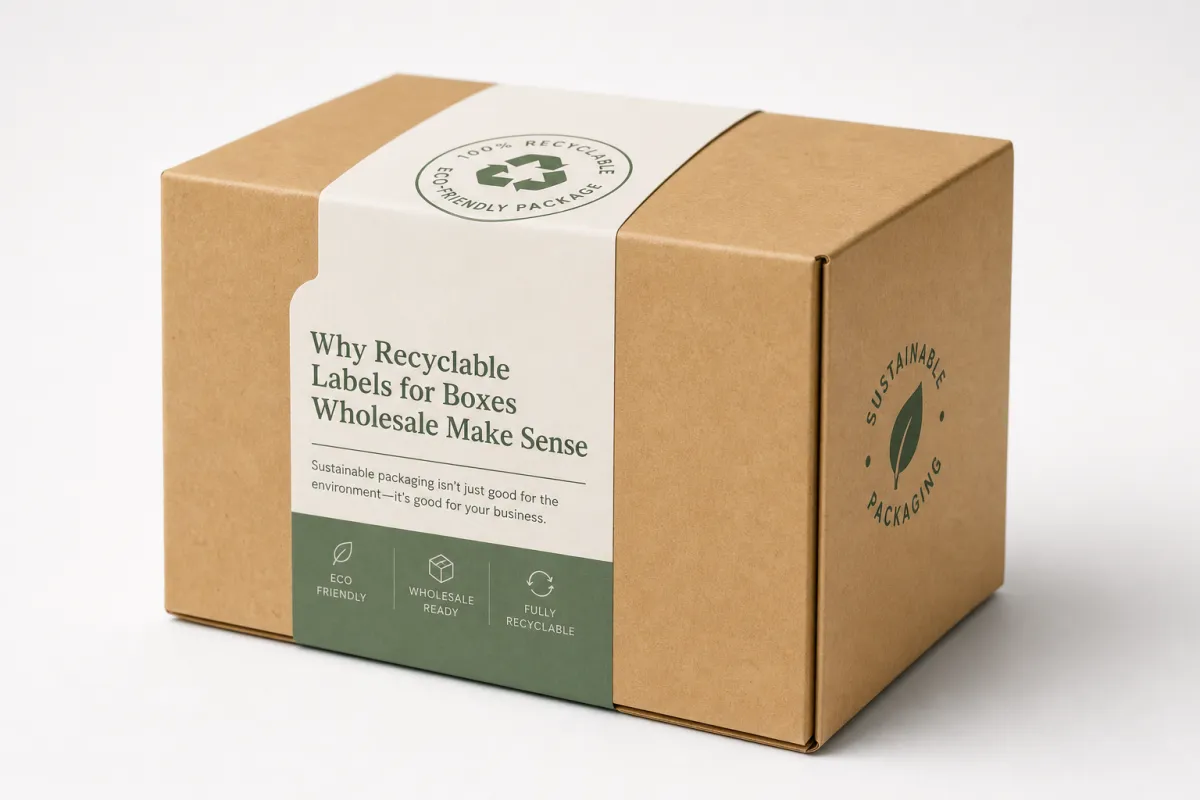
A warehouse floor is a pretty honest place. If a label peels in transit, jams an auto-applier, or leaves gummy residue on a carton, nobody has to guess what went wrong. It shows up as rework, slower pack-out, damaged presentation, or a customer service issue that could have been avoided with a better spec. That is the practical value of recyclable labels for boxes wholesale: fewer surprises in production and fewer headaches when the box reaches its end of life.
Buyers usually start with cost, and that instinct is sound. A larger run often reduces unit price, and it can also cut the hidden cost of repeated setup, artwork checks, and small-batch reorders. But label price by itself does not tell the full story. The real question is how the label behaves on the actual box substrate, whether it scans cleanly, and whether it fits the recycling path the company wants to support.
For a packaging buyer, the decision usually comes down to a few simple questions:
- What is the box made from: uncoated corrugate, recycled-content board, coated retail carton, or a mailer?
- Does the label need to hold for the entire shipping cycle, or come off cleanly for reuse, returns, or inspection?
- Will the box face humidity, cold storage, abrasion, compression, or long transit time?
- Does the label need a barcode, batch code, SKU, or variable data field?
The best recyclable labels for boxes wholesale order is rarely the one with the cleanest marketing copy. It is the one with the best fit. A paper face stock may be perfect on a plain corrugated carton and wrong on a condensation-prone cold chain box. A permanent adhesive may be ideal for outbound shipping, while a removable adhesive is smarter for reusable cartons or inspection workflows. That kind of fit is where the savings show up, and honestly, it saves a lot of back-and-forth later.
Practical rule: if the label looks right on the proof but fails on the carton, the specification was incomplete. Face stock, adhesive chemistry, and liner handling all matter.
There is also a documentation side to this. Buyers who want to support recycling claims often reference general recycling guidance from the EPA recycling resources and paper sourcing information from FSC. Those references do not select the label for you, but they do help separate measurable material attributes from vague environmental language.
For procurement teams, the sequence matters: identify the box substrate first, then choose the adhesive behavior, then confirm print durability and roll format. That order avoids a lot of churn. It also keeps recyclable labels for boxes wholesale tied to a real production requirement instead of a general sustainability claim that sounds good on paper and falls apart on the line.
Recyclable Labels for Boxes Wholesale: Material Options
Face stock is usually the first thing buyers notice, but it is only one piece of the build. For recyclable labels for boxes wholesale, the goal is usually to stay fiber-based and avoid plastic film unless the application truly needs extra moisture resistance or heavy abrasion protection. On corrugated cartons, that often means paper-based constructions paired with adhesives that match the box surface.
Common face stock choices include recycled paper, FSC-certified paper, uncoated paper, and other fiber-based options. Recycled paper works well for standard shipping cartons and inner pack labels. FSC-certified paper matters when the brand needs an auditable sourcing story. Uncoated paper is a good fit for write-on fields, routing labels, and cartons that do not need a glossy finish. Each of these can support recyclable labels for boxes wholesale without drifting into film-based constructions.
Adhesive selection deserves equal attention. Permanent adhesive is the default for outbound shipping because the label needs to survive handling, scuffing, and temperature swings. Removable adhesive makes sense for reusable boxes, inspection labels, or temporary routing. High-tack adhesive is often the right answer for rough kraft surfaces, recycled corrugate, or cartons with a dusty finish. The best choice depends less on what sounds strongest and more on the surface texture and the full life cycle of the box.
Liners and release materials are easy to overlook, yet they affect both waste handling and application speed. A recyclable label face does not automatically make the entire roll recyclable in the same way. The backing liner is usually silicone-coated paper or another release layer, and that changes how leftover material is collected, baled, or discarded. For large wholesale runs, it is worth asking how the liner will be handled after application, because the answer can affect both plant housekeeping and sustainability reporting.
Finish also matters. Matte paper is easier to write on and usually gives a more natural look on kraft cartons. It also tends to work well for barcode contrast when the print area is simple and the scanner setup is not forgiving. Coatings should be added only when the label truly needs them. Extra abrasion resistance can be useful on high-touch cartons, but it can also add cost and complicate the recycling story. That tradeoff should be intentional, not automatic.
Here is a straightforward comparison buyers can use before requesting recyclable labels for boxes wholesale quotes.
| Material option | Typical wholesale price range | Best use | Recycling and handling note |
|---|---|---|---|
| Uncoated recycled paper | $0.018-$0.035 per label at 5,000+ units | Standard shipping cartons, write-on fields | Good fiber-based fit for corrugated boxes |
| FSC-certified paper | $0.022-$0.045 per label at 5,000+ units | Brand programs that need certified sourcing | Useful when paper sourcing documentation matters |
| Heavy-duty paper with coating | $0.028-$0.060 per label at 5,000+ units | Abrasion-prone cartons and longer transit cycles | Added performance, but confirm recovery expectations |
| Removable paper label | $0.030-$0.065 per label at 5,000+ units | Reusable boxes, returns, temporary routing | Cleaner removal, but test for residue on the actual box |
Two questions usually separate a solid spec from a weak one. First, does the label need to hold under real warehouse stress, or only look good on a sample sheet? Second, will the label be applied by hand or by machine? Those answers often change the best material. That is why experienced buyers treat recyclable labels for boxes wholesale as a system choice, not a single-item choice.
Box Label Specifications That Affect Performance
Specifications are where label purchases succeed or fail. A label can have the right material and still underperform if the width, core size, roll direction, or application method is wrong. For recyclable labels for boxes wholesale, a detailed spec sheet is not paperwork. It is the difference between a smooth production run and a line that keeps stopping.
Start with the basics: label size, shape, quantity per roll, core size, and unwind direction. If the labels will run through a dispenser, those details need to match the equipment. A 3-inch core may be standard for automated application, while smaller desktop formats are often used for lower-volume operations. Roll count also matters. Fewer labels per roll can be easier to handle, but more frequent changeovers can slow pack-out.
Environmental conditions deserve equal scrutiny. Humidity can affect paper face stock and carton surface behavior. Cold storage can make adhesive slower to grab. Dusty warehouses reduce bond strength on kraft surfaces. Long transit times increase the chance of scuffing, especially if cartons are stacked tightly or slide against each other. In practical terms, recyclable labels for boxes wholesale should be tested where the box will actually live, not only in a clean sample room with perfect lighting and no line pressure.
Barcode performance is another common pain point. A label can look crisp to the eye and still scan poorly if contrast is weak or the print area is crowded. If fulfillment depends on fast reads, specify the barcode type, required quiet zones, and any inventory system constraints. Better buyers often test a few cartons with their own scanners before placing the full order, because that test catches problems faster than a discussion about print density ever will.
Useful specification checklist:
- Exact label dimensions and corner radius
- Paper grade or recycled-content target
- Adhesive type: permanent, removable, or high-tack
- Core size and roll direction
- Print colors, barcode requirements, and any variable data
- Application method: hand-applied, semi-automatic, or automatic
- Target use environment: dry, chilled, humid, dusty, or high-abrasion
Documentation matters too. A label described as recyclable should not rely on a vague claim. Ask what part of the build is recyclable: the face stock, the adhesive behavior, the liner, or the full construction. In many cases the answer is mixed, and that is normal. What is not normal is a supplier making a blanket claim without showing the actual bill of materials. Buyers of recyclable labels for boxes wholesale should expect documentation, not slogans.
Testing can be simple and still be useful. Apply the label to the actual carton stock, let it sit for the expected dwell time, then run it through packing, stacking, and simulated transit. If the box will be tested against vibration, compression, or drop cycles, a transit profile informed by ISTA methods can reveal weak spots fast. That approach is especially helpful for e-commerce packaging and multi-stop distribution lanes.
That one step often saves more than people expect. If the buyer shares the box photo, material description, and application conditions upfront, a supplier can recommend a tighter spec and avoid guesswork. Serious recyclable labels for boxes wholesale programs usually cost less over time because there are fewer adjustments, fewer rejects, and fewer emergency reprints.
Recyclable Labels for Boxes Wholesale Pricing and MOQ
Price should be viewed through the whole order, not as a single number on a quote sheet. For recyclable labels for boxes wholesale, the biggest cost drivers are material grade, label size, number of colors, finish, adhesive type, tooling if a custom shape is involved, and total volume. A standard round or rectangular label almost always prices better than a specialty die-cut, and a one-color print usually comes in below a full-color build.
Typical wholesale pricing can vary quite a bit, but buyers often see better value once volumes move above the low thousands. As a rough frame, a simple paper label run may land in the $0.018-$0.035 range per label at higher volumes, while coated paper, removable adhesive, or heavier print coverage can push that higher. That spread is normal. What matters is whether the final cost still works against the time and labor saved by standardizing the program.
MOQ is usually tied to the same variables. Standard sizes and common paper stocks often allow lower minimums. Custom shapes, special adhesives, or multiple artwork versions usually raise the floor. If a supplier offers recyclable labels for boxes wholesale at a lower MOQ, ask what changed. Sometimes it is a stock construction. Sometimes it is a simplified print spec. Sometimes it is just a different roll configuration. The answer matters, because lower minimums can be helpful, but not if they hide a compromise that shows up later on the line.
Comparing quotes fairly is where many teams go wrong. One supplier may quote 5,000 labels on a 2-inch core, another on a 3-inch core. One may price a basic recycled paper, another a coated stock. One may include freight, another may not. To compare apples to apples, line up the same size, same substrate, same adhesive, same color count, and same delivery assumptions before judging price.
Use this buying framework:
- Estimate monthly box usage.
- Set the label consumption rate per carton.
- Choose a reorder point that leaves room for production and transit.
- Compare the cost difference between a small first run and a larger run.
- Check whether storage space makes the larger run practical.
That last step matters more than many teams admit. A slightly larger first order often lowers unit cost enough to offset some inventory carrying cost, especially if the label is stable and the artwork will not change soon. For recyclable labels for boxes wholesale, that can be the sweet spot: enough volume to get a solid rate, but not so much that cartons of labels sit idle for months.
Wholesale buyers also benefit from grouping related packaging spend. If labels are part of a broader carton or fulfillment program, it can make sense to coordinate them with Custom Packaging Products or a general Wholesale Programs review. That keeps procurement cleaner and often reveals where standardization will reduce cost faster than negotiation alone.
Order Process and Timeline for Wholesale Labels
A good order process saves more time than a rushed quote ever will. For recyclable labels for boxes wholesale, the normal sequence is simple: request quote, confirm specifications, review artwork, approve proof, run production, then ship and receive. Problems usually appear when one of those steps is rushed or skipped.
What speeds things up? Clear box dimensions, application details, target quantity, artwork files, and notes on whether the label is permanent or removable. If the buyer also states the recycling goal, the supplier can suggest a better face stock or liner approach before the quote goes out. That reduces back-and-forth and helps the first proof land closer to final.
Timelines vary by build. A straightforward paper label with standard sizing may move through production faster than a specialty shape or a construction that needs unusual adhesive performance. As a general planning range, many wholesale runs take about 10-15 business days after proof approval, though very simple reorders can move sooner and specialty builds can take longer. If the order needs a custom die, more print coverage, or a nonstandard liner, add margin.
Where do delays usually come from? Proof revisions. Missing artwork. Unclear barcode requirements. A surface that needs sample testing. Those are not rare issues. They are the usual ones. Buyers of recyclable labels for boxes wholesale who build in one extra review cycle tend to avoid costly rush charges later.
Good suppliers also set up reorders well. Once the label spec is approved, they should store the build details, print setup, and artwork version so the next run is faster and more consistent. That matters if the label is tied to a recurring shipping program or seasonal packaging cycle. It is one of the main reasons buyers stay with a packaging-focused supplier instead of shopping each order from scratch.
Urgent orders can still work, but the best candidates are standard shapes, common paper stocks, and one- or two-color designs. If the request is a fully custom die-cut, a specialty removable adhesive, and a new barcode layout, lead time needs more breathing room. That is not a sales tactic. It is production reality. The tighter the schedule, the fewer deviations a buyer should ask for.
For teams building a broader packaging system, this is also the moment to think past the label alone. If you are ordering cartons, inserts, mailers, or branded tape alongside recyclable labels for boxes wholesale, keep all the specs in one file. A cleaner handoff improves pricing accuracy and reduces proof errors.
Good order files include: artwork, finished size, quantity, box type, adhesive preference, delivery address, and the date the labels must be on the line. The more complete the file, the less likely it is that the first quote will miss the mark. That little bit of homework pays off, every time.
What to Expect From a Wholesale Supplier
For buyers comparing suppliers, the real question is not who can print a label. It is who can deliver the right label repeatedly, with the same behavior on the box every time. That is where a packaging-focused source matters. The best recyclable labels for boxes wholesale programs depend on consistent materials, repeatable print quality, and fewer variables from one order to the next.
Quality control should be visible, not assumed. That means adhesion testing on the intended box surface, barcode checks where scan performance matters, artwork verification before production, and roll inspection before shipment. Those steps sound basic, but they are often skipped by lower-cost vendors. When they are skipped, the buyer pays later in rework and wasted cartons. Nobody wants that kind of surprise after the goods are already moving.
A good supplier should recommend the right construction instead of forcing the cheapest one. A low-cost label that falls off rough kraft board is not a bargain. A removable adhesive on a permanent shipping carton is not a win either. The better option is usually the one that works on the box, in the warehouse, and in the shipping lane. That is the standard a buyer should expect when sourcing recyclable labels for boxes wholesale.
Transparency matters too. Buyers should be able to compare the label size, face stock, adhesive, liner, print method, and freight assumptions without hunting through vague notes. If the quote is clear, the decision is faster. If the quote is vague, the order tends to drift. A good wholesale partner makes the decision simpler, not noisier.
Sustainability claims need careful handling. Honest claims are usually more useful than broad ones. A fiber-based label on a corrugated box may fit a recycling program well, but that does not mean every component behaves the same way. Better buyers ask how the label was built, what it is made from, and how the recycling claim was verified. That level of detail is what separates recyclable labels for boxes wholesale from packaging language that only sounds responsible.
If you need a broader packaging refresh, it can help to review the label alongside Custom Labels & Tags and other box-level materials. That keeps the graphic system consistent and lets the packaging team compare performance, not just price. A label that matches the carton stock and print style often looks better and runs better, which is exactly the kind of practical improvement buyers want.
Honestly, that is the part many teams miss. Packaging is not a design contest. It is a working system. The label has to survive line handling, remain legible, fit the recycling plan, and land inside budget. If a supplier can solve those four things, recyclable labels for boxes wholesale becomes a business tool, not just a procurement item.
Next Steps for Ordering the Right Label Run
Before you ask for quotes, narrow the decision. Confirm the box material, the adhesive behavior you need, the label size, and the target quantity. Those four inputs solve most of the ambiguity around recyclable labels for boxes wholesale.
If the application is uncertain, order two sample versions. One should be closer to the minimum-cost option. The other should be the more durable construction. A side-by-side test on actual boxes tells you more than a spec sheet ever will. Apply both, let them sit, move them through packing, stack them, and check for lift, curl, residue, and scan quality.
It also helps to run a small internal trial before the full order. Put labels on packed cartons, simulate a real shift, then inspect the boxes after handling and transit. If the labels are meant for a fulfillment workflow, test them with the real scanner and the actual operator path. If they are meant for a retail carton, test the visual finish under store lighting. Those details sound small. They are not.
When you request a quote, include usage volume, delivery date, artwork files, and whether the label must be removable or permanent. If you have an existing standard, send a sample or spec sheet. A better brief means a better price and a more accurate lead time. It also makes it easier to compare suppliers on the same basis for recyclable labels for boxes wholesale.
For teams buying multiple packaging components, keep the order plan tied together. Labels, cartons, tags, and secondary packaging all influence one another. A coordinated approach is easier to administer and usually cleaner in production. If you are reviewing a larger packaging program, it can make sense to align the label order with broader Wholesale Programs planning so the timing, spec, and budget stay synchronized.
The bottom line is simple. Recyclable labels for boxes wholesale should be chosen for the box, the warehouse, the shipping lane, and the recycling path. If you want the right price, the right lead time, and the right behavior on the carton, send the specs, order a sample pair, and compare the results before you place the full run. That is the cleanest way to avoid guesswork and keep the packaging system moving the way it should.
What materials work best for recyclable labels for boxes wholesale orders?
Fiber-based face stocks are usually the first place to start, especially uncoated or recycled paper options for corrugated boxes. The best choice depends on the box environment: dry warehouse, refrigerated shipping, rough handling, or retail presentation all change the right fit for recyclable labels for boxes wholesale.
Can recyclable labels for boxes wholesale use strong adhesives and still recycle?
Yes, but adhesive choice matters because strong does not automatically mean recycling-friendly in every application. Ask for adhesive guidance based on the box surface and the recycling stream so the label holds during use without creating avoidable contamination concerns. That balance is central to recyclable labels for boxes wholesale.
What is the typical MOQ for recyclable labels for boxes wholesale?
MOQ depends on size, material, print complexity, and whether the label is a standard spec or a custom run. Standard shapes and common materials usually allow lower minimums than specialty constructions, so asking for an alternate spec can reduce the entry quantity for recyclable labels for boxes wholesale.
How do I know if a label will stick to kraft corrugated boxes?
Kraft surfaces are often more textured than coated packaging, so high-tack or surface-optimized adhesives may be needed. Request a sample test on the actual box stock before final approval, since paper caliper, dust, and compression all affect real adhesion on recyclable labels for boxes wholesale.
What should I send for an accurate quote on recyclable labels for boxes wholesale?
Send box dimensions, label size, material preference, adhesive needs, quantity, print colors, and whether the labels need to be removable or permanent. Include artwork files and the shipping deadline so pricing, proof timing, and production scheduling can be aligned in one pass for recyclable labels for boxes wholesale.


