Buyer Fit Snapshot
| Best fit | Recyclable Mailers for Clothing Brands projects where brand print, material claims, artwork control, MOQ, and repeat-order consistency need to be specified before quoting. |
|---|---|
| Quote inputs | Share finished size, material target, print colors, finish, packing count, annual reorder estimate, ship-to region, and any compliance wording. |
| Proofing check | Approve dieline scale, logo placement, barcode or warning zones, color tolerance, closure strength, and carton packing before bulk production. |
| Main risk | Vague material claims, crowded artwork, missing packing details, or unclear freight terms can make a low unit price expensive after revisions. |
Fast answer: Recyclable Mailers for Clothing Brands: Film, Print, MOQ, and Carton Packing should be specified like a repeatable production item. The safest quote records material, print method, finish, artwork proof, packing count, and reorder notes in one written spec.
Production checks before approval
Compare the actual filled-product size with the drawing, then confirm tolerance on folds, seals, hang holes, label areas, and retail display edges. Reserve space for logos, QR codes, warning copy, and material claims before decorative graphics fill the panel.
Quote comparison points
Review material grade, print process, finish, sampling route, tooling charges, carton quantity, and freight assumptions side by side. A quote is only useful when the supplier can repeat the same color, closure quality, and packing count on the next order.
Recyclable Mailers for Clothing Brands: Smart Packaging That Holds Up
Recyclable mailers for clothing brands can look like a simple packaging decision, but the real result depends on a handful of details that affect waste, freight, labor, and the customer’s first impression all at once. A mailer may look sustainable on a spec sheet and still miss the mark if the film mix, adhesive, print coverage, or closure design works against recovery. That is the part many teams do not catch until the first reorder, or until a customer emails about a torn bag that arrived stuffed with a sweater and a pair of jeans.
Apparel moves in high volume, so the math changes quickly. A packaging choice repeated thousands of times each month turns tiny shifts in unit price, seal strength, or dimensional weight into real money. I have seen brands save a fraction of a cent on the mailer itself and give most of it back through slower packing or avoidable damage. That is why recyclable mailers for clothing brands deserve a more careful review than a generic eco label usually gets.
Recyclable Mailers for Clothing Brands: What They Are
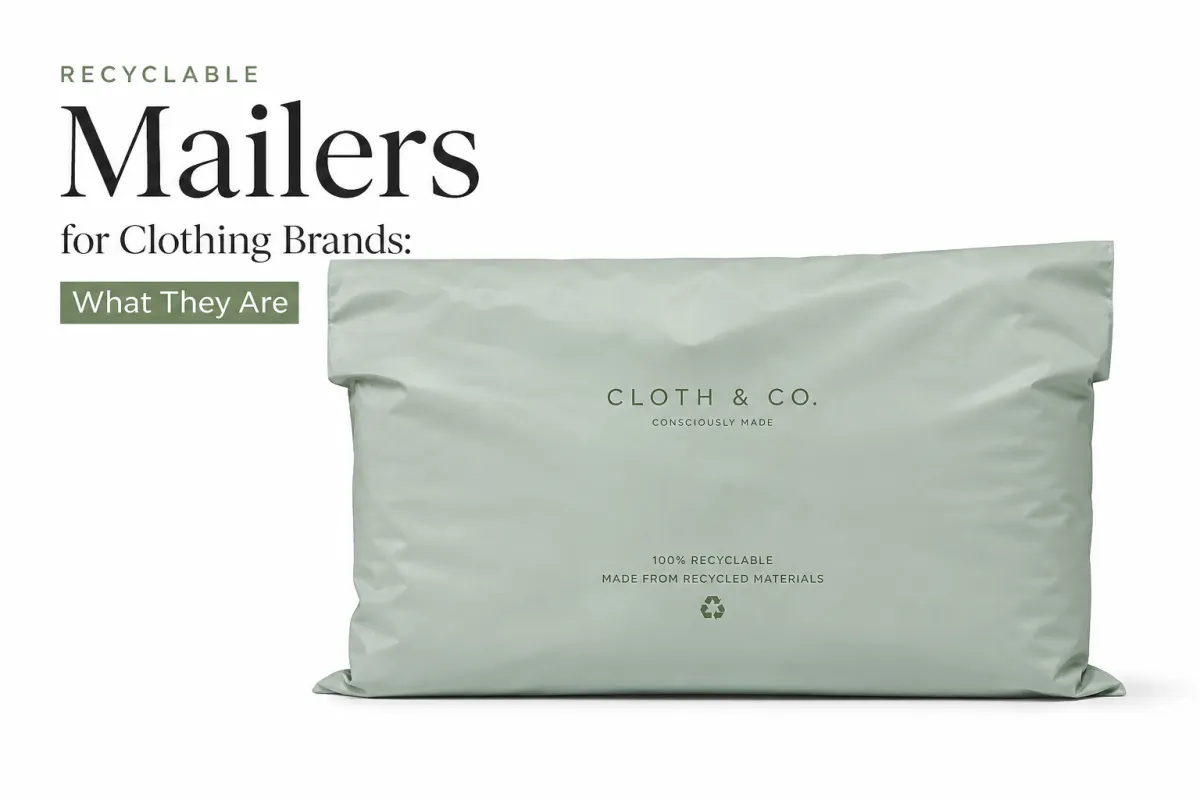
Recyclable mailers for clothing brands are shipping bags designed to enter a recycling stream after use, usually by relying on a single dominant material and avoiding layered combinations that complicate sorting. In practice, that often means a mono-material polyethylene film instead of a pouch built from mixed plastics, paper, foil, and coatings.
The important distinction is simple: a package can be recyclable without being recycled everywhere. Those are separate claims. Recycled content is different again. Brands sometimes merge those ideas into one tidy sales line, then discover that the customer-facing promise is more ambitious than the local recycling system can support. Clearing up that difference before ordering recyclable mailers for clothing brands saves a lot of trouble later.
Technical recyclability is only part of the decision. Apparel shipments are light, but they still need enough puncture resistance to handle folded zippers, buttons, hang tags, and rough parcel handling. If a mailer tears in transit, the sustainability message turns into a returns issue fast. That is not the place to learn that the film gauge was too thin.
“Eco-friendly” is a weak buying signal unless the supplier can explain the base resin, the film thickness, the seal method, and the intended recovery path. Packaging decisions should be grounded in material data, not broad adjectives. The more precise the answer, the easier it is to judge whether the mailer belongs in your shipping program.
For clothing brands, the right starting point is to map the product mix first, then match the mailer to the real shipping conditions. A folded tee, a knit sweater, and a denim bundle each put different demands on the package. Recyclable mailers for clothing brands should be chosen around those details, not around a generic sustainability badge.
Practical note: if your team wants a broader packaging baseline before narrowing to a mailer format, our Custom Packaging Products page is a useful place to compare structures and print options.
How Recyclable Mailers for Clothing Brands Work
The simplest recyclable mailers for clothing brands are usually built from one primary polymer, often polyethylene, because a single-material structure is easier to sort and process than a package made from several incompatible layers. That does not guarantee curbside acceptance, but it does improve the odds that the mailer can move through the right recovery stream. The structure matters more than any recycling symbol printed on the outside.
Construction details carry more weight than many buyers expect. A practical mailer usually has three core parts: the film body, the closure, and the print layer. When those pieces are compatible, the package stays closer to true recyclability. When they are not, one weak element can pull the entire claim off course. A mailer is a system, not just a bag, and recyclable mailers for clothing brands need to be treated that way.
Closures deserve special attention. Peel-and-seal strips, pressure-sensitive adhesives, and tear features all affect the customer experience and the recovery path. A closure that grabs too hard can make the bag awkward to open. One that is too weak can fail in transit. The strongest option is the one that holds through shipping, opens cleanly, and keeps extra material out of the package design.
Ink coverage matters too. Heavy decoration is possible, but it should be deliberate. Most brands get better results from controlled print zones, restrained coverage, and a clear idea of how much ink is needed to give the mailer a branded feel. Overprinting can make a package look premium in a rendering, yet it can also add unnecessary material load and cost. That is why recyclable mailers for clothing brands often work best with disciplined graphics instead of full-surface treatment.
It also helps to separate curbside collection from drop-off programs. Many plastic films are not accepted in curbside bins because they can tangle sorting equipment. Store drop-off or a specialized collection stream is often the intended route. That distinction matters because a brand should never promise a recycling action the customer cannot reasonably complete at home. The EPA recycling guidance is a better reality check than a vague recyclable claim, and ISTA testing methods are a useful reference when you want to understand how the package should hold up during parcel transit before it ever reaches the recycling question.
Here is the short version: if the mailer is built from a compatible material system, printed with restraint, sealed properly, and matched to the right recovery stream, recyclable mailers for clothing brands can perform well. If any one of those pieces slips, the claim weakens quickly.
Key Factors That Shape Performance and Fit
Fit is the first filter. Oversized mailers waste film and create a loose, sloppy opening experience. Undersized mailers create stress at the seams, raise puncture risk, and can compress garments too tightly during packing. A good fit is not flashy, but it is where recyclable mailers for clothing brands either control cost or quietly leak it away.
Garment type changes the equation right away. A lightweight tee or tank can often move in a thinner film, while folded denim, sweatshirts, and outerwear need more strength at the corners and better resistance to stretching. Knitwear can snag on rough seams. Jackets may have zippers or snaps that press against the interior wall of the bag. A mailer may still function with the wrong gauge, but the margin for error narrows fast once returns or transit damage start showing up. That is why recyclable mailers for clothing brands should be chosen by product family, not by a single blanket rule.
The customer experience deserves equal attention. A mailer that opens neatly and arrives looking clean supports the brand story. One that is wrinkled, overfilled, or hard to open can make a sustainable package feel cheap. Apparel lives in two worlds at once: logistics and presentation. Teams often underestimate how much the unboxing moment influences repeat purchase behavior. A customer might forgive a plain bag; they are less forgiving when it feels kind of careless.
Print decisions can help or hurt. High-opacity inks improve graphics, but they should be used with restraint. Dark, full-coverage designs may look strong in a mockup, yet they can add cost and complicate environmental claims if the build depends on extra coatings. A cleaner approach is often a sharp logo, one or two brand colors, and enough negative space to keep the mailer legible and recyclable. That difference separates strategic branding from decoration for its own sake.
Warehouse handling is another real-world variable. If the packing line is semi-automatic, the opening width, film stiffness, and seal behavior need to match the station speed. If staff pack by hand, the mailer should be easy to grab, open, fill, and close without wasting seconds on every order. On a 5,000-piece run, even a two-second improvement per pack can save hours of labor. That is not theory. It is simple arithmetic.
The toughest shipment should set the standard. Test the heaviest item in the line, not the average one. Use a worst-case folded bundle. Add the carton slip, the label, and any inserts you actually ship. That is the fairest test for recyclable mailers for clothing brands if the goal is to avoid rework later.
A mailer that saves half a cent but adds two minutes of packing labor is not savings. It is just a delayed expense with better packaging.
If you need proof points from apparel packaging programs rather than theory, our Case Studies page is a useful place to see how different packaging choices perform in practice.
Cost and Pricing for Recyclable Mailers
Price is usually the first question, and it should be. The wrong comparison is mailer A versus mailer B at the sticker price only. The real question is what happens to freight, damage, labor, and returns once the choice is live. That is especially true for recyclable mailers for clothing brands, where shipping volume turns small differences into real budget shifts.
Here are the main price drivers:
- Material type: mono-material polyethylene, paper-based alternatives, and blended structures sit in different cost bands.
- Recycled content: post-consumer or post-industrial content can add a premium, depending on supply and certification needs.
- Print coverage: one-color logos are usually cheaper than full-coverage branding.
- Order volume: 3,000 units and 30,000 units are not priced the same way.
- Mailing size: larger formats use more resin and more freight space.
- Closure style: stronger adhesive systems and tear features can raise the unit cost slightly.
At a practical level, a stock recyclable mailer at a 5,000-unit quantity might land around $0.09-$0.16 per unit, depending on size and material thickness. A custom printed mono-material option might run about $0.14-$0.28 per unit. Heavier-duty versions, premium print coverage, or lower order quantities can push that higher. Those ranges keep the discussion anchored in reality instead of vague “affordable” language. Recyclable mailers for clothing brands are rarely the priciest item in the box, but they are often the most visible.
Stock versus custom is worth separating. Stock mailers can be cheaper and faster to launch, which helps if you are testing a new line or replacing a packaging format after a failure. Custom mailers take longer and usually cost more at the start, but they can be more efficient once the design is locked and the volumes are steady. For brands shipping a consistent SKU mix, custom often makes sense after the trial period. For brands still changing sizes or fold methods every other month, stock can be the smarter bridge.
There is also a hidden cost question: dimensional weight. If a mailer is too large, the parcel can cost more to ship even when the film itself is inexpensive. A cheaper mailer is not always a cheaper package. A tighter fit often reduces wasted air, and in some fulfillment lanes that translates into meaningful savings over a year. With apparel, a few extra millimeters can matter more than buyers expect.
| Option | Typical Use | Approx. Unit Price at 5,000 | Lead Time | Main Tradeoff |
|---|---|---|---|---|
| Stock mono-material mailer | Fast launch, simple apparel orders | $0.09-$0.16 | Often immediate to 2 weeks | Limited branding and size choice |
| Custom printed recyclable mailer | Core DTC shipping program | $0.14-$0.28 | Often 12-15 business days after proof approval | Higher setup effort |
| Recycled-content premium mailer | Brands with stronger sustainability targets | $0.18-$0.35 | Varies by material availability | Can depend on resin supply and certification |
| Heavy-duty oversized mailer | Outerwear, dense knits, bundled orders | $0.20-$0.40+ | Often 2-4 weeks | Higher film use and freight cost |
Always ask for freight separately. A quote that looks strong on unit price can turn less attractive once shipping, duties, or warehousing are added. The best buying habit is to request three tiers of pricing, compare total landed cost, and then test the top two options side by side. That is the clearest way to judge recyclable mailers for clothing brands without getting trapped by a low number that only works on paper.
For brands building a fuller packaging lineup, our Custom Poly Mailers page can help you see how standardized sizes and printed formats are usually structured before you request quotes.
Process and Timeline: From Sample to Shipment
The process is usually straightforward, but only if the brand is decisive. The typical path for recyclable mailers for clothing brands starts with material selection, moves to artwork and proofing, then sampling, final approval, production, and freight. The order sounds simple. The reality gets messy if the team is still debating size, print coverage, or sustainability claims halfway through the run.
Sample timing is often faster than full production, though not instant. A sample can arrive in a few days if the material is stock, or a bit longer if it needs custom print or a special gauge. Once the sample is in hand, the useful question is not whether it looks nice. The useful question is whether the garment folds cleanly, whether the seal closes reliably, and whether the package survives the carrier route you actually use. That is the real test for recyclable mailers for clothing brands.
Production often takes 12 to 15 business days after proof approval for common custom runs, although that can stretch if the order needs a special resin blend, a larger print setup, or extra compliance checks. Freight adds another layer. Domestic transit may be quick, but overseas or cross-border shipments need more buffer. Smart brands do not wait until the last reorder day to begin the next cycle.
Where do delays usually show up? Three places, and the pattern is predictable:
- Artwork revisions: teams change logos, legal copy, or color counts after the proof is already moving.
- Material substitutions: a supplier may need to switch film stock if one grade is unavailable.
- Late-stage testing: a sample passes visually but fails seam strength, fit, or peel performance.
The last one matters more than brands like to admit. A late failure can push the launch back by a week or two, and in apparel that can mean shipping defaulting to an older package while the new one waits. That is not ideal, but it is still better than sending out a weak design just to protect a calendar date.
A pilot rollout is the cleanest way to reduce risk. Ship one product line, or even one size family, before switching the whole catalog. Use the pilot to check pack speed, label adhesion, customer response, and the rate of damaged returns. If the mailer does the job, scale it. If not, adjust the gauge or size and test again. That is how recyclable mailers for clothing brands become a durable program instead of a one-off purchase.
Step-by-Step Guide to Choosing the Right Mailer
The cleanest way to choose recyclable mailers for clothing brands is to start with a packaging audit, not a catalog. List the top SKUs, average folded dimensions, weight ranges, return rates, and the failure points in your current packaging. If one style tears, another arrives too loose, and a third looks oversized, the package issue is probably a sizing problem first and a sustainability problem second.
Then define the goal. Are you trying to reduce waste, improve presentation, lower unit cost, meet a retailer requirement, or support a sustainability statement already on your site? The answer changes the mailer spec. A brand chasing a premium unboxing feel may accept a slightly higher cost for a better print finish. A fast-growing essentials brand may care more about pack speed and reorder simplicity. Recyclable mailers for clothing brands should match the goal, not the other way around.
Next, shortlist two or three constructions. Do not ask for ten. That creates decision fatigue. Request samples in the actual sizes you are likely to use, and test them with real folded garments, not empty bags. Run them through the same route your orders take today. If you use multiple carriers, test the roughest one. If your team knows the lane where parcels get beat up, test that one too. Practical testing beats assumptions every time.
Use a scorecard so the choice stays objective. A simple five-point grid works well:
- Fit: Does the mailer match the garment with minimal wasted space?
- Durability: Does it resist puncture, splitting, and seal failure?
- Print quality: Is the branding clean and legible without overdoing the surface?
- Cost: Does the total landed cost fit the margin plan?
- Customer experience: Does it open well and arrive looking intentional?
If one option wins on cost but fails on fit, the savings are fragile. If another looks excellent but slows packing by five seconds per order, the labor cost may erase the packaging gain. The best result is usually the one that performs well across all five areas, even when it is not the absolute cheapest line item. That is the kind of judgment that keeps recyclable mailers for clothing brands from becoming a vanity purchase.
One more practical rule: test the worst-case item in the line, not the best. A thick hoodie, an uneven bundle, or a return shipment can reveal flaws that a simple tee never will. Packaging should survive edge cases. That is what makes the program trustworthy.
Common Mistakes, Expert Tips, and Next Steps
The biggest mistake is greenwashing language. If a supplier says the mailer is recyclable “everywhere,” ask for the exact material spec and the actual recycling path. A package that only works in certain programs should not be sold as universally accepted. Recyclable mailers for clothing brands deserve accurate claims, because customers notice when a sustainability promise feels inflated.
The second mistake is sizing by intuition. Apparel teams often guess the mailer size from the garment itself rather than from the folded, packed, labeled order. That leads to too much headspace, more material use, and a package that looks larger than it needs to be. The fix is simple: measure the final packed form, not the hanger sample.
The third mistake is weak sealing. A mailer that opens in transit creates a customer service problem immediately. Seal strength should be tested with real handling, not just a quick finger press. Try corner drops, compression, and rough sorting simulation. If the mailer can survive that, it is much closer to ready. That is the kind of discipline that separates dependable recyclable mailers for clothing brands from a nice-looking prototype.
There are also a few expert habits worth copying:
- Test with the heaviest and bulkiest item in the line.
- Check how the mailer opens when the customer receives it.
- Confirm that your packing staff can use it at speed.
- Ask for resin and print details in writing.
- Compare total landed cost, not just the printed unit price.
It also helps to think beyond the bag itself. If your inserts are heavy, your labels are oversized, or your return flow is changing, those details influence the final mailer choice. Packaging rarely fails because of one dramatic issue. It usually fails because three small things were not aligned.
So what should happen next? Start with a current-state audit, request two or three sample constructions, run one short pilot on a single product line, and compare damage, labor time, and customer feedback before you commit to a full switch. If the pilot is solid, broaden the rollout. If not, adjust the gauge or size and test again. That measured path is usually the safest way to adopt recyclable mailers for clothing brands without creating shipping headaches.
If you want to see how packaging choices fit into a wider branding and fulfillment plan, our Case Studies page is a practical place to start. And if you are comparing formats beyond mailers, the Custom Packaging Products page can help you map the options without starting from scratch.
I think the brands that do best here treat recyclable mailers for clothing brands as a logistics specification first and a marketing message second. That order matters. Get the structure right, keep the claims honest, test the package hard, and the sustainability story becomes much easier to defend.
FAQ
Are recyclable mailers for clothing brands actually curbside recyclable?
Not always. Curbside acceptance depends on the exact film, the local recycling program, and whether the mailer is clean and empty. Many recyclable mailers for clothing brands are designed for store drop-off or specialized collection streams instead of curbside bins. Always verify the material specification before promising recyclability to customers.
What makes recyclable mailers for clothing brands different from recycled mailers?
Recyclable refers to the end-of-life path, while recycled refers to the input material used to make the mailer. A mailer can contain recycled content and still not be widely recyclable, and vice versa. Brands should check both claims separately so they do not assume one automatically means the other.
How do I choose the right size recyclable mailer for apparel orders?
Base the size on your folded product dimensions, not on the shipping label size or a rough guess. Leave enough room for seals and easy insertion, but avoid so much excess space that the package looks wasteful. Test your top three order types to confirm the mailer works for single items, bundles, and heavier garments.
Do recyclable mailers for clothing brands cost more than standard poly mailers?
They can, especially when recycled content, custom printing, or low order volumes are involved. The full cost comparison should include freight, damage risk, returns, and brand impact, not just the per-unit price. Buying in larger quantities and standardizing sizes often narrows the gap quickly.
What should I test before switching to recyclable mailers for clothing brands?
Test seal strength, puncture resistance, packing speed, label adhesion, and how the mailer looks when it arrives. Ship real orders through your normal carriers and routes, including any rough handling cases you already know about. Use the test results to decide whether you need a stronger film, a different size, or a different closure.
For clothing brands that want packaging to feel sharper without losing control of cost or performance, recyclable mailers for clothing brands are a serious option, not a trend piece. Start with the SKUs that matter most, match the mailer to the folded product and the carrier lane, and only then scale the design across the rest of the line. That is the practical path that keeps the sustainability claim honest and the shipping operation steady.


