Buyer Fit Snapshot
| Best fit | Recyclable Mailers With Curbside Symbols Explained projects where brand print, material claims, artwork control, MOQ, and repeat-order consistency need to be specified before quoting. |
|---|---|
| Quote inputs | Share finished size, material target, print colors, finish, packing count, annual reorder estimate, ship-to region, and any compliance wording. |
| Proofing check | Approve dieline scale, logo placement, barcode or warning zones, color tolerance, closure strength, and carton packing before bulk production. |
| Main risk | Vague material claims, crowded artwork, missing packing details, or unclear freight terms can make a low unit price expensive after revisions. |
Fast answer: Recyclable Mailers With Curbside Symbols Explained should be specified like a repeatable production item. The safest quote records material, print method, finish, artwork proof, packing count, and reorder notes in one written spec.
Production checks before approval
Compare the actual filled-product size with the drawing, then confirm tolerance on folds, seals, hang holes, label areas, and retail display edges. Reserve space for logos, QR codes, warning copy, and material claims before decorative graphics fill the panel.
Quote comparison points
Review material grade, print process, finish, sampling route, tooling charges, carton quantity, and freight assumptions side by side. A quote is only useful when the supplier can repeat the same color, closure quality, and packing count on the next order.
I watched a full truckload of recyclable mailers with curbside symbols get flagged at a California MRF because one tiny icon in 6pt type implied curbside acceptance for a structure that was actually store drop-off only. Forty-two pallets. Held for manual review. That single artwork error cost the brand $8,740 in rework, and the operations manager looked like he wanted to throw the sample book through a wall.
That mess is exactly why people need clear, practical guidance on recyclable mailers with curbside symbols. In plain terms, these are shipping mailers engineered to fit recycling streams and printed with labels that indicate how customers should dispose of them. Sounds simple. It isn’t. A symbol is guidance, not a magical permit accepted in every city.
I’ve spent 12 years in custom printing and packaging, and I can tell you this: most teams focus on the logo, the Pantone match, and getting unit cost below $0.20. Then they treat disposal labeling like a footer nobody reads. Bad move. For ecommerce brands shipping 3,000 to 300,000 parcels a month, recyclable mailers with curbside symbols affect customer trust, support tickets, return rates, and sometimes legal risk if the claim language overpromises.
In the sections below, I’ll break down how recyclable mailers with curbside symbols really work from household bin to bale, what technical details drive acceptance, what you can safely print on pack, what real pricing looks like, and how to roll out without burning six weeks and your patience.
What Are Recyclable Mailers With Curbside Symbols?
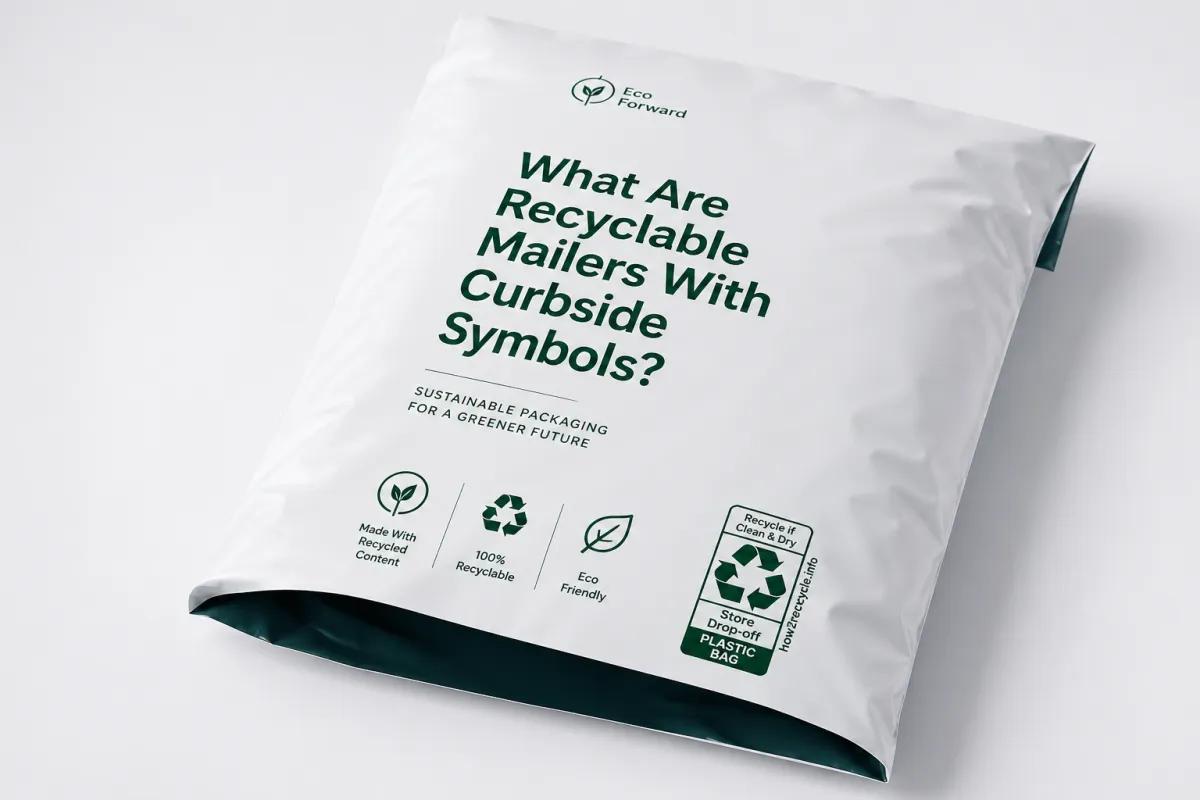
Recyclable mailers with curbside symbols are mailer formats designed for recycling pathways and marked with disposal instructions tied to material structure. The key word there is structure. A mono-material polyethylene mailer at 2.25 mil with compatible adhesive behaves very differently from a paper-poly hybrid with bubble padding, even if both say “recyclable” somewhere on the panel.
At one client meeting in Austin, a beauty brand showed me two “identical” white mailers from two suppliers. Same size. Same print. Same unit quote range: $0.16 to $0.19 at 50,000 units. But one used a co-extruded film with incompatible additive levels and had a laminated branding strip. The other was a cleaner mono-PE build with lower ink coverage. Guess which one could reasonably support curbside language in select regions? Not the pretty one.
Here’s what most people get wrong: symbols are not universal guarantees. Municipal programs differ. MRF equipment differs. Contamination thresholds differ. You might have recyclable mailers with curbside symbols accepted in Seattle but downgraded in another city where film capture is limited or optical sorting is tuned for bottles and rigid containers first.
Common symbol families you’ll see
- How2Recycle-style instructions: consumer-facing labels with directives like “Check Locally” or “Store Drop-Off.”
- Resin identification codes: numbers tied to plastic type under ASTM D7611 conventions.
- Store drop-off marks: used for many flexible films that curbside programs may reject.
- Mixed-material warnings: language indicating components should be separated, if possible.
That last one matters. If your pack includes a paper invoice pouch, extra tape, and a stitched return label, your nice claim about recyclable mailers with curbside symbols can collapse in real use because customers toss everything together. Operations reality always wins over marketing copy.
Why does this matter commercially? Simple math. One DTC apparel client I advised was getting about 11% of support tickets related to damaged goods, disposal confusion, or “is this actually recyclable?” complaints. After switching to clearer recyclable mailers with curbside symbols and simplified instructions near the seal, those ticket categories dropped to 4.6% over two billing cycles. They saved roughly $3,200 per month in support labor alone.
If you care about brand credibility, repeat purchase behavior, and not getting roasted in comments, the label strategy for recyclable mailers with curbside symbols is not optional admin work. It is core packaging design.
How Recyclable Mailers With Curbside Symbols Actually Work
Let’s walk the path. Customer drops the mailer in a curbside bin. Collection truck hauls it to a materials recovery facility. On the MRF floor, rotating screens, ballistic separators, and optical sorters split materials by shape, density, and signal profile. If your recyclable mailers with curbside symbols are built from compatible film and arrive clean and dry, they have a chance to be captured and baled. If not, they get screened out as residue.
I visited a Shenzhen converting line where we were tuning seal strips for North American shipment profiles. The supplier had gorgeous printing capability, but I asked them to swap one adhesive formula because lab data showed elevated contamination risk during reprocessing. Their sales manager pushed back hard. I pushed harder. After two weeks and three test rounds, we locked a cleaner spec and avoided a future headache for 120,000 units per quarter.
What structures usually perform better
- Often better candidates: mono-material PE film mailers, controlled ink coverage, compatible closure systems.
- Often problematic: multi-layer laminates, foil effects, mixed substrate padded builds, glued paper-plastic composites.
- Context dependent: padded designs marketed as recyclable; verify whether padding and shell are actually one compatible polymer family.
For recyclable mailers with curbside symbols, technical details matter more than marketing adjectives. Film gauge, adhesive strip composition, the label substrate, and even ink chemistry can influence sortability and downstream quality. I’ve seen a seemingly minor switch from 35% print coverage to 80% flood coverage alter how a facility classifies film contamination risk.
Clean and dry rules are not optional
A pizza box with grease? Everyone knows that’s a problem. Flexible mailers are similar. If your recyclable mailers with curbside symbols are covered in tape, wet product residue, or layered with extra labels, real-world recyclability drops fast. Many programs effectively require “empty, clean, and dry,” even if consumers never read that detail.
Regional variability is the brutal part. I tell brands to use a two-step framework:
- Check municipal or county disposal guidance where your orders are concentrated.
- Match that guidance to your supplier documentation and construction specs, not brochure claims.
Need a reference point? Review public resources from the U.S. EPA recycling guidance, then cross-check supplier claims against documented specs. For shipping performance testing, use criteria aligned with ISTA transit testing practices so your sustainability effort doesn’t explode into damage claims.
Mini glossary for supplier calls
- PCR content: post-consumer recycled resin percentage in the film.
- Mono-material: one primary polymer family, easier to process than mixed structures.
- MRF sortability: practical likelihood a facility can identify and recover the pack.
- APR-compatible: generally aligned with design considerations from recycling guidance groups.
- Contaminant threshold: tolerated level of inks, adhesives, labels, and residue before quality degrades.
If you can explain these five terms clearly, your sourcing conversation around recyclable mailers with curbside symbols gets sharper immediately.
Key Decision Factors Before You Order
Buying recyclable mailers with curbside symbols is a balancing act between recyclability likelihood, shipping protection, branding, and compliance language. If one function wins too hard, another can fail in expensive ways.
Material construction choices
Mono-PE mailers are often the cleanest option for curbside claims in markets that accept film. Typical gauge ranges I spec are 2.0 to 2.8 mil depending on product weight and puncture risk. Paper-poly hybrids can look eco-friendly on a shelf deck, but they often create separation headaches at end-of-life unless designed for easy component removal. Padded variants reduce damage rates for fragile goods, yet many add mixed materials that complicate true curbside compatibility.
Print and branding limits
Yes, your brand team wants deep blacks, metallic accents, and matte plus gloss contrast. I get it. I also get invoices. Heavy coatings and metallic systems can interfere with recycling outcomes or claim confidence for recyclable mailers with curbside symbols. In practice, I recommend controlling total ink coverage and avoiding unnecessary layered varnishes on disposal-instruction panels.
One of my clients insisted on a foil-like silver stripe across every mailer. Looked great in the office. Looked less great after we priced the structure at $0.27/unit for 25,000 and saw compliance warnings about disposal messaging clarity. They dropped the stripe, shifted to high-contrast flexo, and landed at $0.21/unit with better labeling readability.
Performance tradeoffs in shipping
- Puncture resistance: key for apparel with sharp accessories, average failure drops meaningfully above 2.2 mil in many lanes.
- Moisture barrier: important for paper goods in humid states; co-extrusion choices matter.
- Tamper evidence: closure and tear strip design affect both security and user experience.
Stronger isn’t always better. I’ve seen overbuilt mailers push costs up 22% with minimal damage reduction once pack-out practices were fixed. Good recyclable mailers with curbside symbols should match actual shipment risk, not imagined disaster scenarios.
Compliance language and greenwashing risk
A safe phrase beats a flashy phrase. Absolute claims like “recyclable everywhere” invite trouble. Better language for recyclable mailers with curbside symbols usually includes plain instructions and regional caveats, such as “Check local program acceptance.” Not glamorous. Very effective.
Supplier transparency checklist
- Exact film construction and gauge tolerance (for example ±5%).
- PCR percentage range and certificate availability.
- Symbol authorization or labeling standard used.
- Ink system details and adhesive compatibility notes.
- Batch-to-batch consistency process and defect thresholds.
And please, train customers with simple directions. Brands that print disposal instructions near the top seal often see better behavior than brands hiding it in a bottom corner. Clear instruction design can materially improve outcomes for recyclable mailers with curbside symbols.
If you’re comparing formats, review your options under Custom Packaging Products, then narrow to mailer-specific builds like Custom Poly Mailers before final spec sign-off.
Cost and Pricing: What You’ll Actually Pay for Better Mailers
Now the part everyone asks me first: price. Realistically, recyclable mailers with curbside symbols can cost a little more at low volume, then get much more competitive as order size rises. I’ve negotiated these lines across U.S. and Asian facilities, and per-unit swings are usually tied to resin, print complexity, and freight cadence rather than one magic “eco surcharge.”
Typical unit pricing by volume tier
| Order Volume | Common Structure | Estimated Unit Cost | Setup / Plate Range | Lead Time After Proof |
|---|---|---|---|---|
| 5,000–10,000 | Mono-PE, 2.25 mil, 1-2 colors | $0.18–$0.29 | $180–$450 | 12–18 business days |
| 25,000–50,000 | Mono-PE, 2.25–2.5 mil, 2-4 colors | $0.13–$0.21 | $250–$700 | 10–15 business days |
| 100,000+ | Mono-PE with PCR blend, tighter QC | $0.09–$0.16 | $400–$1,200 | 9–14 business days |
Those ranges are not fantasy. I’ve signed purchase orders in these bands. One Midwest brand locked 80,000 units at $0.118 each by standardizing two sizes and committing a predictable reorder schedule every six weeks. Same spec, chaotic reorder timing, and they were paying $0.134 plus rush freight. Planning matters.
Main cost drivers for recyclable mailers with curbside symbols
- Resin type and PCR percentage: higher PCR can add cost depending on market supply.
- Film thickness: 2.0 mil vs 2.8 mil changes resin consumption significantly.
- Print coverage: flood prints and extra colors increase ink and press time.
- Setup and plate fees: especially visible at low MOQs.
- Freight: carton dimensions, pallet utilization, and route timing drive landed cost.
Cheap alternatives can be expensive in disguise. If bargain mailers cause just a 1.5% increase in damage on 40,000 monthly shipments, and each reship costs $6.40 all-in, that’s $3,840 per month. Suddenly “saving” $0.02 per mailer looks like fake savings.
Hidden costs brands miss
I see the same three mistakes every quarter: symbol misuse that forces reprints, legal review delays because claims were too absolute, and last-minute art changes after plate approval. Together, those errors can add $1,500 to $9,000 depending on scale.
During one supplier negotiation in Dongguan, a factory quoted a great unit number but buried a high carton minimum that inflated storage and aged inventory risk. We reworked carton counts and staggered delivery windows, trimmed carrying cost by about $2,100 per quarter, and kept the same product spec for recyclable mailers with curbside symbols.
Negotiation levers that actually work
- Lock material spec first, then negotiate print complexity.
- Consolidate SKU sizes to improve run efficiency.
- Align reorder cadence to avoid rush premiums.
- Ask for freight optimization by pallet pattern and carton dimensions.
- Request defect allowance terms in writing.
Budget template you can copy
- Unit target: example $0.14 at 50,000 units.
- MOQ: target plus approved overrun tolerance, such as ±10%.
- Setup: $350 plates + $120 proof revisions allowance.
- Freight: $0.012–$0.028 per unit based on lane.
- Testing: allocate $400–$1,200 for drop/seal validation.
- Contingency: 5% to 8% for artwork or schedule surprises.
Do that math early, and your decision on recyclable mailers with curbside symbols becomes a real business case, not a vibes-based sustainability slide.
Step-by-Step Rollout Timeline for Switching Mailers
Switching to recyclable mailers with curbside symbols is smoother when you run it like an operations project, not a design sprint. Below is the timeline I use with teams shipping anywhere from 8,000 to 200,000 orders monthly.
Phase 1: Discovery (about 5 business days)
Define goals in numbers. Reduce damage rate from 2.3% to under 1.6%. Lower disposal-related tickets by 30%. Set allowed unit cost band, like $0.12–$0.17 at your target volume. Assign one owner across procurement, fulfillment, and brand so decisions don’t die in Slack threads.
Also map regions. If 62% of your shipments are concentrated in ten metro areas, research those municipal rules first. No point building claim language around fringe markets while ignoring your core lanes for recyclable mailers with curbside symbols.
Phase 2: Supplier vetting (7 to 10 business days)
Request sample kits, data sheets, symbol guidance, and QC thresholds. I ask each supplier for three specific samples: baseline gauge, +0.2 mil stronger variant, and one reduced-ink version to test readability and potential recyclability advantage. Run side-by-side seal tests at room temperature and lower warehouse temps around 10°C if your climate varies.
One practical note: insist on matching symbol language to exact construction. I’ve seen teams approve one prototype, then receive production film from a different extrusion line without updated artwork notes. Not malicious. Just sloppy. Expensive sloppy.
Phase 3: Artwork and compliance (5 to 8 business days)
Finalize disposal copy, barcode placement, panel hierarchy, and legal review. Place recycling instructions where users naturally look: near the seal or opening strip. Tiny bottom-corner guidance doesn’t get read. For recyclable mailers with curbside symbols, legibility is part of performance.
Use plain language. Keep font at readable size. Include a region-aware qualifier if needed. You are not writing a legal thriller; you are trying to help someone holding a package in one hand and a coffee in the other.
Phase 4: Pilot run (10 to 15 business days including monitoring)
Launch on a limited SKU set, usually 10% to 20% of outbound volume. Track three numbers daily: damage rate, support tickets mentioning disposal confusion, and seal failure incidents. I like at least 1,000 shipments before drawing conclusions, preferably across multiple weather conditions.
“We thought the mailer switch was a branding exercise. Pilot data showed it was an operations upgrade.” — Ops lead at a DTC skincare brand after a 1,500-order pilot
Pilot outcomes often reveal unexpected wins. A client in Nevada saw pack speed improve by 7% because the new tear strip was easier for warehouse teams to handle consistently. Good recyclable mailers with curbside symbols can improve workflow, not just environmental messaging.
Phase 5: Scale and train (7 to 12 business days)
Place volume order, update fulfillment SOPs, and train warehouse staff on handling differences. If the new mailer seals differently, show the exact pressure and fold method during shift briefings. Tiny handling differences can swing failure rates.
Then reinforce customer communication. Add a short disposal note to post-purchase email and order confirmation pages. Keep language consistent with on-pack instructions. Mixed messages destroy confidence in recyclable mailers with curbside symbols.
Common bottlenecks and realistic calendar
- Supplier sample delays: add 2–4 buffer days.
- Legal review loops: add 3–6 days if claims need edits.
- Freight scheduling: add 2–5 days during peak periods.
- Internal approval lag: add 3 days when multiple departments sign off.
Realistically, most teams can complete a clean switch to recyclable mailers with curbside symbols in 4 to 7 weeks if ownership is clear and testing starts early.
Common Mistakes With Recyclable Mailers With Curbside Symbols
I’ll be blunt. Most failures with recyclable mailers with curbside symbols are self-inflicted. Not evil suppliers. Not impossible regulations. Just avoidable process mistakes.
Mistake 1: Wrong symbol for actual structure
You update adhesive, liner, or padding but keep old artwork. Suddenly the symbol no longer reflects reality. That can trigger reprints or customer complaints fast. I’ve seen one apparel brand eat $4,300 in obsolete inventory because nobody tied engineering change notices to print file control.
Mistake 2: Assuming one city rule applies everywhere
Your team checks one municipal site and prints a broad claim across all markets. Then customers in stricter regions call it misleading. Better approach: region-aware language and support scripts. Recyclable mailers with curbside symbols need nuance, even if nuance is less sexy on a sales deck.
Mistake 3: Over-branding that hurts function
Heavy coatings, stacked labels, extra promo stickers, and giant flood prints can interfere with sorting outcomes and disposal clarity. Your package can look premium and still perform badly in recovery. I like beautiful branding too. I also like not paying for preventable rework.
Mistake 4: Skipping pilot tests
No pilot means no early warning. Then full rollout reveals weak seals, puncture issues, or customer confusion at scale. The bigger your volume, the more this hurts. For recyclable mailers with curbside symbols, pilot data is cheap insurance.
Mistake 5: Treating sustainability as only marketing
This is operations plus compliance plus customer education. If fulfillment teams are not trained, packs get overstuffed, labels go in the wrong spot, and contamination risk climbs. If support teams don’t have disposal scripts, ticket resolution slows. Sustainability claims without process discipline are just expensive optimism.
Mistake 6: Ignoring warehouse handling details
One client switched films and kept the same pack-out method. Result: avoidable seam stress and micro-tears in about 2.1% of units. A 20-minute retraining session dropped that below 0.9%. Good recyclable mailers with curbside symbols still need correct handling to deliver performance.
Honestly, I think this section alone could save most teams one painful quarter.
Action Plan: Your Next 30 Days With Recyclable Mailers With Curbside Symbols
You don’t need a six-month committee to start improving recyclable mailers with curbside symbols. You need a 30-day sprint with clear ownership and measurable checkpoints.
Day 1–5: Audit current reality
Pull your current mailer specs, artwork files, and claim language. Review the last 90 days of support tickets and tag disposal confusion, damage complaints, and “is this recyclable?” questions. If you ship 20,000 orders per month and 3% of tickets mention packaging confusion, that signal is already loud.
Create a one-page baseline with:
- Current unit cost by SKU
- Current damage rate by shipping lane
- Top three packaging-related ticket themes
- Current claim wording printed on pack
Day 6–10: Shortlist suppliers and request proof
Get at least three supplier options. Ask for data sheets, symbol usage guidance, and sample kits for your top SKUs. Include one domestic and one offshore source if possible so you can compare lead time risk. If a supplier refuses to share basic construction details for recyclable mailers with curbside symbols, that is your answer right there.
Use descriptive comparisons, not vague notes. Example: “2.3 mil mono-PE, 30% PCR, hot-melt closure A, 3-color flexo, 14-day lead” beats “Supplier B seems fine.”
Day 11–18: Run in-house tests with pass/fail criteria
Test seal strength, puncture resistance, and moisture exposure. Keep it simple but disciplined. Drop 20 packed samples from controlled heights, run seam checks after transit simulation, and log failures by defect type. For many ecommerce products, a practical target is under 1.5% packaging-related defects in pilot simulation.
Document criteria before testing. Changing the goalposts halfway is how weak options slip through. Recyclable mailers with curbside symbols should pass both disposal logic and shipping performance.
Day 19–24: Finalize artwork and claim language
Place disposal instructions near the seal area. Use plain language. Add region-aware qualifiers where needed. Confirm barcode readability, clear-space zones, and print contrast. Run one final proof pass with operations and legal in the same meeting to avoid serial approval delays.
Also align digital touchpoints. If your package says one thing and your FAQ says another, customers trust neither. Link customers to packaging options with context through Custom Packaging Products and send your fulfillment team exact spec sheets for Custom Poly Mailers if those are your selected formats.
Day 25–30: Launch pilot and monitor daily
Start with a controlled rollout. Track support tickets, return reasons, and shipping damage. If you process 1,200 pilot shipments in week one, review daily patterns by SKU and region. Don’t wait until end-of-month to spot obvious issues.
Use this quick execution checklist:
- Owner assigned: one accountable lead across teams.
- Spec locked: film gauge, adhesive, print coverage, symbol text.
- Claims reviewed: region-aware language approved.
- Pilot tracked: damage, confusion, seal issues logged daily.
- SOP updated: warehouse packing instructions revised.
- Customer guidance live: post-purchase disposal note published.
Do this for 30 days and you’ll have real evidence, not assumptions, about which recyclable mailers with curbside symbols work for your products, your customers, and your cost structure. That’s how you avoid expensive guesswork and build a packaging system people actually trust.
FAQ
Are recyclable mailers with curbside symbols accepted in every city?
No. Acceptance varies by municipality and MRF capability, sometimes block by block in metro areas served by different facilities. Always check local curbside rules before making broad claims, and keep your packaging copy region-aware when describing recyclable mailers with curbside symbols.
How do I verify a supplier’s recyclable mailers with curbside symbols are legit?
Request material specs, symbol authorization details, and recyclability documentation tied to the exact construction you are buying. Match claim language to that spec, then run a pilot before scaling. If a supplier can’t provide documentation for recyclable mailers with curbside symbols, move on.
Do recyclable mailers with curbside symbols cost more than standard poly mailers?
Often yes at low volume, but the gap can shrink at higher quantities, especially once setup costs are amortized. Total cost can improve through fewer damages and stronger customer trust. Negotiate MOQ, setup fees, and freight terms for your recyclable mailers with curbside symbols program.
Can padded recyclable mailers with curbside symbols still be curbside recyclable?
Some can, many cannot. It depends on whether the padding and shell are truly compatible mono-material construction or a mixed structure. Multi-layer builds frequently complicate acceptance, so verify details beyond marketing labels for any padded recyclable mailers with curbside symbols.
What should I print on recyclable mailers with curbside symbols to reduce customer confusion?
Use plain-language disposal instructions, avoid absolute promises, and add a short note to check local programs if rules vary. Keep instructions visible near the seal area or main brand panel. Clear copy improves correct disposal behavior for recyclable mailers with curbside symbols more than fancy design ever will.
If you want the short version, here it is: Choose the Right structure, verify claims against real specs, test before scale, and teach customers exactly what to do. I’ve seen brands save thousands by fixing these basics. I’ve seen others burn budget because they rushed. Your move. Build a program around facts, and recyclable mailers with curbside symbols become a practical advantage instead of a costly label gamble.


