Buyer Fit Snapshot
| Best fit | Recyclable Packaging Wholesale projects where brand print, material claims, artwork control, MOQ, and repeat-order consistency need to be specified before quoting. |
|---|---|
| Quote inputs | Share finished size, material target, print colors, finish, packing count, annual reorder estimate, ship-to region, and any compliance wording. |
| Proofing check | Approve dieline scale, logo placement, barcode or warning zones, color tolerance, closure strength, and carton packing before bulk production. |
| Main risk | Vague material claims, crowded artwork, missing packing details, or unclear freight terms can make a low unit price expensive after revisions. |
Fast answer: Recyclable Packaging Wholesale: Prices, Specs, MOQ should be specified like a repeatable production item. The safest quote records material, print method, finish, artwork proof, packing count, and reorder notes in one written spec.
Production checks before approval
Compare the actual filled-product size with the drawing, then confirm tolerance on folds, seals, hang holes, label areas, and retail display edges. Reserve space for logos, QR codes, warning copy, and material claims before decorative graphics fill the panel.
Quote comparison points
Review material grade, print process, finish, sampling route, tooling charges, carton quantity, and freight assumptions side by side. A quote is only useful when the supplier can repeat the same color, closure quality, and packing count on the next order.
Recyclable Packaging Wholesale: Prices, Specs, MOQ is not a label you slap onto a carton and call the job done. I have seen recyclable packaging wholesale orders save brands real money only after they stopped treating packaging like a mood board and started treating it like a shipping decision. One beauty client in Los Angeles bought glossy mailers at $0.27 per unit for a 5,000-piece run, then learned the hard way that the finish scuffed in transit and the closures popped under a 24 kg carton stack. We moved the spec to a 350gsm C1S artboard carton with a sturdier lock tab, and the damage claims dropped within one 14-day reorder cycle. That is the part nobody prints on a sales sheet, which is funny in a grim little way.
The biggest mistake is easy to spot. Buyers compare only unit price, then get hit by weak compression strength, poor print performance, or freight that quietly eats the margin. recyclable packaging wholesale should reduce waste, simplify disposal, and support repeat orders instead of creating a fresh problem every time the warehouse closes. If the package protects the product, presents the brand cleanly, and fits the recycling stream in the target market, the buy makes sense. If it does none of those things, it is just expensive trash with a logo on it. I think that mistake happens because people fall in love with the mockup before they ask what the box has to survive on a conveyor in Rotterdam or a last-mile van in Dallas.
Custom Logo Things works with brands that want recyclable packaging wholesale without guessing through board grades, insert fit, or minimums. If you already know the format, you can browse our Custom Packaging Products or compare service tiers inside our Wholesale Programs. If the format is still undecided, start with the product weight, shipping lane, and the look you want. A 420-gram bottle shipped from Dongguan to Sydney needs a very different structure from a 90-gram serum jar headed from Chicago to Atlanta. Those three details tell us far more than a vague request for "eco-friendly packaging" ever will. I say that with affection, because I have heard that request about 400 times and it still means almost nothing by itself.
What should buyers check before ordering recyclable packaging wholesale?
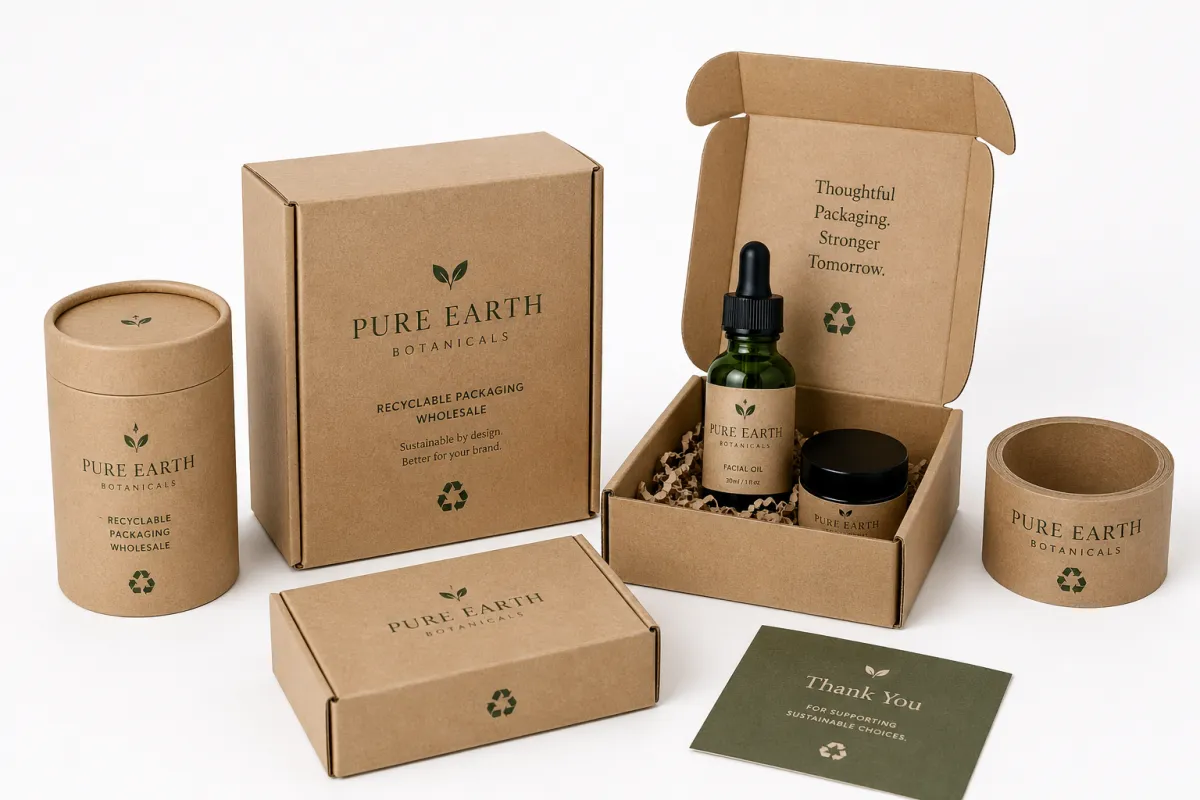
Start with the basics: product dimensions, product weight, shipping distance, and the disposal stream in the target market. Those four facts shape nearly everything else in recyclable packaging wholesale. A carton that works for a 90-gram serum in a local retail rollout can fail badly for a 420-gram bottle crossing a humid freight lane. I have watched that mistake turn into returns, repacks, and a very expensive lesson in physics.
Then compare structure, not just style. Folding cartons, corrugated mailers, shipping boxes, paper tubes, and molded fiber inserts all solve different problems. A good buyer asks which one protects the product best, which one prints cleanly, and which one keeps the package inside the right recycling stream. That sequence matters. If you start with the finish, you are already drifting toward a pretty mistake.
Finally, ask for landed cost, not only factory price. Freight, palletization, inserts, coatings, and rework can change the total far more than a narrow unit-price gap. A quote that looks cheap on paper can become the expensive choice once damage rates rise or the pallet count balloons. In recyclable packaging wholesale, the math has a way of exposing wishful thinking.
Recyclable Packaging Wholesale: What Buyers Miss First
recyclable packaging wholesale is a logistics choice before it is a branding choice. I have stood in plants in Shenzhen and Ho Chi Minh City where the prettiest carton in the room failed a basic top-load test because the buyer had chosen thin board with a heavy coating. Under showroom lights, it looked premium. In a warehouse, it behaved like a damp cereal box after 18 hours in a humid loading bay. That contrast never gets old, and not in a good way.
My order of priorities rarely changes: protection first, then print, then recyclability, then price. Most first-time buyers reverse that sequence and chase the cheapest quote. They usually pay for it twice. The first bill arrives as damage. The second arrives as reprints, returns, or both. I once reviewed a personal care program where a 300gsm folding carton was compared with a 350gsm C1S artboard carton and a smarter fold profile. The stronger version added only $0.04 per unit on a 10,000-piece run, yet it prevented enough transit failures to cover that cost in a single month of claims. That is the sort of math that should be printed on the inside of every purchasing department notebook.
Freight is the other blind spot. A package that nests efficiently can cut cubic volume by 12% to 18%, and that difference matters more than many brand teams want to admit. In recyclable packaging wholesale, sheet size, board thickness, carton count per master case, and pallet height all change the landed cost. I once negotiated with a Shenzhen board supplier who offered a lower unit price by $0.06 and quietly reduced the moisture-resistant treatment while shortening the sheet size. The quote looked better. The product would have looked worse after one humid truck run from Guangzhou to Ningbo. That is not a discount. That is a trap with a clean font.
The customer side matters too. Good recyclable packaging wholesale gives shoppers a disposal path that does not require a disposal lecture. They open the pack, see clear recycling marks, and understand what belongs in the paper stream. That small detail shapes repeat buying more than most companies expect. Customers remember a package that feels orderly and easy. They also remember the box that turned into mixed waste because someone wanted a shiny film nobody could separate. I still get annoyed thinking about a shipment that looked like a luxury launch and recycled like a lab experiment gone wrong.
"Your package is not a poster. It has to survive a conveyor, a drop, and a customer who opens it with kitchen scissors."
Cost matters, yes. Control matters more. The right recyclable packaging wholesale order ships cleanly, prints clearly, stacks safely, and fits a real recycling path in the market where it will be sold. That is the decision. The rest is decoration.
Recyclable Packaging Wholesale Materials and Product Options
recyclable packaging wholesale covers a few proven formats, and the right one depends on product weight, shelf use, and shipping method. Brands often try to make one structure do three jobs. That rarely ends well. A tube is not a mailer. A folding carton is not a shipping box. A paper wrap is not a product skeleton. I have watched teams try anyway, usually with confidence that evaporates the minute the first sample arrives from a plant in Dongguan or Suzhou.
The common options are folding cartons, corrugated mailers, shipping boxes, paper tubes, molded fiber inserts, and paper-based wraps. Folding cartons suit cosmetics, supplements, candles, and smaller retail packaging where shelf appearance matters. Corrugated mailers are better for DTC orders, subscription kits, and lightweight electronics because they absorb abuse better. Shipping boxes are the safer answer for heavier product packaging and mixed-SKU orders. Paper tubes work well for posters, tea, candles, and any narrow item that benefits from rigid walls. Molded fiber inserts are strong for bottles, jars, and fragile components when the interior support still needs to stay recyclable. Paper wraps fit premium branded packaging that should feel stripped-back and intentional from the first touch.
My practical rule is simple. If the product is under 1 lb, a folding carton or a small mailer may be enough. If it sits between 1 and 5 lbs, corrugated usually makes more sense. Above that, I look closely at flute type, insert design, and compression performance. In recyclable packaging wholesale, the structure needs to match the mass. Nice artwork does not stop a box from crushing. I have had to say that sentence out loud to more than one team, and yes, it is always less fun the second time.
Finishing choices matter as much as the structure. Water-based coatings are usually safer than heavy plastic lamination if the buyer wants genuine recyclability. Soy or vegetable inks are common for print, and FSC-certified paper can support cleaner fiber documentation. I ask for FSC-certified paper sourcing when the brand wants traceability in writing, and I keep ISTA transit testing in the conversation when the package has to survive real shipping abuse. Those are not vanity details. They separate packaging that sounds responsible from packaging that behaves responsibly.
What should stay out of the spec? Mixed-material laminations, heavy plastic windows, metalized films, and closures that are difficult to separate. I have seen customers spend $8,000 on tooling only to discover the shiny window made the whole structure awkward to recycle. That hurts, especially when the problem was built in from the first sample. recyclable packaging wholesale works best when the materials tell the truth. Paper should look like paper. Board should act like board. If a premium effect is needed, use typography, embossing, debossing, or tighter ink coverage. Do not bury the structure under plastic and call it sustainable.
For buyers comparing formats, this simple table usually saves a round of bad quoting. I keep versions of it in nearly every recyclable packaging wholesale proposal because it cuts through the usual back-and-forth before it starts.
| Option | Typical MOQ | Typical Unit Price | Best For | Notes |
|---|---|---|---|---|
| Folding carton, 300-350gsm | 1,000-3,000 pcs | $0.18-$0.42 | Cosmetics, supplements, retail packaging | Good print surface, light protection, fast setup |
| Corrugated mailer, E-flute | 500-2,000 pcs | $0.55-$1.20 | DTC shipments, subscriptions, kits | Stronger for shipping, better crush resistance |
| Shipping box, B-flute or C-flute | 500-1,500 pcs | $0.72-$1.85 | Heavier product packaging, bulk distribution | Lower print finesse, higher protection |
| Paper tube, rigid board | 1,000-5,000 pcs | $0.35-$1.10 | Tea, candles, posters, gift packaging | Premium feel, good for cylindrical products |
| Molded fiber insert | 3,000-10,000 pcs | $0.12-$0.38 | Bottles, jars, fragile components | Great for fit and protection, tooling can raise MOQ |
A design team that understands materials does not fight them. It designs around them. I saw a beauty brand in Milan insist on full-bleed black ink, a foil stamp, and a plastic window on a compact carton. It looked expensive on a screen. It also confused the recycling story. We rebuilt it with one-color print, a tighter dieline, and a matte water-based coating. The final pack still felt premium, and the structure stayed inside the right lane for recyclable packaging wholesale. The client was relieved, and frankly so was I.
Specifications That Make or Break Bulk Orders
If you want recyclable packaging wholesale to arrive without surprises, the spec sheet has to be exact. Not vague. Not "standard size." Exact. I want dimensions, material thickness, board grade, flute type, print coverage, finish, and any insert or closure detail written down before the quote goes out. A supplier cannot price what it has to imagine. Guessing makes quotes heavier, and somehow more annoying, too.
Start with product dimensions. Length, width, and depth. Then give product weight, because two products with the same size can behave very differently if one weighs 120 grams and the other weighs 420 grams. For boxes and mailers, I also want the internal fit target and the acceptable tolerance. A 1.5 mm tolerance can work for some paperboard jobs. For others, especially rigid inserts, it is too loose. In recyclable packaging wholesale, precision beats wishful thinking every time.
Material strength comes next. For folding cartons, I pay attention to board weight, caliper, and fold memory. For corrugated, I want flute type, ECT rating, and burst strength if the product is rough on the pack. A 32 ECT mailer may be fine for a light garment. It is not enough for a heavy glass jar kit. I learned that during a client review for a candle brand in Toronto. The outer box looked clean, but the inner tray had no support. Half the first run reached the retailer with crushed corners because nobody had checked the compression test before approval. The phrase "we thought it would be fine" has caused a shocking amount of unnecessary freight.
Testing is not optional once the shipment is serious. I look at drop test needs, compression strength, vibration exposure, and moisture risk. If the product is food related, food contact rules may come into play. If the lane is humid, the paper grade and coating matter more than most teams expect. The recyclable packaging wholesale buyer who ignores moisture is usually the same buyer who later wonders why the carton bowed on a summer truck run from Miami to Houston. I have seen that exact arc more times than I can count.
Real standards keep the conversation honest. If your product needs ISTA-based testing, say so. If material traceability matters, ask for it. Standards are not there to sound impressive. They keep the blame where it belongs. A package should not pass because someone liked the mockup. It should pass because it met the actual requirement.
Artwork details matter just as much. Color targets, dieline version, barcode placement, logo bleed, and recycling marks should all be locked before production. I have watched teams approve a proof with the barcode too close to a fold line, then spend two more weeks fixing the layout after the die was already made. That is waste. It is also avoidable. The cleaner the file, the cleaner the recyclable packaging wholesale quote.
Here is the short checklist I give buyers before we move from inquiry to quote:
- Exact product dimensions in millimeters or inches
- Product weight and whether it shifts inside the pack
- Board grade, flute type, or paper weight target
- Print colors, finish, and any special coating
- Required inserts, dividers, or closures
- Target market and shipping method
- Expected drop, stack, or moisture exposure
If you bring those seven items, I can usually give you a much tighter recyclable packaging wholesale quote than a vague "need something eco" request. That vague request costs time. Time costs money. The math is dull, but it is still the math. And if you are wondering whether this part matters, yes, it matters a lot.
Recyclable Packaging Wholesale Pricing and MOQ
recyclable packaging wholesale pricing comes down to a handful of variables, and none of them are mysterious. Material choice, print complexity, size, finish, inserts, and shipping lane control most of the cost. MOQ follows the same pattern. The more custom the structure, the higher the minimum usually climbs. Stock-size boxes can move at lower quantities. Custom die-cuts, unique inserts, and specialized finishing often need larger runs to make production efficient.
I tell clients to ask for at least two quote scenarios. One should be the practical spec they actually want. The other should be a leaner version with fewer print steps or a simpler coating. That comparison shows the real tradeoff. A quote that looks $0.11 cheaper on paper can become the expensive option once freight, sample revisions, and rework are counted. I saw that during a negotiation with a European skincare brand in Paris. The "cheap" supplier quoted lower per unit, but the landed cost ended up higher because the cartons shipped flat in a way that wasted pallet space. Their savings vanished before the truck reached the street. Packaging arithmetic can be rude that way.
Here is a useful way to read recyclable packaging wholesale pricing:
- Material cost sets the floor.
- Setup cost spreads across the run size.
- Print and finish add labor and machine time.
- Insert work adds tooling or assembly cost.
- Freight and import handling can move the total more than unit price alone.
That last point carries more weight than most buying teams expect. If you buy 5,000 units at $0.22 each but pay $1,900 in freight for a dense, badly packed carton, the unit price is not the real story. The landed price is. recyclable packaging wholesale should be judged on total delivered cost, not just the factory quote. I have seen solid offers lose because nobody checked the pallet footprint until the end. It is a strangely common failure, like forgetting your keys and your lunch at the same time.
MOQ shifts by structure because setup time shifts with it. A folding carton with standard print can run at 1,000 to 3,000 pieces in many programs. A corrugated mailer with custom print may need 500 to 2,000, depending on the plant and finishing line. Molded fiber inserts often sit higher, sometimes 3,000 to 10,000, because tooling costs money and mold changes are not free. That is not a supplier being difficult. That is machinery doing what machinery does.
Buyers should also ask about hidden costs up front. Plates. Cutting dies. Sample fees. Palletizing. Export carton charges. Import handling. I have watched companies focus so hard on the unit price that they forgot the die fee was $420 and the sample pack was another $75. Those are not huge numbers in isolation, but they matter on smaller runs. If your recyclable packaging wholesale order is only 1,000 or 2,000 pieces, every setup line item gets louder.
For a quick reference, I usually frame the economics like this:
| Cost Driver | Low Impact | High Impact | What to Ask |
|---|---|---|---|
| Material grade | Standard kraft board | Heavy board, specialty fiber | What thickness and caliper are you quoting? |
| 1-2 colors | Full bleed, multiple passes | How many print stations are required? | |
| Finish | Water-based coating | Foil, lamination, spot effects | Does the finish affect recyclability? |
| Insert | None | Custom molded or multi-part | Is tooling included in the MOQ? |
| Freight | Efficient pallet packout | Bulky, low-density packing | What is the estimated landed cost per unit? |
So yes, recyclable packaging wholesale can be affordable. But affordable only matters if the package protects the product, supports the brand, and does not quietly add costs in three other places. Cheap packaging becomes expensive when it fails. I have seen the invoices, and they are never charming.
Process and Timeline for Recyclable Packaging Wholesale
The order flow for recyclable packaging wholesale should be boring. Boring is good. Inquiry, spec review, quote, proof or sample, artwork approval, production, QC, packing, shipment. That is the sequence I want. Every extra loop usually means someone was unclear on dimensions or material choice at the start. I have never met a project manager who enjoys discovering that three days before launch.
Stock-style work moves faster. Custom tooling slows the schedule. Special finishes slow it further. If the box is a simple fold with one-color print and no insert, production may take 12 to 15 business days after proof approval, depending on the plant queue. If you need custom die-cutting, molded fiber, or special coatings, 18 to 30 business days is a more realistic planning range. Freight can add another 3 to 12 days depending on lane and method. I do not like handing buyers fantasy timelines. They come back to bite everyone in the same week the launch team is already tense.
The cleanest way to avoid delay is to lock the specs before the order starts. I mean really lock them. Not "we might tweak the width later." That sentence is how schedules die. One Chicago client wanted a premium mailer for a seasonal launch and kept changing the insert height by 2 mm after sample round one. Two millimeters sounds harmless. It turned into a re-cut, a reproof, and a ten-day slip. The launch still happened, but the team lost sleep and probably a few years off their lives. I lost a little sleep too, if I am being honest.
Physical samples beat pretty mockups every time. A render can help align the room, but a screen does not tell you how a flap closes or whether a bottle rattles. A sample tells the truth. It shows fit, ink behavior, fold tension, and how the recycled board feels in the hand. In recyclable packaging wholesale, the sample stage is where the expensive mistakes are caught before they become production mistakes.
Communication checkpoints matter too. Buyers Should Know when the order is in prepress, when materials are being staged, when production begins, when QC is underway, and when the cartons are packed for shipment. That cuts down on panic emails and keeps everyone aligned. A decent supplier should be able to say whether the order is in prep, in process, or ready to move. If they cannot, that is a warning sign.
Here is the timeline I use as a working reference for recyclable packaging wholesale:
- Day 1-2: Inquiry and spec review
- Day 2-4: Quote and revision round
- Day 4-8: Dieline or proof approval
- Day 8-12: Sample or pre-production check
- Day 12-25: Production, depending on complexity
- Day 25-30: QC, packing, and dispatch
Those numbers are planning ranges, not promises. I always tell buyers to build in a cushion if the product launch is tied to a trade show in Las Vegas or a retail reset in London. A two-day slip in packaging can become a two-week problem for the brand team. That is why recyclable packaging wholesale should be ordered with enough lead time to absorb normal friction, not just ideal-case speed.
One more factory-floor detail. On a humid afternoon in Guangdong, I watched a run of paper tubes warp because the warehouse had stacked the cartons too close to an open loading bay. The product was fine. The packaging was not. That was a storage issue, not a design issue. The lesson was simple: the supplier is part of the timeline, and so is the receiving plan. If paper-based packaging is stored badly, the best quote in the world still lands in trouble.
Why Choose Us for Recyclable Packaging Wholesale
I have spent enough time in packaging plants to know that the cheapest quote is usually the one with the fewest facts. That is why buyers come to us for recyclable packaging wholesale. They want a supplier who talks in board grades, not slogans. They want cost control without mystery. They want someone who can tell the difference between a clean manufacturing decision and a sales line that sounds polished on a webpage.
My best negotiations have usually happened at a board mill or in a QC room in Dongguan, not in a glossy conference room. I remember one supplier trying to sell a lower price by switching to a lighter paper stock and skipping a compression check. I asked for the test data. The numbers were weak. The quote stayed on the table. Experience teaches you that a few cents saved on paper can create a much larger problem in the field. That is exactly why a serious recyclable packaging wholesale partner matters.
We focus on material sourcing, print accuracy, and predictable output. Incoming materials should be checked before production. Print should be inspected against the approved art. Structural pieces should be tested for fit and strength. Pre-shipment review should catch the obvious errors, not excuse them. Those controls are basic, yet plenty of suppliers still treat them like optional extras. They are not optional. They are how branded packaging stays consistent across reorder cycles.
We also care about the fit between packaging design and product packaging. A carton can look beautiful and still be wrong for the item inside. A box can be fully recyclable and still disappoint the customer if it arrives scuffed, crushed, or difficult to open. Our job is to keep the package brand story honest: good materials, sensible structure, and graphics that look intentional instead of overworked. That is the kind of recyclable packaging wholesale most brands actually need.
"The best packaging project is the one nobody has to rescue at the last minute."
If you want a practical partner, not a pep talk, that is the angle. We can help compare thicknesses, finishes, insert options, and production runs without turning the conversation into design theater. Some buyers need a simple carton at 2,500 pieces. Others need a shipping program with custom printed boxes, secondary packaging, and a repeat order plan. Both deserve clear numbers. Both deserve straight answers.
And yes, we can support a wide range of recyclable packaging wholesale needs through our Wholesale Programs, whether the project is for retail packaging, e-commerce shipments, or branded packaging that has to make the first impression count. I have seen enough bad packaging projects to know that certainty is worth paying for. The wrong box costs more than the right one ever will.
Next Steps for Recyclable Packaging Wholesale Orders
If you are ready to request a recyclable packaging wholesale quote, gather three things first: product dimensions, order quantity, and shipping destination. Those three items drive nearly every decision after that. If you have product weight and a photo of the item in its current packaging, even better. That lets us judge fit and protection instead of guessing. A 160 mm x 92 mm x 38 mm product shipped to Melbourne needs a different answer than a 240 mm x 140 mm set going to New Jersey.
Then compare two material options. Not five. Two. One should be the structure you think you want. The other should be the practical alternative with a different board grade, flute type, or finish. That side-by-side comparison usually reveals the tradeoff between cost and performance in a way a single quote never can. For recyclable packaging wholesale, the smart buyer wants a decision, not a guess.
After that, the approval sequence should be simple: review the quote, confirm the dieline, approve the sample, sign off on artwork, and lock the production schedule. Once the schedule is locked, keep changes to a minimum. A 1 mm change can affect a die. A color adjustment can affect print setup. A new coating can affect recyclability. The process stays cleaner when each approval is treated like a real checkpoint.
If your product is fragile, seasonal, or still being refined, a small pilot run is often the right move. I have seen 500-piece test runs save thousands in rework because the team spotted a fit issue before committing to a larger quantity. That is not caution for its own sake. That is sane buying. recyclable packaging wholesale should scale up after the package has proven itself, not before.
Before you sign off, make sure one written approval covers the final specs, MOQ, price, and lead time. No loose language. No "roughly." No "should be fine." If the order matters, the paperwork should be specific enough that everyone knows what was promised. That protects the buyer, the supplier, and the schedule.
When the details are tight, recyclable packaging wholesale becomes easier to manage than most people expect. The package ships, the customer opens it, the product stays intact, and the recycling path stays clear. That is the whole point. If you want the cleanest path forward, start with the dimensions, the shipping lane, and the disposal stream; everything else should be built around those three facts.
Frequently Asked Questions
What is the minimum order for recyclable packaging wholesale?
MOQ depends on the structure, print method, and whether tooling is required. A simple stock-size paper box may start around 500 to 1,000 pieces, while custom printed or die-cut formats often start higher, typically 1,000 to 3,000 pieces for folding cartons and 3,000 to 10,000 for molded fiber inserts. If you want to compare a pilot order against a production run, ask for both MOQ options in the same quote so the difference is easy to see.
How do I know if recyclable packaging wholesale is truly recyclable?
Look for single-material or easy-to-separate structures, and avoid heavy plastic laminations, metalized films, or mixed-material add-ons that block recycling. Ask the supplier how the package should be sorted in the target market. Recycling rules vary by region, so a package that works in California may need a different setup in Germany or Ontario. A supplier should be able to name the fiber stream, the coating type, and the disposal path in plain language.
What affects recyclable packaging wholesale pricing the most?
Material grade, board thickness, print coverage, finishing, inserts, and shipping volume move the price quickly. Freight and packaging setup costs can change the landed cost more than the factory unit price alone. A quote that looks cheap on paper can become expensive if damage rates or return rates go up. For example, a $0.21 carton that fails compression can end up costing more than a $0.29 carton that survives the lane from Shanghai to Chicago.
How long does a recyclable packaging wholesale order take?
Stock-style orders move faster than fully custom packaging with new tooling. Lead time depends on sample approval speed, artwork readiness, and the production queue at the factory. A simple order may ship in 12 to 15 business days from proof approval, while a custom die-cut run with inserts and special coating may need 18 to 30 business days. If you lock the specs early, you reduce revision cycles and avoid the delays that usually come from last-minute changes.
Can recyclable packaging wholesale still look premium?
Yes. Premium results can come from clean typography, strong structure, embossing, and careful ink use rather than plastic-heavy finishes. The trick is to design for the material instead of fighting it. A good recyclable structure can look more expensive than a glossy box if the layout and print choices are disciplined, especially on 350gsm C1S artboard or a well-formed E-flute mailer with a matte water-based coating.


