Buyer Fit Snapshot
| Best fit | Poly Mailer Price per Thousand projects where brand print, material claims, artwork control, MOQ, and repeat-order consistency need to be specified before quoting. |
|---|---|
| Quote inputs | Share finished size, material target, print colors, finish, packing count, annual reorder estimate, ship-to region, and any compliance wording. |
| Proofing check | Approve dieline scale, logo placement, barcode or warning zones, color tolerance, closure strength, and carton packing before bulk production. |
| Main risk | Vague material claims, crowded artwork, missing packing details, or unclear freight terms can make a low unit price expensive after revisions. |
Fast answer: Poly Mailer Price per Thousand: Film, Print, MOQ, and Carton Packing should be specified like a repeatable production item. The safest quote records material, print method, finish, artwork proof, packing count, and reorder notes in one written spec.
Production checks before approval
Compare the actual filled-product size with the drawing, then confirm tolerance on folds, seals, hang holes, label areas, and retail display edges. Reserve space for logos, QR codes, warning copy, and material claims before decorative graphics fill the panel.
Quote comparison points
Review material grade, print process, finish, sampling route, tooling charges, carton quantity, and freight assumptions side by side. A quote is only useful when the supplier can repeat the same color, closure quality, and packing count on the next order.
Poly Mailer Price Per Thousand: What Buyers Should Know
The cheapest quote for poly mailer price per thousand is often the wrong quote, especially when the bag size is off by even 1 inch or the film is only 2.0 mil when the shipment really needs 2.5 mil. I have watched a buyer save $14 per thousand on paper and lose more than that in postage, damage claims, and over-ordering because the mailer was two inches too large for the garments they shipped every week. I remember standing in that meeting thinking, "Well, that bargain aged about as well as milk in the sun." A small difference on a line item can become a very real cost once the bags leave the carton and start moving through a carrier network, and the same rule applies whether you are buying stock mailers, Custom Printed Mailers, or a mix of both.
That is why I treat poly mailer price per thousand as a buying benchmark, not a trivia question. In one apparel meeting, a team was using one oversized bag for every order, from folded tees to lightweight hoodies, and the bags were landing in their Dallas fulfillment center in cartons of 500 units each. We split the program into two right-sized options, including a 10 x 13 bag for tees and a 12 x 15 bag for hoodies, and the result was less waste, steadier replenishment, and fewer emergency buys when inventory ran hot. The unit price moved a little, from about $97 per thousand to $112 per thousand on the higher-spec bag. The landed cost moved a lot. That is the real skill: not in chasing the lowest sticker price, but in knowing what the packaging actually does once it hits the dock and starts moving through the warehouse.
Most procurement teams already know the headline number matters. What gets missed is the stack underneath it: 2.5 mil or 3.0 mil film, flexographic print method, pressure-sensitive adhesive, freight from Dongguan or Ningbo, carton count, and the risk of buying the wrong size in a quantity that looks efficient on paper but expensive in practice. A clean poly mailer price per thousand only matters when the spec is clean too. I have seen too many quotes that looked tidy until somebody noticed the bag size, the seal width, or the freight lane hiding in the fine print, including a $0.08 per unit freight surcharge that only appeared after the shipment moved from Los Angeles to Chicago. Buyers comparing bulk mailers need that kind of clarity from the start, because packaging cost lives in the details as much as in the number printed on the quote.
Poly Mailer Price Per Thousand: Why Bulk Buyers Care
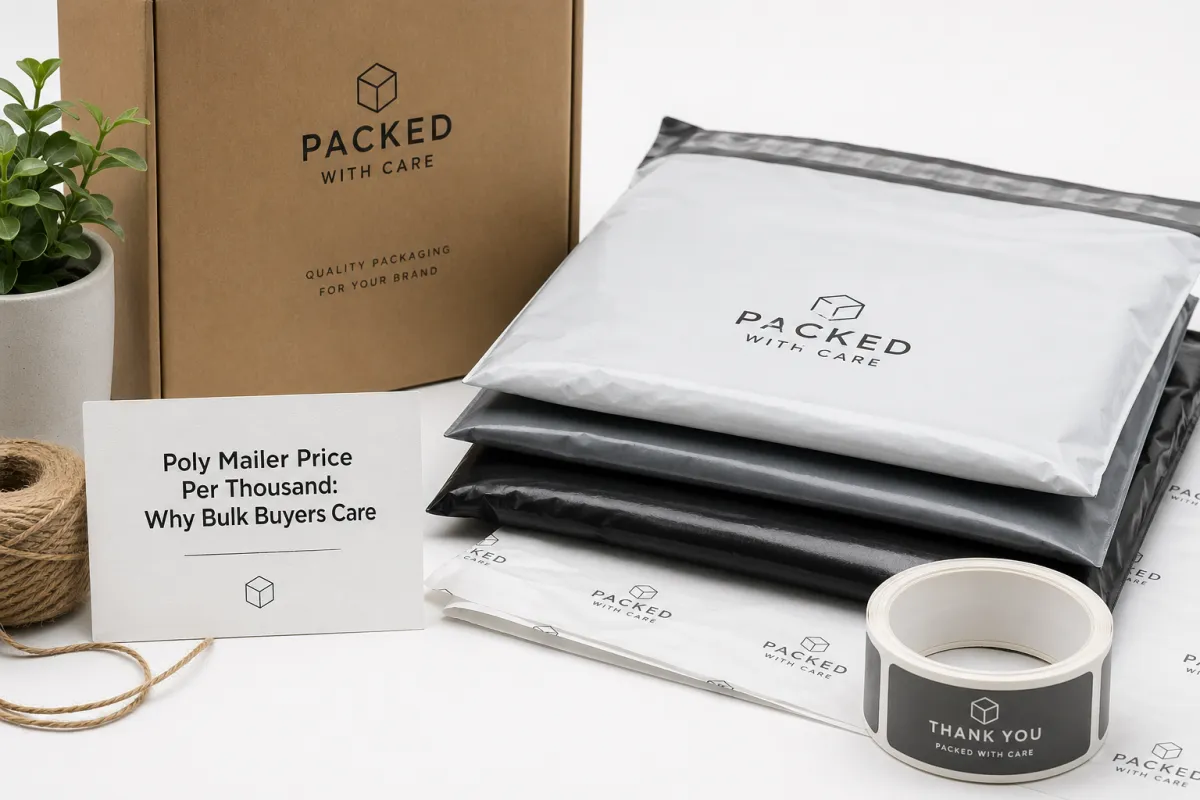
I have seen buyers lose money by chasing the lowest poly mailer price per thousand without asking one basic question: what happens after the mailer leaves the carton? A low unit price can be swallowed by dimensional weight, a thin seal that fails in transit, or the cost of carrying excess inventory because the minimum order was larger than the actual monthly run rate. And yes, I have seen the "win" on paper turn into a headache so fast it made the whole team look at the spreadsheet like it had personally betrayed them.
"We thought we won on price, then we paid for the mistake three times: once on the bags, once on freight, and once when the wrong size started showing up in returns." - apparel buyer, regional fulfillment team in Atlanta, Georgia
That comment came from a client meeting after they had compared three quotes that all looked close on the spreadsheet. The difference was not just cents. One quote was for a 2.0 mil stock bag, another for a 2.5 mil co-extruded mailer made in Foshan, Guangdong, and the third quietly assumed a higher freight class and a longer lane into their warehouse in Columbus, Ohio. The buyer was comparing three different products and calling it a price check. That happens more often than people admit, and it still makes me wince when I see it.
Poly mailer price per thousand matters because procurement needs a clean benchmark. If a vendor says 10,000 units at one rate and another vendor says 5,000 units at a slightly higher rate, the first question is not "which is cheaper?" The first question is "what is the exact spec, what is the finished use case, and what is the landed cost after freight?" I have seen a $0.09 difference per unit disappear the moment the cartons were shipped across the country, and I have also seen a quote of $0.15 per unit for 5,000 pieces beat a lower-looking quote once the buyer added freight from Shenzhen to Kansas City.
The most expensive mistake is not overpaying by a little. It is buying the wrong size, the wrong thickness, or the wrong print spec in a quantity that forces you to sit on inventory for months. If your mailers are used for apparel, soft goods, documents, or subscription shipments, the right poly mailer price per thousand is the one that keeps the order stream predictable without bloating your warehouse. I am biased, admittedly, but I would rather pay $11 more per thousand for the right bag than spend three weeks untangling why returns are rising and why the packing team in Phoenix is reworking every third order.
There is also a behavioral piece here. A quoted poly mailer price per thousand gives buyers a common language across suppliers, regions, and volume tiers. It lets a sourcing manager compare a domestic stock option in Texas, an imported custom print run from Dongguan, and a recycled-content version from a converter in Illinois on the same sheet. That is useful because price alone can hide real tradeoffs: stronger adhesive may cost more, but it can reduce claims; a smaller bag may cost slightly less, but it can cut postage and reduce dunnage; a larger minimum can lower the headline number while increasing cash tied up in inventory.
In practice, the right way to think about poly mailer price per thousand is not "What is the cheapest bag?" but "What bag protects the product, ships in the right lane, and keeps the reorder cycle under control?" That question is more commercial, and far more honest, than a simple unit-price race. If I sound a little opinionated there, it is because I have cleaned up enough bad buys to earn the right, including a 7,500-piece order that had to be repacked by hand in Nashville because the seal width was only 0.4 inches.
What Affects Poly Mailer Price Per Thousand the Most?
The main product types change poly mailer price per thousand more than most buyers expect. Stock white bags usually sit at the low end because they are produced in predictable runs, with standard dimensions and limited print complexity. Colored mailers, matte finishes, clear styles, recycled-content films, and Custom Printed Mailers each add material, conversion, or setup cost in different ways. I have always thought the pricing looks simple until you step inside the factory in Dongguan or Jiaxing and watch the line changeover from a plain 10 x 13 stock bag to a branded matte black mailer with a one-color logo and a 60 mm seal.
Here is the practical split I use when I am reviewing poly mailer price per thousand with a sourcing team:
- Stock white - usually the lowest friction option for documents, light apparel, and general fulfillment, often quoted around $82 to $118 per thousand for a 10 x 13, 2.5 mil bag.
- Colored or matte - often chosen for branding, but the finish and ink coverage can nudge the poly mailer price per thousand upward by $8 to $20 per thousand.
- Clear - useful for label visibility or internal product identification, though not always ideal for privacy or retail presentation.
- Recycled-content - can support sustainability goals, but resin availability and performance specs need review, especially if the material is sourced from Ningbo or Suzhou.
- Custom printed - best when branding matters and you want the packaging itself to carry the message, usually with a 10 to 15 business day production window after proof approval.
Closure style matters too. A self-seal adhesive strip with a clean peel-and-stick closure is not the same as a weak adhesive that lifts during transit or loses tack in winter warehouses at 38 to 45 degrees Fahrenheit. I still remember standing on a factory floor in Jiangsu while an operator tugged at two bags that looked identical from a distance. One had a wider seal band and a more consistent adhesive laydown; the other had slightly better film price but a weaker closure. The stronger bag cost more per thousand, yet it would have saved a customer from re-taping returns and re-shipping damaged orders. That is the part buyers rarely see in the first poly mailer price per thousand quote, and it is why I keep pressing for samples.
Print choice also changes the math. A one-color logo on the front panel is usually simpler than a full-bleed graphic that covers most of the exterior. Inside print, warning text, and multi-color artwork add press time and often increase setup waste. If a brand wants a clean logo and a simple message, the poly mailer price per thousand can stay relatively controlled, sometimes landing near $118 to $145 per thousand for 5,000 pieces. If the brand wants a wrapped color field, fine detail, and a precise registration target, the quote moves because the production process is more demanding. And if the art team keeps "one more tweak"ing the file, the schedule starts to get moody too.
For many buyers, stock mailers are the smartest purchase. If the product is light, the branding is minimal, and the shipment profile is stable, stock can keep lead times short and the poly mailer price per thousand attractive. I have also seen custom options earn their keep when the mailer replaces a separate insert, a branded sticker, or a more expensive outer carton. The right answer depends on the job the packaging is doing, not just the way the quote looks in a neat little column.
Use case matters as much as material. Apparel brands often need a balance between appearance and puncture resistance. Soft goods can usually run in lighter gauges if the fold pattern is consistent. Documents and samples need opacity and tamper resistance more than brute strength. Subscription fulfillment often needs repeatable presentation, so print consistency and size control matter more than shaving the last cent off the poly mailer price per thousand. I have watched teams save pennies and then spend real money fixing the customer experience, including a cosmetics brand in Miami that had to replace 1,200 mangled mailers after a humidity-sensitive adhesive failed in August.
One supplier negotiation taught me this the hard way. We were reviewing a low-cost quote for a 10 x 13 mailer, and the vendor was proud of the number. Then we asked about the adhesive strip, the seal width, and the carton pack count. The quote looked good until we added freight and discovered the cartons were packed inefficiently, which raised the landed poly mailer price per thousand by more than the raw resin savings. The cheapest line item was not the cheapest program. It never is, not once you count the parts that actually hit your budget.
Specs Buyers Need to Compare Before They Quote
Any serious quote should show the same core specs, or the poly mailer price per thousand comparison is basically noise. I want to see finished dimensions, usable interior space, film thickness in mil, seal width, opacity, and the usable print area. If one vendor quotes a 10 x 13 bag and another quotes a 9.5 x 12.5 usable interior with a wide seam, those are not interchangeable products. They might both be called mailers, but they are not the same thing, and pretending they are is how purchasing mistakes get dressed up as savings.
Film thickness matters, but only in context. A 2.0 mil bag may work for a soft garment on a stable line, while a 3.0 mil or 4.0 mil bag makes more sense for items with sharp corners, heavier weight, or rough carrier handling. Thickness affects puncture resistance, tear resistance, and the confidence level your packing team has at the station. It also affects the poly mailer price per thousand because more film usually means more raw material. I have seen teams over-spec film because nobody wanted to be blamed for a failure. That is understandable, but it is not always efficient.
I like to separate the spec sheet into a simple comparison grid. If a vendor cannot answer these questions quickly, I slow the conversation down:
- What are the finished outside dimensions and the usable inside dimensions?
- What is the film gauge in mil and what is the resin type?
- What is the seal width and adhesive style?
- How opaque is the film under bright light in a 500-lux warehouse bay?
- What is the print method and the usable print area?
- Is there recycled content, tamper evidence, or gusseting?
- What carton count and freight class are included in the quote?
That list has saved more than one buyer from a bad apples-to-apples comparison. A buyer may think they are evaluating the same poly mailer price per thousand, but one quote hides a narrow print window, another assumes a loose tolerance on film thickness, and a third ignores the seal width that actually protects the shipment. The ugly truth is that the line item is often the easy part; the real work is asking the annoying questions nobody wants to ask until the order is already in motion.
There is also a measurement problem that trips people up. The finished dimension is not always the same as the usable interior area. A 10 x 13 bag can lose a measurable amount of space to the side seal, bottom seal, and top adhesive flap. That matters if you are packing folded jeans versus a flat t-shirt. I have seen teams overpay for larger bags because the quote looked safer, then lose efficiency because the bag was too loose and the product moved around inside. Safety margin is useful. Excess slack is just annoying.
Secondary specs deserve real attention. Recycled-content film can support sustainability goals, but You Need to Know whether the performance matches your shipping lane. Tamper evidence can reduce disputes. Gusseting may help with thicker products. Custom sizing can be the difference between a neat, stable pack and a sloppy one that costs more in film and freight. Each of those choices changes the poly mailer price per thousand, sometimes modestly and sometimes enough to reshape the whole program.
For transit validation, I like to lean on industry references instead of gut feel alone. The test methods published by ISTA are useful for checking package performance under distribution stress, and ASTM methods such as D882 help frame film strength discussions in a more objective way. If your packaging program includes paper cartons or inserts alongside mailers, the sourcing side may also need a sustainability checkpoint through FSC. That is not a luxury. It is a cleaner way to compare real packaging decisions, and it saves a lot of hand-waving.
Here is the shortest honest version: if the quote does not show size, mil, seal width, print area, and carton pack count, then the poly mailer price per thousand is incomplete. I would not sign off on it, and I would not expect a downstream shipping team to trust it. If that sounds blunt, well, it is. Packaging deserves better than guesswork dressed up as precision.
Poly Mailer Price Per Thousand, MOQ, and Volume Breaks
Volume breaks are where the poly mailer price per thousand story gets interesting. Lower quantities usually cost more per thousand because setup, handling, and production inefficiency are spread across fewer units. Larger runs reduce that overhead, but they also increase inventory exposure. The buyer has to balance unit economics against cash flow and storage. I have seen people get dazzled by the lower tier and then realize they bought themselves a warehouse problem. Not my favorite kind of surprise, especially when 10,000 pieces are stacked in a leased space in Reno and the art changes two weeks later.
MOQ, or minimum order quantity, is not just a supplier preference. It is often driven by print setup, film sourcing, and the economics of running a specific size on a line. If a supplier has to change film width, ink setup, or print plates, the cost floor rises. That is why two quotes for the same poly mailer price per thousand can be shaped by completely different production assumptions. The machine does not care about the spreadsheet. It cares about the setup, the roll width, and whether the line in Shaoxing is already committed to a 12 x 15 run that afternoon.
Below is an example comparison I would use in a sourcing discussion. These are illustrative ranges, not live quotes, and they assume a standard shipping lane rather than a special freight situation.
| Option | Typical Spec | Example Price Per Thousand | MOQ Signal | Best Fit |
|---|---|---|---|---|
| Stock white | 10 x 13, 2.5 mil, peel-and-seal | $82 - $118 | Low to moderate | General apparel and documents |
| Stock colored | 10 x 13, 2.5 mil, matte finish | $94 - $132 | Low to moderate | Brand-focused fulfillment |
| Recycled-content | 10 x 13, 2.5 mil, gray or white | $88 - $126 | Moderate | Sustainability-led programs |
| Custom printed one-color | 10 x 13, 2.5 mil, one-color logo | $122 - $178 | Moderate to higher | Retail branding and subscription mailers |
| Custom printed full-bleed | 10 x 13, 3.0 mil, high-coverage art | $168 - $248 | Higher | Premium presentation and heavy use |
Those ranges show the main pattern: the lower the quantity and the more complex the print, the higher the poly mailer price per thousand. Freight can still swing the final answer. I once reviewed a quote that looked excellent until the cartons were shipped across two zones and billed at a rate that added almost $0.11 per unit. The headline price was strong. The landed price was not. That is the sort of thing that makes a buyer stare at a carrier invoice and let out a very unprofessional sigh, which was deserved in that case.
That is why I tell buyers to request the quote two ways: with freight included and with freight shown separately. If the supplier refuses, I assume the poly mailer price per thousand is hiding something. Freight can be shaped by carton count, destination ZIP code, palletization, and whether the order ships ground or air. Even packaging that looks cheap at origin can become expensive after transit charges, particularly on orders headed from Southern California to the Northeast.
The other volume-break issue is over-ordering. I have seen teams chase a lower poly mailer price per thousand by jumping from 2,000 units to 10,000 units, then discover the run rate only justified 3,000 units over the next quarter. Suddenly the storage cost, the risk of art changes, and the possibility of a size revision outweighed the savings. A lower unit number is not a win if it forces a bad inventory decision.
A practical rule: compare the poly mailer price per thousand at your real run rate, not just the best quoted break. If you use 1,500 units a month, the 5,000-piece tier may be the sensible floor. If you use 12,000 units a month and the artwork is stable, the larger tier may pay back quickly. The right answer is based on usage, lead time, and storage discipline, not just a printed rate card. I know that sounds almost too simple, but simple is usually where the money is hiding.
From Proof to Delivery: Process and Timeline
The order flow is usually straightforward, but every missed detail can distort the poly mailer price per thousand or delay the shipment. The path is usually inquiry, quote, sample or proof, artwork review, production, quality check, and shipment. A clean file and a clean spec sheet can shave days off the process. I have learned the hard way that the more "almost ready" a file is, the less ready it actually is, especially when the logo is still being exported from a designer's laptop in CMYK instead of the requested vector format.
There are a few details that speed approval immediately: exact dimensions, film choice, target quantity, print files in the right format, and the delivery address. If the buyer only says "need a branded mailer," the quote will be soft and the timeline will stretch. If the buyer provides the size, the mil, the print coverage, and the destination ZIP code, the supplier can usually build a much tighter poly mailer price per thousand and a firmer lead-time estimate. Specificity is boring, but it is incredibly profitable.
For stock orders, I typically expect a shorter cycle because there is no custom artwork approval. Depending on inventory and freight mode, a stock order may move in 3 to 5 business days if the bags are already in a U.S. warehouse in California or New Jersey. Custom printed runs take longer because proofing and production must happen first. A realistic custom timeline is often 12 to 15 business days from proof approval, then transit on top of that. If the shipment is going by ground to a distant region, the calendar can stretch another 3 to 6 days. If the order is urgent, do not pretend the calendar will be kinder just because everybody is excited.
Delays usually come from the same places. A logo file is supplied at low resolution. The buyer changes the print color after proof. The team forgets to confirm the delivery point. Or the buyer approves a mockup without noticing that the usable print area is narrower than expected. Each of those mistakes can affect the final poly mailer price per thousand because changes after setup often add labor or scrap. I have watched a tiny artwork adjustment turn into a day of back-and-forth, which is a remarkably inefficient way to spend anybody's afternoon.
I still remember one launch meeting with a subscription brand that wanted the first pallet before a campaign date. They had the right quantity and the right size, but they did not lock the inside print message before production started. That meant a second proof, a revised approval loop, and a week lost in scheduling. The fix was simple, but the cost was real. If the buyer had sent the final artwork on day one, the poly mailer price per thousand would not have changed, but the project would have landed on time.
"A good proof does not just look right. It prevents the next three problems." - packaging coordinator I worked with on a seasonal launch in Charlotte, North Carolina
Pre-production samples or digital proofs are worth the time when branding accuracy matters more than raw speed. If your logo has thin lines, if your background flood has to match a brand color, or if the print sits close to a seal edge, ask for a proof before committing. That extra step can protect the poly mailer price per thousand from hidden rework and protect the launch from an ugly surprise. The few extra days are usually cheaper than explaining to marketing why the first run looks off.
One useful launch checklist keeps the process tight:
- Confirm finished size and usable interior space.
- Pick the film thickness and adhesive style.
- Approve the artwork file and print placement.
- Check carton count and freight destination.
- Set the required delivery date and a backup date.
That list does not just reduce stress. It helps the buyer compare the real poly mailer price per thousand against the cost of delay, the cost of rework, and the cost of shipping a rush replacement if the first run misses the deadline. I wish every project started this way. It would save a lot of coffee, a lot of overnight emails, and at least one last-minute call to a warehouse in Irving, Texas.
Why Buyers Choose Us for Poly Mailer Orders
Buyers do not stay with a supplier because the presentation deck was polished. They stay because the bags show up at the right size, the print is consistent, and the reorder is boring in the best possible way. That is the standard I use for Custom Poly Mailers and for broader Custom Packaging Products programs. A stable packaging partner should reduce noise, not create it. If the process is calm, the buyer can spend time on the parts of the Business That Actually need attention, like forecasting the next 8,000-unit run or reconciling carrier charges.
At Custom Logo Things, the useful promise is not hype. It is repeatability. If a customer comes back three months later and asks for the same 10 x 13 mailer with the same one-color logo, the second run should match the first run within a tight tolerance. That is how the poly mailer price per thousand stays meaningful from reorder to reorder. If the spec drifts, the price comparison becomes useless. I care more about a dependable reorder than a flashy first quote, and I say that with no apology.
I have seen too many programs where the first batch was fine and the second batch was different enough to raise questions on the dock. Film feel, seal strength, print registration, and carton count all matter. A supplier that checks those points is saving the buyer time and money in ways that are not obvious on the quote line. A slightly higher poly mailer price per thousand can be the better deal if it cuts defect rates and prevents repacks. A few cents spent wisely is better than a few dollars spent cleaning up avoidable messes.
Here is how we think about quality control on a practical level:
- Film consistency - the gauge should be stable, not visibly thin at the edges.
- Print registration - logos should sit where the proof showed them, without drift.
- Seal performance - adhesive should hold under normal packing pressure and transit handling.
- Carton counts - the shipper should get the quantity stated on the packing list.
- Reorder match - the second run should match the approved sample and the first run.
That sounds basic. It is not always basic in practice. A few years ago, I watched a team switch suppliers because the new quote for poly mailer price per thousand was lower by a small margin. The film arrived slightly glossier, the logo sat a few millimeters lower, and the fulfillment manager spent two weeks fielding complaints from a brand team that had signed off on a different look. The savings disappeared into internal labor. Price is only part of the story, and sometimes not the most expensive part.
Our packaging experience also helps when buyers are not fully certain which spec to choose. Some want a recycled-content bag but are unsure whether the shipping lane can tolerate a lighter film. Some need a custom print but do not know whether one color is enough. Some want to know whether a slightly smaller bag will cut postage enough to justify a new print plate. A good advisor helps the buyer find the best poly mailer price per thousand for the actual use case, not just the prettiest quote. That is where the real value lives.
Packaging consulting matters here. I have sat in enough supplier negotiations to know that a few extra minutes spent on dimensions, adhesive, and freight can save weeks of cleanup later. The best outcome is simple: the right bag, the right count, the right lead time, and a poly mailer price per thousand that makes sense after the boxes leave the dock. Everything else is just decorative noise.
How Do You Get an Accurate Poly Mailer Price Per Thousand Quote?
If you want a clean quote, start with the exact spec sheet. The faster you provide the dimensions, quantity, material preference, print requirement, and delivery ZIP code, the faster the supplier can return a real poly mailer price per thousand instead of a placeholder number. That saves everyone time, and it also keeps the conversation grounded in facts rather than estimates that are too fuzzy to help. A buyer in Orlando will get a much tighter freight number than a buyer who only says "ship it somewhere in the Midwest."
Before you request pricing, gather these items:
- Finished dimensions and any preferred usable interior size.
- Desired film thickness in mil, plus whether the item has sharp edges or heavy corners.
- Stock or custom printed requirement, including one-color or multi-color artwork.
- Estimated monthly usage and first order quantity.
- Delivery ZIP code so freight can be calculated accurately.
- Any special requirements such as recycled content, tamper evidence, or opacity.
Then ask for two quotes side by side: one stock and one custom. That comparison often reveals whether the brand value of a custom bag justifies the gap in poly mailer price per thousand. I have seen companies discover that a stock white mailer plus a label or insert solved the problem at a lower landed cost than a full custom print run. I have also seen the opposite, where custom printing removed the need for outer branding and actually reduced total packaging spend. The only way to know is to compare the real options, not the imaginary ones.
If size, opacity, or branding accuracy is important, request samples or a digital proof before you lock the order. This is especially true for a new launch or a seasonal promotion. A sample lets you check the finish, the adhesive, and the real-world fit. That extra step may not change the quoted poly mailer price per thousand, but it protects the buyer from an expensive mismatch. I would rather spend an extra hour reviewing a proof than spend a week explaining why the finished bags do not fit the product right.
A practical buying sequence looks like this:
- Confirm the product fit and required protection level.
- Compare stock and custom poly mailer price per thousand options on a landed basis.
- Review sample or proof for size, print, and finish.
- Approve the order only after freight and carton count are confirmed.
- Set a reorder point based on lead time and actual weekly usage.
That last point matters more than people think. If lead time is 12 to 15 business days after proof approval, and your weekly usage is 800 units, then the reorder point should not be set as if replenishment were instant. A good sourcing plan protects the poly mailer price per thousand by avoiding rush freight, last-minute substitutions, and panic orders. Those last-minute saves are rarely savings at all.
Move from estimate to order only after the spec sheet and landed cost match. That is the cleanest path, and it keeps the poly mailer price per thousand conversation grounded in reality instead of hope. The takeaway is straightforward: know the bag, know the freight, know the run rate, and ask for a sample if the packaging has to do more than just hold an item closed. That is the buying discipline that actually saves money.
What does poly mailer price per thousand usually include?
Most quotes include the mailer unit cost, but some separate print setup, tooling, and freight. I always ask whether the poly mailer price per thousand is stock only, custom printed, and based on a specific thickness and size. Landed cost is the number that matters for vendor comparison, because the quote line alone can be misleading if freight or setup is hiding elsewhere, especially on orders shipping from Guangdong or Zhejiang to the U.S. East Coast.
How does thickness affect poly mailer price per thousand?
Thicker film usually costs more because it uses more material and often offers better puncture resistance. A 2.0 mil bag may be fine for light apparel, while a 3.0 mil or 4.0 mil option may be the better choice for heavier or sharper items. Overspecifying thickness can inflate the poly mailer price per thousand without adding real value, so I always ask whether the extra film is actually doing useful work, such as protecting a boxed accessory with hard corners.
Do custom printed mailers cost more per thousand than stock mailers?
Yes. Custom printed bags usually add setup, proofing, and production complexity, so the poly mailer price per thousand is typically higher than stock. The gap can shrink at larger quantities, and custom can still be the better value if it replaces labels, inserts, or outer branding. I have seen custom pay for itself when the packaging had to do more than just ship a product, especially in a launch where the first impression starts at the mailbox.
What MOQ should I expect for poly mailers?
Stock mailers often have lower MOQs than custom printed versions because there is no artwork setup or plate cost to recover. Custom MOQ is usually driven by print setup, film sourcing, and size-specific production. If MOQ is a concern, ask for a simpler print spec or a stock alternative before you chase the lowest poly mailer price per thousand. A 5,000-piece run is often a practical starting point for custom work, while 1,000-piece stock orders can move faster.
How long does it take to receive a thousand poly mailers after approval?
Stock orders usually move faster because there is no custom proof stage. Custom orders take longer because proofing, production, and quality checks must happen first. A realistic custom window is often 12 to 15 business days from proof approval, plus transit time. Freight method and destination can change the final schedule, so confirm both the lead time and the shipping estimate before you rely on the poly mailer price per thousand alone. If the ship date matters for a campaign in Austin or Denver, build in a buffer of at least 3 extra business days.
The smartest buyers do not just hunt for the lowest poly mailer price per thousand; they compare the landed price, the fit, the print quality, and the reorder rhythm. That is where real savings live. I have seen the same lesson prove itself over and over, which is probably why I keep repeating it. If you only remember one thing, make it this: a useful quote names the exact bag, the exact freight lane, and the exact quantity before anybody starts talking about savings.


