Buyer Fit Snapshot
| Best fit | Recyclable Packaging with Logo projects where brand print, material claims, artwork control, MOQ, and repeat-order consistency need to be specified before quoting. |
|---|---|
| Quote inputs | Share finished size, material target, print colors, finish, packing count, annual reorder estimate, ship-to region, and any compliance wording. |
| Proofing check | Approve dieline scale, logo placement, barcode or warning zones, color tolerance, closure strength, and carton packing before bulk production. |
| Main risk | Vague material claims, crowded artwork, missing packing details, or unclear freight terms can make a low unit price expensive after revisions. |
Fast answer: Recyclable Packaging with Logo: QC and Delivery Scope should be specified like a repeatable production item. The safest quote records material, print method, finish, artwork proof, packing count, and reorder notes in one written spec.
Production checks before approval
Compare the actual filled-product size with the drawing, then confirm tolerance on folds, seals, hang holes, label areas, and retail display edges. Reserve space for logos, QR codes, warning copy, and material claims before decorative graphics fill the panel.
Quote comparison points
Review material grade, print process, finish, sampling route, tooling charges, carton quantity, and freight assumptions side by side. A quote is only useful when the supplier can repeat the same color, closure quality, and packing count on the next order.
Recyclable packaging with logo sounds straightforward until a brand team starts approving finishes. Then the trouble shows up fast: a glossy varnish, a metallic accent, a laminated sleeve, a label with the wrong adhesive. I have sat in enough packaging reviews to know how quickly a “small” decoration choice can change the fate of the whole pack after use. A premium mailer can look polished on the shelf and still be a headache once it reaches the bin. Recyclable packaging with logo has to be treated as a system, not a print decision.
From a buyer’s point of view, decoration is only one part of the brief. The package still needs to protect the product, carry the brand, and leave disposal simple enough that customers do not hesitate. The strongest versions usually rely on recycled content, water-based inks, and fewer mixed layers instead of a greener-looking claim that collapses under scrutiny.
“If the structure cannot be recovered cleanly, the logo is not the issue; the structure is.”
That mindset saves money and avoids awkward apologies later. It also keeps packaging design honest. A recycled-content carton only matters if it can move through a real recycling stream with the inks, adhesives, and finishes still attached. In practice, the smartest branded packaging choices are often the least flashy, because they protect the product without getting in the way of recovery.
What Makes Recyclable Packaging With Logo Truly Recyclable?
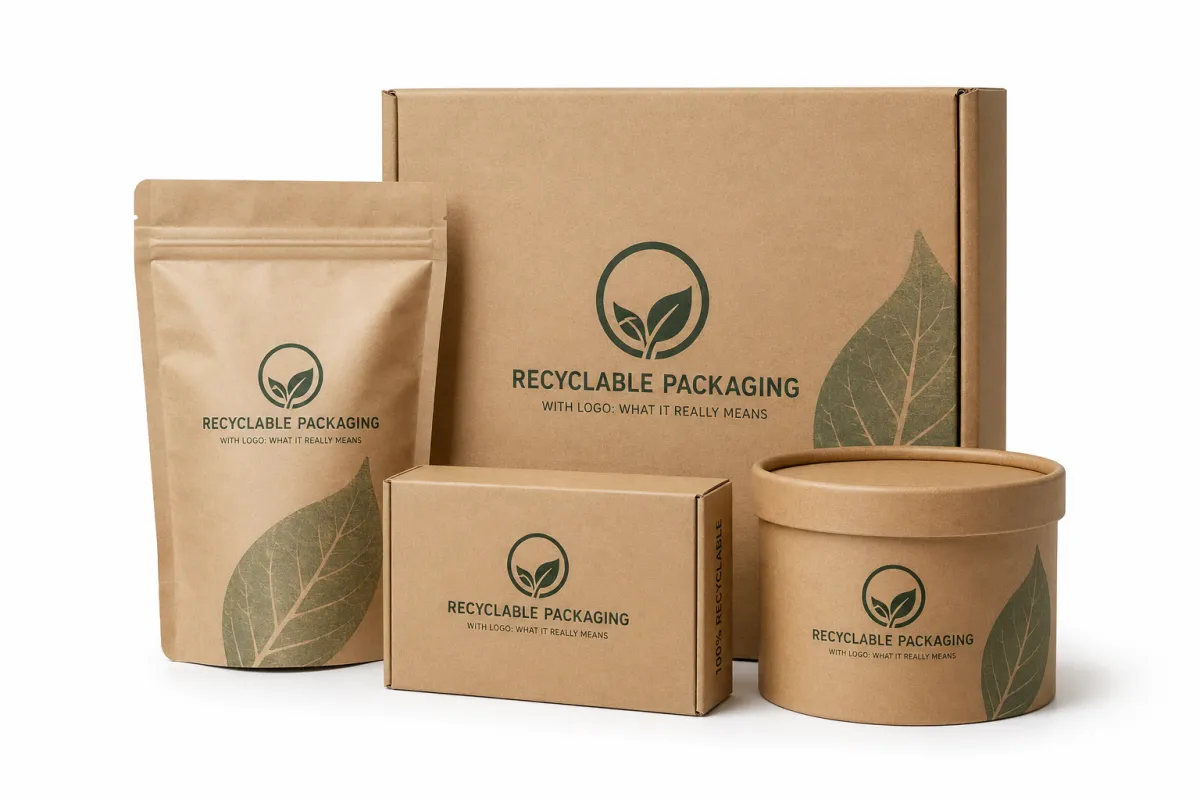
Recyclable packaging with logo means the base material, print system, adhesive, and finish are chosen so the pack can enter common recycling streams where accepted. That sounds tidy on paper. It is not always tidy in the real world. A package may be technically recyclable, while local curbside acceptance still varies by municipality, county, or commercial collection program. A supplier saying “recyclable” is not the same thing as a resident being able to toss it into a blue bin with confidence.
The easiest way to think about recyclable packaging with logo is to follow the pack through its full life cycle, not just its launch photos. It has to look good, hold up in shipping, and then break down in a way recycling systems can handle. Material selection comes first, before artwork. A kraft carton with simple black print behaves very differently from a plastic-lined pouch with foil stamping and a soft-touch lamination.
Most mistakes happen because teams treat the logo as an add-on. In reality, the logo is part of the material story. On some structures, a small one-color mark barely registers to recyclers. On others, that same logo sits on a laminated surface that complicates recovery. Recyclable packaging with logo is not about stripping away identity; it is about placing that identity on a substrate that can still be processed efficiently.
There is also a trust question here. Shoppers spot green claims faster than many brands expect. If a pack says recyclable but feels coated, glossy, or oddly heavy for its size, the claim starts to lose credibility. That matters in retail packaging, where people make a judgment in seconds. Good package branding does not overpromise. It uses clear materials, direct language, and a finish that supports the claim instead of fighting it.
For brands building Custom Printed Boxes or mailers, the first question should be, “What recycling stream is this meant for?” not “How much shine can we fit on the panel?” That question filters out trouble early. If the answer is paper fiber, recyclable packaging with logo usually works best with direct print, minimal coatings, and a board or corrugated structure that is easy to repulp. If the answer is plastic recovery, the design choices shift toward mono-material films and low-ink graphics.
There is a practical reason for that, and it is not glamorous. Recovery systems do not read marketing copy. They respond to material behavior. That is why recyclable packaging with logo should be judged on print coverage, coating weight, liner type, and adhesive performance, not on how convincing the claim sounds on a sales sheet.
How Recyclable Packaging With Logo Works
Recyclable packaging with logo works best when the package is designed from the inside out. Start with the substrate. Choose the print method. Test the assembly. That order matters because the base material usually determines the recycling path long before the logo is applied. Paperboard, corrugated fiber, molded fiber, and mono-material films are generally easier to handle than mixed-material packs that combine paper, plastic, and foil in one structure.
For fiber-based formats, the recycling path usually moves through collection, sorting, pulping, cleaning, and reprocessing into new sheet or board. A plain kraft carton with low-coverage print enters that stream more predictably than a carton wrapped in a laminated sleeve. The more layers the package has, the more work the recycler has to do. If a coating must be removed during pulping, the cost and rejection risk rise. Recyclable packaging with logo should reduce that burden, not add to it.
Logo application changes the outcome in practical ways. Direct printing with water-based or low-impact inks usually interferes less with recycling than foil stamping or a full-wrap laminate. Embossing is often safer than heavy varnish because it changes the shape without creating a recovery barrier. Low-coverage artwork is typically easier to process than dense full-panel graphics, especially on paper-based product packaging.
Think about the material journey in simple steps:
- Collection: the pack enters curbside, store drop-off, or commercial recovery streams.
- Sorting: optical and mechanical systems separate fiber, plastic, and contamination.
- Processing: the substrate is pulped or reprocessed based on material type.
- Reformation: recovered material becomes new board, sheet, or resin feedstock.
At each stage, the logo can help or hinder. A clean one-color mark on paperboard is usually a minor issue. A metallic foil line or a heavily glued patch label is different. Even the adhesive matters. Some pressure-sensitive labels peel cleanly; others leave residue that clogs systems or creates reject waste. Recyclable packaging with logo has to account for those details before mass production starts.
Here is a useful comparison for brands weighing Custom Printed Boxes against more complex structures:
| Package Type | Typical Print Approach | Recycling Impact | Practical Notes |
|---|---|---|---|
| Kraft folding carton | Direct one- or two-color print | Usually favorable in fiber streams | Best for simple branding and low ink coverage |
| Corrugated mailer | Flexo or digital print | Usually favorable if uncoated | Good for ecommerce and shipping protection |
| Foil-laminated sleeve | Metallic print and lamination | Often more difficult to recover | Looks premium, but can conflict with recycling goals |
| Mono-material film pouch | Surface print with minimal layers | Depends on local film collection access | Works only when the recovery stream supports it |
If a brand needs a mix of retail packaging and shipping-ready formats, it helps to compare options early rather than forcing one structure to do everything. Many teams find that browsing Custom Packaging Products alongside their sustainability brief keeps the conversation tied to actual material choices instead of aesthetic wish lists. Recyclable packaging with logo improves when the format is chosen for the channel, not the mood board.
Key Factors That Decide If It Is Truly Recyclable
Material compatibility is the first gate. A substrate has to match what local recycling systems actually process, not just what a spec sheet labels recyclable. Recyclable packaging with logo can fail this test if the structure combines materials that separate poorly or if the substrate is common in one region but not accepted in another. A broad claim should always be backed by a specific material description.
Substrate First
Paperboard and corrugated fiber are the most familiar choices for many brands because they are widely collected and easy to understand. Molded fiber also performs well in certain protective formats. Mono-material plastic films can work too, but only when the collection infrastructure supports them. Recyclable packaging with logo becomes much easier to defend when the base material is simple and the structure avoids unnecessary layers.
Ink and Finish Matter More Than Most Teams Expect
Ink load, varnish, and surface treatments can make or break the final claim. Heavy metallics, soft-touch films, laminated wraps, and aggressive adhesives create friction in recovery systems. Direct print usually causes fewer issues than decorative add-ons that look premium but add little functional value. In recyclable packaging with logo, the least dramatic finish is often the safest one.
For brands that want a credible benchmark, the EPA recycling guidance is a useful starting point for understanding how local collection and accepted materials vary. It is not a substitute for supplier testing, but it reinforces the core idea: a package is only recyclable if the receiving stream can handle it. Recyclable packaging with logo should be evaluated against that reality, not against optimism.
Structural Details Decide the Outcome
Small parts create outsized problems. Windows, glued-on inserts, mixed labels, tear strips made from dissimilar materials, and plastic tape can all complicate sorting. Dark full-coverage print can also make optical sorting harder in some recovery systems. That is not a reason to avoid branding. It is a reason to simplify package branding so the logo still works without crowding the substrate.
Testing helps separate assumptions from facts. Ask for fiber test data, supplier declarations, and any documented recyclability guidance. If the pack is fiber-based, ask whether the coating or adhesive has been assessed for repulpability. If the structure is plastic, ask what local programs accept that resin and whether labels or inks interfere with sorting. Recyclable packaging with logo should come with paper trails, not just promises.
Certification can add another layer of trust, especially for brands that need to show discipline in sourcing. FSC-certified fiber does not automatically make a package recyclable, but it does support responsible fiber sourcing. That matters to procurement teams that need both environmental credibility and predictable supply. Recyclable packaging with logo works best when sustainability claims are specific, documentable, and easy for a buyer to verify.
The strongest packaging design teams usually ask three questions in sequence: What is the substrate? What happens to the surface? What happens to the accessories? If any answer is unclear, the claim is not ready. That mindset keeps product packaging honest and saves a brand from launching a nice-looking box that fails in the one place consumers actually test it: disposal.
Recyclable Packaging With Logo Costs, Pricing, and ROI
Recyclable packaging with logo usually costs more than the cheapest stock option, but the gap is often narrower than brands expect once artwork is simplified and finish choices are trimmed back. The biggest price drivers are substrate grade, order volume, number of print colors, die-cut complexity, certification needs, and whether the structure needs a custom tool. Recyclable packaging with logo gets expensive when teams insist on decorative features that do not improve protection or recovery.
For a rough planning range, a simple recyclable kraft mailer at 5,000 units might land around $0.22-$0.38 per unit depending on size and print coverage. A more complex structure with specialty board, custom die-cuts, or added print passes can move higher, often into the $0.45-$0.75 range. Those are not universal numbers. They change with volume, material market conditions, and art complexity. Still, they give a buyer a better starting point than “cheap” or “premium.”
Here is the hidden part of the math: cost is not only about unit price. Recyclable packaging with logo can reduce disposal complaints, lower customer service friction, and support better retailer acceptance. Those benefits are not easy to invoice, but they matter. A pack that looks responsible and disposes cleanly can protect the brand in ways a glossy, overbuilt carton never will.
Many brands waste money in the same few places. They order too many SKUs, add special coatings that do not support the story, or chase visual effects that vanish once the box is opened. In branded packaging, restraint often pays. A simpler layout can reduce print passes, lower spoilage risk, and improve consistency across the run. Recyclable packaging with logo rewards discipline.
If a line needs multiple formats, compare the total system cost rather than the box price alone. A basic mailer, a retail carton, and a protective insert may each have different economics. Sometimes the better move is to reassign duties: let one custom printed boxes format protect the product, and let another minimal format carry the brand message. That is where custom printed boxes can be more efficient than a single overdesigned package that tries to do everything.
There is also a shelf-value component. A neat, low-gloss carton with a clear logo often looks more credible than a busy pack full of effects. That credibility can lift package branding without adding much material cost. Recyclable packaging with logo may not be the cheapest line item on the quote, but it can perform better in retail packaging and consumer perception.
For many buyers, the question is not whether recyclable packaging with logo costs more. The real question is whether the added spend buys a better outcome. If the answer is yes, the premium is easier to defend. If the answer is only “it looks greener,” then the spend is hard to justify.
Step-by-Step Process and Timeline
The cleanest way to manage recyclable packaging with logo is to treat it like a controlled production project, not a last-minute artwork task. Start with a requirements brief. Include product weight, drop risk, shipping method, retail environment, target recycling goal, and any store or marketplace compliance rules. If those details are missing, the pack will drift. Recyclable packaging with logo performs best when the function is fixed before the visuals are finalized.
Choose the substrate and print method together. That pairing matters because a logo that looks excellent on one board can perform poorly on another. A one-color flexographic Print on Corrugated fiber behaves differently from digital ink on coated board or a film label on a pouch. Recyclable packaging with logo should be designed as one system, not stitched together from separate departments that never compare notes.
Then build the dieline. This is where packaging design becomes practical. Fold lines, glue flaps, panel sizes, barcode placement, and logo position all need to work without wasting board. Small changes here can save material and reduce print failures. If the structure is for ecommerce, test fit against the actual product and void space. If it is for retail packaging, confirm shelf face and hang-tab placement before approval.
After the structure is set, move into proofing and testing. A realistic sequence looks like this:
- Artwork review and brand sign-off.
- Digital or physical sample approval.
- Fit check with the actual product.
- Transport testing, if the package ships through parcel or pallet networks.
- Final review of disposal instructions and recyclability claims.
For transport testing, many teams reference ISTA test standards to simulate drops, vibration, compression, and handling stresses. The exact test depends on the distribution path, but the point stays the same: a box that looks good in a photo should still survive the trip. Recyclable packaging with logo only earns its keep if it protects the product before it ever reaches the recycling bin.
Timing varies, but a straightforward run can often move from proof approval to production in about 12-15 business days when the structure is simple and the supplier already has tooling in place. Custom tooling, tight color matching, and multiple proof cycles can add two to four weeks. Add more time if the project needs outside compliance review or special material sourcing. Recyclable packaging with logo should be planned with enough runway to test and correct mistakes before inventory is committed.
One useful habit is to keep a sample archive. Save one approved unit, one transit-tested unit, and one production unit from the first run. That small archive helps when a later reorder needs comparison. It also gives the team a concrete reference if the print, coating, or glue starts drifting. Recyclable packaging with logo becomes much easier to manage when the original standard is visible on the shelf, not buried in a PDF.
If a brand is scaling into multiple channels, it helps to map the full launch sequence by market. Direct-to-consumer, wholesale, and retail packaging often have different durability and messaging needs. Recyclable packaging with logo can be adapted across channels, but only if the packaging buyer knows where the differences really matter. Shipping performance is not the same as presentation strength, and a good production plan respects both.
Common Mistakes That Undercut Recyclability
The most common mistake is assuming all paper is recyclable. It is not that simple. Coatings, laminates, wet-strength treatments, and mixed layers can completely change the answer. Recyclable packaging with logo often fails at the point where a team accepts a “paper-based” claim without asking how the surface is finished. Paper fiber is one of the easiest materials to understand, and one of the easiest to overcomplicate.
Another frequent problem is overbranding. Too much ink coverage, unnecessary foil, spot UV, soft-touch lamination, and decorative add-ons can create more waste than value. A logo should help a package sell. It should not make the pack so busy that recovery becomes harder. Recyclable packaging with logo often looks better when the artwork breathes. That is especially true on custom printed boxes where the structure already carries enough visual weight.
Vague claims create a third problem. Words like “eco-friendly” or “fully recyclable” sound good until a customer asks what to do with the label, tape, or insert. If the answer is not specific, trust falls away. A better approach is to say exactly what the package is made from, which components should stay on, and which ones should be removed. Recyclable packaging with logo should explain itself in one glance and one short instruction line.
Hidden blockers matter too. Labels are a classic example. Tape is another. So is a clear window that looks harmless but is glued onto a paper carton with a stubborn adhesive. Even a protective insert can cause trouble if it is built from a different material than the outer pack. From a packaging buyer’s perspective, these are not small details. They are the difference between a clean recovery path and a package that becomes contamination.
There is a bigger issue beneath all of this: teams often separate brand and sustainability decisions too early. The brand group wants stronger package branding. Operations wants fewer failures. Procurement wants lower cost. Recycling compatibility gets squeezed between those goals and ends up under-specified. Recyclable packaging with logo works best when all four groups are at the same table before the first proof is approved.
Another easy trap is assuming a higher price means a better environmental result. Sometimes it does. Often it does not. A more expensive coating can be worse for recovery than a simpler one. A heavier board can be more durable but also more resource-intensive. Recyclable packaging with logo should be judged on system performance, not on the size of the finish budget.
Expert Tips and Next Steps for Your Rollout
Start small. One SKU, one channel, one structure. That is usually the smartest first move for recyclable packaging with logo. It gives the team room to test actual customer response, review real damage rates, and confirm that the disposal instructions are clear enough. A pilot run also shows whether the art direction holds up when the box is printed, folded, packed, shipped, and opened by a real customer.
Request a full material spec from every supplier you are considering. Do not settle for a broad line like “recyclable board.” Ask for substrate type, coating details, adhesive type, ink system, and any recycling guidance the supplier can document. Recyclable packaging with logo is much easier to defend when the file includes the kind of detail a compliance team can review without guesswork. If you are also sourcing branded packaging for other product lines, keep those specifications in one place so they can be compared side by side.
Write disposal instructions in plain language. Keep them short. Tell customers whether the insert should be removed, whether tape can stay on, and where to check local rules. A QR code can help, but it should not replace useful text. Recyclable packaging with logo should reduce customer confusion, not add another task after unboxing.
Build a launch checklist that covers art, durability, and claims. Here is a practical version:
- Confirm the substrate and finish match the intended recycling stream.
- Review logo placement for ink coverage and visual clarity.
- Test fit with the product and protective components.
- Run transit checks for the intended shipping method.
- Verify all disposal statements against supplier documentation.
- Save an approved production sample for reorder comparisons.
Then compare the first production run against the sample, not just against the PDF. Ink density, fold quality, glue performance, and scuff resistance all matter. Recyclable packaging with logo can look perfect in a proof and still fail on a production line if the substrate is not forgiving enough. That is why a pilot run is not wasted time. It is insurance.
One last recommendation: do not bury the sustainability story under too many claims. Keep the language direct. If the pack is paper-based, say so. If a component should be removed before recycling, say that too. If local rules vary, acknowledge it. Honest instructions build trust faster than polished but vague messaging. Recyclable packaging with logo earns credibility when it tells the truth cleanly, without fluff or clutter.
For brands that want to expand beyond a single format, the smartest next step is to look at the broader packaging system, not just one carton. Recyclable packaging with logo becomes more effective when the outer box, insert, label, and shipper all point in the same direction. That is the difference between a nice idea and a repeatable packaging program.
Frequently Asked Questions
Is recyclable packaging with logo really curbside recyclable?
Only if the exact material and finish are accepted by the local recycling program. A fiber-based carton with simple print may be curbside recyclable in one area and rejected in another if the coating, adhesive, or added component changes the recovery path. Recyclable packaging with logo should always be checked against local acceptance before the claim is used.
What print method works best for recyclable packaging with logo?
Direct printing with water-based or low-impact inks is often the safest choice for fiber-based packs. Simple artwork, limited coverage, and minimal finish layers are usually easier to recycle than foil stamping, heavy varnish, or laminated wraps. The best method depends on the substrate, so test the material and the print system together.
How much does recyclable packaging with logo cost compared with standard packaging?
The biggest cost drivers are material grade, order quantity, print complexity, and finishing choices. A recyclable option can cost more upfront, but simplifying the structure and avoiding decorative extras often narrows the gap. Brands also recover value through stronger shelf trust, fewer disposal complaints, and better retailer response.
How long does a recyclable logo packaging project take?
A simple run can move from proof approval to production in roughly 12-15 business days if tooling already exists and the artwork is straightforward. Custom structures, new dies, color matching, sample rounds, and compliance checks can extend that timeline by several weeks. Recyclable packaging with logo tends to move faster when the brief is clear at the start.
How do I explain recyclable packaging with logo to customers?
Use short, specific disposal instructions instead of broad claims like “eco-friendly.” Say what the pack is made from, whether any components should be removed, and where customers should confirm local rules. A small note or QR code can reduce confusion, and it keeps recyclable packaging with logo honest at the point where customers actually decide what to do next.


