Buyer Fit Snapshot
| Best fit | Recycled Corrugated Mailers Supplier projects where brand print, material claims, artwork control, MOQ, and repeat-order consistency need to be specified before quoting. |
|---|---|
| Quote inputs | Share finished size, material target, print colors, finish, packing count, annual reorder estimate, ship-to region, and any compliance wording. |
| Proofing check | Approve dieline scale, logo placement, barcode or warning zones, color tolerance, closure strength, and carton packing before bulk production. |
| Main risk | Vague material claims, crowded artwork, missing packing details, or unclear freight terms can make a low unit price expensive after revisions. |
Fast answer: Recycled Corrugated Mailers Supplier: Film, Print, MOQ, and Carton Packing should be specified like a repeatable production item. The safest quote records material, print method, finish, artwork proof, packing count, and reorder notes in one written spec.
Production checks before approval
Compare the actual filled-product size with the drawing, then confirm tolerance on folds, seals, hang holes, label areas, and retail display edges. Reserve space for logos, QR codes, warning copy, and material claims before decorative graphics fill the panel.
Quote comparison points
Review material grade, print process, finish, sampling route, tooling charges, carton quantity, and freight assumptions side by side. A quote is only useful when the supplier can repeat the same color, closure quality, and packing count on the next order.
Recycled Corrugated Mailers Supplier: What Buyers Need
If you are comparing a Recycled Corrugated Mailers supplier, recycled content is only one piece of the decision. A mailer can look responsible on a spec sheet and still fail in transit if the flute is underbuilt, the liner is too thin, or the recycled fiber blend changes the stiffness more than your product can tolerate. From a packaging buyer's point of view, supplier choice reaches into damage rates, packing speed, branding, and waste all at once, so the tradeoffs deserve a careful look rather than a quick yes.
A recycled corrugated mailers supplier does more than turn board into a shipping format. The stronger partners source recycled-content board, convert it into mailers, manage print quality, and help balance protection with sustainability claims. That matters for apparel, books, subscription kits, accessories, samples, and light industrial parts, because those categories often need a curbside-recyclable shipper that looks considered without using extra material. The commercial pressure is plain enough: buyers want lower fill, stable pricing, and clean branding, yet they still need repeatable performance and dependable supply. Those goals can fit together, but only if the recycled corrugated mailers supplier knows the product, not just the purchase order.
A mailer that saves half an ounce but fails a drop test is not a win. It just shifts cost into returns, replacements, and customer service.
Why a recycled corrugated mailers supplier matters
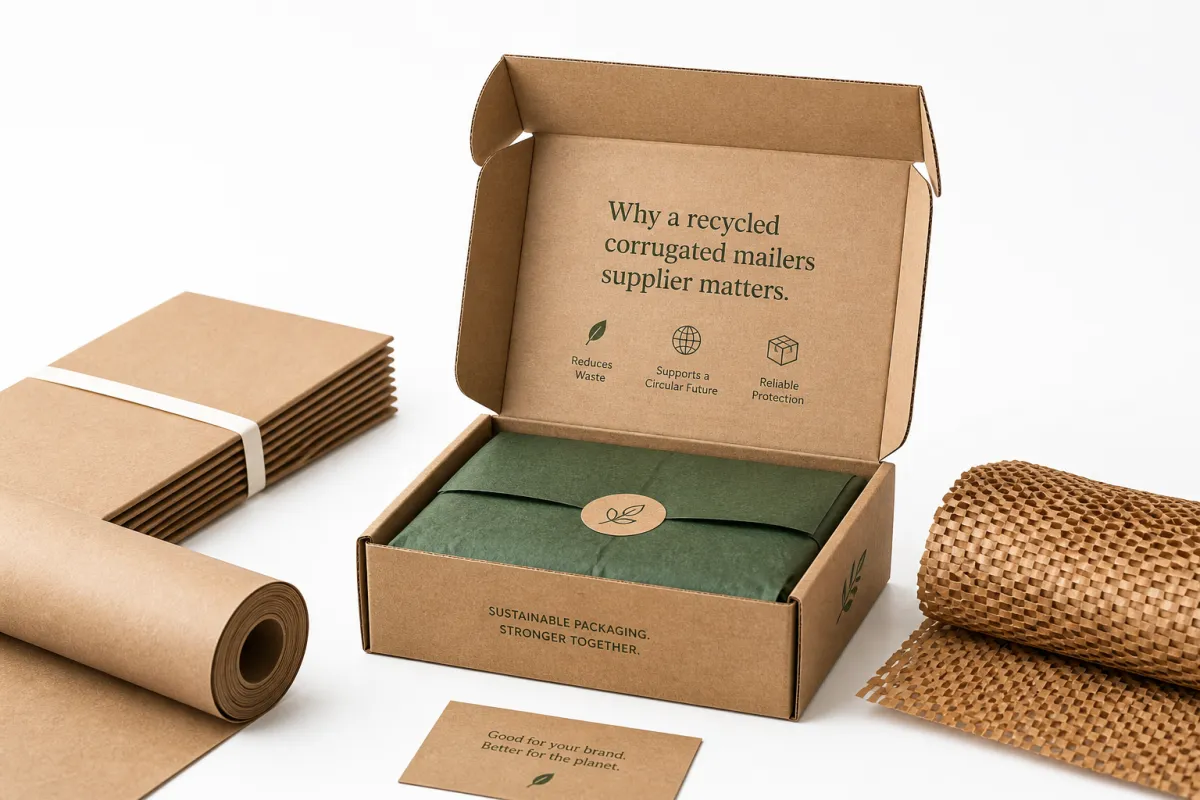
Packaging trouble often starts with a quiet assumption. A buyer sees the word recycled and assumes the mailer will behave like any other corrugated shipper. In practice, the fiber mix, board construction, and folding geometry decide whether the package survives conveyors, parcel sortation, and the rough handling that happens once it leaves your dock. A recycled corrugated mailers supplier brings those variables together in one product, which is why the supplier choice shapes transit performance as much as it shapes sustainability messaging. I have seen teams put recycled claims first and shipping damage second, and that order usually costs more than it saves.
The right recycled corrugated mailers supplier helps match the board to the shipment. That sounds basic, yet it is where many projects drift off track. A lightweight hoodie does not need the same structure as a ceramic sample set, and a 12-ounce accessory kit does not need the same closure logic as a book bundle headed across the country. The mailer should fit the product, the route, and the customer expectation. For e-commerce apparel, books, subscription kits, accessories, and small industrial parts, the best result is usually a mailer that feels tidy, resists crush, and prints cleanly without extra coatings that muddy recycling guidance later.
Brand perception deserves the same attention. Customers notice packaging when it feels flimsy, oversized, or wasteful, and they notice when branding looks cheap. A recycled corrugated mailers supplier that understands print registration, ink coverage, and the limits of recycled linerboard can help you avoid that trap. The goal is not to make the package louder. It is to make it feel intentional, protective, and honest about what it is. That is a very different brief from simply asking for a greener box.
Experienced buyers usually ask three questions before they ask for price: How will the mailer protect the product, what proof supports the recycled-content claim, and how consistently can the supplier repeat the same result? Those questions help because they move the conversation away from slogans and toward the actual shipping outcome. A recycled corrugated mailers supplier should be able to answer all three with evidence, not just with a polished sales pitch. If the answers stay vague, you are probably looking at a vendor, not a packaging partner.
How a recycled corrugated mailers supplier builds the product
The manufacturing chain starts with recovered fiber. That fiber is cleaned, pulped, refined, and formed into recycled linerboard and medium, which are then combined into corrugated board with adhesives and, often, water-based inks. A recycled corrugated mailers supplier converts that board into die-cut mailers, folds them, glues them where needed, and checks dimensions before packing them for shipment. The flow sounds straightforward, though each step can shift stiffness, print clarity, and consistency from run to run. The supplier is managing a series of tradeoffs, not simply running a machine.
Recycled content changes performance in ways buyers can feel. Higher recycled fiber content can affect rigidity, moisture response, and surface appearance. That does not mean the material is inferior; it means the spec has to be matched properly. A recycled corrugated mailers supplier with experience will speak in practical terms about caliper, edge crush resistance, flute profile, and how the material behaves after creasing. If the answer stays at the level of "eco-friendly board" and never reaches the board grades, the buyer is missing the information that matters.
Customization is broader than many teams expect. A recycled corrugated mailers supplier can often adjust size, closure style, flute profile, print coverage, tear strips, and inserts without overengineering the job. That flexibility matters because a mailer that is too large wastes material, while one that is too tight can slow packing and increase product scuffing. The best spec is usually not the most elaborate one. It is the one that protects the item with the fewest unnecessary features.
For buyers comparing structures more carefully, the useful question is not whether corrugated is strong enough in a general sense. It is whether the board grade and flute selection match the actual load, the stacking pressure, and the route. That is where a recycled corrugated mailers supplier earns its place. Anyone can say the mailer is recycled. The better supplier can explain why a certain board behaves properly under real conditions, which is the part that actually keeps goods intact.
Quality control is where the difference becomes visible. A careful supplier checks fold scores, glue placement, cut accuracy, print alignment, and bundle consistency before the cartons leave the plant. If the mailer is intended for automation, small dimensional drift matters. If it is intended for hand packing, the focus may shift toward closure repeatability and ease of loading. A recycled corrugated mailers supplier that understands those differences can save a buyer from a long chain of small annoyances that never show up in the first sample.
Key factors when choosing a recycled corrugated mailers supplier
The first filter is proof. Ask whether the board uses post-consumer fiber, post-industrial fiber, or a blend, and ask for documentation rather than a marketing line. A recycled corrugated mailers supplier should be able to explain the recycled-content percentage and, where relevant, provide certification or chain-of-custody records. If the answer is vague, you are not buying certainty; you are buying a claim. That distinction matters because sustainability reporting is getting stricter, and buyers need numbers they can defend internally.
Board grade and flute selection come next. The right structure depends on product weight, fragility, stack pressure, and shipping distance. A recycled corrugated mailers supplier that understands board engineering will not push the thickest possible mailer for every SKU. Instead, it will match the structure to the job. That might mean a lighter configuration for apparel and a stronger one for glass, books, or dense components. The aim is not to maximize material. It is to land on the lowest practical spec that still survives your route.
Branding can create trouble when teams treat it as an afterthought. A supplier should support logos, return instructions, handling cues, and scan-friendly artwork without depending on coatings or finishes that complicate recyclability guidance. Water-based inks are common for that reason. Foil-heavy graphics, overly saturated coverage, and decorative treatments may look attractive in a proof, yet they can make the package less practical for recycling streams or more expensive to produce. A recycled corrugated mailers supplier should be able to tell you where the line sits, not just nod at every request.
Sustainability proof points are most useful when they are specific. FSC chain-of-custody documentation, written recycled-content statements, and clear end-of-life guidance are far better than broad claims about being green. For context on testing standards, many buyers use parcel and distribution protocols from ISTA and recycling guidance from the EPA to align packaging choices with actual shipping and disposal conditions. A recycled corrugated mailers supplier that can discuss those references clearly is usually more reliable than one that leans on vague sustainability language.
Service depth is the final separator. Strong suppliers help with spec review, prototyping, testing, and reorder planning. Weaker ones take the order, send a sample, and disappear until the next PO. Buyers should value the supplier that flags risk early. If a closure line is hard to open in a fulfillment center, or if a print area is too tight for a logo, those problems should show up before production, not after launch. In that sense, the best recycled corrugated mailers supplier is also a practical advisor, and that kind of guidance is worth real money over time.
- Verify fiber claims: ask for post-consumer and post-industrial percentages in writing.
- Match structure to use: choose board grade and flute based on product weight and route length.
- Protect branding: keep artwork readable without adding finishes that undermine recyclability.
- Test the sample: use drop, crush, and vibration checks before approving volume production.
Cost, pricing, and MOQ with a recycled corrugated mailers supplier
Price is usually the first number buyers want, yet it is rarely the best starting point. The biggest cost drivers are board thickness, mailer size, print coverage, closures, insert complexity, and total order volume. Recycled content itself often has less impact on unit cost than people expect. A recycled corrugated mailers supplier will often price a simple unprinted mailer very differently from a branded mailer with die-cut inserts, tear strips, and custom internal fit. The material recipe matters, but geometry and volume matter more.
Minimum order quantities can help or frustrate depending on the buying pattern. Lower MOQ is convenient for a launch or a small catalog, but unit cost tends to fall sharply when production is standardized and the supplier can run larger batches. A recycled corrugated mailers supplier may quote a small trial order at a higher per-unit rate, then reduce that rate once the size is locked and reorders are predictable. That is normal. What buyers should not do is compare a trial quantity against a repeat-run quote as if they are the same transaction. They are not, and pretending otherwise usually muddies the conversation.
Several hidden costs show up only after the first quote. Tooling, plates, sample runs, freight, rush charges, and waste from overcustomized specs can push the real cost higher than expected. A recycled corrugated mailers supplier that is transparent will spell out those line items early. If you are comparing quotes, make sure the dimensions, board grade, print method, closure style, and shipment terms match exactly. One supplier may look cheaper on paper because freight was excluded or artwork setup was spread across a larger order.
Here is a practical way to compare options side by side:
| Option | Typical use | Approx. unit price at 5,000 pieces | Lead time | Cost driver |
|---|---|---|---|---|
| Unprinted recycled mailer | Apparel, books, accessories | $0.18-$0.32 | Often 10-15 business days | Board grade and size |
| Single-color branded mailer | Retail shipments and subscription kits | $0.28-$0.48 | Often 12-18 business days | Print coverage and plates |
| Heavier board with tear strip | Denser products, longer routes | $0.42-$0.78 | Often 15-22 business days | Board thickness and converting steps |
| Low-volume prototype run | New launches, pilot tests | $0.65-$1.20 | Often 7-14 business days | Setup, sample handling, and short-run inefficiency |
The lowest quote can still become the most expensive one if it raises damage rates, rework, or stockouts. That is the uncomfortable truth. A recycled corrugated mailers supplier should help you price the full picture: unit cost, spoilage, fulfillment speed, and the replacement shipments that happen when a package fails. Buyers who keep the conversation at that level tend to make better decisions and fewer apologies. If the math only works because the packaging is underbuilt, it is not really working.
Process, timeline, and lead time with a recycled corrugated mailers supplier
The production path usually starts with a discovery brief, then moves into specification review, artwork setup, sampling, approval, production, packing, and delivery. A recycled corrugated mailers supplier that works in a disciplined way will not skip straight to printing. It will ask for product dimensions, target weight, shipping mode, handling risks, and any regulatory or recycling language that must appear on the package. Those details keep the project from drifting later, and they keep everybody from making assumptions that blow up on the dock.
Timing depends on how much is already defined. Stock-like custom work can move quickly, especially when the dimensions are close to an existing die-line and the artwork is simple. Once you ask for a new die-cut shape, printed graphics, or a special recycled board construction, the schedule extends. That does not mean the project is slow. It means the supplier has more variables to control. A recycled corrugated mailers supplier can often move faster than buyers expect when the decision set is clean and the approval chain is tight.
Delays usually come from avoidable issues. Unclear dimensions are common. Late artwork changes cause trouble too, along with recycled-content verification requests that arrive after sampling starts and approval bottlenecks between packaging, marketing, and operations teams. I have seen launches slip by a week because one stakeholder wanted a small logo shift after the proof was already circulating. That is not a manufacturing failure. It is a process failure. The supplier can only build the approved version, so moving the approvals earlier saves a lot of grief.
There are a few simple ways to shorten the timeline. Lock dimensions early. Use a standard closure unless the product truly needs something special. Approve artwork in one round if possible. Ask the recycled corrugated mailers supplier for its current production calendar before you announce a launch date internally. If the packaging schedule is tied to a store opening, a campaign, or a subscription drop, build in buffer time so the mailer does not become the bottleneck. A week of planning can prevent a very expensive scramble.
Testing adds time, though it is time well spent. Many buyers use a structure of internal fit checks plus parcel testing based on ISTA methods or similar in-house procedures. The purpose is simple: confirm that the mailer survives the trip without wasting material. A recycled corrugated mailers supplier that supports pre-production testing is helping you avoid a much more expensive correction later.
Planning also matters for reorder cycles. If the first run is a pilot, the team should already know the trigger point for the next order. That can be based on weeks of coverage, units shipped, or forecasted volume. Good lead-time management turns packaging from a recurring emergency into a stable part of the operation. A recycled corrugated mailers supplier that shares realistic timelines is worth more than one that promises everything and misses the shipment window.
Step-by-step guide to choosing a recycled corrugated mailers supplier
Start with the product, not the packaging. Measure weight, fragility, dimensions, shipping distance, return flow, and any special handling issues before you ask for quotes. A recycled corrugated mailers supplier can only recommend well if the brief is specific. A sweater in a flat mailer, a hardcover book, and a fragile electronics accessory do not need the same structure. Once the product profile is clear, the packaging conversation gets far easier and a lot less guessy.
Next, build a shortlist of suppliers and compare more than price. Ask for recycled-content proof, testing capability, responsiveness, and evidence that the supplier can scale with your volume. You want a recycled corrugated mailers supplier that can grow with you, not one that is only convenient for the first order. If the company is already managing large repeat programs, that usually shows in how it handles sampling and spec questions. The answers tend to be faster, cleaner, and less vague.
Then request samples and a spec sheet. Physical samples reveal things a PDF cannot: stiffness, fold memory, print feel, and whether the mailer opens and closes the way the warehouse team expects. A recycled corrugated mailers supplier should also give realistic guidance on protection limits. If the product is borderline, the supplier should say so rather than pushing the cheapest form. That honesty is a good sign. It means the supplier is thinking like a packager, not only like a seller.
Run a pilot order in real fulfillment conditions. Do not test only on a desk. Put the mailers through the actual pack line, the actual label process, and the actual shipping lane. Track damage rates, packing speed, and customer feedback. If the return rate changes, note why. If the team can pack faster, note that too. The right supplier choice often shows up in these operational details before it shows up in a financial report. A recycled corrugated mailers supplier that takes pilot feedback seriously is usually worth keeping.
Once you pick the winner, lock the configuration in writing. Document dimensions, board grade, print files, tolerance ranges, and reorder triggers. That makes future buys consistent and prevents spec drift. If your packaging mix also includes other formats, it can help to map the role of Custom Packaging Products, Custom Poly Mailers, and Custom Shipping Boxes so the recycled corrugated mailers are used where they fit best instead of being forced into every SKU.
- Measure first: use product dimensions, weight, and route risk to define the mailer spec.
- Shortlist carefully: compare documentation, testing support, and repeatability, not just price.
- Sample in reality: test the mailer on the line, not only on a table.
- Record the final spec: keep the approved version fixed for future reorders.
Common mistakes, expert tips, and next steps
The biggest mistake is buying only on price. Another is skipping drop tests because the sample looked fine. A third is overcustomizing too early, which can add cost and slow approvals without improving protection. A recycled corrugated mailers supplier can only work with the brief it receives, so if the brief is vague, the result will be vague too. That is why the most expensive packaging decisions are often the ones that feel easiest at the beginning.
There is a more practical way to approach it. Standardize sizes across multiple SKUs wherever possible. Use simple print layouts so the art stays legible and the cost stays under control. Ask for tolerance ranges on dimensions, board caliper, and print registration so the buyer knows what "acceptable" actually means. A recycled corrugated mailers supplier that gives those tolerances in writing is usually easier to manage over time, because the buyer is not guessing at acceptable variation during each reorder.
Scorecards help too. Rate each recycled corrugated mailers supplier on performance, sustainability proof, unit cost, lead time, and communication. Give each category a 1-to-5 score, then compare the totals with your actual product risk. A cheap supplier that scores poorly on proof or consistency may not be cheap once you add damage, rework, and service time. Conversely, a slightly higher quote from a reliable supplier can save money if it reduces mistakes and keeps the warehouse moving.
There is also a strong strategic reason to keep the packaging mix flexible. If a product family outgrows mailers, or if some SKUs need a different shipping method, packaging should evolve rather than fight the product. That is where a broader packaging partner perspective helps. A supplier that can discuss mailers alongside carton options, label placement, and other pack formats gives you more room to match the pack to the item instead of forcing every shipment into the same mold. It is a small shift in thinking, but it keeps operations a lot saner.
For buyers who want a practical next step, gather your product specs, ask two or three suppliers for samples, compare them with a simple scorecard, and set a pilot order window. That sequence keeps the process grounded. It also makes your internal decision easier to defend because the comparison is based on testable facts, not marketing language. A recycled corrugated mailers supplier should help you reduce waste, protect products, and buy with more confidence, and the right process makes that outcome much more likely.
If you are sorting through recycled corrugated mailers supplier options right now, focus on proof, fit, and repeatability first. Price matters, of course, but the best result comes from a recycled corrugated mailers supplier that can keep damage low, keep your line moving, and keep the recycled-content story credible from the first shipment to the hundredth. The clearest takeaway is simple: lock the spec, verify the claims, test the mailer in real fulfillment, and then scale the version that actually performs.
FAQ
What recycled content should I ask a recycled corrugated mailers supplier for?
Ask for the exact recycled-content percentage and whether it is post-consumer, post-industrial, or a blend. A recycled corrugated mailers supplier should give that in writing, along with supporting documentation or certification where available. It also helps to confirm whether the outer liner, inner liner, and medium use the same recycled mix or different grades, because that can affect stiffness and appearance.
Are recycled corrugated mailers strong enough for fragile products?
Yes, if the board grade and flute profile match the product weight and shipping risk. A recycled corrugated mailers supplier can often recommend a stronger board, tighter tolerances, or inserts for fragile items. The key is testing. Use drop, crush, and vibration checks before scaling up, especially if the product has sharp edges, high value, or a long transit route.
How do I compare quotes from recycled corrugated mailers suppliers?
Compare identical specs: dimensions, board grade, print method, closures, and shipment terms. Then add tooling, freight, sample charges, and payment terms to the total cost comparison. A recycled corrugated mailers supplier with a lower unit price can still be more expensive if it creates defects, slows production, or increases reorders because the mailer does not perform well.
What is a normal lead time for custom recycled corrugated mailers?
Stock sizes can move quickly, while custom dielines and printed mailers usually take longer. Sampling, approvals, and artwork revisions often determine the real schedule more than manufacturing itself. Ask the recycled corrugated mailers supplier for its current production calendar and build buffer time into the launch plan so the packaging does not delay the release.
How can I tell if a recycled corrugated mailers supplier's claims are real?
Look for written recycled-content details, certification records, and chain-of-custody information. A recycled corrugated mailers supplier should also be able to explain how quality is measured and whether test data or sample reports are available. Check whether the supplier's end-of-life guidance matches how the mailer is actually disposed of in your market, because recycling advice is only useful if it fits local practice.