Buyer Fit Snapshot
| Best fit | Custom Stand Up Pouches Supplier projects where brand print, material claims, artwork control, MOQ, and repeat-order consistency need to be specified before quoting. |
|---|---|
| Quote inputs | Share finished size, material target, print colors, finish, packing count, annual reorder estimate, ship-to region, and any compliance wording. |
| Proofing check | Approve dieline scale, logo placement, barcode or warning zones, color tolerance, closure strength, and carton packing before bulk production. |
| Main risk | Vague material claims, crowded artwork, missing packing details, or unclear freight terms can make a low unit price expensive after revisions. |
Fast answer: Custom Stand Up Pouches Supplier: Film, Print, MOQ, and Carton Packing should be specified like a repeatable production item. The safest quote records material, print method, finish, artwork proof, packing count, and reorder notes in one written spec.
Production checks before approval
Compare the actual filled-product size with the drawing, then confirm tolerance on folds, seals, hang holes, label areas, and retail display edges. Reserve space for logos, QR codes, warning copy, and material claims before decorative graphics fill the panel.
Quote comparison points
Review material grade, print process, finish, sampling route, tooling charges, carton quantity, and freight assumptions side by side. A quote is only useful when the supplier can repeat the same color, closure quality, and packing count on the next order.
Custom Stand Up Pouches Supplier: What Buyers Need to Know
A good custom Stand Up Pouches supplier does a lot more than print artwork on a pouch and send it out the door. The real job is balancing shelf appeal, seal strength, barrier performance, and fill-line behavior in one project, and each choice affects price, timing, and how the package performs once it reaches the customer. For a packaging buyer, the job is less about buying a bag and more about avoiding surprises after launch.
Buying stand-up pouches is closer to managing packaging risk than buying a simple commodity. A skilled custom Stand Up Pouches supplier takes product details, brand goals, and machine limits and turns them into packaging that stands upright, survives transit, and still looks sharp after warehouse handling and retail display. The same logic applies across branded packaging, retail packaging, and even custom printed boxes for other SKUs: the format has to fit the product and the process, not the other way around.
Custom Logo Things works with buyers who need packaging decisions to make sense in the real world, not just on a mockup. The strongest projects usually start with better questions, because a custom Stand Up Pouches supplier can often save more money by preventing a poor structure than by trimming a few cents from unit cost.
I have sat through enough press checks to know this part firsthand: the pouch that looks perfect on screen can still fail on a filler if the seal width, film stiffness, or zipper placement is off by a little. That kind of thing is gonna show up later if nobody catches it early.
What a Custom Stand Up Pouches Supplier Really Does
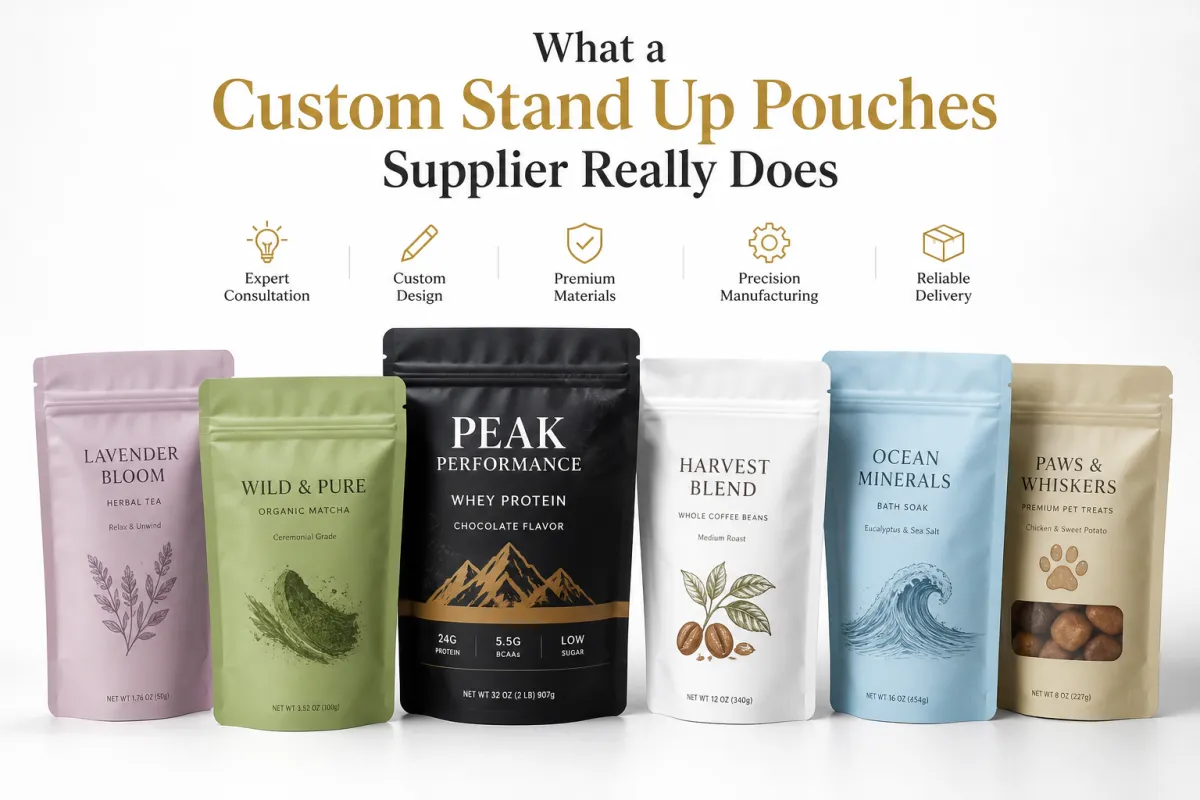
A custom stand up pouches supplier sits at the point where packaging design, manufacturing, and logistics meet. The strongest version of that role is part converter, part printer, and part process engineer. The supplier receives a product brief, then works backward from fill method, shelf-life needs, retail channel, and artwork to build a pouch that is commercially practical and physically sound.
That sounds tidy on paper, then the material stack starts to matter. A pouch may need a glossy or matte printed exterior, a moisture barrier, an oxygen barrier, a heat-seal layer, and a closure system that matches the product. Coffee usually needs aroma retention and often a degassing valve. Supplements often need light protection and tamper evidence. Pet treats may need puncture resistance. Snack brands care about grease resistance and a clean shelf presence. A custom stand up pouches supplier has to connect those needs without making the pouch too expensive or too difficult to fill.
There is a meaningful difference between a printer and a full-service custom stand up pouches supplier. A printer may only handle graphics on a film structure you already chose. A converter may form the pouch but leave artwork support to another party. A full-service supplier usually manages material selection, print method, lamination, pouch forming, closures, and quality control. That difference matters because many first-time buyers assume they are comparing the same service level when the scopes are actually very different.
The companies that rely on a custom stand up pouches supplier most often include snack brands, coffee roasters, nutraceutical companies, pet food makers, and startup CPG teams that want premium-looking product packaging without moving into rigid containers too early. The appeal is easy to understand: stand-up pouches take less storage space than cartons, often weigh less than jars, and give branding a strong front panel to work with.
If you already compare formats like pouches, films, and Custom Packaging Products across multiple SKUs, the pattern will feel familiar. Packaging decisions are never only visual. They shape filling speed, freight cost, warehouse cube, retail merchandising, and spoilage risk. That is why a custom stand up pouches supplier should be judged on more than whether they can print a polished mockup.
One practical reality often surprises buyers: a good supplier removes hidden costs you do not see on the first quote. Weak seals, poor ink adhesion, curl, and zipper misalignment create trouble later, long after the artwork has been approved. A careful custom stand up pouches supplier is helping you manage the full packaging system, not just producing a bag.
From a trust standpoint, I always treat a supplier claim as a starting point, not a fact. If a vendor cannot explain why a laminate was chosen, what the barrier layer actually does, or where the trade-offs are, I want more data before I trust the recommendation.
How a Custom Stand Up Pouches Supplier Turns Specs Into Packaging
The production chain is more technical than many buyers expect. A custom stand up pouches supplier usually begins with material selection, then moves into print setup, lamination, curing, pouch forming, zipper or fitment addition, slitting, and final inspection. Each step can influence how the pouch feels, seals, and holds up in use.
Material selection is where barrier performance gets engineered rather than guessed. Appearance can be deceptive. Two pouches can look nearly identical on a shelf, yet one may offer much better oxygen resistance or moisture protection because of the inner film structure. That distinction matters if you are packing coffee, powdered nutrition, dehydrated foods, candy, or anything sensitive to humidity. A capable custom stand up pouches supplier should explain whether your product needs oxygen, moisture, grease, UV, or puncture protection, because the answer usually changes the structure.
For food and supplement programs, it helps to talk in real technical terms. Oxygen transmission rate, or OTR, matters for aroma loss and oxidation. Water vapor transmission rate, or WVTR, matters for products that clump, soften, or stale out in humid storage. If the product is shelf-stable but still delicate, the supplier may also talk about seal integrity and headspace oxygen. Those details sound a little dry, but they are the difference between a package that protects the product and one that just looks nice in a photo.
Print method matters as well. Digital printing is often a practical fit for short runs, test launches, or multiple SKUs with smaller quantities. Flexographic printing and rotogravure become more economical as volume rises, especially when color consistency and per-unit cost matter more than setup simplicity. Artwork complexity can also affect the choice. If your design uses heavy solids, fine gradients, or multiple versions, a custom stand up pouches supplier may recommend one process over another to keep results stable from batch to batch.
Structural details change the pouch just as much as print. Tear notches help customers open the pouch cleanly. Degassing valves support freshly roasted coffee. Zippers improve resealability, although zipper type affects both cost and user experience. Clear windows can help sell a product, yet they reduce barrier in the exposed area. Rounded corners, euro holes, matte finishes, and metalized layers all change the final look and the way the pouch performs in hand. A custom stand up pouches supplier is always making those trade-offs, even if the conversation starts with graphics.
That is why it helps to think of the supplier as a hybrid role: part packaging designer, part process engineer, and part logistics coordinator. A brand may bring the creative direction, but the supplier turns that direction into a repeatable physical item. Weak communication usually shows up as a mismatch between what the buyer pictured and what the production line can actually support.
“The pouch that looks best in a mockup is not always the pouch that performs best on a filler. The difference is often a seal width, a film stiffness choice, or a zipper that slows the line by two seconds per unit.”
Buyers who want a clearer picture of the technical side can use industry references such as Packaging Institute resources and transport-testing guidance from ISTA. Those references will not replace supplier expertise, yet they do help you ask sharper questions about package design, shipping durability, and transit risk.
To make the production choices more concrete, this comparison is a useful starting point when discussing options with a custom stand up pouches supplier:
| Print or Production Option | Typical Volume Fit | Cost Signal | Strengths | Trade-Offs |
|---|---|---|---|---|
| Digital printing | Often best for 500-5,000 pouches | Higher unit cost, lower setup burden | Fast artwork changes, useful for test launches and many SKUs | Less economical at scale |
| Flexographic printing | Often best for 5,000-50,000+ pouches | Setup costs spread across higher volume | Competitive unit economics, good consistency on long runs | More preparation time and setup complexity |
| Rotogravure | Often used for large, repeat programs | Highest setup investment, lowest unit cost at scale | Strong visual quality and repeatability | Not ideal for small or frequently changing orders |
Seen this way, the supplier’s role becomes easier to judge. A custom stand up pouches supplier is not just executing artwork. They are turning specifications into packaging that can survive production conditions, retail handling, and daily consumer use.
What Drives Pricing With a Custom Stand Up Pouches Supplier
Pricing starts with structure. The film build, pouch size, and barrier requirements usually move the quote more than the artwork itself. A custom stand up pouches supplier has to price the substrate, print process, finishing, forming, and quality control work. If one of those steps is more complex than expected, the quote rises quickly.
Film structure is a major driver because barrier properties are not free. A basic pouch for a dry product may be very different from a pouch designed for freshness retention, aroma control, or grease resistance. Add UV protection, puncture resistance, or a higher-clarity window, and the material cost often rises. If the product is sensitive to oxygen or moisture, the custom stand up pouches supplier may recommend a higher-performance laminate that improves protection but also increases price.
Quantity is the next big lever. Setup costs are real, and they get spread across more units as volume rises. That is why a quote for 5,000 units often looks very different from a quote for 50,000. Smaller runs usually carry a higher per-unit price because the supplier still has to prepress, set up the press, calibrate the line, and inspect the output. A custom stand up pouches supplier with lower minimums may be useful for launch testing, while the unit economics usually improve as the order grows.
Print coverage and color count also influence price. Heavy ink coverage, photographic artwork, specialty finishes, metallic effects, and multiple front-and-back panels can increase cost. Matte varnish, soft-touch lamination, and custom transparent windows do the same. From a branding perspective, those details can make the pouch feel more premium. From a budget perspective, each choice adds another line item. A thoughtful custom stand up pouches supplier will show where the design adds value and where it only adds expense.
Then there are the costs buyers often miss. Plates, tooling, proofs, freight, warehousing, and minimum order quantities can shape the real budget more than the unit price on the first page of the quote. One supplier may show a lower per-piece number but charge more for setup and shipping. Another may bundle services differently. That is why the cheapest custom stand up pouches supplier is not always the lowest-cost option once landed cost is calculated.
For food, pet, coffee, and supplement products, the real cost question is not simply “What is the pouch price?” It is “What does the pouch protect, and what does it prevent?” If a stronger barrier reduces spoilage, or a better seal improves run efficiency, the higher quote may be the smarter business decision. In that sense, a custom stand up pouches supplier should be judged on total package performance, not unit cost alone.
Typical pricing signals, very roughly, can look like this for a custom stand up pouches supplier project:
- Short-run digital pouches can work well for testing, but the unit price stays higher than larger-volume formats.
- Mid-volume flexographic orders often find a better balance between cost and customization.
- High-volume, repeat programs usually get the strongest per-unit pricing if the design stays stable.
- Special closures, valves, and premium finishes can add noticeable cost per pouch.
Comparing quotes only by unit cost is risky. A custom stand up pouches supplier that looks expensive at first may be cheaper once freight, quality, and product protection are included. The reverse happens too, and that is where packaging programs often go sideways.
To keep the budget honest, I usually ask for one thing that is easy to miss: a clear explanation of what the quote excludes. If freight, proofing, or tooling is missing, the total can move fast. That is not a supplier problem by itself, but it does need to be visible before anyone signs off.
Step-by-Step Process and Timeline With a Custom Stand Up Pouches Supplier
A clean process matters because packaging timelines rarely fail at the finish line; they slip at the handoff points. A custom stand up pouches supplier usually works through a sequence that starts with discovery and ends with shipment, and every step depends on how complete the buyer’s brief is.
The first step is usually a discovery call or requirements review. The supplier needs product weight, fill method, pouch dimensions, shelf-life goals, target retail channel, and whether the product is sensitive to moisture, oxygen, light, or puncture. If the SKU is liquid, oily, powdered, granular, or irregularly shaped, that changes the structure. The more exact your input, the more accurate the quote from the custom stand up pouches supplier.
Next comes specification and quoting. Many buyers can get a preliminary quote in 24-72 hours, though that quote is only as good as the brief. If measurements are rough or the closure requirement is undecided, the supplier may need to revise the estimate later. The best practice is to ask the custom stand up pouches supplier to quote one clearly defined version of the pouch, then compare alternate options separately instead of blending them into one comparison.
After pricing, artwork handoff and proofing begin. Delays often appear here. Missing dielines, incorrect bleed settings, low-resolution images, unapproved brand colors, or unclear back-panel copy can slow the process. A good custom stand up pouches supplier will catch many of these issues, though not all of them. If you want the schedule to stay on track, the art team needs the correct file specs up front.
Sampling comes next. Depending on the project, you may receive a stock sample, a digital proof, or a custom production sample. A stock sample helps you feel the material. A proof shows the graphic layout. A custom sample gives the best sense of how the pouch behaves with your product, though it takes longer. For some projects, the supplier may also run fill tests or seal evaluations. A custom stand up pouches supplier that skips sampling entirely is asking you to take on more risk than most brands should accept.
Then production begins. A realistic production window after proof approval is often 12-20 business days for many standard custom pouch programs, although the exact timeline depends on print method, quantity, and closure complexity. Add shipping time and a launch can move quickly or drift, depending on the season. A custom stand up pouches supplier that understands scheduling should be able to point out the real bottleneck before it becomes a problem.
Inspection and shipment are the final steps. Buyers should ask whether the supplier performs incoming material checks, in-process inspection, seal verification, or visual quality control on finished bags. If damage during transit is a concern, ask how the packaging was tested for shipping conditions and whether any relevant transit protocols were used. That kind of question matters even more for products that move through long distribution routes or e-commerce channels.
“Start from the launch date and work backward. If the pouch must be on a shelf by a certain week, build in time for artwork corrections, sample approval, and freight. That is the part many teams underestimate.”
Here is a practical way to think about the schedule with a custom stand up pouches supplier:
- Week 1: Brief, measurements, and quoting.
- Week 2: Artwork handoff and proof review.
- Week 3: Sampling or technical validation.
- Weeks 4-6: Production and inspection.
- Final step: Freight and receiving.
This is not a fixed formula. A digital short run may move faster, while a complex barrier structure, zipper change, or multi-SKU launch may take longer. Even so, the milestone approach makes the process easier to manage because the buyer can see where the schedule actually lives. The right custom stand up pouches supplier should welcome that kind of planning.
A small personal note: the projects that stay calm usually have one person keeping the spec sheet current and one person protecting the deadline. Without that, even a good supplier can end up chasing answers in circles.
Common Mistakes Buyers Make When Choosing a Supplier
The most common mistake is comparing only the unit price. That is understandable, yet it is also how a buyer ends up with a pouch that looks fine on paper and fails in production. A custom stand up pouches supplier may quote a lower number because the material is thinner, the barrier is weaker, or the finish is simpler than the buyer expected. If the pouch fails on the filler, that cheap quote becomes expensive very quickly.
Barrier assumptions are another frequent error. Brands often select a pouch based on appearance and forget the product may need moisture control, oxygen resistance, or light blocking. Coffee, powdered drinks, nutritional supplements, dried fruit, spice blends, and pet treats all react differently to storage conditions. A good custom stand up pouches supplier will push for product-specific questions, because “looks premium” is not a barrier spec.
Artwork problems can be just as costly. Missing dielines, wrong bleed, unlinked images, or unapproved color values can create rework and prepress charges. If the file package is not organized, the supplier may need extra revisions before the order can move forward. A custom stand up pouches supplier can often rescue a weak file package, but that rescue takes time. For brands building broader product packaging systems, this is the same reason custom printed boxes also need disciplined file management.
Fit and functionality errors matter too. Some teams forget to check whether the zipper is easy to close, whether the pouch stands straight at the filled weight, or whether the tear notch aligns with the user’s first pull. Others do not consider how the pouch behaves in transit or on a crowded shelf. A custom stand up pouches supplier should help you think through these details before the order is locked.
The timeline trap is the last big one. Many teams start conversations too late and then pay for rush production, air freight, or a compromise on material structure. That can be avoided with a simple rule: talk to the custom stand up pouches supplier before the launch calendar gets tight. If the pack matters to the launch, it deserves lead time.
Some buyers also forget to ask for proof of material claims. For paper-based elements, FSC certification may matter. For shipping durability, testing against standards and protocols from organizations like ISTA gives a more realistic picture than a sales claim alone. A custom stand up pouches supplier that can speak to those details is usually better prepared to support a serious brand.
One more thing I tell teams all the time: if a supplier answer sounds too smooth, ask for the test method behind it. Real packaging performance lives in the details, not the pitch deck.
Expert Tips for Working Better With a Custom Stand Up Pouches Supplier
The fastest way to improve results is to treat supplier selection like a technical review, not a price hunt. A simple scorecard can help. Rate each custom stand up pouches supplier on communication, technical guidance, sample quality, lead time reliability, cost clarity, and willingness to explain trade-offs in plain language. That turns a vague buying decision into something measurable.
Ask for specs, not just sales language. If you need food-grade freshness, aroma retention, or a better shelf-life window, request material data or performance explanations. If the product is sensitive, ask what the laminate is designed to resist and what it is not designed to resist. A strong custom stand up pouches supplier should be able to explain the difference between barrier claims and actual use cases without hiding behind buzzwords.
Run a packaging trial before you place a very large order if the launch is important. Even a small trial can reveal seal behavior, line speed, static issues, and how the pouch stacks in cartons. A three-hour run on the filler may surface more truth than a week of email threads. The right custom stand up pouches supplier will treat that as prudent risk control, not hesitation.
Design for the machine first and the shelf second. That may sound backward, yet it is usually the best order of operations. If the pouch fills slowly, leaks at the seal, or requires constant line adjustment, the savings from a prettier design disappear. A practical custom stand up pouches supplier can help balance package branding with production reality so the line keeps moving.
Build a backup plan. If you rely on only one substrate, one zipper style, or one supply path, the whole launch can get exposed. Approved alternates are useful: a second film option, a backup pouch size, or a second-source supplier for critical SKUs. That strategy does not eliminate risk, but it lowers the chance that one material shortage or machine issue stops the launch. A custom stand up pouches supplier that supports alternates is usually easier to work with over the long term.
The more ambitious the program, the more useful a written spec sheet becomes. Include dimensions, fill weight, barrier needs, finish, closure type, target retail channel, and artwork versioning. Then use the same document for every quote. That one habit makes the comparison much cleaner, whether you are buying pouches, cartons, or another packaging format from Custom Packaging Products.
I also like to keep one honest line in the conversation: lab data is useful, but product testing beats guesswork every time. A pouch can look great in a sample kit and still behave differently once it sees heat, humidity, or a fast filler.
Next Steps After Shortlisting a Custom Stand Up Pouches Supplier
Once you narrow the field, the job changes from finding a supplier to validating a fit. The next step is to gather the information a custom stand up pouches supplier needs for an accurate quote: product weight, pouch dimensions, closure preference, fill method, shelf-life target, artwork files, and launch date. Without those inputs, quotes tend to drift.
Request the same brief from every supplier so you can compare structure to structure, not guesswork to guesswork. If one quote includes a zipper, another excludes freight, and a third assumes a different film build, the comparison is misleading. A serious custom stand up pouches supplier should be comfortable quoting against a defined spec rather than a fuzzy idea.
Before you decide, ask three questions that cut through most of the noise: Can the pouch run on my machine? Can it protect my product? Can it arrive on time without surprise fees? If the answer to any of those is uncertain, the quote is not finished yet. A practical custom stand up pouches supplier will help resolve the uncertainty before you place the order.
Then review total landed cost, not just the purchase price. Freight, proofing, tooling, warehousing, and rush charges can alter the final number. So can package features that look minor in a design meeting but matter during production. This is where many buyers realize why branded packaging decisions deserve operational review, not just visual approval.
Finally, set a decision deadline that sits well ahead of launch. That gives you time to approve samples, adjust artwork, and make one last technical correction if needed. The right custom stand up pouches supplier should make the process feel controlled, not frantic.
For buyers at Custom Logo Things, the practical takeaway is straightforward: choose the custom stand up pouches supplier that can show technical clarity, predictable timelines, and honest pricing. A pouch is only “just a bag” until it fails to seal, misses a shelf date, or slows a line. After that, it becomes a lesson. The better move is to choose the custom stand up pouches supplier that helps you avoid the lesson in the first place.
How do I compare a custom stand up pouches supplier fairly?
Use the same product brief for every quote so size, barrier, finish, and closure options are directly comparable. Compare more than unit price; include freight, tooling, proofs, and minimum-order requirements in the total cost. Ask each custom stand up pouches supplier how they handle sampling, revisions, and quality checks before you decide.
What minimum order quantity is typical for a custom stand up pouches supplier?
Minimums vary by print method, material structure, and pouch size, so there is no universal number. Digital runs are often more flexible for lower quantities, while larger volume projects usually fit flexographic or gravure economics. Ask whether the MOQ applies to one artwork version or the total order across multiple SKUs from the custom stand up pouches supplier.
How long does it take to get samples from a custom stand up pouches supplier?
Timing depends on whether you need a stock sample, a digital proof, or a custom production sample. Artwork approval, film selection, and zipper or valve choices can extend the sampling stage. Build extra time into the schedule if your launch depends on testing seals, fill speed, or shelf-life performance with the custom stand up pouches supplier.
What affects pricing the most when working with a custom stand up pouches supplier?
Material structure and barrier needs usually have the biggest influence on price. Print complexity, finishing options, closures, and order volume also move the quote significantly. Shipping, tooling, and rush timelines can change the final landed cost more than expected when you work with a custom stand up pouches supplier.
What information should I send to a custom stand up pouches supplier for an accurate quote?
Send product weight, pouch size, desired closure, fill method, and any shelf-life or barrier targets. Include artwork files, brand colors, and whether you want matte, gloss, clear, or window features. Mention your target launch date so the custom stand up pouches supplier can flag timing risks early.
The cleanest next step is to build one complete spec sheet, then use that same brief for every custom stand up pouches supplier you are considering. That keeps the quotes honest, exposes the real trade-offs, and gives you a much better shot at choosing a pouch that runs well, protects the product, and lands on schedule.

