Buyer Fit Snapshot
| Best fit | Recycled Paper Shopping Bags Wholesale projects where brand print, material claims, artwork control, MOQ, and repeat-order consistency need to be specified before quoting. |
|---|---|
| Quote inputs | Share finished size, material target, print colors, finish, packing count, annual reorder estimate, ship-to region, and any compliance wording. |
| Proofing check | Approve dieline scale, logo placement, barcode or warning zones, color tolerance, closure strength, and carton packing before bulk production. |
| Main risk | Vague material claims, crowded artwork, missing packing details, or unclear freight terms can make a low unit price expensive after revisions. |
Fast answer: Recycled Paper Shopping Bags Wholesale: Film, Print, MOQ, and Carton Packing should be specified like a repeatable production item. The safest quote records material, print method, finish, artwork proof, packing count, and reorder notes in one written spec.
Production checks before approval
Compare the actual filled-product size with the drawing, then confirm tolerance on folds, seals, hang holes, label areas, and retail display edges. Reserve space for logos, QR codes, warning copy, and material claims before decorative graphics fill the panel.
Quote comparison points
Review material grade, print process, finish, sampling route, tooling charges, carton quantity, and freight assumptions side by side. A quote is only useful when the supplier can repeat the same color, closure quality, and packing count on the next order.
Recycled Paper Shopping Bags Wholesale: Buying Guide - Recycled paper shopping bags wholesale can protect margin, carry products cleanly, and communicate a sustainability message at checkout without pushing packaging costs into awkward territory.
I have seen more than a few brands discover, usually the hard way, that a shopping bag can change how the entire purchase feels. A bag that sags, tears, or wrinkles badly makes the product inside seem less considered, even if the item itself is excellent. That is the quiet problem with recycled Paper Shopping Bags Wholesale: the bag is not just packaging, it is part of the customer's last impression.
There is also a practical side that people tend to miss. Shopping bags travel farther than inner packaging, and they do it in public. They move through parking lots, subway platforms, office lobbies, front desks, and a thousand phone cameras. Shelf talkers never see that kind of exposure. Boxes stay in the stockroom. Recycled paper shopping bags wholesale gets seen, carried, and judged in real time.
A weak bag is not a green story. It is a customer service issue wearing your logo.
Recycled paper shopping bags wholesale: why the bag matters more than it looks
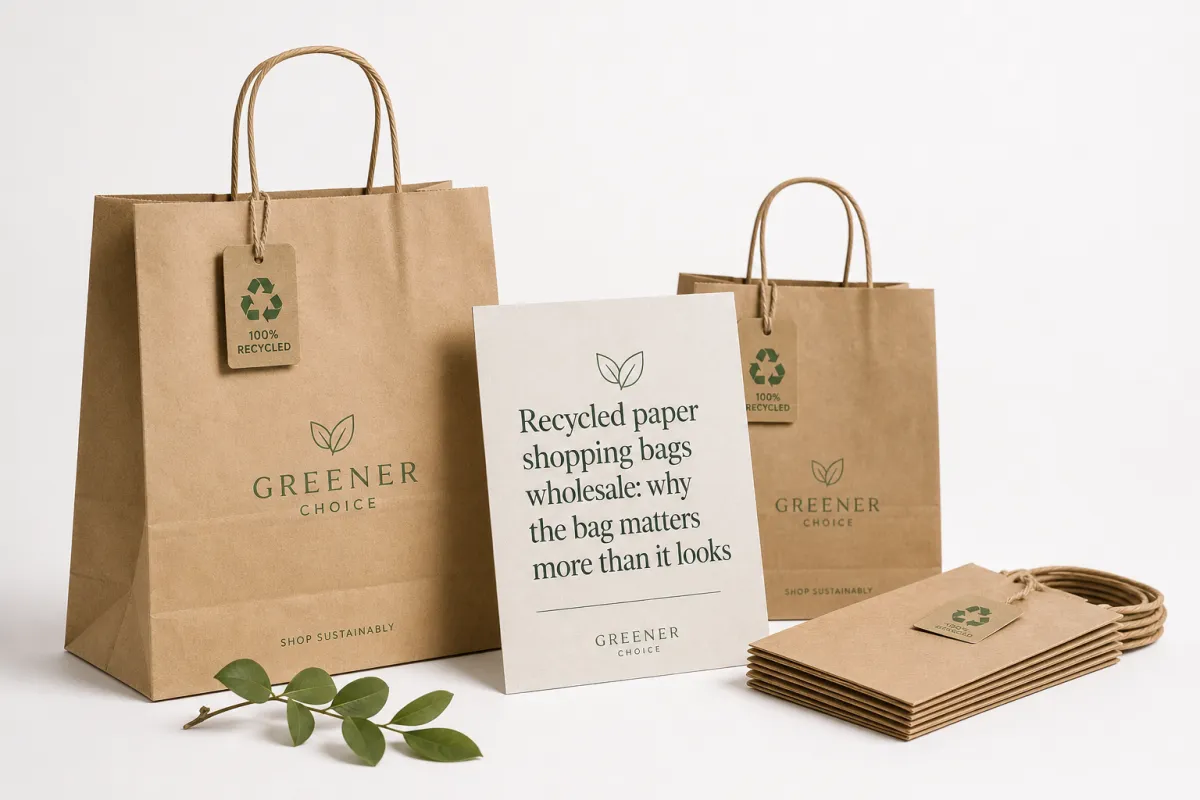
From a packaging buyer's perspective, recycled paper shopping bags wholesale sits at the intersection of presentation, handling speed, and transport durability. You can shave a few cents per unit by dropping paper weight or simplifying the handle, but if the bag folds under a boxed candle or splits at the fold, that savings vanishes fast. The real win comes from matching the bag to the actual product mix instead of buying from a vague idea of what feels "standard."
That is why the bag matters more than it looks. A shopping bag is a short-distance shipping surface, a retail handoff tool, and a mobile brand sign all at once. Recycled paper shopping bags wholesale works best when the bag does all three jobs well. If the base bows too much, if the handle pull is too weak, or if the footprint is oversized for the merchandise, the bag may still pass a quick visual check and fail the moment the store gets busy.
The economics are not complicated. On a run of 5,000 bags, a small change in paper weight, handle construction, or reinforcement can move unit price by 10% to 30%. That sounds modest until it spreads across a seasonal program or a multi-store rollout. Recycled paper shopping bags wholesale is much easier to buy well once the buyer defines the carrying load, the product dimensions, and the presentation standard before comparing quotes. Otherwise, the purchase becomes a guessing game, and nobody wants that.
Customer perception matters just as much as performance. Recycled fiber content signals practical sustainability, but only if the bag still feels clean, sturdy, and deliberate in the hand. A lot of buyers assume the green message lives inside the material claim alone. It does not. It lives in stiffness, print sharpness, crease resistance, and the way the bag behaves once it is filled and lifted. Recycled paper shopping bags wholesale should support the brand, not ask the customer to excuse the bag.
Supplier comparisons should start with use, not price alone. A bag for a boutique scarf line is a different purchase from a bag for boxed skincare, bakery takeaway, or a heavy gift set with sharp corners. Recycled paper shopping bags wholesale gives buyers room to tune the spec, but only if the brief includes weight, dimensions, and the way the bag will actually be used at the counter. Otherwise the quote looks neat and the bag itself comes up short.
On the buyer side, I always recommend thinking in terms of failure points. Will the handles be held by one hand or two? Will the customer leave with a single item or a stacked purchase? Does the bag need to stand upright while orders are packed? Those details sound small, but they are usually where the cheap option gives itself away. The spec does not need to be complicated; it just needs to be honest.
Recycled paper shopping bags wholesale product details and style options
Recycled paper shopping bags wholesale covers more styles than many buyers expect. The simplest option is a flat paper bag, often used for light items, event handouts, or lower-cost retail packaging. One step up is the SOS style, which stands upright and is common in bakery or takeaway settings. Twisted-handle carry bags are the workhorse for apparel, beauty, and specialty retail. Premium gift-style bags use heavier paper, more reinforcement, and a more refined finish for products that need a stronger presentation.
Recycled content also varies. Some bags use post-consumer recycled fiber, some use mixed recycled fiber, and some blend recycled and virgin fiber to balance appearance, brightness, and stiffness. A 100% recycled kraft look can feel natural and direct, which suits certain brands very well. A white recycled paper bag can give stronger print contrast, though it often costs more because the finish has to work harder to look clean. Recycled paper shopping bags wholesale is not a simple green-versus-not-green decision; it is a set of trade-offs between appearance, cost, and performance.
Handle choice changes both comfort and strength. Paper twist handles are economical, familiar, and often easier to recycle in paper streams. Flat paper handles sit low and can feel comfortable, though they are not always the best choice for heavier products. Rope handles can signal premium positioning and improve comfort on heavier loads, but they usually raise cost. The right answer is usually not the fanciest option. It is the one that matches the lift weight and the brand story without pushing the budget into a corner.
Print choices deserve the same discipline. A one-color logo on kraft stock can look crisp and controlled. A full-panel print can be powerful, although heavy ink coverage may raise cost and can affect recyclability depending on the local recovery system. Minimal stamping often works well for brands that want a restrained look. Recycled paper shopping bags wholesale usually delivers better value when artwork is simplified to the essential brand elements instead of covering every square inch.
| Style | Typical recycled content | Common use | Typical wholesale price per unit at 5,000 pcs | Best fit |
|---|---|---|---|---|
| Flat paper bag | 30% to 100% | Light retail items, inserts, handouts | $0.08-$0.16 | Low-weight, low-cost carryout |
| SOS bag | 30% to 100% | Bakery, takeaway, basic retail | $0.10-$0.20 | Standing presentation and fast packing |
| Twisted-handle carry bag | 40% to 100% | Apparel, beauty, specialty retail | $0.16-$0.34 | Daily retail handoff and moderate loads |
| Premium gift-style bag | 40% to 100% | High-value gifting, launches, events | $0.28-$0.70 | Strong presentation and heavier items |
Those numbers are reference points rather than fixed quotes. Recycled paper shopping Bags Wholesale Pricing shifts with print coverage, reinforcement, and freight. The same style can move up or down depending on whether the supplier uses a high recycled-content kraft sheet, a brighter white stock, or a heavier bottom insert. Comparing style to style is more useful than comparing one headline number and hoping the rest will sort itself out.
Best use cases become clear once the bag style is defined. Apparel brands usually want a clean handoff, moderate strength, and a logo that reads well from a distance. Beauty brands often care more about presentation and surface finish. Food and takeaway programs need a bag that opens quickly and handles moisture better than a decorative gift bag. Recycled paper shopping bags wholesale can serve all of those categories, but not with one generic spec.
In some projects, the whole decision comes down to speed. If a store team needs to pack orders in a rush, an upright bag with a stable mouth matters more than a delicate finish. If the bag is going out with high-value items, the visual polish matters more. You are not trying to find the "best" bag in the abstract. You are trying to find the one that fits the work the bag has to do.
Specifications to check before you buy
The quickest way to run into trouble with recycled paper shopping bags wholesale is to approve a good-looking sample without checking the numbers. Start with the three dimensions that matter most: width, gusset, and height. A compact 8 x 4.5 x 10 bag can be ideal for cosmetics or accessories, while a 13 x 7 x 15 format may work better for boxed apparel or bundled retail purchases. If the product has height, a gusset that is too narrow will make the bag bulge awkwardly and push stress into the seams.
Paper weight matters just as much. Buyers often hear gsm and stop there, but the more useful question is what the bag actually needs to hold. For lightweight retail use, 120 gsm to 150 gsm can work. For regular carryout, 150 gsm to 180 gsm is common. Premium or heavier loads may call for 200 gsm or more, along with a reinforced base. Recycled paper shopping bags wholesale should be specified by performance, not guessed from how the sample feels in the hand.
Reinforcement details deserve close attention. A bag can look sturdy and still fail if the bottom insert is thin or the top fold is weak. Ask about top reinforcement, base board thickness, glue coverage, and whether the handle patch is built for the intended load. If the bag will hold boxed goods, choose a structure with enough stiffness to stay open and enough base support to keep the corners from cutting into the paper.
Here is a practical checklist buyers can use before requesting a quote:
- Dimensions: exact width, gusset, and height in inches or millimeters.
- Load target: the real product weight, not a guess based on appearance.
- Paper grade: recycled kraft, white recycled paper, or blended stock.
- Paper weight: gsm or basis weight range, plus any reinforcement.
- Handle: twisted paper, flat paper, or rope, with handle drop measurement.
- Print: one color, two color, full panel, or minimal branding.
- Compliance: recycled content target, food-contact need, and any store-specific sustainability rules.
- Artwork: vector files, Pantone or CMYK references, bleed, and safe zone.
For sourcing language tied to recycled claims, the FSC site is a useful reference for forest management and chain-of-custody concepts, while the EPA sustainable materials guidance is a solid place to review recycled-content procurement principles. Those references do not replace a supplier spec sheet, but they help buyers ask sharper questions. Recycled paper shopping bags wholesale becomes easier to evaluate once the sustainability language is tied to actual documentation instead of marketing fluff.
Artwork should be checked before the design team sends files. Ask for bleed, safe zone, and file type requirements first. Many production delays start with avoidable file issues: low-resolution logos, missing fonts, or colors that were never confirmed. Recycled paper shopping bags wholesale moves faster when the printer gets a vector logo, a clear print area, and a simple note on where the brand mark should sit relative to the handle fold or gusset panel.
If the bag will be used in stores with multiple departments or by seasonal staff, include a note about packing behavior too. A design that looks great flat on a proof can become awkward if the staff needs to fill it one-handed at a crowded register. That kind of detail does not show up on a spec sheet unless somebody asks for it, and somebody usually should.
Recycled paper shopping bags wholesale pricing, MOQ, and quote basics
Recycled paper shopping bags wholesale pricing comes down to five variables more than anything else: size, paper grade, handle type, print complexity, and order volume. A small unprinted bag made from recycled kraft will usually sit near the bottom of the range. Add reinforcement, heavier paper, a premium handle, and full-panel print, and the price rises quickly. That is normal, not a flaw. The mistake is assuming every bag should fit inside the same cost band.
MOQ often changes with construction and print method. A basic recycled kraft bag may allow lower starting quantities than a premium laminated gift bag or a custom handle build that needs more setup. Buyers should compare landed cost, not just unit price. On a bulky paper product, freight can matter a great deal, especially when the order ships in cartons, on pallets, or across borders. Recycled paper shopping bags wholesale can look inexpensive until shipping and handling are added back in.
There is another pricing trap: order volume. Larger runs reduce cost per bag because setup, waste, and production time are spread across more units. If the buyer expects to reorder soon, a slightly larger first run may produce a better total cost than placing two smaller orders a few months apart. That does not mean every brand should overbuy. It means the quote should include tiered pricing so the buyer can see where the breakpoints sit.
For a quick benchmark, these are common commercial patterns:
- Simple unprinted recycled bags often start lower because there is no plate or layout work.
- One-color logo printing usually adds moderate setup cost without pushing the job into premium territory.
- Two-side branding or full-panel coverage increases ink, proofing, and run complexity.
- Rope handles and reinforced tops can add value, but they also add labor and material cost.
- Smaller quantities almost always carry a higher per-unit price than repeat runs.
A practical way to compare quotes is to request three spec sets at once. Ask for a basic recycled kraft version, a mid-range twisted-handle version, and a premium reinforced version. Then place the numbers side by side. Recycled paper shopping bags wholesale becomes easier to buy when the quote shows what a stronger base or better handle actually costs. That often reveals that a modest upgrade is worth it, especially if the bag supports higher-value merchandise.
Sample or pre-production proof requests are worth the extra time when the brand risk is high. If the order is for a launch, a premium gift program, or a retail window event, paying a bit more to verify print placement is reasonable. Recycled paper shopping bags wholesale should be evaluated like any other commercial packaging purchase: the cheapest quote is not always the best outcome if it creates hidden cost later.
It is also smart to ask how the supplier builds waste into the quote. Paper trimming, print setup, and handle attachment all affect actual yield, and a good supplier will be transparent about that. If the quote looks unusually low, ask what has been left out. You do not need to be skeptical for sport, just precise enough to avoid surprises later.
Recycled paper shopping bags wholesale process and lead time from artwork to delivery
The buying process should be structured. Start with a spec sheet, not a vague request for paper bags with a logo. A good supplier will ask for dimensions, paper type, handle preference, print colors, quantity, and destination before giving a real quote. Recycled paper shopping bags wholesale moves faster when both sides are working from the same measurements and the same use case. That reduces back-and-forth and keeps the quote realistic.
Once the quote is aligned, artwork approval matters more than many teams expect. Print placement, Pantone matching, and the relationship between the logo and the handle fold can all change how the bag looks on shelf or in hand. A shift of 10 mm may not sound serious, but on a narrow bag panel it can change the whole design. Sample approval can catch that early. For higher-volume runs, that is cheap insurance.
Lead time depends on complexity. A repeat run of a simple recycled kraft bag may move from proof approval to production in roughly 10 to 15 business days, with shipping added on top. A more complex bag with premium handles, heavier paper, or custom packaging may need longer. If the job requires new tooling, special finishing, or a broader print setup, plan for more time. Recycled paper shopping bags wholesale is predictable when the supplier is honest about these steps.
A practical production flow usually looks like this:
- Specification review and quote confirmation.
- Artwork file check and digital proof.
- Sample or mockup approval if needed.
- Paper sourcing and material staging.
- Printing and drying.
- Bag forming, handle attachment, and reinforcement.
- Quality checks for size, print alignment, glue, and finish.
- Carton packing, palletizing, and dispatch.
Rush orders are possible, but only if the spec stays manageable. Simplified artwork, standard materials, and repeat structures are the easiest path. If the buyer asks for a rush job and a complex premium build at the same time, something has to give - usually cost or lead time. Recycled paper shopping bags wholesale is best treated as a planned purchase, not an emergency fix. Gonna rush a custom bag without clear specs is how people end up paying twice.
Shipping and receiving details deserve their own review. Ask whether the bags ship flat or packed in cartons for resale, how many units go into each carton, and whether the warehouse has any pallet height limits. If a store team needs to receive the order quickly, clarity on carton labels and delivery windows saves labor on the back end. Recycled paper shopping bags wholesale should fit the receiving process, not disrupt it.
If you are coordinating with multiple store locations, ask for carton counts that are easy to split. That reduces the chance of partial receiving mistakes and makes inventory control less of a headache. Small operational details like this are often overlooked because they do not show up in a product photo, but they matter a lot once the order lands.
Why choose us for recycled paper shopping bags wholesale
Custom Logo Things is built around practical packaging decisions, not vague sustainability language. That matters because recycled paper shopping bags wholesale only works when the numbers and the use case line up. Clear pricing, documented recycled paper options, and straightforward spec guidance make the buying process easier to trust. Buyers do not need marketing fluff; they need a bag that fits the product and the budget.
The value of packaging expertise shows up in the details. A good supplier can recommend the right gusset so the bag opens properly, the right paper weight so it holds shape, and the right handle style so the customer does not need to brace the bag with both hands. Recycled paper shopping bags wholesale is not only about making something printable. It is about matching structure to the item being carried.
Quality control is the commercial advantage most brands underestimate. If the bag arrives with crooked handles, weak glue, or inconsistent print, the cost is not limited to replacements. It also creates receiving delays, store labor, and lost confidence in the packaging program. Reliable production matters for that reason alone. Recycled paper shopping bags wholesale should reduce exceptions, not create them.
Design support matters too. Many buyers overspecify the bag because they want it to look premium, then discover the print area, handle placement, or reinforcement makes that design expensive. Others underspecify and end up with a bag that feels cheap. A stronger approach is to balance the visual brief with the commercial brief. Recycled paper shopping bags wholesale can support both, but only if the art and the structure are planned together.
For repeat programs, supply reliability is often more valuable than a tiny price drop. A reprint that lands late can interrupt a store launch or a seasonal promotion. A stable wholesale process helps with that, and our Wholesale Programs are set up to support repeat ordering, cleaner approvals, and fewer surprises when a brand needs the same spec again.
That is the real business case. Recycled paper shopping bags wholesale should strengthen the checkout experience, protect the product, and keep the operational side calm. When the supplier communicates well, checks the structure, and confirms the print details early, the bag becomes an asset rather than a risk. If you have ever watched a good product wobble in a flimsy bag, you already know why that matters.
Next steps: what to prepare for a fast recycled paper shopping bags wholesale quote
If you want a fast, accurate quote, start with the facts. Prepare the exact bag dimensions, the product weight, the preferred handle style, the paper finish, and the recycled content target. Recycled paper shopping bags wholesale quotes improve when the request includes the real load, not an estimate based on a similar bag someone used last season.
Artwork files matter just as much. Send vector logos, color references, and notes on print placement. If the brand uses Pantone colors, say so. If the bag needs a minimal mark on one side and a larger logo on the other, write that down. The more complete the brief, the less back-and-forth later. Recycled paper shopping bags wholesale is faster when the supplier can quote from a clean file package on the first pass.
Quantity and timing should be clear as well. If you are deciding between 3,000, 5,000, and 10,000 units, ask for all three. If the delivery date is strict, say that up front so the supplier can advise whether the spec needs to be simplified. Recycled paper shopping bags wholesale is always a balance between cost, lead time, and finish; the quote only makes sense when all three are visible.
Before you send the brief, use this short checklist:
- Exact dimensions and carry weight.
- Handle preference and desired drop length.
- Paper type, paper weight, and recycled content target.
- Print method, logo files, and color references.
- Quantity range and delivery destination.
- Need for samples, mockups, or proof approval.
Ask for a comparison between two or three specs if you are not sure where the budget should land. That one move can show where a small improvement in paper weight or handle type changes the price only slightly, while a more dramatic upgrade pushes the order into a different cost bracket. Recycled paper shopping bags wholesale should be bought with that level of clarity, because the right spec often costs less than the wrong one over time.
In the end, recycled paper shopping bags wholesale is not about chasing the lowest quote. It is about buying a bag that carries the product properly, supports the brand visibly, and arrives with fewer surprises. Send the measurements, quantity, artwork, and destination details, and the next recycled paper shopping bags wholesale order is far more likely to ship on time and perform exactly as intended.
What is the usual MOQ for recycled paper shopping bags wholesale orders?
MOQ depends on size, print complexity, and handle type rather than a single universal number. Simple recycled paper shopping bags wholesale styles often allow lower entry quantities than fully printed premium bags. Ask for tiered pricing so you can compare a trial run with a larger stock order and see where the real break point sits.
Are recycled paper shopping bags wholesale options strong enough for heavier retail items?
Yes, if the paper weight, bottom reinforcement, and handle style match the load. Heavier apparel, boxed goods, and gift items usually need stronger gussets and a more rigid base. Recycled paper shopping bags wholesale should always be evaluated by recommended weight capacity, not by appearance alone.
Can I add custom printing to recycled paper shopping bags wholesale bags?
Yes, most suppliers can print logos, patterns, or full-panel branding. Print coverage affects cost, turnaround, and the visual recyclability of the bag. Clear vector artwork and color references help avoid proof delays, which is why recycled paper shopping bags wholesale orders move faster when the design files are ready.
How do I compare quotes for recycled paper shopping bags wholesale fairly?
Compare the same dimensions, paper grade, handle type, print method, and packaging format. Include freight, setup charges, and any sample fees when calculating landed cost. A lower unit price can be misleading if the bag spec is weaker or shipping is higher, so recycled paper shopping bags wholesale quotes should be judged on the full landed number.
What information speeds up a recycled paper shopping bags wholesale quote?
Provide exact dimensions, quantity, artwork files, recycled content target, and delivery location. State whether you need samples, a strict deadline, or a specific handle style. A complete brief reduces back-and-forth and gives you a more accurate recycled paper shopping bags wholesale quote on the first pass.

