Buyer Fit Snapshot
| Best fit | Recycled Paperboard Folding Cartons Bulk Ordering projects where brand print, material claims, artwork control, MOQ, and repeat-order consistency need to be specified before quoting. |
|---|---|
| Quote inputs | Share finished size, material target, print colors, finish, packing count, annual reorder estimate, ship-to region, and any compliance wording. |
| Proofing check | Approve dieline scale, logo placement, barcode or warning zones, color tolerance, closure strength, and carton packing before bulk production. |
| Main risk | Vague material claims, crowded artwork, missing packing details, or unclear freight terms can make a low unit price expensive after revisions. |
Fast answer: Recycled Paperboard Folding Cartons Bulk Ordering: Board, Finish, Dieline, and Unit Cost should be specified like a repeatable production item. The safest quote records material, print method, finish, artwork proof, packing count, and reorder notes in one written spec.
Production checks before approval
Compare the actual filled-product size with the drawing, then confirm tolerance on folds, seals, hang holes, label areas, and retail display edges. Reserve space for logos, QR codes, warning copy, and material claims before decorative graphics fill the panel.
Quote comparison points
Review material grade, print process, finish, sampling route, tooling charges, carton quantity, and freight assumptions side by side. A quote is only useful when the supplier can repeat the same color, closure quality, and packing count on the next order.
Recycled Paperboard Folding Cartons Bulk Ordering Guide
A carton can look straightforward on paper and still decide whether a production run stays smooth or turns into a headache, which is why recycled paperboard folding cartons bulk deserve a careful look before the first plate is made. The right structure can lower unit cost, keep pack-out moving, and still give the product a clean retail face that holds up on shelf and in transit. For buyers balancing margin, appearance, and repeat ordering, the real value is not just a lower quote; it is a carton that behaves well through printing, folding, filling, shipping, and display.
Custom Logo Things works with buyers who need practical packaging decisions, not vague promises. If you are comparing board grades, checking dimensional tolerances, or trying to understand why one carton folds cleanly while another resists the line, this guide lays out the details that matter. Recycled paperboard folding cartons bulk programs work best when the structure fits the product, the finish fits the brand, and the order quantity fits the launch plan.
I have seen beautiful mockups fall apart the minute a packer starts running cartons at speed, and I have also seen a simple, well-scored box save a team from weeks of frustration. The difference usually comes down to the basics, not the fancy stuff.
Why recycled paperboard folding cartons bulk make sense
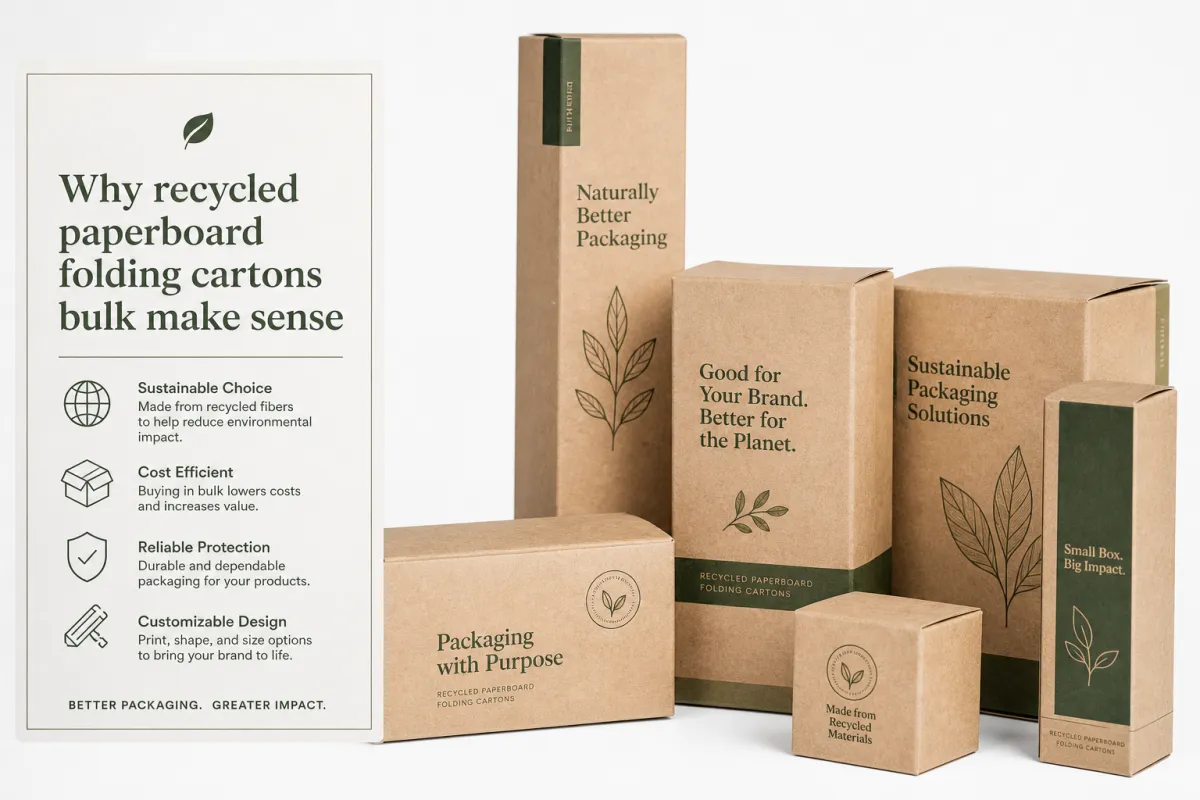
Recycled paperboard folding cartons bulk make sense for a plain practical reason: the carton does more than hold a product, because it shapes labor, storage, brand presentation, and freight protection all at once. A well-built carton can lower unit cost, simplify pack-out, and still deliver a retail-ready face that feels intentional instead of improvised. That matters whether the product is a supplement, a cosmetic, a personal care item, a dry food item, or a small consumer good that has to travel through a warehouse before it reaches a shelf.
In recurring programs, buyers often prefer recycled paperboard because the supply chain is familiar and the converting process is efficient. Large runs can be die cut, scored, folded, and glued with less waste than many newer-format packages, and the board itself is flexible enough to support simple one-color branding or more polished retail graphics with varnish, aqueous coating, or lamination. Recycled paperboard folding cartons bulk orders also tend to be easier to standardize across seasons, which helps purchasing teams avoid requalifying a package every time a new SKU is added.
Many packaging failures are not printing failures. A carton can carry excellent color and still create trouble if the caliper is wrong, the score is too tight, the glue flap is too short, or the panel proportions make the blank fight itself during folding. From a production point of view, that kind of issue is expensive because it slows line speed and creates rework. Buyers asking for recycled paperboard folding cartons bulk should look at the structure first, then the graphics, because a carton that behaves well in the hand usually behaves well on the line too.
Practical rule: a good carton is one that folds square, holds its shape, and does not make the packer stop and adjust it every few minutes.
The goal is not to overspec the package. It is to match board grade, style, and quantity to the product so the carton performs in shipping, storage, and display without driving unnecessary cost. That is where recycled paperboard folding cartons bulk becomes a buying decision with real weight: the right build gives you consistency, and consistency is what keeps a recurring program under control.
Recycled paperboard folding cartons bulk: product details and build options
Recycled paperboard folding cartons bulk programs usually start with the carton style, because style influences both cost and performance. Straight tuck cartons are common for lightweight products and retail presentation, reverse tuck cartons are often chosen when a different opening direction helps the line, auto-bottom cartons support faster hand packing or semi-automated filling, and hanger tab cartons are useful for peg display. Some buyers also add windows, paperboard inserts, or small locking features when product visibility or internal restraint matters.
Material choice shapes the feel of the carton as much as the style. Recycled paperboard is commonly selected by caliper or basis weight, and the practical question is whether the board is stiff enough to stack, print well, and stay flat after scoring. A thinner board can save money, but it may crush more easily or open up at the seams during shipping. A heavier board can improve shelf presence, yet it may raise cost and change how sharply the folds behave. For recycled paperboard folding cartons bulk, that tradeoff should be matched to the product weight and the way the carton will be handled.
Buyers also need to think through coating and finish. Aqueous coating gives a clean, economical finish and helps with rub resistance. Varnish can add a bit of protection and visual control. Lamination gives another level of surface durability but raises cost and can change recyclability expectations depending on the construction. If the product needs a premium retail face, soft-touch or matte treatments can help, though the decision should be weighed against scuff resistance and budget. Recycled paperboard folding cartons bulk are at their best when the finish supports the brand without creating avoidable process steps.
Typical build details worth confirming before a quote include:
- Finished dimensions, not rough estimates.
- Dieline style and panel orientation.
- Caliper or board thickness target.
- Glue flap size and adhesive requirements.
- Print side, inside print, and any reverse copy.
- Hand-pack or machine-pack use.
- Whether the carton needs a display window or insert.
One practical way to compare options is by looking at how the structure affects both production speed and the final retail result. The table below gives a simple purchasing view of common formats used in recycled paperboard folding cartons bulk programs.
| Carton style | Typical use | Production note | Relative cost impact |
|---|---|---|---|
| Straight tuck | Light retail items, cosmetics, supplements | Clean appearance; straightforward folding pattern | Lower to moderate |
| Reverse tuck | General consumer goods, multi-SKU programs | Useful when opening direction matters on the line | Lower to moderate |
| Auto-bottom | Hand-packed or fast-fill items | Speeds assembly, but structure is more involved | Moderate to higher |
| Window carton | Products that benefit from visibility | Adds a film or cutout, which changes material and handling | Moderate to higher |
| Insert carton | Fragile items or nested components | Improves fit and restraint, but adds converting steps | Higher |
For products in the food-adjacent or personal care space, the right coating and board selection matter just as much as the graphics. Recycled board can work very well for dry goods, shelf-stable items, and non-direct-contact applications if the structure and finish are chosen properly. For buyers who want a sustainability reference point, the EPA guidance on recycled-content claims is a useful baseline, especially when packaging language will appear on a spec sheet, retail line card, or procurement report. The more a program scales, the more important it becomes to keep the carton spec simple, repeatable, and easy to verify.
That last part matters more than people expect. A spec that is only clear to the designer is not really a usable spec, and a carton spec that can be read three different ways is gonna create confusion somewhere down the line.
Specifications that affect performance and shelf life
Recycled paperboard folding cartons bulk should always be specified with the production realities in mind, not just the shelf-facing appearance. The most important specs are usually caliper, basis weight, print coverage, finish, fold score quality, and whether the carton needs extra protection against grease, moisture, or abrasion. A carton can look excellent in a digital proof and still fail if the board choice makes it buckle, if the scores crack, or if the glue area is too narrow for consistent closure.
Caliper and basis weight influence how the carton stands up to stacking, palletizing, and retail handling. Thicker board can feel more substantial, but the score depth must be adjusted or the folds will crack. Lighter board can run well and reduce cost, but it may deform if the product is heavy or the insert adds stress. In recycled paperboard folding cartons bulk production, the board is never just a substrate; it is part of the package’s mechanical design.
Surface finish affects shelf life in the practical sense. If the carton will travel through distribution before it reaches retail, scuff resistance matters. If it will sit in a humid stockroom or pass through a fulfillment center with varied conditions, warp resistance becomes important. If the carton must preserve barcode readability, then the print surface, contrast, and ink density all need to be reviewed after finishing. That is why a carton that is perfectly acceptable on press can still cause problems later if the finished surface changes too much during conversion.
For compliance-sensitive categories, the detail work matters even more. Product labeling space has to fit mandatory copy, ingredient declarations, warnings, and UPC placement. The code has to remain readable after coating. If the item is food-adjacent, the team should confirm the intended use and any needed compliance review before final signoff. Many buyers in recycled paperboard folding cartons bulk programs also ask for a transport test, and industry references such as ISTA test standards are commonly used as a benchmark for package distribution performance.
Here is the kind of fit check that saves trouble later:
- Confirm the finished carton size against the actual filled product, not only the bottle drawing or jar spec.
- Check whether the closure flaps can tolerate repeated handling without opening.
- Review the panel layout so the UPC, ingredients, and legal copy remain visible.
- Decide whether the product needs an insert or whether board stiffness alone will hold it in place.
- Test the carton under the same pack-out method you expect in production.
The best recycled paperboard folding cartons bulk specs are the ones that reduce surprise. A buyer who knows the real carton dimensions, the product weight, the line speed, and the storage environment is usually in a much better position than a buyer who only has a mockup. That is especially true for heavier jars, sachet multipacks, and e-commerce shipments, because each of those applications places different stress on the carton and the score lines.
Useful rule of thumb: if the product is heavy, irregular, or highly sensitive to presentation, test a sample under real handling conditions before approving the final run.
Pricing and MOQ for recycled paperboard folding cartons bulk
Recycled paperboard folding cartons bulk pricing is driven by a handful of variables that buyers can actually control: board grade, carton size, print complexity, coatings, finishing, quantity, and the number of unique SKUs in the job. A simple one-color carton in a standard size is far easier to price than a multi-color carton with a soft-touch finish, foil accent, window cutout, or custom insert. The more steps involved, the more setup time and production handling show up in the quote.
Minimum order quantity is usually tied to the economics of setup. A print run needs plate prep, die cutting, folding, gluing, and packaging, and every one of those steps has a fixed cost before the first finished carton is boxed. That is why MOQ often feels high for small launches. For recycled paperboard folding cartons bulk, the minimum can vary widely by structure and print method, but a buyer should expect larger quantity thresholds for jobs with specialty finishing, complex die lines, or multiple versions.
Unit cost usually improves as volume rises, though the price break is not always linear. Moving from one tier to the next can bring meaningful savings, but a buyer should compare total landed cost, not only the quoted per-carton price. Freight, spoilage allowance, and the cost of storing extra inventory can change the real number. A lower quote that forces a long freight lane or creates warehousing pressure may not be the best choice for a lean program. That is why recycled paperboard folding cartons bulk buyers often review both the carton price and the inventory plan together.
The table below gives a simple way to think about how budget choices affect the final spend. These are directional comparisons, not fixed catalog prices, because every custom program has its own setup and finishing profile.
| Option | Typical cost effect | Best for | What to watch |
|---|---|---|---|
| Standard size, simple print | Lowest | High-volume repeat orders | Less room for premium branding |
| Custom size with moderate print | Moderate | Most retail programs | Balance fit and setup cost |
| Premium finish with coating or foil | Higher | Retail-facing products that need shelf pop | Check whether the finish adds real value |
| Insert or special closure | Higher | Fragile or premium packaged items | Test pack-out speed and carton integrity |
A practical cost-saving strategy is to standardize wherever possible. If two SKUs can share a carton size, or if the print can change with a small copy variation instead of a full structure change, the program usually becomes easier to manage. That advice sounds basic, but it saves money in real production. For recycled paperboard folding cartons bulk, a few small decisions often matter more than one large dramatic specification.
Budget-minded buyers also ask for alternative build levels. One option may use lighter board, another may simplify the finish, and a third may tighten the dieline for better sheet yield. That is a sensible way to compare actual tradeoffs. If the carton is destined for a retail shelf and the outer shipper does most of the protective work, there is no reason to overbuild the folding carton itself. If the folding carton must do more of the work, it is better to spend on structure than to save a few cents and create line headaches later. Many recycled paperboard folding cartons bulk purchases are won or lost on that exact judgment.
How the process and timeline work from quote to delivery
The ordering sequence for recycled paperboard folding cartons bulk is usually straightforward, but the details matter. It starts with a quote request, then moves to dimensions, artwork, structural confirmation, proof approval, production, and shipping. The jobs that move fastest are the ones where the buyer sends complete information up front, because incomplete specs create back-and-forth that slows the schedule and increases the risk of revision later.
The most helpful information is also the most ordinary: finished carton dimensions, product weight, print count, coating needs, packaging use, and the target in-hand date. If a dieline already exists, send it. If a sample box is available, send that too. A carton that looks "close enough" on a screen can be very different in the hand. For recycled paperboard folding cartons bulk, an accurate quote starts with a clear structural target, not a guess.
Sampling and approval can take more time than buyers expect. A structural mockup can reveal a fit issue before any print is committed. A printed proof can expose copy placement, barcode contrast, or color concerns. Final signoff closes the loop and protects the production schedule. None of that is wasted time; it is the part that keeps a large run from turning into a correction job. In practice, a careful approval process is one of the best ways to protect both the budget and the launch date on recycled paperboard folding cartons bulk programs.
Timelines depend on the method and the finishing level, but buyers often plan for roughly 12 to 15 business days after proof approval on straightforward jobs, with more time needed for complex print, special coatings, or insert work. Shipping time adds another layer, especially if the cartons are moving across regions or crossing a longer freight lane. For product launches, the safest habit is to work backward from the receiving window, not forward from the print date. That is especially true for recycled paperboard folding cartons bulk orders tied to retailer calendars or fulfillment cutoffs.
One way to keep the schedule under control is to break the project into a few clear milestones:
- Quote and spec review.
- Dieline and artwork confirmation.
- Sample or proof approval.
- Production and finishing.
- Pack-out and freight booking.
Recycled paperboard folding cartons bulk orders also benefit from an honest discussion about changes. A simple copy swap is usually manageable. A size change, a board upgrade, or a new finish can affect lead time and cost much more than expected. Buyers who understand that early tend to have smoother launches and fewer surprises at the end of the run.
The cleanest projects are the ones where everyone agrees on the carton spec before production starts, because once the run is underway, even a small tweak can ripple through the schedule.
Why choose us for recycled paperboard folding cartons bulk
Choosing a supplier for recycled paperboard folding cartons bulk is about more than getting a carton made. It is about working with a packaging partner who understands how print, scoring, adhesive, and folding behavior affect the line. A supplier who pays attention to those details can help you avoid common mistakes such as weak glue flaps, poor score depth, or dimensions that look fine in a mockup but slow down pack-out.
Custom Logo Things is built for buyers who want straight answers on structure, pricing, and scheduling. That matters because sustainable packaging should still be operationally sound. If the carton costs less but causes rework, it is not actually saving money. If the board is recycled but the build does not suit the product, the result is a problem in transit or on shelf. The better approach is to balance recycled content, visual quality, and reliable performance at scale. That is the point of sourcing recycled paperboard folding cartons bulk with a packaging team that understands production realities.
There is also value in clear communication. Buyers Should Know what drives the quote, what drives the lead time, and which options are truly optional versus essential. That kind of clarity helps procurement teams compare vendors and helps brand teams make decisions without sorting through vague sustainability language. If you need additional purchasing support, the Wholesale Programs page is a useful place to start, especially for repeat runs and multi-SKU planning. For broader company information, the Custom Logo Things team can help frame the packaging plan around your actual production needs.
For brands that care about fiber sourcing, it is also worth checking whether the project aligns with recognized forest certification standards. The Forest Stewardship Council is one of the most widely recognized references for responsibly managed forest fiber. That does not replace a full packaging review, but it gives procurement teams a familiar point of comparison when sustainability credentials need to be documented. In a well-run recycled paperboard folding cartons bulk program, the sustainability story and the production story should support each other rather than compete.
From a buyer’s point of view, the best supplier is the one that helps you keep the carton simple, the quote honest, and the schedule visible. That is not flashy. It is steady, and steady is usually what keeps a packaging program from drifting off course.
Next steps for ordering recycled paperboard folding cartons bulk
If you are preparing to order recycled paperboard folding cartons bulk, the smartest first step is to gather the essentials before you request pricing. Finished dimensions, product weight, print requirements, quantity target, coating preferences, and any retail or regulatory constraints should all be in one place. That single habit usually saves time, because a quote based on real information is easier to trust than a quote built on assumptions.
It also helps to ask for more than one build option. A premium structure may be worth the extra cost for one product line, while a simpler version may be the right answer for another. If the program is cost-sensitive, request two or three alternatives so you can compare board weight, finish, and carton style side by side. That is one of the best ways to keep recycled paperboard folding cartons bulk purchases efficient without guessing at value.
For new launches, ask for a sample or dieline review before production starts. Small structural changes can improve fill speed, reduce scuffing, and make the carton sit better on shelf. Those changes are much easier to make before the run than after. If you already have artwork, send it with the spec package so any copy fit or barcode placement issue can be caught early. In a serious recycled paperboard folding cartons bulk program, the most expensive mistake is usually the one discovered after the schedule has already tightened.
Use this checklist before you send the request:
- Finished carton dimensions.
- Filled product weight or range.
- Expected annual or launch quantity.
- Board preference or recycled-content target.
- Print colors, finish, and any special effects.
- Need for inserts, windows, or special closures.
- Target in-hand date and shipping destination.
Send those details to Custom Logo Things, and the team can quote recycled paperboard folding cartons bulk with the kind of practical alignment that helps a packaging program stay on budget and on schedule. The result should be a carton that performs in the warehouse, looks right on shelf, and keeps the purchase process clear from the first inquiry through the final delivery.
Recycled paperboard folding cartons bulk work best when the structure, print, and quantity all match the real job, because that is what keeps cost under control and the packaging line moving.
What is the usual MOQ for recycled paperboard folding cartons bulk orders?
MOQ depends on board type, print method, finishing, and carton size, but higher setup jobs usually need larger runs to stay cost-efficient. If you have multiple SKUs, standardizing dimensions or graphics can help reduce the effective minimum per version. Ask for quantity break pricing so you can see whether moving up a tier lowers the per-carton cost enough to justify the extra inventory.
How do recycled paperboard folding cartons bulk prices get calculated?
Pricing usually reflects board grade, carton dimensions, number of print colors, coatings, special finishes, and total quantity. Complex structures, inserts, or tight registration requirements can add cost because they increase setup and production handling. The best comparison is total landed cost, not just the unit price, because freight and waste rate can change the real spend.
Can recycled paperboard folding cartons bulk be used for food products?
Yes, if the structure, coating, and application fit the product and any relevant compliance requirements. Dry goods and shelf-stable items are common uses, while moisture, grease, and direct contact needs should be reviewed carefully. Share the product type early so the carton can be matched to the correct board and finish.
What information should I send to get an accurate quote?
Provide finished carton dimensions, product weight, quantity, print requirements, coating or finish preferences, and target ship date. If you already have a dieline or sample, include it so the quote reflects real structure rather than a guess. The more complete the specs, the faster the pricing and the fewer surprises during production.
How long does production usually take for recycled paperboard folding cartons bulk?
Lead time depends on approval speed, print complexity, finishing, and current production load. Sampling, proofing, and artwork revisions can extend the schedule, especially for first-time packaging programs. If timing is tight, ask for a timeline that separates approval, production, and shipping so you can plan each milestone.