Buyer Fit Snapshot
| Best fit | Clear Plastic Envelopes Supplier projects where brand print, material claims, artwork control, MOQ, and repeat-order consistency need to be specified before quoting. |
|---|---|
| Quote inputs | Share finished size, material target, print colors, finish, packing count, annual reorder estimate, ship-to region, and any compliance wording. |
| Proofing check | Approve dieline scale, logo placement, barcode or warning zones, color tolerance, closure strength, and carton packing before bulk production. |
| Main risk | Vague material claims, crowded artwork, missing packing details, or unclear freight terms can make a low unit price expensive after revisions. |
Fast answer: Clear Plastic Envelopes Supplier: Material, Print, Proofing, and Reorder Risk should be specified like a repeatable production item. The safest quote records material, print method, finish, artwork proof, packing count, and reorder notes in one written spec.
Production checks before approval
Compare the actual filled-product size with the drawing, then confirm tolerance on folds, seals, hang holes, label areas, and retail display edges. Reserve space for logos, QR codes, warning copy, and material claims before decorative graphics fill the panel.
Quote comparison points
Review material grade, print process, finish, sampling route, tooling charges, carton quantity, and freight assumptions side by side. A quote is only useful when the supplier can repeat the same color, closure quality, and packing count on the next order.
A clear plastic envelopes supplier can look like a boring line on a purchase order until the sample lands on your desk with haze, weak seals, or a flap that gives up the second someone touches it. The best clear plastic envelopes supplier is doing more than selling transparent pouches. They are balancing visibility, protection, finish, and the way the piece feels in a buyer's hand.
That matters because clear packaging gets judged fast. A document sleeve, retail insert pack, or lightweight mailer has a few seconds to look right and feel right. If the film is wrong, the whole package reads cheap. A dependable clear plastic envelopes supplier knows the envelope is part of the presentation, not just a shell around it.
I have seen buyers obsess over print color and then ignore the film itself. Bad move. A slightly cloudy sleeve or a sloppy seal will sink the whole thing faster than a tiny artwork tweak ever will. That is why the supplier matters so much here: not just for inventory, but for how the product performs in the real world.
Comparing vendors gets easier once you stop treating every quote like the same thing. This article breaks down how a clear plastic envelopes supplier usually prices work, what pushes cost up or down, which specs deserve attention, and how to tell a steady supply partner from a salesy one with a nice PDF. The boring details do most of the damage here.
What a Clear Plastic Envelopes Supplier Actually Does
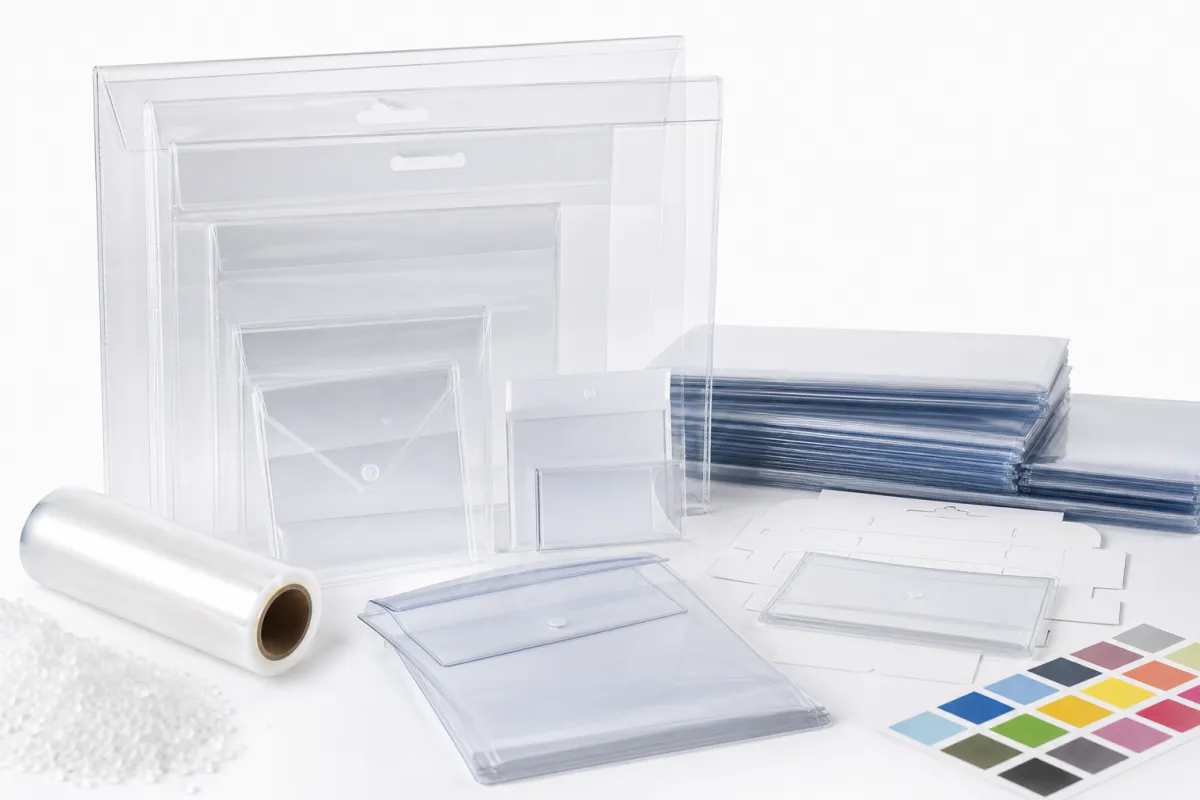
A clear plastic envelopes supplier starts with film selection, then turns that film into the finished size, seal style, and closure system you need. Sounds simple. It usually is not. The difference between a clean, durable envelope and one that looks cheap hides in tiny choices: resin quality, thickness tolerance, seal temperature, and the amount of trimming after conversion. A few millimeters can change how the finished piece is perceived.
From a packaging buyer's point of view, the supplier is solving three problems at once. The contents have to stay visible. They have to stay protected from dust, scuffing, and moisture during handling. The package also has to stay presentable long enough to support the sale or the workflow. Miss one of those, and the result is obvious: torn corners, cloudy film, weak seals, or a presentation that drags the value down.
Different uses need different constructions. A document sleeve for samples does not need the same rigidity as a retail-ready enclosure for cards, small parts, or inserts. Some buyers want a simple tuck flap. Others want a peel-and-seal strip. Others need a zipper closure or a press seal that can survive repeated opening. A clear plastic envelopes supplier should explain those tradeoffs in plain language, not hide behind generic product names.
I usually ask suppliers to describe the film before they talk about anything else. If they cannot tell me whether it is PET, PP, or another clear resin, and what that means for stiffness and clarity, the conversation is already off track. A supplier who knows the category will also talk honestly about gloss, haze, puncture resistance, and whether the material scuffs too easily in transport. That kind of detail is boring, sure. It is also what keeps customers from complaining later.
A quote that only names size and price is thin gruel. A dependable clear plastic envelopes supplier should tell you what the film is, how it closes, what the tolerance is, and what the packaging will look like after handling.
That level of detail matters more than many buyers expect. The wrong film can cloud under pressure. The wrong closure can fail after a few open-and-close cycles. The wrong thickness can make a package feel flimsy even if it technically holds up. Once the envelope becomes part of a display, those issues stop hiding. A clear plastic envelopes supplier earns trust by preventing the small failures before they become larger costs.
For buyers comparing vendors fairly, the supplier's role should be reduced to a simple chain: source, convert, inspect, coordinate. A clear plastic envelopes supplier should source the film, convert it into the correct format, inspect the output for consistency, and coordinate the size, thickness, finish, and closure so the result fits the shipping or display use. That is the job. The rest is sales noise.
There is also a practical side that does not show up in marketing copy. Good suppliers know how the product will be handled after it leaves the factory. Will it be tossed into kitting trays, stacked in cartons, or packed into retail-ready bundles? That answer affects everything from edge finish to carton count. If the supplier never asks how the envelopes are being used, they are guessing. Guessing is cheap. Rework is not.
How a Clear Plastic Envelopes Supplier Handles Quotes and Lead Times
The quoting process usually starts with a spec request, but the better clear plastic envelopes supplier will ask follow-up questions before pricing anything. They want to know the finished dimensions, what the contents weigh, whether the envelope will be mailed or handed out, whether print is required, and how the closure will be used. Those details shape the film choice and the production path. Skip them, and the quote gets rebuilt later.
A clean quote process often follows a simple path: inquiry, spec confirmation, sample or proof, pricing approval, production, then shipment. Simple on paper. Messier in real life. If the buyer gives incomplete dimensions, the clear plastic envelopes supplier may have to rework the quote. If artwork changes after proofing, the schedule moves. If the closure requirement stays fuzzy, production stalls while someone decides whether the job needs a peel seal, tuck flap, or pressure-sensitive strip.
Lead times depend on a few predictable variables. Stock sizes move faster than custom dimensions. Plain envelopes move faster than printed ones. Standard film grades move faster than specialty films with higher clarity or different stiffness. A clear plastic envelopes supplier may quote a simple stock order in 5 to 10 business days, while a custom printed run can stretch into 12 to 20 business days before freight gets added. Tooling changes, sampling, and special inspection add more time.
Delays usually show up in the same places:
- Missing dimensions or vague size references that force a re-quote.
- Artwork revisions after the proof has already been issued.
- Unclear closure requirements, especially for resealable or repeated-use packs.
- Late approval on samples, which pushes the production start date back.
- Confusion about whether transit time is included in the quoted lead time.
A clear plastic envelopes supplier should separate those time buckets for you. Ask for sample time, production time, and transit time as three different lines. That habit cuts down on bad assumptions fast. If a supplier only gives a single date without explaining what is included, the schedule is hard to trust. If they break it apart, you can see whether the real constraint is manufacturing, proof approval, or shipping.
Ask about inspection and packing details early too. A clear plastic envelopes supplier may wrap units in master cartons, polybags, or palletized shipments depending on volume and fragility. That changes handling time and freight cost. On a small order the difference may be minor. On a larger run, those details can move the timeline enough to matter to a launch or replenishment cycle.
One useful signal is how the supplier answers process questions. A clear plastic envelopes supplier that gives direct dates and explains the assumptions behind them is usually more dependable than one that promises speed without context. Speed helps. Predictable speed helps more.
And yes, sometimes the fastest quote is the worst one. I have watched teams rush to save a day, only to lose a week fixing a bad spec. That is not a glamorous mistake. It is just expensive.
Clear Plastic Envelopes Supplier Pricing: What Changes the Cost
Pricing starts with the film, but it never ends there. A clear plastic envelopes supplier usually prices based on thickness, resin quality, envelope size, closure style, print coverage, and order volume. A plain stock sleeve is one thing. A custom-sized, printed, higher-clarity envelope with a peel-and-seal flap is another. Those are not tiny tweaks. They change conversion speed, waste rates, and the amount of quality control needed before the job ships.
The biggest mistake buyers make is staring at unit price alone. A lower number can vanish quickly if the envelopes arrive damaged, if the seals fail, or if the usable quantity shrinks because of waste and rejection. A clear plastic envelopes supplier with a slightly higher unit price may still offer the better landed cost if the film performs well and the order does not need rework. That matters even more for repeat programs where consistency beats a cheap headline number.
Minimum order quantities also play a part. A low-volume custom run can carry setup charges, tooling costs, or low-quantity surcharges that make the per-unit number look ugly. Freight is another quiet cost driver. A quote that looks attractive on a per-piece basis may not be attractive once shipping, packaging, and any special handling are added. A strong clear plastic envelopes supplier should be willing to show the full cost stack, not just the first number your eyes land on.
Tiered pricing helps a lot. Ask for pricing at 1,000, 5,000, and 10,000 units so you can see how the economics improve with volume. That makes it easier to tell whether the program should be treated as a pilot or a full production run. A clear plastic envelopes supplier that only gives one quantity is making the comparison harder than it needs to be.
| Option | Typical Use | Typical Unit Price | Usual Lead Time | Watchouts |
|---|---|---|---|---|
| Stock unprinted clear envelope | Internal documents, simple inserts, quick replenishment | $0.08-$0.18 at 5,000 units | 5-10 business days | Limited sizing; less control over closure and finish |
| Custom unprinted envelope | Retail inserts, kitting, branded presentation without print | $0.14-$0.26 at 5,000 units | 10-18 business days | Setup fees, tooling questions, and size tolerance checks |
| Printed clear envelope | Branded retail packs, promotional mailers, displays | $0.22-$0.48 at 5,000 units | 15-25 business days | Artwork revisions, print alignment, and proof approval delays |
| Heavy-duty specialty envelope | Stronger handling, repeat opening, higher puncture resistance | $0.30-$0.60 at 5,000 units | 15-30 business days | Higher material cost and tighter quality checks |
Those ranges are planning numbers, not promises. Still, they help you ask sharper questions. If a clear plastic envelopes supplier comes in far below those ranges, ask what got removed from the spec. If they are far above them, ask whether the film, print, or closure is materially different from the other quotes you collected.
Testing can add cost too, and sometimes it should. If the envelope will move through a distribution chain with repeated drops or compression, ask whether the sample plan reflects real handling conditions. A clear plastic envelopes supplier may recommend drop or transit testing based on ISTA methods, especially if the package sits inside a larger mailer or retail shipper. For broader packaging guidance, the Institute of Packaging Professionals is a useful reference point, and ISTA publishes widely used transit test standards.
A simple rule works well here: compare the film grade, the closure cost, and the freight assumption before you accept a quote. That trio explains more pricing variation than most buyers expect. A clear plastic envelopes supplier that hides those pieces is not giving you a fair comparison. They are just handing you a number.
A good pricing request asks for line items, not just totals. If the clear plastic envelopes supplier cannot show setup, sample, production, packaging, and freight separately, the real cost is still hidden.
One more thing people miss: scrap. A supplier may quote a decent unit price, but if the run has high trim waste or a lot of rejects, that cost sneaks back into the project anyway. I always ask how much overage they expect for setup and whether that overage is already baked into the quote. It is not glamorous, but it keeps the math honest.
How to Compare Clear Plastic Envelopes Suppliers Step by Step
Start with the material spec, because that is where a lot of buying mistakes begin. A clear plastic envelopes supplier should be able to tell you the thickness in mils or microns, the film type, the clarity level, and whether the material has been checked for haze or tensile consistency. If they cannot explain those items without wrapping them in jargon, they are not helping you evaluate the product properly.
Thickness matters, but thickness alone does not tell the full story. Two envelopes can both be labeled the same gauge and still feel different in hand if the resin quality, film orientation, or seal structure changes. For document protection, a 3 to 4 mil film may be enough. For retail display or repeated handling, 5 to 7 mil may make more sense. A clear plastic envelopes supplier should help you match that choice to the job instead of defaulting to the cheapest option.
Fit matters too, because the envelope has to work in the real environment. If the contents are barely smaller than the opening, the user experience gets awkward. If the sleeve is too loose, the package shifts around and looks sloppy. A clear plastic envelopes supplier should ask for the insert dimensions and the actual use case, not just the nominal product size. That is how you avoid the kind of fit issue that only shows up after a pallet arrives.
Compare these points in every vendor conversation:
- Film type, thickness, and clarity level.
- Closure style and whether it can be opened and closed repeatedly.
- Finished size tolerance and edge quality.
- Print method, if any, and how registration will be controlled.
- Carton pack-out, palletization, and protection during transit.
- Sampling process and how close the sample is to the final run.
I like asking for a sample that is as close to production as possible, even if it takes a little longer. A supplier can make almost anything look good in a hand-cut prototype. Production is where the truth shows up. A clear plastic envelopes supplier who understands that will not get defensive when you ask for a real sample. They will probably do it anyway.
Read the quotes side by side, not one by one. That sounds obvious. It still gets skipped all the time. One vendor may include master cartons, another may not. One may quote freight, another may exclude it. One may be pricing a stock thickness while another is pricing a specialty film that happens to look similar on paper. A clear plastic envelopes supplier is only comparable if the spec is actually comparable. Otherwise you are comparing labels, not products.
There is a second layer too: service quality. If one supplier replies in a day with specifics and another takes four days to send a half-answer, that difference matters. Slow communication is often a clue, not a one-off. I am not saying every late email means disaster. I am saying patterns matter, and they tend to keep mattering after the order is placed.
Common Mistakes When Choosing a Clear Plastic Envelopes Supplier
The first mistake is choosing on price alone. Cheap can work for a simple internal use. It falls apart quickly for anything that gets handled, shipped, displayed, or judged by a customer. If a clear plastic envelopes supplier is priced well below everyone else, there is usually a reason. Maybe the film is thinner. Maybe the closure is simpler. Maybe inspection is lighter than you want. Sometimes the reason is totally fair. Sometimes it is just a future headache with a nice invoice.
The second mistake is under-specifying the closure. A tuck flap is not the same thing as a peel-and-seal strip, and neither one behaves like a zipper or a pressure-sensitive seal. Buyers sometimes assume the supplier will "figure it out." That is how people end up with a package that cannot be reused the way the team expected. A clear plastic envelopes supplier should be asking how often the envelope will open and close. If they do not ask, you should.
The third mistake is ignoring the handling environment. A sleeve that works fine on a desk may fail in a warehouse, retail back room, or shipping lane. Heat, compression, and friction all matter. I have seen clear sleeves arrive looking fine and then scratch badly after they ride in a carton with hard edges. That is on the spec, not on luck.
The fourth mistake is accepting a quote without proofing the final size. Tolerance sounds dull until a batch of inserts runs too tight or too loose. Ask how the supplier measures finished dimensions, what the acceptable variance is, and whether the samples reflect the final production method. A clear plastic envelopes supplier worth trusting will answer that cleanly.
The fifth mistake is forgetting about packing density. If the clear envelopes are stacked too tightly, they may crease or stick. If they are packed too loosely, freight cost climbs. Small detail, big money. A supplier who knows the category should be able to suggest a carton configuration that protects the product without turning the freight bill into a joke.
And one more, because it shows up a lot: buyers assume all clear films are equal. They are not. Clarity, stiffness, antistatic behavior, and surface finish can vary a lot. If the package is meant to showcase printed inserts, those differences show up fast. If the supplier waves that away, keep moving.
Expert Tips for Working With a Clear Plastic Envelopes Supplier
Write the spec like a production person will read it. That means finished size, film type, thickness, closure, print requirements, tolerance, pack count, and target use. A clean spec keeps the conversation grounded. A messy spec gets you a messy quote. Simple.
Ask for one approved sample and one production reference sample if the order is important. They are not always identical, and pretending they will be is how people get surprised later. A clear plastic envelopes supplier should be able to explain any differences in method or material. If the sample was hand-made and the production run is machine-made, that needs to be obvious.
Use the quote call to test how the supplier thinks. I usually ask what they would change if the order had to survive colder freight lanes, repeated handling, or a more premium look. That question reveals a lot. A supplier with real experience will talk through tradeoffs. A weak one will just restate the catalog.
Keep an eye on consistency across reorders. A first run can go fine and a second run can drift if the supplier does not control the same resin lot, thickness tolerance, or sealing conditions. A clear plastic envelopes supplier with a stable process will have a better answer for repeat work than for one-off work. That is the kind of detail that separates a decent vendor from a real partner.
Document the stuff that tends to get lost in email: approved artwork, sample date, final sign-off, carton counts, and shipping method. Not glamorous. Very useful. The more repeatable the order, the less room there is for confusion later. That is especially true if multiple people touch the project between sourcing and receiving.
Also, be honest about the application. If the envelopes are going inside a premium kit, say so. If they are only for internal document handling, say that too. A clear plastic envelopes supplier can work much better with an honest use case than with a polished but vague one. A lot of problems start when the buyer tries to make a low-spec job behave like a high-end pack.
The best supplier conversations sound a little plain. That is a good sign. Fancy language usually shows up when someone is trying to hide a weak process.
What to Do Next Before You Place an Order
Before you place an order, gather a short spec sheet that includes finished dimensions, intended contents, film type or desired feel, closure type, print needs, quantity, and target delivery window. Send that to each clear plastic envelopes supplier you are considering and ask for a quote that separates sample time, production time, freight, and any setup charges. If they cannot break those apart, the comparison is already shaky.
Then ask for one sample that matches the final use as closely as possible. Check clarity, stiffness, seal quality, opening force, and how the envelope behaves after a few open-and-close cycles. If the piece scratches easily, feels too soft, or looks cloudy under normal light, that is your answer. Do not talk yourself out of what your hands are already telling you.
Finally, compare the vendors on three things: how well they understand the application, how clearly they price the job, and how predictably they talk about timing. That is the real test. A clear plastic envelopes supplier who does those three things well is usually worth more than a cheaper quote that makes you do detective work.
One last practical takeaway: if you are emailing a supplier tomorrow, do not send just a size and a quantity. Send the contents, the closure you want, the surface finish you prefer, and the tolerance you can live with. That one shift cuts wasted back-and-forth fast, and it usually gets you a quote that is actually worth reading.
FAQs
What should I ask a clear plastic envelopes supplier before requesting a quote?
Ask about film type, thickness, closure style, finished size tolerance, print requirements, pack-out, and lead time. If the supplier needs more detail after that, fine. If they need none of it, that is usually not a good sign.
Is the cheapest clear plastic envelopes supplier always the worst choice?
Not always. But a low quote should make you inspect the spec line by line. Sometimes the lower price comes from a thinner film, a simpler closure, or lighter packing. Sometimes it is a real savings. You just need proof, not hope.
How much lead time should I expect?
Stock unprinted orders are often faster, while custom and printed runs take longer. A realistic clear plastic envelopes supplier should separate sample time, production time, and transit time instead of tossing out one vague date. That split matters more than most people think.
What is the biggest quality risk?
Weak seals and cloudy film are the two problems that show up fastest. After that, size tolerance and poor packing can create damage before the order even reaches the customer. If a supplier cannot explain how they control those issues, keep looking.
Can I use the same supplier for retail and internal document sleeves?
Sometimes, yes. But the specs may not be the same. Retail packs usually need a better finish, tighter appearance, and more consistent presentation. Internal sleeves can be more forgiving. A clear plastic envelopes supplier should tell you whether the same construction works for both.
Choosing a clear plastic envelopes supplier is mostly about discipline. Get the spec right, ask for the cost breakdown, check the sample like it matters, and pay attention to how the supplier handles the details. That is where the good ones separate themselves. Not in the headline. In the parts that show up after the box opens.

