Recycled Polyester Woven Labels low moq is usually a practical buying choice, not a branding slogan. It shows up when a brand is testing a new drop, replacing damaged trims, reworking a label spec, or keeping inventory tight on a limited run. The label still has to identify the product cleanly, survive handling, and look deliberate on the garment.
Low MOQ matters only if the label still performs. A small woven label can carry a lot of visual weight on a T-shirt neck, a tote side seam, or a jacket lining. If the weave is fuzzy, the edges are rough, or the text collapses into a blur, the product looks cheaper than it should.
Recycled polyester is useful because it gives a durable woven base without forcing a brand into excess inventory. It is a practical trim material for brands that want lower waste and controlled batch sizes. That is the real value, not the sustainability headline.
A low-MOQ label is only useful if it reads cleanly, sews flat, and survives washing. The line item is inexpensive; the failure is not.
Why recycled polyester woven labels low MOQ still need to look retail-ready
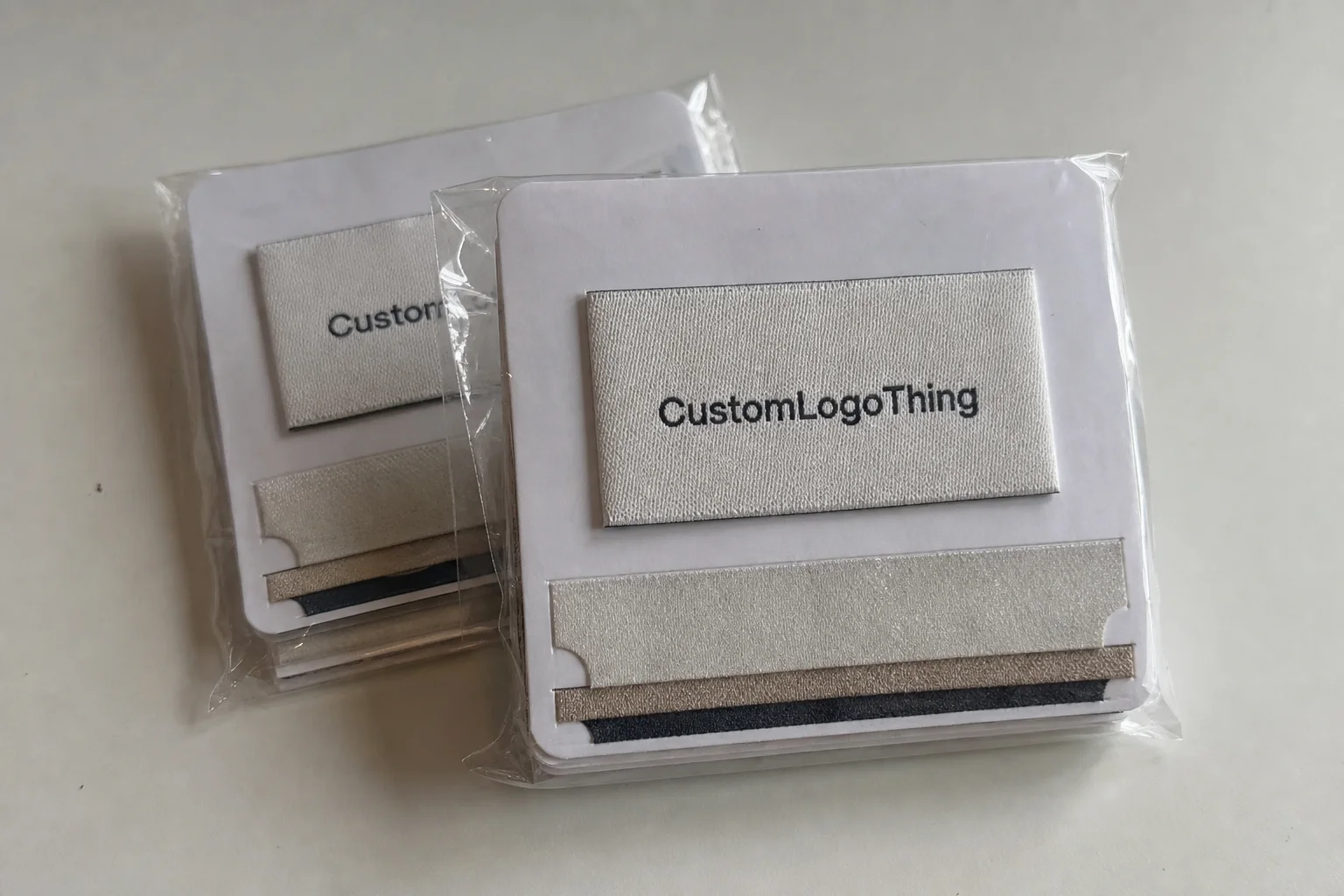
Small runs do not excuse weak presentation. A 150-piece capsule still sits next to products from brands ordering in the thousands. Customers do not know or care what the MOQ was. They only see whether the product looks coherent.
The best low-MOQ label orders are designed from the final use backward. A label on a soft tee needs a smooth edge and a weave that does not feel scratchy against skin. A label on a backpack needs abrasion resistance and sewability. A neck label for children’s apparel is a different problem from a loop label on a canvas tote. Treating them as the same spec is how weak labels happen.
There is also a planning benefit. Low-MOQ runs are often used to test a design before scaling. If the label itself looks off, the test gets noisy. It becomes harder to tell whether the collection missed or the trim looked unfinished. Keeping the label retail-ready reduces that uncertainty.
The real tradeoff is usually not low quantity versus good quality. It is a forgiving design versus a difficult one. Thick typography, simple shapes, and moderate contrast usually weave better than tiny, decorative, high-detail artwork. A label is not a billboard. It is a small textile structure.
Recycled polyester woven Labels Low MOQ are also useful when a brand needs consistency across a batch. Reorders are easier when the first run was documented well: size, fold style, thread colors, back finish, and packing method. Once those pieces are locked, the label stops being a recurring fire drill.
Construction options that hold up on apparel, bags, and accessories
Woven labels are not one material outcome. They are a set of choices that change feel, clarity, and durability. Weave type, thread density, cut style, and fold style all affect how the label behaves after sewing.
Damask-style weaving is the common choice when detail matters. It handles logos and small text better than a looser weave because it gives tighter line definition. Satin-like constructions can feel softer against the skin, which is useful for neck labels and apparel that touches bare skin often. A tighter weave is usually safer when the artwork has thin strokes or compressed lettering.
Recycled polyester works well in these applications because it is stable under repeated handling and can preserve edge detail better than some softer, lower-density options. It is a synthetic trim, so the expectation should be durability and consistency, not a biological-fiber handfeel. For many brands, that is exactly the point.
The finishing style matters just as much as the weave. The right fold depends on where the label sits and how visible it needs to be:
- Sew-in for direct attachment and the cleanest finished look on garments.
- Center-fold for neck labels and labels that need to wrap around a seam or edge.
- End-fold for side seams, outer branding, or applications where the raw edge must stay hidden.
- Fold-over for a classic visible label with branding on both faces.
- Loop-fold for bags, accessories, or hanging applications where the label needs more flexibility.
Thickness is where buyers get surprised. Too thick and the label creates irritation or a visible bump on thin fabric. Too thin and the weave can lose definition. The right spec depends on the product category. A heavyweight hoodie can tolerate a different label body than a fitted T-shirt or a lining-heavy jacket.
If you are standardizing trims across a full product line, it helps to keep labels and packaging aligned early. Our Custom Labels & Tags page covers label formats in more detail, and our Custom Packaging Products page is useful if you want the rest of the presentation to match the same production logic.
Artwork limits, label sizes, and color control that prevent bad surprises
Size is where many label specs start to fail. A neck label might be 25 x 50 mm or 30 x 60 mm. A seam label could be closer to 15 x 40 mm. A bag tag usually needs a little more width so the logo does not crowd the fold lines. If the artwork is forced into a shape that is too small, woven production exposes it immediately.
Small text is the first thing to suffer. Thin rules and fine borders are next. In woven work, anything below roughly 5 to 6 pt can become fragile depending on the weave density, number of colors, and label size. That does not mean small type is impossible. It means the design has to be chosen with the process in mind.
Color control is also different from print. Woven labels use thread colors, not ink, so the match is about choosing the closest yarn tones and keeping the palette within what the loom can cleanly reproduce. Slight variation is normal from one batch to another, especially if the supplier is matching a new order to an older reference. Good suppliers will confirm the thread chart, background color, and direction of the weave before production begins.
Before approving a run, check the following:
- Confirm the exact dimensions in millimeters.
- Decide whether the artwork sits on one face or both faces.
- Check font size and line thickness against the weave density.
- Choose the fold style before the quote is finalized.
- Verify thread colors against the garment or packaging palette.
That checklist is basic, but it prevents most expensive mistakes. A label order rarely goes wrong because of one dramatic error. It usually goes wrong because a few small decisions were left vague and then interpreted differently by production.
For brands that care about material claims, keep the broader context straight. If the rest of the packaging line includes paper components, FSC is useful for chain-of-custody questions, and EPA recycling guidance is a practical reference point for disposal language. A woven label should fit into the packaging system, not distort the claim set around it.
Pricing, MOQ, and unit cost tradeoffs for custom orders
Low MOQ gives flexibility, but the price structure still behaves like manufacturing. Lower volume usually means higher unit cost because setup charges are spread across fewer pieces. That is not a penalty; it is the math of running a small job through equipment that still needs setup, calibration, and finishing.
For planning purposes, these are reasonable ranges for woven labels with standard sizes and common finishing:
| Order Type | Typical Quantity | Likely Unit Cost | Best For |
|---|---|---|---|
| Sample or proof run | 50-200 pieces | $0.45-$1.20 per piece | Artwork checks, fit testing, buyer approval |
| Low MOQ production | 500-1,500 pieces | $0.16-$0.38 per piece | Capsules, test drops, small restocks |
| Repeat production | 3,000-10,000 pieces | $0.05-$0.14 per piece | Core styles, steady inventory, better cost control |
Those figures move with label size, weave density, color count, fold style, and packing requirements. A one-color label is easier to produce than a four-color label with tiny lettering and an unusual fold. If the order also needs special bagging, bundling, or sort-by-SKU packing, that can add setup time and cost. The quote should show those differences clearly.
There is a bigger comparison that matters more than the unit price alone. A small order that validates demand can be cheaper in the real sense than a bulk order that sits unused. That is especially true for brands with seasonal drops, frequent artwork changes, or uncertain sell-through. Low-MOQ woven labels can reduce inventory risk even if the per-piece price is higher.
When comparing quotes, compare the same variables. If one supplier includes a finished fold and the other quotes raw cut edges, the numbers are not equivalent. Likewise, if one quote assumes simple artwork and the other has already priced for a denser weave, the difference is functional, not just commercial.
Production process, proofing, and turnaround expectations
The usual workflow is straightforward: inquiry, quote, artwork review, proof approval, weaving, cutting, finishing, inspection, and packing. The point most buyers miss is that the proof stage is not a formality. It is where the job becomes real. If the spec is vague or the artwork file is messy, unclear details get interpreted by production instead of being decided by the buyer.
A clean vector file moves quickly. A raster logo exported from a low-resolution image does not. If the supplier has to rebuild text or redraw edges, time stretches. If the fold style changes after proof approval, the job slows again. The machinery is not difficult to understand. It simply needs a stable target.
Typical turnaround for low-MOQ recycled polyester woven labels often looks like this:
- Proof review: same day to 2 business days, depending on file quality.
- Weaving and finishing: about 5 to 10 business days for a straightforward run.
- Inspection and packing: 1 to 3 business days.
- Total turnaround: often 10 to 15 business days after approval, longer for complex artwork or special packing.
That is a practical estimate, not a promise. Fine text, dense colorwork, unusual folding, or split packing by SKU can push the schedule. Speed is usually a function of file readiness more than urgency.
Quality control should happen before the labels leave production, not after they are sewn onto garments. The checks that matter most are simple: edge finish, weave clarity, color consistency, and count accuracy. If the order is for apparel, the label should sit flat after sewing and not twist or curl in a way that becomes visible in wear.
What batch buyers should check before approving a supplier
Batch buyers do not need a sales pitch. They need proof that the production process is disciplined. For this kind of order, the supplier should be able to answer specific questions without turning them into vague generalities.
Start with the basics: can they show the thread chart, confirm the fold style, explain the minimum order, and identify where the setup charges come from? If those answers are unclear, the order is likely to be handled loosely. That becomes expensive later, usually in the form of reproofs, rework, or a batch that does not match the approved sample.
There are also a few quiet signs of competence that matter more than marketing language:
- Spec discipline: the supplier repeats the dimensions and finishing details back accurately.
- Proof clarity: the artwork proof shows fold orientation, thread colors, and placement.
- Production realism: the turnaround estimate changes when the artwork complexity changes.
- Packing control: quantities are counted and separated cleanly before dispatch.
That is especially important for brands ordering in batches. The goal is not just to get a good first run. The goal is to repeat the result six weeks or six months later without rebuilding the spec from scratch. A label supplier that keeps the file, the thread references, and the finishing notes organized saves time on reorders.
If you need the surrounding trim and packaging system to line up, our FAQ page answers the common order questions that usually slow down low-volume jobs. For broader packaging components, the Custom Packaging Products range can keep the visual language consistent across inserts, tags, and secondary packaging.
What to send for a fast quote and the next steps
The fastest quote requests are the ones that remove guesswork. Send the data that affects production, not just a loose request for “a woven label.” The more complete the spec, the fewer follow-up questions, and the faster the proof stage starts.
A practical quote request should include:
- Label dimensions in millimeters or inches.
- Quantity for the first run and any likely reorder volume.
- Fold style or cut style.
- Artwork file in vector format if possible.
- Color count and any thread color preferences.
- Intended use such as neck label, side seam, bag trim, or accessory tag.
- Deadline and whether a sample is required before production.
It also helps to state whether the order is a test run or a production release. That distinction changes the quote and the workflow. A sample run is for verifying appearance and function. Production is for finished goods that are ready to ship. Blurring the two usually creates delays that feel avoidable in hindsight.
Ask about setup charges if they appear in the quote. A transparent supplier should be able to explain what they cover: weaving setup, file prep, cutting, folding, or packing. The language does not need to be fancy. It just needs to be clear.
The point of low-MOQ woven labels is not to pretend small orders are cheap in the abstract. The point is to keep product launches and restocks controlled, readable, and repeatable. If the spec is clear, the proof is clean, and the material choice fits the garment, the label does its job without pulling attention away from the product.
FAQ
What makes recycled polyester woven labels low MOQ a better fit for small brands?
They let a brand test demand without tying up cash in excess inventory. The label still looks and feels like a finished retail trim, so the product does not read as temporary or unfinished.
How small can the minimum order be for recycled polyester woven labels?
MOQ depends on size, weave detail, and finishing, but low-run orders are usually possible for small launches and restocks. The exact floor is driven more by setup and finishing requirements than by raw material cost alone.
Do recycled polyester woven labels work on delicate garments?
Yes, but fold style and thickness matter as much as the base material. For softer garments, buyers usually choose thinner weaves and smoother edge finishes to reduce irritation and visible bulk.
How long does production usually take for a low-MOQ woven label order?
Turnaround depends on artwork approval, quantity, and finish complexity. Clean files and quick proof approval usually keep the job in the 10 to 15 business day range after approval, while more complex specs take longer.
What should I include in my quote request for recycled polyester woven labels?
Send size, quantity, fold style, color count, artwork, and intended use. If you already know the deadline or target budget, include that too so the quote reflects the actual job instead of a generic estimate.