Ecommerce Logo Patch Beanies unit cost review sounds like a narrow buying exercise. It is not. The first quote only tells part of the story, and usually not the most useful part. A beanie can look cheap on paper and still sell well if the patch, fit, packaging, and freight all support the final presentation. The reverse is true too: a “premium” quote can hide sloppy details that ruin the product once it is bagged, shipped, and photographed for a listing.
That is why the real job is to separate decoration cost from total delivered cost. A stitched or woven patch can make a knit hat feel more deliberate, more retail-ready, and less like a giveaway. For ecommerce, that matters. The customer is not touching a sales sample in a showroom. They are judging the product from photos, a few bullets, and whatever the hat looks like after a warehouse has touched it twice.
For brands selling seasonal accessories, the question is never just “what is the cheapest beanie?” It is “what spec gives the best shelf appeal, keeps returns down, and still leaves margin after packing and freight?” That is the only review that matters.
Why logo patch beanies can outperform printed winter promos
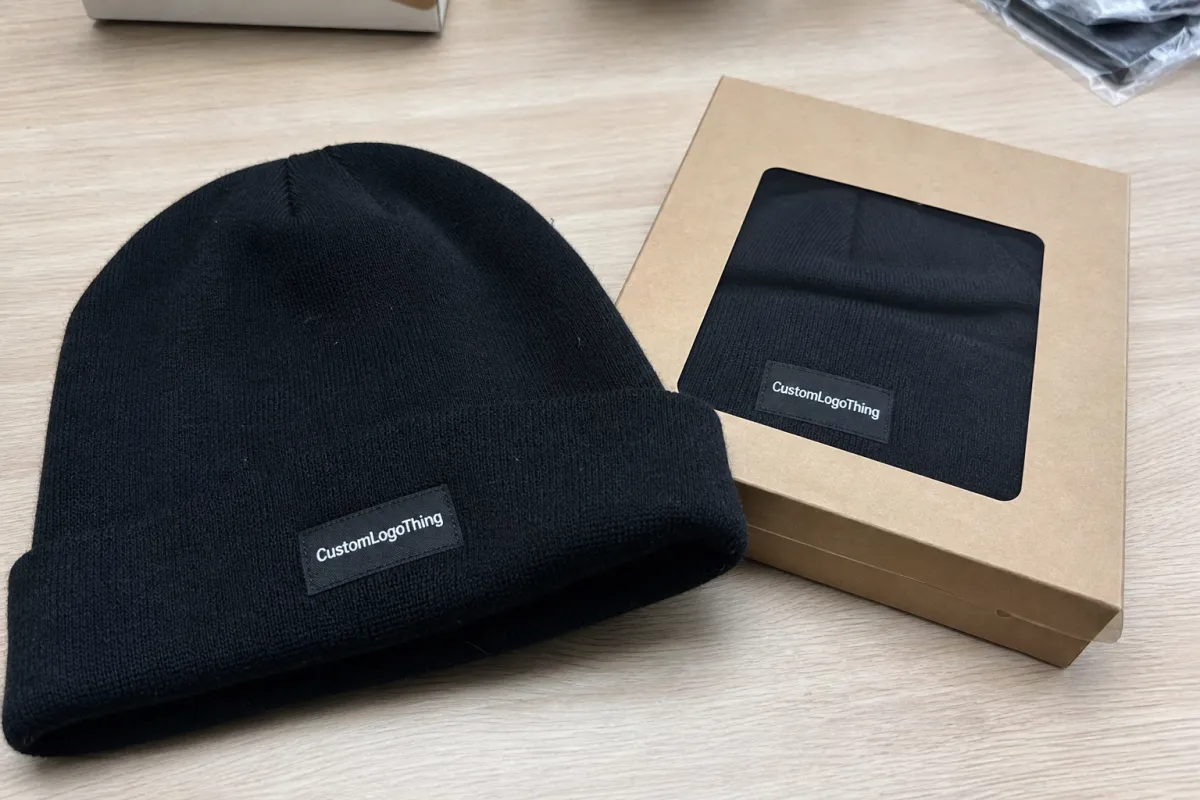
A patch usually reads as more finished than a print on knit. Printed logos can work, but knit texture, stretch, and panel movement often soften the image. On a cuffed hat, a patch creates a defined brand area. The logo has edges. It has presence. That is a small thing in production and a big thing in ecommerce images.
In product photography, a patch gives the eye a clear anchor. Front-facing shots look cleaner. The hat stacks better in cartons. The brand can be recognized from a thumbnail instead of only from a zoomed image. None of that is glamorous, but it affects conversion and perceived value. Buyers spend a lot of time comparing unit price and not enough time comparing how the item will actually present online.
There is also a wear-and-tear argument. Ink on knit can fade visually, crack, or disappear into the texture after the hat is folded and worn. A sewn-on patch holds its shape better and usually survives packing abuse more gracefully. If the product is meant to move from winter promo to repeat-use retail accessory, that durability is not optional. It is part of the product.
I see the same mistake repeatedly: buyers focus on the decoration line item and ignore how the hat will ship. A patch that helps the beanie keep structure can be worth more than a cheaper print that looks flat by the time it reaches the customer. The best version is usually the one that photographs cleanly, survives compression, and still looks intentional after a season of wear.
“If the hat looks good in a flat lay and still looks good after shipping, the construction is probably right.”
That is the practical backdrop for a review of unit cost. Not decoration cost alone. Not the quote total in isolation. The full result: how the beanie looks, how it packs, how it ships, and how much margin remains once the order lands in the warehouse.
Patch construction and beanie styles that change the final look
Patch type changes the product faster than many first-time buyers expect. A woven patch is usually the best choice for small text, sharp edges, and cleaner detail. It stays flatter and can keep a logo legible at a smaller size. An embroidered patch brings more texture and a stronger tactile feel, but the raised thread can blur tiny details. PVC patches look molded and bold, which works for simple shapes and outdoor branding. Faux leather and genuine leather both lean more premium and restrained, though neither is friendly to fine lettering.
The beanie body matters just as much. A cuffed acrylic beanie remains the most common format because it is stable, easy to source, and simple to decorate on the cuff. Rib knit gives a classic winter look and usually supports a patch well if the knit is not too loose. Slouch styles feel softer and more fashion-forward, but the drape changes the logo read once the hat is folded for packing or worn on head. A patch that looks centered on a flat sample can appear awkward on a slouch body if the logo sits in the wrong spot.
Placement tends to fall into three buckets: cuff front, body front, or side panel. The cuff front is the easiest to merchandise online because the logo area stays predictable. Body-front placement can work on no-cuff styles, but it depends more on knit tension and panel shape. Side placement can look stylish, though it is usually better for fashion brands than for direct brand visibility.
Fiber choice affects both hand feel and cost. Acrylic remains popular because it is light, warm, and available in many colors. Recycled polyester works well if the supplier can document the content and the buyer wants that story on the product page. Wool blends feel softer and can justify a higher retail price, but they usually raise the unit cost and may require more careful handling in production. A little stretch helps the hat recover after compression, which matters when the inventory is packed tightly for ecommerce fulfillment.
One rule saves a lot of sample revisions: match patch size to knit gauge. A large patch on a loose knit can look pasted on. A tiny patch on a thick cuff can disappear. The logo, the patch, and the body need to belong together. When they do not, the product looks assembled instead of designed.
That is the real question buyers should ask: which patch works with this beanie, this logo, and this price point? Not which patch is trendy. Not which sample looked expensive in isolation. The right answer is usually the one that balances visual clarity with production stability.
Specifications buyers should confirm before requesting samples
Before asking for pricing, the spec has to be clear enough to build from. That sounds obvious. It is where many projects get fuzzy. The supplier needs the hat body material, knit gauge, cuff height, patch type, patch size, patch shape, logo colors, placement, and packaging expectation. If those items are still open, the quote will be less trustworthy and the sample process will slow down.
Artwork quality matters more than most ecommerce buyers want to admit. Vector files are the right starting point because they show line weight, spacing, and color separation cleanly. Tiny type, thin borders, and crowded icons may look sharp on a screen and collapse on a patch. If the logo needs a magnifying glass, it is probably too detailed for a beanie patch.
Color is another place where assumptions cause trouble. Woven and embroidered patches can usually match color references closely, but the beanie body often depends on stock yarn or a separate dye process. That means the patch may be matched tightly while the hat body is only close. If color consistency is critical, ask for physical references, a lab dip, or a pre-production sample before approving a larger run.
Packaging belongs in the spec, too. Individual polybags, size stickers, UPC labels, barcode scans, hang tags, and carton marks all add labor. A simple bulk-packed hat is not the same as a retail-ready unit built for a fulfillment center. If the buyer forgets to specify the packaging plan early, the quote can look low and then rise once the warehouse requirements become clear.
Measurement tolerances should be discussed before approval. Hat length, cuff depth, and patch position will vary slightly in normal production. That is not a defect by itself. It becomes a problem only when the buyer expects a hand sample to define every detail perfectly. A realistic tolerance range keeps the order honest and prevents arguments later.
For a cleaner quote cycle, the first email or form should include the essentials:
- Vector logo artwork
- Target quantity and any backup quantity
- Beanie color and acceptable alternates
- Patch type, size, and placement
- Packaging, labeling, and barcode needs
- Ship-to country or warehouse ZIP code
That list is short for a reason. Most quoting delays come from missing one of those six items, not from a complicated factory process.
Ecommerce logo patch beanies unit cost review: what drives the quote
The quote usually comes down to a handful of levers: base beanie material, patch construction, patch size, number of colors, order quantity, packaging, and whether the body is stocked or custom-knit. A single-color woven patch on a standard cuffed acrylic beanie will usually sit in a very different price band from a multi-color embroidered patch on a custom body with retail packaging. Same product category. Very different economics.
Quantity matters because fixed charges have to go somewhere. Digitizing, patch tooling, setup time, and color matching are easier to absorb across 5,000 pieces than across 300. That does not make small runs bad. It just means the buyer should expect a higher unit cost until volume improves. A short test run can still be the smartest move if the brand is proving demand, not scaling it yet.
It also helps to separate product cost from landed cost. Product cost is the beanie, decoration, and packaging at the supplier level. Landed cost adds freight, duty, carton dimensions, and delivery to the final warehouse or prep center. A quote that looks acceptable at origin can become expensive once air freight, import duty, and final-mile delivery are added. Winter programs punish that mistake because the shipping window is tight.
For budgeting, a rough market range can be useful, with one caveat: market conditions move. For stock acrylic cuffed beanies with a simple woven or embroidered patch, lower-volume ecommerce orders often land somewhere around the low single digits per unit before freight, while larger runs can drop materially. Add custom knit bodies, complex patches, leather, or retail packaging, and the number climbs quickly. That is not a promise. It is the shape of the market.
| Patch type | Typical look | Cost impact | Best fit |
|---|---|---|---|
| Woven patch | Clean detail, flat profile | Often efficient for simple art | Retail logos, small type, sharp edges |
| Embroidered patch | Raised texture, strong presence | Can rise with thread coverage | Bolder logos, heritage look |
| PVC patch | Molded, modern finish | Tooling fees may apply | Bold shapes, outdoor branding |
| Faux leather patch | Understated, premium feel | Usually moderate | Minimal branding, lifestyle lines |
| Genuine leather patch | Natural grain, premium tone | Higher material cost | Fashion-forward or heritage products |
More colors usually mean more labor and more chances for mismatch. A clean one- or two-color patch often gives the best balance of appearance and price. That is why many ecommerce brands keep the logo art deliberately simple. The goal is not to show every possible design trick. The goal is to produce a repeatable item that looks good in a listing and does not become expensive to approve.
MOQ behavior can surprise buyers. Stock-supported beanies may allow lower quantities, while fully custom knit bodies or specialty patches often start higher. Reorders are usually easier because the artwork, placement, and material spec are already approved. A first run that is documented well tends to be cheaper to repeat, which is a quiet advantage many brands forget to factor into the initial review.
Ask whether the quote includes patch tooling, digitizing, sewing, bagging, label application, and carton marks. Those costs may be included, hidden, or split across separate lines. They are still real. A transparent supplier will explain the structure instead of pretending the number arrived by magic.
For unit cost control, the smartest move is usually to simplify anything the customer will not notice. A slightly smaller patch, a stocked beanie color, or a standard polybag can save money without hurting the product. Chasing a fancier spec just because it sounds better is how margins disappear.
Process, proofing, and production steps from file to shipment
A clean workflow keeps the order from drifting. The usual sequence is artwork review, spec confirmation, quote approval, digital proofing, sample or pre-production approval, bulk production, inspection, packing, and shipment. Each step matters because changes get more expensive the further the order moves.
Delays usually start with unclear artwork, uncertain patch colors, or last-minute changes to hat color and placement after the first proof is issued. A small revision at the proof stage can reset the schedule. Once sourcing and patch production are already in motion, every change has a cost. Sometimes that cost is a day. Sometimes it is a week.
Timeline depends on the build. Stock beanie bodies can move faster because the yarn or blanks are already available. Custom patches still need production time, and the sewing or application step has to be checked before cartons close. A typical run might move from proof to bulk production to final QC to freight booking, but the actual lead time changes with quantity, decoration method, packaging, and shipping mode. Air can save time and destroy margin. Ocean saves margin and tests patience.
The checkpoints that matter most are simple. Approve the digital proof only after the logo size, contrast, and placement look right. Ask for a physical sample if the logo is detailed, the color match is sensitive, or the brand cannot afford a placement surprise. Lock the purchase order once those points are settled so the order can move without stop-start revisions.
For ecommerce sellers, staging is a real issue. A holiday launch is not the same as a replenishment order. A launch may justify a higher starting quantity if the branding is locked and the calendar is tight. A test run may need a lower MOQ and simpler packaging. The launch window changes the economics, and the economics change the build.
A supplier that can break down source time, patch time, attachment time, and packing time is giving the buyer something useful. A vague “about three weeks” is not useful. Clear timing is part of the cost review because time affects freight choice, and freight choice affects the landed number.
“The lowest quote is not the lowest buy if it misses the launch window and forces rush freight.”
What makes a reliable manufacturing partner for ecommerce programs
Consistency is the first thing to check. Ecommerce does not forgive drift between orders. If the patch shifts slightly from one run to the next, the customer notices. If the knit hand changes, the product feels different on reorder. A reliable partner keeps repeat production close to the approved sample so the brand can scale without reworking listings or rechecking every carton.
Communication has to be plain and specific. A good partner should be able to translate a brand file into production language without turning every order into a fresh experiment. That means confirming patch dimensions, placement, bagging, barcode labeling, carton counts, and any receiving instructions before the run starts. Fewer assumptions, fewer mistakes.
Quality control should be measurable. Look for checks on logo alignment, patch adhesion or stitch security, color consistency, and carton labeling before goods leave the facility. If the supplier can explain what they inspect and what they reject, that is a good sign. Clear QC saves money later by reducing returns, relabeling, and warehouse disputes.
Packaging readiness matters more than people think. Ecommerce inventory often needs individual bagging, size stickers, SKU labels, or readable barcodes at receiving. If the supplier handles that in-house or through a controlled workflow, the buyer saves time at the fulfillment center. That matters as much as shaving a few cents off unit price when the goal is sellable stock.
For brands that want to sanity-check packaging and material choices, references from groups like the Packaging Machinery Manufacturers Institute and the EPA can help. If a program uses paper hang tags or cartons from managed forests, FSC documentation may also matter; see FSC for reference.
Reliable partners protect margin by preventing errors, protecting timing, and keeping the product line repeatable. That is not flashy, but it is the part that keeps a program from becoming expensive after the first purchase order.
Next steps to get a cleaner quote and faster approval
Send the minimum useful set first: logo file, quantity, preferred patch type, beanie color, decoration placement, packaging needs, and ship-to country or warehouse ZIP code. That gives the supplier enough information to return a quote that can actually be used. Missing any of those pieces usually creates a number that changes later.
Decide how the order will be used. Launch inventory, seasonal replenishment, and promotional drops do not want the same structure. A launch may justify a slightly higher starting quantity if the brand is fixed and the calendar is tight. A test order may call for a simpler spec and lower MOQ. The use case changes the build, and the build changes the cost.
Provide two acceptable options if possible. A target spec and a backup spec keep the quote moving when one patch type, yarn color, or packaging style is unavailable. That is faster than restarting from zero. Buyers who stay flexible on nonessential details usually get cleaner numbers and fewer delays.
Review the proof with a short checklist: logo size, contrast, cuff placement, patch shape, and label details. If those five items are right, approval tends to move smoothly. Then lock the PO so production can start without extra revision cycles. In most programs, the fastest way to protect cost per piece is not to squeeze every line item. It is to stabilize the spec before the order enters the line.
For anyone comparing winter accessory options, an ecommerce logo patch Beanies Unit Cost Review is really a decision tool. It separates decoration price from landed cost, shows where setup charges and tooling fees matter, and creates a cleaner path from quote to approval. If the spec is tight, the artwork is buildable, and the supplier understands ecommerce packaging, the final product usually lands where it should: on brand, on time, and at a unit cost that still leaves room to sell.
What affects ecommerce beanie patch unit cost the most?
Order quantity usually has the largest impact because setup charges are spread over more pieces. Patch type, patch size, and logo detail also change material and labor cost, while packaging, freight, and destination affect the landed cost the buyer actually pays.
What MOQ should I expect for custom logo patch beanies?
MOQ depends on whether the beanie body is stock-supported or fully custom. Simple patch styles often support lower runs than detailed multi-color builds, and reorder quantities are usually easier to reduce once the original spec is already approved.
How long does production usually take for patch beanies?
Timeline depends on sample approval, material sourcing, patch production method, and freight mode. Digital proofing is quick, but bulk production, inspection, and shipping still need scheduled time, especially if the order has custom packaging or a tight launch window.
Can you match Pantone colors on knit beanies and patches?
Patch elements can often be matched closely, especially on woven or embroidered logos. The beanie body depends more on yarn availability, dye method, and quantity, so a physical sample or approved color standard is the most reliable reference.
What files do I need for a fast custom beanie quote?
Vector artwork is best because it shows shape, line weight, and color separation clearly. Include quantity, target patch type, placement, and packaging instructions with the file, and note the minimum readable size if the logo contains small text.


