Buyer Fit Snapshot
| Best fit | Review Biodegradable Freezer Packaging Options projects where brand print, material claims, artwork control, MOQ, and repeat-order consistency need to be specified before quoting. |
|---|---|
| Quote inputs | Share finished size, material target, print colors, finish, packing count, annual reorder estimate, ship-to region, and any compliance wording. |
| Proofing check | Approve dieline scale, logo placement, barcode or warning zones, color tolerance, closure strength, and carton packing before bulk production. |
| Main risk | Vague material claims, crowded artwork, missing packing details, or unclear freight terms can make a low unit price expensive after revisions. |
Fast answer: Review Biodegradable Freezer Packaging Options: Material, Print, Proofing, and Reorder Risk should be specified like a repeatable production item. The safest quote records material, print method, finish, artwork proof, packing count, and reorder notes in one written spec.
Production checks before approval
Compare the actual filled-product size with the drawing, then confirm tolerance on folds, seals, hang holes, label areas, and retail display edges. Reserve space for logos, QR codes, warning copy, and material claims before decorative graphics fill the panel.
Quote comparison points
Review material grade, print process, finish, sampling route, tooling charges, carton quantity, and freight assumptions side by side. A quote is only useful when the supplier can repeat the same color, closure quality, and packing count on the next order.
Review biodegradable freezer packaging options like this means trusting what the cold room tells you, not what the render file promises. The most expensive lessons I see in cold-chain sourcing usually hide in tiny failure points: a seal that looks perfect at 20°C, a corner that warps after 24 hours at -18°C, or a print layer that flakes after one thaw cycle. I’ve had teams come in with glossy sample racks, only to lose the batch because pallets sweated through the first night, and none of that showed up in static spec sheets. Moisture, vibration, and compression are the three villains that move packaging from “looks good” to “rejected” faster than almost anything else.
That is the real world check: biodegradable does not remove the laws of physics. A package still has to protect food structure, carry the load in transit, survive stacking pressure, and hold brand integrity after real handlers, not after a sales pitch.
What Should You Know When You Review Biodegradable Freezer Packaging Options?
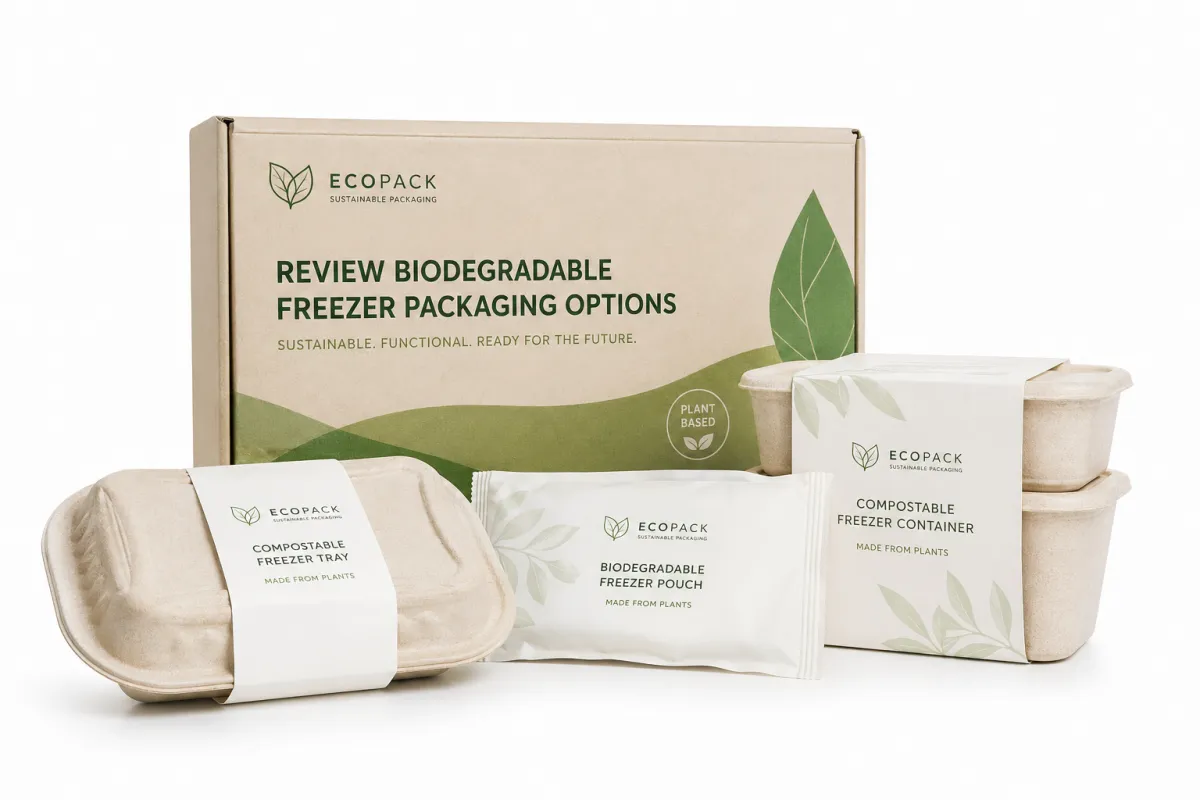
Short answer: review biodegradable freezer packaging options through a cold-case lens first, not a sustainability brochure lens. For low-moisture goods—dry bakery, snack portions, light entrées—a well-built coated paperboard carton or fiber-forward hybrid can work. For high-moisture sauces, protein portions, and products with freeze-thaw stress, compostable films, high-quality pouches, or hybrids usually do better in barrier performance. The practical rule is simple: if a structure is a hero on the shelf but a weak performer at -18°C, it is the wrong package.
When I review biodegradable freezer packaging options, I start with a failure map. I check seal creep under repeated compression, edge lift after condensation exposure, layer migration at the seam, and print readability after at least one freeze-hold-thaw cycle. If packaging can’t hold shape and legibility, it is already losing in the aisle and in the warehouse.
I learned this the hard way with a protein rice bowl launch that had strong visuals but failed after two days in distribution. The package hit every marketing checkpoint and still split seals on the third rotation. The replacement freight and support calls erased any unit-cost advantage in the first two weeks.
That is why robust review work begins with data, then layers in claims. A package with clean test records and a conservative claim set often beats a more “eco-forward” narrative that can’t prove itself through logistics abuse.
The best cold-chain package is not the one with the loudest certification language; it is the one that stays stable after freezing, vibration, and handling without losing service quality.
If you need a fast comparison, use this working map: for short dwell and low moisture, paperboard is often practical; for premium serving formats, molded fiber with a tuned liner is strong; for DTC frozen SKUs, flexible compostable pouches can improve logistics efficiency; for bulk ingredients and repeated transport loops, bag-in-box architecture usually controls cost and risk better. If your review touches Custom Packaging Products broadly, assume freezer-readiness always requires deeper qualification than ambient packaging.
Testing has to mimic real conditions. Fill weight, ambient-to-cold transitions, vibration, and stacking density all move the outcome line dramatically. A carton that survives an empty trial can still show edge collapse with a full mass load. That is why I always review biodegradable freezer packaging options as a system: material stack, process window, product profile, and use-case context.
Top Options Compared for Review Biodegradable Freezer Packaging Options
Across most teams, five categories come up repeatedly when we compare review biodegradable freezer packaging options: coated paperboard, molded fiber with bio-based liners, compostable flexible pouches, hybrid paper-and-film, and bag-in-box systems. They don’t just differ in “green score.” They behave differently in oxygen barrier behavior, cold crack resistance, and how forgiving they are in operations. Claim stories must survive handling and testing, not only supplier decks.
Paperboard is often chosen first for premium shelf presence, but can be less forgiving over long cold storage. Pouches usually deliver stronger transport efficiency and better moisture performance per gram, especially when volume shipping dominates total cost. Molded fiber wins where presentation matters and structure can be tuned, while hybrids often become the practical sweet spot when brand and barrier both matter. Bag-in-box is less glamorous, but in long-haul high-volume programs it can be the most stable technical choice.
| Option | Typical Unit Cost | Setup / Tooling | Freezer Performance | Best Fit |
|---|---|---|---|---|
| Coated paperboard carton | $0.22-$0.48 at 5,000 units | Low to moderate; dies and print plates | Good for dry or lightly moist products; weak on long dwell and surface condensation | Retail packaging, meal sleeves, lighter frozen goods |
| Molded fiber tray with bio-based liner | $0.28-$0.62 at 5,000 units | Moderate; tooling can be higher for custom cavity shapes | Strong structure; liner quality determines seal and moisture resistance | Premium frozen meals, portion trays, display-ready formats |
| Compostable flexible pouch | $0.16-$0.39 at 5,000 units | Moderate; seal testing and film qualification matter | Very good for moisture control if seal integrity is strong | DTC frozen food, dry mixes, portioned ingredients |
| Hybrid paper-and-film structure | $0.30-$0.68 at 5,000 units | Moderate to high; layered material spec adds complexity | Often the best balance of print and barrier | Premium retail packaging and stronger package branding |
| Bag-in-box style format | $0.45-$0.90 at 5,000 units | Higher; custom fit and liner qualification often needed | Excellent for bulk storage, stackability, and handling | Ingredient supply, foodservice, high-volume cold chain |
Supplier language can be slippery here. A package can be called biodegradable because one layer has plant content, and that alone says almost nothing about durability. Full stack review means checking face stock, barrier layer, sealant chemistry, adhesives, and final conversion finish as one connected structure.
From a sourcing perspective, the performance formula is still straightforward: protect food first, protect logistics second, protect shelf visibility third. If any one of those fails, your conversion team will absorb the pain downstream, often through returns, relabeling, and expedited rework. In my experience, a balanced package almost always costs less over 60 to 90 days than a weaker design corrected too late.
If your portfolio includes custom printed boxes, factor in that freezer use changes the entire material qualification stack. Water-based coatings can behave differently at subzero temperatures, adhesives may need separate low-temperature validation, and minor board upgrades can outperform expensive surface glosses. That is the kind of practical distinction between “cold chain packaging” and “packaging that just looks cold-compatible.”
Detailed Reviews of Biodegradable Freezer Packaging Options
Now the differences are no longer theoretical. Real freezer cycles expose whether each structure manages water ingress, repetitive compression, and expansion stress. The following assessments are structured the way I use them in sourcing reviews: what survives, where weakness appears, and what food profiles stress it the most.
Coated Paperboard Cartons
Coated paperboard remains a common starting point for frozen products where appearance is important and moisture load is controlled. An 18-24 pt board with a moisture-resistant aqueous barrier can print cleanly, hold brand color, and pass through standard retail systems with good familiarity. It also aligns well with brands needing a familiar carton profile with clear stackability cues.
Its vulnerability is exposure to repeated surface frost, condensation, and thaw stress. The fibers at corners and fold lines are usually the first to fail, especially when humidity is high and the supply chain sees repeated temperature movement. That is why I only approve these for products with controlled exposure, and ideally low-fat, low-sauce formulas.
My verdict: visually strong, operationally acceptable for moderate duty cycles, and less reliable for harsh freeze abuse. FSC sourcing can support your sustainability message, but only if board grade, coating chemistry, and logistics scenario are fully specified before signoff. That exact phrase “specified before signoff” saves teams from late claims disputes.
Molded Fiber Trays with Bio-Based Liners
Molded fiber trays look sturdy because they do. Portion geometry improves brand service and handling consistency, and shoppers often perceive them as premium and natural. In ambient testing this format behaves predictably; in freezer conditions it is all about the liner’s behavior.
The liner is the deciding component, especially for grease and moisture. If film-seal adhesion drops, you get pucker, seam whitening, and occasional delamination exactly where customers notice first. Some teams confuse “molded fiber structure” with “frozen resilience,” and those are not the same thing. The seam and liner still carry the load.
Best fit: products moving from hot to cold, or freezer to plate service, where presentation matters and the tray can justify a more premium conversion. For highly sauced, high-fat, or vibration-heavy routes, I need stronger lab evidence before giving a clean recommendation.
Compostable Flexible Pouches
Compostable flexible pouches usually lead on material efficiency and logistics flexibility per square meter. A 70-100 micron bio-film construction can outperform paper-heavy options for moisture control in many DTC and mix-and-match retail scenarios. They also reduce shipping volume, which can matter when outbound freight dominates total landed cost.
They can also fail quietly if sealing windows are narrow and process control drifts. In freeze conditions, slight fill variance creates localized stress around stress-ridges that look harmless at room temperature but can rupture during handling. Surface varnish layers and high-coverage graphics may scuff or whiten at fold lines after cold exposure, and that visual drift can hurt first-impression quality.
From a visual standpoint, pouches are less rigid than cartons, but they can still carry memorable branding if the window placement and graphics are engineered. They often lose less in transport performance than they gain in shelf height efficiency, especially for DTC where storage footprint is expensive. For many teams, that makes them the most defendable option in cross-functional reviews.
Hybrid Paper-and-Film Structures
Hybrid constructions are usually the practical middle lane: paper identity plus film barrier and controlled seal behavior. They can carry premium branding while maintaining practical moisture resistance where pure paper boards struggle. That is why the format keeps climbing in premium frozen retail programs.
With complexity comes paperwork complexity. Once you stack inks, adhesives, paper types, and coatings, every statement about compostability or biodegradation becomes more nuanced. The failure mode in these programs is usually not technical; it is communication. One team says “compostable,” another says “compostable in industrial stream,” and legal gets dragged in.
Use a strict glossary in procurement and make sure quality, sustainability, and legal sign the same definitions before sampling. If you do that, hybrids can give you better thermal appearance retention, stronger edge control, and cleaner compliance conversations at scale.
Bag-in-Box Style Formats
Bag-in-box is not the flashy choice, but it is operationally one of the most predictable under repeated transport stress. Rigid outer structures support stacking and forklift handling, while internal liners protect against oxygen and moisture drift. In bulk chains this is often the biggest practical advantage.
It is especially effective for high-volume ingredients and ingredient-heavy lines where shelf display is not the primary objective. The tradeoff is setup and coordination overhead: more complex specs, longer qualification, and tighter procurement control. If your program needs industrial durability over visual drama, this format is usually the one that quietly wins.
For premium front-of-store lines, bag-in-box might need secondary merchandising, but for foodservice and warehouse-driven channels it can reduce variation and handling defects. I have seen teams end long debates once they quantify drop survival and stack compression performance over three cycle tests.
Standards note: ask suppliers how they verify cold-chain behavior under recognized methods. A credible review includes transit simulation, seal verification such as ASTM F88, and repeat barrier testing after freeze handling. If biodegradation claims are part of the package story, request FSC chain-of-custody and regional composting pathway details early. These checks do not prove marketing intent; they prove whether the package can actually be trusted in a real supply chain.
Skip warm-room-only tests. I review biodegradable freezer packaging options only after data from post-freeze, post-handling, and transport simulation. That is where the selection decision stops sounding like marketing and starts sounding like engineering.
Price Comparison for Biodegradable Freezer Packaging Options
First-time buyers usually underestimate total cost because they focus on base unit pricing. Paperboard may seem economical, but freezer-safe glues, barrier upgrades, and extra printing controls can move cost quickly. In cold-chain packaging, every upgrade lands with a cost signal, and most budgets blow up in phase two when revisions arrive.
Use a total-cost lens: unit cost plus risk of failure. A few cents saved per unit disappears if your first week of launch triggers breakage, returns, and customer support loops. In practical terms, a higher initial package cost can be lower overall cost of ownership when it cuts spoilage, rejections, and relabeling. This matters most in products with strict quality perception.
| Option | Typical Unit Price Range | Common MOQ | Lead Time After Approval | Cost Risk Notes |
|---|---|---|---|---|
| Coated paperboard carton | $0.22-$0.48 | 3,000-10,000 | 12-18 business days | Low setup, but coatings and board upgrades can add cost fast |
| Molded fiber tray with liner | $0.28-$0.62 | 5,000-15,000 | 15-25 business days | Tooling and liner qualification can push early project costs higher |
| Compostable flexible pouch | $0.16-$0.39 | 5,000-20,000 | 10-20 business days | Film testing and seal validation are easy to underbudget |
| Hybrid paper-and-film structure | $0.30-$0.68 | 5,000-12,000 | 15-25 business days | Multiple layers raise approval time and spec coordination |
| Bag-in-box style format | $0.45-$0.90 | 5,000-10,000 | 18-30 business days | Higher conversion cost, but usually stronger protection for bulk use |
Startup costs can quietly become the real project killer. Dies and sample tooling remain modest for simple concepts and then escalate with custom cavities, liner swaps, and late-stage seal adjustments. I’ve watched teams win a price negotiation and then lose margin to 4 or 5 sample loops because packaging changes kept shifting.
Failure cost is not a line item you can recover from a spreadsheet revision. Complaints from freezer burn, carton collapse, and shelf deformation affect not only replacements, but brand confidence and operations bandwidth. The right structure for your product class often justifies a higher quote if it reduces hidden rework by even a few percentage points.
If brand impact matters more than ever, you can often get measurable gains from process discipline rather than radical material changes. Tighten board grade, print finish control, and sealing settings before you jump to a new architecture. When you compare across broader product packaging, ask for both baseline and freezer-optimized variants and evaluate costs by expected revision count.
Process and Timeline for Biodegradable Freezer Packaging
A project timeline for freezer packaging looks linear in planning software and becomes iterative once ice forms on the real thing. That is normal, and in my experience the teams who respect this from day one lose fewer schedule surprises.
- Brief the product honestly. Define fill weight, moisture and grease content, target temperature window, transport distance, and distribution touchpoints (retail, DTC, or foodservice).
- Select base material family. Choose carton, fiber, pouch, or hybrid architecture first, then request freezer-rated spec sheets and food-contact documentation before detailed CAD or artwork lock.
- Build samples. Plan one to two production-like rounds for simpler designs; add extra loops for new liners, unique adhesives, or complex decorative finishes.
- Run real cold tests. Hold at actual storage temperature, then evaluate seals, corners, board deformation, print stability, and any whitening or delamination.
- Simulate distribution. Add vibration, stack stress, and transport movement to test cold durability, seal recovery, and appearance retention.
- Approve and launch. Lock artwork, validate final volume commitments, confirm supplier calendar, and keep a single correction loop reserve for post-approval clarifications.
Lead times are rarely dramatic surprises if you plan for them. Stock carton routes can run in roughly 12-18 business days after approval. Custom molded fiber and hybrid structures often need 15-25 days, depending on sample results. Pouches can sometimes move faster if prequalified film is already approved, but seal validation is still mandatory and non-negotiable.
Most delays are rarely technical—they are documentation delays. Chain-of-custody files, food-contact declarations, and claim scopes can arrive late, then freeze your launch window. If a graphics approval comes back because of low-temperature readability, the clock jumps again. Budget those buffers up front, especially for regulated or international channels.
Use this buyer checklist before signoff:
- Material spec: exact board grade, film gauge, liner stack, and allowable substitution triggers.
- Seal spec: target dwell window, seal strength threshold, and temperature range.
- Storage limit: maximum frozen dwell before visual or structural degradation appears.
- Compliance file: food-contact declaration, biodegradability or compostability scope, and chain-of-custody records.
- Test protocol: cold-cycle and transit simulation method used by supplier, including sample count and failure acceptance criteria.
That checklist is intentionally boring, and that is why it works. In cold packaging, boring rigor beats dramatic claims. A package earns a place only when it performs in storage, handling, and transport—reliably and repeatedly.
How to Choose the Right Biodegradable Freezer Packaging
Start with the food, not the catalog. Saucy entrées behave differently from dry bakery lines; fatty portions stress seals differently than grain-based mixes. Retail-facing units face a different test mix than warehouse-only bins, even when both are “frozen.” If you map product profile first, packaging choices become clearer, faster, and less emotional.
Dry goods often work with coated paperboard or paper-forward hybrids when short exposure and clear shelf messaging are priorities. Moisture-heavy products usually need stronger barrier behavior, so compostable pouches or engineered hybrids are often safer. Bulk ingredient programs frequently perform best with bag-in-box because transport and stacking predictability outweigh showroom aesthetic. In those programs, liner chemistry and freezer-safe coatings matter as much as print.
Beware deciding by claim language alone. A package can carry ambitious end-of-life messaging yet fail at high humidity and still seem “good” until the first real shipment. A less “sexy” architecture can be the better environmental and operational move if it lowers waste from returns and prevents repeated handling damage. That tradeoff is exactly what review biodegradable freezer packaging options should expose.
Use this practical filter when you evaluate options:
- Temperature exposure: short storage, long storage, or repeated freeze-thaw movement.
- Moisture load: dry, damp, or sauce-heavy.
- Branding need: premium retail storytelling, utility-forward labeling, or warehouse identification.
- Disposal goal: biodegradable, compostable, recyclable, or mixed-end-of-life claims.
- Distribution abuse: parcel shipping, pallet freight, or direct store delivery loops.
One detail that still surprises teams is sample realism: always request filled samples at real fill weight. Empty shells are okay for ergonomics, but they hide edge collapse and expansion stress. Ask for a test run with your exact SKU, exact fill profile, and a real temperature history. That one step will usually sort out a strong concept from a launch-ready one.
Trust, but verify the standards language as well. EN 13432 and ASTM D6400 are useful reference points in many regions, but local municipal infrastructure and collection pathways can change the actual environmental outcome. That is a subtle but important point when claims affect labeling and legal review.
If your design system spans cartons, pouches, and retail inserts, keep brand mechanics consistent from shipper to shelf. Custom printed boxes and matching cartons perform better when typography, labeling hierarchy, and opening action are aligned with the same service context. Consistency reduces confusion, especially when your team is deciding across multiple biodegradable formats at once.
That’s the actionable takeaway: in most programs, you are reviewing the whole ecosystem, not just one material. Start with a narrow shortlist, fill real samples, and prove performance before you scale.
Our Recommendation and Next Steps
If you want the clearest decision framework, compare three use cases separately. For premium frozen meals with visible shelf presence, a hybrid paper-and-film build often gives the best balance of branding and cold stability. For lean DTC volumes and shipping efficiency, compostable flexible pouches are often the strongest option. For high-volume, heavy handling, and bulk storage, bag-in-box generally performs the best over time. Coated paperboard still has a place, especially for controlled cold exposure and lighter moisture loads.
The best way to make this move faster is to choose two candidates and push both through identical validation, no matter which department pushes which option. Same fill mass, same freeze profile, same handling profile, same post-thaw visual audit. If one pass is done “kind of equal,” you are not comparing yet—you are guessing.
If your team wants to go fast, ask suppliers these questions now:
- What exact material stack is used, including barrier coating, liner type, and adhesive system?
- What freezer temperature range has been tested with your claimed structure?
- What are the MOQ, sample lead times, and revision windows?
- Can you provide food-contact declarations and any biodegradation or compostability certification with scope and region?
- How do print integrity, seal integrity, and edge stability behave after repeated freeze and handling cycles?
Clear answers usually move a project from debate to execution. Vague claims with no test attachment should stop the process until corrected. A package worth approving protects product quality, survives logistics, and supports the brand narrative after the cold chain has done its worst. That is the real value in review biodegradable freezer packaging options: turning sustainability language into evidence-based packaging decisions.
Which biodegradable freezer packaging options work best for direct food contact?
Direct food-contact products need two things at once: a verified food-contact declaration and a moisture barrier layer that stays stable through freezing. Sample with the actual product, not cardboard voids, because mass and expansion stress often reveal the first failures. In many cases, seam design and seal energy are the first weak points, so request post-freeze seal data, not just room-temperature values.
Do biodegradable freezer packaging options stop freezer burn?
They can reduce freezer burn when oxygen and moisture control are strong and process parameters are disciplined. They are not magic shields. High headspace, poor purge strategy, and weak sealing can still create desiccation and textural damage even in a good material choice. Keep structure, fill profile, and operational control aligned for the strongest outcome.
How long do biodegradable freezer packaging options take to produce?
Simple stock-based builds can move quickly once art, specs, and approvals are complete. Custom freezer-rated formats usually take longer because suppliers need to run validation cycles before final release. Plan at least one additional sample loop in your launch calendar for seal or coating adjustment after cycle testing, especially when working with new supply chains.
Are biodegradable freezer packaging options always compostable?
No. “Biodegradable” can refer to part of the structure, and mixed layers can limit real-world compostability. Confirm claim scope, certification method, and disposal route before you publish sustainability statements. A compostable pouch, a bio-based layer, and a biodegradable carton are related but not interchangeable categories.
What should I test before ordering biodegradable freezer packaging options in volume?
Baseline tests should include seal strength, corner integrity, print durability, condensation resistance, and repeat-cycle behavior. Run the same sequence the package will face: fill, freeze, transport simulation, storage, and thaw. Also test one repeat lot at your expected peak load, because scale and handling pressure often expose issues that pilot-scale samples never show. That test pack is your minimum viable evidence set when reviewing biodegradable freezer packaging options responsibly.


