Buyer Fit Snapshot
| Best fit | eco friendly packaging for ecommerce buyer review for packaging buyers comparing material specs, print proof, MOQ, unit cost, freight, and repeat-order risk where brand print, material, artwork control, and repeat-order consistency matter. |
|---|---|
| Quote inputs | Share finished size, material target, print colors, finish, packing count, annual reorder estimate, and delivery region. |
| Proofing check | Approve dieline scale, logo placement, barcode or warning zones, color tolerance, and any recyclable or compostable wording before bulk production. |
| Main risk | Vague material claims, crowded artwork, or missing packing details can create delays even when the unit price looks attractive. |
Fast answer: Eco Friendly Packaging for Ecommerce Buyer Review: Claims, Protection, MOQ, and Cost should be specified like a repeatable production item. The safest quote includes material, print method, finish, artwork proof, carton packing, and reorder notes in one written spec.
What to confirm before approving the packaging proof
Check the product dimensions against the actual filled item, not only the sales mockup. Ask for tolerance on folds, seals, hang holes, label areas, and retail display edges. If the package carries a logo, QR code, warning copy, or legal claim, reserve that space before decorative graphics fill the panel.
How to compare quotes without losing quality
Compare board or film grade, print process, finish, sampling route, tooling charges, carton quantity, and freight assumptions side by side. A lower quote is only useful if the supplier can repeat the same color, closure quality, and packing count on the next order.
Eco Friendly Packaging for Ecommerce: What Works Best
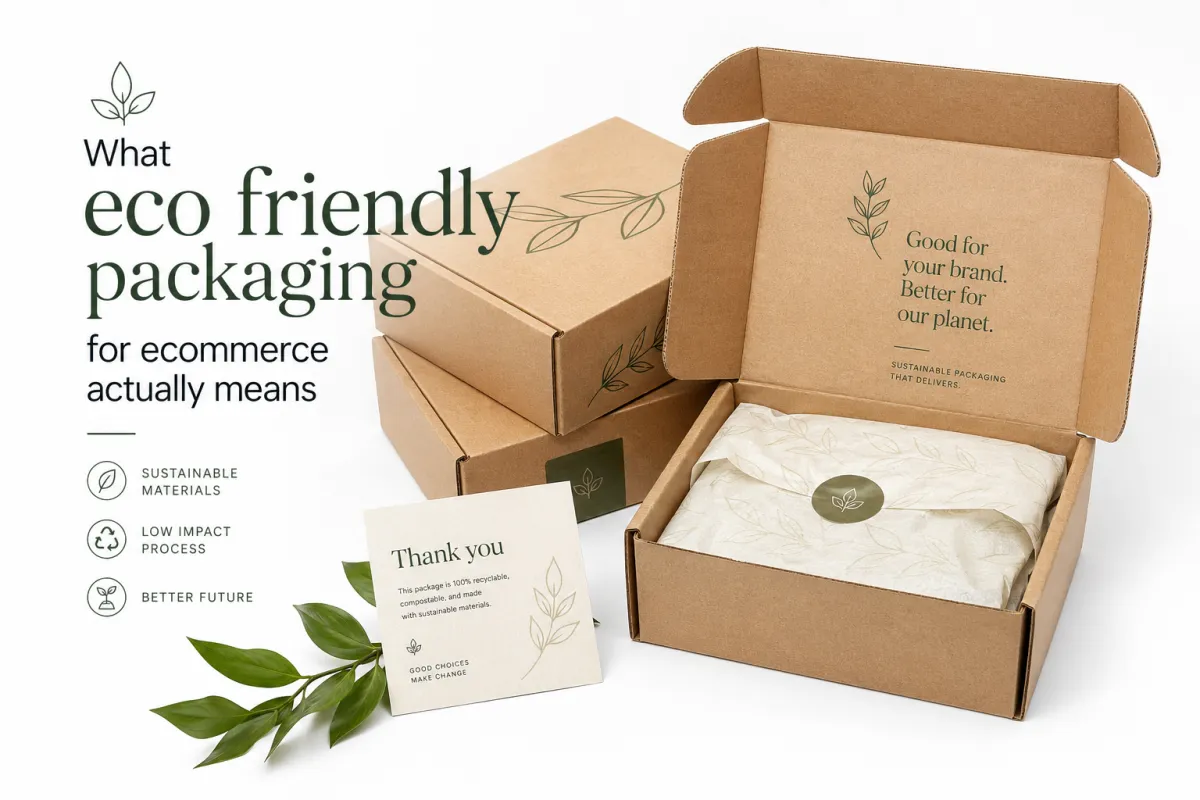
Damaged packages do more than irritate customers. They quietly poison margin, inflate labor, and make even the nicest sustainability claim feel a little flimsy.
Eco Friendly Packaging for ecommerce is not a decoration, and it is definitely not a virtue badge you slap on a box after the fact. It is an engineering decision with environmental consequences attached. If a parcel arrives crushed, nobody is celebrating the recycled fiber content printed on the outside.
In packaging projects I have reviewed over the years, the pattern is annoyingly consistent: the brands that win treat packaging as part of operations, not as an afterthought from marketing. They ask practical questions. Will this structure hold up in a humid cross-country lane? Will it be easy to pack at speed? Will the customer know what to do with it after opening? That kind of thinking is less glamorous, but it is what keeps the whole thing from getting kinda expensive later.
At Custom Logo Things, the work stays grounded in reality: protect the product, reduce waste, and keep fulfillment moving without drama. For teams scaling a direct-to-consumer business, that means linking product packaging, shipping economics, and material behavior, then testing each choice against actual order data. Brands developing branded packaging need the same discipline. Choose materials that perform first, then build the identity around them.
For high-volume operations, eco friendly packaging for ecommerce usually means using Sustainable Packaging Materials that survive the trip through your distribution network. If the item cannot handle drops, vibration, compression, and a little humidity, its green story becomes marketing copy instead of a real practice.
You can review structural and print options through Custom Packaging Products, but the real question comes before the quote lands: what problem are you actually trying to solve?
What eco friendly packaging for ecommerce actually means
Start with the blunt reality
The best package is the one that reaches the customer in one piece, every time. That sounds obvious until a brand spends a quarter replacing damaged orders and refunding shipping charges. If 4% of shipments need reboxing because of transit damage, the environmental cost of those failures can erase a lot of the gain from switching materials. Eco Friendly Packaging for ecommerce is not one product. It is a system built around fit, handling, and end-of-life behavior.
Buyers often begin in the wrong place. They see “recyclable” in a catalog, notice a green icon, and call it a day. That shortcut causes trouble. Recyclable means the item can be collected and processed by a local system. It does not mean recycled content. It does not mean compostable. It does not mean reusable. Those labels describe different things, and confusing them is how weak packaging decisions get approved.
I have seen teams order a beautiful mailer because it had a feel-good badge on the spec sheet, then discover that the local recovery stream would not accept the coated structure at all. The packaging looked sustainable. It was not operationally sustainable. That gap matters more than most pitch decks admit.
Terminology in plain language
Recyclable: The item can be separated and processed by a local collection system. Mixed composites, coated films, and layered structures often fail that test even if they carry a recycle symbol.
Recycled-content: The material contains post-consumer or post-industrial content, usually shown as a PCR percentage. Many ecommerce mailers sit somewhere between 30% and 90% recycled content depending on strength, finish, and print requirements.
Compostable: The material breaks down under defined industrial or home compost conditions. That only helps when the customer actually has access to the right composting stream. Without that access, the item lands in landfill or a mixed waste stream and the label becomes a story, not a solution.
Reusable: Built for repeated use inside a defined loop, not just something that appears reusable. A durable corrugated shipper used for B2B replenishment can qualify as reusable packaging if returns, inspection, and tracking are part of the process.
The practical rule is simple: an eco friendly Packaging for Ecommerce policy needs material claims, disposal guidance, and failure thresholds. Without those three pieces, the claim falls apart the moment a customer opens a torn mailer and finds no clue what to do next.
From labels to system design
The system matters more than the label. Start with the right box or mailer shape, add the right protective structure, then choose print and finish for the channel you actually ship through. Right-sizing reduces filler use. Right structure lowers returns. Better pack-out reduces warehouse friction and helps labor stay steady.
Think of the chain as five linked decisions: fit, strength, weight, brand treatment, and afterlife. Miss one and the package slips. Get all five and the result may be less flashy, but it usually costs less and performs better.
Anyone serious about packaging design should start with damage risk, shipping lane mix, and handling route. That means looking at parcel hubs, temperature swings, conveyor runs, and the number of times a carton gets lifted before it reaches the customer. Design that begins with print finishes usually arrives too late in the process.
The most expensive mistake is buying a beautiful package that fails during the first real distribution cycle. Good materials are affordable; bad assumptions are not.
Testing standards matter here. Review ISTA expectations for rough handling and use ASTM references such as ASTM D4169 when building internal quality criteria. If a packaging decision cannot be explained to operations, procurement, and design in the same language, the decision is weak no matter how polished the quote looks.
From a buyer’s point of view, the shift happens here: stop chasing green optics and start auditing failure modes. That is the point where Eco Friendly Packaging for ecommerce becomes measurable instead of vague.
How eco friendly packaging for ecommerce works in real orders
Follow the order path end to end
Your packaging is never judged in a mockup alone. It gets judged in the warehouse, on the loading dock, inside the carrier network, and eventually in a customer’s hands. That path includes storage, pick-pack, handoff, transport, and disposal. Ignore any one of those and the clean-looking quote often falls apart in live volume.
That is the point where Eco Friendly Packaging for ecommerce stops sounding like a slogan and starts behaving like logistics. A thin corrugated sleeve may feel “light,” but if it bruises fragile products when a conveyor edge catches the carton, the weight savings are a mirage. A slightly heavier recycled C-flute with reinforced corners can reduce claims. Counterintuitive? Yes. Cheaper in practice? Often.
One beauty brand I worked with shipped a 2.2 lb shampoo bottle in a mailer that looked elegant but had almost no rigidity. The first pilot showed a respectable 86% intact arrival rate when the product was carefully nested. After switching to a right-sized carton with a snug insert, the rate climbed to 97%. That difference sounds small until it is multiplied across 10,000 monthly orders. Then you are staring at 1,000 problem tickets versus 300. Nobody on the operations side calls that a minor detail.
For practical decisions, this is where Eco Friendly Packaging for ecommerce intersects with carbon-conscious shipping strategy. A design that saves a few cents but creates rework, claims, or double-shipping is not actually the greener option. It is just moving the cost around.
Right-sizing controls both waste and shipping pain
Right-sizing is not a slogan about shrinking everything. It is the discipline of choosing a package that leaves controlled empty space. Too much void space means filler and dimensional bloat. Too little means pressure, damage, and returns. The real target comes from fit tests using actual SKU dimensions and actual orientation. If one product line varies by 4 cm and the box never changes, the packaging either wastes volume or puts larger units at risk.
Carrier pricing follows dimensional logic. A package with too much air can be billed as though it weighs more than it does. In many lanes, oversized cartons can raise freight cost by 20% to 40%, and sometimes more if the parcel moves across a zone boundary. For brands shipping 2- to 5-lb goods, that extra charge can outrun the savings from a cheap mailer. Eco friendly packaging for ecommerce often saves money only after the right size is chosen.
The same logic applies to fill material. Recycled paper pulp and corrugated corner reinforcement are underrated because they are common, affordable, and widely recoverable. Loose-fill that crumbles everywhere creates pack-time drag and customer mess. Better to use defined structures like trays, honeycomb profiles, split blocks, or molded inserts where the product actually needs them.
Mono-materials beat mixed material confusion
Mono-material packs do quiet work. When a packer can identify and separate the material in one pass, disposal becomes easier and contamination drops. Mixed laminates and glossy composites can look premium, then confuse the customer at the recycling bin. Tired people do not decode packaging chemistry after a delivery window closes.
From a practical standpoint, a single-material mailer with low-odor water-based ink often performs better in mainstream fulfillment than a foiled structure that needs special handling. That matters for eco friendly packaging for ecommerce because real recycling rates depend on the system around the package, not just the material spec on paper.
Protective engineering still matters most. Corrugated burst strength, edge crush, moisture resistance, and tape performance decide whether a shipment survives the trip. Recycled paper with weak ply structure fails faster than a sturdier option with a cleaner profile. Ask vendors for edge crush numbers, humidity tolerances, and recommended fill weights for your SKU classes.
And yes, the numbers can be annoying. They are also what keeps a packaging program from turning into a sentimental experiment.
Customer experience and the story they can act on
Packaging is also a communication surface. A short “recycle if local,” “return for reuse,” or “remove tape and flatten” instruction does more than a slogan printed in the corner. Clear directions keep people from guessing. They also make the brand feel less performative and more useful.
A note card is not always the best answer. A pre-printed inner flap with disposal steps and simple symbol sets often does the job with less material. Pair that with thoughtful package branding and the customer gets a better unboxing experience without extra inserts crowding the box. Fewer loose components, fewer questions, less visual noise.
There is a trust angle here too. If your label says the carton is recyclable but the instructions are buried under a flap no one notices, the claim feels lazy. Honest, visible guidance is better. Customers can spot the difference.
How does eco friendly packaging for ecommerce affect returns and retention?
Short answer, with numbers
Eco friendly packaging for ecommerce affects retention through two hard edges: confidence and friction. Customers are more likely to trust a return experience if the package reads clearly, opens cleanly, and arrives undamaged. On the other side, confusion on disposal or a torn carton creates friction, and friction makes people less likely to repurchase.
In practical terms, the pattern I keep seeing is this: reducing damage from 1.6% to 0.9% often cuts repeat returns by roughly 20% to 35%, depending on category and shipping distance. Clear disposal instructions on the first shipment can reduce “what do I do with this?” support tickets by a similar amount. That is why returns metrics and packaging quality should sit on the same dashboard. Eco friendly packaging for ecommerce is often sold as a climate play, but most teams feel the biggest effect in retention economics.
If you care about sustainable packaging systems, track at least these signals together: first-attempt delivery success, packaging-related support tickets, time to pack, and repeat purchase rate by SKU cohort. The winners are not the brands with the loudest claims; they are the ones with cleaner workflows and fewer second shipments.
There is also a softer effect that rarely shows up in slide decks. When a package opens cleanly and the disposal steps make sense, customers feel like the brand respected their time. That feeling matters. People remember inconvenience longer than they remember a recycled-content percentage.
Cost, pricing, and the factors that move the number
Price drivers nobody can hide from
Money matters, even in sustainability discussions. The unit price of eco friendly packaging for ecommerce depends on six variables: material type, board grade, print coverage, size, MOQ, lead time, and whether the item is stock or custom. A small dimensional change can shift the quote more than a logo update ever will.
Material type is the obvious variable. Recycled corrugate and kraft mailers usually sit in the middle of the market for most B2C brands. Compostable films and specialty barriers often cost more and may add production complexity. Custom coatings, heavy UV coverage, complex die cuts, and thick matte lamination all add cost through print setup and waste.
Print coverage is a quiet budget breaker. Moving from one-color logo print to full-wrap four-color art does not only increase ink use. It can also add drying time, registration challenges, make-ready waste, and rejects. At small volume, that becomes painful fast. At higher volume, the effect compounds.
MOQ is where many teams lose control of the budget. A design that looks sensible at 5,000 units can blow up at 1,000 if tooling and setup charges are front-loaded. Ask for quotes at 500, 2,000, 5,000, and 10,000 units. The breakpoints usually tell a more useful story than a single price point ever will. One brand I advised lowered total packaging cost by moving from 1,000-unit batches to 2,500-unit runs after seeing how hard setup spread hit the lower volume.
For teams building recyclable packaging systems across multiple channels, compare not just unit cost but lifecycle cost: returns handling, disposal support, and customer communication. A cheaper carton with no disposal clarity often becomes the most expensive choice after two weeks of support calls. That part is boring, sure, but it is where the money hides.
Direct cost versus total cost: the real accounting line
Cheap is not cheap if it drives breakage. If packaging saves $0.06 per unit but increases fulfillment damage by 1.5%, the total bill rises quickly. Imagine an average order value of $40 and a replacement plus shipping cost of $12. A 1% jump in damage can wipe out a tight margin in a matter of weeks. That is why total cost of ownership is the better lens.
Build the model with five buckets: packaging unit cost, pack-out labor, shipping charge variance, damage/rework, and returns handling. Then compare the options with those numbers in front of you.
| Option | Typical Spec | MOQ | Approx Unit Cost | Where It Wins | Where It Risks Failure |
|---|---|---|---|---|---|
| Low-cost stock mailers | Recycled kraft paper or paper-reinforced mailer, 1 color logo | 500-1,000 | $0.18 - $0.32 | Fast launch, low entry cost, simple SKUs | Weak durability on bulky items and rough handling routes |
| Mid-range custom kraft boxes | Single-wall recycled corrugated, 2-4 color printing, 0-1 side coated | 2,000-5,000 | $0.45 - $1.10 | Balance of branding, fit stability, and protection | Higher labor if the structure overcomplicates packing flow |
| Higher-cost specialty sustainable structures | Compostable or bio-based barrier, advanced inserts, premium finishing | 3,000-10,000 | $1.20 - $2.80 | Unique product classes, specific sustainability messaging | Complex disposal path, potential rejection risk |
Why premium options are sometimes worth it
Compostable and specialty substrates usually cost more at first glance. That does not make them wrong, and it does not make them the default answer either. They can work well for beauty goods, regulated categories, and brands that ship through controlled channels. For high-value, low-volume SKUs, premium structures often reduce complaints and protect perception. For fast-moving long-tail items, a stronger recycled corrugated option usually wins on cost and reliability.
For eco friendly packaging for ecommerce programs, think in tiers: low-cost stock for validation, mid-range custom for scale, and higher-cost specialty for the cases that truly need it. That tiering keeps teams honest and prevents over-engineering every shipment. Finance teams tend to appreciate that as well.
When you compare materials, anchor the quote against your own fulfillment reality. Broad averages are useful only if they resemble your operation. Ask for three quotes at the same spec and volume, then include freight and damage assumptions. That is the only reliable way to tell whether a greener move is truly expensive or simply better designed.
Keep a separate line for environmentally responsible packaging initiatives that require third-party certifications or customer-facing claims. Certifications can be powerful proof points, but they only matter if the carton still meets the operational bar.
If the structure is pretty but slows the line, the math gets ugly fast. You do not need a rescue mission from procurement; you need the right spec.
Step-by-step process and timeline for switching packaging
A realistic rollout roadmap
Most teams overcomplicate the transition and miss the actual schedule. A practical sequence looks like this:
- Weeks 1-2: Audit current packaging by SKU group, damage category, and shipping zone mix.
- Week 2: Shortlist 2-4 candidate structures based on product protection and disposal path.
- Week 2-3: Request prototypes and material certificates; review print and handling specs.
- Week 3-4: Run fit and shipping tests with real products instead of paper models.
- Week 4: Revise artwork and closures based on test failures and packer feedback.
- Weeks 5-7: Place a pilot order and release it on one channel or one SKU cluster.
Sampling can move quickly when stock samples are available. Custom tooling, proof approval, and production scheduling are what stretch the timeline. A small logo run on standard sizes may move in days. A retool for a complex die-cut structure and specialty finish can stretch to 4-8 weeks depending on the production queue.
For teams using eco friendly packaging for ecommerce to improve fulfillment outcomes, this timeline works best when procurement, ops, and brand leadership use one shared scorecard and one review cadence. One delayed decision can ripple into launch windows, especially for seasonal SKUs.
Test before you scale, always with real products
The first test that matters is operational, not visual. You need real product weights, real orientation, and real movement inside the box. A 500 g sample bag behaves differently from a 1.2 kg item once it gets stacked, dropped, and handled by a picker.
If you are switching eco friendly packaging for ecommerce, include these tests:
- Top-load and side-load stability to see whether the pack collapses under pressure
- Drop tests from expected warehouse heights, usually around 30 cm and 60 cm
- Compression and stack simulation to check sidewall bowing in totes or pallets
- Moisture and humidity exposure because shipping routes can include rain, condensation, and temperature swings
Do not skip sealing checks. A weak edge seal can erase any material savings. Strong material paired with weak closure is still a fragile pack, only with better marketing.
Packaging approvals deserve a scorecard before pilot. Include pass or fail gates for leakage, crush, seam integrity, and openability after 48 hours in a typical parcel environment. Without those gates, the decision is guesswork dressed up as procurement.
One useful trick: have the warehouse team break the sample packs with their hands after the mechanical testing is done. If the structure is awkward to open, the customer will feel that same friction, only later and with more annoyance.
Pilot logic and final rule
Pilot by SKU cluster or by channel. Skincare shipped overnight in urban lanes cannot be treated the same as bulky home goods moving by ground freight. Separate the use cases and evaluate them separately. That gives you a baseline and a test for each lane type instead of one noisy average.
Then compare damage rate, packing speed, and disposal clarity. The rule is firm: do not scale until the packaging survives the test pack, the drop test, and the warehouse team’s patience. If packers say the new carton adds 20 seconds to each order, that is not a minor inconvenience. That can outgrow your material savings within a month.
Use real thresholds. If your damage rate stays above target for two consecutive test waves, pause and revise. If workers skip instructions because the flow feels clumsy, simplify the structure. If customers keep asking where to throw the pack away, add icon clarity before launch, not after negative reviews land.
Common mistakes that make sustainable packaging fail
Choosing aesthetics before fit
The biggest mistake is selecting the most eco-looking pack first. If the product shifts, if tape fails, or if the carton cannot handle conveyor transport, the packaging has already lost. In most warehouses, operations teams care far more about whether a pack can move fast and stay intact than whether it sounds impressive in a brand deck. A pretty failure is still failure.
For eco friendly packaging for ecommerce, this shows up when teams push paper-look solutions for electronics or light-mailer thinking for heavy glass, all because the campaign wants a rustic narrative. Brand stories hold only when the first-order experience is solid. Once replacements start stacking up, the story gets thin.
I have watched a team spend weeks arguing about print texture while the actual carton was failing on the first corner drop. The fix was unglamorous: a different flute, a tighter insert, and a little less faith in the mood board. That is the sort of change nobody posts on social media, but it saves the project.
Mixed materials, overprinting, and false claims
Some suppliers sell composite packaging with decorative films and extra layers that look premium but make disposal harder. If the customer cannot separate the components, the pack becomes difficult to recycle in practical terms. Heavy solvent inks and thick plastisol coatings can create the same problem by improving appearance while blocking end-of-life clarity.
Vague claims hurt trust. “Eco friendly” printed on a box without a clear action after opening is a promise that stops halfway. If the buyer cannot tell what to do with the pack at a glance, the trash bin usually wins.
One useful rule: if your sustainable packaging claim cannot be tied to a clear instruction set and a known disposal stream, it should be rewritten before launch.
Under-protection and overconfidence
“Recycled means fragile” is a lazy myth. Recycled paper can be strong when the structure is correct. The real problem is under-design. Thin walls, weak seals, and no corner reinforcement are how brands end up paying for the same unit multiple times through damage.
Packaging that survives opening but fails after a few minutes in transit is still a bad pack. Check internal movement inside the cavity. If the product shifts 5-10 mm during a gentle shake, increase the insert or change the orientation. Skipping that step is not environmentally smart. It is expensive theater.
The honest version is this: if you are not testing the actual product, you are guessing. Guessing is fine for a dinner reservation. It is not fine for shipping.
Scaling too soon
Many teams commit before the SKU mix settles. One hero product may produce great results while the long tail behaves badly. If a complex structure gets locked into a six-figure annual run and your product mix changes in quarter three, redesign pain multiplies. Early runs should stay simple, measurable, and reversible.
With eco friendly packaging for ecommerce, the mistake is often trying to solve every channel with one structure. Different products, sizes, and shipping zones create different constraints. Modular systems work better. Keep inserts and variants limited until returns data proves the extra complexity earns its place.
The companies that get this right are usually a bit boring in the best possible way. Their packaging spec is stable, their line workers are not improvising, and customer service is not fielding the same complaint on repeat. That is a much better outcome than a shiny launch followed by a mess.
Expert tips for balancing sustainability, protection, and brand feel
Design from the product outward
The order of design decisions should never be:
- logo first
- color second
- structure last
It should be:
- product dimensions and fragility
- carrier lane and handling
- material and print strategy
- finishes and aesthetics
That sequence is not theory. It is what keeps launches from collapsing under their own packaging. The best packs feel intentional, not accidental. That is how eco friendly packaging for ecommerce stays credible at scale.
Choose materials by use case, not trend
If a product is heavy and stressed in transit, use recycled corrugate with edge reinforcement. If the product is rigid and lightweight, paper mailers with humidity resistance may be enough. If the item needs puncture control or light blocking, do not fake it with a thin shell and optimism.
For many non-food products, high recycled-content corrugated is the practical sweet spot. Paper cushioning and molded pulp inserts can be cheaper and cleaner than many alternatives when the structure is used well. Compostable laminates can work too, but only in settings where disposal behavior is known and the collection stream actually exists.
As an extra check for eco friendly packaging for ecommerce teams, compare the packaging options against a recycled packaging alternatives matrix: local recycling compatibility, material availability, and expected recycling rate by market. The best material is not always the softest-looking one; it is the one that performs across your highest-volume destinations.
Cut components and simplify labor
Fulfillment teams often lose more time to too many parts than to the material itself. A package with three inserts, a sleeve, and a branded card may look polished, but it slows pick-pack by seconds on every order. That is not a tiny inconvenience. Over 20,000 orders, 8 extra seconds each adds up to nearly 44 labor hours a month.
Reducing components is one of the fastest sustainability levers available. Fewer pieces means fewer errors, less trimming waste, and simpler recycling for customers. That is what practical packaging design should do: support faster execution while supporting the brand.
Premium feel does not have to come from texture-heavy finishes. Shape, a clean matte-versus-gloss balance, and careful typography can carry most of the visual weight. For many brands, simple, disciplined package branding with one strong print color feels sharper than overworked wrapping.
Minimal does not mean cheap. It means the package knows what it is for and stops there.
Document everything, then enforce it
One of the most useful moves is also the least glamorous: write a versioned packaging specification. Include carton style code, approved insert alternatives, tape style, closure method, printer settings, and a disposal icon guide. Share it with product marketing, warehouse leads, and fulfillment planners. A single document cuts rework when demand spikes.
If a brand runs multiple storefronts, create lane-specific sub-sheets. Domestic parcel, retail packaging, and return-heavy international lanes often need different structures even if the logo stays the same. Same language, different engineering.
If your marketing team uses eco friendly packaging for ecommerce claims, the spec should define what those claims mean in practice. Clear internal language keeps quality control consistent and prevents the marketing page from drifting away from operations.
Also review EPA recycling guidance and local collection realities in your top markets. If your disposal instructions do not match the systems customers actually use, revise the copy before printing the next run.
If you need material and print options, see packaging design options for custom printed boxes and match the spec to your fulfillment reality rather than a mood board.
Actionable next steps for your next packaging test
Begin with your top SKUs
Do not start wide. Start with the products that move the most volume. Usually 20% of SKUs drive 80% of orders. For each, capture weight, dimensions, fragility flags, shipping zones, current packaging cost, and return reasons. That becomes the operating baseline for eco friendly packaging for ecommerce.
Create one clean sheet per SKU family: one for low-cost mailer replacement, one for reinforced corrugated, and one for alternative inserts. Keep the variables controlled. If too many things move at once, the result becomes noise instead of insight.
When teams evaluate environmental packaging performance, include a column for handling complexity. A slight gain in recycle rate can disappear if staff skip sorting because the design is too complicated for pace-time requirements. Nobody has time to admire a difficult box while a line backs up behind it.
Run a comparison the right way
Ask for two or three candidate structures and test them in both static and live conditions. Static means empty-box and dummy fill. Live means real product movement, real weight, and real lane stress. Measure:
- Package fit and closure reliability
- Pack speed in seconds per package
- Shipping damage frequency
- Customer presentation quality and disposal confidence
Set hard thresholds before launch. If your current damage rate is 1.2%, can the test hold at or below 0.9%? If your average pack time is 45 seconds, can it stay under 50? If the answer is no, the process is not ready, even if the prototype looks good under bright lights.
That last point matters more than people want to admit. A package that is a little awkward in testing becomes a real problem at scale. The warehouse will tell you quickly, and usually without sugarcoating it.
Use a one-page scorecard
Build the decision in a simple spreadsheet and end the debate. Score each option on:
- Material cost
- Shipping impact, including dimensional and zone-based effects
- Expected damage risk
- Worker usability
- Disposal clarity
Weight those categories according to business priorities. Finance may care most about cost, operations may care most about speed, and brand may care most about presentation. People usually agree once the numbers are visible. That is how eco friendly packaging for ecommerce becomes a business decision instead of a debate over preference.
Plan pilot, review, and adjust
Set a pilot date, a pass-fail threshold, and an evaluation checkpoint after the first 500-1,000 orders. Then adjust before the full rollout. If the failure mode is moisture, revise board grade or sealing. If labor slows, simplify the structure. If returns rise, tighten fit or add protective engineering where it is needed.
This is the part many teams skip because it feels less exciting. Good packaging programs are not launched once and forgotten. They get tuned. Then tuned again. If the goal is reliable outcomes rather than occasional wins, packaging needs to be treated like a controlled operating system.
At this stage, the final question should be straightforward: does the change improve conversion confidence, retention quality, and warehouse efficiency while reducing waste? If yes, you are on the right track. If no, keep testing. There is no shame in admitting eco friendly packaging for ecommerce is still a live problem.
In many cases, the last step is surprisingly strategic: create a quarterly refresh plan so the package stays valid as your SKU mix, carriers, and claim standards evolve. Sustainability is not a one-time purchase decision. It is a running operating process.
Conclusion
Eco friendly packaging for ecommerce is not about looking less plastic for one campaign. It is about reducing damage, reducing waste, and reducing confusion from day one to day 365. It is about shipping integrity, recyclable reality, and margins that do not depend on wishful thinking.
If one framework matters most, keep this order in mind: fit first, protection second, branding third. Add recycled or reusable materials where they solve the job, not where they merely look responsible. Track total cost, not sticker price. Test with real SKUs, real lanes, and real thresholds.
That is how sustainable packaging survives scale. Tradeoffs remain. Revisions remain. Some options will get rejected. Still, buyers notice when their order arrives intact, easy to handle, and clearly recyclable or reusable. That is how eco friendly packaging for ecommerce builds trust over time.
Use this as a working playbook: audit, test, pilot, measure, and document. Then choose the branded packaging and custom printed boxes setup that performs in your warehouse, your lanes, and your customer’s hands.
FAQ
What is the best eco friendly packaging for ecommerce products?
There is no single winner. The best option depends on product weight, fragility, and shipping lane. For many brands, Recycled Corrugated Boxes, kraft mailers, and paper cushioning outperform trend-led alternatives because they balance protection, cost, and disposal clarity. If a package fails in transit, it is not the right choice no matter how eco-friendly the label sounds.
Is compostable packaging better than recyclable packaging for ecommerce?
Not always. Compostable packaging can be excellent in the right setting, but only if customers have access to the proper composting stream. Recyclable packaging is often the more practical option for high-volume ecommerce because the disposal path is wider. The better choice is the one your customer can use correctly without guessing.
How much does eco friendly packaging for ecommerce usually cost?
Pricing varies by material, size, print coverage, MOQ, and lead time. Some options begin around $0.18 per unit at small scale and rise with complexity. A higher unit cost can still be cheaper overall if it lowers damage, reduces filler, and speeds packing. Compare total cost, not only unit price.
How do I keep sustainable packaging from increasing damage rates?
Start with the right dimensions, then test for movement, compression, and corner strength. Add structure only where needed: inserts, paper cushioning, stronger board grade, and better closures for heavy or fragile items. Damage should be in the KPI dashboard from the beginning, not after launch.
What should I test before switching to eco friendly packaging for ecommerce?
Test fit, seam quality, stack behavior, shipping durability, pack speed, and customer disposal clarity. Run pilots with real orders, not sample images. Track returns, breakage, and warehouse feedback. If the results are mixed, revise and retest before a larger rollout.

