Buyer Fit Snapshot
| Best fit | Review Mushroom Mycelium Protective Packaging Options projects where brand print, material claims, artwork control, MOQ, and repeat-order consistency need to be specified before quoting. |
|---|---|
| Quote inputs | Share finished size, material target, print colors, finish, packing count, annual reorder estimate, ship-to region, and any compliance wording. |
| Proofing check | Approve dieline scale, logo placement, barcode or warning zones, color tolerance, closure strength, and carton packing before bulk production. |
| Main risk | Vague material claims, crowded artwork, missing packing details, or unclear freight terms can make a low unit price expensive after revisions. |
Fast answer: Review Mushroom Mycelium Protective Packaging Options should be specified like a repeatable production item. The safest quote records material, print method, finish, artwork proof, packing count, and reorder notes in one written spec.
Production checks before approval
Compare the actual filled-product size with the drawing, then confirm tolerance on folds, seals, hang holes, label areas, and retail display edges. Reserve space for logos, QR codes, warning copy, and material claims before decorative graphics fill the panel.
Quote comparison points
Review material grade, print process, finish, sampling route, tooling charges, carton quantity, and freight assumptions side by side. A quote is only useful when the supplier can repeat the same color, closure quality, and packing count on the next order.
review mushroom Mycelium Protective Packaging sounds clean on paper. In a sample room, it gets messier fast. The material can look premium, cushion fragile goods, and make a box feel intentional instead of tossed together. It can also miss the mark if the cavity is wrong, the carton is weak, or someone trusts a sustainability claim more than the test data.
I have seen the same pattern over and over: a brand falls in love with the story first, then asks for the actual performance numbers later. That order is backwards. If you are trying to review mushroom mycelium protective packaging for a real launch, judge it on protection, fit, cost, lead time, and how it behaves in the lane your product actually ships in. The green story helps the pitch. It does not save a crushed corner.
For Custom Logo Things, the real question is simple. Does this insert improve the package enough to justify the extra cost and time? Sometimes yes. Sometimes absolutely not. I have watched beautiful inserts eat margin while doing nothing a plain corrugated solution could not have done for less. Pretty is nice. Pretty and functional is better. Pretty and fragile is a headache.
The best approach is boring, which is usually a good sign in packaging. Keep the conversation on fit, protection, assembly, and shipping reality. Sustainability belongs in the decision, but it should not be the only reason you approve a format.
What Should You Look For When You Review Mushroom Mycelium Protective Packaging?
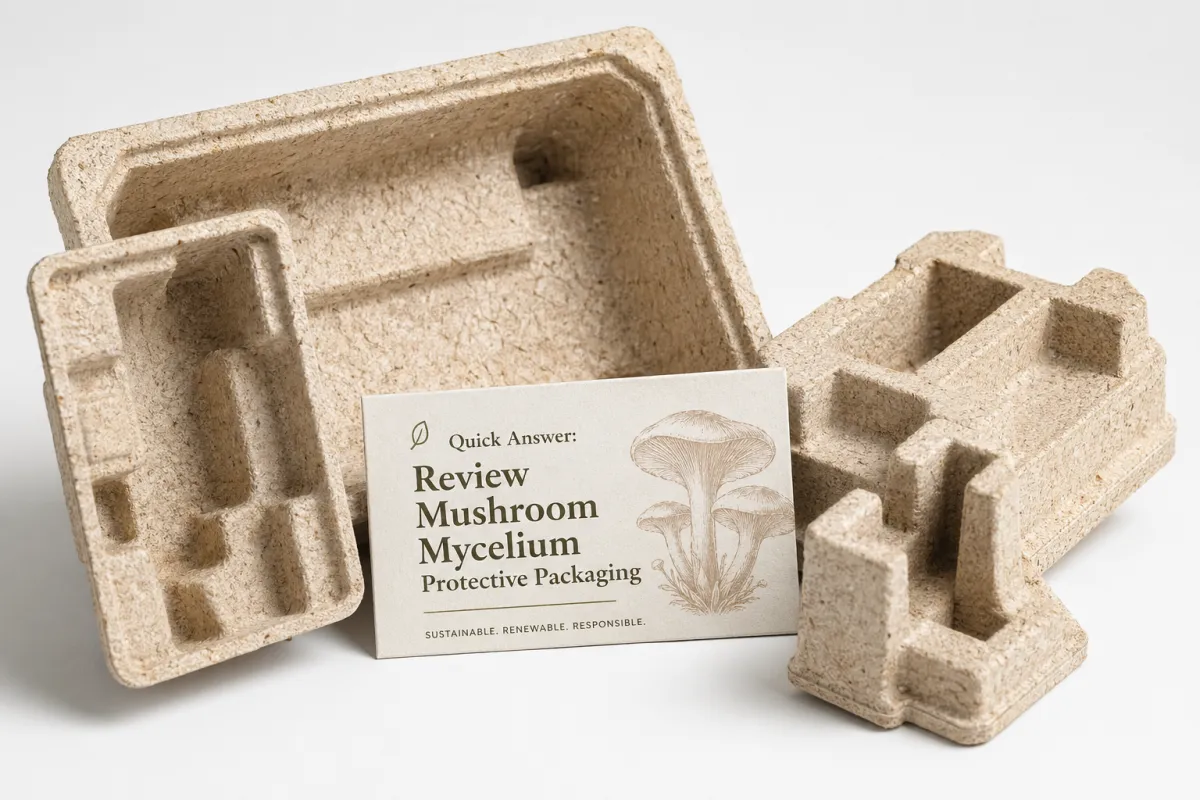
review mushroom mycelium protective packaging is rarely the cheapest path, and it is not usually the fastest either. It still competes well against generic foam when fit and presentation matter. The strongest use case is a light-to-medium weight product that is fragile, standardized, and meant to feel premium in the hand.
Here is the blunt version. A glass candle set, cosmetics kit, small electronics bundle, or specialty gift box can benefit from it. A heavy metal tool, a shape with sharp protrusions, or a product that gets abused in transit should trigger a redesign conversation first, then a material conversation. Not the other way around.
One use case that surprises teams is glass. Buyers assume an organic-looking insert will be too soft or too inconsistent, then a molded mycelium cradle holds bottle necks, isolates contact points, and keeps movement down better than expected. I have seen that happen with starter sets and small bottle programs more than once. A good cavity design does the work. The material just has to stay out of the way.
Before you buy, check these four things:
- Protection: Will the insert stop movement and survive drop testing?
- Presentation: Does it look deliberate when the box is opened?
- Cost: Does landed cost still fit the margin on this SKU?
- Speed: Can the supplier hit the launch window without drama?
Before choosing, line up Custom Packaging Products with your current insert and run a direct comparison. Brands often discover that a cleaner outer carton plus a simpler internal insert performs better than a fancy insert trying to carry the whole packaging story. That is not glamorous, but it is usually the right answer.
Top Options Compared for Review Mushroom Mycelium Protective Packaging
review mushroom mycelium protective packaging usually shows up in four practical forms: corner blocks, full-coverage inserts, tray-style supports, and hybrid systems with corrugated outer cartons. The label is one thing. Performance is everything else. Density, wall thickness, and cavity tolerance decide the result far more than the brochure copy.
Corner blocks suit lighter items that need edge support and center stability. Full-coverage inserts hold the product in place and make the unboxing feel engineered instead of improvised. Tray-style supports shine when stacking or nesting drives the design. Hybrids matter when transit conditions are rough; the mycelium manages cushioning, and the corrugated shell handles crush and stack load.
Teams still compare mushroom inserts to molded pulp and foam as if they were interchangeable. They are not. Molded pulp is usually easier and cheaper at scale. Foam stays light and price-friendly, but often looks generic. review mushroom mycelium protective packaging tends to win when tactile quality and premium presentation matter more than absolute lowest unit cost. That is the trade.
| Option | Best For | Strengths | Weak Spots | Typical Fit |
|---|---|---|---|---|
| Corner blocks | Light fragile items | Low material use, simple nesting, decent edge protection | Limited restraint on odd shapes | Cosmetics, small glass bottles, gift sets |
| Full-coverage inserts | Premium kits | Strong product lock, tidy unboxing, best presentation | Higher cost, more mold complexity | Display sets, branded packaging, retail packaging |
| Tray-style supports | Stacked or nested products | Stable stacking, cleaner assembly, good repeatability | Can feel bulky if overdesigned | Multi-piece bundles, boxed accessories |
| Hybrid with corrugated outer | Shipping-heavy SKUs | Better carton control, stronger transit behavior | More parts to manage | E-commerce, subscription boxes, fragile glassware |
The right comparison is never just mycelium versus foam. It is system versus system. A simple molded pulp insert can beat review mushroom mycelium protective packaging when the geometry is simple and the product tolerates it. A branded premium format can justify the higher cost when presentation is part of the sale and the box is designed for it.
For buyers building Custom Printed Boxes around giftable products, this matters a lot. Internal packaging is not an afterthought. It is part of the product experience, and customers notice when the inside says as much as the outside.
If you want other structural options in the same shopping lane, compare the insert system to outer carton style at Custom Packaging Products. That is usually where tradeoffs become obvious and easy to measure.
Detailed Reviews: What the Tests Actually Showed
review mushroom mycelium protective packaging works best when the product is light to medium weight and the insert is shaped for that exact SKU. In drop tests, a tight design helps on corners, caps, and thin glass shoulders. Harder drops, including 30-inch impacts, still depend more on cavity grip than on the marketing language printed around the sample.
Vibration is where weak design shows up fast. A 2-3 mm gap is enough for movement, and movement becomes chatter. Chatter leads to scuffing, edge wear, and ugly surprises at the receiving dock. A good mycelium fit sounds boring for a reason: fewer rattles, fewer marks, and fewer complaints. I like boring packaging when the product arrives intact.
Compression behavior is straightforward once you test it properly. Mycelium handles reasonable top load well, but it is not magic. Load it beyond its profile and the insert deforms or collapses at the contact points. That is why review mushroom mycelium protective packaging makes sense for a 250 g candle and not for a 2 kg appliance, even though both can be sold with the same buzzwords attached.
"The best insert disappears once it has protected the product."
The sensory layer can help or hurt. Texture feels natural and intentional; the visual language can support an eco-forward message without trying too hard. Odor is usually mild, but consistency varies by batch. Finish can shift from smooth to slightly fibrous between lots. That variation is manageable for most SKUs, but visible packaging puts every small change under a magnifying glass.
Humidity is a real constraint. Hot, damp storage changes the material profile faster than many teams expect. Storage discipline, moisture control, and proper carton airflow become part of the design spec, not a warehouse footnote. For validation, use recognized testing methods such as ISTA. Standards beat opinion every time, and packaging opinion tends to get expensive.
Surface consistency is another point teams like to hand-wave away. One batch can be crisp and clean. The next can show rougher edges or slight dimensional drift. The material is not alone there, but because it is visible, the variation is judged immediately. If you sell a premium narrative, the packaging has to keep up. No one gives points for trying.
Practical fit by product class stays pretty clear:
- Good fit: candles, cosmetics, premium glassware, sample kits, stationery sets, small gift bundles.
- Possible fit: compact electronics, accessory packs, specialty food gifts with stable contents.
- Poor fit: heavy tools, high-impact industrial parts, irregular items with sharp projections.
review mushroom mycelium protective packaging can be excellent, but not universal. The best results come from products and boxes designed together, not from broad sustainability hopes and a nice render.
Price Comparison: What Mushroom Mycelium Inserts Cost
review mushroom mycelium protective packaging usually costs more than molded pulp and more than basic foam, especially at low volume. Sample sets often look expensive on a per-piece basis because setup costs are spread across only a few units. Unit pricing improves as volume rises, but the premium character stays visible on the invoice.
For planning, these ranges are realistic, even if exact pricing changes by supplier. A sample or prototype often lands around $80-$250 per design iteration. Small custom runs commonly fall in the $1.80-$4.50 per unit range. Mid-volume production, around 3,000-5,000 pieces, usually ranges from $0.95-$2.40 per unit depending on mold complexity, cavity count, and finish requirements. review mushroom mycelium protective packaging can scale down in cost over time, but bulky forms still carry a higher landed price than many teams expect.
The landed-cost equation matters more than the list price. Freight can turn a neat quote into a surprise. Mycelium inserts may be lighter in material and still bulky in shipping, which lowers pallet efficiency. Add drying time, mold setup, and QC and total cost can rise faster than the original unit number suggests. A costly failure on launch is still costly, regardless of the per-piece figure.
| Material | Sample / Prototype | Small Run | Mid-Volume | Notes |
|---|---|---|---|---|
| Mushroom mycelium | $80-$250 per design | $1.80-$4.50 each | $0.95-$2.40 each | Premium look, better for presentation-heavy product packaging |
| Molded pulp | $60-$180 per design | $0.35-$1.20 each | $0.20-$0.85 each | Cheaper, widely available, less tactile impact |
| Foam | $40-$120 per design | $0.25-$0.90 each | $0.15-$0.55 each | Low cost, light weight, weaker sustainability story |
| Corrugated insert | $30-$100 per design | $0.15-$0.60 each | $0.10-$0.35 each | Best for simple shapes and budget-driven runs |
Cost control is still possible without wrecking the design. Reduce cavity count where it does not improve performance. Use standard box dimensions. Remove decorative voids that do not protect anything. Overengineering a shell for visual flair is how teams burn budget for no return, and I have seen that mistake more than once.
For buyers cross-checking FSC-based corrugated components, keep sourcing language separate from disposal claims. FSC helps with paper chain-of-custody context, and FSC can inform sourcing posture. Compostability and end-of-life handling are different conversations, and they need their own evidence.
One cost line gets missed constantly: review time in the approval loop. Three rounds of sample tweaks can erase per-unit gains fast. Extra freight, extra revisions, and delayed launch windows are not just logistics drama; they are direct financial impact. That is the part a lot of spreadsheets politely ignore.
How to Choose the Right Mushroom Mycelium Protective Packaging
The first filter for review mushroom mycelium protective packaging is product behavior, not the sustainability paragraph. Weight, fragility, finish sensitivity, transit distance, and stack pressure decide fit before anything else. If the item is light, fragile, and presentation-sensitive, this format is a serious option. If the product is heavy or awkward, redesign the geometry before arguing about materials.
The practical framework is simple. Choose the material when you need edge support and a premium unboxing experience. Consider it only after engineering when the product has an unstable center of gravity or needs deep mechanical restraint. Even a good material cannot rescue a bad internal layout. Packaging math is rude that way.
Procurement teams usually ask the same three questions before approving a run. What is the MOQ? Is batch-to-batch dimensional consistency stable? How much humidity will it tolerate in actual lanes? Those questions sound dull compared with "Does it compost?" but they cut returns and complaints faster than a cute claim sheet ever will.
- Buy it when the SKU is premium, visible, and light enough for the insert to manage movement cleanly.
- Test it when fragility is high, mass is moderate, and carton space is tight.
- Skip it when geometry wastes too much material or landed cost breaks margin assumptions.
Retail-facing shipments follow the same logic. If the insert is visible during opening, it shapes perceived value. That can justify review mushroom mycelium protective packaging for cosmetics, drinkware, and curated sets where the package is part of the product promise. A simple outer box can still look considered if the internal fit is sharp.
End-of-life claims need local proof. Composting access varies by city and region, and so do accepted materials. For practical language, use the guidance from EPA recycling and composting resources and local disposal rules before writing anything customer-facing. Inflated claims age badly, and customers remember when reality does not match the label.
If you are evaluating Custom Packaging Products, line up three physical references: your current insert, a mycelium sample, and a lower-cost control sample. That side-by-side view is the easiest way to keep the favorite render from winning by accident. It also keeps everyone honest.
Process and Timeline for Review Mushroom Mycelium Protective Packaging
review mushroom mycelium protective packaging usually takes longer than expected from brief to production. A realistic timeline starts with exact product measurements, carton specs, and clear photos from multiple angles. Next comes CAD or dieline review, sample production, shipment testing, and approval. Skip any step and the redesign usually shows up later with a bigger price tag.
Simple insert programs can deliver first samples in about 7-14 business days after approved dimensions and files. Complexity in mold shape, deeper cavity architecture, or custom branding details can push sampling to 2-3 weeks. Production often lands between 12-20 business days once approval is final, then stretches to 5-8 weeks for harder profiles once growth, drying, trimming, and QC are part of the process. review mushroom mycelium protective packaging is not overnight manufacturing, and pretending otherwise just sets everybody up to miss a date.
Schedule slips usually come from familiar habits: revisions after sampling, slow internal approvals, seasonal capacity pressure, unclear shipping requirements, and the repeated "one more tweak" loop. Design teams ask for a better reveal, then a tighter fit, then one more finish change. The calendar shrinks right in front of you. I have watched a two-week job turn into six because nobody wanted to say, "This sample is good enough."
- Brief the product. Record dimensions, weight, finish, and break risk.
- Review the carton. Confirm box strength and internal clearance before finalizing the cavity.
- Approve the sample. Validate fit, movement control, appearance, and assembly workflow.
- Test the shipment. Run drop, vibration, and humidity checks on actual shipment stacks.
- Lock production. Confirm MOQ, ship windows, and carton count before release.
Ask for sample schedule, production slot details, and shipping mode before committing. Teams know this is obvious, but many still skip it and then wait a month for an order they thought was two weeks. review mushroom mycelium protective packaging pays off when timing is locked early.
When launch depends on cartons and inserts arriving together for retail packaging, build a buffer from day one. That is not pessimism. That is operational reality. Packaging should support launch timing, not create a delay that marketing has to explain with a strained smile.
Our Recommendation: Review Mushroom Mycelium Protective Packaging Before You Buy
review mushroom mycelium protective packaging is strongest for premium consumer goods, glassware, cosmetics, specialty kits, and other low-to-mid weight products where presentation drives conversion. It is most convincing when customers see the insert while opening and the brand experience feels intentional from first touch to last. That matters more than people admit in buyer meetings.
My advice stays practical. Evaluate one current insert, one mycelium sample, one worst-case drop, and one humidity check before committing to volume. Not a presentation deck. Not a polished comparison sheet that hides the ugly parts. A real SKU in a real carton on a real route tells you the truth, and it is usually not shy about it.
If sample tests pass, margin allows scale, and lead time supports launch, move forward with confidence. If not, molded pulp, corrugated, or foam may be smarter on that exact job. Good packaging protects the product and supports sales; it is not a sustainability contest where the winner still arrives damaged.
The final takeaway is direct: test review mushroom mycelium protective packaging against one real product, one real carton, and one real shipping lane before placing volume orders. That is how Custom Logo Things gets cleaner decisions and avoids expensive surprises. If the insert does not survive the lane, it does not belong in the launch.
Frequently Asked Questions
Is mushroom mycelium protective packaging strong enough for fragile products?
For many fragile SKUs, yes, when the insert is designed for the exact geometry and tested against expected handling. It performs best on products needing cushioning, edge support, and visible premium packaging. Heavy or high-impact items still require strict testing, which is why review mushroom mycelium protective packaging should always be validated with the specific SKU.
How much does review mushroom mycelium protective packaging usually cost?
Samples and short runs usually carry the highest per-unit cost because setup is spread across few pieces. Pricing improves with volume, but mold complexity and shipping bulk can keep it above molded pulp. The number to monitor is landed cost; that is where review mushroom mycelium protective packaging often surprises first-time buyers.
What is the typical lead time for custom mushroom mycelium packaging?
Expect extra time for design, sampling, and approval before production starts. Timeline shifts with mold readiness, drying time, and revision volume. Teams with launch-critical needs should lock sample and production dates before design sign-off, because review mushroom mycelium protective packaging is generally slower than foam or standard corrugated inserts.
Can mushroom mycelium protective packaging be used for e-commerce shipping?
Yes, when fit is tight and testing is done for drop and vibration. It performs well for branded direct-to-consumer kits where unboxing quality matters. In rough handling lanes, pair it with a strong outer carton and real transit validation so review mushroom mycelium protective packaging performs as designed instead of relying on luck.
Is mushroom mycelium protective packaging compostable everywhere?
Compostability is location-dependent. Compost collection access and accepted materials are not universal. Buyers should verify claims with suppliers and local waste rules before publishing guidance. If compostability is a key claim, keep language accurate or trust will erode quickly when reality catches up.


