Buyer Fit Snapshot
| Best fit | of custom kraft shipping mailers options for packaging buyers comparing material specs, print proof, MOQ, unit cost, freight, and repeat-order risk where brand print, material, artwork control, and repeat-order consistency matter. |
|---|---|
| Quote inputs | Share finished size, material target, print colors, finish, packing count, annual reorder estimate, and delivery region. |
| Proofing check | Approve dieline scale, logo placement, barcode or warning zones, color tolerance, and any recyclable or compostable wording before bulk production. |
| Main risk | Vague material claims, crowded artwork, or missing packing details can create delays even when the unit price looks attractive. |
Fast answer: Of Custom Kraft Shipping Mailers Options: Film, Closure, Print, and Fulfillment should be specified like a repeatable production item. The safest quote includes material, print method, finish, artwork proof, carton packing, and reorder notes in one written spec.
What to confirm before approving the packaging proof
Check the product dimensions against the actual filled item, not only the sales mockup. Ask for tolerance on folds, seals, hang holes, label areas, and retail display edges. If the package carries a logo, QR code, warning copy, or legal claim, reserve that space before decorative graphics fill the panel.
How to compare quotes without losing quality
Compare board or film grade, print process, finish, sampling route, tooling charges, carton quantity, and freight assumptions side by side. A lower quote is only useful if the supplier can repeat the same color, closure quality, and packing count on the next order.
Review of Custom Kraft Shipping Mailers: Best Options
Your shipping budget can disappear fast after one crushed corner, one reprint, and one annoyed customer service ticket. Pretty packaging does not fix that. A review of custom kraft shipping mailers has to start with the boring part: the cheapest quote is often not the cheapest outcome once damage, rework, and packing labor show up.
This review of custom kraft shipping mailers breaks down the builds, production realities, and total cost factors that actually matter on the floor. You will see practical details like weight ranges, closure styles, minimums, lead times, and price bands you can use when choosing packaging for real shipments. Not mockups. Not brochure fluff. The stuff that has to survive a dock, a truck, and a courier who is already behind schedule.
Call it a field-level view from shipping operations, not branding theater. If you run ecommerce fulfillment, retail logistics, or direct-to-consumer packing, the patterns below will probably feel familiar. They should. A kraft mailer succeeds or fails in handling, not in a slide deck.
Quick Answer: Review of Custom Kraft Shipping Mailers
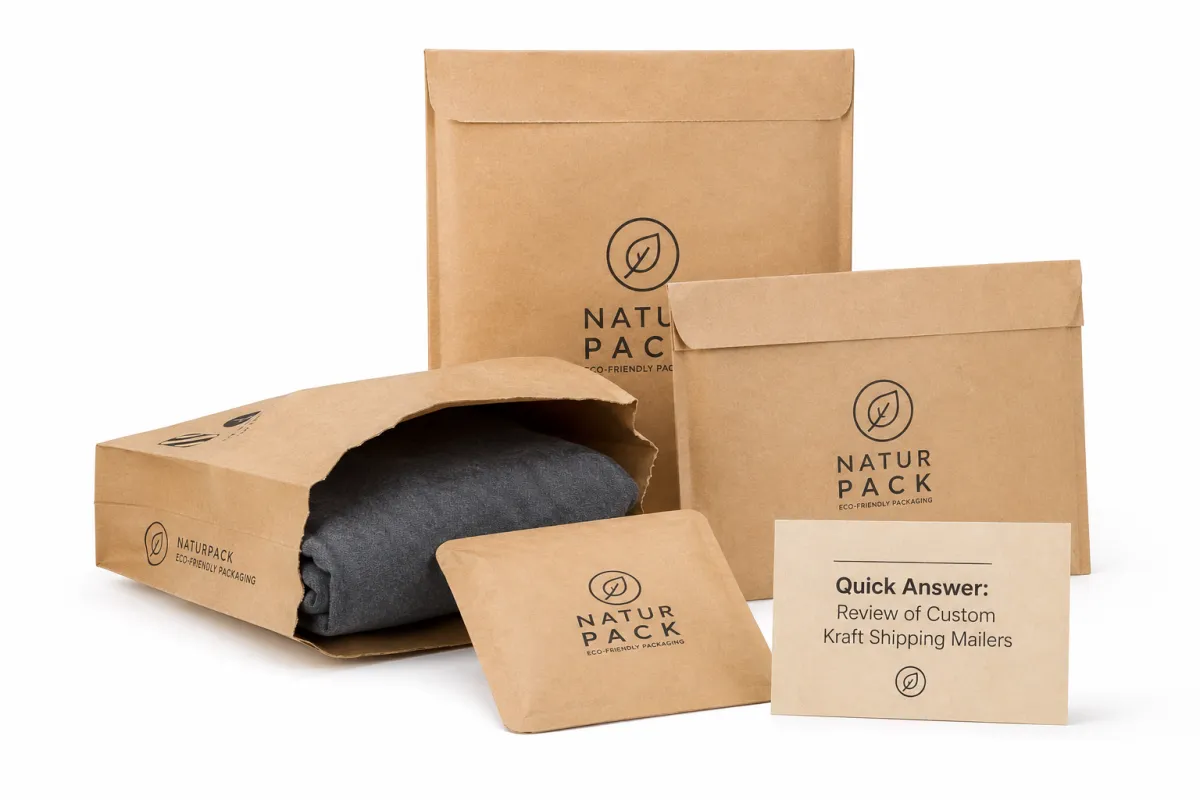
The short version of this review of custom kraft shipping mailers is simple: choose kraft for light to medium shipments that are flat, folded, or soft, and where you want cleaner brand presentation than a poly envelope without moving up to a rigid box. Documents, apparel, textile items, sample packs, and small retail bundles are the sweet spot.
If the contents stay under about 5 pounds and do not have sharp edges, most options in this review will work with the right size and fold. If the product is glass, tools, dense hardware, or anything with a corner that can punch through paper, this review of custom kraft shipping mailers points you toward padded or reinforced builds instead. Tiny accessories under a pound can use a plain style. Fragile inserts need interior protection, then the kraft shell handles the presentation.
Best fit at a glance
- Best fits: light ecommerce goods, documents, apparel, retail brochures, catalog packets, sample kits, and soft bundle shipments.
- Avoid for: heavy objects, rigid corners, sharp edges, and wet or humid lanes unless the stock is coated or reinforced.
- Main upside: lower footprint than boxes plus a clean surface for package branding.
- Main risk: seam tearing and corner crush if the stock is too thin or the flap is too short.
The real tradeoff is straightforward. Plain and Custom Printed Kraft mailers can be a strong value for standard ecommerce shipping, but not every build handles puncture, moisture, or load the same way. A review of custom kraft shipping mailers has to separate three things people often mash together: material density, print behavior, and assembly reliability. A mailer can look sharp in a sample and still fail in terminal handling if the closure is weak or the folds lose memory.
I watch three failure modes first: edge crush, corner tear, and adhesive peel after storage. If a sample shows any of those, I do not need a pitch about premium branding. A nice logo will not rescue a collapsed corner. One bad run at the dock costs more than the cosmetic uplift ever made back. Harsh, yes. Also true.
So for this review of custom kraft shipping mailers, keep one rule in mind: the cheapest option wins only if quality stays steady from 10 units to 500. If the first box and the fifth box look different, ask for process controls before you scale.
What Should I Check in a Review of Custom Kraft Shipping Mailers?
If you want this review of custom kraft shipping mailers to help your team, answer these before comparing suppliers. First, do your SKUs have consistent dimensions? If not, your best-priced option turns into a custom-sizing headache. Second, will the route include rough sorting stops, high humidity, or extra manual rehandling? Third, is the main constraint speed, cost, or brand quality at handoff? The answer changes the best choice.
Most teams fail because they score samples on aesthetics and then discover handling breaks on day one. That is a fun way to burn money, I guess, if you enjoy chaos. A real comparison adds fold memory, tear resistance, and seam integrity. Use this review as a decision filter, not decoration.
For a stronger signal, test the same sample under normal packing pressure: 50 open-close cycles, one drop, one fold, and one strip of tape removal. If the construction still looks clean, you are in the right neighborhood. If the edges whiten out, the ink is not the issue. The structure is.
Top Options Compared
Below is the practical comparison Buyers Actually Need. The cleanest way to judge each option is by board caliper, closure type, print method, and protection level for inserts. Those factors decide whether the mailer saves time or creates a daily headache.
| Option | Typical Structure | MOQ | Core Use Cases | Key Cost/Performance Note |
|---|---|---|---|---|
| Plain Kraft Mailer | 80-95 gsm kraft, glued flap, no print | 250-500 pcs | Documents, invoices, samples, lightweight garments | Lowest entry cost; best value when volume is steady and contents are forgiving. |
| Custom-Printed Kraft Mailer | 85-110 gsm kraft, optional matte or water-based barrier | 500+ pcs typical | Branded packaging, welcome kits, subscription mailings | Higher cost, better brand impact, and more repeat-order consistency when print stays stable. |
| Padded Kraft Mailer | 90-120 gsm kraft + 1.5-3 mm cushion (bubble film or pulp) | 250-1000 pcs | Cosmetics, soft electronics, delicate flat goods | More freight volume and thickness, but much better puncture and drop resistance. |
| Reinforced Kraft Mailer | 120-170 gsm kraft, reinforced seams, optional stitch or double-wall | 300+ pcs | Retail apparel, branded collateral, heavier internal contents | Premium pricing, better crush resistance, and the safest choice for rougher handling cycles. |
Most buyers ask for board caliper and forget closure style. That is a mistake. Closure is half the strength story. Self-seal adhesive flaps are fast, which is great until heat or cold starts messing with the bond. Pressure-sensitive or gummed closures grip better but need a clean seal face. Some reinforced styles use side-locked seams, which slow packing a little and usually survive rough handling better.
Use-case pairing for shipping scenarios
If you ship subscription orders with repeat insert counts, Custom Printed Kraft usually works best because the team can check size and fold pattern fast. For retail packaging with return risk, padded mailers can cut damage claims without moving to boxes. Boxes are not a personality trait.
- Subscription orders: usually work best with a custom printed mailer body and a printed insert card for a tighter brand look.
- Retail orders: reinforced kraft with a stronger flap lock fits folded fabric, accessories, or medium-weight sets.
- Document packets: plain kraft with a high-quality closure and tamper strip when contents need extra control.
- Brand-forward unboxing: custom printed kraft with a clean logo edge and a consistent color field.
Handling behavior is where people get surprised. Clean folding depends on fold memory and whether die-cut lines actually align. Some mailers open along the same weak crease every second run, then close with a different seam overlap the next time. That belongs in the failure column, not the maybe column, because it affects packing speed and the customer handoff.
Exterior scuffing matters too. Uncoated brown kraft looks good in a simple brand system, but it marks faster than coated stock. If customer-facing presentation matters, use a light internal protection layer or a UV-sealed coating to cut abrasion. That can add about $0.03-$0.08 per unit at mid volume, which sounds annoying until you compare it with a damaged unboxing on a higher-value basket.
Use this one-minute check before you approve a sample: peel the top flap from the body at three points, twist 90 degrees, then open and reseal. If edges lift or adhesive leaves powder behind, the batch control is weak. In this review of custom kraft shipping mailers, that quick line check catches more issues than a glossy visual pass ever will.
Detailed Reviews of Custom Kraft Shipping Mailers
The next part of this review of custom kraft shipping mailers is the useful part: how each option behaves after repeated use. Brochure language always sounds noble. Strong. Durable. Premium. The floor cares about 20-second pack cycles, conveyor drag, and route handling after the parcel leaves the building.
Plain Kraft Mailers
Plain kraft mailers are usually built from 80-95 gsm paper layers with simple folding dies and adhesive flaps. For stable, light, non-moisture-sensitive products, this is often the best ROI in the whole bunch. Packing is quick because there is less bulk and fewer variables. Common sizes run from 6x9 to 11x14 inches for flat goods, and custom sizes are easy to justify when fit needs to be tighter.
Material behavior is direct. Lower caliper folds faster but resists corner abuse less. Around 80 gsm, the mailer can handle one- to two-piece apparel shipments up to about 1.5 pounds without drama. Push past that and seams can begin to tear at stress points. Humidity above 60% and warm storage for more than a week can also weaken tear resistance. Paper remembers bad conditions.
Print on plain kraft is usually minimal or absent. One-color marks can work if you want a quiet brand touch, but expect less color depth than coated stock. Natural kraft has a muted brown tone and absorbs ink unevenly. That can look intentional if your packaging design leans earthy. It looks less charming if you need strict Pantone matching and a tight brand grid.
On the customer side, plain kraft reads clean and responsible. For straightforward ecommerce shipping, that can beat louder packaging. In this review of custom kraft shipping mailers, plain style wins on value when the brand story already lives in the product, the insert, or the website and the kraft mailing envelope just needs to do its job.
Custom-Printed Kraft Mailers
Custom-printed kraft is usually the default for buyers who want branded packaging and repeatable fulfillment. Typical stock sits around 90-110 gsm, sometimes with a light coating or water-based finish to improve print holdout. That helps logo sharpness, especially on two-color logos and full-color fronts with lighter backgrounds.
Ink holdout depends on the print method and surface prep. Flexographic and digital combinations can vary in this price tier, while offset-style production usually gives cleaner color consistency but needs more setup and longer lead times. Many vendors can handle 1-color, 2-color, or full-color work. One or two spot colors often stay within budget for 500-1000 piece batches. At 5,000 pieces, full-color custom logo work can become surprisingly cost-effective if the same film and dieline repeat across SKUs.
The best results usually show up when buyers submit final artwork with vector text outlined and a full-bleed-safe logo block at least 2 mm from folding lines. That avoids seam clipping when the line runs fast. White type on dark backgrounds is another place where people get fancy and then complain later. If the base kraft cannot hold density, ask for spot white. If the supplier cannot match the color profile cleanly, drift appears around 250-500 pieces and the batch starts looking tired.
For direct-to-consumer shipments, this option feels premium when closure is stable and stock is controlled. The customer sees your brand the moment the parcel is handed over. For higher return profiles, add a secondary paper insert for tear-out risk and avoid full saturation on corners where scuffing happens most.
Since this review of custom kraft shipping mailers is tied to real operations, here is a useful benchmark: if your shipping team sees fewer than 1 complaint per 200 units for print misalignment at 2,000 units, you are in a good zone. More than that and even a sharp layout starts losing commercial value.
Padded Kraft Mailers
Padded kraft is usually the first upgrade people buy once they need cushion without moving to a box. A common build is 90-120 gsm kraft with 1.5, 2.0, or 3.0 mm PE bubble or pulp foam. Bulk rises by roughly 15-30%, which can change carton count and freight density. If your cartons already run tight, check this before you place the order. Freight does not care about your spreadsheet optimism.
For puncture and impact, padded builds win a lot of ecommerce shipping cycles. Flat accessories, fragile paper goods, perfume samples, and soft electronics handle vibration better with added cushion. Folding speed drops a bit because the cushion compresses and the flap resists seating. In line checks, packing time often slips around 8-12% versus plain builds, mostly because workers need to adjust the closure angle.
Print behavior stays close to Custom Printed Kraft, though texture can soften the visual edge. If your brand depends on fine registration or a precise gradient, padded surfaces need a proof test. Logos with lines thinner than 0.4 pt or tiny text below 6 pt should be stressed before launch. Otherwise blur shows up after the first hundred units and nobody looks shocked except the buyer who skipped the sample review.
The padded option gets overlooked for documents moving through humid lanes. If humidity is high, cushion can trap condensation against folded edges. A breathable interior and controlled coating lower that risk, though the finish may add ~$0.04-$0.10 per unit depending on thickness.
In this review of custom kraft shipping mailers, padded kraft is often the strongest fit for subscription fulfillment where a single return can chew through margin. On a 500-unit test, the first-cost increase is obvious. At 2,000 to 5,000 units, lower claim rate often makes the math behave better.
Reinforced Kraft Mailers
Reinforced kraft mailers are for heavier loads and rougher routes. Most use 120-170 gsm stock with reinforced seams, stronger bottom seams, and sometimes stitch points or extra wall layers. If you ship 3-5 pound parcels often, reinforcement is not optional. It is the baseline.
Strength is the whole point. These mailers resist corner burst, handle edge hits better, and hold shape during stacking. In warehouse tests, reinforced builds usually show stronger fold memory and less seam split than standard versions after 25 open-close cycles. If the product has rigid parts or the route includes heavy handling, this is the practical choice.
Closures in this class deserve close inspection. I prefer pressure-sensitive or reinforced lock seams over basic glue-only closures. The cost bump is real, but this class protects contents and your reputation. A torn mailer on arrival makes people suspicious fast, even if the product inside survived.
Printability stays good for premium packaging and brand-forward programs. One caution: thicker stock makes color drying and ink laydown less forgiving on tiny fonts. If order volume is not massive, simpler artwork usually gives more repeatable output than a dense layout packed with fine details.
In this review of custom kraft shipping mailers, reinforced builds are the best choice for items with occasional shock, long-distance transit, or brand programs where the mailer is part of the experience rather than just a container.
Ordering Process and Production Timeline
The mailer decision does not end with selection. The real pain starts after the purchase order lands. A clean workflow prevents delays and keeps quality predictable. The process usually runs in five phases: spec alignment, proofing, sampling, pre-production approval, and manufacturing plus dispatch.
1) Artwork and spec finalization
The first gate is final dimensions and dieline approval. Confirm width, height, flap overlap, and minimum closure allowance. If the team changes dimensions late, every station downstream slows down. That kind of shift can add 2-4 business days, especially if multiple sizes share the same folder line.
Give the supplier the final dieline as a vector file, plus clear die instructions for fold lines and scoring. If branding uses strict color rules, provide Pantone values and approved CMYK conversions. In this review of custom kraft shipping mailers, this is where a lot of rework gets decided before anyone notices it.
2) Proof review and sample testing
A digital proof in 24-48 hours is common for standard formats. Physical sample review usually takes another 2-4 days depending on stock and finishing. Ask for samples whenever print is full-color or closure chemistry is new. Request a sealing and tear test sheet that shows how adhesive behaves after 24 hours on shelf.
For confidence, run a simple internal handling test: 50 open-close cycles, then a knee-height drop, then a third-day aging check. If the operation can support it, use a small transit simulation on the same courier route and distance you use for live shipments. That gets you closer to reality than a spotless lab sample ever will.
3) Production setup
Setup includes die-cutting, registration, and proofing. For simple plain and plain-print runs, setup can take as little as 1-2 days. Custom print with multiple colors often adds 2-5 days, especially if metallic inks, spot white, or special adhesives are involved. Coating adds another day for curing and inspection.
4) Manufacturing and finishing
Most production runs finish in 3-7 days for medium volume. High complexity, odd sizes, and rush reruns can push that to 8-12 days. Final finishing includes packing, palletization, and labeling with shipping manifests. If the contract includes pre-packed master cartons, confirm whether that changes lead time.
5) Shipment and release
Freight transit depends on destination, carrier windows, and order size. A reasonable assumption for domestic lanes is 2-4 business days after factory release for standard shipping. Cross-border orders can take longer once customs paperwork enters the room. International lanes can double that if clearances or quality holds get involved.
What slows things most in this review of custom kraft shipping mailers is not art approval alone. It is change management. Custom sizing, revised logo files, and "one more color" requests are common delay drivers. If timeline is tight, lock changes at proof and do not let creative tweaks sneak in after final signoff unless the change is tiny. Ask suppliers for rerun speed commitments. Some can turn 250-piece substitutions in 24 hours. Others need a full reset and a fresh cup of coffee.
To reduce timeline risk:
- Submit dielines early and do not wait for final campaign copy.
- Confirm ink standards against a shared proof profile before approval.
- Approve the physical sample before the first full run.
- Ask for production slotting before artwork lock.
If the supplier follows recognized testing and documentation discipline, ask for references to ISTA and material test statements. For fiber origin and sustainability claims, verify whether the paper carries an FSC chain. Those checks do not remove every defect, but they cut the odds and make repeat orders less annoying.
In this review of custom kraft shipping mailers, the most reliable approach is to treat sample validation as non-negotiable. Saving two days on proof means nothing if a 5,000-unit lot shows up with weak closures.
Price Comparison and Total Cost
Unit price is where purchasing teams get trapped. Plain unprinted kraft can run as low as $0.12-$0.22 per unit for 250-500 pcs in many regions, while custom printed versions may start around $0.28-$0.50 for the same quantity depending on coverage and setup. Move into padded builds and the range can rise to $0.40-$0.90. Reinforced models may land at $0.60-$1.40 each.
Those numbers move with paper stock, print complexity, and supplier location. Compare not only this review of custom kraft shipping mailers but the full pricing matrix: print prep fee, setup, artwork revisions, freight, and storage. A review of custom kraft shipping mailers means very little if the quote hides a big plate or die charge that wipes out savings at low volume.
Hidden costs hurt more than headline rates. Overpacking because the size is wrong can add up to 20-35% extra fill by weight and volume. A mailer that is 1 inch too large creates more void, slower packing, and higher storage cost. If returns rise from 1.2% to 2.5%, that can wipe out a quarter of margin on small-ticket ecommerce shipping without much drama at all.
How small-batch economics hurt and help
For 250 pieces, setup can represent 30-60% of total cost. At 1,000 pieces, setup often drops below 15% in many bids, and by 5,000 pieces the per-unit cost usually settles into a predictable band. If the forecast is shaky, run phased orders. Start with 500 to validate, then place a larger top-up once the failure rate is known. That usually beats one oversized bet on an untested design.
A practical example helps. Say you ship 1,500 parcels a month. Plain custom printed costs $0.32 per unit. Reinforced costs $0.62. The reinforced option looks expensive by $0.30 each. If it reduces damage claims from 2% to 0.5% on a $35 average parcel value, the claim reduction can be real money. At 1,500 parcels, that is 22.5 fewer claims. If each claim costs $12 in handling plus reship, the monthly risk reduction is more than $270 before repeat purchases.
This review of custom kraft shipping mailers also has to include labor. If a sturdier style slows packing by 15 seconds, multiply that by daily order count. At 400 parcels a day, 15 seconds costs 100 extra minutes of bench time. At $18 an hour effective labor, that is close to $30 a day in overhead. So the cheaper-looking mailer can get expensive in a warehouse very quickly.
Storage matters too. Bulkier padded stock takes more shelf space and may need lower-density stacking. A 20% rise in storage footprint matters in smaller warehouses where every pallet position is already spoken for. If inventory sits for a long time, carrying cost can become worse than people expect.
For buyers comparing this review of custom kraft shipping mailers, do not ignore total landed cost. Compare the quote against:
- Damage and return probability over the first 60 days
- Packing speed in your current setup
- Storage density and picking convenience
- Reorder consistency and rerun pricing behavior
And yes, paying a bit more for lower complaint volume can be the cheaper move over a full year. Math is rude like that.
How to Choose the Right Kraft Mailer
Selection gets easier when you turn it into a simple framework. Start with four buckets: product weight, fragility, travel distance, and customer expectation. Then map stock choices and closures to those buckets. If all four are low stress, plain and custom printed options are usually enough. If two or more are high, padded or reinforced systems deserve the budget.
For light, non-fragile goods under 2 pounds, a plain or custom-printed shell with a 2-inch interior buffer often works. For 2-4 pounds, or for routes with sort hubs and rough drops, choose reinforced or padded. For 4 pounds plus heavy flat contents, I usually recommend reinforced stock with an optional sleeve or internal support.
Closure strength should never be treated as a side note. Ask for measured peel force if the supplier has it, or run your own simple test: clamp the seam and pull until failure. If the seam fails before your handling threshold, reject it. Moisture exposure matters just as much. In humid climates, choose coated or barrier-enhanced kraft. Uncoated stock can absorb moisture and weaken fold bonds faster than people like to admit.
Printing scope matters too. If the logo has fine lines under 6 pt, test a sample at full size under real light. Natural brown kraft can mute light colors. For accurate branding, define the printable area with clear margins around fold lines and avoid edge-to-edge artwork in unprotected zones. Good packaging design balances the brand system with the mechanics of the mailing pouch.
Operational fit beats theoretical specs. If the fulfillment team handles 200 orders an hour and needs simple folds, plain and custom printed with consistent dies will win on labor time. If the brand depends on premium unboxing, the extra print complexity may be worth it. Do not force one answer across every channel. That is how teams end up buying three versions of the same problem.
For buyers with broader catalog planning, pair this review of custom kraft shipping mailers with related categories. Compare with Custom Poly Mailers for softer products and Custom Shipping Boxes for puncture-sensitive lines. For the full mix of packaging options, the larger catalog sits under Custom Packaging Products.
A quick decision check before the first purchase order:
- Is the printed area still legible after two fold cycles?
- Can the team reseal at speed without reusing old flaps?
- Can it sit in warehouse humidity and temperature for 48 hours?
- Does it stack safely in the current rack system?
- Can your reorder policy keep the same result for six months?
Honestly, most teams fail because they compare a few samples and assume the rest of the batch will behave the same way. It will not. Selection is a process, not a one-time glance.
Our Recommendation and Next Steps
If you want one clear recommendation from this review of custom kraft shipping mailers, here it is: start with a custom-printed kraft build around 90-105 gsm for standard light to medium ecommerce shipping, then move to padded for impact-prone shipments and reinforced for heavier or sharper mixes. That setup usually gives the best all-around outcome for day-to-day fulfillment because it balances brand presentation with handling reliability.
When should you move up? Move to a stronger build right away if your average return rate is above 2%, your products have corners and edges, or your lanes are long with lots of transfer points. If your team keeps seeing closure failures, do not patch the problem with more tape. Switch stock class and closure structure at source.
"The cleanest way to protect your margin is a boringly reliable mailer, not the flashiest sample." - Common feedback from fulfillment teams after launch cycles.
Action plan before scaling:
1. Request samples for each candidate option, including plain, custom printed, padded, and reinforced.
2. Validate seam closure strength with a 50-cycle fold and reseal test.
3. Run a short transit trial on your busiest route, not just a local shuttle test.
4. Compare landed cost with at least one month of actual returns and labor data.
5. Confirm tolerance and scheduling commitments, including rerun speed and quality checkpoints.
Before ordering, confirm four supplier details plainly: size tolerances, printable area rules, proof and revision standards, and delivery windows. Ask for visible evidence of material and environmental claims. If they mention FSC, ask for the certificate path. If they mention handling standards, ask for the test notes. In a review of custom kraft shipping mailers, that cuts surprises and gives you a repeatable buying baseline.
Also check what happens if your next size change is 0.5 inch wider or your branding gets a refresh. Even small revisions can shift the schedule by 2-5 days in some workflows. Ask for change-control terms now, not after production starts. Saves headaches. Strange concept, apparently.
So where does that leave you? This review of custom kraft shipping mailers points to a practical pattern: optimize for stable quality first, then tune the visuals. If your operation runs on speed and low waste, a solid Custom Printed Kraft base can beat flashier options. If not, use padded or reinforced builds with a strict sample-based rollout. Start there, and you will avoid the usual mess of cheap quotes, weak seams, and avoidable claims.
FAQ
What should I look for in a review of custom kraft shipping mailers?
Start with material weight, seam strength, and print quality under normal handling. Then check seal consistency, scuff resistance, and whether the mailer protects contents without forcing extra void fill. In this review of custom kraft shipping mailers, those practical tests matter more than polished sales language.
Are custom kraft shipping mailers strong enough for apparel and flat products?
Usually yes for correctly sized apparel and documents, especially under 2-4 pounds with stable stacking. For heavier items, choose a reinforced build or add internal protection. If edges are sharp, the reinforced path from this review of custom kraft shipping mailers is usually the safer call.
How long does the custom kraft shipping mailer process usually take?
Typical timing is 12-15 business days from approved proof and sample to shipment for standard runs, depending on stock and print complexity. Custom sizing, specialty coatings, and revisions can stretch that by 3-8 days. Seasonal demand can also slow capacity and proof turn times.
Why do custom kraft shipping mailers prices vary so much?
Price depends on stock selection, print method, order volume, and whether reinforcement or special coatings are needed. Small runs carry higher setup costs per unit. That is why in this review of custom kraft shipping mailers you should compare unit rates at equal quantity bands, not just one line item.
What is the best way to compare custom kraft shipping mailers from different suppliers?
Compare more than the headline price. Ask for material specs, closure notes, lead-time guarantees, and sample handling tests. Run the same test pack for each supplier so print, durability, and packing speed are measured under identical conditions before you place a bigger order.

