Buyer Fit Snapshot
| Best fit | plant based cold chain packaging for packaging buyers comparing material specs, print proof, MOQ, unit cost, freight, and repeat-order risk where brand print, material, artwork control, and repeat-order consistency matter. |
|---|---|
| Quote inputs | Share finished size, material target, print colors, finish, packing count, annual reorder estimate, and delivery region. |
| Proofing check | Approve dieline scale, logo placement, barcode or warning zones, color tolerance, and any recyclable or compostable wording before bulk production. |
| Main risk | Vague material claims, crowded artwork, or missing packing details can create delays even when the unit price looks attractive. |
Fast answer: Plant Based Cold Chain Packaging: Claims, Protection, MOQ, and Cost should be specified like a repeatable production item. The safest quote includes material, print method, finish, artwork proof, carton packing, and reorder notes in one written spec.
What to confirm before approving the packaging proof
Check the product dimensions against the actual filled item, not only the sales mockup. Ask for tolerance on folds, seals, hang holes, label areas, and retail display edges. If the package carries a logo, QR code, warning copy, or legal claim, reserve that space before decorative graphics fill the panel.
How to compare quotes without losing quality
Compare board or film grade, print process, finish, sampling route, tooling charges, carton quantity, and freight assumptions side by side. A lower quote is only useful if the supplier can repeat the same color, closure quality, and packing count on the next order.
Review Plant Based Cold Chain Packaging: Quick Answer
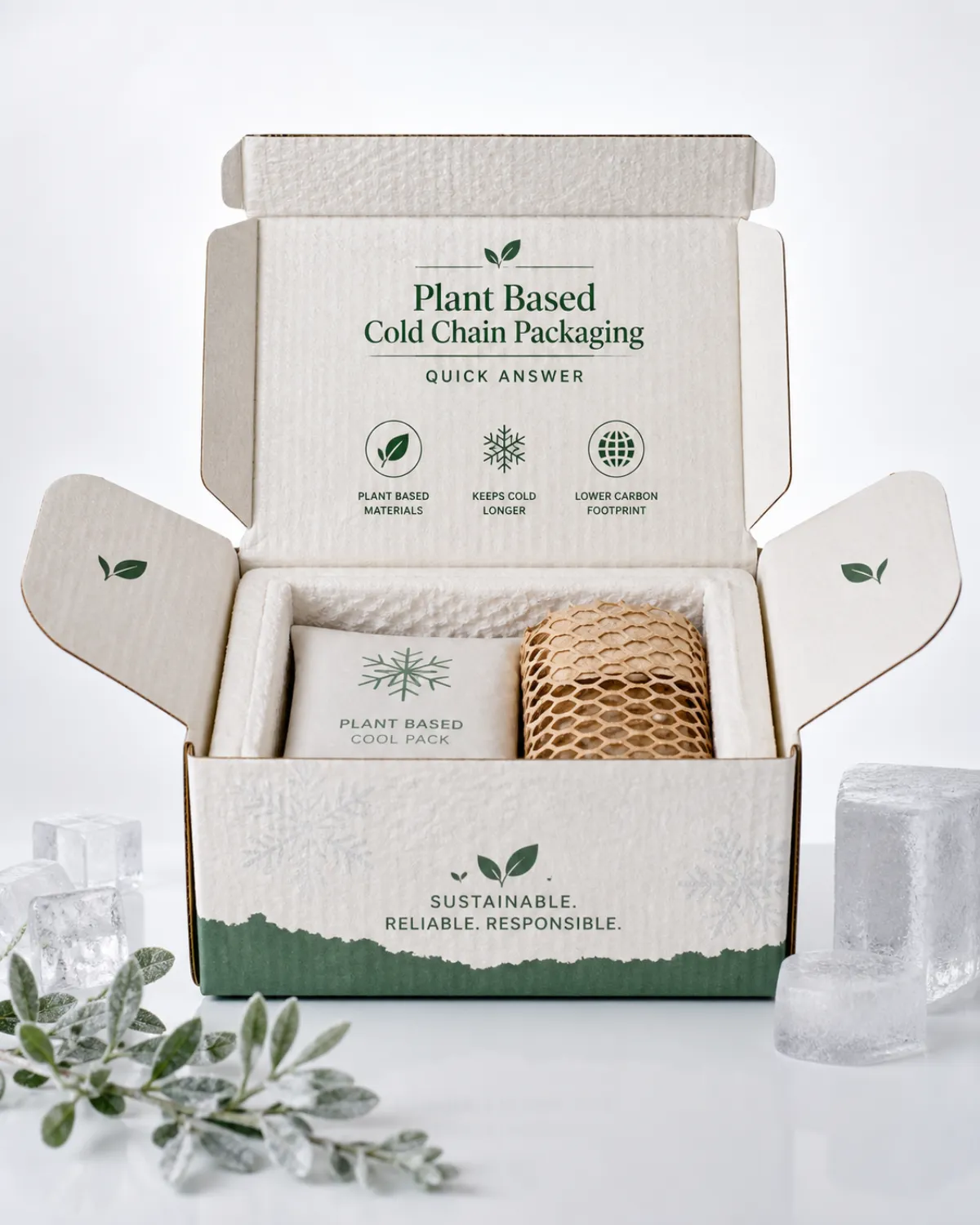
Review plant based cold chain packaging with a cold eye, and the first thing That Stands Out is pretty simple: the greenest-looking shipper is usually the first one to disappoint if moisture control, compression strength, and pack-out speed are ignored. That is not a sustainability speech. It is logistics. A box can look responsible on a slide and still arrive with softened corners, a damp outer sleeve, or a coolant load that never held temperature long enough for the route you actually run.
So what counts as plant based cold chain packaging? In practice, it includes molded fiber shippers, paper-based liners, plant-fiber boards, starch-based foams, and hybrid systems that use renewable content in part of the build. Some are fully bio-based. Others are only partly renewable, with a fiber shell and a barrier film, or a paper outer paired with a molded insert. Buyers blur those categories all the time, which makes comparisons sloppy. A proper review plant based cold chain packaging process starts by separating the outer carton, the insulation core, the coolant pairing, and any barrier layer that affects moisture or vapor transfer.
The quick verdict depends on the lane. Short chilled delivery gives the better plant-based systems a real chance to work, and they usually look cleaner for branded packaging and product packaging teams that care about unboxing. Frozen shipping over one or two days pushes you toward hybrid builds or denser plant-fiber structures with disciplined pack-out habits. Premium direct-to-consumer meals need review plant based cold chain packaging through both thermal hold and presentation, because retail packaging expectations now travel home with the customer. Pharma-style temperature control raises the bar again, and test discipline matters more than the material story.
Before approving any finalist, I would use the same yardstick: insulation performance, lane stability, ease of assembly, recyclability claims, total landed cost, and supplier support. If a supplier cannot show thermal data, packing instructions, and a sensible validation path, the design is not ready, even if the sample looks polished. I would rather ship a plain system that works than a pretty one that creates rework on the fulfillment line.
Practical rule: a plant-based shipper is only sustainable if it arrives intact, holds temperature long enough, and fits the labor reality of your packing room.
One more point gets missed more often than it should: review plant based cold chain packaging is not a single product category. It is a performance conversation. The right answer changes if the route is 90 minutes versus 36 hours, if ambient exposure is 55 F versus summer heat, or if the team packs 80 orders an hour instead of 12. That is why any serious comparison has to be lane-specific, not slogan-specific.
Top Options Compared: Review Plant Based Cold Chain Packaging Materials
To review plant based cold chain packaging properly, start with the material families, because the material drives thermal behavior, moisture resistance, storage footprint, and labor burden. Molded fiber is usually the most familiar choice. Paper-based liners are the lightest and easiest to brand. Plant-fiber boards can offer a good balance of stiffness and compressive strength. Starch-based foams mimic the feel of conventional expanded materials while keeping a renewable story. Hybrid systems are the wildcard: they mix renewable fibers with barrier films or secondary liners to improve performance in harsher lanes.
Each family wins in a different way. Molded fiber often scores well on stackability and compression, but it can absorb moisture if the outer pack or coolant strategy is weak. Paper-based liners are attractive for package branding and light lanes, yet they usually need careful coolant tuning. Plant-fiber board solutions can be surprisingly strong in handling and transit. Starch foams tend to hold up better in rough handling than many buyers expect, though they may take up more storage space and sometimes need more attention during disposal. Hybrid systems can be the strongest all-around performers, though they usually carry a higher material cost and a more complex bill of materials.
The lane matters more than the label. Same-day local chilled delivery often rewards lighter structures, flat-pack formats, and quick assembly. One-to-two-day frozen shipping pushes you toward thicker walls, better coolant management, and tighter pack-out discipline. Long-haul routes with summer heat exposure are where many plant based cold chain packaging concepts look good on paper and then expose their weak points: condensation, lid flex, or thermal drift after the first 12 to 18 hours. A lane that crosses multiple freight hubs is not the place to assume a paper-first system will behave like a high-density polymer shipper.
There are hidden tradeoffs that buyers miss because they focus on the unit price. A thicker liner can add 20 to 40 percent to the cube footprint in storage. A denser molded shell may slow the pack-out line by 10 to 20 seconds per order if it needs to be assembled by hand. A hybrid design can require a separate film or pouch, which means more SKUs and more training. If your team is already stretched, that labor penalty can erase the savings from a lighter material choice. I have seen that happen more than once, and it is never fun to explain after launch.
For a broader sustainability lens, it helps to separate marketing language from accepted sourcing claims. Industry resources at packaging.org can help frame recovery, material choice, and end-of-life claims without turning the conversation into a branding contest. For shipping validation, ISTA is still one of the clearest references because it keeps the discussion grounded in measurable performance rather than wishful thinking. If a supplier says the system is recyclable, compostable, or certified, ask what that means in the actual local collection stream, not in the sales deck.
Here is the simplest side-by-side view I would use before asking for samples:
| Material family | Thermal hold | Moisture behavior | Storage footprint | Typical use case |
|---|---|---|---|---|
| Molded fiber | Moderate to strong | Moderate risk if wet | Moderate | Chilled meals, seafood, premium consumer goods |
| Paper-based liner | Light to moderate | Lower resistance without barrier support | Low | Short chilled lanes, branded packaging, light parcel shipping |
| Plant-fiber board | Moderate | Better than plain paper, still lane dependent | Low to moderate | Meal kits, specialty produce, retail packaging |
| Starch-based foam | Moderate to strong | Usually fair, still needs humidity review | Moderate to high | Frozen products, fragile shipments, mixed routes |
| Hybrid system | Strongest overall | Best protection when designed well | Moderate to high | Long-haul, multi-day, premium direct-to-consumer programs |
That table is not a ranking. It is a map. The best review plant based cold chain packaging choice depends on whether you value lower labor, lower dimensional weight, or stronger thermal margin. A buyer who only sees the sustainability claim can easily miss the operational bill that shows up later.
Detailed Reviews: Best Plant Based Cold Chain Packaging Formats
This is the part where review plant based cold chain packaging stops being abstract, because the differences show up as soon as the shipper lands in the packing room. A good sample should tell you how the material feels in the hand, whether it springs back after compression, how it behaves in a cold room, and what fails first if the lane runs hot. That is the kind of detail a fulfillment supervisor cares about. Marketing teams usually care later, after the first complaint email.
Molded fiber systems
Molded fiber is one of the more credible choices for review plant based cold chain packaging because it feels familiar to operators and usually stacks well in the warehouse. It is often shipped as inserts or a formed shell around a corrugated outer. In a cold room, the structure feels rigid enough to handle repeated loading, and that matters when staff are packing 100 orders before noon. It can hold shape under moderate stacking, which is why it shows up often in meal kits and premium seafood boxes.
The downside is moisture. If the cooler stays open too long or the coolant strategy is too aggressive, molded fiber can soften at the edges or lose some surface integrity. I would not call that a dealbreaker, but it does mean the outer carton and coolant pairing have to be right. In review plant based cold chain packaging terms, molded fiber works best for chilled products with predictable route times and moderate humidity exposure. It is less forgiving for multi-day frozen lanes unless the design is thick and the pack-out discipline is tight.
For product fit, think seafood, dairy, or high-end meal kits where presentation matters and the customer will notice a sturdy opening experience. It also works well for brands trying to connect product packaging and package branding without turning the whole shipper into a billboard.
Paper-based liners
Paper-based liners are the lightest and most branding-friendly option in this review plant based cold chain packaging group. They can ship flat, which keeps inbound freight lower and makes warehouse storage easier. That matters more than many teams admit. If a liner arrives flat and folds quickly, you can shave meaningful time off the pack line. For a small team, that can be the difference between a manageable launch and constant overtime.
Paper-based liners usually need the rest of the system to carry more of the load. They are not the strongest choice for harsh frozen routes, and they do not love wet conditions. But for same-day or next-day chilled programs, they can be a smart commercial choice if you need a clean unboxing story and the route is controlled. They are also one of the easiest structures to pair with custom printed boxes, which gives them an edge in retail packaging and premium DTC branding.
My honest view: paper-based liners look simple, but the simple versions are rarely enough. If a supplier is not talking about vapor management, coolant type, and pack-out sequence, the review plant based cold chain packaging decision is not mature yet.
Plant-fiber boards
Plant-fiber board systems sit in the middle of the pack for review plant based cold chain packaging. They tend to offer better stiffness than plain paper liners and a cleaner structure than some loose-fill options. That makes them attractive when the outer pack has to survive parcel networks with repeated sortation, compression, and drop events. A board that holds its shape can reduce the risk of voids opening inside the shipper, and voids are where thermal failures often start.
They are a practical option for specialty produce, chilled beverages, and meal kits with a more polished look. They also tend to pair well with branded packaging programs because the surfaces accept print more cleanly than some rougher molded materials. The caution is that a board alone is not insulation magic. If the coolant or secondary barrier is weak, the board will not save the lane. It is a structure component, not a miracle material.
For buyers, the best test is simple: assemble it twice, then leave it in a cold room and see how the edges behave after condensation forms. Review plant based cold chain packaging with that kind of test, and the weak points show up fast.
Starch-based foams
Starch-based foams are often misunderstood. Some teams assume they are fragile because they are plant based, but in use they can be tougher than expected. For review plant based cold chain packaging, they are often the sleeper option for frozen shipping and longer transit, especially where shock protection matters as much as thermal hold. They can absorb impact well and usually provide more insulation mass than a paper-only liner.
The weakness is bulk. They can take up more room in storage, and they are not always the easiest format for compact warehouses. If your fulfillment site is already tight, that extra cube can matter. Some starch foams also need more careful quality checks on consistency from batch to batch. That is not unique to this material, but it is worth asking about if the lane is highly temperature sensitive.
Seafood, frozen prepared meals, and some temperature-sensitive personal care items are good candidates. If the brand wants a stronger sustainability story but cannot tolerate a flimsy feel, starch foam deserves a sample. Among plant based cold chain packaging choices, it often gives the most reassuring combination of cushion and thermal mass for the money.
Hybrid systems
Hybrid systems are usually the strongest answer in review plant based cold chain packaging because they stop pretending one material has to do everything. A hybrid might pair a molded fiber shell with a barrier liner, or a paper-based carton with a high-performance renewable insert and a more controlled coolant pack. That extra complexity is not elegant in a marketing sense, but it is often what keeps the lane holding temperature through the rough middle hours.
Hybrid systems are the best choice for premium DTC meals, long-haul frozen, and high-value shipments where the cost of a failure is higher than the cost of a slightly more complex build. They often ship with a better customer experience, too, because the outer carton can carry the visual story while the inner components do the hard work. From a package branding standpoint, that split is useful. The brand gets presentation, and the shipper gets engineering.
The catch is labor. A hybrid system can add steps, which means training matters. If your team needs a machine to form the shipper, or if the pack sequence involves multiple inserts and coolants, the review plant based cold chain packaging question becomes as much about operations as about insulation. I would still shortlist hybrids first for demanding lanes, but only if the packing line can support them without slowing to a crawl.
Reviewer note: the best plant-based design is not the one with the cleanest sustainability slogan; it is the one that survives condensation, stacking, and real pack-out behavior on the worst day of the lane.
Review Plant Based Cold Chain Packaging Price Comparison
Price comparisons are where review plant based cold chain packaging gets more useful, and more uncomfortable. The lowest quoted unit price is rarely the lowest total cost. Material cost is only one line on the sheet. You also need coolant cost, assembly labor, freight dimensional weight, storage space, and any disposal or return handling. Once those pieces are in the same model, the cheap-looking option is not always cheap.
For low-volume ordering, plant based systems often look expensive because tooling, setup, and carton print charges are spread across fewer units. At production scale, the picture can improve. A design that cuts damage rate by even 1 to 2 percent can offset a material premium very quickly, especially on high-value goods. In review plant based cold chain packaging, damage prevention is part of the economics, not a side benefit.
| Format | Typical unit cost at 500 to 1,000 | Typical unit cost at 5,000+ | Assembly labor | Cost risk note |
|---|---|---|---|---|
| Paper-based liner | USD 2.40 to 4.20 | USD 1.45 to 2.80 | Low to moderate | Needs careful coolant tuning, or performance drops |
| Molded fiber system | USD 3.10 to 5.60 | USD 1.95 to 3.90 | Moderate | Can absorb moisture if packing discipline slips |
| Plant-fiber board | USD 2.80 to 5.00 | USD 1.80 to 3.45 | Low to moderate | Often needs secondary insulation support |
| Starch-based foam | USD 3.60 to 6.40 | USD 2.20 to 4.80 | Low | Storage cube can increase warehouse cost |
| Hybrid system | USD 4.10 to 7.50 | USD 2.60 to 5.90 | Moderate to high | Usually strongest on long routes, but total build complexity rises |
Those figures are broad ranges, not promises. They still help because they force the quote conversation into the right frame. Review plant based cold chain packaging on a cost per successful delivery basis, not just a cost per box basis. If one shipper costs 20 percent more but cuts spoilage or chargebacks, it may be the better commercial choice.
There are a few ways buyers overpay. First, they specify frozen performance for a chilled lane that does not need it, which adds insulation and coolant cost for no real benefit. Second, they buy more thickness than the product weight or transit time justifies. Third, they rush into a custom shape before testing a standard geometry. That last one shows up constantly in custom printed boxes and branded packaging programs, where the visual brief arrives before the thermal brief. Good packaging design should reverse that order.
A simple framework helps. Build a quote comparison with four numbers: cost per shipper, cost per successful delivery, cost per minute of thermal hold, and cost per pack-out minute. The best review plant based cold chain packaging option is rarely the one that wins all four, but the best commercial option usually wins the total when the math is done honestly.
If you need a broader starting point for the sourcing side, our Custom Packaging Products page is a useful place to compare structural options before you lock in a final design. It is easier to negotiate when you already understand the material families, the print choices, and the likely cost bands.
How to Choose: Process, Timeline, and Validation
The best way to review plant based cold chain packaging is to treat it like a controlled project, not a one-off purchase. Start with a brief that names the product weight, temperature band, pack-out method, expected lane duration, and acceptable failure rate. If the supplier cannot translate that brief into a build recommendation, keep looking. A serious supplier should ask as many questions as it answers.
A realistic timeline usually runs like this: discovery call, sample request, bench test, live lane test, revision, and final approval. For a stable chilled program, that can move in a few weeks if everyone is responsive. For frozen lanes or multi-zone routes, allow more time because ambient variation can change the result. A packaging team that skips testing to hit a launch date is not saving time; it is borrowing risk from the future.
- Discovery call: 2 to 5 business days to define the route, product, and target hold time.
- Sample build: often 5 to 10 business days for a standard concept, longer if tooling is needed.
- Bench test: 2 to 7 days for thermal and compression checks in a controlled environment.
- Live lane test: 1 to 3 weeks depending on shipment frequency and temperature range.
- Revision and approval: 3 to 10 business days if the change is minor.
What should you test first? Temperature retention, condensation resistance, compression under stacking, pack-out speed, and compatibility with existing fulfillment equipment. Those are the five checks that usually expose the real tradeoffs in review plant based cold chain packaging. If a shipper looks strong in thermal data but slows the line by 15 seconds per order, that is a real cost. If it performs well but sweats in humid conditions, that is a real risk. If it fits the lane but requires a new machine, the capex conversation starts immediately.
Ask suppliers for minimum order quantities, lead times, proof of recycled content or renewable content, and whether the design can scale without reengineering. For sourcing claims tied to fiber, FSC chain of custody is worth asking about if the material story matters to your buyers. For test protocols, ask whether the design has been evaluated against ISTA 3A, ISTA 7D, or ASTM-style compression and conditioning methods. The exact standard depends on the product, but the point is the same: review plant based cold chain packaging with data, not assumptions.
If you want a faster approval cycle, run a controlled pilot with one route, one product, and one temperature band before expanding. That gives you a clean read on variance. It also makes it easier to compare the results to another concept without blending data from different lanes. A supplier that can support iteration becomes valuable here, because the best packaging partner does not just ship samples; it helps refine the structure after the pilot.
For teams already building broader product packaging systems, this is a good moment to align the cold chain shipper with the rest of the brand. The outer carton, inserts, and print language should not feel disconnected from the rest of your retail packaging or branded packaging strategy. If the cold chain box looks like an afterthought, customers notice. If it feels designed, the whole shipment carries more confidence.
If you are comparing multiple structural directions, another pass through our custom printed boxes and packaging options can help you separate what the brand wants from what the route can actually support. That distinction saves money later.
Our Recommendation: Review Plant Based Cold Chain Packaging by Use Case
I do not think there is one universal winner in review plant based cold chain packaging, and anyone promising one is oversimplifying the problem. Route length, coolant choice, humidity, and pack-out discipline matter too much. The better way to choose is by use case.
For low-risk chilled shipping, paper-based liners and lighter molded fiber systems are usually the safest commercial bets. They keep weight down, support decent presentation, and can work well for meal kits, produce, and premium food boxes. For mid-range frozen delivery, starch-based foam or a hybrid system usually gives more margin. For premium brands that care about shelf appeal as much as environmental positioning, a hybrid build with a well-designed outer carton is often the best fit because it supports both performance and package branding.
For hot lanes, high breakage rates, or limited pack-out labor, I would avoid fragile paper-only systems. They may look attractive in sample form, but the field data is what matters. Review plant based cold chain packaging against the worst lane, not the average lane. That advice sounds cautious because it is. The lane that ruins confidence is usually the one that was underestimated at the start.
Compared with EPS, the plant-based answer usually wins on brand perception, customer communication, and renewable content. EPS often wins on pure thermal efficiency and unit cost. That does not make EPS the automatic answer. It just means the comparison has to be honest. If your route is short and your retail packaging story matters, review plant based cold chain packaging can be the stronger commercial choice. If your route is long, hot, and unforgiving, a hybrid or even a mixed-material system may be the better operational choice. I care more about delivered performance than about purity tests.
Bottom line: choose the system that protects the product, fits the labor model, and supports the brand; then use the sustainability story to reinforce a good operational decision, not replace it.
Next Steps After Review Plant Based Cold Chain Packaging
Once you narrow the field, review plant based cold chain packaging through three sample builds: a budget option, a balanced option, and a high-performance option. That makes the tradeoffs visible immediately. If the cheapest option fails on hold time and the premium option is overbuilt, the middle choice often becomes obvious. Still, do not assume that. Measure it.
The best next move is a two-step pilot. First, run a lab-style test for temperature retention and compression. Second, ship the winning candidate on a real customer route. That combination gives you both control and reality. It also helps you spot packaging design problems that only show up when a live team packs under time pressure. Honestly, that last part is where a lot of polished concepts go to die.
Here is the scorecard I would use before final approval:
- Hold time: Does the shipper protect the product across the full lane plus a safety buffer?
- Damage rate: Did compression, leakage, or failure drop compared with the current pack?
- Pack-out speed: Can the team assemble it without slowing the line?
- Cost per delivery: Does the landed cost still make sense after labor and freight?
If two options are close, choose the one that gives operations more room. That usually means the one with a flatter learning curve, simpler packing steps, and fewer surprises in the cold room. A clever structure that only one person can pack correctly is not a good structure. A slightly less elegant system that the team can run consistently is usually the better business decision.
For buyers building a broader merchandising story, this is also where custom printed boxes, product packaging, and branded packaging should align. The cold chain shipper is no longer hidden in the back room; it lands on the customer doorstep and becomes part of the brand experience. That is why the final review plant based cold chain packaging decision should account for performance and perception together.
My final recommendation is simple: sample, test, compare, then negotiate. Do that in order, and review plant based cold chain packaging becomes a sourcing exercise with clear economics instead of a hope-driven purchase. If the material can handle the route, the labor, and the customer expectation, it earns its place. If it cannot, keep looking. The best packaging is not the prettiest one. It is the one that arrives cold, intact, and on budget.
The actionable takeaway is even simpler: pick one real lane, test the worst-case condition, and approve only the design that survives it without slowing the pack line. Anything else is just a nice-looking guess.
How does review plant based cold chain packaging compare with EPS shippers?
Plant based systems usually win on brand perception and renewable content, while EPS often wins on pure thermal efficiency and unit cost. The best comparison is not material to material alone; it is delivered performance, labor burden, and damage rate on your actual lane. If your route is short and your branding matters, review plant based cold chain packaging can be the stronger commercial choice.
Can plant based cold chain packaging hold frozen products long enough?
Yes, if the design uses enough insulation thickness and the right coolant strategy for the route. Frozen performance drops fast when pack-out is inconsistent, so assembly discipline matters as much as the material. Always test the worst-case lane, not the average lane, before approving a frozen application.
Is plant based cold chain packaging more expensive than traditional options?
Sometimes at the unit level, yes, but total cost can narrow when labor, storage, and freight are included. A lighter or flatter shipper may cut warehouse and transport costs enough to offset a higher material price. Quotes should be compared on cost per successful delivery, not just cost per box.
What should I ask suppliers before ordering samples?
Ask for thermal data, recommended coolant pairings, minimum order quantities, and real lead times. Request sample builds that match your exact product weight, pack-out process, and shipping lane. Confirm whether the supplier can support redesigns after pilot testing without restarting the whole project.
How long does it take to test and approve review plant based cold chain packaging?
A simple chilled pilot can move from sample to decision in a few weeks if the lane is stable. Longer frozen or multi-zone routes usually need more cycles because ambient conditions vary more. Build time for testing into the project plan early so launch dates are not set by packaging lead times.


